June 6, 2023 6:00 am
This post is part of Reflecting on Imtiaz Habib’s Black Lives in the English Archives: An Online Symposium, organised and edited by Rebecca Adusei and Jamie Gemmell. The blog series is introduced here. The blog series was launched on Friday 19 Mary 2023 at the London Metropolitan Archives to tie in with their new ‘Unforgotten Lives’ exhibition.
Jamie Gemmell
Jamie Gemmell is a historian of race and power in the early modern Anglo-Atlantic World. He is an AHRC-funded History PhD student at King’s College, London. His project traces how London life changed in the wake of Atlantic slavery in the late seventeenth century. His project is titled “Reckoning with Race in Early Modern London, 1655-1712”. Jamie is Assistant Editor at the University of Maryland’s Slavery, Law, and Power Project and Project Director of jamesknightjamaica.com. He is former Editor-in-Chief of Retrospect Journal, where he co-edited “Race in Retrospective” with RACE.ED.
For Imtiaz Habib, the parish register “is the predominant source for [black] records” and “the most inclusive.” While these lists of baptisms, marriages, and burials were the result of Tudor dictate, “such dictates specified only purpose, not format”. As a result, the register’s format reflects “the non-standard orthography and improvisational documentary habits of the local clerical record keeper”.[1] In their randomness, they offer proximity to everyday social relations.[2] As argued by David Postles and Alexandra Shepard, the very ubiquity of these kinds of record permit an understanding of the early modern English structure that begins with social relations.[3] Habib skilfully uses the records to connect the growing numbers of encumbered Black lives, and their geographies, in the later seventeenth-century London registers to the emergence of empire and racial slavery. Specifically, the registers add further context to the 1677 Butts v. Penny decision, a King’s Bench precedent that legalised racial slavery across England and its emerging empire, by revealing how social practices preceded, and necessitated, legal clarity from above.[4]
Here, I wish to build on Habib’s use of the London parish registers and present them as sites of contestation.[5] Since the publication of Habib’s Black Lives it has become easier to access these records via the London Metropolitan Archives’ “Switching the Lens” (StL) project. The project has databased and digitised the London Anglican parish registers that list people of African, Caribbean, Asian, and Indigenous American heritage between 1561 and 1840. While some work has been done on the individual lives revealed by StL, the dataset remains underused.[6] Between 1660 and 1730, the period of my research, there are 563 “black citations” within the StL dataset. Most of them are, relatively, standard. They note the date of the event (baptism, marriage, or burial), the individual’s name, and, in the cases examined here, include some kind of racial signifier.
In some cases, the parish clerk included extra details. For example, it was noted that the baptisms of Thomas Dingley and Hannah Boton in 1676 took place “at night”.[7] In the record referring to the baptism of Joseph Montgomery, the clerk noted he was “servant to Mrs. Jane Moore”, lived in “Wapp[ing] in the Lower Hamlet”, and was “baptized by the Doctor”.[8] A register for the parish of Saint Michael, Highgate, in 1706 noted that Tomasin, described as a “black woman”, “Lived with Mr Waters [John Walter] at Cain Wood”.[9] Likely a reference to Kenwood House, which would later be the home of Dido Elizabeth Belle, this instance demonstrates how the fragmentary notes within the registers can help to build a richer picture of Black lives in early modern London. In this case, it demonstrates a longer history of Black residence at Kenwood that shifts understandings of the specificity of Belle’s life.[10]
The registers, and perhaps the ceremonies they record, point to the ways in which white people attempted to assert, publicly, possession over the Black people within their households while eliding the language of slavery.[11] Of the 563 records, only one directly deploys the term slave. In 1662, in the parish of Saint Benet Fink, Emanuell Fernande, described as a “Blackamoor”, was buried. The register notes he was “Mr Adams[’] friend[‘]s Slave”.[12] In most cases, these relations of racialised unfreedom were elided via the term “servant”.[13] Daniel Thomas was described as “servant of Mr Hutchinson”, Benjamin Poplar was described as “Serv[an]t to Capt[ai]n Leonard Brown”, and Daniel, only 10 years old and recorded without a surname, was described as “servant to Mr Garnier”.[14] In other cases, even the term “servant” was dropped and the individual was simply stated as “belonging to” or “of” another individual. Edward Angell was described as “belonging to Madam Hampton” while Thomas Williams was described as “belonging to S[i]r Rich[ard] Raynes”.[15] A person whose name was unrecorded, they are simply referred to as “a Negro”, was described as “of Capt[ain] Churchill”.[16] These notes within the register appear to have been an attempt by white people to claim possession over the Black people within their households. They functioned as paper trails that bound the Black people listed within them.[17] In a society where explicit references to racial slavery were elided and mystified, notes asserting forms of unfree status were deployed instead.
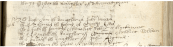
[Figure 1: An extract from the St. Mary at Lambeth parish register recording the baptism of John Potter in 1669. LMA, Z/PROJECT/BAL/M/P85/MRY1/342/1193]
The register could also mark alternative possibilities. In 1669, in the parish of St. Mary at Lambeth, John Potter was baptised. He was described as “the sonne of Abimelech Potter – a blackamore” [Figure 1].[18] In this case, the register was mobilised by Abimelech Potter to recognise his son, John. As Jennifer Morgan has argued, Atlantic racial slavery required the denial of kinship.[19] In staking a claim to kinship in the parish register, it seems possible that Abimelech Potter was working against a political economy that increasingly attempted to render ties of kinship among and between Black people meaningless. It also seems that John Potter was not directly racialised in the register: the racial signifier appears to be attached only to Abimelech Potter. This may reflect early modern discourses of racialisation that understood blackness as developing with age. As a child, John Potter may not have been read as black.[20] However, it may also have been a strategy used by Abimelech Potter. In refusing to permit the racial signifier to be attached to his son’s name, Abimelech Potter may have been working to create distance between his son and a political economy where blackness was racially commodified as property. An ordinary note of care slipped into the register.[21]
In marking these alternative possibilities within the registers, they emerge as sites of contestation. The non-standardised notes within them could attempt to encumber Black lives with claims of possession or hint at the recognition of kinship ties and community. Habib clearly understood this tension, continually noting community and the communal within his wider genealogy that sketched the shift from “excluded inclusion” in the sixteenth century to “included exclusion” in the later seventeenth century.[22] Indeed, as noted by Kim Hall, the terms “community” and “communal” appear far more regularly than the term “imprint”.[23] By following Habib and better attending to the registers, we can work to understand how racialisation and status were encoded into the social relations of the parish while piecing together the individual lives these records attest to.
Click here to see all the posts in this series.
[1] Imtiaz Habib, Black Lives in the English Archives, 1500-1677: Imprints of the Invisible (London: Routledge, [2008] 2020), 15-17.
[2] Keith Wrightson, “Mutualities and Obligations: Changing Social Relationships in Early Modern England,” Proceedings of the British Academy 139, (2006): 174.
[3] Postles uses various forms of address while Shepard uses court witness statements.
David Postles, “The Politics of Address in Early-Modern England,” Journal of Historical Sociology 18, no. ½ (2005): 99-121; Alexandra Shepard, Accounting for Oneself: Worth, Status, & the Social Order in Early Modern England (Oxford: Oxford University Press, 2015).
[4] Habib, Black Lives, 170-187; Holly Brewer, “Creating a Common Law of Slavery for England and its New World Empire,” Law and History Review 39, no. 4 (2021): 765-834.
[5] For other analyses of parish registers see the blog posts of Graham Moore and Annabelle Gilmore.
Graham Moore, “Black Lives in Berkshire: Making the Imperceptible Perceptible,” many-headed monster, May 9, 2023, https://manyheadedmonster.com/2023/05/09/black-lives-in-the-berkshire-archives-making-the-imperceptible-perceptible/; Annabelle Gilmore, “Black Rural Life: Continuing from Habib in Eighteenth-Century Warwickshire,” many-headed monster, May 23, 2023, https://manyheadedmonster.com/2023/05/23/black-rural-life-continuing-from-habib-into-eighteenth-century-warwickshire/; Montaz Marché, “Centering Blackness: A Focus on Gender and Critical Approaches Through Black Women’s Lives,” European History Quarterly 53, no. 1 (2023): 26-31.
[6] Recently, a team at Northeastern University, London, has mapped the StL dataset: https://mappingblacklondon.org/;
“Switching the Lens Project,” City of London, May 17, 2022, https://www.cityoflondon.gov.uk/things-to-do/history-and-heritage/london-metropolitan-archives/about-lma/switching-the-lens-project.
[7] London Metropolitan Archives (LMA), Z/PROJECT/BAL/C/CLC/478/MS03713/001/2.
[8] LMA, Z/PROJECT/BAL/M/P93/MRY1/006/0602.
[9] LMA, Z/PROJECT/BAL/M/P90/MIC1/018/0558.
[10] Gretchen Gerzina, Black London: Life before Emancipation (New Brunswick, NJ: Rutgers University Press, 1995), 88-89.
[11] For one form of resistance to these attempts see, Simon P. Newman, Freedom Seekers: Escaping from Slavery in Restoration London. London: University of London Press, 2022.
[12] LMA, Z/PROJECT/BAL/C/P69/BEN1/A/010/MS04098/1.
[13] Urvashi Chakravarty, Fictions of Consent: Slavery, Servitude, and Free Service in Early Modern England (Philadelphia, PA: University of Pennsylvania Press, 2022).
[14] LMA, Z/PROJECT/BAL/M/P93/DUN/258/0458; LMA, Z/PROJECT/BAL/C/P69/MRY7/A/003/MS04998/2; LMA, Z/PROJECT/BAL/M/DRO/007/A/01/001/0344.
[15] LMA, Z/PROJECT/BAL/C/P69/OLA1/A/004/MS28868/4; LMA, Z/PROJECT/BAL/M/P78/ALF/002/1554.
[16] LMA, Z/PROJECT/BAL/M/P93/DUN/281/7.
[17] For an Atlantic history on the importance of paper to emancipation, see Rebecca J. Scott and Jean M. Hébrard, Freedom Papers: An Atlantic Odyssey in the Age of Emancipation (Cambridge, MA: Harvard University Press, 2014.
[18] LMA, Z/PROJECT/BAL/M/P85/MRY1/342/1193.
[19] Jennifer L. Morgan, Reckoning with Slavery: Gender, Kinship, and Capitalism in the Early Black Atlantic (Durham, NC: Duke University Press, 2021).
[20] My thanks to Montaz Marché for this argument.
Roxann Wheeler, The Complexion of Race: Categories of Difference in Eighteenth-Century British Culture (Philadelphia, PA: University of Pennsylvania Press, 2010), 21-28.
[21] Christina Sharpe, In the Wake: On Blackness and Being (Durham, NC: Duke University Press, 2016), 132.
[22] Habib, Black Lives, 18.
[23] Kim F. Hall, Urvashi Chakravarty, Lisa Barksdale-Shaw, Jean E. Howard, Marisa J. Fuentes, and Lehua Yim, “Black Lives in the English Archives: A RaceB4Race Roundtable,” ACMRS, YouTube video, 00:59:19, https://www.youtube.com/watch?v=Oi8b3DjUWdY.
Posted by manyheadedmonster
Categories: History
Tags:
Mobile Site | Full Site
Get a free blog at WordPress.com Theme: WordPress Mobile Edition by Alex King.
[…] Jamie Gemmell, Habib and the London Parish Register […]
By Reflecting on Habib’s Black Lives in the English Archives: An Online Symposium | the many-headed monster on June 6, 2023 at 8:24 am