This post is part of our ‘The People and the Law‘ Online Symposium, a series exploring early modern English legal sources. Zoë Jackson (Twitter: @ZoeMJackson1, Bluesky: @zoejackson.bsky.social) is a PhD student at Gonville and Caius College, University of Cambridge, researching the relationship between memory and perjury in later seventeenth-century England.
Zoë Jackson
From personal experience ‘perjury’ (intentionally lying under oath in a legal setting) is not a widely understood term amongst most people today. Whenever I explain my research, I usually have to define what perjury is (and sometimes must clarify that I’m not specifically concerned with other, similar sounding terms – ‘purgatory’, anyone?) Calling someone a ‘perjurer’ today would probably get you, at most, a quizzical look.
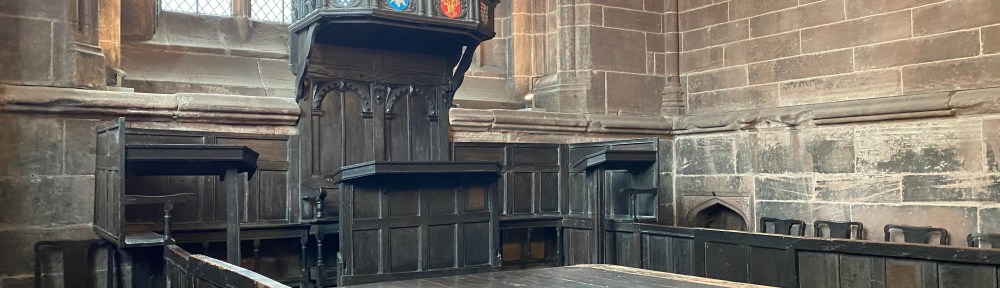
But in early modern England, as Mary Basnett was made fully aware, calling someone a ‘perjurer’ was grounds for a defamation suit. In November 1673, the Consistory Court of Chester ordered Mary Basnett to perform penance in the parish church of Frodsham, by reciting before the congregation the following words: ‘Whereas I Mary Basnett have wronged Alice Gee in rashly saying, If shee hath taken such an oath shee is forsworne, I am heartily sorry for the same, for I know no such crime of her, and I desyre her to forgive mee’. In the court case that preceded this judgment, multiple witnesses testified to hearing Mary Basnett accusing Alice Gee of taking a false oath in a previous trial.[1]

Legal disputes like this one between Mary Basnett and Alice Gee are of interest to me for what they reveal about local understandings of perjury (as opposed to the formal definitions you find in legal treatises and dictionaries). Perjury was a crime in early modern England, but it was also a sin, breaching both the Third Commandment (against taking God’s name in vain) and the Ninth Commandment (against bearing false witness). In church court defamation cases, witnesses described whether or not accusations of perjury were made, and what damage this did to the alleged perjurer’s reputation. As historians such as Natalie Zemon Davis and others have established, although these records do not represent the direct words of the people, they can still be useful in illuminating contemporary attitudes and practices, such as in this case around the functioning of community.
These depositions also illuminate a legal literacy by both men and women in later seventeenth-century England. John Brereton deposed that when he had informed Mary Basnett of Alice Gee’s testimony, she asked ‘has she sworne that, and this deponent told her that she had declar’d it before them all, and what should she declare it for if she would not sweare it, then the said Mary reply’d if she have sworne it I’le…take my oath to the contrary at Frodsham Court before the Steward there if I may be admitted’.[2] In this exchange, Mary Basnett, at least, seemed to understand that there was a difference between providing false testimony and providing false testimony under oath, suggesting she (and likely others) understood that testimony could only be perjured if it was made under oath. Further than that, each of the various men and women involved in this dispute apparently knew what it meant to be perjured or forsworn, and knew that it was a serious enough accusation to remember for a future legal dispute.
The depositions also reveal something of the choices early modern people made to pursue (or not pursue) legal action. There is no suggestion in any of the witness statements that Mary Basnett’s insult of Alice Gee ever proceeded to a formal indictment. Perhaps Mary Basnett felt that the criminal legal system would be less effective than the court of community opinion, especially if accusations of perjury were perceived as difficult to prove, and successful prosecutions so limited. Perhaps Alice Gee felt her defamation case had a higher chance of success, due to her ability to take it to the church courts, where historians have noted relatively high levels of female litigants and witnesses.
Further, Mary Basnett’s very public apology indicates that her accusations of perjury, and the effect they were perceived to have on their target, were the concern of the whole community, and her penance required shaming before this community. Being called a perjurer was perceived to have consequences beyond the courtroom and was apparently worth the time and expense to challenge. The very public nature of the order for penance concerned the sinful nature of slandering, but it was also about the communal memory of this individual’s reputation—how her reputation was damaged in this memory by the accusations, and how she would be remembered moving forward.
Being accused of perjury damaged one’s credit amongst one’s neighbours, a potentially devastating economic and social blow in a society which historians such as Craig Muldrew and Alexandra Shepard have established as heavily concerned with reputation. To be defamed as a perjurer struck right at the heart of this culture—a perjurer could not be trusted, either with the truth or, likely, with anything else of value. Perjuring oneself, or being accused of perjury, would therefore weaken the weight of one’s word as a future witness but it could also weaken one’s place in the community.
A glimpse into the impact of such accusations comes through in the depositions of another Cheshire defamation suit. In 1661, William Small stated that John Palden’s accusations of perjury against his brother, Richard Small, had hurt Richard’s ability to do business. According to William Small, his brother was ‘by trade a Carpenter and upon occasions either concerning his trade or…buying of Cattle he had credit and could have borrowed considerable summes of money of his neighbours and friends thereabouts’. However, William added that ‘since the speaking of the words aforesaid this deponent hath heard … one of those his neighbours that had formerly lent him money, say, that except he could and should right himselfe in this busines he would never trust him for a groat’.[3]
Perjury was a concern of the community, and people remembered instances of perjury and the individuals who had committed them. Perjury was about truth, but it was also about trust, and if an individual could be trusted or was liable to falsely testify in court to hurt another member of the community. Local people remembered perjury, and accusations of the crime, because it indicated a betrayal of the expectations of neighbourliness and the standards of trust upon which early modern relationships depended.
For Further Reading
Davis, Natalie Zemon. Fiction in the Archives: Pardon Tales and Their Tellers in Sixteenth-Century France. Stanford: Stanford University Press, 1987.
Gowing, Laura. Domestic Dangers: Women, Words, and Sex in Early Modern London. Oxford: Oxford University Press, 1996.
Muldrew, Craig. The Economy of Obligation: The Culture of Credit and Social Relations in Early Modern England. Houndmills, Basingstoke: Palgrave, 1998.
Shapiro, Barbara J. ‘Oaths, Credibility and the Legal Process in Early Modern England: Part Two’. Law and Humanities 7, no. 1 (2013): 19–54.
Shepard, Alexandra. Accounting for Oneself: Worth, Status, and the Social Order in Early Modern England. Oxford: Oxford University Press, 2015.
[1] Consistory Court Papers, Helsby, 1673 [Alice Gee c Maria Basnett], Cheshire Archives & Local Studies (CALS), EDC 5/1673/17; In transcriptions of the manuscript records, contractions have been silently expanded, and ‘u’ and ‘v’ used as in modern spelling for clarity.
[2] CALS, EDC 5/1673/17.
[3] Consistory Court Papers, Cheadle Hulme, 1661 [Richard Small c John Palden], CALS, EDC 5/1661/42; A ‘groat’ was a coin valued at four pence, but the term was also used to indicate a small amount of money. See Oxford English Dictionary, s.v. ‘groat (n.), sense 2.a’, and ‘groat (n.), sense 2.c’, September 2023, https://doi.org/10.1093/OED/9923977322.
 the many-headed monster
Pingback: The People and the Law: an Online Symposium | the many-headed monster
A comment from Dave Postles via email:
‘This is a very interesting piece. It ties in with the use of
compurgation in ecclesiastical courts. The ultimate sanction, of course,
was one of the levels of excommunication, but I wonder if that had any
purchase in the late 17th century. In an earlier period, debt (fidei
laesio et perjurij) was drawn into ecclesiastical courts under the guise
of a breach of faith or breach of promise, but was eclipsed by assumpsit
in common law courts, as Richard Helmholz has shown. I have recently
revisited this (fidei laesio et perjurij) and my piece should soon be on
early view at Continuity and Change.’
The Chester courtroom seems strange. Who sits inside the walled square and who sits outside it?
Hels, Art and Architecture mainly