
This post is part of our ‘The People and the Law‘ Online Symposium, a series exploring early modern English legal sources. Emily Rhodes is a fourth-year PhD student at Christ’s College, Cambridge. Her work uses petitions to study family, community and poverty in early modern Britain. You can find her on Twitter/X @elrhodes96.
Emily Rhodes
In 1691, Isabel Scales was the talk of the parish of Coulton in Lancashire. Isabel was an unmarried mother, an uncertain and potentially shameful position which affronted the social order of the period and could lead to punishment. Despite her situation, her neighbours in the community of Coulton rallied around her. The inhabitants of Coulton went above and beyond for Isabel. On top of paying her a mandated 12d a week towards her and her child’s maintenance, they had also found the mother and child a house which ‘doth acrue a great Charge vpon the parish’, and had even taken it upon themselves to provide the child with clothes. According to the parishioners, however, Isabel did not return the goodwill.
In a petition submitted by the inhabitants of Coulton to the Justices of the Peace (JPs) of the local Quarter Sessions court, Isabel was labelled ‘a loud incorigible woman’. They stated that in 1689, Isabel was sent to the local House of Correction for reasons that were not documented. While there, she had become pregnant with another bastard child. After this second illegitimate pregnancy, Isabel neglected to go to great lengths to improve her reputation. Instead, when faced with the prospect of returning to the House of Correction as a result of her continued objectionable behaviour, Isabel issued a threat to her fellow parishioners. According to their petition, she declared that ‘ if she be sent to the House of Corection Againe she will ly [lie] out all her indevors to be begotten with another Bastard Child’. After this final upset, the inhabitants of Coulton asked the JPs to relieve them of their responsibility towards Isabel Scales and her two children. By cutting off their support, they hoped to control her behaviour.[1]
That Isabel Scales faced judgement and patriarchal oppression for acting against the societal norms of her community would not surprise historians. Susan Amussen has stressed the relationship between the family, community and control in early modern England, maintaining that, in the period, ‘the social control of family life came primarily from within the village’.[2] Societal standards were established and regulated by local communities and familial business was both publicised and controlled. Family life was shaped by the concept of the ‘little commonwealth’, which maintained that the nation’s patriarchal governance should be reflected in the structure of the household. For a community to function properly, patriarchal rule had to prevail and any breakdown in the operation of this ‘little commonwealth’ would force members of the community to intervene to restore patriarchal order.
Mothers like Isabel Scales frequently found themselves subjected to this community control. As mothers raised the next generation, it was important that they instilled the values and morals of the ‘little commonwealth’ into their children. Scrutiny intensified when their own living situation deviated from the norm, such as when they headed a household alone as a widowed or single mother. Without a patriarchal authority in the home, these mothers frequently turned to the local community for additional parenting support. This made them liable to the criticism and control of their neighbours. As seen in the case of Isabel Scales, communities could offer or withdraw their support depending on whether they condoned or condemned a mother’s behaviour and parenting. Thus, needy mothers needed to be careful to comport themselves in a manner their community would approve of.
Quarter Sessions petitions are a particularly insightful source through which to study these power dynamics. Readers of this blog will be well acquainted with petitions and their value in studying early modern history. They have been a key tool used by historians to uncover the voices of ordinary people. Not only did communities rally together to petition about the behaviour of one parishioner. It was also common practice for needy and impoverished widowed and single mothers to petition these courts themselves over issues concerning poor relief, housing, child support, and intervention in personal disputes. Collectively, these petitions demonstrate the diverse ways in which mothers engaged with and struggled under the control of their neighbours, peers and local authorities.
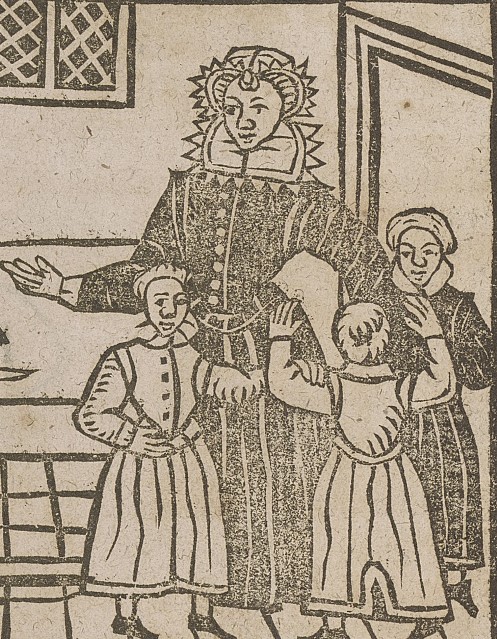
We can see these dynamics at work in the 1662 petition of Elizabeth Green of Thurnham in Lancashire, who augmented every claim in her petition seeking more poor relief by stating she had community encouragement. When she was widowed and left to care for her three young children alone, she supplemented her petition for relief with ‘the testimonie of severall of her neighbours touching her indigencie’. The subsequent order — which decreed that she was to receive 8d a week — was implemented until the parish overseers of the poor, who determined the allocation of poor relief, at some stage decided that ‘your poor petitioner is not so needfull as some others that have noe allowance’.
Again, Elizabeth’s neighbours rallied around her: ‘the truth is as severall of her neighbours can now certifie shee hath but very little to relieve her selfe & two smale children’. Six of these neighbours endorsed her petition, signing or marking their names at the bottom of it, and the court subsequently ordered that her relief be resumed.[3] Supporting Elizabeth Green and her children would be financially detrimental to the wider community, as any funds allocated to her would be taken from rates collected from wealthier members of the parish. Despite the fact that supporting Elizabeth’s petition might not have been a wise choice economically, her neighbours were willing to undertake this greater financial burden to help a mother they deemed worthy.
What I find particularly interesting about this petition and others like it, though, and particularly relevant for this series of posts, is what they reveal about pauper and female understandings of the law in early modern England. These petitioners knew what to do and where to go when they had a community dispute too large to fix themselves, displaying knowledge of the process and conventions of petitioning a legal court – knowing, for instance, that the support of their neighbours could be crucial to overturning a decision by the overseers.
Furthermore, mothers who petitioned reveal that they comprehended what they were entitled to under the poor laws that affected their day-to-day lives. Petitions, then, can tell us much about the legal knowledge and activities of ordinary people in the past, but they were sources adjacent to the courts rather than a product of the legal process itself. They remind us that we sometimes need to examine documents from outside the traditional source bases of the discipline to take research in new directions. Doing so can help us see that ordinary and even impoverished people were not always oppressed by the law. They could also make the law work in their favour.
[1] Lancashire Record Office (LRO), Quarter Sessions Petitions (QSP) 700/10. Thousands of petitions submitted to the Lancashire Quarter Sessions between 1648 and 1908 are available to view on Ancestry.
[2] Susan Amussen, An Ordered Society: Gender and Class in Early Modern England (1988), p. 96.
[3] LRO, QSP 225/9.
 the many-headed monster
Pingback: The People and the Law: an Online Symposium | the many-headed monster