Gender, Blackness, and Habib: How can contemporary disciplines and practices of Gender Studies make use of Habib’s Black Lives in the English Archives?

This post is part of Reflecting on Imtiaz Habib’s Black Lives in the English Archives: An Online Symposium, organised and edited by Rebecca Adusei and Jamie Gemmell. The blog series is introduced here. The blog series was launched on Friday 19 Mary 2023 at the London Metropolitan Archives to tie in with their new ‘Unforgotten Lives’ exhibition.

Amber Burbidge

Amber Burbidge is a PhD researcher in the department of History at the European University Institute, Florence, whose research reassesses representations of race and gender in early modern material culture in European geographies, such as France and Britain, between 1650 -1800. Her research develops from the Early Modern History MA she completed at the University of York which looked at the Black female presence in portraiture, prints, and porcelain ‘blackamoor’ ornaments. She also works as a co-convenor for the Visual and Material Culture working group, as well as volunteering as an administrator for the Decolonising Initiative.

Habib’s Black Lives is monumental in its thorough rereading of archival material and its early establishment of the Black British presence. The monograph takes the form of both a methodological guide, leading readers through an incremental progression of archival findings, as well as providing a database-like appendix which holds 448 itemised ‘black citations’. Its methodologies and content have therefore been used by historians such as Kaufmann, Olusoga, Spicer and Chater, with its vast database proving to be a great inspiration for contemporary historians of the field. This post will critically assess and reflect on Habib’s work for historians who are thinking through gender studies and intersectional frameworks, considering how Black Lives is still relevant in contemporary historical gender studies.

Black history has been critiqued by Black feminist historians, such as Hooks, Hull, Bell-Scott and Smith, for its ignorance towards Black women. This is not completely the case with Habib, as his research is inclusive of a female presence. The issue, nevertheless, is that he writes with limited engagement on gender and with little recognition of the differences that women faced. In his first chapter he includes just one sentence on the issue mentioning that “of the 16 individuals of color named, three are women and 13 are men”, highlighting the gender imbalance, but without questioning why, or what this could mean for Black women. In his second chapter, where gender is addressed, it is still inadequate considering the level of research completed. He recognises that “black women themselves remain muted in a history that cannot speak”, however, he finishes his participation in the subject here, falling short of meaningful questioning or comprehensive intersectional research on the gendered experiences of British Black women. Furthermore, where he analyses numerical data, gender appears to be an afterthought, rather than a genuine academic question, as in comparison to his other data assessments gender takes up little space within the discussions. He questions if “the dearth of black women might be the reflection of an English preference for labor-capable black males”, yet again seems to leave this question floating without addressing the issue further.

Continue reading
Imtiaz Habib and ‘Lucy Negro, Redux’

This post is part of Reflecting on Imtiaz Habib’s Black Lives in the English Archives: An Online Symposium, organised and edited by Rebecca Adusei and Jamie Gemmell. The blog series is introduced here. The blog series was launched on Friday 19 Mary 2023 at the London Metropolitan Archives to tie in with their new ‘Unforgotten Lives’ exhibition.

Hannah Crawforth

Hannah Crawforth is a Reader in Early Modern Literature in the English Department at King’s College London. She has published extensively on poetry both modern and early modern.

Black Lives in the English Archives seeks to make visible those whose presence in early modern England has been overlooked. It does so using a methodology that Imtiaz Habib also believes has been overlooked as a result of what he calls “the triumph of theory in a poststructuralist age”.[1]  His painstaking excavation of “obscure, truncated and largely inaccessible documentary records” and magisterial synthesis of these archival findings into a compelling narrative, is an incontrovertible argument for the importance of the archive, as well as a field-changing account of the Black lives we encounter there.[2] “Scattered across the four quadrants of London” and beyond, drawn from fragments of “legal, taxation, medical and civic archives is the varied impress of black working lives,” Habib writes in his introduction. The stories that emerge from the archive are the hard facts that counteract the lingering falsehood that “there were no actual people of color in early modern England; references to them in popular media of the time are metaphoric; and the period is race-innocent.”[3] But I call them stories because I am interested here in the ways in which Habib draws upon his extensive archival research to narrativize the lives of the Black working classes that his work uncovers. Habib’s book is powerful not just in the extraordinary body of evidence he amasses, but also in the way he marshals these archival discoveries, carefully assembling the fragments into narratives that leap off the page, bringing the lives they recount to life.

It is this idea of reanimating the archive, and the Black lives Habib locates within it, that inspires the work of the poet Caroline Randall Williams, which I have been teaching and writing about. Williams’ Lucy Negro, Redux, published in 2019 with the subtitle: The Bard, a Book, and a Ballet, tells the story of Shakespeare’s Sonnets from the point of view of a figure from the archives who has been called “Lucy Negro”, and whom some have seen as a possible model for the so-called “Dark Lady” to whom the later part of the sequence seems to be addressed. “In August of 2012, I got it into my head that Shakespeare had a black lover,” Williams writes, “and that this woman was the subject of sonnets 127 to 154.”[4] Lucy Negro, Redux intersperses Williams’ poems about Lucy with a prose account telling the story of her meeting with English professor Duncan Salkeld and, consequently, with the figure of “Black Luce” in the archives of Bridewell prison. Interweaving archival narrative with original poems Williams recovers and reclaims an overlooked Black life from the English archive in ways that resonate with Habib’s own critical and creative project.[5] Continue reading

Black Rural Life: Continuing from Habib into Eighteenth-Century Warwickshire

This post is part of Reflecting on Imtiaz Habib’s Black Lives in the English Archives: An Online Symposium, organised and edited by Rebecca Adusei and Jamie Gemmell. The blog series is introduced here. The blog series was launched on Friday 19 Mary 2023 at the London Metropolitan Archives to tie in with their new ‘Unforgotten Lives’ exhibition.

Annabelle Gilmore

Annabelle Gilmore is a third year PhD student at the University of Birmingham, funded by AHRC Midlands4Cities, in collaboration with the National Trust. Her thesis explores how Asian imperialism and slavery in Jamaica can be traced through art objects collected and displayed at the country house, Charlecote Park in Warwickshire. She continues to work on exploring Black British history in eighteenth-century Warwickshire.

Habib’s succinct methodology in tracing Black lives in the English archives for the sixteenth and seventeenth century is a framework that still holds strong today. His model of painstakingly viewing the parochial archives is something I feel nearly all historians working in this field have had to contend with. What Habib points out is that the very nature of these records can be considered “a key of identity, whereby the nature and history of each kind of record is a clue to the social knowledge and hence communal imprint of the black individual cited by it.” This drives home the point that when searching for the lives of Black people in Britain, it is necessary to read the silences left by the modicum of information harvested from the archives.

Habib’s work has been insightful for my own efforts in trying to illuminate Black lives in Warwickshire in the long eighteenth century. This has its own challenges, as Habib points out in his chapter on Black people outside London. It is a simple fact that the numbers are just not as plentiful outside London, for Habib’s dates as well as my own. But it is certain that they matter just as much. While Habib uses the provincial records to “offer important confirmations as well as modifications of the black history of the London citation”, I believe this still anchors the provinces to London as the centre for the Black experience. It is true that it is all connected. London’s socio-political influence did spread across the country but centring it risks missing the specificity of provincial records. Continue reading

Black Lives in the Restoration Household: The Queen’s Account

This post is part of Reflecting on Imtiaz Habib’s Black Lives in the English Archives: An Online Symposium, organised and edited by Rebecca Adusei and Jamie Gemmell. The blog series is introduced here. You can join Rebecca and Jamie to celebrate the publication of the posts at a free event at the London Metropolitan Archives on Friday 19 May – the event includes presentations by the post authors and a tour of the LMA’s new ‘Unforgotten Lives’ exhibition.

Susannah Lyon-Whaley

Susannah Lyon-Whaley is completing her PhD in Art History at the University of Auckland in Aotearoa New Zealand on the Stuart queen consort Catherine of Braganza.

Imtiaz Habib’s groundbreaking study Black Lives in the English Archives, 1500-1677: Imprints of the Invisible (2008) searches for traces of its subjects in parish registers, legal documents, and also amidst the records of the royal court. Histories of European kings and queens – even to the present day – often say little about black lives, yet royal records offer rich, if sporadic, evidence of these. To establish the presence of African slaves in the train of Catherine of Aragon, the Spanish princess who arrived in England in 1501 to marry Henry VIII’s older brother, Habib looks to official letters and the accounts of bystanders.[1] While these records are rich, their references to black lives are not easy to find but must be mined, likely why Habib does not apply the same detail to the Restoration court of the seventeenth century (c. 1660-1688) as he does to the household of the Spanish princess.

Similar to many of Habib’s finds, the £2 paid “To the Lady Wood ffor the Blackemores Lienning [linen]” – in 1663 in the accounts of Catherine of Braganza (1638-1705), Portuguese queen consort of Charles II (r. 1649/1660-1685), is easily glossed over, sandwiched between payments to attendants at the waters of the spa at Tunbridge Wells and for gold to play at cards. While ‘Lady Wood’ can be identified as Dame Mary Wood (d. 1665) through her appearance in Catherine’s household lists, the ‘Blackemores’ – a phrase indicating African heritage – are not named, gendered, nor even quantified.[2]  By the Restoration, Habib argues that blackness was more likely to be associated with enforced servitude.[3] What, then, can the ‘queen’s account’ of these lives tell us about black lives in the Restoration household? Continue reading

Love Me or Leave Me: Black Lives in the English Archives, A Response

This post is part of Reflecting on Imtiaz Habib’s Black Lives in the English Archives: An Online Symposium, organised and edited by Rebecca Adusei and Jamie Gemmell. The blog series is introduced here. You can join Rebecca and Jamie to celebrate the publication of the posts at a free event at the London Metropolitan Archives on Friday 19 May – the event includes presentations by the post authors and a tour of the LMA’s new ‘Unforgotten Lives’ exhibition.

Jacqui Stanford, PhD

I thought I knew what I would call this post. Someone had kindly dropped a citation in the chat as a group of people working on race in medieval/early modern Britain met in an online symposium discussing Habib’s Black Lives in the English Archives. My contributions to the symposium were really me still responding in my head to the final words in another book. That book had taken Habib to task on the idea of black slaves being in Britain in Tudor times, and Habib’s decision to include as many people in his database as their names suggested they were Black to him, Blackmoore and its variations being a chief source. I hadn’t even read Habib’s Black Lives when I was reading the critique, yet I felt protective of Habib and had a willingness also to allow what he had done. Call it instinct…

Now, I am sitting on my own book. Rather it’s sitting inside of me. Rather it’s a maelstrom seething begrudgingly in the depths of me. For it is time.

My book’s about six Black individuals I discovered in the archives. Others have seen their names before me. My six are not unknown. They are listed and noted in the parish registers, although they have remained out of focus as other things and people, who share the same pages on which they are recorded come into focus. No one as yet has taken up the detritus about them. Removed the dust, excavated the site of their burial in a single line, if that, set in parchment. There they lay, sullen, aggrieved; … something caught my eye. Continue reading

Amantacha: An Indigenous American in Seventeenth-Century English News from Canada to Suffolk

This post is part of Reflecting on Imtiaz Habib’s Black Lives in the English Archives: An Online Symposium, organised and edited by Rebecca Adusei and Jamie Gemmell. The blog series is introduced here. You can join Rebecca and Jamie to celebrate the publication of the posts at a free event at the London Metropolitan Archives on Friday 19 May – the event includes presentations by the post authors and a tour of the LMA’s new ‘Unforgotten Lives’ exhibition.

Nikki Clarke

Nikki Clarke is a final year PhD student at Birkbeck, University of London. Her research focuses on how people gathered and assessed news in the multimedia world of seventeenth-century England. You can find her on Twitter at @nikkiclarke1.

He delivered a prince that the French had taken in the country, who by two Jesuit priests was put to torment by a suite of apparel whose linings were full of prickes. The Jesuits in the coming home were put to tast of the same sauce. The prince was diverse days together, in the beginning of Michaelmas terme, at the Royall Exchange to be seene.[1]

With this diary entry in November 1628, the Reverend John Rous alerts us to the fact that news of the travels of Amantacha, the son of Soranhes, a Wendat leader who traded with French near Quebec in the 1620s and 1630s, had arrived in the quiet, rural parish of Santon Downham, in Suffolk.  My usual research is on multimedia news and accuracy in the seventeenth-century, and this blog tries to explore the way both English and French sources use the story of Amantacha to reinforce their own religious and political conflict on both sides of the Atlantic. Continue reading

Black lives in the Berkshire Archives: Making the Imperceptible Perceptible

This post is part of Reflecting on Imtiaz Habib’s Black Lives in the English Archives: An Online Symposium, organised and edited by Rebecca Adusei and Jamie Gemmell. The blog series is introduced here. You can join Rebecca and Jamie to celebrate the publication of the posts at a free event at the London Metropolitan Archives on Friday 19 May – the event includes presentations by the post authors and a tour of the LMA’s new ‘Unforgotten Lives’ exhibition.

Graham Moore

Graham is a PhD student on a Collaborative Doctoral Partnership scheme between the University of Reading and The National Archives. His current research focuses on piracy and maritime communities in the early seventeenth-century, through the lens of the records of the High Court of Admiralty. He is also working as part of an ongoing project with the Berkshire Record Office and the University of Reading to uncover diverse histories in Berkshire’s archives. You can read Graham’s recent publication, the open-access article ‘The Liues, Apprehensions, Arraignments, and Executions of the 19 Late Pyrates: Jacobean Piracy in Law and Literature’ (2022), in MDPI’s Humanities journal.

The majority of work on the history of diverse presences in Britain have focused on major urban and economic centres such as London. Away from the metropole, the story of ‘imperceptible’ Black presence (and the presence of those from other cultural and ethnic groups that are, contextually, in minority) often remains untold.[1] Yet the evidence is there. If only one knows where and how to look, we do indeed find that “Black history is everywhere”.[2]

This blog post will explore an ongoing project with the Berkshire Record Office (BRO) to uncover histories of rural diversity. It will suggest that whilst such a survey is fruitful and worthwhile, a methodology that actively recognises the unique problems posed by its respective ‘archival silences’ is required to overcome the imperceptibility identified by trailblazing scholars like Imtiaz Habib.[3] Continue reading

Reflecting on Imtiaz Habib’s Black Lives in the English Archives: Introduction

Rebecca Adusei and Jamie Gemmell

Imtiaz Habib’s Black Lives in the English Archives, 1500-1677: Imprints of the Invisible (Routledge, 2008) is one text within the relatively small, but longstanding, field of early modern Black British History. Neither a cultural history of early modern racialisation nor a social history of Black Britons, the text is a kind of analytical cataloguing that seeks to locate a “missing subject” through the literal construction of an archive and an accompanying commentary. It manages to be both empirically rigorous – Habib located 448 “Black citations” – and theoretically rich. It provides a roadmap and a grammar for the social historian to think carefully about early modern England’s Black inhabitants and the archives that render those lives (il)legible.

Habib’s herculean effort in 2008 highlighted, and continues to highlight, the importance of adopting an interdisciplinary approach when looking at the lives of people of colour in early modern Britain. In its robust, rigorous, and in-depth analysis, Black Lives laid a solid foundation which Early Modern Studies continues to build on. Habib’s bridging of the gap between the historical and literary disciplines has enabled Early Modern Studies to create a holistic idea of what it was like to be a person of colour in the early modern period and to track the origins of racism.

Despite its weighty contributions, the text remains relatively neglected by social historians and, in some cases, actively dismissed. Our Symposium seeks to reflect on Habib’s Black Lives and firmly establish its importance to Early Modern Studies, particularly social history. This is especially important given the emergence of the “archive” as a heuristic within Black Feminist literature, Atlantic History, and Slavery Studies. While scholars have critically interrogated the colonial archives, less attention has been paid to the archives of the imperial metropole. Habib’s work is, therefore, an ideal way to integrate these archives and think relationally across different methodologies. We hope the reflections published here will demonstrate both the importance of Habib’s work and the vitality of scholarship thinking about early modern Britain’s Black inhabitants. Continue reading

Reflecting on Habib’s Black Lives in the English Archives: An Online Symposium

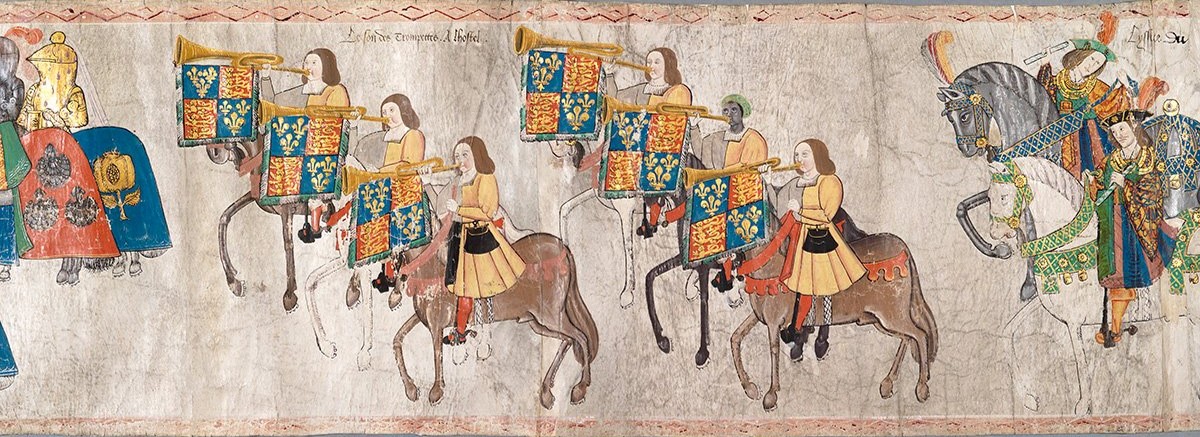
trumpeters-cropped

The many-headed monster is delighted to bring you a series of posts responding to Imtiaz Habib’s Black Lives in the English Archives, 1500-1677: Imprints of the Invisible (Ashgate: 2008, Routledge: 2020). The posts are part of Rebecca Adusei and Jamie Gemmell’s multi-event symposium, which brings together scholars working at the forefront of early modern Black history and premodern race studies to discuss the vital importance and continuing legacy of Habib’s text.

Rebecca and Jamie will introduce the blog series on Thursday 4 May, and we will then publish two posts a week over the following month – links to all the posts will be added to this page as we go, so you can bookmark it now if you want to follow along.

Rebecca and Jamie celebrated the publication of the blog series on Friday 19 May, at the London Metropolitan Archives, to tie in with their ‘Unforgotten Lives’ exhibition. This exhibition presents the stories of Londoners of African, Caribbean, Asian and Indigenous heritage who lived and worked in the city between 1560 and 1860 and are recorded in London’s archives.