
Our second post in The Voices of the People symposium (full programme here) is by Julia Laite, Lecturer in British History at Birkbeck, University of London. Reflecting on her own work on prostitutes and traffickers in the early twentieth century, Julia addresses a number of themes that will recur frequently throughout this symposium: the value of the microhistorical approach and the capacity of digital technology to support the work of close contextualisation; the importance of self-reflecting on ‘history from below’ writing as a genre and methodology; and the ethics of recovering the ‘voices of the people’.
Julia Laite
When Lydia Rhoda Harvey steamed away from the shores of New Zealand, enroute to Buenoes Aires where she would, according to her traffickers, ‘see gentlemen’, what did she think? What did she say? What did her traffickers, Antonio Adolfo Carvelli and Veronique White, say to her? To each other? Is it possible to guess, and if so, do I want to and should I?
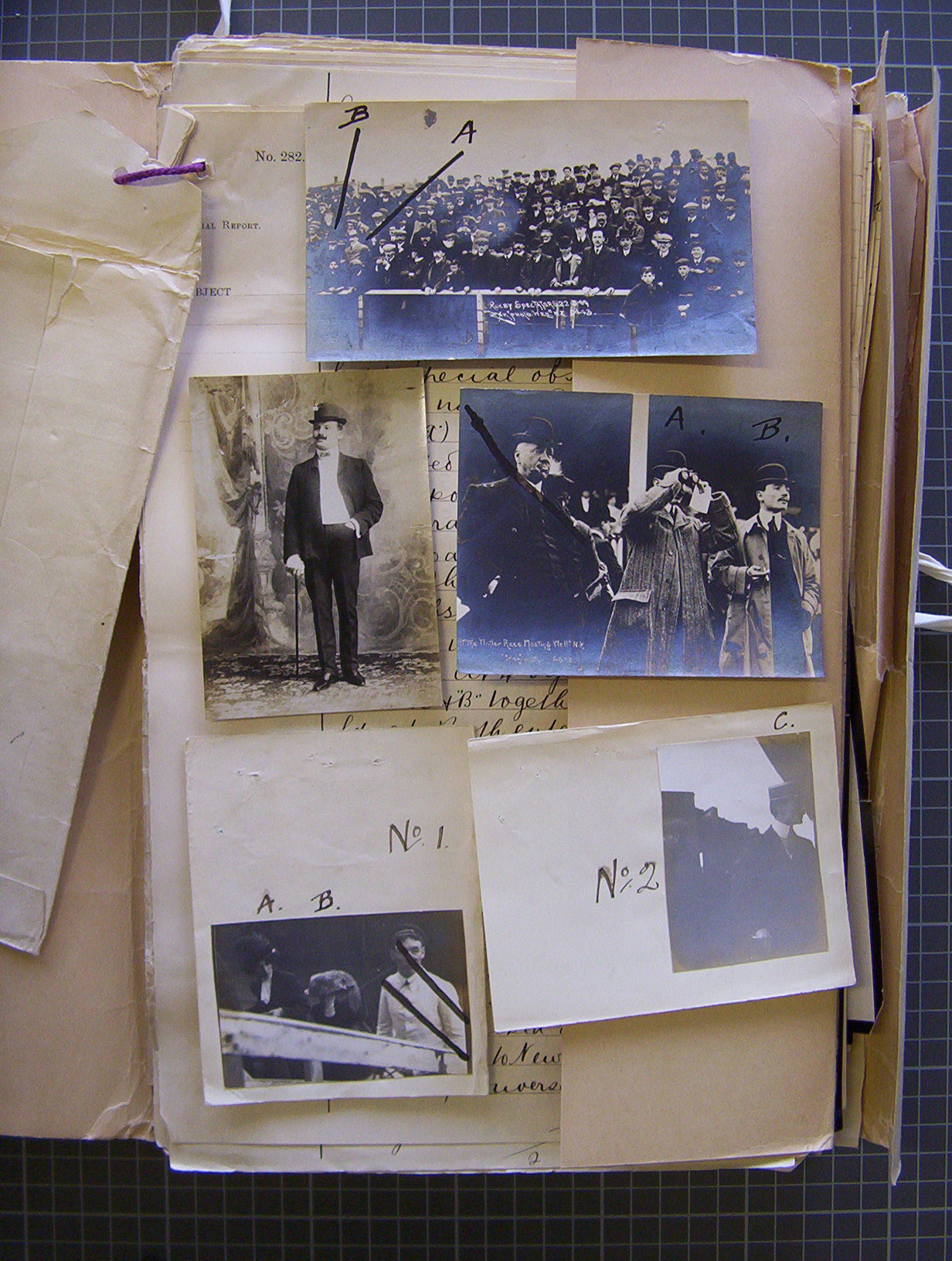
A collection of voiceless photographs from the Carvelli/Harvey trafficking case, London, The National Archives, MEPO 3/197
My new book project examines the story of Carvelli, White, Harvey and the other women who were trafficked alongside of her, as well as some of the police officers, campaigners, and social workers who were directly or indirectly involved in the case. The project didn’t start out as a global microhistory, but as I got further into my research on the subject of trafficking, I became increasingly convinced that examining it in this way would allow me to capture, more effectively than any other way, the complexity of trafficking as a historical subject. Debates rage in the historiography over whether trafficking is most meaningfully described as a form of migrant labour or as exploitation; scholars examine it either from a national or an international perspective; they examine either state action or philanthropic campaigning; they examine the formation of law or the way law looks in practice (though this is actually not very well covered). Histories of trafficking are methodologically transnational (by their very nature), but scholars are coming to realise that they are also very locally contingent. Trafficking also tells us a great deal about power: state power, patriarchal power, economic power; but it also reveals complex voices of people caught up in, facilitating, or fighting ‘the traffic in women’.
A microhistory is an excellent lens with which to capture this complexity; but while also focusing on these individual voices. And so I have spent some time thinking—at times agonizing—about what it means to capture the voices of ‘ordinary’ people in such an extraordinary case; people who were thought of as marginal and monstrous in equal measure: as abject victims, as despicable ruffians. I’ll share some of this thinking here, in the form of four interrelated questions that have been troubling and captivating me as I have gotten deeper into the project, and into my historical actor’s lives. The first is,
How can I listen? Continue reading

 the many-headed monster