

This post in our After Iconophobia Online Symposium comes from Susan Orlik, a PhD student based in the University of Birmingham’s Department of History. Susan is working with Tara Hamling and Jonathan Willis on the changing material culture of the English parish church, c.1560-1640. Here she reflects upon the implications of a close case study of the Somerset parish of Somerton for Collinson’s ‘iconophobia’ thesis.
Over the last thirty years scholars have challenged Patrick Collinson’s generalised arguments on iconophobia, which he laid out in his famous 1985 Stenton lecture, and then developed in The Birthpangs of Protestant England in 1988. In the book he used the famous phrase ‘severe visual anorexia’ to describe the absence of the visual.[i] Recently the rich material evidence from local parish churches has been used to challenge his view and provide a more nuanced perspective about the visual.
Somerton in Somerset provides such rich material evidence. It has an inscribed and coloured pulpit of 1615 and a carved communion table of 1626 with some rare images on its bulbous legs. The material evidence is matched here by informative Churchwardens’ accounts: these tell of the Churchwardens raising an annual rate and also raising an additional rate for a specific purpose. In 1615 the additional rate was levied ‘for and towards the building of the new pulpit and repayeringe of defects about the church’. The octagonal pulpit has the date on it, as well as an elaborately decorated cornice with a frieze of flowers and leaves. Continue reading



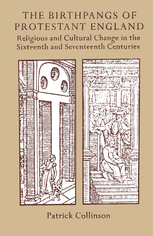 I began my undergraduate career convinced that I wanted to be a historian, but entirely unsure which bit of the past I should dedicate my life to unlocking. Patrick Collinson’s Birthpangs of Protestant England (1988) – of which a revised version of his Stenton Lecture From Iconoclasm to Iconophobia (1986) formed a part – was one of four books (the others being John Bossy’s Christianity in the West (1985), Robert Scribner’s For the Sake of Simple Folk (1981) and Alexandra Walsham’s Providence in Early Modern England (1999)) which convinced me that the Reformation was the thing for me. In each case I became so absorbed in reading them that all sense of time lapsed. I emerged from their pages to discover that day had become night and in one instance a grumpy porter had to inform me rather briskly that the library was now closing. Such was their power that over a decade later I can still remember exactly where in the Morrell Library at the University of York I was sitting when I first encountered each author: remarkable experiences in an otherwise unremarkable building.
 the many-headed monster