Unknown's avatar

About Jonathan Willis

Jonathan Willis is a Senior Lecturer in Early Modern History at the University of Birmingham, and is on twitter as @CREMS_Bham and @drjpwillis

A Reformation Roundup

Jonathan Willis

Last week, I had the very great pleasure of organising and attending the annual meeting of the European Reformation Research Group, and attending and presenting at the bi-annual Reformation Studies Colloquium, back-to-back, at Murray Edwards College (formerly New Hall), Cambridge. I heard 36 papers over 72 hours (including my own), and on Wednesday alone I began conferencing at 9am, didn’t finish until nearly 9.45pm, and heard 14 different papers over the course of the day. What I want to do in this post is to reflect on some of what I heard, and on what it says about the exuberance of reformation studies today. I have three disclaimers. The first is the Colloquium at times had four sessions running in parallel, so my experience of the conference was incomplete, and tailored around my own interests as a historian of the English reformation. The second is that I think it would be a bit tedious to summarise every one even of the 36 papers I heard, and so I’m going to be selective, and pick out papers relating to a few of the themes that stuck out to me most prominently. That means I won’t be mentioning some brilliant work, but I don’t think that can be helped – it would be great if other delegates could add some of their highlights to the comments below! Finally, apologies if I’ve misrepresented anybody’s ideas in what follows. If that’s the case, just let me know, and I will correct it. Continue reading

Elizabethan ‘madmen’ Part III: Puritans, Plums, and a Cereal Complainer…

Jonathan Willis

I don’t know about you, but I’m always delighted and intrigued when I’m unexpectedly reminded of the humanity we share with the inhabitants of early modern England. I’ve been reading through a large quantity of godly lives recently (spiritual diaries, memoirs, biographies, books of remembrance, etc.), and if I’m honest the content is often rather unedifying – by which I mean, far, far too edifying! It’s therefore quite pleasing when, amidst the intensely personal but also strangely generic soul-searching, you come across something which gives you a flavour of the individual. This happened while I was reading the diary of Samuel Ward. Ward finished his career as a moderate, establishment puritan figure and Master of the recently founded puritan college, Sidney Sussex, Cambridge. In the 1590s, however, whilst a student (later Fellow) at Emmanuel, Ward was ‘a vigorous and outspoken puritan’.[1]

NOT historically accurate, but who can forget?  'Wicked child!'

NOT historically accurate, but who can forget? ‘Wicked child!’

Outspoken or not, though, his diary reveals his ongoing struggles with sin, and particularly with food and drink. In June 1595, for example, he recorded ‘to much drinking after supper’ on the 21st, ‘going to drink wyne, and that in the Taverne, befor I called upon God’ on the 27th, and ‘immoderate’ eating of cheese at 3 o’clock in the morning on the 22nd (perhaps a snack to satisfy the hunger cravings brought on by drinking too much the night before?). Cheese was a recurrent weakness. He recorded ‘immoderate eating of walnuts and cheese after supper’ on October 3 1595, and ‘intemperate eating of cheese after supper’ on August 13 1596. Perhaps the catalyst for this binge was the fact that, the day before, Ward recorded in his diary ‘my anger att Mr. Newhouse att supper for sayng he had eaten all the bread’. As well as bread, cheese and wine, Ward also hankered after fruit: references to damsons, plums, pears and raisins pepper his diary.[2] On 8 August 1596 Ward noted that after observing ‘my longing after damsens … I made my vow not to eat in the orchard. Oh that I could so long after Godes graces…’

Lovely cheese...

Lovely cheese…

Continue reading

Memorial and History, appendix i; in which Jonathan jumps on Laura’s bandwagon…

Jonathan Willis

This short post is inspired by Laura’s brilliant mini-series on ‘Memorial and History’, which took its own inspiration from her discovery of Exeter’s 1909 memorial to the Marian martyrs Thomas Benet and Agnes Prest.

Hearing Laura talk about Exeter made me curious about the city where I was born and raised, and which bears the somewhat ignominious dual-honour of being the location of the first documented case of medieval blood-libel (a false accusation of ritual murder against the Jewish community), and also of witnessing the execution of one of the first evangelical martyrs of the reformation. Continue reading

Elizabethan ‘madmen’ Part II: Nightmare neighbours and Tudor ASBOs

Jonathan Willis

This post is, if not a follow-up, then perhaps a sequel to my investigation last month into the eccentric Elizabethan Miles Fry, aka Emmanuel Plantagenet, who claimed to be the secret lovechild of no less a coupling than Elizabeth I and God Himself. My next archival oddball is Goodwife Dannutt, from Rose Alley in London. Dannutt is described in the calendar of the Lansdowne manuscripts as ‘a poor distracted woman’, writing to Lord Burghley and ‘begging him for Jesus Christ’s sake to punish a constable and two watchmen, who are so noisy in the night she can take no rest’.[1]

Modern society seems more than a little preoccupied with the idea of nuisance neighbours. A quick google search reveals the website http://www.nfh.org.uk/ – designed to help embattled residents deal with, you guessed it, ‘Neighbours from Hell’. Newspapers, it appears, love to run stories about neighbours from hell; from the story of an academic whose experience of hellish neighbours may (the Telegraph speculates) have contributed to her tragic suicide, to the Mirror’s more risible account of Gywneth Paltrow and Chris Martin’s decision to install a nine-foot gate at the entrance to their $10,000,000 California mansion, ‘without permission’. The UK’s Channel 5 is currently screening a television series called The Nightmare Neighbour Next Door, which promises to reveal ‘the traumatic, shocking, humorous and occasionally bizarre experiences of nightmare neighbours’; that’s people who live ‘next door’, in case anybody was in any doubt. In recent years even governments have taken this sort of thing increasingly seriously with the advent of the ASBO, or ‘anti-social behaviour order’, such as that given to a noisy Burnley resident.

Gwyneth-Paltrow-and-Chris-Martin-3319352

Gwyneth and Chris – no longer a couple, but still neighbours from hell?

Elizabethan communities did not have to cope with electric gates, celebrity (ex-) couples, domestic cannabis farms, electronically amplified dance music or an influx of stag and hen parties to ‘party houses’ in affluent parts of Dorset. However, they were no less affected by noise. Just as Mary Douglas observed in Purity and Danger that ‘dirt’ was ‘matter out of place’, so we can usefully think of ‘noise’ as ‘sound out of place’. Sounds that might be acceptable, even appropriate, in one time or place or context could be deeply disturbing or offensive in others. I’ve written about this myself, in terms of religious music.[2] But clearly the principle can be extended to all forms of noise pollution.

The exact nature of the noise that disturbed Goodwife Dannutt is unknown, but in her frantic letter to William Cecil she noted that the time of the disturbance was ‘at one of the clocke at an unlawfull time’.[3] She requested Cecil ‘be so good unto me’ as to force her neighbour, ‘my good man Johnson’, to reveal ‘the counstables name that dwell next house’ and also the names of two watchmen, who were presumably responsible for the unseemly night time interruptions.

Dannutt’s desperation is palpable. She beseeched Burghley ‘for godes sake’ to help her, ‘for godes sake your honour’ and that she ‘may have some ende of it for cryste Jesus sake’. This sort of language, incidentally, would not have endeared her to any particularly religious neighbours, who would have viewed this sort of casual swearing as a serious breach of the Third Commandment.[4] Dannutt also requested that Burghley help her ‘have some ende upon it without gret expense’, suggesting that the constable and his accomplices request ‘pay every nighte’ and that she ‘can never take coste for them’. Quite what was going on here is unclear – some sort of nocturnal racket? – and if anybody has come across any similar cases I would be intrigued to hear about them.

No ‘nightmare neighbour’ story is complete without a sense of how powerless law-abiding citizens are to resolve their desperate situation. Not only was Dannutt complaining about a constable and a pair of watchmen, she also noted that ‘the judges of the Kinges Bench ar a kinde’ to the offenders, and that they have ‘so maney frendes that I coud never reste day nor nighte’. Reaching out to Cecil was therefore her last hope for peace, quiet, and a good night’s sleep.

Nightmare neighbours - not just a modern problem.

Nightmare neighbours – not just a modern problem.

The goodwife ended her letter on a strange note. She also claimed that ‘moste of the lands that the queen gave he meanes to kepe it from me’, and also lamented that ‘every one cossus me & decevses me’. There are perhaps two conclusions to be drawn. The first is that, like many neighbourly disputes, this one may well have concerned the more serious question of property rights, as well as the nuisance issue of antisocial behaviour. The second is that Dannutt appears to have been socially isolated, and therefore may not have been as innocent a party as she herself claimed. There is no evidence as to whether Burghley slapped whatever the Elizabethan equivalent of an ASBO was on to the noisy constable, or even whether or not Dannutt ever managed to get a decent forty winks. Even if this incident was resolved amicably, we can at least say for certain that the problem of noisy neighbours has unquestionably never gone away.


[1] Catalogue of the Lansdowne MS in the BL, p. 191.

[2] Jonathan Willis, Church Music and Protestantism in Post-Reformation England (2010), p. 225.

[3] Lansdowne vol. 99 no. 28, f. 77.

[4] John Dod, for example, forbade idle, curious, vain or unreverent speaking of God’s word titles, attributes or works. John Dod, A plaine and familiar exposition of the Ten commandements (1604), p. 92.

Elizabethan ‘madmen’ Part I: Not such a Virgin Queen; or, that’s one DNA test I’d like to see the results of!

Jonathan Willis

This post is the first in what may (or may not) become an occasional series about the ravings of assorted Elizabethan ‘madmen’.  This is a topic I’ve become quite interested in recently, after stumbling over some fascinating letters in the state papers.  This has nothing to do with a desire to procrastinate because I need to start writing up my monograph on the Ten Commandments.  Nothing at all…

Anyway, the letter I want to talk about today is one I came across quite accidentally because of its proximity to another letter which I have been using in my teaching and research.  The calendar entry for said letter reads as follows:

Miles Fry, a madman (who calls himself Emanuel Plantagenet), to Lord Burghley; saying he has an embassage from God to the Queen his (Fry’s) mother, he himself being the son of God and Queen Elizabeth, but was taken from her by the angel Gabriel and carried to one Mrs. Fry to be kept by her for a time, June 28, 1587.

A small amount of digging confirms that the letter is certainly not unknown to history or historians: other than its presence in the catalogue of the Lansdowne MSS, it also features in Henry Ellis’ nineteenth century edition of Original Letters, Illustrative of English History, and it merits a (very) brief mention in Christopher Haigh’s important biography of Elizabeth I.  Still, the letter was new to me, and I expect that the contents are unfamiliar to all but the geekiest Tudorphiles.

Miles Fry's mother?

Miles Fry’s mother?

The letter itself is relatively brief – just over half a single side – and, for a ‘madman’, Fry has a style which is lucid and concise, and a hand which is surprisingly legible to the modern reader (it beats most Tudor churchwardens’ accounts, that’s for sure!).  The concision and neat appearance of the letter, however, belie its extraordinary contents.  Addressed ‘To the right honourable the lord burley, lord tresorar of the queen of england’, it begins:

My lord I am sent an embassador from god the father unto the quenes highness to declare unto her that I am the sonne of the both…

Now that is an episode of Jerry Springer I would actually want to watch!  Fry explained to Burghley that, after his birth he was taken from Elizabeth to ‘one mistres ffry’ by the angel Gabriel ‘for to be kept’; but that ‘the time of this keeping is ended’, and that Fry had been sent by God to reveal himself to his mother.  His true name revealed both his royal and divine origins, for he signed his letter off, ‘your honors to use emanuel plantagenet’.  For Christopher Haigh, the significance of this event lay in the fact that ‘the official image of Elizabeth as virgin mother of her people … seems to have been effective – even if it was taken too literally by some’.[1]  That is certainly true.  Fry explains that he writes his letter because he is ‘in great extremity and redi to perish for lak of helpe’.

Definitely a case for Jerry Springer...

Definitely a case for Jerry Springer…

His divine ‘embasage’ and royal birth, however, mean that Fry also demanded a personal audience with the Queen.  He was nothing if not persistent.  In his letter to Burghley, he explained that he had made first made a similar plea to Sir Francis Walsingham some four years previously, and that Walsingham had ‘promised to helpe me unto the queen but did it not’.  In the intervening time, Fry wrote letters to the queen herself, assorted members of her counsel, and again to Walsingham, with whom he even claimed he had spoken ‘at divers times’.  Leaving aside the contents of his communications, this tale highlights the extraordinary ease which ordinary people could speak to the powers-that-were in Tudor England, even if they could not necessarily expect a response.

And not that his letters did Miles Fry much good.  As he lamented, ‘I am so far from helpe of my ladi that I have not the favour of a subiect in her relme thou I be her sonne: and during this sute I have bin hardli used’.  This, he explained to Burghley, was his last attempt to force the Queen ‘to accept me for her sonne’.  Thirty-five year old Miles was the (adopted?) son of John and Jone Fry, and he claimed that Burghley knew John Fry ‘wel’.  The Fry clan lived near Axminster in Devon, and Fry (writing from ‘the signe of the rose and crowne in Saint Johns street beyond smithfelde in london’) explained that it was not convenient (and it was too expensive) for him to remain in the capital for long.  The consequences of refusing to help him, Fry threatened, were not only that ‘immediatli upon my returne thither I shal end my life’ but that, as a consequence, god would ‘punish this land’.

Fry’s embassy was not only one of family reunion and material aid, however.  He explained:

My calling is not to redeme the worde but to shewe the end of generation and the love between christ and his church: which Salomon began to do and did it amisse…

History does not record the fate of Miles Fry, a.k.a. Emanuel Plantagenet.  Dismissed by the state papers as a ‘madman’ and ‘distempred in his wytts’, we can be fairly confident that his plea was also dismissed by Burghley, and it seems unlikely that a story with such a sad beginning can have had a very happy ending.  Fry was clearly a somewhat disturbed character, but it seems likely that the fiction he created was, in part at least, a response to an extremely difficult reality.  His misguided insistence that he was the queen’s son was juxtaposed several times with the desperate plea that he was not even being treated as favourably as ‘the quenes pore subiects’.  Perhaps because of the realisation that his life was of such little value that the threat of suicide was no threat at all, Fry attempted to gain greater leverage by appealing to a providential framework, in which a failure to treat him with charity would bring down the wrathful judgement of his divine progenitor.  In many respects Fry had a lot going for him: he was literate, educated, and possessed the wherewithal to make the one-hundred-and-fifty mile trip from his home to London (indeed, it seems likely that he had made the 300 mile round trip several times before).  He knew not only how to write, but also who to write to, even if his attempts to persuade were clumsy and heavy-handed.  Goodness only knows what his elderly parents made of their son’s delusions, but if we ever needed more evidence that ordinary people in Tudor England could be just as troubled, complex, thoughtful and pathetic (in the sense of arousing compassion) as in society today, then we have it in Miles Fry.


[1] Christopher Haigh, Elizabeth I (London: Pearson, 1998), p. 161.

Little monsters part I: putting together a successful course on early modern history (or anything else for that matter)

Jonathan Willis

LittleMonsters.com_2013_July Most of the posts which appear on the many-headed monster are either related directly to historical research into the early modern period, or focus on other questions relating to historiographical concerns, methodological issues, theoretical problems or matters arising out of our experience as professional early modern historians.  Nothing wrong with that, I hope you’ll agree! But in this post, I’d like to do something slightly different.  There is a big aspect of life as an academic which is so far conspicuous by its absence from the pages of the monster (fellow heads, correct me if I am wrong…), and that is: teaching.  How, in other words, do we prepare for the important professional task of raising little monsters?

This is something that has been on my mind for several months now.  In September, I returned to a full teaching load after three years of research leave.  This involved taking over and contributing to existing courses, as well as devising a couple of brand new ones.  The initial shock was (just about) mitigated by the genuine pleasure of sitting down and figuring how to try to formulate courses which would be appealing to students, would develop their skills and knowledge, and which would hopefully act as a good introduction to a world which I find endlessly fascinating, exciting, and even downright fun!  But writing a course is hard work, and out of all the things that academics have to do – teaching, research, writing, publishing, attracting funding, organising and presenting at conferences – it is probably the activity for which we receive the least guidance and support.  It is also the foundation on which pretty much all other aspects of teaching depend: if your curriculum is over- or under-ambitious, incoherent, or just plain dull, then you are sowing all sorts of nasty seeds which you will have no choice but to reap in the fullness of time.  I wouldn’t dream of saying that I have a solution to this issue, yet alone a blueprint of ‘best practice’.  Instead, I just want to talk around some of the challenges I think that we probably all experience at one time or another, and I invite your thoughts on these areas and more!

Needs must…

cuck

Some modules sit in our teaching portfolio like cuckoos in the nest – definitely the product of another gene pool!

First of all, it is worth noting that we don’t all get to teach the courses we would like to teach.  A permanent post tends to bring with it the opportunity to devise your own courses around your personal interests, but that is not often the case earlier in your career, although thankfully there are some exceptions to that. Still, there are at least two approaches to taking over an existing course.  The first is to ask for copies of the module handbook (maybe even the lecture notes) and simply deliver the course as written.  The other, more time-consuming but perhaps more rewarding option, is to ask whether there is leeway for you to tweak the course, within the existing module specifications and learning outcomes.  You can’t spring a course on Elizabethan popular culture on a group of unsuspecting students who have signed up for a module on Henrician court politics, for example, but by tweaking discussion questions, reading lists, primary source exercises and topic headings you can come up with something which is a much better reflection of your interests: you’ll enjoy it more, and the students will probably enjoy it more as a result.

Horses for courses

Secondly, once you’ve been given a license to create your own course, it’s really important to sit back and give some broad thought as to where it fits in with the broader programme

How does your piece fit into the rest of the puzzle?

How does your piece fit into the rest of the puzzle?

structure of (let’s say, for the sake of argument) your students’ undergraduate history degree.  History isn’t the same as mathematics or some of the other sciences, where before you tackle a subject like fluid dynamics you probably need to be pretty damn good at the basics of adding up, algebra, basic mechanics, that sort of thing. (OK, this is maths, I don’t really know what I’m talking about, which kind of proves my point.) The seventeenth century isn’t ‘harder’ than the sixteenth century; and knowing everything that happened before a given date isn’t an absolute prerequisite for studying what happened after it, although admittedly some context is always key.  But if your students have no experience of early modern history at all, is it wise to go straight in with something very learned and abstruse, which might just scare them off?  Most institutions I have experience of offer broad surveys in the early years of a degree, to introduce some of the key religious, social, political, economic and cultural ideas of the period, but often only in the most general way.  Also, what is the size and shape of the course you have to design?  Is it ‘short and fat’ or ‘long and thin’?  Is it lecture heavy with the odd seminar, a balance of the two, or mainly seminar based?  Is it an individual or a group research project?  Is it assessed by exams, essays, presentations, or in some other way?  Often these sorts of decisions are out of our hands – the structure and assessment methods for your module may need to tally with those of other modules of the same basic type, for reasons of equity and administrative convenience.  But how often do we really take the time to shape our courses to the structures through which we are expected to deliver them, however back-to-front this approach may seem, or indeed actually be?  If we are offering courses at different levels of a programme, do we think about the relationships between them?  And what happens if the second year module you designed to feed in to your third year class is dropped, or moved to a different place in the programme?  Can you really recycle it, or do you need to rethink completely its role in the degree?

Less is more

Less...

Less…

My final thinking point is at the level of the individual

...or more?

…or more?

module.  To use a seasonal analogy, is an undergraduate option like one of those tastefully decorated, expensive department-store Christmas trees, or does it look better festooned with gaudy glitz and glamour?  In other words, is less more, or is more more?  Again this depends on the size and shape of your course, and the point at which it comes in the degree programme.  But as a general principle, I’m starting to realise that however I like to decorate my Christmas tree, less is probably more in this instance.  Another terrible seasonal metaphor: if you’re trying to get somebody to like Christmas pudding, given them a little to try, and give them some more if they ask for it; don’t demand that they eat a whole one, make them sick in the process, and put them off for life.  If your teaching is predominantly seminar based, heavy on activity, interaction and enquiry, I think it is especially important not to try to cram too much in, but to allow time for students to really get to grips with the material.  After all, surely learning in a classroom environment is at least as much about the quality of the interaction as it is about the quantity of ‘stuff’ you get through: it is about developing intellectual and analytical skills, not just imparting ‘knowledge’ or ‘facts’ (whatever they are).  Knowledge is of course a pre-requisite for understanding, which is where reading, preparation and introductory lectures come in, but it is no substitute for it.
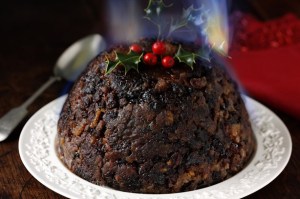
How much is too much?!

How much is too much?!

This post has turned out to be quite a general reflection on teaching, perhaps valid for most arts subjects, not just early modern history.  I’m going to follow up with something a little more subject specific in a few weeks: about how we engage students with early modern history subjects in the classes we teach.  But I suppose what I’m saying is that if the initial conditions aren’t right, then that noble aim becomes much harder to achieve.  I’d be really interested to hear about how other people have gone about designing or adapting courses, in order to stand the best chance of turning students into proper little ‘monsters…

Tudor history on TV, and a partial review of David Starkey’s ‘Music and Monarchy’…

Jonathan Willis

Early modern history has done pretty well out of the BBC lately. Earlier this year, in late May and early June, there was a season of programmes (apparently 5 documentaries constitute a ‘season’) based around the Tudor Court. We had an interesting and quite adventurous treatment of The Last Days of Anne Boleyn, which made the brave decision not to give top billing to a single authoritative historical narrator, or wrap up its argument with neat historical conclusions, but instead featured a real diversity of opinions from half a dozen historians and historical novelists. Diarmaid McCulloch presented a view of Thomas Cromwell which, while at first glance appearing to owe much to GR Elton, also contained a few tantalising hints of the major new biography he is working on (and which I for one am very much looking forward to reading). Thomas Penn told the story of Henry VII, Winter King, and Ian Mortimer presented a Time-Traveller’s Guide to Elizabethan England. And finally, Melvyn Bragg made the case for William Tyndale as The Most Dangerous Man in Tudor England in appropriately evangelical mode, in a strange piece of film which was shot like an episode of the late-lamented popular BBC spy drama, Spooks.
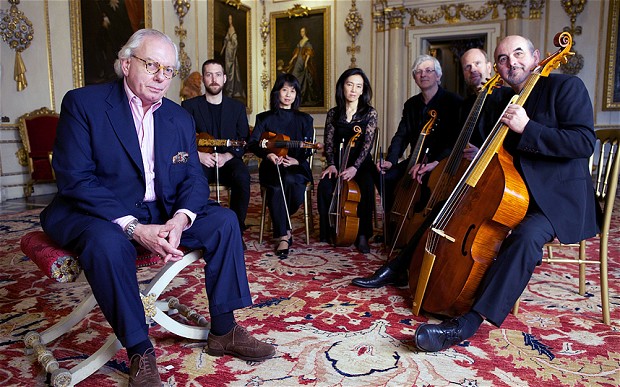
spooks002These documentaries were accompanied by re-runs of the Showtime series, The Tudors (which I don’t intend to dissect here!), and all in all I think that this sort of documentary interest in the period is, in the immortal words of Sellar and Yeatman, A Good Thing. Another recent onscreen foray into Tudor England has been conducted by David Starkey, in his four-part series Music and Monarchy, which began airing on 20 July and finished on Saturday 10 August: UK residents can still catch it on iplayer. Entitled ‘Crown and Choir’, the first episode looked at ‘royal music’ in England from Henry V to the death of Elizabeth I. I have to say, that as a historian who has written a fair amount about sixteenth century music, I had somewhat mixed feelings about watching this documentary. I like the fact that the history of music is something that people (and documentary-makers) seem to be increasingly interested in: in recent years the BBC has also given us Sacred Music and Howard Goodall’s Story of Music, both of which were interesting pieces of television. But music and monarchy? Starkey is of course primarily an historian of elites, and of court culture. But (and I hope that, given the recent online symposium on history from below, I am preaching largely to the converted) the story of music in the sixteenth century is so much more interesting than that, in terms of the broader role it played in popular culture and religion. david-starkey_2622826b

On balance, watching this first episode of Music and Monarchy I was pleasantly surprised. Starkey, for all his controversy and confrontational style as a commenter on current affairs, is a compelling and captivating storyteller, and it’s pretty clear that he is passionately interested in his subject. The tone strikes about the right balance: it isn’t overly simplified or patronising, and neither is it loaded with too much technical jargon. Occasionally Starkey allows his effusiveness about the music to cloud what could be a more rigorous analysis, but this is popular TV, not an academic lecture. He talks to a small number of musicians and academics, including the multi-talented David Skinner, and includes lots of long, sumptuous performances of pieces of early music in the venues in which they were (or at least in which they could possibly have been) performed. All in all then, this documentary too, to my surprise, is probably A Good Thing. Except… For 50 minutes of ‘Crown and Choir’ I broadly enjoyed what I was watching. But for the last 10, I pulled out my hair, and if my train carriage had had opening windows I might have thrown the iPad I was watching out of one of them. This is for two main reasons.
ipadrepairspreston

Bad Thing #1. In large part, the interplay between music and monarchy (and religion) was dealt with well, but in the final ten minutes what had functioned quite successfully as a lens turned suddenly into a pair of blinkers. Elizabeth I saved church music, we were told (partly right), but not only that, she did it singlehandedly, solely by maintaining a chapel royal of equivalent musical magnificence to her father, Henry VIII. Inside it, Elizabeth composed for herself a warm and dazzling sacred oratorio; beyond her chapel was merely a cold and frosty Protestant wasteland. Now that is just plain wrong. Even if we leave aside the complex musical picture in the Elizabethan parish church, which may well have still contained an organ, a choir, or at least a couple of paid singers, what about the musical livings she preserved elsewhere, and the university college and cathedral choirs up and down the country? True the chapel royal was probably the best resourced choir in Elizabethan England, but its musical reputation was maintained in part by poaching singers and composers from other musical establishments, such as the composer and organist William Byrd from Lincoln Minster.

Bad Thing #2. Where the parish church was briefly mentioned, it was as a cold, austere, whitewashed box, devoid of all visual and oral ornament. Cue a group of aged parishioners slowly and tunelessly droning out the ‘Old Hundredth’, a musical oxymoron; ‘all people than on earth do dwell, sing to the lord with cheerful voice’! That, Starkey observed, was as good as it got: the best that the man in the street (or at least the parish church) could aspire to. Again, leaving aside the complexity of the parish situation, which I would characterise as a vibrant and amorphous fusion of traditional and innovatory musical forms, the problem with this sort of approach is that it harks back to an outdated musicological approach that equated musical ‘quality’ with historical significance. Congregational metrical psalmody might not be the sort of music that features on the glossy CDs produced by modern choirs like the Sixteen or the Tallis Scholars, but that does not mean that it lacked value or importance (interestingly, the bibliography of the book that accompanies the series references rather dated literature on this topic, such as Temperley’s 1979 Music of the English Parish Church). For the first time, ordinary men and women were invited to play an active and participatory role in parish church worship, by joining in and singing praises together in one resounding voice. Starkey even misses a trick here in terms of his focus on music and monarchy. Such was the popularity and success of congregational song, that in the 1570s the government produced a series of metrical anthems, to be sung to familiar tunes to the glory of both God and the Queen. These works were most obviously to be sung on the ‘Crownation Day’ celebrations of 17 November, and far more people sang them than ever even heard Byrd’s beautiful motet, O Lord, let thy servant, Elizabeth. The reason that the vernacular sacred oratorios of Handel proved so popular in the eighteenth century, one might surmise, is at least in part because by that point the English had been singing themselves Protestant for the best part of two centuries. The reformation had effectively turned every parish church into a choir, albeit often a not very good one.

I don’t feel professionally qualified to comment on the rest of the series, and anyway this is supposed to be a blog, not a monograph. I’m now three-quarters of the way through, and broadly I think that his perspective is an interesting one, and that the documentary is a Good Thing – it might even inspire some people to find out more. But just as the story of popular religious music cannot be told without paying some attention to the interventions of kings and queens, so the musical legacy of kings and queens cannot be properly told without paying some attention to popular reception. And ‘reception’ in this context should not be envisaged as a passive process, but as a means by which people helped to shape the Protestant nation of which they themselves were part.

Idols of the mind; or, what on earth does God look like?

Jonathan Willis

Term has ended, I’m organising a big conference next week, and I also urgently need to start writing the paper I am giving at said conference; so what better time, I thought, to write a blog post on an entirely unrelated topic? Frankly, it was either this or finally write that book review I’ve been putting off for weeks…

This post is about God; or more specifically, about what God looks like; or, more specifically still, about how people may have thought about and/or visualised God in Reformation England. I’ve been thinking about this for some time, largely related to different aspects of my work on the ten commandments. First of all, the commandments as a whole derived much (let’s not beat around the bush, pretty much all) of their authority from the fact that they had been given by God himself. Exodus 19 describes how God came down upon mount Sinai in ‘thunders and lightnings, and a thick cloud upon the mount’. He ‘descended’ upon the mountain ‘in fire’ and delivered his commandments. Afterwards, Moses, Arron, Nadab, Abihu and seventy elders came up the mountain to see God, although only Moses himself was given leave to come near to God. Exodus 24:10 describes the supernatural encounter:

And they saw the God of Israel: and there was under his feet as it were a paved work of a sapphire stone, and as it were the body of heaven in his clearness.

Several chapters later, Exodus 31:18 describes another pivotal moment, the point at which the commandments were passed to Moses:

And he gave unto Moses, when he had made an end of communing with him upon mount Sinai, two tables of testimony, tables of stone, written with the finger of God.

william-blake-god-writing-the-commandments-boards_i-G-59-5923-ZI3RG00Z

Blake’s vision of God, writing the Commandments

God’s presence in Exodus is suitably awe-inspiring and mysterious, cloaked as it is in fire, earthquakes, trumpets and smoke. But for the careful reader and listener there are some rather intriguing human details. Firstly, God spoke. Now we in the twenty-first century have seen and read enough works of science-fiction and fantasy fiction to imagine a booming voice emitting from nowhere, or perhaps beaming telepathically directly into our heads. But for most early moderns, surely a voice would have implied a mouth, a tongue, a head… Exodus 24:10 talks of a sapphire pavement under God’s feet, and perhaps most crucially, the ten commandments are described as having been written with the finger of God.There is a marvellous depiction of God doing precisely that, engraving stone tablets with his right index finger extended like some sort of divine welding torch, by the romantic poet and painter William Blake. But such a depiction would have been unthinkable in Reformation England, because of the great weight placed upon the commandments themselves, and in particular the first, ‘Thou shalt have no other gods before me’, and the second. Exodus 20:4 stated quite clearly,

Thou shalt not make unto thee any graven image, or any likeness of any thing that is in heaven above, or that is in the earth beneath, or that is in the water under the earth.

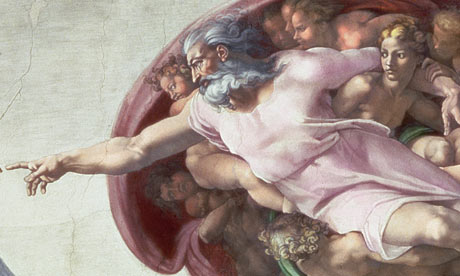
Michaelangelo's God as shown creating Adam on the ceiling of the Sistine Chapel

Michaelangelo’s God as shown creating Adam on the ceiling of the Sistine Chapel

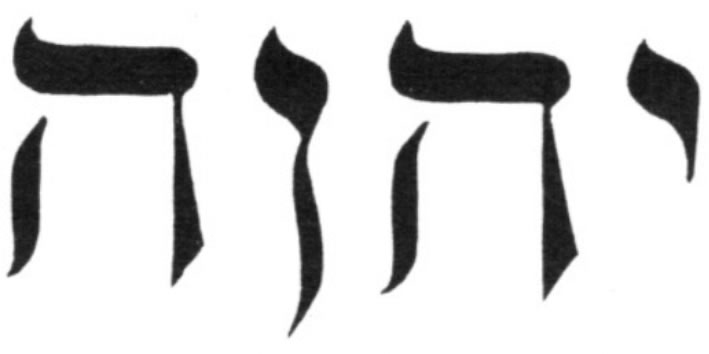
This is in large part a familiar story. Depictions of God the Father as a white-bearded old man (like the rather famous one above) were out in Protestant Reformation England, and so imaginative painters, printmakers and carvers resorted to figurative alternatives like the Hebrew ‘tetragrammaton’:

YHWH, or 'Yaweh', in Hebrew

YHWH, or ‘Yaweh’, in Hebrew

People recognised this as a symbolic depiction of God, the newest element of a longstanding visual language which recognised that rays of light and prominent doves could function as representations of the holy spirit, and that indeed Christ could be represented as a lamb, or by the ‘holy monogram’ IHS and other Christograms.

But people recognised the lamb and the holy name as symbols. They did not think that Christ was a sheep – the bible was rather insistent on the fact that he had been both God and man. So when people saw the tetragrammaton, or heard references to God’s voice, and feet, and fingers, what could they do but picture somebody in the form of a man, a man old enough to be the ‘father’ of the ‘son’ who had died for their sins? It is therefore easy to see an unresolved tension in the way in which most writers discussed the second commandment, with its absolute ban on images of the divine directly contradicted by the partial painting of a picture of God in words, through references to hands, feet, mouth, voice, and other physical elements of fleshy human bodies.

While most ministers and godly authors like Samuel Purchas and John Brinsley were happy to speak of a law ‘renued by the voice and finger of God on Mount Sinai’,[1] or of ‘the Ten Commandements written by the Lords owne finger’,[2] others recognised this inherent contradiction and were more careful. Calvin, in his sermons on Deuteronomy, explained that while God had chosen to write his law on stone tables with his own finger, we should not believe

that God hath anie hands: but that the holy scripture speaketh so by a resemblance as if it were saide, the lawe was note written or ingrauen by mans hand: but God approoued and ratified it by way of miracle.[3]

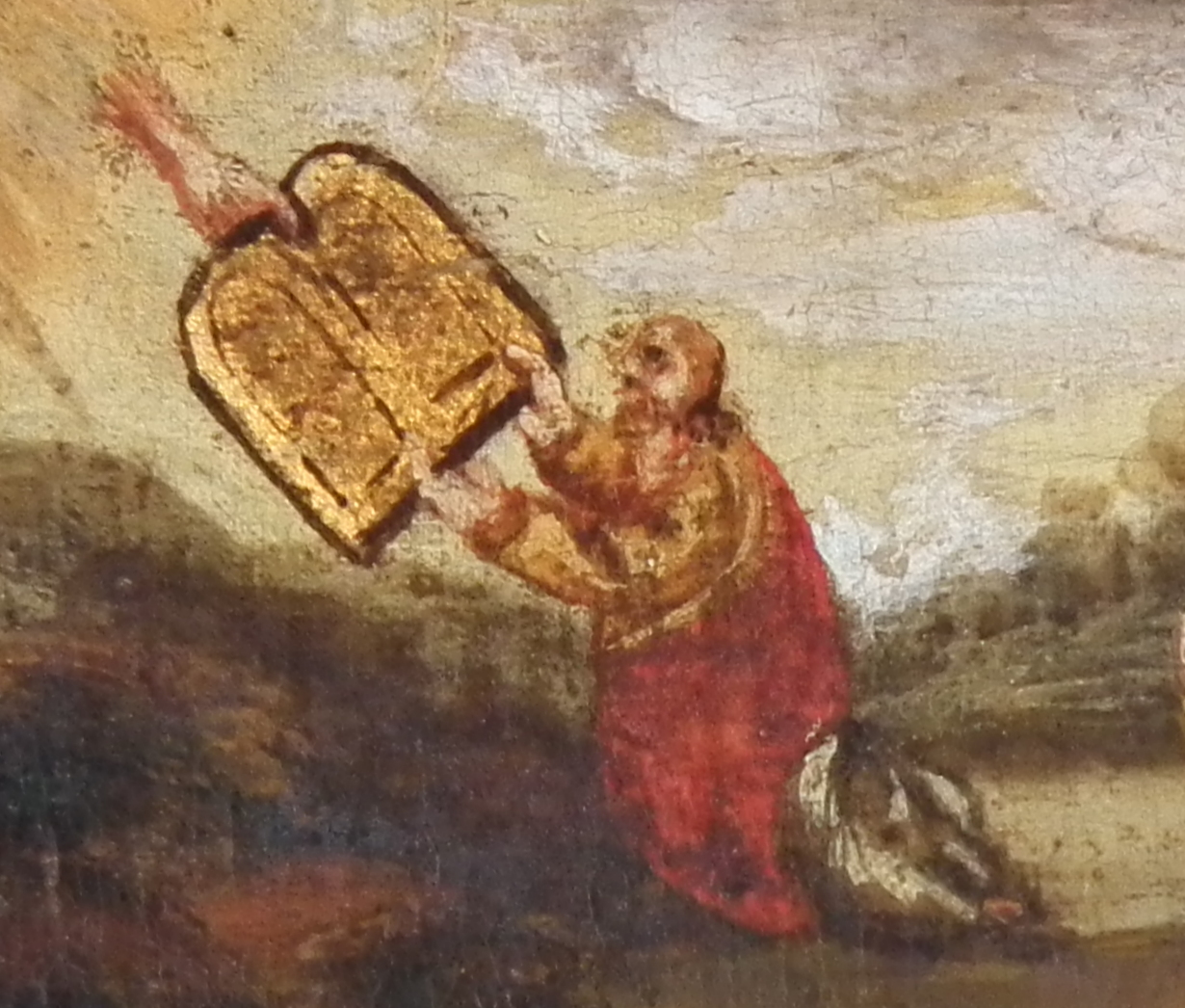
Not many people could maintain such a rigid division in their heads, however, and occasionally idols of the mind could be made partially manifest. I want to share just two examples today. The first, taken from a rare Elizabethan commandment board hanging in a Hampshire church, shows what is unmistakeably a divine hand, fully formed with four celestial fingers and a god-like thumb, handing the ten commandments out of the sky to a kneeling Moses.

Gravatar

The second, knowledge of which I very gratefully owe to University of Birmingham PhD student Susan Orlik, is the baleful eye of God staring down at the occupants of an astonishing family pew in a Berkshire church, the pupil of which is inscribed with the words deus videt – God watches.

3780847851_57fff22182_z

If any monster readers have come across any interesting, unusual or incongruous representations or descriptions of, or references to, God, I’d be very interested to hear about them here!


[1] Samuel Purchas, Purchas his pilgrimage (1613), p. 17.

[2] John Brinsley, The fourth part of the true watch containing prayers and teares for the churches (1624), p. 78.

[3] Jean Calvin, The sermons of M. Iohn Caluin vpon the fifth booke of Moses called Deuteronomie, trans. Arthur Golding (1583), p. 391.

Something for Good Friday (it would be Rood not to)…

Jonathan Willis

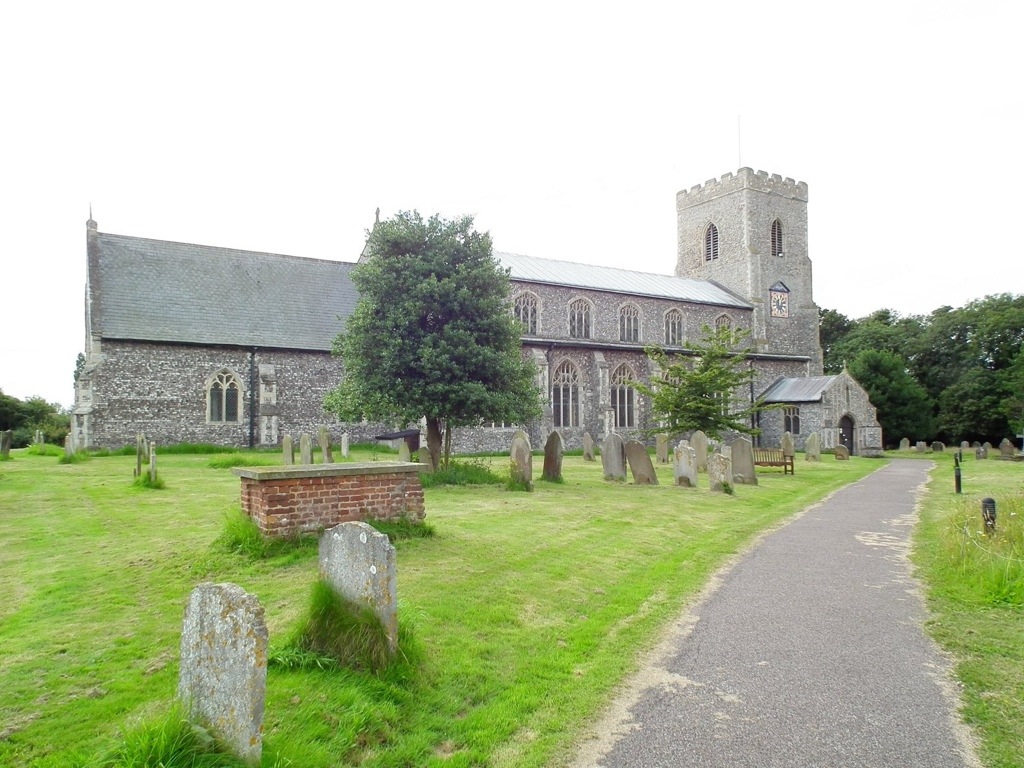
Just a little something for Good Friday: I don’t know how many of you know the parish church of St Catherine, Ludham, Norfolk, but like so many of the county’s churches it has a solid medieval pedigree and is really worth a visit!

20130329-090718.jpg
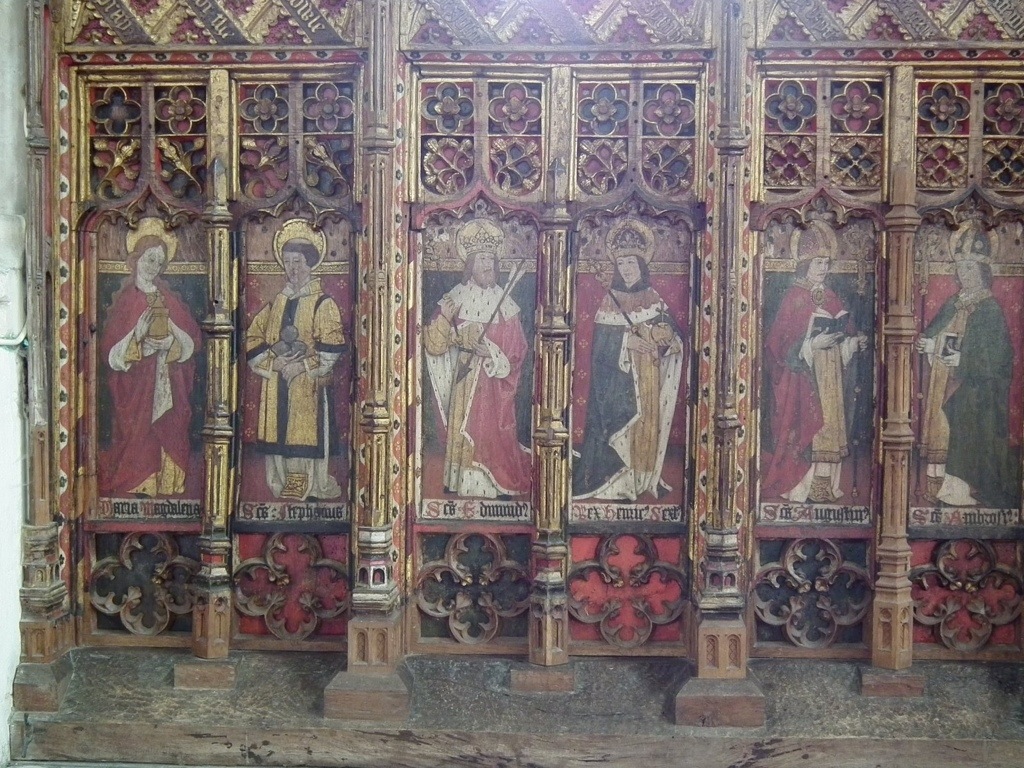
I went there last summer (remember summer?!) on the trail of an early commandment board, and while I’m still not convinced that I found one there, I did come across something rather special. Ludham has one of those vast, flint-clad churches so characteristic of East Anglia, a result of huge wealth generated by a thriving local economy, and particularly the strength of the cloth trade. Anyway, one of the main attractions is its beautiful, intricate medieval painted screen:

20130329-091344.jpg
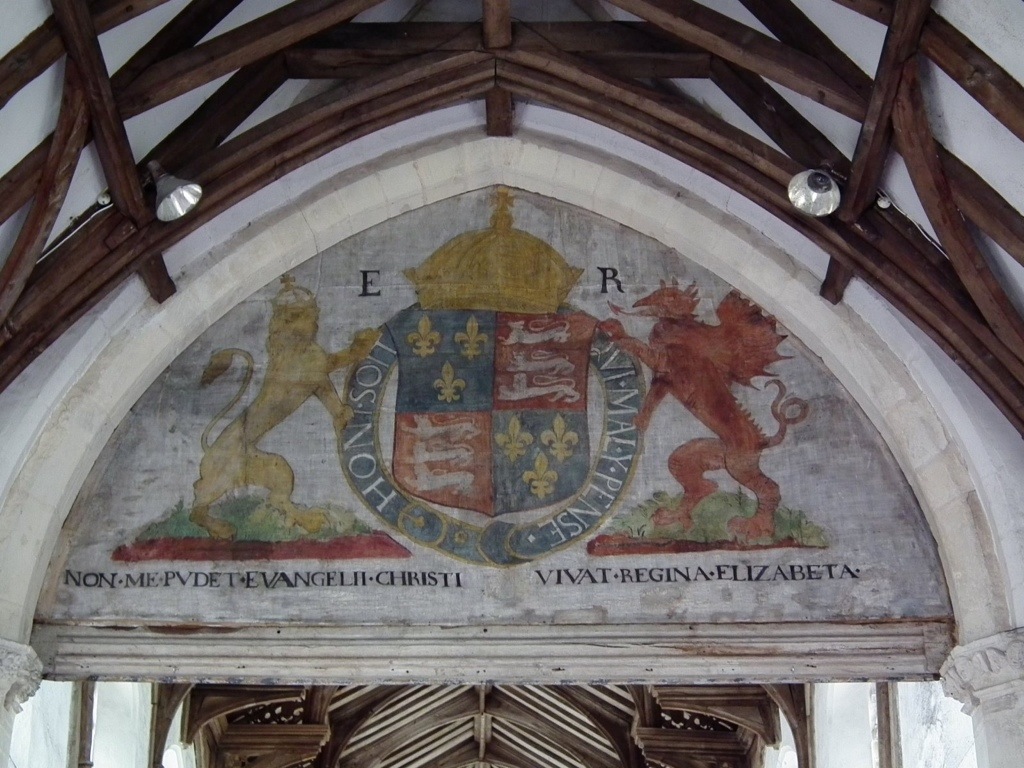
But more interesting I think, at least from an early modern perspective, is the contents of the chancel arch. Viewed from the nave, it contains a striking, early example of an Elizabethan Royal Arms, declaring Vivat Regina Elizabeta alongside the motto Non me pudet evangilium Christi, ‘Let me not be ashamed of the Gospel of Christ’.

20130329-092339.jpg
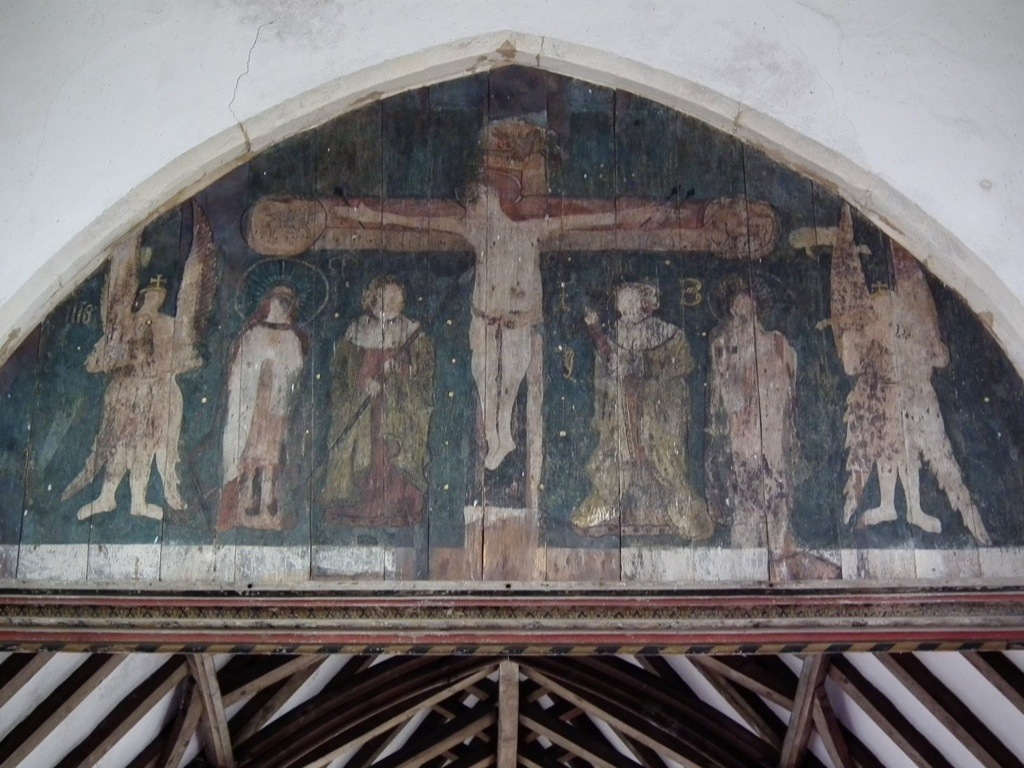
Arms like this are rare enough, and I’ve not come across any other examples with this particular motto, but on the reverse side, facing into the Chancel, is something quite spectacular: a rare survival from the Catholic restoration of the reign of Mary I, a painted Rood. Christ crucified in the centre is surmounted (I think) by the dove of the Holy Spirit, and flanked by (probably) Mary and John the Baptist, two other saints, and two crowned, winged figures who I think are unmistakably angels:

20130329-093026.jpg
Beyond that, the rest is speculation. We have very little to compare either example to, and it may be that Ludham was just an extremely compliant parish when it came to obeying the capricious religious policies of the Tudor monarchs. Perhaps this Rood was nothing special, just a rare example of the sort of stop-gap measure adopted by hundreds of churches across the country, and which the death of Mary prevented from achieving greater permanence. But (and this is surely the reformation historian inside me) it is also tempting to read a more polemical narrative into the actions of Ludham. Was their strident Elizabethan declaration not to be ashamed of the gospel in part a defence against charges of conservatism of the type embodied by their Marian Rood? Both Rood and Arms survive today purely by chance, hidden away until they were rediscovered at the end of the nineteenth century. How fortunate for us that they do: now we just have to figure out what to make of them!