Mark Hailwood
Marooned On An Island Monographs: An Early Modern Social History Summer Reading List
11


Mark Hailwood
Mark Hailwood (I’m now on twitter: follow me @mark_hailwood)
As many readers of the ‘monster will know, April is one of the academic year’s prime conference seasons – and this year I threw myself into it with gusto, delivering three different papers on two continents in the space of a week. Now I’ve recovered, I wanted to offer some reflections on a unique conference experience that I enjoyed at the Huntington Library’s ‘Living English Broadside Ballads, 1550-1750’ event, convened by Paddy Fumerton of EBBA fame.
‘Immersive’ history has been an important theme of many posts on this blog; that is, an approach to history that concerns itself not only with surviving written sources, but also with the sights, sounds and material traces of past society. So it was fascinating to attend a conference that sought to ‘bring to life’ the various aspects of early modern printed ballads, not just as texts but as songs, dances and visual objects. This isn’t a conventional paper-by-paper conference report, but rather a selection of some of the highlights that spoke to this idea of ‘immersive’ history: Continue reading
I suppose it is natural when you are on the other side of the world to turn your thoughts towards home. And so it is that on a trip to the Huntington Library in California (to attend this ace conference on ballads) I’ve felt inspired to write a post about my home town: Portishead in North Somerset.
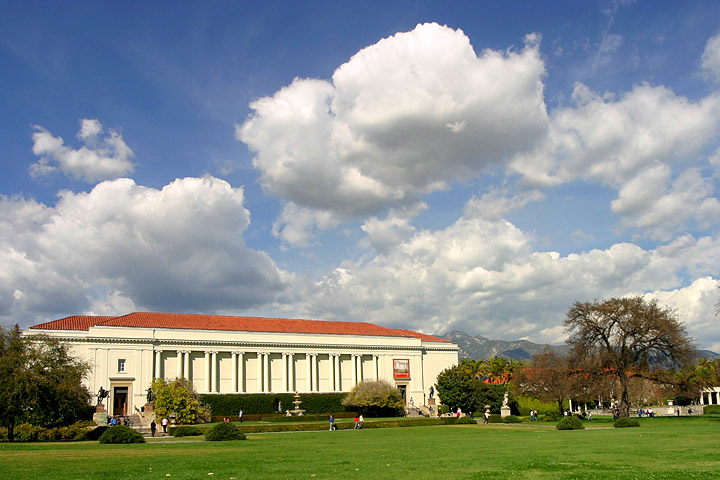
The Huntington: A long way from home…
One of the areas I focused on in researching alehouses for my forthcoming book was the county of Somerset, which has excellent quarter sessions records. Of course, as I scoured the archive looking for evidence of alehouse regulation and instances of good fellowship, I kept an eye out for references to my home town. I didn’t find much – it was no more than a small village before the Victorians adopted it as a seaside resort in the nineteenth century – but there were a few cases I came across which suggest something of the character of the place and its inhabitants. They don’t necessarily portray my ancestors in a positive light.
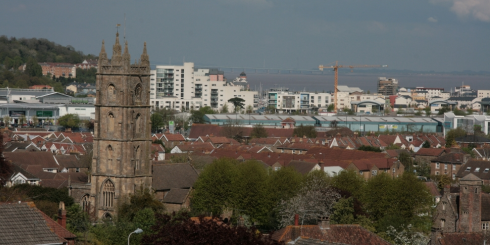
Home sweet home
The first thing I discovered was the following order, made by the county magistrates, at a meeting of the Somerset quarter sessions in Wells, in 1656:
‘Whereas one Susan Gulston a poore cripple is lately come into the parish of Portishead in this County; and itt appearing that shee was last settled att Takeley in the County of Essex, this Court uppon complaint of the parishioners of Portishead doth order: That the said Susan bee retorned from parish to parish by the officers of each parish to Takeley aforesaid there to bee provided for according to lawe.’[1]
Basically, a poor crippled woman had turned up in the parish, and the locals did not want to be responsible for paying her poor relief. So they had asked that she be escorted from parish border to parish border all the way back to her home parish some 154 miles away to claim relief. That’s 51 hours of walking, according to google maps (assuming she stuck to the most direct A roads). That’s some walk, especially given that this poor woman was disabled:
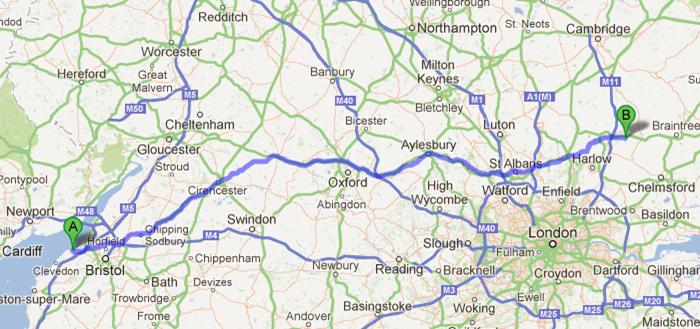
The Long Walk Home
The case doesn’t, I think, reflect particularly well on my Portishead forebears – but it is not by any means an untypical response to a poor stranger turning up in an early modern parish. As Brodie’s recent post on a 101-year old vagrant woman attests, the world’s first nation-wide welfare system was not necessarily a deeply compassionate one.
The next reference I found came from a meeting of the quarter sessions at Taunton in 1630. This time, the county magistrates were issuing an order that:
Fifty pounds be raised by a County rate and the money arising therefrom to be paid unto Rice Davies and Richard Cole, Esquires, to be by them imployed for and towards the transportinge of a greate number of Irish people from the parishe of Portishead.[2]
The precise details of what was going on here are not entirely clear, but it seems once again like a case of a cold Portishead welcome for outsiders – perhaps a group of Irish migrants had landed a ship at the beach in the parish, only to be apprehended by the locals who then asked for assistance to fund sending them straight back.
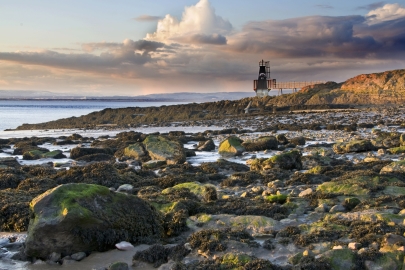
A stony welcome at Portishead beach?
I was starting to fear that the only imprint left by my ancestral townsfellows on the historical records of the early modern period were a few cases of a pronounced, if not unusual for the period, lack of hospitality and compassion to outsiders – ‘local xenophobia’ if you will.[3]
Then I recently came across another reference rather more to my liking. In 1637, the churchwardens of Portishead – a local voluntary office whose duties included maintaining peace and good order in the community – were reported to their superiors for their tolerance of:
‘fives playeinge [an early racket sport like squash], dauncing, Cudgill playeinge [an early form of cricket perhaps?], and fightinge in the churchyard there’.[4]
Since the Reformation, church authorities had worked hard to banish games and pastimes from taking place in the church grounds, as they sought to establish clear lines between the ‘sacred’ and the ‘profane’, and increase a sense of sober reverence in and around the church itself. But here were the parishioners of Portishead, having a merry old time in the churchyard, whilst local officials willingly turned a blind eye to this defiance of authority.
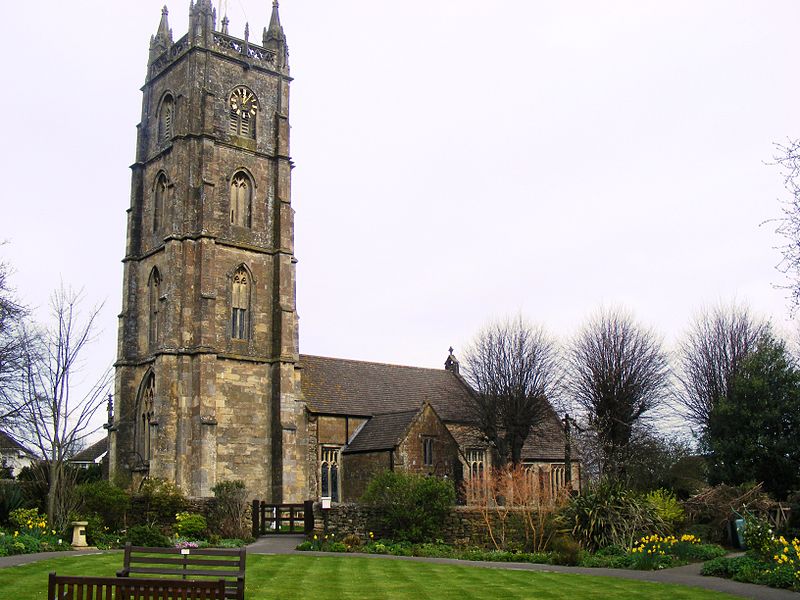
Fun and games at the parish church – now Grade I listed: http://en.wikipedia.org/wiki/Church_of_St_Peter,_Portishead
As Chris Marsh puts it, such ‘inveterate traditionalism’ was probably unusual by this date and these kind of activities had been largely suppressed. So here at last was something for me to hold on to: a sense of pride that Portishead had, albeit in a small way, played its part in the West Country’s long tradition of non-conformity and libertarianism. Even better, it sounds as though an afternoon of cricket, dancing and fighting was as popular in seventeenth-century Portishead as it is today.
* If anyone else happens to have come across a reference to seventeenth-century Portishead, please share it in the comments section.
[1] Bates Harbin, E.H. (ed.), Quarter Sessions Records for the County of Somerset, Vol. III, Commonwealth, 1646-1660 (London: Somerset Record Society, 1907-12)
[2] Bates Harbin, E.H. (ed.), Quarter Sessions Records for the County of Somerset, Vol. II, Charles I, 1625-1639 (London: Somerset Record Society, 1907-12)
[3] For more on the ‘culture of local xenophobia’ in early modern England see: Keith Snell, ‘The Culture of Local Xenophobia’, Social History, 2003, 28 (1), pp.1-30.
[4] The case is from REED (Somerset, p.207), though I encountered it through reading Chris Marsh, Music and Society in Early Modern England (Cambridge, 2010), p.375.
Mark Hailwood
I know what you are thinking: isn’t it about time for yet another historical ‘turn’? Well, you’re in luck! I think there is a really interesting one already underway in early modern studies, quietly coming together from a number of different approaches and without, as yet, a clear sense of itself. I want to give it an identity, and I’m going to start by giving it a name: the ‘immersive turn’. But I’m open to suggestions.
What I mean by this is a growing desire on the part of early modern historians to try to recover a more multi-dimensional, multi-sensory feel for the period than we conventionally derive from an analytical reading of written sources: a search for the texture of the past, not just its texts. What prompted me to pull together this line of thought into a blog post was the recent attempt by students at De Montford to create a virtual version of seventeenth-century London before the Great Fire of 1666. It is worth a look, if you haven’t seen it already.
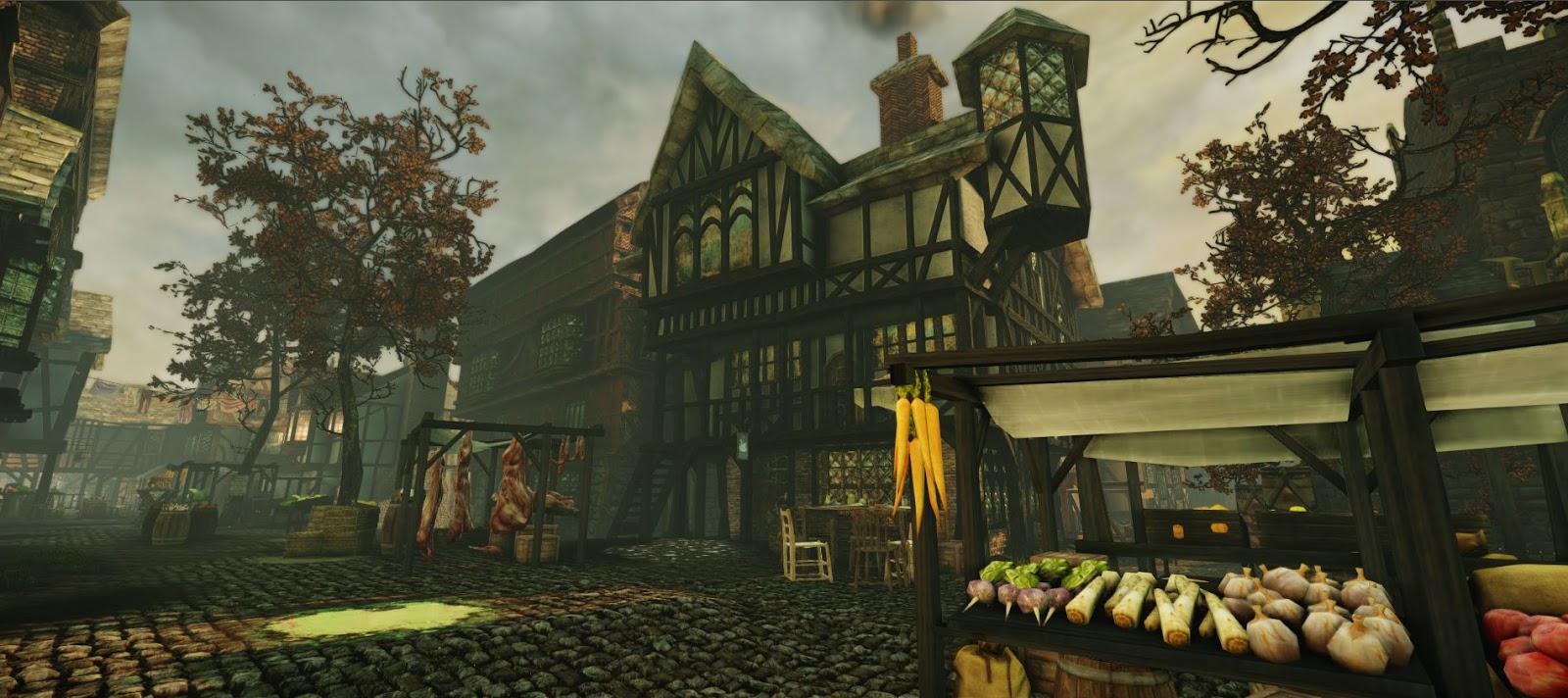
Pudding Lane Productions (http://puddinglanedmuga.blogspot.co.uk/century) have created a virtual 17th century London.
It seems to me that the interest generated by this project is a symptom of the fact that early modern historians are increasingly attracted to the idea of ‘immersing’ ourselves more fully in the physical and sensory aspects of the world that we study: the emergence of the study of material culture, increased attention to visual sources, to ‘space’, and to the history of the senses, might all be seen as part of this same process.
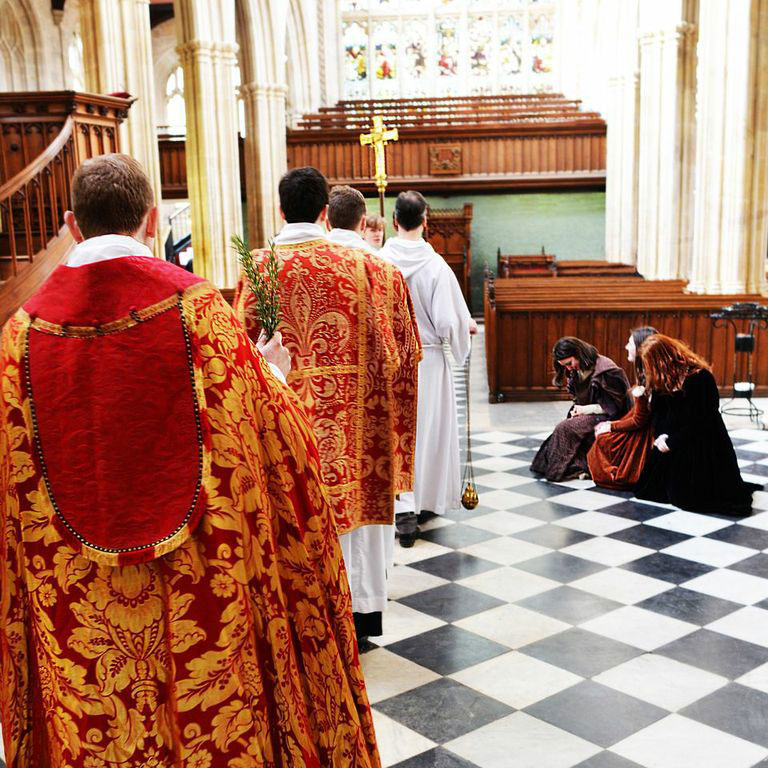
Pre-Reformation recreated
There have been recent attempts to recreate pre-and post-Reformation church interiors, and experiences of worship, for instance, and popular history books and TV shows taking the form of ‘Time Travellers’ Guides’ invite their readers and viewers to imagine the sights and smells one would encounter on entering a medieval or early modern city. All of these approaches invite us to imaginatively transport ourselves into the shoes of our early modern ancestors, and to concentrate on the immediate experience of sights, sounds and material surroundings.
These ‘immersive’ approaches have influenced my own work, especially in relation to the seventeenth-century drinking songs that I use to examine alehouse culture in the period. I don’t just mean that I get drunk and try singing them in the pub—although, we’ll come back to that—but rather that to understand the meanings of such songs it is important to think about the ways in which they were performed. It might be easy for a historian, sat alone at their desk quietly reading such a song, to misjudge the tone of its meaning, a tone that was informed by its tune, and also the manner and context in which it was actually sung, aloud, communally.
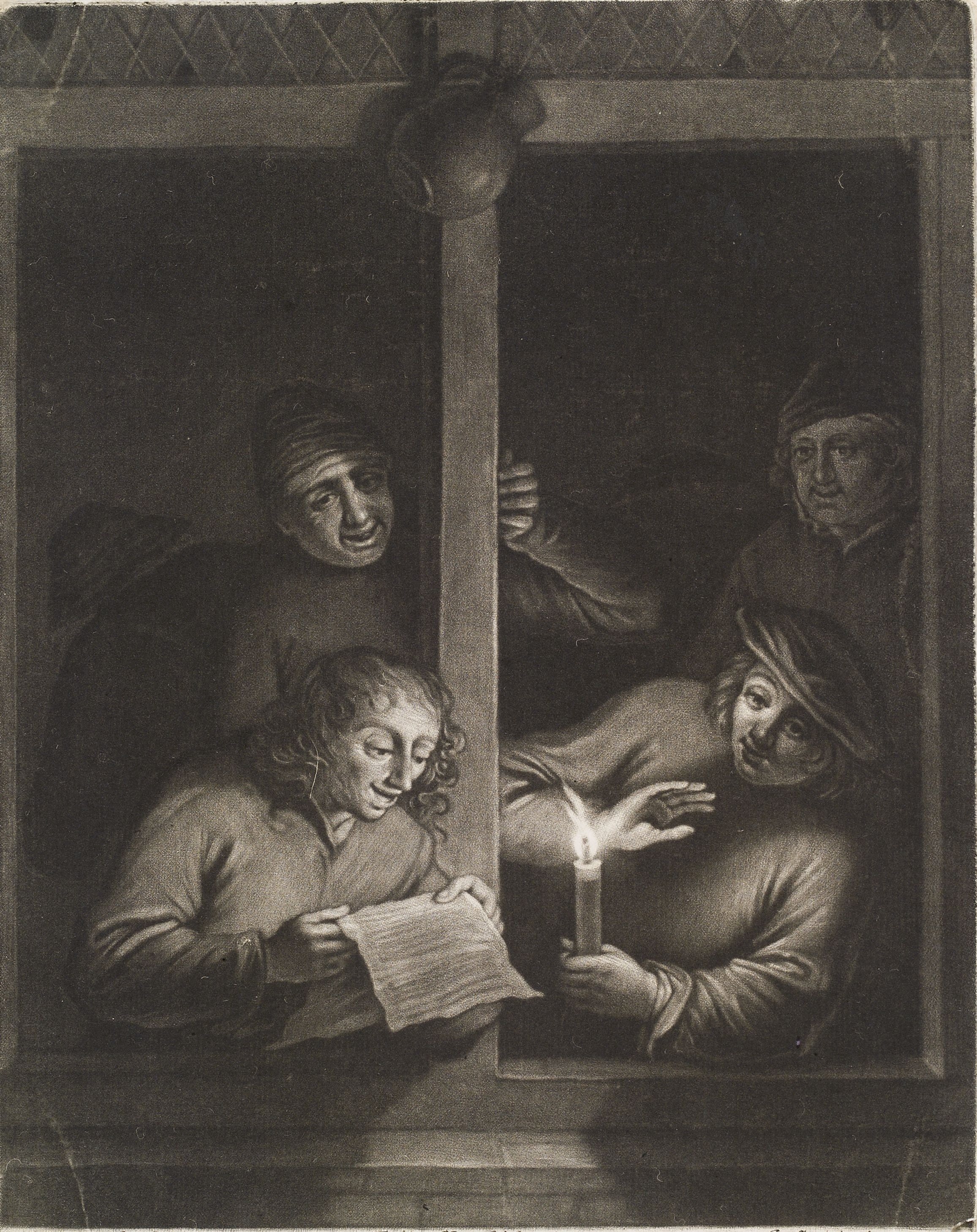
Singers in an alehouse window – hardly the same environment as sitting at my desk.
I developed a few thoughts on this in a short article for The Appendix, a new journal that embraces these new types of immersive and experimental history. You can read it for free here, and it would make sense to do so before reading on…. but, if you don’t have the time or inclination, here is the nub of it: I argue that it is important to think about how performance might influence the meaning of a seventeenth-century drinking ballad, and I applaud some recent attempts to recreate ballad performances. But I think they can misrepresent the tone in which such songs would have been sung.
For instance, take a moment to listen to EBBA’s recording of the drinking ballad, A Messe of Good Fellows, by clicking here.
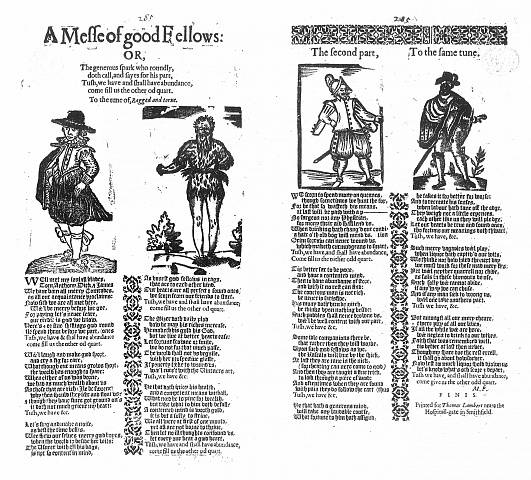
A Messe of Good Fellows (© British Library)
It’s helpful to hear it put to a tune, but surely the tone would be a little more raucous if performed by a company of intoxicated good fellows bellowing it out from the alebench?

A bit more raucous. A bit more like it?
Indeed, I suggest in the article that a modern-day football song – with a well-known tune, repetitive chorus, and an inebriated collective of (mostly) men – might actually come closer to capturing how such drinking songs would have been experienced in the alehouse. In case you haven’t had the pleasure of experiencing terrace tunefulness first hand, click here. I’ve tried to pick a relatively inoffensive one, but apologies to residents of Cardiff.
In response to the article I also received a suggestion from Phil Edwards, a Lecturer in Criminology at Manchester Met and an enthusiastic folk musician, that present day folk singing – often pub-based and communal – might be a closer descendent of the seventeenth-century alehouse song. I expect many historians would probably agree, but it is still a bit too sanitised and orderly for what I imagine performance would have actually sounded like. See what you think by listening to this ballad singaround recorded by Phil.
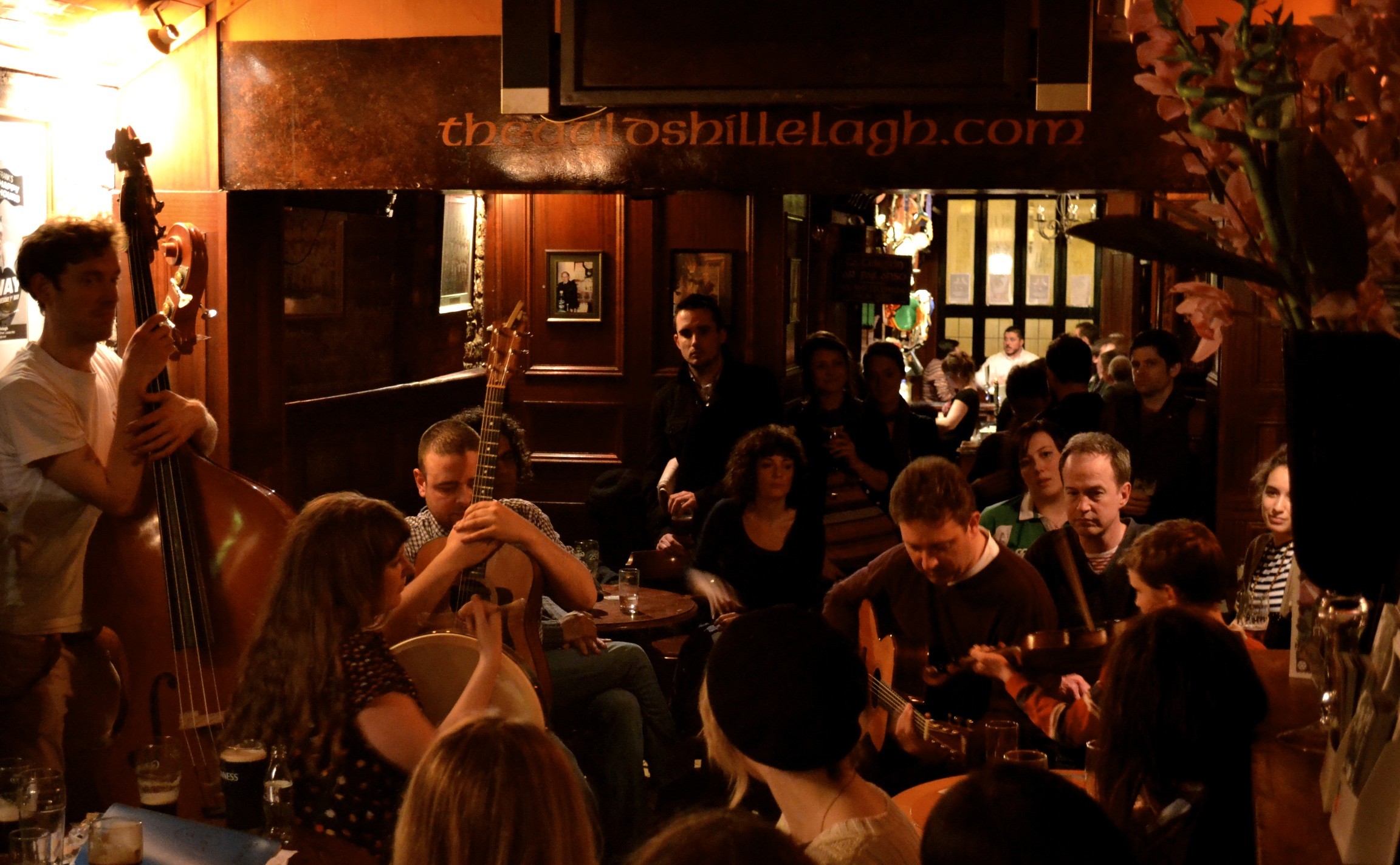
Are folk singarounds the key?
I’d be interested to hear your thoughts on which style of performance you think is most effective at ‘transporting’ us into the experiential world of our early modern forebears, but more importantly, I suppose, I’d like to know whether you think this little experiment in ‘immersion’ is a worthwhile exercise at all. Is attempting to recreate the sounds, or the smells, or the sights/sites, of the early modern past allowing just a little too much imagination into the historical process? It is undoubtedly an imprecise science, and we will never be able to capture with any certainty the tone of ballad performances – which no doubt varied immensely anyway. Is it therefore likely to be as often misleading as illuminating? A bit of fun perhaps – a harmless thought experiment to fill a coffee break – but not to be taken as a serious part of the historian’s craft? Or is the ‘immersive turn’ the next big thing, a way of bringing history to life that can enhance the understanding of both academic historians and non-academics alike?
[This is the eighteenth piece in ‘The Future of History from Below’ online symposium (#historyfrombelow). Claire Langhamer is Senior Lecturer in History at the University of Sussex. Her research and publications focus on aspects of everyday life in the 20th century, and in particular on the history of love. Here she asks whether the Mass-Observation Archive can help us to write the history of emotion ‘from below’.]
What I want to talk around in this post are the intersections between History from Below and the History of Emotion. What might a history of emotion ‘from below’ look like, how do we get at it and how might it re-frame our understanding of the period I am particularly interested in – the mid-twentieth century? I’m approaching the 1940s and 1950s as decades when the meaning and status of feeling seems to be particularly contested. Tensions between a need for self-discipline and desire for self-expression, anxieties about the impact of war and secularisation on moral standards, and concern about the future of the family, coalesced into a post-war discourse of emotional instability. Within this context the correct management of emotion was a political as well as a personal matter and became a marker of effective citizenship in a rapidly changing world. And yet, I want to argue, emotion itself could drive social and political change, acting as a vehicle for the operation of agency within everyday life. It was also increasingly seen as a legitimate basis upon which to assert knowledge claims about the world and carve out a place within civil society. Continue reading
Mark Hailwood
It’s been great to see so much interest and enthusiasm generated around the subject of ‘history from below’ this summer. The online symposium on it’s future that we have been running here on the many-headed monster – which grew out of a physical version held between a group of early career historians at Birkbeck in April – has been a real success. So we thought we would bring you more.
In July we held a second event, in Cambridge, on ‘History from Below in the 21st Century’. This grew out of conversations I’d been having with Jon Lawrence, a historian of modern Britain, who helped to organise the workshop – and who used his pull to secure the participation of some of the leading historians in this field. In particular, we were keen to get a group together who worked on diverse time periods, to get a sense of the different ways medieval, early modern, and modern historians viewed the current state of ‘history from below’. Needless to say, the resulting conversations were fascinating, for although Brodie has rightly pointed out that ‘many of the most interesting discussions about history aren’t happening in wood-panelled seminars rooms’, some do.
But, in the spirit of democratising history that has been a key theme in the online symposium so far, we thought we would bring the discussions we had that day out of the seminar room and into this wider conversation taking place here on the blog. So each day this week we will be posting a paper from the Cambridge workshop. Here is the programme:
These posts will differ a little from those we have seen so far in the online symposium: they are full versions of the papers that were presented at the workshop, rather than custom-made blog-posts, so they are a bit longer, more heavily footnoted, and were composed for an audience of academic historians. They are, of course, packed with really interesting insights, and are well worth taking that bit of extra time to read.
Feel free, as ever, to leave your comments – we will encourage the authors to respond to direct questions, but we can’t make any promises that they will. Either way, that shouldn’t stop your own conversations developing in the comments section, so keep posting your thoughts, and let’s keep the discussion going…
[This is the sixth piece in ’The Future of History from Below’ online symposium (#historyfrombelow). Mark Hailwood is a historian of early modern England and one of the founders of the many-headed monster.]
The posts that have appeared so far in this symposium have suggested a number of interesting directions for the future of ‘history from below’: a future that opens up new avenues for research through explorations of material culture, of the landscape, and of global connections and comparisons, with a critical but ultimately optimistic disposition regarding the possibilities of drawing together fragmentary evidence, potentially through the use of digital databases. All of this excites and encourages me. And yet, there is one particular problem that I think we all need to address if ‘history from below’ is to have a coherent future: how to define its subjects.
I’m not so much concerned here with who should ‘qualify’ as an appropriate subject for ‘history from below’ – I’m not sure prescriptive precision here is possible or helpful, but maybe someone would like to take this up in the comments section – so much as with the labels we use to refer to those that are generally accepted to fall within its remit. Let’s start with that classic statement of the ‘history from below’ agenda found in Thompson’s preface to The Making… ‘I am seeking to rescue the poor stockinger, the Luddite cropper, the “obsolete” hand-loom weaver, the “Utopian” artisan, and even the deluded follower of Joanna Southcott, from the enormous condescension of posterity.’ Continue reading
Mark Hailwood
The visual culture of the early modern period has been a prominent theme here on the many-headed monster, what with Jonathan’s recent post on what God looked like, and my own series of posts on woodcut workers, so I thought another contribution to these musings would be welcome.
So, below is an essay I was recently asked to write for a guidebook for an art exhibition being held at The Collection Museum, Lincoln. ‘Masterstrokes: Great Paintings from York Art Gallery’ runs until 26th August, and contains some of the highlights from York Art Gallery’s collection, on temporary display in Lincoln.
The painting I was asked to comment on is Cornelis Bega’s ‘Tavern Scene’, 1662, approaching it from the angle of what it might be able to tell a social historian. Here is what I came up with:
What is a social historian? The main thing that marks us out from our colleagues in political or economic history is that we are concerned not so much with the ‘great men’ or macro-economic developments—which have undoubtedly played their part in shaping our past and present—but with the everyday lives and experiences of ordinary men and women. We want to know what life was like in the past for the majority of our ancestors.
Recovering these experiences is far from straightforward. For the period that I study—the seventeenth century—the subjects of my research have rarely left behind any of their own accounts of what their lives were like. Only 30% of men, and 10% of women, were fully literate, and those that were tended to come from the upper ranks of society. As such, there are few letters or diaries surviving from humble men and women recording the fine details of their day-to-day trials and pleasures.
As a result, the social historian needs to be ‘omnivorous’ in their search for useful sources of evidence. They need to cast their net wide and glean what they can from surviving court records such as witness statements, from surviving popular ballads and songs, or from the indirect evidence provided by the extant writings of elite social groups. They might also be able to gain insights from the visual culture of the period they study.
In this regard, Dutch Golden Age paintings—such as Cornelis Bega’s ‘Tavern Scene’ on display here—are a tantalising prospect for the social historian. Many adopt a realist focus on the everyday life of seventeenth-century peasants and artisans. Moreover, many of them depict scenes of tavern culture, an aspect of everyday life that has increasingly come to attract the attention of social historians. There is a frustration here though for the historian of seventeenth-century England: there is no English equivalent in this century for the vibrant genre of everyday life paintings being produced in the Netherlands (I’m not quite sure why, but it is a common subject of speculation in conversation with my colleagues). So there is an obvious problem inherent in trying to use paintings of Dutch tavern culture to draw conclusions about English tavern culture, but if we put that to one side for the moment we might think about what sorts of questions a social historian could ask of paintings such as Bega’s ‘Tavern Scene’.
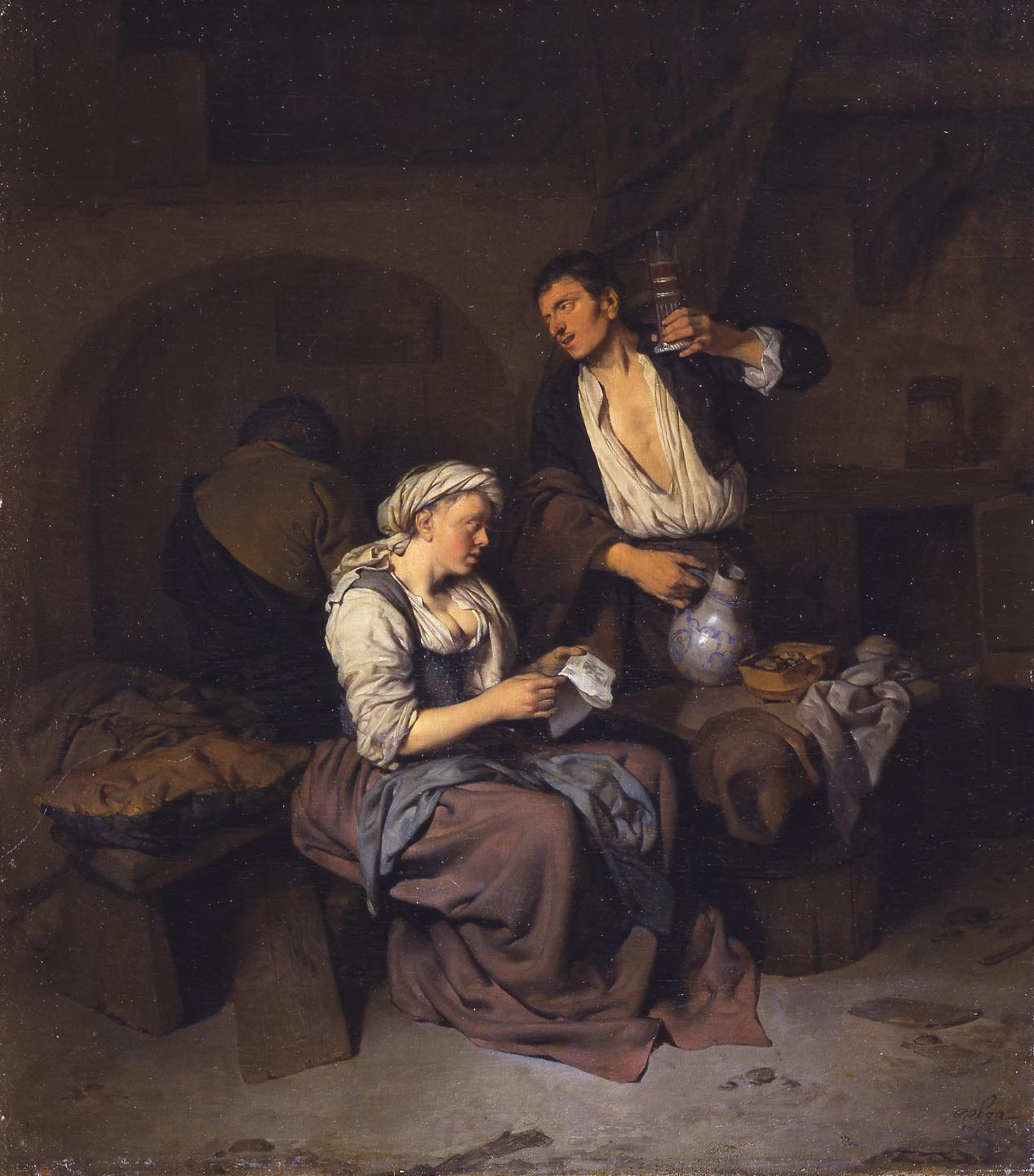
Thanks to York Art Gallery for permission to reproduce this image (YORAG782)
At first glance we might wonder if the utility of this painting lies more in what it tells us about contemporary attitudes towards tavern culture than what it can tell us about what actually took place in them from day to day. It could be taken to encapsulate a common negative stereotype of taverns that was most closely associated in England with Puritans—those who enthusiastically embraced the new Protestant religion—who were known to be particularly vociferous in condemning drunkenness as an ‘odious’ and ‘loathsome’ sin. Is the standing male character slightly off-balance perhaps, his shirt falling open as the decorum slips, drunkenly leering at the bosom of the… serving maid? Taverns were often criticised as sites of inappropriate sexual promiscuity, and we could read this depiction as a visual equivalent to the many sermons that were preached against the immorality of tavern culture in the period.
A closer look suggests that Bega is offering us much more than well-trodden moralising in his tavern scene. The social historian’s gaze is drawn to some of the more quotidian aspects in the painting. There seems, for instance, to be crumpled bedding laid out on the bench behind the central female character. This highlights an important fact about seventeenth-century taverns (or as they were more commonly called in England, alehouses) that the modern viewer may not appreciate: unlike the pubs of today, the primary purpose of an alehouse in this period was not to provide a location for recreational drinking. Rather, it had two main functions: one was to sell ale to local people who did not have the means to brew their own at home. Ale (usually weaker than our modern equivalent) was an important part of the daily diet and a key source of calories and nutrients, and was consumed with all meals by men, women and children. In this sense the alehouse was meant to serve more as an off-license. In practice, of course, many allowed drinking on site and they did become sites for recreational drinking and drunkenness, but this was forbidden in legislation.
Their other (legitimate) purpose was to provide lodging to travellers. As such they were invariably situated on main roads, something we can see in another painting in this exhibition, Meindert Hobbema’s ‘A Wooded Landscape’. It looks like a drinking house on the left, identifiable by its ‘ale-post’, the ancestor of the pub sign, protruding into the road to show that ale was available.
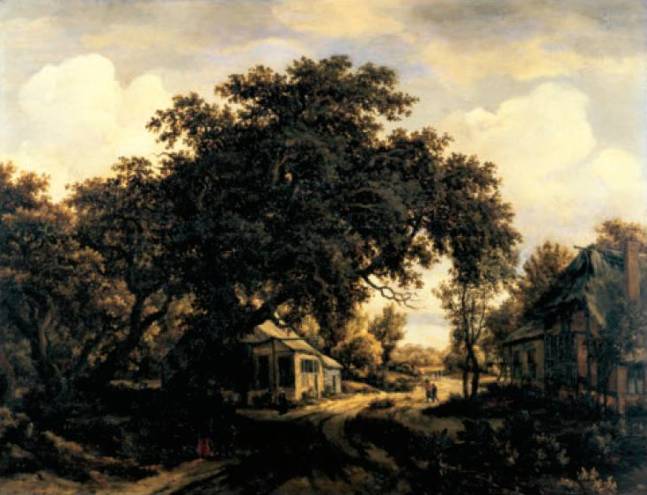
Thanks to York Art Gallery for permissions (YORAG2005.608)
With this is mind another reading of this tavern scene is possible. What we have is not a scene of drunken debauchery, but a party of travellers who have spent the night asleep on the alebench (alehouse accommodation was rarely plush, and often involved simply sleeping on a bench or sharing a bed with landlord and landlady!) The man with his back to us is still rousing himself from sleep. The standing character is not yet fully dressed, but is nonetheless taking his ‘morning draught’ of ale, the seventeenth-century equivalent of that first cup of coffee. What we might be seeing is the depiction of a morning routine after an overnight stay at the tavern, a far from untypical experience in an age when the lower orders did most of their travelling on foot, and only limited distances could be covered in a day.
We are also struck, of course, by the act of reading taking place at the centre of the scene. It is intriguing, given the statistics of female literacy, that it is the female character doing the reading. What is she reading? Could it be a broadside ballad? These were songs printed on a single (sometimes folded) sheet of paper that were sold cheaply—usually for a penny, the same price as a pint of ale—and often took the form of drinking songs to be sung in alehouses, or even pasted up on their walls. Is that one pasted up in the alcove on the back wall? Perhaps one discarded on the floor in the fore ground to the right? These drinking songs have received a lot of recent attention from social historians, who have mined them for insights they may offer into seventeenth-century tavern culture. Is this a depiction of one being performed? Is the standing male responding to a call that was common in these songs to raise a toast to his companions, or to raise a loyal toast to the King, another familiar feature of these songs?
Arguably the scene is too sedate to be a raucous rendition of a drinking song. Another interpretation may be that the reader is relaying the latest news from a printed newsheet—possibly news of a successful sea battle that is spurring the toast of her companion, or even a satirical political broadside that is the root of his mirth. Both of these were common subjects for cheap printed wares that circulated in taverns. Indeed, the discussion of news and politics in taverns was common and widespread long before the emergence of the coffeehouse in both England and the Netherlands from the mid-seventeenth century, the drinking establishment which is more commonly associated with a public thirst for news and politics. Is Bega looking to capture the fact that the politics of ‘great men’ were not as detached from the world of everyday tavern culture as historians have often thought?
It is, of course, beyond us to know for sure what Bega wanted us to take from his tavern scene, and at best it remains a somewhat indirect form of evidence of everyday life in the past for the social historian. That said, there are a number of aspects of his scene—the tavern as a place of lodging, the circulation of printed ware in these locations—that accord with the evidence of tavern culture in the seventeenth century that social historians have garnered from other sources. It reinforces our sense that tavern culture was about more than mindless drunkenness and sexual promiscuity, providing vital services and a venue for the dissemination and discussion of the issues of the day. Given these areas of overlap between Bega’s scene and what we can recover from other sources there may well be cause for optimism for social historians that such paintings can be a reliable guide to everyday life in the past. Or at the least, another component of our omnivorous diet of sources.
Mark Hailwood
Regular readers of the monster will no doubt be aware from the content of many of my posts that I am a historian of drinking. This may sound like a rather niche or unusual subject for a historian to study, but I am certainly not alone in my interest in the history of intoxication – in fact it is a major growth area, especially in early modern history,[1] and you can now even get a job working specifically on ‘Intoxicants and Early Modernity: England c.1580-c.1740’ .
Why are historians so interested in intoxicants then?
Well, im portant changes in our relationship with intoxicating substances took place in the early modern period. In 1550 English men and women had a limited choice of substances they could turn to for a ‘psychoactive’ experience: ale for the poor, wine for the rich. In contrast, by 1750 ale and wine were joined by beer, gin, tobacco, tea, coffee, and chocolate, all of which were being mass consumed across the social scale.
This transformation in the range and quantity of intoxicants being ingested by the English population should not be seen simply as a footnote in our history: it was a historical development of wide-ranging significance that was intimately connected with major transformations in economics, politics, society and culture. Colonial expansion, the relationship between the state and the individual, gender roles and conventions, ideas about appropriate forms of behaviour or ‘manners’, class differences, and the role of public opinion in the political process, are all crucial aspects of English history in this period that cannot be understood without reference to the trade, regulation, and above all consumption, of intoxicants. Historians, including myself, are now arguing that we put intoxicants where they belong: at the centre of early modern English history.
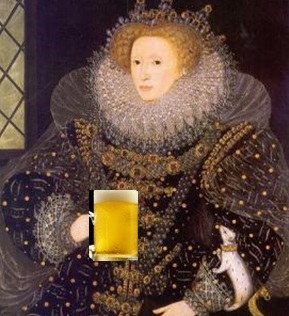 So, with that in mind I thought I would offer a mini blog ‘carnival’ to draw attention to some recent posts that touch on aspects of the important history of intoxicants. I’ve said plenty on this blog about the history of drinking, so here are a few suggestions of other popular ‘poisons’ you might be interested in:
– Over at Early Modern Medicine, Jen Evans has been exploring the way people in the seventeenth-century thought about the health implications of new introductions such as coffee and tobacco, including some rather creative songs about the effect of tobacco on male virility.
– The history of tobacco has also been taken up in a recent blog over at History Today, which provides a useful introduction to the emergence and development of smoking habits, and reveals the rather surprising fact that tobacco’s initial success owed much to its perceived medicinal properties.
– And I also came across this interesting post recently which corrects a view I often get presented with: that people drank a lot of ale and beer in medieval and early modern England because they didn’t drink water, which was thought to be unsafe. According to Tim O’Neill, they did drink water – and ale and beer were more like an early version of energy drinks than an alternative to water.
So, pick your poison, and expect to hear more about the history of intoxicants as this field of study continues to expand.
[1] For a flavour of the recent work in this field check out the following: Phil Withington, ‘Intoxicants and Society in Early Modern England’, Historical Journal (2011), Mark Hailwood, ‘Sociability, Work and Labouring Identity in Seventeenth-Century England’, Cultural and Social History 8:1 (2011), Alexandra Shepard, ‘Swil-bolls and tos-pots’: Drink Culture and Male Bonding in England, 1560–1640’ in Laura Gowing, Michael Hunter and Miri Rubin, eds., Love, Friendship and Faith in Europe, 1300–1800 (2005), and the essays in Adam Smyth (ed.), A Pleasing Sinne: Drink and Conviviality in Seventeenth-century England (Cambridge, 2004).
Mark Hailwood
The recent horsemeat scandal – demonstrating just how crooked much of the meat industry is – has provided vegetarians with some potent new ammunition for those well-trodden dinner-table debates with their carnivorous cousins. But who can claim to have history on their side? Both parties offer up arguments based on our historical relationship with eating animals: meat-eaters often reach all the way back to our hunter-gatherer origins to suggest that quaffing down animal flesh is an inherent part of human nature; veggies refute the necessity of eating meat, pointing out that for most of human history the vast majority of the population have subsisted well enough on the peasant diet of bread, beer, cheese and vegetable stew, with meat being both an elite luxury and a rarity until the twentieth century.

Meat-munching caveman

Bruegel’s Peasant Wedding: beer and broth all round! (via wikimedia commons)
What do early modern English sources suggest about the history of eating animals? Elites were certainly capable of putting their meat away, and both quantity and variety were the order of the day. At the wedding of his daughter in 1582, Lord Burghley served up the following over three days of feasting: 6 veal calves, 26 deer, 15 pigs, 14 sheep, 16 lambs, 4 kids, 6 hares, 36 swans, 2 storks, 41 turkeys, over 370 poultry, 49 curlews, 135 mallards, 354 teals, 1,049 plovers, 124 knots, 280 stints, 109 pheasants, 277 partridges, 615 cocks, 485 snipe, 840 larks, 21 gulls, 71 rabbits, 23 pigeons and 2 sturgeon. No horse though.[1]
More surprisingly, Craig Muldrew has recently shown that even the poorer members of society were eating considerable amounts of meat—those involved in physical labour such as farm servants or agricultural labourers routinely consumed between 1 and 2 pounds of meat a day in the seventeenth century, the equivalent of a 16 ounce steak or two! [2] One mid-eighteenth century guide to running a farm advised that workers be served at breakfast with ‘minced Meat left the Day before’ with ‘a mixture of shred Onions and Parsley’; at lunch some ‘Broad Beans and Bacon or Pork one day, Beef with Carrots… another day’; and after some bread and cheese in the afternoon a dinner of ‘pickled Pork boiled hot with Broad Beans’.[3]
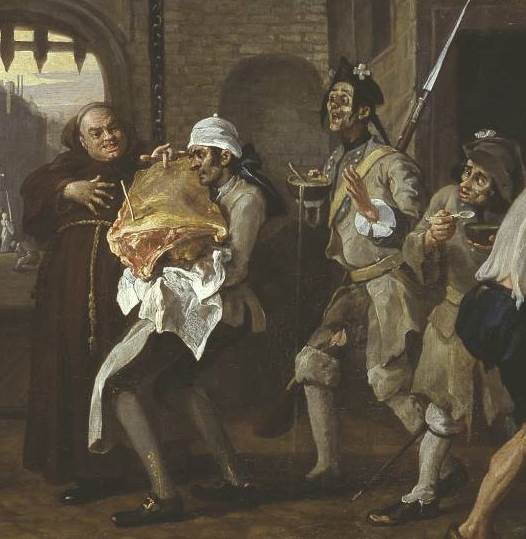
Hogarth’s ‘O the Roast Beef’ (via wikimedia commons)
The range of meats consumed by the ‘peasants’ was not as extensive as that served up at aristocratic feasts – the staples for the lower orders were pork, bacon, mutton, and most of all, beef. Indeed, the idea that beef was a particularly central foodstuff to both the English diet and identity dates from at least the sixteenth century. The physician Andrew Boorde wrote in 1542 that ‘Beefe is a good meate for an Englysshe man’ and ‘it doth make an Englysshe man stronge’, [4] and this association of the English with beef was well-entrenched by the time William Hogarth produced his 1748 painting, ‘O the Roast Beef of Old England’, which you can see depicted an English innkeeper lugging a huge hunk of beef past an envious looking French monk and a group of hungry-looking French soldiers eating a watery broth. Continue reading
the history of 'the unruly sort of clowns' and other early modern peculiarities
the history of 'the unruly sort of clowns' and other early modern peculiarities
An Open Access Graduate Course on Utopian Thought.
A blog about bodies and medicine c.1500 - 1780
Adventures in the world of history
history/folklore/writing
stories from a nineteenth-century prison
the history of 'the unruly sort of clowns' and other early modern peculiarities
Leverhulme Funded Project at University of Exeter: Adopting a New Methodological Approach to Early Modern Women's Work
Early Modern Material Culture
'Making good use of the things that we find / Things that the everyday folk leave behind': ramblings of an early modern historian
A blog (mostly) about early modern history
crime, women, digital history...
 the many-headed monster

