Nikki Clarke is a final year PhD student at Birkbeck, University of London. Her research focuses on how people gathered and assessed news in the multimedia world of seventeenth-century England. You can find her on Twitter at @nikkiclarke1.
He delivered a prince that the French had taken in the country, who by two Jesuit priests was put to torment by a suite of apparel whose linings were full of prickes. The Jesuits in the coming home were put to tast of the same sauce. The prince was diverse days together, in the beginning of Michaelmas terme, at the Royall Exchange to be seene.[1]
With this diary entry in November 1628, the Reverend John Rous alerts us to the fact that news of the travels of Amantacha, the son of Soranhes, a Wendat leader who traded with French near Quebec in the 1620s and 1630s, had arrived in the quiet, rural parish of Santon Downham, in Suffolk. My usual research is on multimedia news and accuracy in the seventeenth-century, and this blog tries to explore the way both English and French sources use the story of Amantacha to reinforce their own religious and political conflict on both sides of the Atlantic. Continue reading →
Graham is a PhD student on a Collaborative Doctoral Partnership scheme between the University of Reading and The National Archives. His current research focuses on piracy and maritime communities in the early seventeenth-century, through the lens of the records of the High Court of Admiralty. He is also working as part of an ongoing project with the Berkshire Record Office and the University of Reading to uncover diverse histories in Berkshire’s archives. You can read Graham’s recent publication, the open-access article ‘The Liues, Apprehensions, Arraignments, and Executions of the 19 Late Pyrates: Jacobean Piracy in Law and Literature’ (2022), in MDPI’s Humanities journal.
The majority of work on the history of diverse presences in Britain have focused on major urban and economic centres such as London. Away from the metropole, the story of ‘imperceptible’ Black presence (and the presence of those from other cultural and ethnic groups that are, contextually, in minority) often remains untold.[1] Yet the evidence is there. If only one knows where and how to look, we do indeed find that “Black history is everywhere”.[2]
This blog post will explore an ongoing project with the Berkshire Record Office (BRO) to uncover histories of rural diversity. It will suggest that whilst such a survey is fruitful and worthwhile, a methodology that actively recognises the unique problems posed by its respective ‘archival silences’ is required to overcome the imperceptibility identified by trailblazing scholars like Imtiaz Habib.[3]Continue reading →
Imtiaz Habib’s Black Lives in the English Archives, 1500-1677: Imprints of the Invisible (Routledge, 2008) is one text within the relatively small, but longstanding, field of early modern Black British History. Neither a cultural history of early modern racialisation nor a social history of Black Britons, the text is a kind of analytical cataloguing that seeks to locate a “missing subject” through the literal construction of an archive and an accompanying commentary. It manages to be both empirically rigorous – Habib located 448 “Black citations” – and theoretically rich. It provides a roadmap and a grammar for the social historian to think carefully about early modern England’s Black inhabitants and the archives that render those lives (il)legible.
Habib’s herculean effort in 2008 highlighted, and continues to highlight, the importance of adopting an interdisciplinary approach when looking at the lives of people of colour in early modern Britain. In its robust, rigorous, and in-depth analysis, Black Lives laid a solid foundation which Early Modern Studies continues to build on. Habib’s bridging of the gap between the historical and literary disciplines has enabled Early Modern Studies to create a holistic idea of what it was like to be a person of colour in the early modern period and to track the origins of racism.
Despite its weighty contributions, the text remains relatively neglected by social historians and, in some cases, actively dismissed. Our Symposium seeks to reflect on Habib’s Black Lives and firmly establish its importance to Early Modern Studies, particularly social history. This is especially important given the emergence of the “archive” as a heuristic within Black Feminist literature, Atlantic History, and Slavery Studies. While scholars have critically interrogated the colonial archives, less attention has been paid to the archives of the imperial metropole. Habib’s work is, therefore, an ideal way to integrate these archives and think relationally across different methodologies. We hope the reflections published here will demonstrate both the importance of Habib’s work and the vitality of scholarship thinking about early modern Britain’s Black inhabitants. Continue reading →
The many-headed monster is delighted to bring you a series of posts responding to Imtiaz Habib’s Black Lives in the English Archives, 1500-1677: Imprints of the Invisible (Ashgate: 2008, Routledge: 2020). The posts are part of Rebecca Adusei and Jamie Gemmell’s multi-event symposium, which brings together scholars working at the forefront of early modern Black history and premodern race studies to discuss the vital importance and continuing legacy of Habib’s text.
Rebecca and Jamie will introduce the blog series on Thursday 4 May, and we will then publish two posts a week over the following month – links to all the posts will be added to this page as we go, so you can bookmark it now if you want to follow along.
Rebecca and Jamie celebrated the publication of the blog series on Friday 19 May, at the London Metropolitan Archives, to tie in with their ‘Unforgotten Lives’ exhibition. This exhibition presents the stories of Londoners of African, Caribbean, Asian and Indigenous heritage who lived and worked in the city between 1560 and 1860 and are recorded in London’s archives.
The #MonsterTakeover showcased the research of our postgraduate and early career researchers as we handed over control to our readers in the first half of 2021. This post handily provides links to all of the posts in case you missed it.
It is early 2021. Large parts of the globe are in lockdown to try to limit the ravages of the covid-19 pandemic. Conferences and Symposia are postponed and there is still a long road to travel back to ‘normal’. What better moment to give you an alternative way to encounter and engage with cutting edge research on the past, in a digestible format that can fit in around online teaching, caring duties, daily exercise and lying on the floor in a darkened room breathing deeply, etc?
Below you will find links to posts written by early career scholars (baggily defined as budding historians who do not have a permanent job), showcasing their research and airing views on academic life. We are closed to new submissions for now, but we’ll probably be back with another issue of the Monster ECR Takeover in the future!
How do we know if something is true? It might seem self-evident: a thing is true if it really happened and we can prove that it happened. But over the last half-decade, especially in my home country, the United States, we’ve been presented with a seeming paradox regarding the nature of truth. Truth is apparently both subjective (some of us simply believe in “alternative facts”) and objective (everyone knows the 2020 presidential election was stolen). These shifting concepts can be very disorienting as we try to make sense of the present and plan for the future.
Early modern people, living through a time of rapid political and religious change, also experienced this disorientation. While both Protestants and Catholics believed in miracles, for example, they differed on how to verify them. People wondered if they could trust the historical record, eyewitness accounts, or even their own senses. In my work, I examine an especially contentious claim relating to the Holy House of the Annunciation, the building within which the Virgin Mary had received the Angel Gabriel and where she and Joseph had raised the infant Christ. It was claimed that after the Latin Kingdom of Jerusalem was returned to Muslim control the Holy House had flown from Nazareth to Italy in 1291. Looking at how early modern people attempted to prove this miracle can help us better understand our own complicated, changing relationship with proof and doubt.
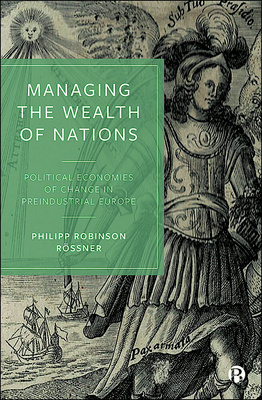
This post is part of the Monster Carnival 2022 – Why Early Modern History Matters Now. Philipp Rössner is Professor of Early Modern History at the University of Manchester and works on the history of commerce, capitalism, and economic thought in Britain, Germany, and Europe more broadly, from the late-medieval period to the present day.
Build(ing) Back Better – An idea developed a long time ago
As usual, history – whilst not exactly repeating itself – keeps coming back; often from unexpected corners; and things that may seem innovative, original or inventive on the surface turn out, upon second inspection, to be old wine in new bottles. The new UK industrial policy (Build Back Better) is, in fact, such an example. Based on “collaboration between industry, science and government,” focused on strengthening urban life (the 21st century global way of life, as it seems) and creativity, it centres on “Strong and active government investing massively in science and technology, coupled with a dynamic enterprise economy.” This paradigm echoes the “Cameralist” model of capitalism, occasionally also known as “mercantilism”: a model developed in early modern Europe, popularised and practiced in the German speaking lands, but widely adopted in Sweden, Denmark-Norway, Finland, even Portugal and Spain. Cameralism amounted to something like an early modern mainstream political economy and early ideology of growth. Radically pro-innovation, pro-market, pro-creativity and pro-government at the same time, it aimed at achieving lasting economic change and development through proactive government intervention; simultaneously enhancing the quality of economic activities (focusing on employment, adding value and raising productivity) and of economic life. This included, apart from mission orientated industrial policy, wider measures of public welfare including clean streets, safe roads, and sound quarantine rules in times of pandemics. The Cameralist model laid the foundations for the wealth of nations and significantly helped Europe undergo the crucial transitions toward industrialisation and modern economic growth.
The Political Economy of Transformation and Growth – The Case of Early Modern Cameralism
As I argue in a new book, early modern Germans were generally literate and well-trained; manufacturing was ubiquitous, and German entrepreneurs were involved in global trades. But in terms of living standards, income levels and trade connectivity Germany was hampered by a general crisis and the disastrous Thirty Years War, lagging behind France, Netherlands and England (after 1707: the UK). But the toolkit to move out of the development trap was there. Since the Renaissance but especially during the seventeenth and eighteenth century Cameralist political economy – extending far beyond the German-speaking countries covered under the unwieldy umbrella also known as ‘Holy Roman Empire’ – became increasingly focused on achieving economic growth through new outlooks on the open human future, proactively interventionist government helping the economy through providing well-designed markets, supporting manufacturing and other high value adding activities; well-regulated monetary systems, and strategies aimed at stimulating the level of circulation or – in contemporary economic lingo – increasing the “vivacity” of economic life. A centrepiece was the creation of productive and efficient manufacturing landscapes transforming nations from simple-life agrarian into increasingly literate, productive, urbanised and industrialised capitalist commonwealths.
Cameralist political economy thus made a signature contribution to the wealth of nations. During the nineteenth century Germany became one of the leading industrial powers.
This post is part of the Monster Carnival 2022 – Why Early Modern History Matters Now.Dr Kirsteen M MacKenzie is an academic historian and broadcaster who is passionate about early modern British, Irish, and French history. Her areas of interest are the Wars of the Three Kingdoms 1637-1660 and the Jacobites. Dr MacKenzie received a PhD in history from the University of Aberdeen in 2008. Her first monograph The Solemn League and Covenant of the Three Kingdoms and the Cromwellian Union 1643-1663 was published by Routledge in 2017. You can follow her on Twitter @kirsteenmm.
Kirsteen M MacKenzie
The relationships between Westminster and the devolved nations are at their lowest ebb for decades, with ongoing tensions between the centre and the periphery. These issues are not unfamiliar to those historians who study the three Stuart kingdoms between 1603 and 1707. The monarch’s ability to manage three very different kingdoms or four nations with different histories, laws, languages, and religious institutions, was key to the peace and stability of Britain and Ireland. During that century various efforts were made to try and find a union that worked for every nation. It could be said that Stuart Britain helps us understand the current parliamentary union and perhaps offers solutions to our constitutional impasse.
The Cromwellian Foundations of British Parliamentary Representation
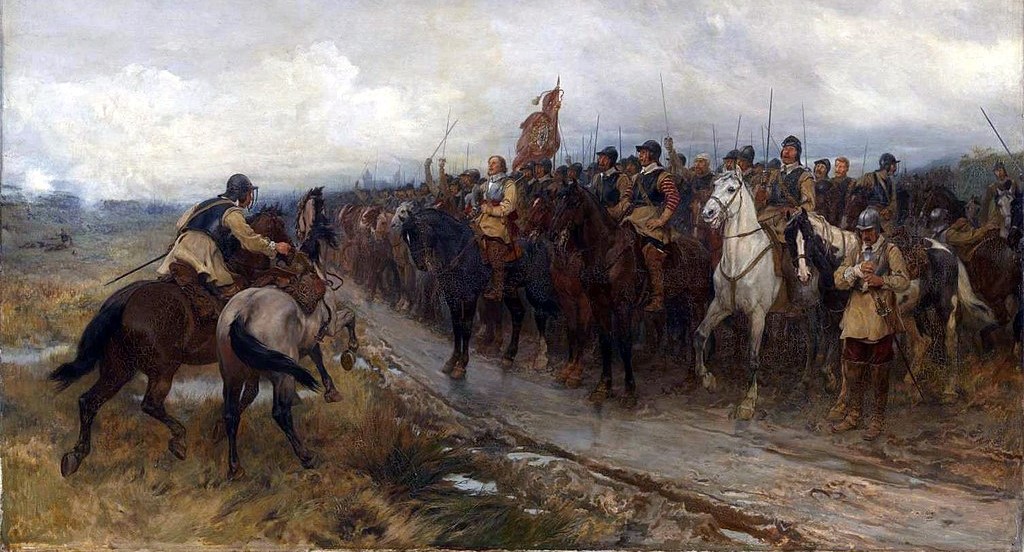
In July 1650 Oliver Cromwell marched towards Scotland with an army, declaring his love for the Scots as neighbours and friends. Cromwell and his army regarded themselves as the liberators of an oppressed nation, bringing religious liberty, enlightened political ideals, and English Common law. This reflected the sense of English superiority that was felt during the English Republic. In essence, Cromwell and his men had headed north to conquer Scotland and incorporate it into the English Republic. Scottish contemporaries rightly feared the loss of Scottish identity and sovereignty. The Cromwellian Incorporative Union was the first to abolish the Scottish Parliament and offer the Scots parliamentary representation at Westminster. This was not an act of benevolence. It was a forceful act where acceptance of the union was mandatory. This was not a British Parliament, it was an English Parliament forcefully incorporating Scottish members into English political structures.
The Act Union of 1707 created a British political union and unlike the Cromwellian Union it protected the independence of Scots Law and the Scottish church after a period of negotiation and consent. However, similar to the union in the 1650s, the Scottish Parliament was abolished and Scottish members were incorporated into English Parliamentary structures, which became the British Parliament. Therefore the weight and distribution of British parliamentary representation in Westminster can trace its origins to the Incorporative Cromwellian Union of the 1650s rather than the Act of Union of 1707.
Under these arrangements English votes outweigh those from the other parts of the United Kingdom and is a major cause of the current constitutional tension between England and Scotland within the United Kingdom.
What is the history of race, and what is the history of class? How are they interwoven and when and why are they rendered separate? We often think of these two genealogies as fundamentally opposed, and certainly current cultural discourse frequently treats them that way (‘But what about class?’ is a familiar rejoinder to those of us who speak and write on race in the past and the present). In particular, we might imagine these histories—of race and class—as converging most explicitly around the sites of slavery, but as I explore in my work, they are in fact deeply interwoven in the literary and cultural texts of early modern England, and in the documentary evidence around labour that persists: if we want to recover a labour history and a class history, I argue, we need to understand the history of race.
In this piece, therefore, I want to think about an early modern fragmentary document, what it might reveal about the entwined relationship between race and labour, and how we might use such documentary evidence to recover and complicate a premodern English history of class and labour.
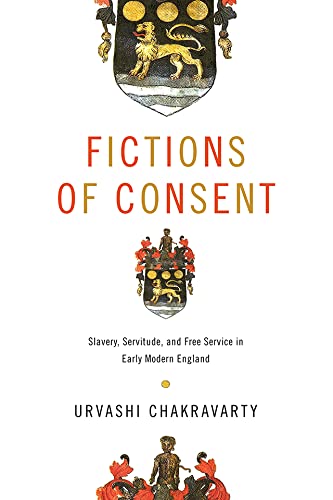
To begin, then: what is the place of slavery in early modern England, how and why is it racialised, and what might forms of early modern labour have to teach us about the construction of race in the premodern period and its enduring legacy today? These are the central questions that have been consuming my work and thinking for over a decade, and so it’s no surprise that they lie at the heart of my recently published book Fictions of Consent: Slavery, Servitude and Free Service in Early Modern England (University of Pennsylvania Press, 2022, published as the first book in its new series on ‘RaceB4Race: Critical Race Studies of the Premodern’). Fictions of Consent argues that forms of household service, apprenticeship, indenture, and liveried retainership in sixteenth- and seventeenth-century England are on the one hand pervasive and everyday, and on the other hand are vexed sites of consent and contract that are paradoxically implicated in the development of racialised slavery.
The two questions that come up frequently when I speak or write about this topic are: was there slavery in early modern England? And what does ‘race’ mean, particularly in an early modern context – and can we even talk about race in this historical period? (‘Don’t we want to talk about class instead?’).
This post is part of the Monster Carnival 2022 – Why Early Modern History Matters Now. Onni Gust is Associate Professor of History at the University of Nottingham. Their research focuses on ideas of sex and the human-animal boundary in eighteenth-century British imperial thought.
Onni Gust
Towards the end of the summer, Disney launched a trailer for its new version of The Little Mermaid, starring Halle Bailey as Ariel. The launch generated much excitement on social media. Parents of young Black girls posted videos of their daughters’ faces lighting up when they saw a heroine that looked similar to themselves. And then came the inevitable pile-on by racists. According to some commentators, the casting of a young, Black actress as Ariel was a distortion of the original, ‘authentic’ and necessarily white Ariel. To turn Ariel into a Black mer-girl was yet another egregious example of ‘wokeness’.
Hans Christian Anderson wrote The Little Mermaid in 1836 and the best-known adaptation is Disney’s 1989 film. In both versions Ariel is portrayed as having white skin – ‘delicately fair’ – with long flowing hair and blue eyes. There is nothing politically neutral about this physical description. These images are deeply embedded in racialised concepts of beauty and femininity that were being developed in the long eighteenth century in the context of European colonial expansion. A brief look at the history of mermaid sightings, capture and display during this period offers some insights into this history of racism and anti-blackness that resurfaces continuously in our own times.
Mermaids have a long and enduring presence across the globe in literature, myth and spiritual beliefs. As Celeste Headlee and Kalyani Saxena write, Black mermaids, notably the gender-fluid Mami Wata, have an important presence in African folklore; aquatic goddesses and spirits also exist in various forms in myths and legends across Asia; in Europe mermaids and sirens were regular features of sea-faring stories and ancient myth. In eighteenth-century Europe, however, a renewed fascination with merfolk formed part of a wider interest in the limits and possibilities of the natural world.



 the many-headed monster