Alice Clark 100 Reading Group: ‘Capitalists’

This post is part of our #AliceClark100 Online Reading Group. In it Amy M. Froide offers some reflections on the first main chapter of The Working Life of Women in the Seventeenth Century, on ‘Capitalists’. Amy is a Professor of History at University of Maryland, Baltimore County. You can access the book here.

Amy M. Froide

When we were organizing this blog project I very quickly claimed Clark’s chapter on capitalists (and I may have even said I was willing to fight Amy Erickson or Laura Gowing for the privilege of writing about this chapter. When we made up our schedule I found that this post would be due right at the end of term, and it was then I realized why the wily Erickson and Gowing so graciously ceded the field to me).  This anecdote does contain a salient point: many of us early modern historians have chosen to study issues pertinent to women and work and this group is a marker of Alice Clark’s influence and legacy.

It is notable that the first body chapter of Clark’s book is on the topic of capitalists. As Tim Stretton noted in his biographical post on Alice Clark, she herself was a capitalist, a director of the family firm that is now Clarks Shoes Ltd. (It is good to know that the money I have shelled out to that company over the years is in a way a homage to Clark). Despite her personal knowledge, Clark eschews a detailed definition of capitalism in this chapter and instead simply equates it with the control of wealth.  She also notes that in seventeenth–century England, capitalists included those who had obtained their wealth through commerce and trade but also the aristocracy who had long controlled wealth in the form of land. The latter are in fact the primary focus of her chapter. Continue reading
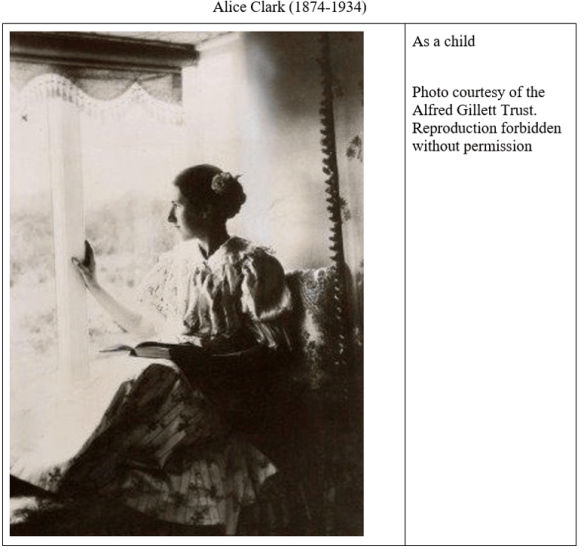
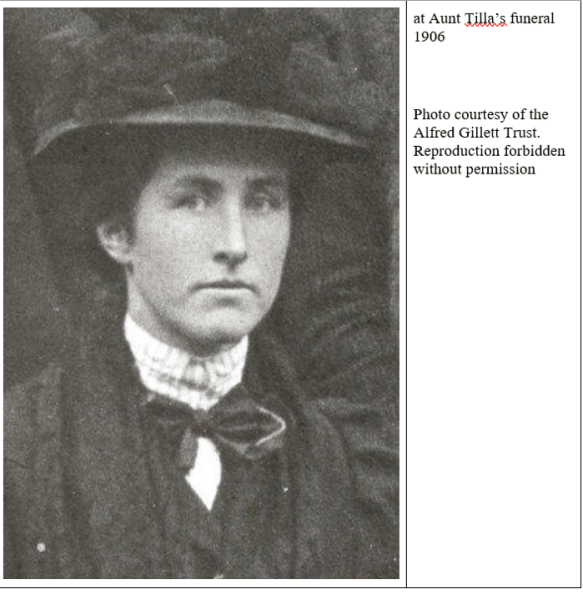
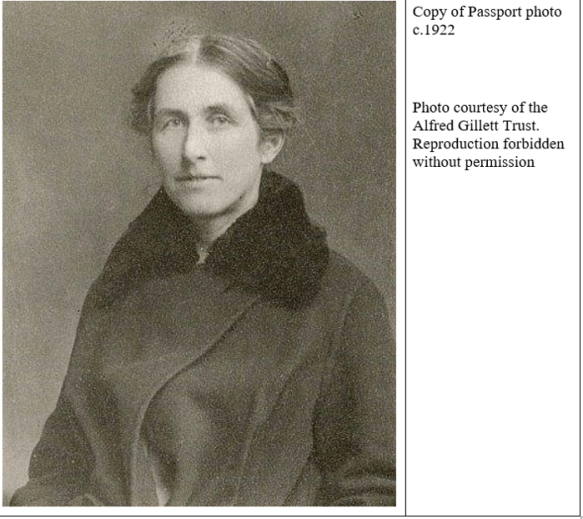
Images of Alice Clark

As an ‘extra’ to our ongoing #AliceClark100 Online Reading Group – which will resume shortly with a post on Chapter II: ‘Capitalists’, so get reading – Tim Stretton has sourced some images of Alice from the Clark family archives:

Clark 1

Clark 2

Clark 3

Images of Alice Clark are supplied courtesy of the Alfred Gillett Trust in Street, Somerset and cannot be reproduced without the Trust’s express permission. Continue reading

Alice Clark 100 Reading Group: ‘Introductory’

This post is part of our #AliceClark100 Online Reading Group. In it Susan D. Amussen offers some reflections on the opening ‘Introductory’ chapter of The Working Life of Women in the Seventeenth Century. Susan is a Professor of History at UC Merced, and tweets as @susandamussen. You can access the book here.

Susan D. Amussen

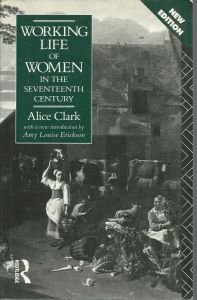
s-l1600Those who have never read Alice Clark’s Working Life of Women might wonder why we would pay any attention to a work that is a hundred years old, and superseded by recent research on women.   Yet anyone who works on the history of women, and particularly the history of women’s work, in early modern England owes a debt to Alice Clark’s work. It was reissued in 1982 with an introduction by Miranda Chaytor and Jane Lewis, and again in 1992 with an introduction by Amy Erickson. As Natalie Davis noted in a paper delivered at the Second Berkshire Conference in 1974, Clark consulted archives, differentiated among women, and had an overarching theory.[1] For me, Clark’s work is one of the two or three books that have fundamentally shaped my understanding of early modern British history, even as I know more and more about the limitations of her work.
Clark’s ‘Introductory’ raises the key thesis of her work, that industrialization fundamentally changed women’s roles and experience; that women were better integrated into the economy under household and family systems of production than in industrial systems.  She admitted how little she knew – her discussion of medieval women’s work “rests chiefly on conjecture” (p. 4); Tim Stretton has noted that her modern comparison was not the 18th century, but her own experience.  As we will see over the coming months in this roundtable, Clark didn’t get it all right.  But she got it enough right that it helps. Continue reading

A Biography of Alice Clark (1874-1934)

To kick off our #AliceClark100 Online Reading Group – marking 100 years since the publication of her groundbreaking Working Life of Women in the Seventeenth Century – Tim Stretton provides some valuable context in this short biography of Alice Clark. Tim is a Professor of History at Saint Mary’s University, Canada, and has contributed a chapter on Alice Clark to a recent book on Generations of Women Historians. The next post – discussing the Introduction – will follow next week. So get reading!

Tim Stretton

Clarks_vintage_photograph_-_man_packing_Clarks_Tor_ShoesAt first glance Alice Clark seems the most unlikely of historians. Due to ill health she managed only sporadic periods at school and she never went to university. She was a capitalist, not a scholar, spending most of her adult life as a director of the family business, known today as Clarks Shoes Ltd.  Yet from a young age she was a voracious reader and would have joined her sister at Cambridge had her parents not felt strongly that the shoe company would benefit from the involvement of a female family member.
In common with almost every one of her relations, she was also a lifelong activist for good causes and I think Working Life of Women is best understood as serving the project to achieve votes and greater equality for women. Her initial subject, when she moved to London in 1912 to work on the suffragist campaign, was not women’s work, but the history of Quaker ideas about gender equality. What puzzled her was the contrast between the striking levels of autonomy 17th century Quaker women experienced––in tandem with the defiance they showed in the face of persecution––and the deep conservatism of Quaker authorities in the 19th and 20th centuries. The organization’s gender segregated meetings and prolonged reluctance to endorse the cause of female suffrage left Clark disillusioned and she set herself the goal of understanding the causes behind this decline in female independence. Continue reading

Alice Clark’s *Working Life of Women in the 17th Century* at 100: An Online Reading Group

Mark Hailwood

The conditions under which the obscure mass of women live and fulfil their duties as human beings, have a vital influence upon the destinies of the human race…

Alice Clark, 1919

It was this conviction that drove Alice Clark to write her pioneering study of the working life of women in seventeenth-century England. One hundred years later, few historians would now contest such a statement, and as a consequence the obscurity of women’s lives in the early modern past is less acute than in Clark’s time. But how far have we come in our understanding of women’s work? How have historians added to, and revised, the picture mapped out by Alice Clark?

s-l1600The centenary of the publication of this seminal work presents a great opportunity to both celebrate the scholarship of Alice Clark, and to reflect on the current state of the history of early modern women’s work. And so, we would like to invite you, dear reader, to join an online reading group here on the many-headed monster that will do just that.
Between now and October of this year we will read one chapter a month of Working Life of Women in the Seventeenth Century (freely available on archive.org here). For each chapter a leading historian will offer their reflections on it in a blog post, which will serve as a starting point for discussion ‘below the line’ in the comments section (and/or on twitter, no doubt).

The blog posts will be published at the start of each month, on the following schedule, with a double-header in early April to kick us off: Continue reading

A Page in the Life of William Kempster: Master Mason and Scribbling Accountant

[In our mini-series ‘A Page in the Life’, each post briefly introduces a new writer and a page from their manuscript. In this post, Dr Judy Stephenson (@judyzara) of University College London explores the possibilities for historians created by a master mason’s messy account book.]

Early modern writers may be sought after by social and cultural historians for their descriptions of daily life or for their literary endeavours, but most economic historians are interested in them for something more prosaic: the prices they paid for goods and the money they earned.

Wages and prices are the backbone of all long run data sets in economic history. The long-suffering work of E. Thorold Rogers over seven centuries of manuscript records still offer most researchers their first sources before 1800. Rogers gathered prices from places like Westminster Abbey, and Oxford and Cambridge colleges which had long run accounts. Until recently, all long run wage series have been based on the prices unearthed by him of ‘day work’ paid to masons, carpenters, bricklayers and their labourers.

Private account books that state wages are rare because not many people in the early modern world were paid a weekly or daily wage.  When they do exist, they are almost never those of the sort of wage earners thought ‘representative’ by economists. Recently, however, I came across some individual account books that were very representative, because they showed that the actual wages paid to craftsmen on a big London building site – St Paul’s Cathedral – were different to the ‘day rates’ recorded in the institutional accounts. They were lower, because building contractors took a mark-up on selling their work and services, and they were much more varied.

The manuscripts were the ‘day books’ of William Kempster. Kempster was the son of Christopher ‘Kit’ Kempster who was Christopher Wren’s most favoured mason and assistant on Tom Tower and many City churches. The family hailed from Burford in Oxfordshire, where they quarried and increasingly contracted for stonework. William started contracting at St Paul’s Cathedral in late 1700 and became Master Mason there in 1714.

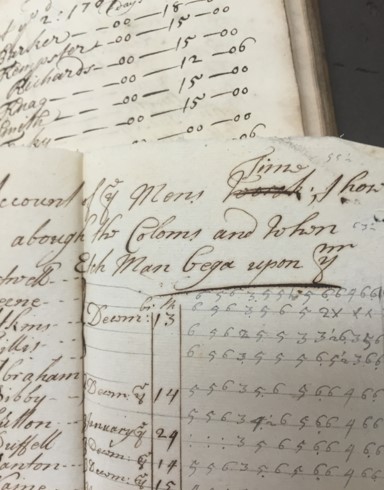
Account of the Mens Time: The National Archives

Account of the Mens Time: The National Archives

My analysis of the day books in a recent article has created all sorts of controversies about wages, but the books also give us a wonderful insight into an early modern businessman as a writer and accountant, and offer some useful insight for quantitative historians about how to turn such sources into meaningful data.

Continue reading

Histories of London, 1640s to 1660s: Continuities and Turning Points

This post speaks to the themes of our ‘On Periodisation’ series. The other posts are:

[Richard Bell is CMRS Career Development Fellow in Renaissance History at Keble College, Oxford. In this post he outlines his response to the questions raised in the opening post on Integrating Histories of London, focusing on continuities and turning points.]

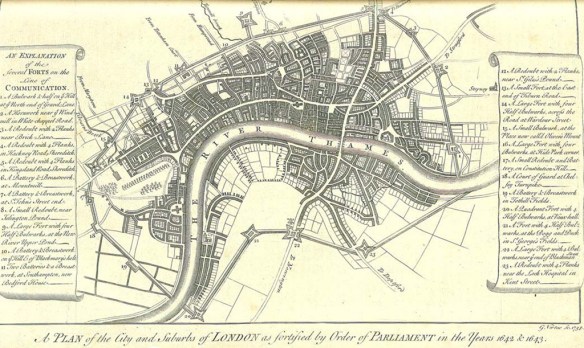
During the middle decades of the seventeenth century, Londoners experienced civil war, revolution, plague and fire. Unsurprisingly, this period looms large in accounts of the early modern capital. It often features as the start or end point of social histories, or is studied alone (often in minute detail) by political historians. Yet why is this? Was this a turning point in the history of early modern London? Or does this periodisation have more to do with the nature of divisions between historians than a marked break in longer patterns of continuity and change between 1500 and 1800?

vertue's_1738_plan_of_the_london_lines_of_communication

My own interest is in understanding how social and economic developments in early modern London contributed to (and were in turn shaped by) the political upheavals of the 1640s and 1650s. Since the work of Keith Lindley and Robert Brenner in the 1990s, there’s been relatively little written on the social history of revolutionary London and its connections to political conflict. Yet I think there’s a growing realisation that there’s a lot to be said on this topic.

We know London was central to, and acutely experienced, the social and economic changes of the early modern period. We also know that London was at the heart of the political conflicts of the mid-seventeenth century. Not only was Westminster obviously central, but the City of London and its suburbs were also important sites of political contest and mobilisation. Yet we know less about how these two things connected, and the relationship between long-term changes in London and the political events of the period. Continue reading

Histories of London, c.1650-1800: Institutions, Work, Poverty and Crime

[In this post, Brodie Waddell sets out another response to the issues raised in the opening post on Integrating Histories of London.]

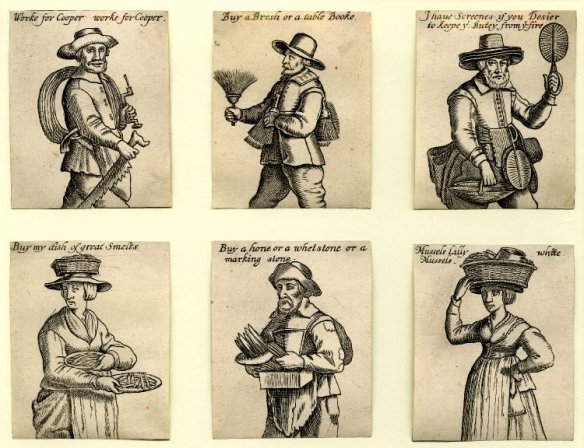
The history of early modern London cannot be written without the people who are often neglected in sweeping national histories. Whereas monarchs and politicians still receive the most attention in conventional textbooks of early modern history, it is the merchants, shopkeepers, craftspeople, criminals and beggars who populate the pages of metropolitan histories, especially those that focus on the late seventeenth and eighteenth centuries.

So, why were these ‘ordinary’ – or even ‘marginalised’ – people so important to development of London at this time?

AN00051201_001_l

Six people one might encounter on the streets of London: British Library.

As a historian whose research has wandered recklessly around early modern England, I have no unique expertise on the capital. Yet, the richness and accessibility of the sources held at the London Metropolitan Archives and freely available online at London Lives has encouraged me to spend more time working on the city’s history since arriving at Birkbeck in 2012. More importantly, working here has meant that I’ve benefitted hugely from the chance to learn from nearby colleagues who know much more about this field than I do. I’ve been able to read or hear a wonderful range of London-focused scholarship through conferences, seminars and supervisions as well as publications. Specifically, the impressions I set out below emerge mostly from what I have gleaned from Vanessa Harding, Jerry White, Mike Berlin, Matthew Davis, Sarah Birt, Charlie Taverner, Anna Cusack, Laura Gowing, Jenny Bishop, Richard Bell and the others at the workshop.

To my mind, if we are trying to understand how people outside the ruling civic elite fit into the ‘grand narratives’ of the metropolis, what we are really talking about is agency and structure. The question of the balance between agency and structure is one that features every historical subfield, but I think it has been especially important to recent work on London.

Before going any further, I know that this terminology is rather old-fashioned and simplistic, but simplicity can be useful when thinking about grand narratives. Moreover, obviously neither agency nor structure were all encompassing. The balance between them is always situational and historically contingent. This is precisely what makes it an interesting question for historians.

How much agency did different people have in ‘late’ early modern London (c.1650-1800)? Continue reading

Histories of London, c.1500-1650: Space, Narratives and Numbers

[Dr Jennifer Bishop is a College Lecturer at Peterhouse College, Cambridge. In this post, she outlines her response to the questions raised in the opening post on Integrating Histories of London, focusing on the sixteenth and early seventeenth centuries.]

‘She is certainly a great world, there are so many worlds in her’ (Donald Lupton, 1632).

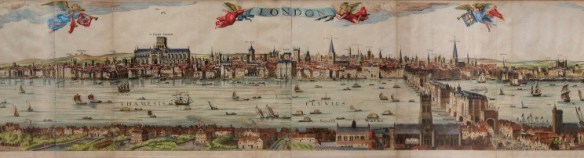
Donald Lupton’s description of London in 1632 neatly encapsulates our view of the early modern city. London was, and indeed is, composed of multiple overlapping and interlocking “worlds” – and the task of the historian is to explore these worlds, and to try and understand the relationships between them. It is perhaps no surprise that many studies of the city have been strongly influenced by the ‘spatial turn’. This is evident in the digital mapping projects of recent years – the Map of Early Modern London being the best example – and also a number of microhistorical studies of the individual streets, parishes, suburbs, and landmarks that made up the physical city.

Vesscher-Panorama-1-001-1024x202

Visscher’s view of London, 1616

But equally as important as understanding London’s topography, the spatial turn has also directed our attention towards how ordinary people understood and navigated the early modern city. Historians now ask how and where different groups, individuals, and communities lived, worked, and socialised; which areas of the city were frequented by men and which were associated with women; which were popular with migrants and which were open only to citizens. We have a greater appreciation of the character and reputation of different spaces, and by asking how these changed over time (not only over the years, but also how they could also change simply in the transition from day to night), we can see a ‘microcosm’ of the changing urban world. Overall, by seeking to understand how disparate networks of people joined up and communicated across the metropolis, we have been able to recover some of the various overlapping and interlocking configurations that made up the early modern city. This approach to the history of London has resulted in some incredibly rich scholarship, with a special attention to minority and marginal groups, and a strong sense of London’s diversity and plurality as one of its key defining features.

The question we set out to discuss in this workshop was, how can we connect these diverse histories and stories together? Can we join up the histories of different groups and minorities in a meaningful way over the long early modern period, bringing them into dialogue over time as well as across space? In short, can we bring London’s multiple ‘worlds within worlds’ into a coherent, meaningful, whole? Continue reading

Integrating Histories of London, c.1500-1800

[Dom Birch, Esther Brot and Jonah Miller are doctoral students at King’s College London. In this post, they set out why and how they think the diverse histories of early modern London can be integrated with each other and with larger national narratives, reflecting on a workshop on this topic that they ran in autumn 2018.]

Between 1500 and 1800 the city of London changed—a lot. It was over this period that we begin to see the development of a London that we might recognise. By the end of the eighteenth century the city had many of its modern-day hallmarks: political power was linked to the metropolis, it was a driver of fashion and popular culture, it was a centre of a globalised world, and the city had grown to include what would have previously been considered its suburbs. The existential changes in London’s nature, and the way in which the history of London can be linked to the history of England, make it a compelling place to study. Understanding early modern London means understanding how it transformed from its medieval origins to an archetype of modernity. This field of study has, however, faced several difficulties recently. So, with this in mind, in October we brought together a group of historians whose work on London we felt is particularly innovative to talk through what, exactly, early modern London was.

The idea for this workshop originally came from the recognition that we were all working on the history of London in some capacity. This may sound obvious but as historians we’re often trained to think of the work we do in certain ways. We all think of ourselves as social historians and within that label as social scientists (Dom), historians of government (Esther) or cultural historians (Jonah). Despite these different fields of study, we were all researching groups of people who lived in London and would often find ourselves together in the London Metropolitan Archives—using sources from London. It then became apparent that this wasn’t an issue faced by us alone. There are plenty of historians working either in or on London who wouldn’t see themselves as historians of London. They might instead have as a primary motivator a historical theme (religious history) or a group of people (foodsellers or guild members). We thought it would be worthwhile to bring these different perspectives together for a discussion on early modern London more generally, and to ask what different focuses and methods could bring to the study of the city.

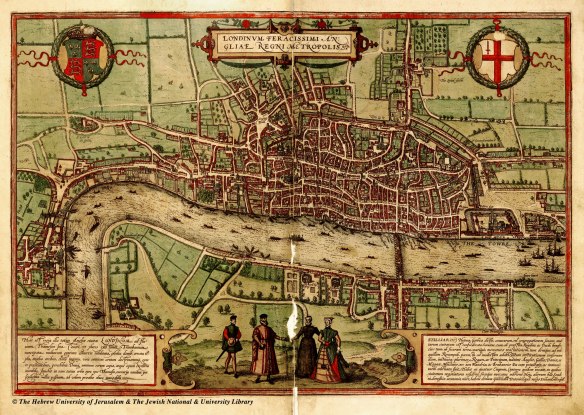
Braun and Hogenberg (1560-72) London map

London in the late sixteenth century: too big for one historian?

As we started to plan the workshop it became obvious that there are many issues in the history of London that can’t be solved by one single historian, or a small group of historians. Continue reading