Memorial and history, Part 4: in which several fights break out and a man is murdered in the Solomon Islands

Laura Sangha

This is the fourth post in a series of posts relating to Exeter’s martyrs memorial, the others are on the following:

harry hems 1     ramm-04

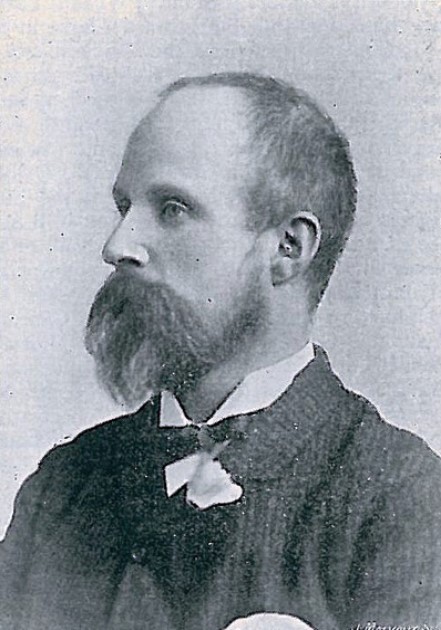
Today’s question is – what do we know about the creation and placing of Exeter’s martyr monument? The endlessly informative Exeter memories website furnished me with more details about the city’s own specimen. Funded by public conscription, it was designed by Exeter’s Harry Hems (above), a London born master sculptor and wood carver, who made Exeter his home. Continue reading

Memorial and history, Part 3: in which Mary Beard sits on a bench

Laura Sangha

This is the third in a series of posts relating to Exeter’s martyr memorial. The first post, contains the details of the martyrs themselves, the second, is on John Foxe’s Actes and Monuments.

What I really wanted to know about Exeter’s martyr monument, was who paid for and created it – when was it erected, how and why? A third plaque on the memorial yielded some information:

To the glory of God & in honour of his faithful witnesses who near this spot yielded their bodies to be burned for love to Christ and in vindication of the principles of the Protestant Reformation this monument was erected by public subscription AD 1909. They being dead yet speak.

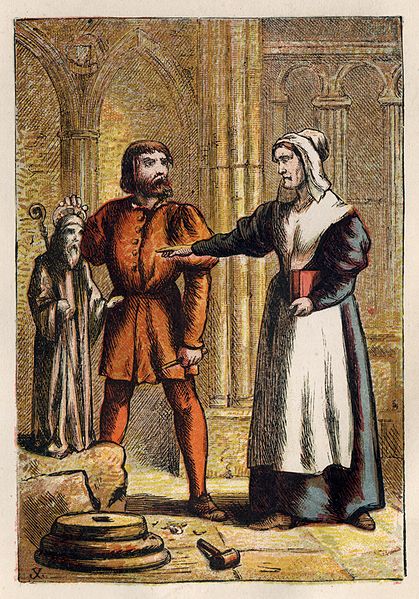
Thus the obelisk dates from the twentieth-century, which makes sense – the English Reformation was profoundly iconoclastic and it is hard to imagine money being spent on erecting monuments in an age when destruction of imagery was a mark of Protestant identity. In fact the image of Agnes Prest from the 1887 edition of Foxe that I mentioned prest and stonemasonin my previous post supports just this point. It depicts a visit that Prest paid to Exeter Cathedral, where she met a ‘cunning’ Dutch craftsmen who was apparently repairing the  images and sculptures that had been disfigured during the previous, iconoclastic reign of Edward VI. Prest supposedly said to the Dutchman ‘what a mad man art thou… to make them new noses, which within a few dayes shall all lose their heades’. In response to this rather prophetic prediction of further reform, the stonemason replied with a well thought out theological argument: ‘Thou art a whore!’. Quick as a flash, Prest replied ‘Nay, thy Images are whores, and thou art a whore hunter: for doth not God say you goe a whoring after straunge Gods, figures of your owne making?’ Continue reading

Memorial and history, Part 2: in which John Foxe reveals his sources

Laura Sangha

This is the second of a series of posts on issues relating to Exeter’s martyr memorial. The first post discusses the details of the martyrs themselves.

A monumental achievement

Foxe’s [?] monumental [?] achievement.

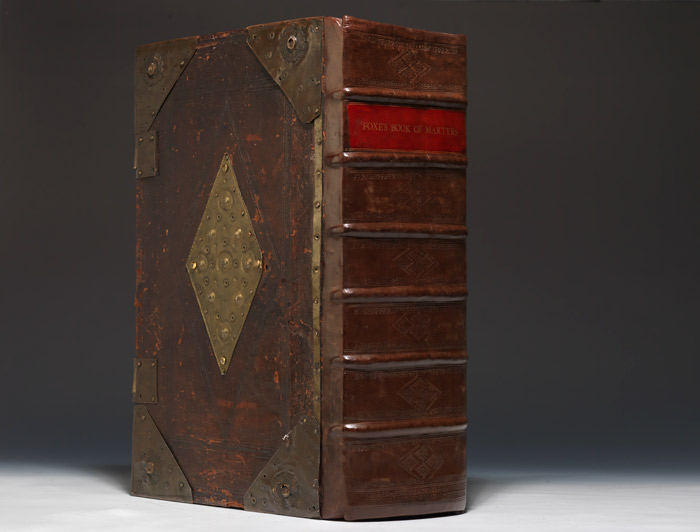
The information about Exeter’s martyrs that I related in yesterday’s post was taken from John Foxe’s Actes and Monuments, popularly known as the ‘Book of Martyrs’. Actes was first published in 1563, five years into the reign of Elizabeth I. It is a work of Protestant history and martyrology, mainly consisting of a polemical account of the sufferings of evangelicals under the Catholic Church.

I’ve previously discussed images of martyrdom on the monster, in this post I am more concerned with the text as a history of the ‘true’ Church. Continue reading

Memorial and history, Part I: in which two people meet a terrible end

Laura Sangha

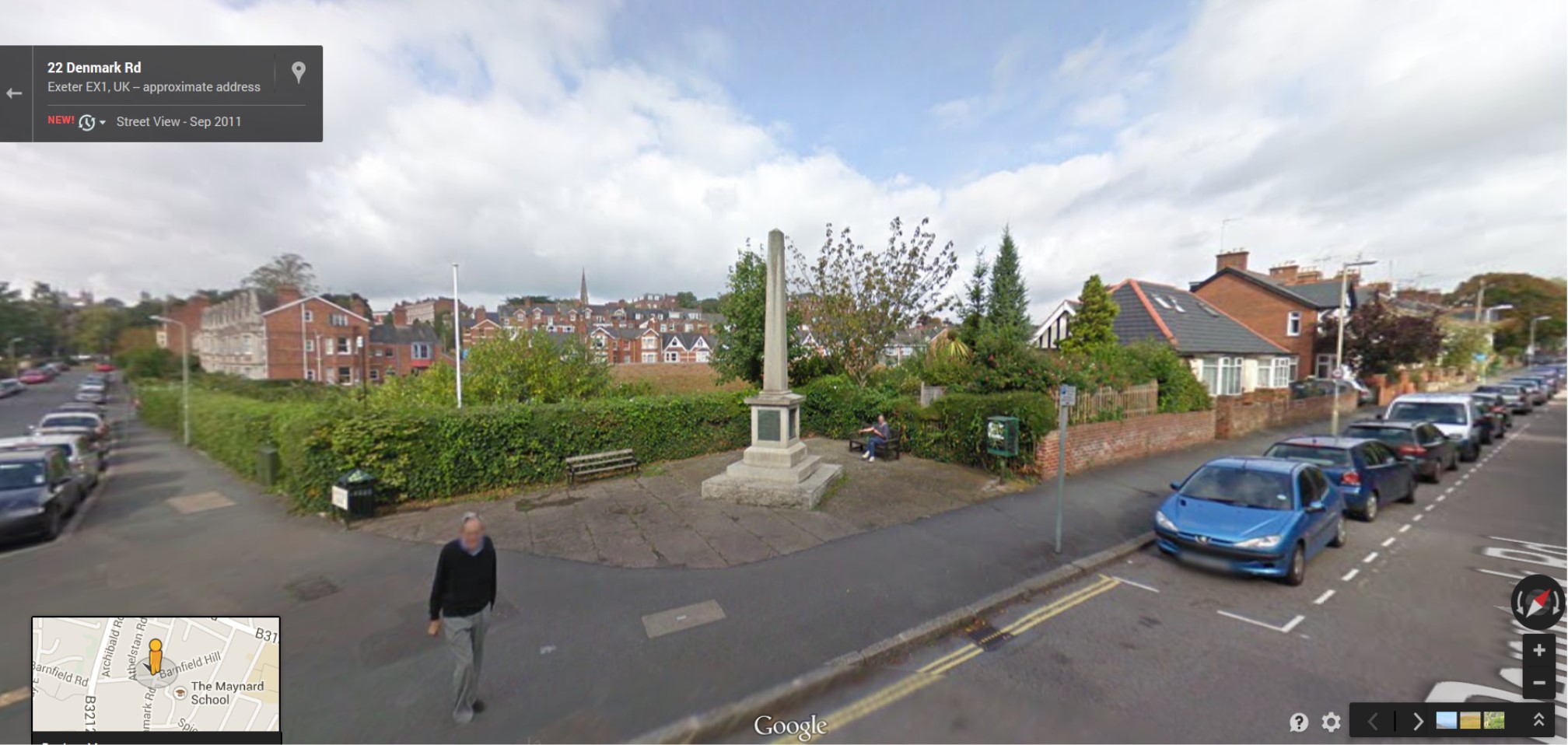
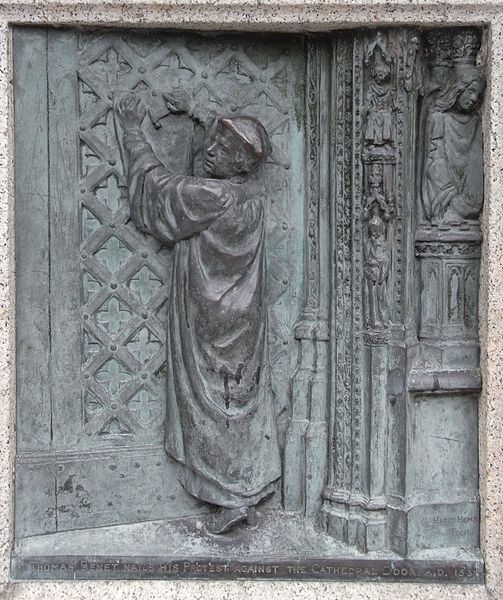
googlemapsA recent trip to the pub took me into a new part of Exeter, and on my way there I stumbled across a fascinating snapshot of its history. At the corner of Barnfield and Denmark roads I came to a memorial in the form of an obelisk of Dartmoor granite, with four bronze panels around its base. I assumed it was a twentieth-century war memorial, and went to have a closer look at the bronze reliefs – hey, I’m a historian, my profession compels me to! On examination, I was surprised to discover not a weary line thomas benet bronzeof soldiers in metal helmets, but instead what appeared to be a monk fixing a notice to a wooden door, and I didn’t need the inscription to tell me the door belonged to Exeter Cathedral – an angel from the first tier of sculptures on the West front is clearly depicted on the right hand side. What’s more, a second bronze showed a women chained to a post, clearly suffering a fiery death at the hands of the authorities. Reading the inscriptions, I realised that I had chanced upon a memorial to two sixteenth-century Protestant martyrs who had met their deaths in Exeter.

Firing up the computer on my return home, I soon disappeared down the rabbit hole of the city’s history and our memories, stories about and uses of our past. My initial idea for a brief post mutated into a series of linked musings on the tangled threads of the regional and national history, in all its venerable and unsavoury glory. I’ll be publishing one each day this week. Today I start with the story of the two martyrs commemorated on the memorial, Thomas Benet and Agnes Prest. Continue reading

Samuel Clarke’s Martyrology: images of religious violence

Laura Sangha

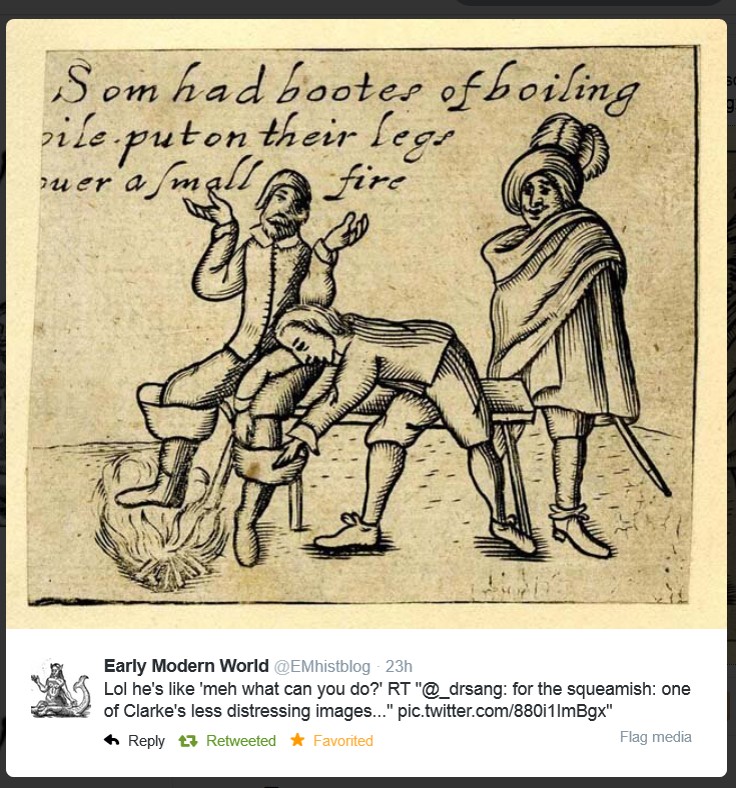
On Friday, one of my fellow tweeters, Early Modern World @EMhistblog, retweeted an image from a 1651 martyrology that I had originally posted last year. Here’s the tweet:

Original tweetIt proved popular, so I wanted to post the full details of the original work and author here (though I make no claim to be an expert on early modern martyrologies). Click on images for enlargements.

Clarke’s Martyrology

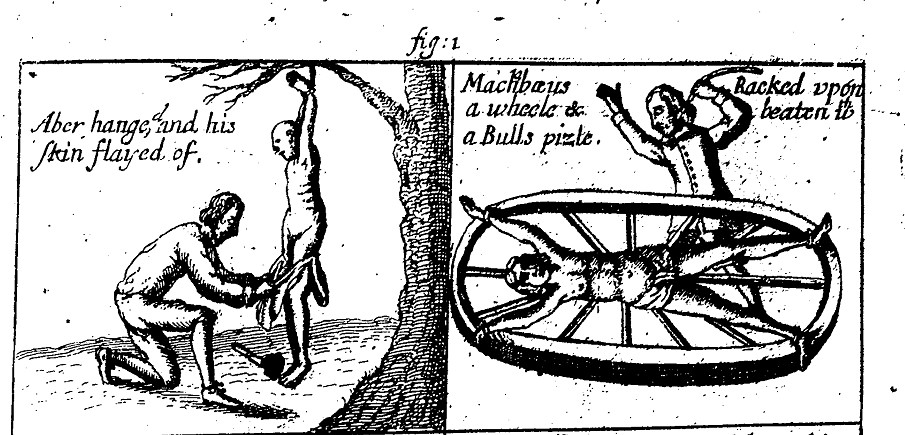
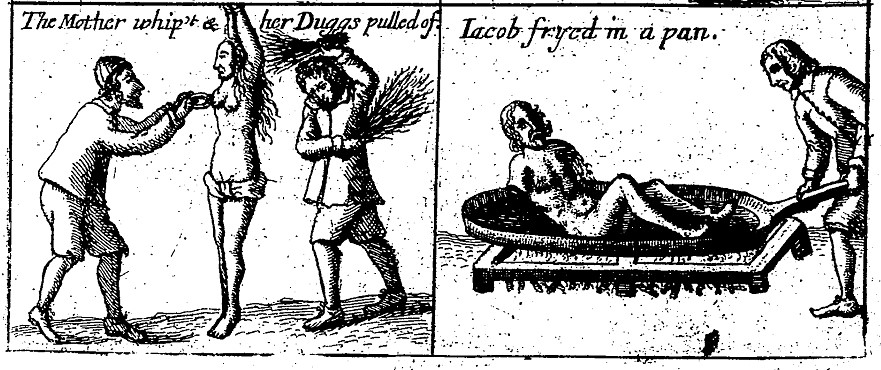
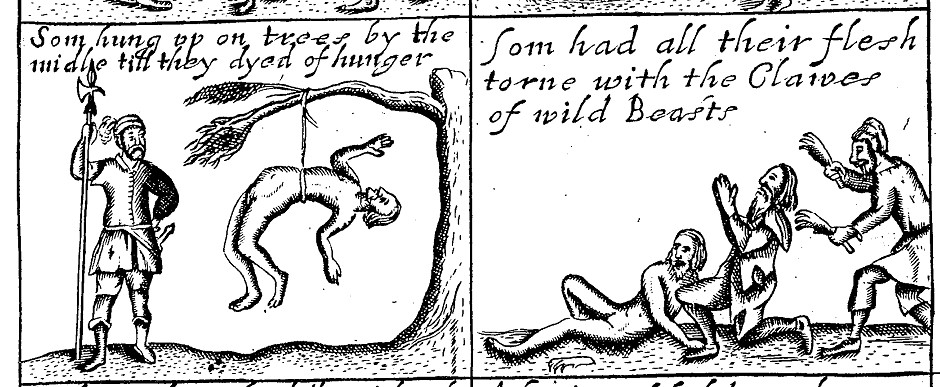
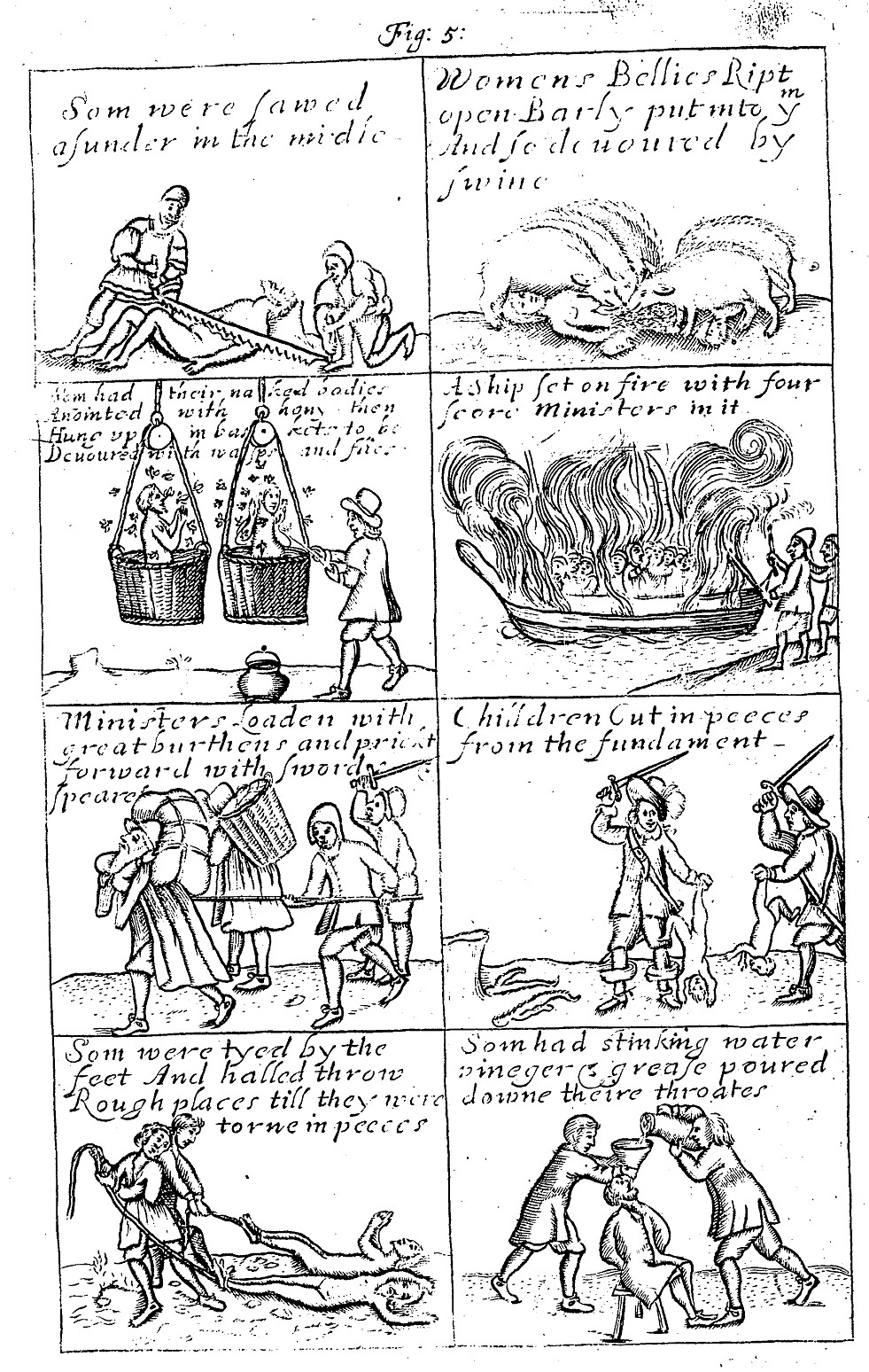
The image is one of many graphic illustrations in Samuel Clarke, A generall martyrologie containing a collection of all the greatest persecutions which have befallen the church of Christ from the creation to our present times (London, 1651), Wing / C4513. Clarke’s compilation was first published in 1651. A second edition in 1660, and a third in 1677 suggests that the work was popular. The Martyrology is almost entirely derived from John Foxe’s Actes and Monuments (1563). Indeed, in the preface to the third edition, Clarke defended himself against the claim that his work was a superfluous repetition of Foxe’s monumental work – Clark argued that Foxe’s was a general history of the church, not just a martyrology, and he also claimed that he had ‘turned over many other Authors’ to supply what was wanting in ‘Master Fox’ – although a cursory perusal of the work suggests this claim is false. Probably closer to the truth was Clarke’s assertion that:

in these times many want money to buy, and leasure to read larger Volumes, who yet may find both money, and time to purchase, and to peruse so small a Volume as this is. (Preface, A2r).

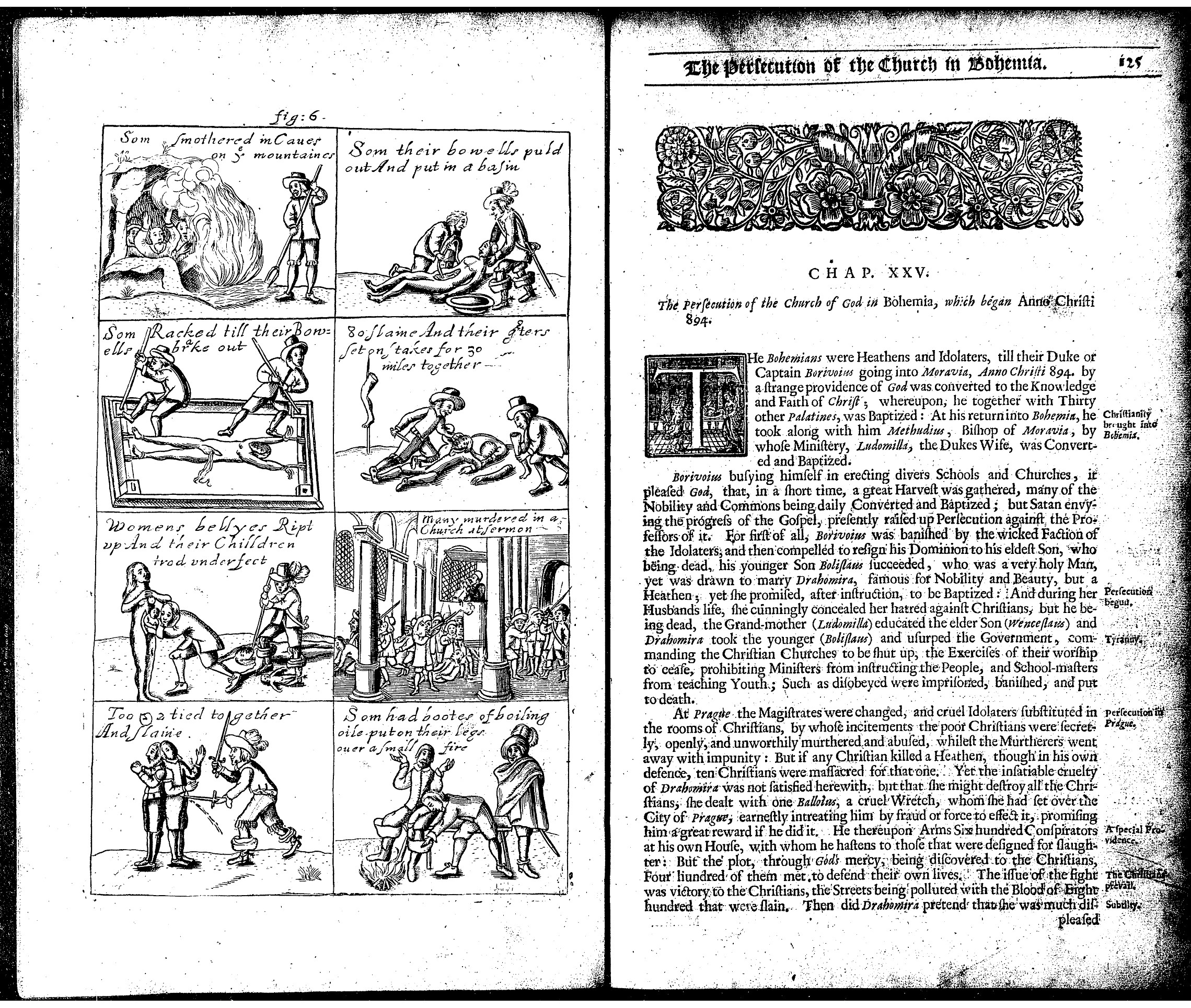
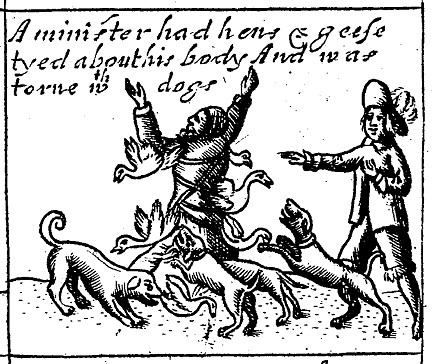
Though even this should be taken with a pinch of salt, because later editions of Clarke would have been reasonably expensive – the third edition was more than 700 pages long; and it contained many illustrations, making it an object of prestige as well as a marker of preferred churchmanship. That said, the images are certainly cruder and less sophisticated than in the large, expensive editions of Foxe. The original image that I tweeted can be seen in context here, bottom right (p. 125, 1677 edn.)Original pic in contextThere were twelve of these plates in the book, each depicting the sufferings of the martyrs in extremely graphic detail. The reader can gaze upon the brutality of religious persecution and be struck by the ingenious capacity of humans to inflict ever more horrible suffering upon their fellows. The enormous variety of types of torture, and the inventiveness of punishments is constantly surprising. Page 18Page 18bpage 52 hung and animal clawsFor the modern viewer, the crude images probably provoke a variety of conflicting emotions. Organised in (what looks to us) a comic book style, the presentation, and the poses and expressions of the victims and torturers often seem terribly mismatched against the outrageous violence that the images depict. The result is both shocking, but at the same time it can also be humorous – as with the nonchalant chap in the ‘boiling oil’ boots. We are used to a extraordinary level of realism in modern media: high definition reproductions of crime scenes, the aftermath of terrorist attacks, the devastating effects of modern warfare. Early modern efforts can seem basic, stiff and even silly, by comparison.

page 74 full page

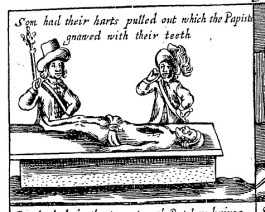
ATROCITY PROPAGANDApage 242 papist hearts


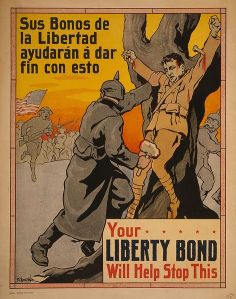
The images also provoke a sense of disbelief – we would prefer to think that this is religious polemic, on a par with the atrocity propaganda of the First World War. Surely no Catholics actually ate a Protestant heart, and the Hun didn’t really crucify a Canadian soldier in Belgium? Though we accept terrible violence happens, the presumption is often that these acts have been exaggerated for greater effect – though countless atrocities throughout history offer plenty of evidence to the contrary.

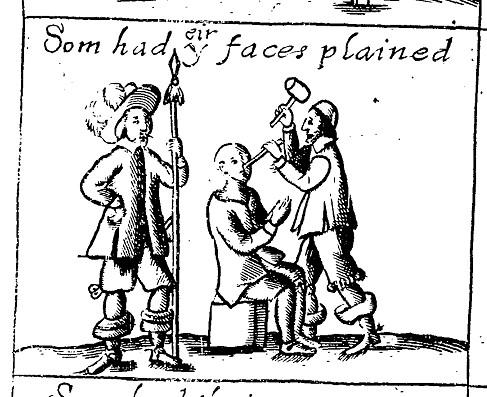
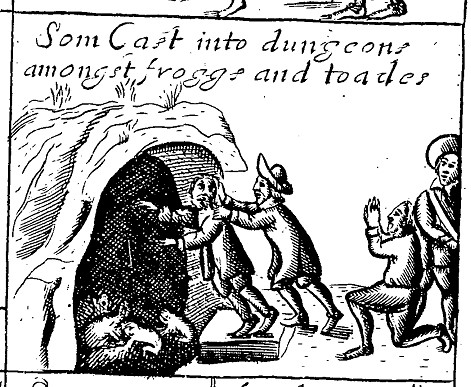
At other times, the violence is so absurd or extreme that humour is almost a logical response:

page 220 face plainedIt’s not really possible to ‘plain’ someone’s face off is it?

page 220 frogs and toadsBeing thrown in a cave with some toads and frogs hardly seems comparable to some of these other tortures, does it?

page 180 geeseHow long did it take them to tie those geese and hens on?

Undoubtedly martyrologies are a form of religious polemic and we shouldn’t assume that the atrocities they depict happened. As with all source material we must recognise the cultural dynamics that have shaped the content and presentation of the material. But of course we mustn’t assume that the viewing experience was the same for the early modern person. Early modernists were used to sub-standard or less accomplished woodcuts, and these visuals would presumably have represented the events they depicted to their imagination as effectively as a photograph does to us today. Early modern readings of these images would also have been informed by their own visceral experiences of religious violence – in the mid-seventeenth century, England had suffered about a 3.7 percent loss of population during the Civil Wars (more than during World War I, around 2 percent) and religious violence was part of everyday existence. Thus in their historical context, these images would perhaps have been just as affecting as Azadeh Akhlaghi recreations of Iran’s most notorious murders are to us today, though in the future they may also be seen as amateurish and slightly absurd.

The Author[1]

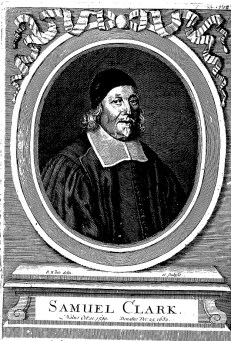
Samuel Clarke (1599-1682) was born in Sam Clarke headshotWarwickshire, the son of a vicar, and he grew up in a notably Puritan parish. He was well educated – first at Coventry school, and then Emmanuel College, Cambridge. In February 1626 he married Katherine Overton, with whom he had six children.

Following his education Clarke had a successful career as a clergyman. He was constantly in trouble for his nonconformity (his refusal to wear the surplice and omitting some of the ceremonies in the Book of Common Prayer), although he was pleased with the reformation that he achieved at Alcester in the 1630s – according to Clarke, as a result of his ministry the town ‘which before was called drunken Alcester, was now exemplary and eminent for religion’.[2]

Clarke campaigned against Laudian innovations in Church government and theology, and witnessed the suffering that the Civil War bought to the Midlands in the 1640s. In 1643 he moved to London, becoming minister at St Benet Fink and getting involved in London Presbyterian circles. In the 1650s he was a more moderate voice, prepared to work with the Cromwellian regime, and he initially welcomed the restoration of the monarchy in 1660. However, the religious settlement of 1662 was too conformist for Clarke’s tastes, and he was ejected from his position in the Church, along with two of his sons.

Excluded from the Church, Clarke then dedicated his time to writing and publishing works that would promote his religious beliefs, including A Generall martyrologie. Clarke specialised in compiling biographies, gathering his material from already published works and the manuscript writings of other godly ministers. His other works included: The Lives of Thirty-Two English Divines, appended to the third edition of A Generall Martyrology (1677) and Lives of Sundry Eminent Persons in this Later Age (1683).

[1] The information about Samuel Clarke is from: Ann Hughes, ‘S. Clarke (1599-1682)’, Oxford Dictionary of National Biography (OUP, 2004); online edn. May 2007 [http://0-www.oxforddnb.com.lib.exeter.ac.uk/view/article/5528, accessed 12 April 2014].

[2] S. Clark [S. Clarke], The lives of sundry eminent persons in this later age (1683), quoted in Hughes, ‘S. Clark (1599-1682)’.

I consulted all three editions of Clarke on Early English Books Online.

No place like home: Seventeenth-Century Portishead

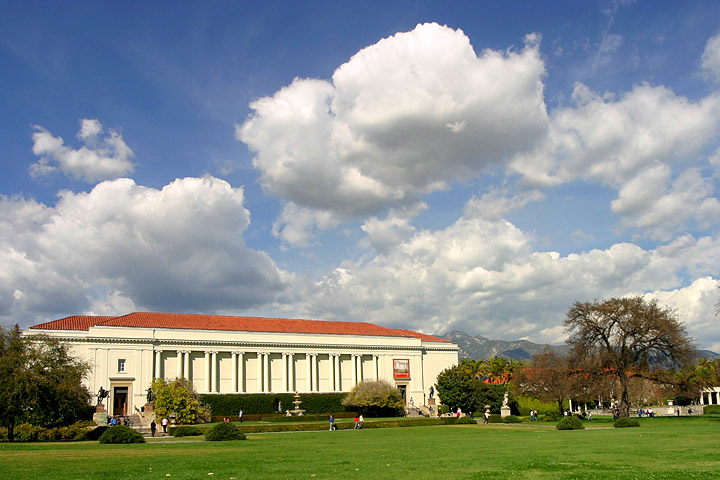
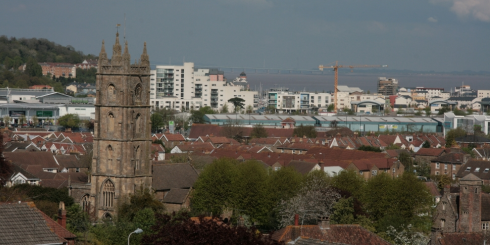
I suppose it is natural when you are on the other side of the world to turn your thoughts towards home. And so it is that on a trip to the Huntington Library in California (to attend this ace conference on ballads) I’ve felt inspired to write a post about my home town: Portishead in North Somerset.

The Huntington: A long way from home...

The Huntington: A long way from home…

One of the areas I focused on in researching alehouses for my forthcoming book was the county of Somerset, which has excellent quarter sessions records. Of course, as I scoured the archive looking for evidence of alehouse regulation and instances of good fellowship, I kept an eye out for references to my home town. I didn’t find much – it was no more than a small village before the Victorians adopted it as a seaside resort in the nineteenth century – but there were a few cases I came across which suggest something of the character of the place and its inhabitants. They don’t necessarily portray my ancestors in a positive light.

Home sweet home

Home sweet home

The first thing I discovered was the following order, made by the county magistrates, at a meeting of the Somerset quarter sessions in Wells, in 1656:

‘Whereas one Susan Gulston a poore cripple is lately come into the parish of Portishead in this County; and itt appearing that shee was last settled att Takeley in the County of Essex, this Court uppon complaint of the parishioners of Portishead doth order: That the said Susan bee retorned from parish to parish by the officers of each parish to Takeley aforesaid there to bee provided for according to lawe.’[1]

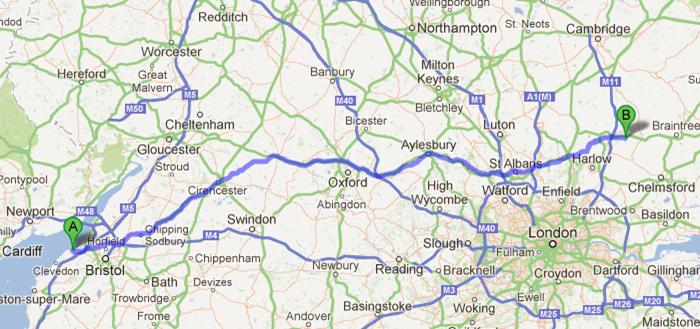
Basically, a poor crippled woman had turned up in the parish, and the locals did not want to be responsible for paying her poor relief. So they had asked that she be escorted from parish border to parish border all the way back to her home parish some 154 miles away to claim relief. That’s 51 hours of walking, according to google maps (assuming she stuck to the most direct A roads). That’s some walk, especially given that this poor woman was disabled:

The Long Walk Home

The Long Walk Home


The case doesn’t, I think, reflect particularly well on my Portishead forebears – but it is not by any means an untypical response to a poor stranger turning up in an early modern parish. As Brodie’s recent post on a 101-year old vagrant woman attests, the world’s first nation-wide welfare system was not necessarily a deeply compassionate one.

The next reference I found came from a meeting of the quarter sessions at Taunton in 1630. This time, the county magistrates were issuing an order that:

Fifty pounds be raised by a County rate and the money arising therefrom to be paid unto Rice Davies and Richard Cole, Esquires, to be by them imployed for and towards the transportinge of a greate number of Irish people from the parishe of Portishead.[2]

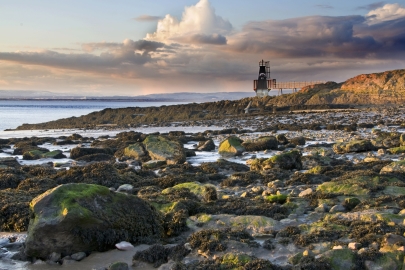
The precise details of what was going on here are not entirely clear, but it seems once again like a case of a cold Portishead welcome for outsiders – perhaps a group of Irish migrants had landed a ship at the beach in the parish, only to be apprehended by the locals who then asked for assistance to fund sending them straight back.

A stony welcome at Portishead beach?

A stony welcome at Portishead beach?

I was starting to fear that the only imprint left by my ancestral townsfellows on the historical records of the early modern period were a few cases of a pronounced, if not unusual for the period, lack of hospitality and compassion to outsiders – ‘local xenophobia’ if you will.[3]

Then I recently came across another reference rather more to my liking. In 1637, the churchwardens of Portishead – a local voluntary office whose duties included maintaining peace and good order in the community – were reported to their superiors for their tolerance of:

‘fives playeinge [an early racket sport like squash], dauncing, Cudgill playeinge [an early form of cricket perhaps?], and fightinge in the churchyard there’.[4]

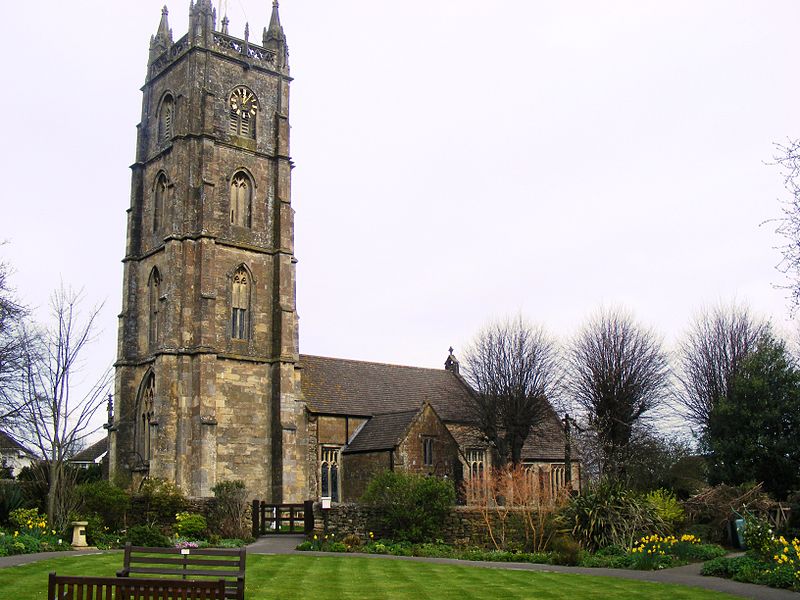
Since the Reformation, church authorities had worked hard to banish games and pastimes from taking place in the church grounds, as they sought to establish clear lines between the ‘sacred’ and the ‘profane’, and increase a sense of sober reverence in and around the church itself. But here were the parishioners of Portishead, having a merry old time in the churchyard, whilst local officials willingly turned a blind eye to this defiance of authority.

Fun and games at the parish church - now Grade I listed: http://en.wikipedia.org/wiki/Church_of_St_Peter,_Portishead

Fun and games at the parish church – now Grade I listed: http://en.wikipedia.org/wiki/Church_of_St_Peter,_Portishead

As Chris Marsh puts it, such ‘inveterate traditionalism’ was probably unusual by this date and these kind of activities had been largely suppressed. So here at last was something for me to hold on to: a sense of pride that Portishead had, albeit in a small way, played its part in the West Country’s long tradition of non-conformity and libertarianism. Even better, it sounds as though an afternoon of cricket, dancing and fighting was as popular in seventeenth-century Portishead as it is today.

* If anyone else happens to have come across a reference to seventeenth-century Portishead, please share it in the comments section.

[1] Bates Harbin, E.H. (ed.), Quarter Sessions Records for the County of Somerset, Vol. III, Commonwealth, 1646-1660 (London: Somerset Record Society, 1907-12)

[2] Bates Harbin, E.H. (ed.), Quarter Sessions Records for the County of Somerset, Vol. II, Charles I, 1625-1639 (London: Somerset Record Society, 1907-12)

[3] For more on the ‘culture of local xenophobia’ in early modern England see: Keith Snell, ‘The Culture of Local Xenophobia’, Social History, 2003, 28 (1), pp.1-30.

[4] The case is from REED (Somerset, p.207), though I encountered it through reading Chris Marsh, Music and Society in Early Modern England (Cambridge, 2010), p.375.

Norwich Entertainments – Part VII: The science of music

Brodie Waddell

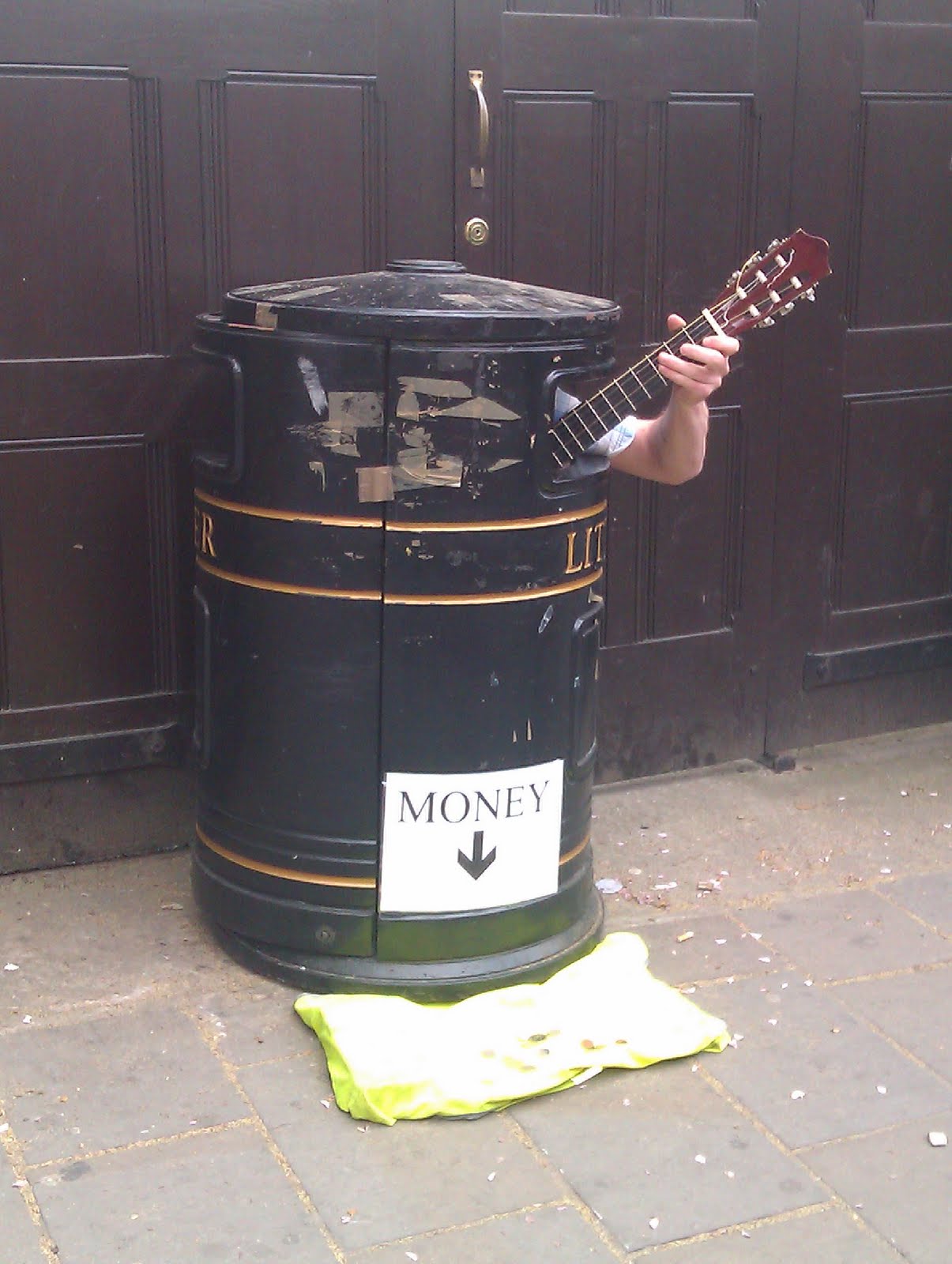
I live in Cambridge, a well-touristed little town, and when the sun is out the streets are Cambridge bin buskerawash with buskers. Some are quite good. For instance, there’s the chap who strums tunes on his guitar from inside a litter bin who always makes me chuckle even when his playing isn’t brilliant.

But there are also some that are decidedly displeasing to the ear. If only – I find myself muttering – these unmusical musicians had been sufficiently trained in the science of music. Continue reading

Mary Stevens, vagrant, age 101

Brodie Waddell

On the fourth of April 1692, the city fathers of Winchester assembled at one of their splendid quarterly courts to judge criminals, hear disputes and resolve pressing civic concerns. As was often the case, one of the poor souls who found herself standing before them was an alleged vagrant. The magistrates probably examined dozens of vagrants in a typical year, but this one was a bit different – she was over 100 years old.

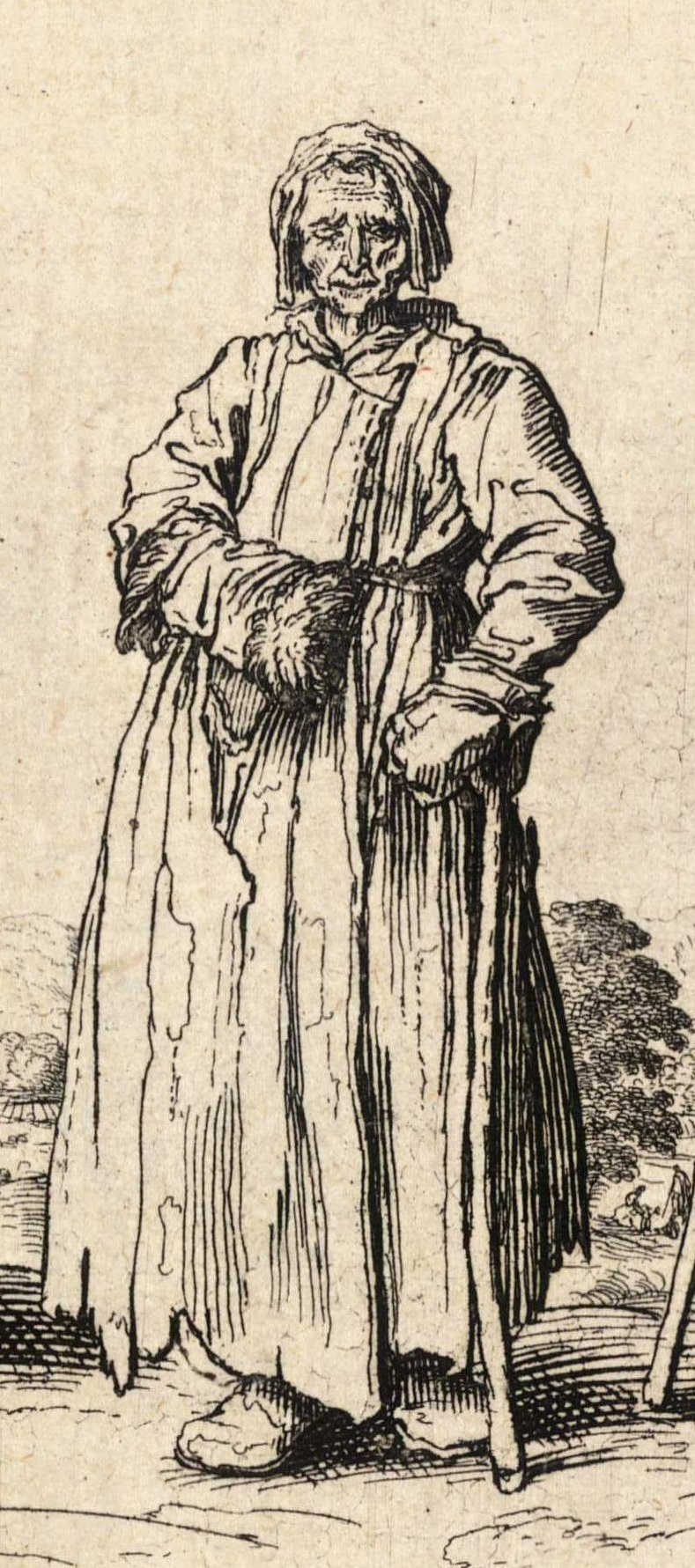
From Wenceslaus Hollar, ‘Men and Women Beggars’ (1625-77)

From Wenceslaus Hollar, ‘Men and Women Beggars’ (1625-77)

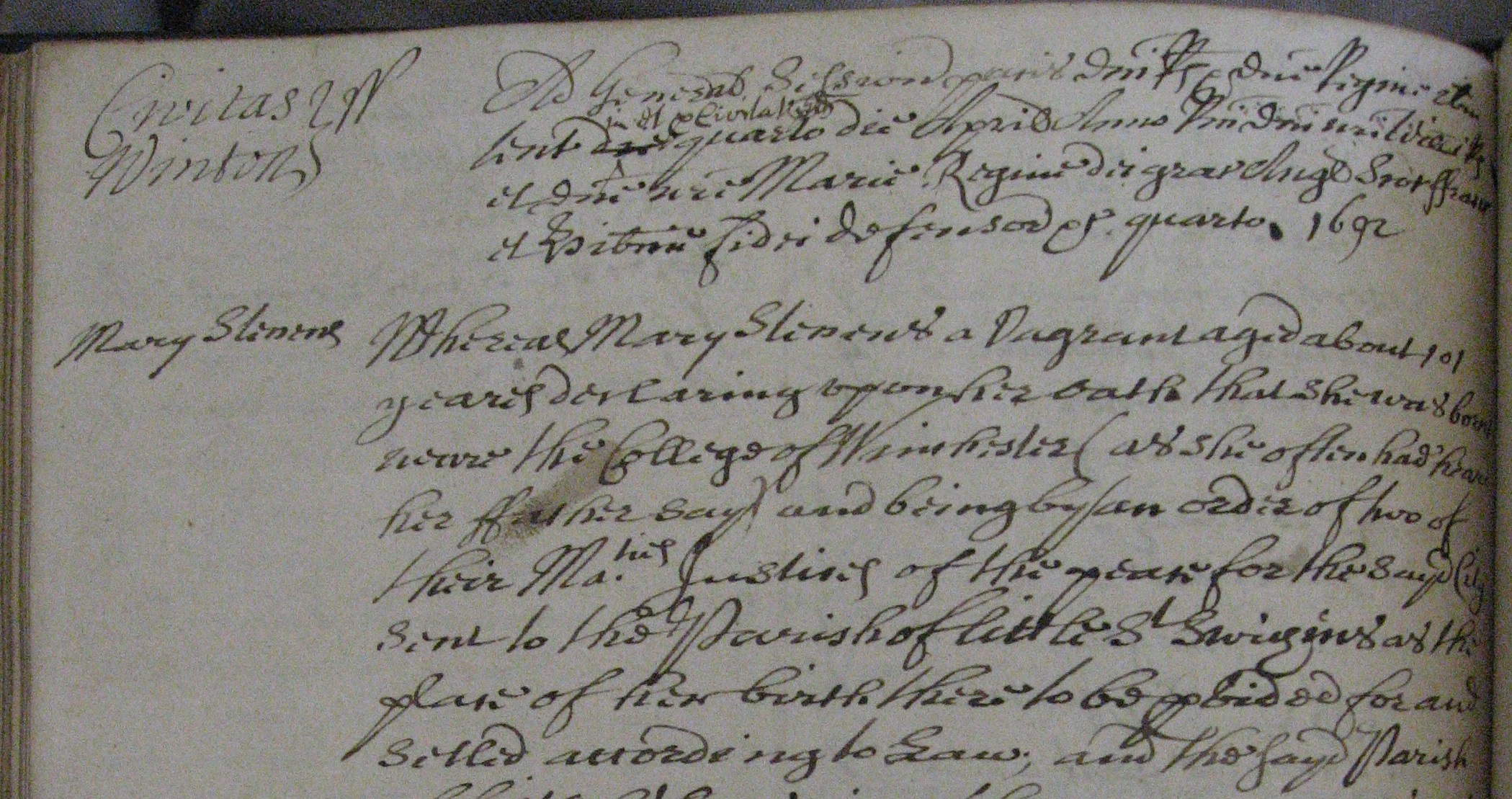
The clerk described her as ‘Mary Stevens a Vagrant aged about 101 yeares’ and noted that she swore ‘upon her oath that she was born neare the College of Winchester (as she often had heard her Father say)’.

In other words, this was a woman had apparently been born sometime around 1591, in the final decade of the reign of Elizabeth I, only a few streets away from the court where she now stood. She had outlived four monarchs and Oliver Cromwell. She had survived a decade of civil wars, another decade of republican rule, the country’s last great visitation of the plague, and then yet another revolution only three years earlier. And, given her description as a ‘vagrant’, she had probably spent many months or years on the road and seen the effects of these upheavals with her own eyes. Yet here she was, back in Winchester.

So why had she come back? The examination does not tell us. Perhaps she had come on her own accord. Or perhaps had been sent back from somewhere further afield, whether a neighbouring village or halfway across the country.

This wouldn’t have been unusual. Beggars and paupers were regularly seized by the constables and brought before the local Justices of the Peace. If they were accused of ‘vagrancy’ – a criminal offence usually defined as ‘wandering and begging’ – they could be punished by whipping or imprisonment in the local house of correction, before being expelled to their place of birth. In other cases, they might be defined as one of the ‘deserving poor’ and escape punishment, but still be sent to a ‘home’ they had long-since abandoned.

What we do know is that once Mary Stevens had arrived back in the area, she was then sent back and forth between the city of Winchester and the parish of ‘little St Swigins’ (St Swithuns) next to Winchester College, presumably just outside the city’s jurisdiction. Neither the city nor St Swithuns wanted to pay the cost of supporting her.

We can only hope that the new order issued by the Winchester authorities – sending her to St Swithuns ‘to be provided for and setled according to Law’ – was the conclusion of this petty jurisdictional argument. There she may have finally become a ‘lawfull & settled Inhabitant’.

With luck, Mary Stevens’ days of ‘wandering and begging’ were over. At age 101, she deserved a rest.

Mary Stevens, vagrant, age 101 IMG_3977Source
Hampshire Record Office, W/D3/1, fol. 79: examination of Mary Stevens, 4 April 1692

Some Further Reading
A.L. Beier, Masterless Men: The Vagrancy Problem in England 1560-1640 (1985)
Steve Hindle, On the Parish? The Micro-Politics of Poor Relief in Rural England, c. 1550-1750 (2004)
David Hitchcock (ed.), ‘Poverty and Mobility in England, 1600-1850’, Rural History, 24:1 (April 2013), special issue.
Tim Hitchcock, Down and Out in Eighteenth-Century London (2004)

The Tudor South West at Exeter’s Royal Albert Memorial Museum: Part 3 – Goldsmiths and urban redevelopment

Laura Sangha

This is the third post in a week long series about an exhibition at Exeter’s museum.

Today I want to talk filthy lucre. One of the things I learnt at the RAMM was that Exeter was an important centre for the goldsmith trade from as early as the thirteenth century, and this set off a train of thought that ended up in the surprisingly short-term world of town planning. I’ll try to recreate the train here.

The goldsmiths golden age

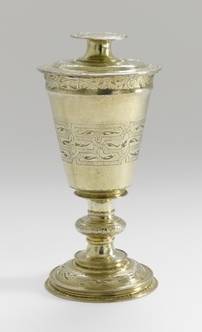
cup editMany of Exeter’s early modern artisans had their workshops in Goldsmith Street, an impressive thoroughfare that had a church at either end, almshouses, and a handsome hall used by the Company of Tailors. The exhibition houses a variety of related items, but the one that took my eye was a communion cup made by John Jones, one of the wealthiest goldsmiths in early modern Exeter. It is indicative of the fact that in this society, ‘fine art’ did not necessarily mean paintings (though there are some wonderful Holbeins in the exhibition, if that’s your thing). This cup, manufactured from silver with delicate engraving around the gilt-edged rim and foot, is extremely accomplished, in fact I was rather surprised by quite how fancy it was, given that this was over ten years into the Calvinist-inspired Elizabethan reign. The cup is still a thing of beauty, it could easily be a lot plainer and less ostentatious.

The uniqueness of the Church of England

My first thought was that perhaps this is proof that the Elizabethan Settlement acted as a ‘broad umbrella’, incorporating a number of different types of Protestants and a range of churchmanship? Christopher Haigh has argued that the adjustments made to the Prayer Book at the start of Elizabeth’s reign, particularly additions to the words used during the administration of the Lord’ Supper, deliberately introduced ambiguity into the ceremony, encouraging a range of opinion about what actually happened during the sacrament to survive or evolve. Diarmaid MacCulloch has argued along similar lines, suggesting that these changes were to bring the English Reformation in line with what was happening in the rest of Europe, particularly in Germany and Geneva. It is entirely plausible that the fancy cup could be a part of these processes – the use of a silver work of art, rather than a plain wooden cup, would have been deeply suggestive to a congregation versed in the ritual and symbolic importance of the liturgy.

The impact of the Reformation

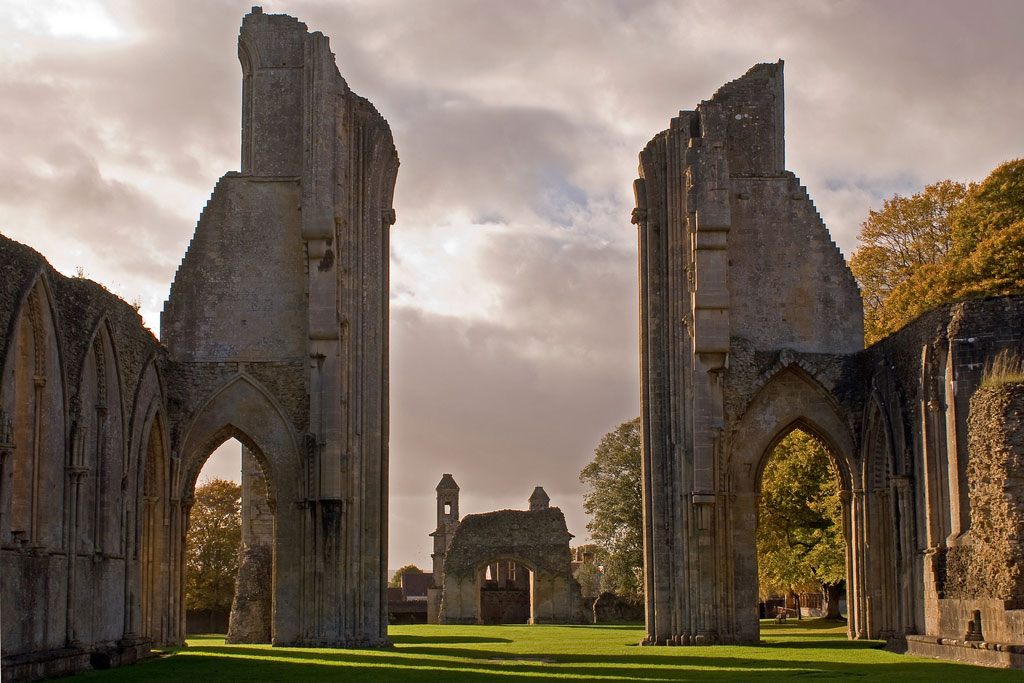
Beyond the sometimes obscure and Glastonbury2always complicated world of Reformation theology, the goldsmiths can also tell us much about the way in which changes in belief left a deep and enduring imprint on early modern society. For part of the reason for the continued success and prestige of the goldsmith community in Exeter was the dissolution of the City’s priory and friaries in 1538 and ongoing changes in religious policy that sent a lot of work their way. Historians have discovered that far from being isolated and cut off from their local communities, monasteries were in many ways integral to the social and economic functions of their local region, providing charity and education, and as producers and consumers. Following their abrupt closure, the shock waves were swift, reshaping the landscapes of local communities physically as well as spiritually. Large, imposing buildings were torn down or their functions changed, and Henry VIII quickly appropriated the vast riches of these institutions. This not only meant that the crown took control of church lands, they also seized their more moveable treasures. For the large group of goldsmiths in Exeter, this would have meant a very welcome steady source of work and income, as church plate was confiscated, some of which had to be melted down and reworked in a more acceptable shape, suitable to the new reformed liturgy. This was a lucrative business, as at each stage of the process the participants could take their cut, not to mention that the parishes had to buy new plate from the goldsmiths to replace the old throughout the Tudor era. Similar processes happened in parish churches – the RAMM’s information card tells us that the churchwarden accounts of St Petrock’s church in Exeter show that Jones was paid £1 15s 5d in 1572 for ‘converting’ this communion cup to make it suitable for Protestant worship. Thus the redistribution of wealth that the dissolution triggered is not restricted to the property market but bought benefits and profits to other groups that can easily be overlooked.

Heritage and Urban Planning

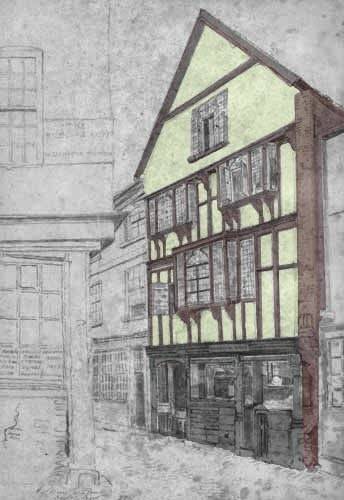
Exeter's Goldsmith's Street as it once was.

Exeter’s Goldsmith’s Street as it once was.

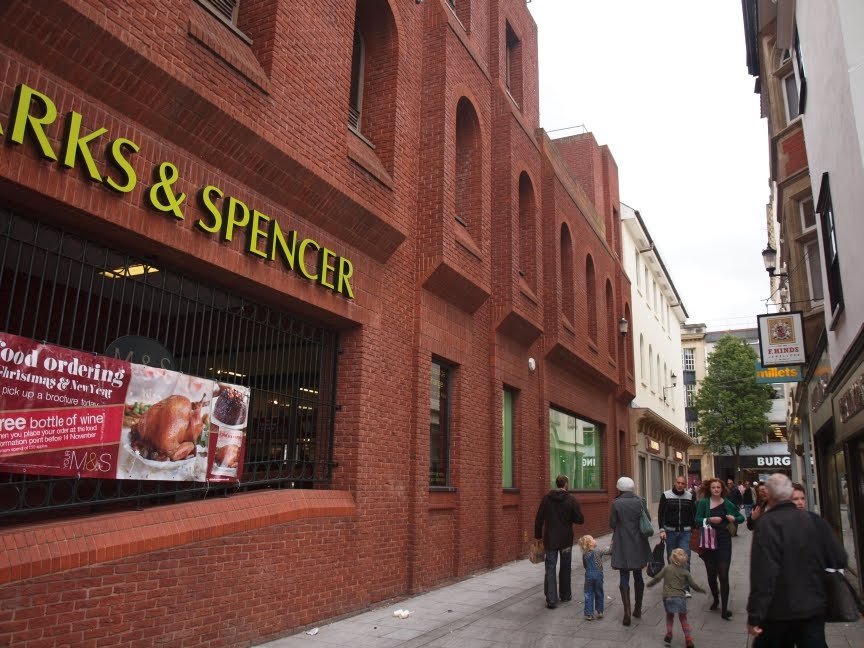
Finally, I was also interested to discover the fate of Goldsmith Street – the majority of the historic buildings there were demolished by the City Council in the 1970s to make way for redevelopment – today you will find Marks and Spencer and Millets where the goldsmiths used to ply their trade. Although one of our enduring national myths is that bombing raids in World War II were responsible for the destruction of much of our pre-modern urban architecture, more recently historians have begun to question this narrative. They have drawn attention to the fact that many cities were already undergoing a programme of redevelopment that included sweeping away inconveniently narrow medieval streets that were seen as obstacles to modern infrastructure and progress. Though the blitz did account for damage in many historic centres, our society’s own decision to prioritise the needs of economic and industrial advancement over our historic past may be the real explanation of urban change. A recent article on the BBC website revealed that this is even true of Coventry, which suffered devastating destruction in a terrible air raid in 1940, but where demolition had actually started before the war and continued after it. Exeter too suffered, in a severe raid in 1942 1,500 houses were destroyed, 2,700 were seriously damaged, and the Cathedral itself was hit, narrowly escaping the destruction of the nave. But much of value was left, though not all of it was subsequently retained – wiped away just as Goldsmiths was to make way for shopping centres and fast food joints.

The shock of the new

Exeter's Goldsmith Street now.

Exeter’s Goldsmith Street now.

In many ways modern redevelopment of our urban landscapes is now just as shocking and significant as the deliberate destruction of the monasteries and the properties of the parish churches in the 1500s, and increasingly we are now beginning to see it that way. Each was an iconoclastic act, signalling a rejection of and moving away from the past. They were both inspired by a shift in the prevailing ideology and the emergence of something new: Protestantism, capitalism, modernity. Each are shocking to us now because these acts display a complete lack of respect for the past and for beautiful treasures which can now never be recreated. Each seems to have been driven by ‘the authorities’ in the face of limited public resistance, and in many cases the public seem unable to prevent the change even where they disagree with it. Perhaps this can helps us to understand the ‘compliance conundrum’ – the question of why there was a relative lack of any widespread resistance to the dissolution, despite the commitment that most English women and men had previously shown to the institutions. Perhaps they felt as helpless as we do in the face of development, perhaps they also felt a sense in which they were swimming against the tide in trying to preserve the past or stand in the way of state sponsored change. Or perhaps they came to terms with and even embraced the changes, regretting the passing of the old ways and the destruction of beautiful things, but eager to make the most of the opportunities that the new future offered them, and keen to create new and more beautiful – but different – things to replace those that had been lost.

In tomorrow’s post: the Spanish Armada arrives off the south west coast.

‘West Country to World’s End: the South West in the Tudor Age’ runs until 2 March 2014 at Exeter’s Royal Albert Memorial Museum. You can find all the details about the museum, it’s opening times, it’s wonderful café and more here

The Tudor South West at Exeter’s Royal Albert Memorial Museum: Part 2 – Domestic Decoration

Laura Sangha

This is the second post in a week long series about an exhibition at Exeter’s museum. View the first post on a map of Exeter here.

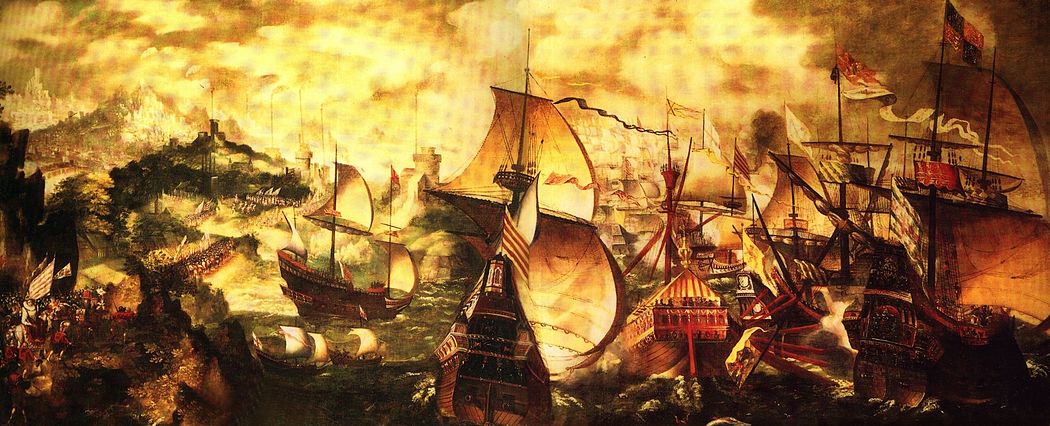
In early modern England the population was expanding incredibly rapidly and massive inflation led to the deterioration of living standards for many of the lower sorts. In contrast, changes in income tended to increase the number of middling groups in society, those merchants, artisans and gentry who benefited from rising property prices. In the west country, the prosperous cloth trade and various mercantile enterprises meant that the middling sorts had money to invest in the arts. You are perhaps already aware of the National Portrait Gallery’s current exhibition on Elizabeth I and her People, and if that is your sort of thing, there are lots of paintings at the RAMM too, including ‘The Armada Portrait’ of Elizabeth I; several from the school of Holbein; numerous works by Exeter’s most significant artist to date, the miniature-painter Nicholas Hilliard; and a huge piece that tells the story of the arrival of Armada in the South West in 1588. Click on images for enlargements.
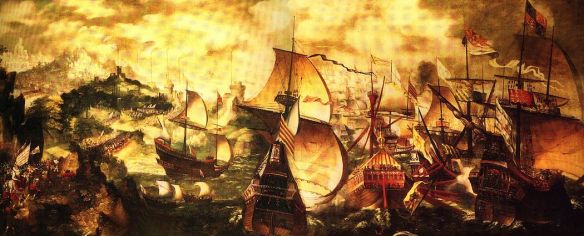
attributed hilliard armardaAll are deeply impressive, but the artistic accomplishment of the south west is also to be found in the crafts – in the production of jewellery, elaborate drinking vessels, church plate (more on that in tomorrow’s post), household utensils, decorative plasterwork, moveable furniture, architectural stone and woodwork, and fine needlework. Some of these were functional, but all displayed the taste, wealth and status of their owners in this society.

Two of my favourite objects in the exhibition seem to be less about status, but certainly fall within the category of the decorative arts. They are a set of boards with an image painted on each them. Both are reasonably small – perhaps the size of an A3 sheet of paper – and one depicts Moses, the other Job. Each has a scriptural extract painted above the image. On loan from the V&A, they are part of a series of Old Testament figures. The drawings are plain but relatively accomplished: Job wears a long red tunic, cinched at the waist with a belt with a tasseled pouch hanging from it. He has a long brown pointed beard and wears a small turban and long boots, an interesting suggestion of ethnic stereotyping. He looks as if he is walking somewhere, and his hands are together and raised in supplication. The figure stands on some scraggly grass, and it is against a black background, in contrast to the scriptural text in black letter against a white background that forms a strip across the top of the board. It reads: ‘I ame sure that my redemer liveth and that I shall rise [oute?] of the earth at the latter day. Job [19?].’

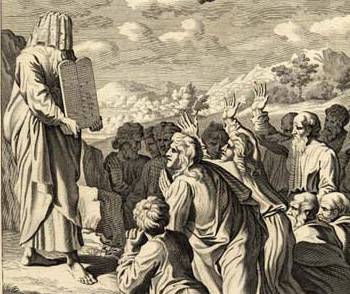
Moses wears a white tunic and his extra long, brownish belt flaps around his legs as if in a breeze. He has tights tucked into his high brown boots, and wears a warm looking hat. He has a brown beard, much shorter than Job’s, and he also looks like he is walking. In his arms is a large tablet divided in two, dashed lines across it representing the Commandments. There is a skull between his feet, and I was intrigued to see that Moses is blindfolded – I am assuming this represents the Lord’s impartial justice but would be delighted to hear of other examples of this. His inscription reads ‘The Lord will stirr up amonge the brethren a Profet, like unto me. Deutrinomy 18’.

The RAMM’s information card informs us that the boards might have been displayed in a church or private house near Plymouth, but immediately my little grey cells started humming. I doubted that it was the former in Elizabethan England, where the work of iconoclasm in parish churches was relatively complete. To me, these images were a surprise – what were images of scriptural figures doing here, in an era when images had been rejected by the reformers as leading to wrong belief and wrong practice?
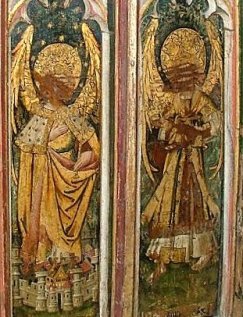
When iconoclasts attack.

When iconoclasts attack.

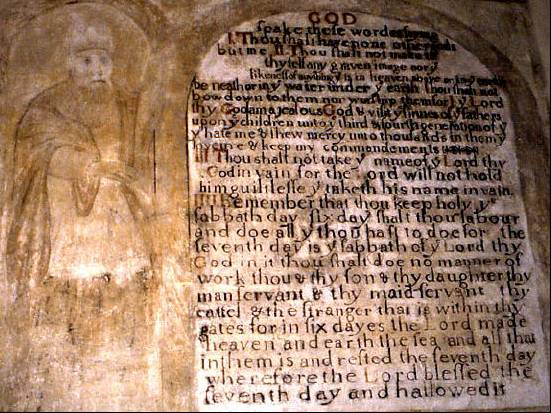
The scholarship on visual culture in early modern England can help to answer this question, as it has been rapidly developing in recent years. Earlier historians had to an extent been won over by Patrick Collinson’s argument that throughout Elizabeth’s reign, English Protestantism became less, not more popular in character. Crudely summarised, Collinson asserted that the first generation of Protestant publicists and propagandists made polemical use of cultural vehicles (songs, drama, cheap print, the visual arts), using these forms to transmit the evangelical message with the aim of converting the English people to Protestantism. Protestant plays were written and produced, godly ballads were published and sung, images were used to attack Catholicism and to commend their own religious beliefs and values. But around 1580 Collinson thought that a new generation of evangelicals began to reject visual and performative culture, judging it to be unsuitable for their religious message. This later generation of Protestants thought that plays, songs and images were distracting the audience and confusing the religious message. Worse, the arts mixed sacred ideas with filthy ‘popular’ forms, doing violence to religious truth by associating it with base, bawdy and inappropriate behaviour and language. In this new world, Collinson argued that Protestants came to completely refuse any appeal to the senses in religious matters. All images were ‘Popish’, most Elizabethan and Jacobean bibles therefore had no illustrations, the only decoration in the parish church was to be the Royal Arms and perhaps a table of the ten commandments. England had moved from iconoclasm in the first stages of reform (rejection of abused, dangerous and false images), to complete iconophobia (rejection of all images).

And yet…, whilst Collinson’s argument is enormously useful in thinking about the continuing repercussions of religious change, it is perhaps more useful for thinking about reforming clergymen than it is English society more broadly. Objections have been raised, and work is afoot to provide a corrective to the ‘iconophobia’ argument. It is easy to point to the continued existence of images in England – British Printed Images to 1700 is a website that hosts a database of several thousand printed images produced in Protestant Britain, and much decorated medieval furniture can be found in parish churches across the country to this day (though of course some of this may have been restored during a later era). Our Moses and Job boards are of course another example of later imagery.
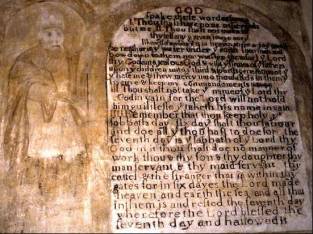
Images persisted despite reforming disapproval. So how can we explain Moses and Job? Are these a rare surviving example of something from the bottom of the Tessa Watt’s ‘ladder of sanctity’ – inoffensive Old Testament figures that Protestants were comfortable displaying in a secular context? Watt has taught us that those scriptural figures who were the least sacred in the Catholic tradition, those that did not have cults associated with them and who were therefore unlikely to be the focus of devotion, were often still depicted in post-Reformation England. Moses and Job fit the bill – they are Old Testament figures, and both are strongly associated with moral teaching and practices. You are not meant to worship them but to learn from their stories and they were probably a new element of visual language in the post-Reformation church – there are no wall paintings of Job in Anne Marshall’s excellent catalogue of medieval wall paintings, and only one of Moses – which was painted after the Reformation.

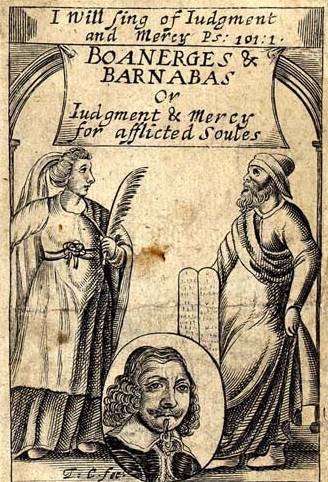
Watt’s theory therefore helps us to explain images that survived in the face of fierce criticism of the Catholic use of imagery in worship. It seems that the purposes of post-Reformation images were usually didactic, images were used symbolically to recall to mind important beliefs or Christian principles. Here the scriptural texts above the images suggest that these figures were intended as an aid to memory, representative of bigger theological and moral truths. Job stood for the trials, temptations and suffering that an ordinary family man might face in everyday life, the text the hope of release from them. Moses would call to mind the Ten Commandments (perhaps displayed for all to see in the parish church) and their Picture1importance as the basis of Christian morality and behaviour. Both are eminently suitable for display in a secular sphere such as the household, reminders of everyday Christian beliefs that could comfort and guide people as they went about their lives. Incidentally the British Printed Images database throws up eight images of Moses and two of Job, all from the seventeenth century, suggesting that these images might be less suitable for publication than for display in the household. Often these images are found in the frontispiece: Drexel’s School of Patience (1640) has an image of Job with the caption ‘Patience’; in Francis Quarles 1646 collection of miscellaneous reflections Boanerges and Barnabas Moses represents justice (in opposition to mercy) and wears a similar outfit to that depicted on our boards (see below); whilst a 1695 edition of Richard Allestree’s Works shows the prophet wearing a veil. Does the latter represent squeamishness over showing Moses’ face, or is it just because the book contains a section on the topic of veiling?
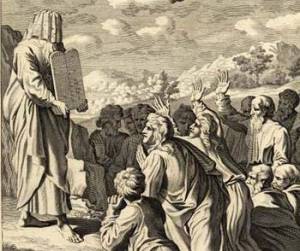
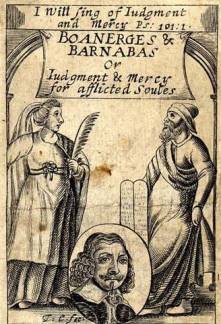
quarles mosesIt appears then that Moses and Job need not have been out of place in the Elizabethan south west after all. Tara Hamling’s recent work on domestic decoration supports such an interpretation, and these boards indeed suggest that Elizabethan England ‘still contained many images to help its inhabitants in converting the words of the Protestant religion into a visualised experience’, as Tessa Watt has argued. These images were complementing and supporting preaching and reading, those activities more traditionally seen as the heart of Protestant practice. The physical environments that people inhabited had also been changed as a result of reform, reconfigured to encourage the development of the Godly society that the evangelicals strove to create.

In tomorrow’s post: musings on the impact of the Reformation, goldsmiths and contemporary urban redevelopment.

‘West Country to World’s End: the South West in the Tudor Age’ runs until 2 March 2014 at Exeter’s Royal Albert Memorial Museum. You can find all the details about the museum, it’s opening times, it’s wonderful café and more here

Further reading:

Patrick Collinson, ‘From Iconoclasm to Iconophobia: the Cultural Impact of the Second English Reformation’, The Stenton Lecture 1985 (University of Reading:1986). Reprinted in Peter Marshall (ed.), The Impact of the English Reformation (London, 1997).

Tessa Watt, Cheap Print and Popular Piety (Cambridge, 1991), chapter 4, ‘Idols in the frontispiece’.

Tara Hamling, Decorating the ‘Godly’ Household: Religious Art in Post-Reformation Britain (London, 2010).