The Devil’s Church

Mark Hailwood

Early modern moralists were quick to condemn alehouses as ‘nests of Satan’, or as ‘the Devil’s church’ – places where impiety and irreligion were rife. The reality, as I will be demonstrating in my book, was that alehouse-haunting and godliness were not necessarily incompatible features of early modern life.

Whilst many ministers perceived themselves as locked in a ‘Battle for the Sabbath’, competing with the local alehouse to put bums-on-seats (or rather bums on pews and ale-benches) during Sunday services, the majority of parishioners seem to have found no great problem – or contradiction – in using their Sundays to congregate both at church and at the local drinking hole. Two diaries from relatively devout Christians—the Yorkshire yeoman Adam Eyre, written in the 1640s, and the Lancashire mercer Roger Lowe, written in the 1660s—both detail routine behaviour of stopping off for drinks either on the way to, or the way back from, a sermon or service. When faced with the seemingly existential choice between church and pub, the most common response was… both.

In fact, religion was a common topic of conversation around the ale-bench, and it is a couple of particularly striking examples of such exchanges that I want to share here, and invite your thoughts on.

The first took place on a December morning in 1656, in a Nottingham alehouse. William Bradshaw, a felt-maker, was discoursing with his companions about food and drink, when the conversation turned to what scripture had to say on the issue. Bradshaw said that ‘there was a saying in scripture that our Saviour fed 5000 men with 5 loaves and 2 fishes, which was as arrant a lie as ever was spoken’.

Jumping forward to 1681, and to the Somerset parish of East Pennard, near Glastonbury, the vicar of the parish, Mr Alisbury, was drinking in an alehouse with Joshua Swetnam, a local farmer. Their discussion came on to the subject of the Old and New Testaments, whereupon Alisbury offered his view that ‘they were not good but were both false and that there was not a good book but the common prayer book’.

We have two expressions here of unorthodox religious belief – but how unorthodox were they? Was Bradshaw’s denial of the miracle of the feeding of the five thousand an instance of truculent plebeian cynicism, demonstrating a healthy dose of mistrust of authoritative discourses? Or was this felt-maker ‘pushing the envelope’ of Protestant theology, taking the official Protestant distrust of the possibility of contemporary miracles to its extreme, and denying the possibility of any of Christ’s miracles? And what about the vicar Alisbury’s rubbishing of both the Old and New Testaments? Was he just a confused drunkard (he did have a reputation for imbibing) who failed to see the contradictions in his statement, or was he simply a ‘hotter sort’ of ‘Prayer Book Protestant’ who exalted the book above even the Bible itself? Would his view have been shared by some of his parishioners, or were these the ramblings of a lone voice?

I’d love to hear from religious historians here – do these views chime with any of the broader trends in religious debates in the mid-to-late seventeenth century, or are these isolated outbursts of unorthodoxy whose origins will remain obscure?

There is a broader question about popular religion at stake here I think – what we might call, after Ginzburg’s famous ‘The Cheese and the Worms’, the Menocchio question – do discoveries such as these help historians of popular culture to tap into hidden veins of belief held by ordinary people, or do they represent the unrepresentative, and lead us up the garden path?
A Seventeenth-Century Comic Strip?

Brodie Waddell

Gavin Robinson, over at Investigations of a Dog, asks ‘Why weren’t there any comics in the 1640s?’

He uses to the wikipedia definition:

a sequence of drawings arranged in interrelated panels to display brief humor or form a narrative, often serialized, with text in balloons and captions

This seems rather strict for my taste. Perhaps this is the nature of wikipedia  – an article on ‘comic books’ is bound to be dominated by comic ‘purists’ (even ‘puritans’) with a prescriptive outlook. The OED, in contrast, simply gives one definition of ‘strip’ as

A sequence of small drawings telling a comic or serial story in a newspaper, etc. Freq. as comic strip. Also transf. orig. U.S.

It gives the first use in 1920, which slightly predates the first supposed ‘comic book’ in 1933.

Apparently the first ‘comics’ (by the strict wikipedia definition) only appeared in the nineteenth century, and Gavin Robinson offers some possible reasons why, all of which seem plausible.

However, is it really true that ‘comics’ only emerged in the nineteenth century?

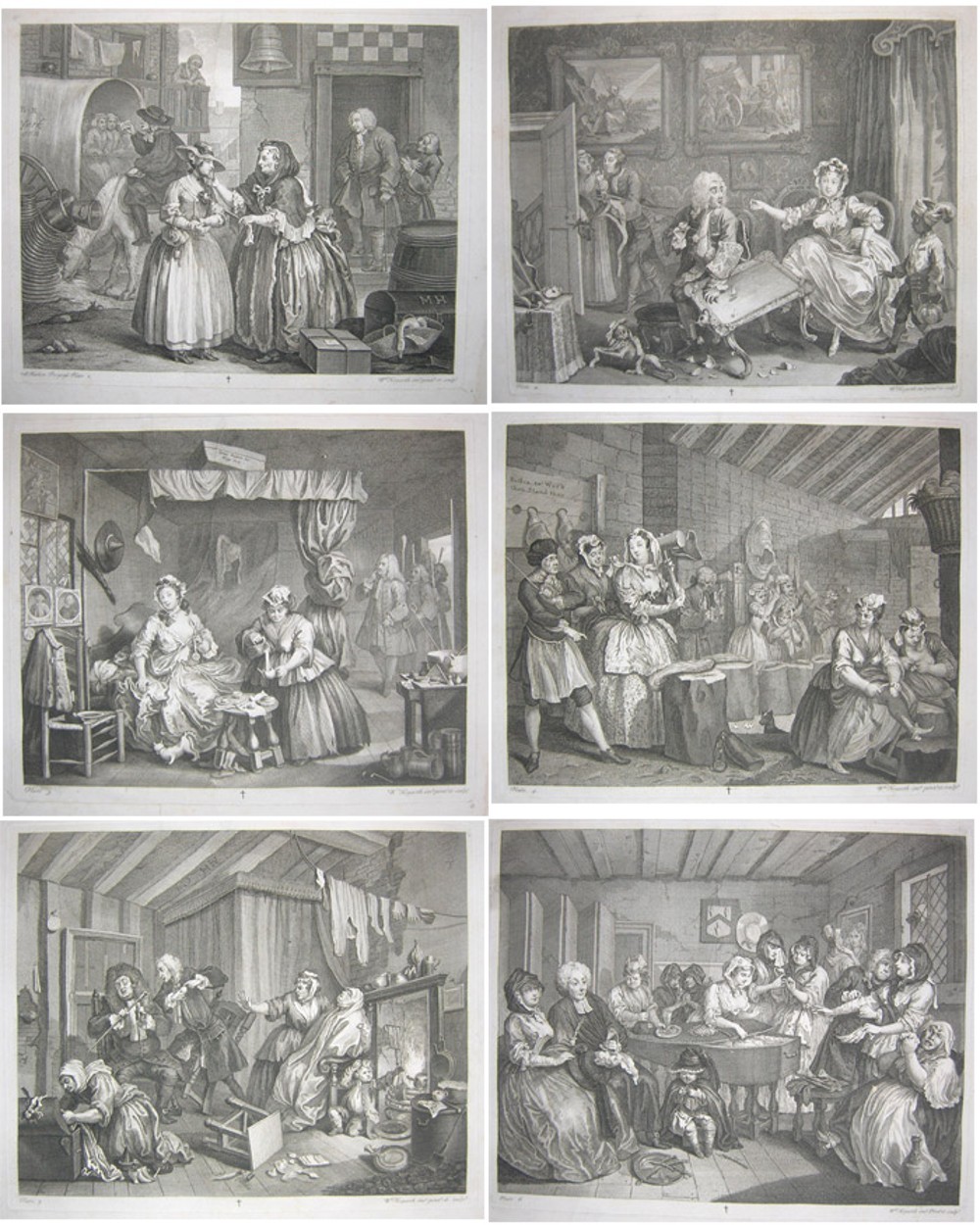
If we go by the OED definition, certainly not. As Gavin points out, ‘sequential art’ goes back to the Romans at least, and there are plenty of early modern examples. Here is Hogarth’s famous series:

William Hogarth, A Harlot’s Progress (1732). Image borrowed from here.

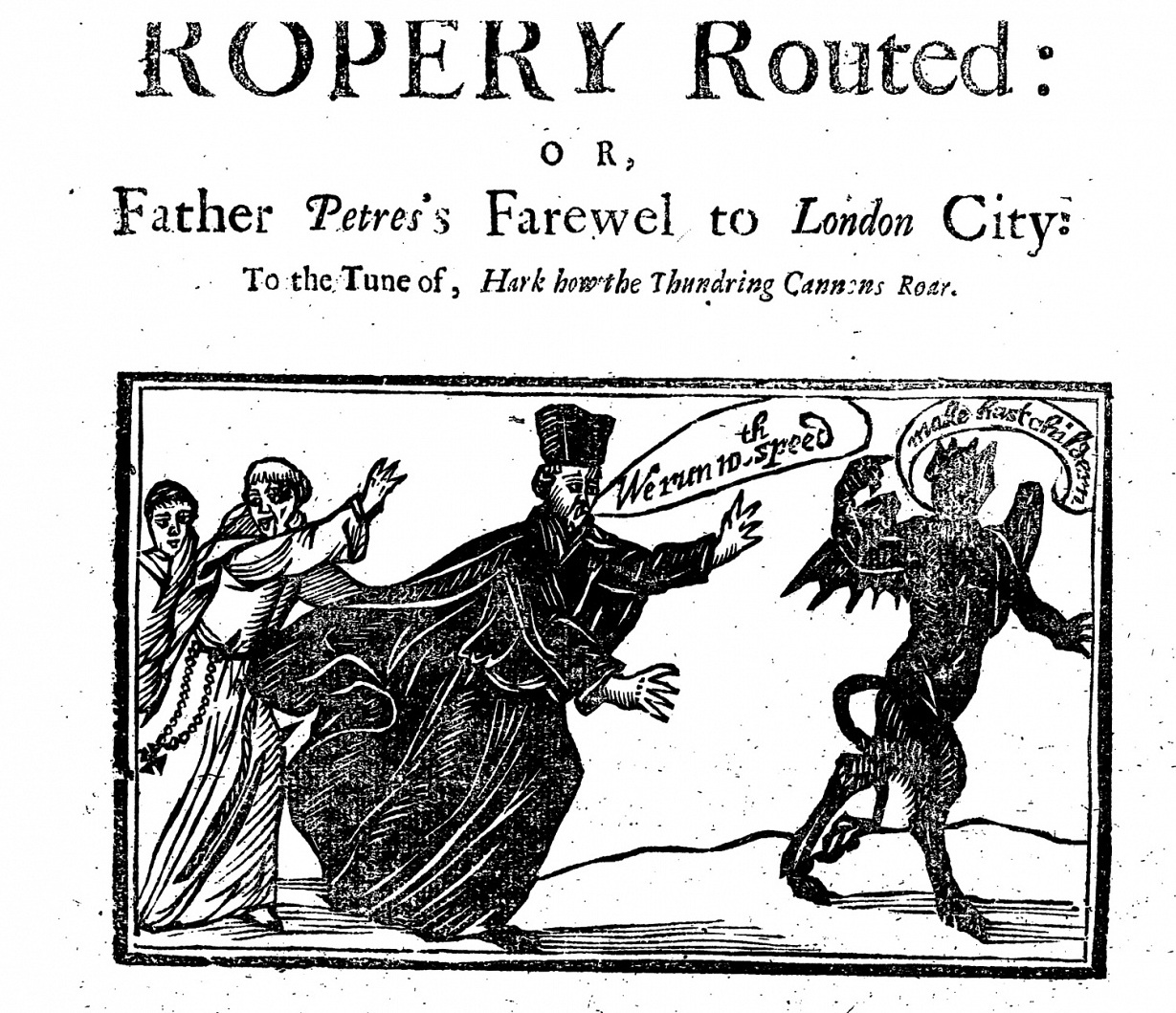
If we go by the wiki definition, we need ‘text in balloons and captions’, both of which are found in many early modern sources, but which was not normally paired with sequential panels. Here, for example, is some dialogue in balloons from a ballad in the Pepys collection:

Ropery Routed: Or, Father Petres’s Farewel to London City (1689) in Pepys Ballads, II, p. 296.

All of this is just a lengthy prologue to my own attempt at a small contribution. Whilst I haven’t found anything that unambiguously matchs the narrow definition, I think this comes pretty damn close.

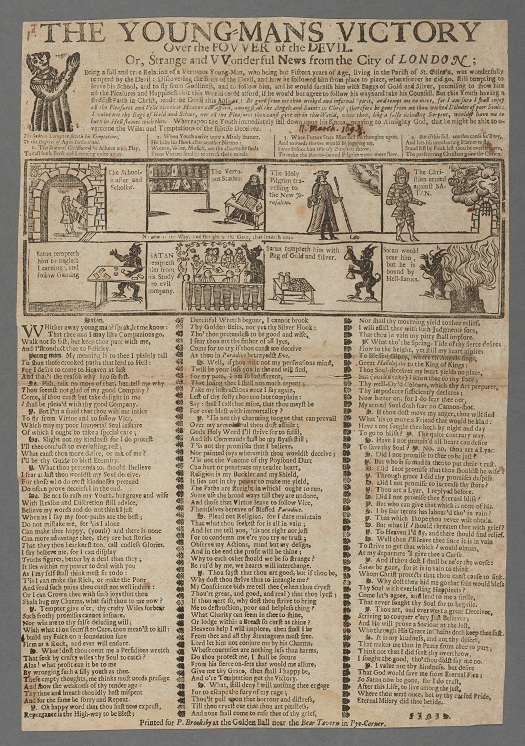
The Young-Mans Victory Over the Povver of the Devil Or Strange and VVonderful News from the City of London (?1693), from the Haughton Library at Harvard.

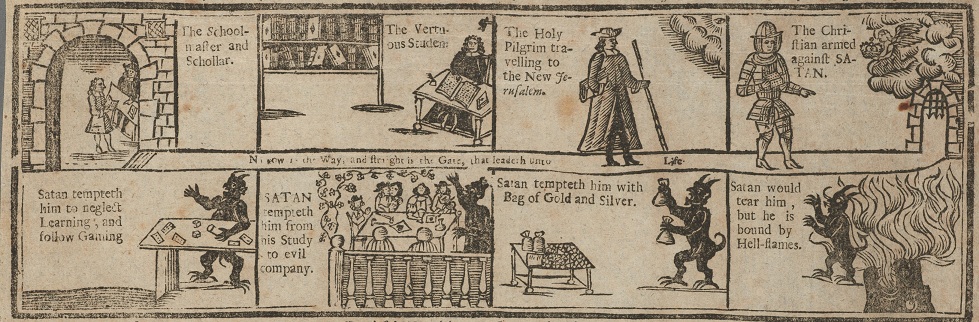
I came across this broadsheet when looking for an image for the cover of my book. You’ll note that although it doesn’t have dialogue in balloons, it does tell a sequential story through pictorial panels with accompanying in-panel text.

Detail of panels from The Young-Mans Victory Over the Povver of the Devil Or Strange and VVonderful News from the City of London (?1693).

My favourite panel (and the one that ended up on my book cover) is that which shows the devil trying to tempt the ‘Young-Man’ with ‘Bag of Gold and silver’. It makes literal the age-old association between ‘gold’ (i.e. riches) and ‘temptation’ (i.e. sin and damnation), neatly encapsulating one of my arguments: traditional Christian moral codes continued to be a popular way to think about economic life at the end of the seventeenth century.

So, is this an early modern comic strip?

Norwich Entertainments – Part II: Pieces of plays and the spatial turn

Brodie Waddell

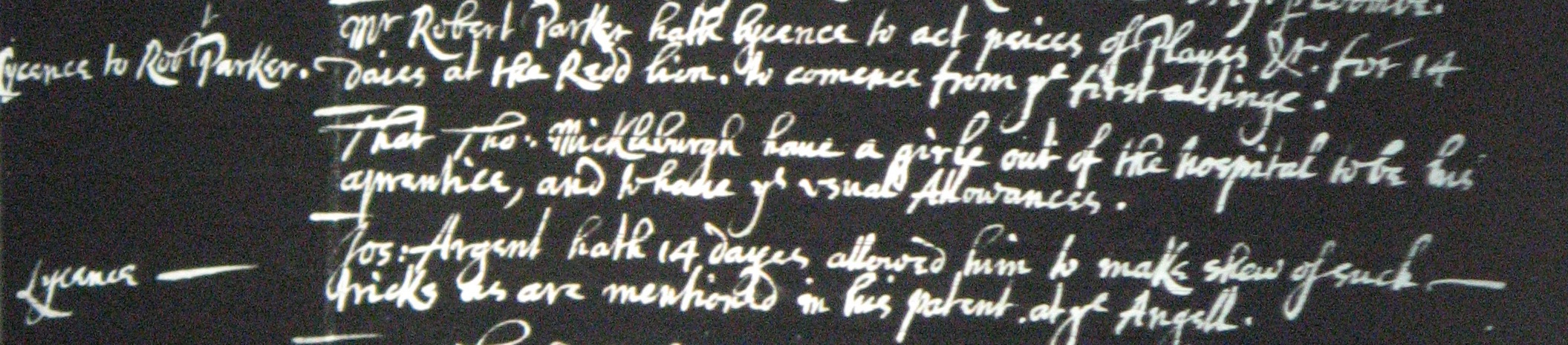
On October 17th, 1677, a month before Bartholomew Laskey arrived with his monstrous hairy child, the Norwich Mayor’s Court licenced Mr Robert Parker ‘to act pieces out of Playes &c for 14 daies at the Redd lion’ and John Argent ‘to make shew of such tricks as are mentioned in his patent at the Angell’.¹

Norwich Mayor’s Court Book, 17 Oct. 1677

Norwich Mayor’s Court Book, 17 Oct. 1677: Norfolk Record Office, NCR Case 16a/25, f. 9 (Sorry about the poor reproduction. The documents were only available on microfilm.)

These are exactly the sort of tantalisingly vague references to popular entertainments that one expects to find in early modern legal records. The ‘pieces of plays’ and unspecified ‘tricks’ surely amused their audiences, and the title ‘Mr’ suggests that at least Parker earned a decent livelihood, so they probably represent typical examples of provincial urban popular culture in the late seventeenth century. Continue reading

Norwich entertainments – Part I: A monstrous hairy child and a boneless girl

Brodie Waddell

On 17 November 1677, the Norwich Mayor’s Court decreed that

Mr Bartholomew Laskey had leave to make shew of a Monstrous Hayree Chyld for 10 daies from this day.

I came across this when looking for something else, but I couldn’t help but make a note of it. And, as I discovered, there were licences like this recorded throughout this period.

About a year later, on 5 October 1678

Isaac Cookesone produced a Lycecne under the seale of his Majesty’s Office of Revells to make shew of a Girle of 16 yeares of age without Bones, and he hath 14 dayes given him to make shew of her at the Lower half Moone in the Market place, He Keeping good order & Houres

Norwich, it seems, was a city that knew how to have a good time.

This is definitely not my area of expertise and I didn’t try to investigate the context of the orders, so I’d welcome ideas. But a few thoughts immediately come to mind… Continue reading