What shall we do with a drunken sailor?

Brodie Waddell

Surely this was an age-old question. Although the traditional sea shanty was only recorded in the early 19th century, there were more than a few early modern seamen who over-indulged in drink.

Indeed, when ‘a crew of Jovial Blades’ met in an alehouse in one late 17th-century ballad, it was the sailor who took the lead over his landlocked companions:

A bonny Seaman was the first,
but newly come to Town,
And swore that he his Guts could burst
with Ale that was so brown.

In another song from this period, a group of cunning ‘Maidens’ from the London suburb of Poplar tricked ‘several young Seamen’ into eating a cat baked in a pasty. Once they realised their mistake, the feline feast ‘did force them to spew’, but they still ‘laughed and quaffed’ and ‘drank off the Liquor before they went out’. It seems the solution to eating ‘A Cat-Pasty’ is to get thoroughly drunk.

Even sailors’ wives were not averse to downing ‘a lusty Bowl of Punch’. According to another ballad, the ‘Jolly Company’ raced to the alehouse as soon as their ‘Seamen had newly left the Land’ and set on their task with gusto:

We Seamens brisk Wives are bonny and glad,
While our Men on the Ocean are sorry and sad;
We love our Liquor to drink it all up,
None of us but love a full Glass or a Cup

They went so far as to claim that the punch would ‘make our Noddles the quicker’, a suggestion that was not as far-fetched to their contemporaries as it might be to us. As unlikely as it sounds, Mark has shown that the idea of alcohol enhancing ‘wit’ and ‘reason’ was not unknown in early modern England.¹ A little of ‘haire of the old Dogge’ might also cure the resulting hang-over.
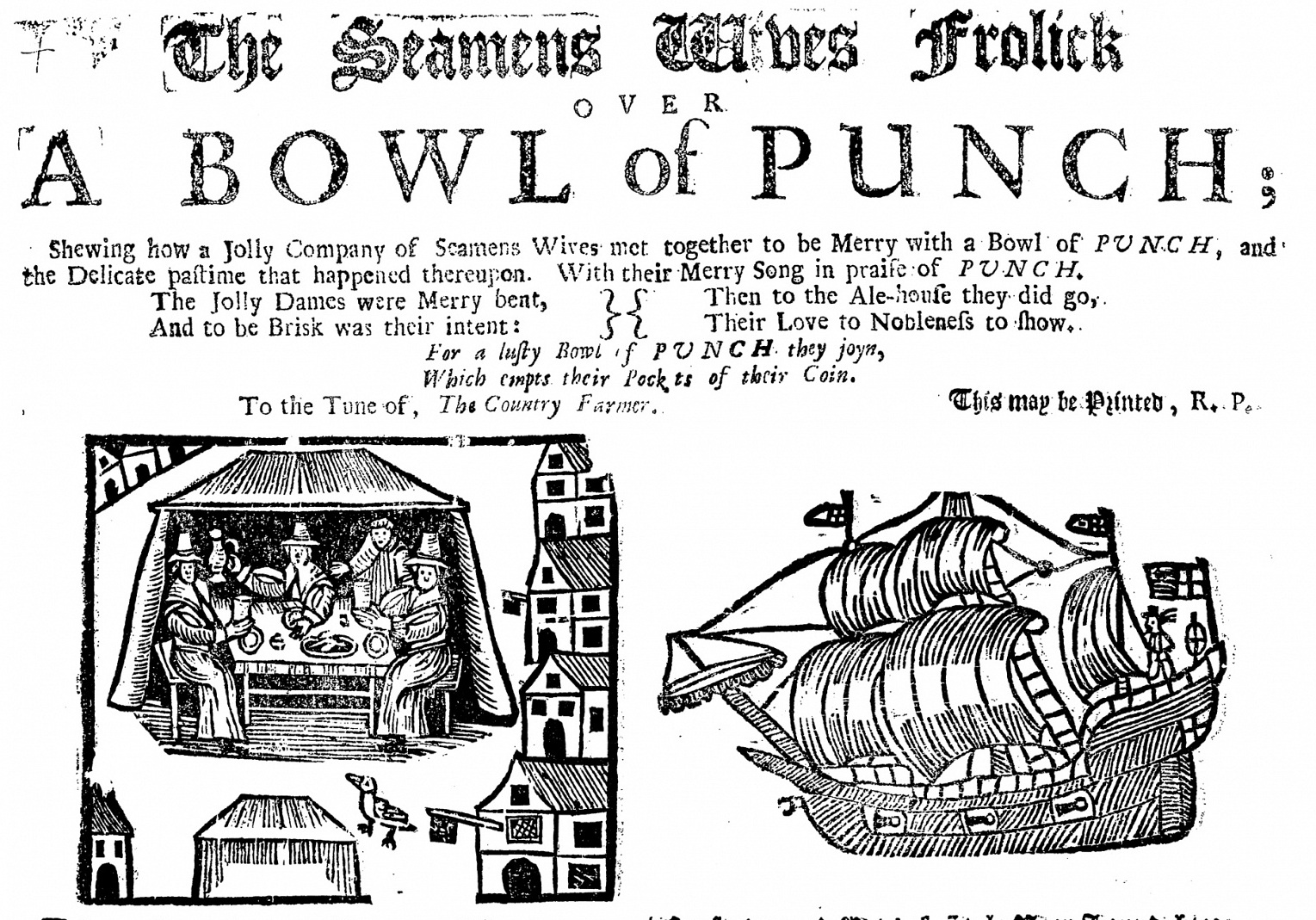
Detail from ‘The Seamens Wives Frolick Over A Bowl of Punch’ (1685-88), in Pepys Ballads, IV, p. 184, via EBBA.

One might be inclined to dismiss these as stereotypes played up by the balladeers trying to make a few extra pence, but there are also examples from the archives. The records of the High Court of Admiralty, for example, include depositions describing sailors such as Robert Oyle who habitually ‘debauch[ed] himselfe with drinke’, Frisby and Archer who spent ‘five dayes and nights together drinking and frequenting houses of lewd repute’, and Thomas Grove who returned aboard ‘much distempered with drink and began to curse and sweare’.

Are these cases typical? It’s hard to say at this point. All of the Admiralty examples come from the MarineLives project, a new group which is currently transcribing and publishing online a whole swathe of rich material from court records held at Kew. Perhaps once we have a complete set of cases over an extended period we’ll have a better idea of just how often 17th-century seamen had to ‘put him in the long-boat and make him bale her’ or ‘put him in the scuppers with a hose-pipe on him’, ‘earl-aye in the morning’.

In the meantime, the MarineLives team report that they are looking for a few more volunteers to join them to help uncover the rough lives of early modern seafarers, so if you’d like to help the world learn about a real ‘drunken sailor’ or two, do let them know.

Footnotes

¹ Mark Hailwood, ‘”It puts good reason into brains”: Popular Understandings of the Effects of Alcohol in Seventeenth-Century England’, Brewery History (forthcoming, January 2013).

The Devil’s Church

Mark Hailwood

Early modern moralists were quick to condemn alehouses as ‘nests of Satan’, or as ‘the Devil’s church’ – places where impiety and irreligion were rife. The reality, as I will be demonstrating in my book, was that alehouse-haunting and godliness were not necessarily incompatible features of early modern life.

Whilst many ministers perceived themselves as locked in a ‘Battle for the Sabbath’, competing with the local alehouse to put bums-on-seats (or rather bums on pews and ale-benches) during Sunday services, the majority of parishioners seem to have found no great problem – or contradiction – in using their Sundays to congregate both at church and at the local drinking hole. Two diaries from relatively devout Christians—the Yorkshire yeoman Adam Eyre, written in the 1640s, and the Lancashire mercer Roger Lowe, written in the 1660s—both detail routine behaviour of stopping off for drinks either on the way to, or the way back from, a sermon or service. When faced with the seemingly existential choice between church and pub, the most common response was… both.

In fact, religion was a common topic of conversation around the ale-bench, and it is a couple of particularly striking examples of such exchanges that I want to share here, and invite your thoughts on.

The first took place on a December morning in 1656, in a Nottingham alehouse. William Bradshaw, a felt-maker, was discoursing with his companions about food and drink, when the conversation turned to what scripture had to say on the issue. Bradshaw said that ‘there was a saying in scripture that our Saviour fed 5000 men with 5 loaves and 2 fishes, which was as arrant a lie as ever was spoken’.

Jumping forward to 1681, and to the Somerset parish of East Pennard, near Glastonbury, the vicar of the parish, Mr Alisbury, was drinking in an alehouse with Joshua Swetnam, a local farmer. Their discussion came on to the subject of the Old and New Testaments, whereupon Alisbury offered his view that ‘they were not good but were both false and that there was not a good book but the common prayer book’.

We have two expressions here of unorthodox religious belief – but how unorthodox were they? Was Bradshaw’s denial of the miracle of the feeding of the five thousand an instance of truculent plebeian cynicism, demonstrating a healthy dose of mistrust of authoritative discourses? Or was this felt-maker ‘pushing the envelope’ of Protestant theology, taking the official Protestant distrust of the possibility of contemporary miracles to its extreme, and denying the possibility of any of Christ’s miracles? And what about the vicar Alisbury’s rubbishing of both the Old and New Testaments? Was he just a confused drunkard (he did have a reputation for imbibing) who failed to see the contradictions in his statement, or was he simply a ‘hotter sort’ of ‘Prayer Book Protestant’ who exalted the book above even the Bible itself? Would his view have been shared by some of his parishioners, or were these the ramblings of a lone voice?

I’d love to hear from religious historians here – do these views chime with any of the broader trends in religious debates in the mid-to-late seventeenth century, or are these isolated outbursts of unorthodoxy whose origins will remain obscure?

There is a broader question about popular religion at stake here I think – what we might call, after Ginzburg’s famous ‘The Cheese and the Worms’, the Menocchio question – do discoveries such as these help historians of popular culture to tap into hidden veins of belief held by ordinary people, or do they represent the unrepresentative, and lead us up the garden path?

An (a)historical headache?

Mark Hailwood

We know that our ancestors inhabited a very different mental universe from our own – that they thought very differently from us – but a much harder question for historians to address is whether our ancestors lived in a world that felt physically different from our own. Are physical experiences ahistorical? Does the experience of stubbing a toe transcend all variations across time and space? Or were our ancestors hardier than us, less sensitive to pain perhaps?

Let’s try narrowing this question down a bit by focusing on one particular physical state that will be familiar to most of us: the hangover. But did our seventeenth-century forebears get them? They didn’t use the term (the Oxford English Dictionary suggests it is a twentieth-century Americanism), but they certainly suffered from them. A broadside ballad that warned against the dangers of drinking too much on the Sabbath day cautioned that men who did so often found themselves incapacitated for as many as two days after:

From Ale-house to Ale-house, they’d ramble and roam
And may be at night they’d come staggering home;
Their Wives have been careful to get them to bed,
Next morning the liquor has lain in their head;
So that beside all their vast charges and cost,
Both Monday and Tuesday they commonly lost.

If anything, we might wonder whether our ancestors experienced their hangovers even more severely than we do if they stretched over two days. But there is another explanation. In a ballad entitled ‘Monday’s Work‘ we hear of the symptoms that followed the morning after a Sunday drinking bout. They may sound familiar:

Last night I was shot
Through the braines with a Pot [of ale],
and now my stomacke doth wamble.*

*[Wamble, surely a word that should enjoy a renaissance, defined by the OED thus: ‘Of the stomach or its contents: To be felt to roll about (in nausea).’]

Yet this condition did not have these ballad drunkards opting for a ‘duvet day’. They had another remedy in mind:

A piece of salt Hogge,
And a haire of the old Dogge
is good to cure our drunken Noddles.

That often debated hangover cure – getting back on the bottle – dates back to at least the sixteenth-century. It might explain why Tuesday too was often a hangover day, but it was deemed effective by the famous diarist Samuel Pepys.  The morning after drinking ‘a great deal of wine’ at The Dolphin on Tuesday 2nd April 1661, Pepys awoke with his ‘head akeing from last night’s debauch’. No doubt he complained of this to the friends with whom he took lunch, for they encouraged him to ‘drink two drafts of sack [a Spanish white wine] to-day to cure me of last night’s disease,’ Pepys was sceptical at first, but the proposed tonic seemed to do the trick: ‘which I thought strange but I think find it true.’

So what does this tell us about the timelessness of physical experiences? Not much perhaps, but it is clear that finding an effective way of dealing with a hangover is one experience that unites us with our early modern forbears.