Unknown's avatar

About Brodie Waddell

Brodie is a Lecturer in Early Modern History at Birkbeck, University of London.

What shall we do with a drunken sailor?

Brodie Waddell

Surely this was an age-old question. Although the traditional sea shanty was only recorded in the early 19th century, there were more than a few early modern seamen who over-indulged in drink.

Indeed, when ‘a crew of Jovial Blades’ met in an alehouse in one late 17th-century ballad, it was the sailor who took the lead over his landlocked companions:

A bonny Seaman was the first,
but newly come to Town,
And swore that he his Guts could burst
with Ale that was so brown.

In another song from this period, a group of cunning ‘Maidens’ from the London suburb of Poplar tricked ‘several young Seamen’ into eating a cat baked in a pasty. Once they realised their mistake, the feline feast ‘did force them to spew’, but they still ‘laughed and quaffed’ and ‘drank off the Liquor before they went out’. It seems the solution to eating ‘A Cat-Pasty’ is to get thoroughly drunk.

Even sailors’ wives were not averse to downing ‘a lusty Bowl of Punch’. According to another ballad, the ‘Jolly Company’ raced to the alehouse as soon as their ‘Seamen had newly left the Land’ and set on their task with gusto:

We Seamens brisk Wives are bonny and glad,
While our Men on the Ocean are sorry and sad;
We love our Liquor to drink it all up,
None of us but love a full Glass or a Cup

They went so far as to claim that the punch would ‘make our Noddles the quicker’, a suggestion that was not as far-fetched to their contemporaries as it might be to us. As unlikely as it sounds, Mark has shown that the idea of alcohol enhancing ‘wit’ and ‘reason’ was not unknown in early modern England.¹ A little of ‘haire of the old Dogge’ might also cure the resulting hang-over.
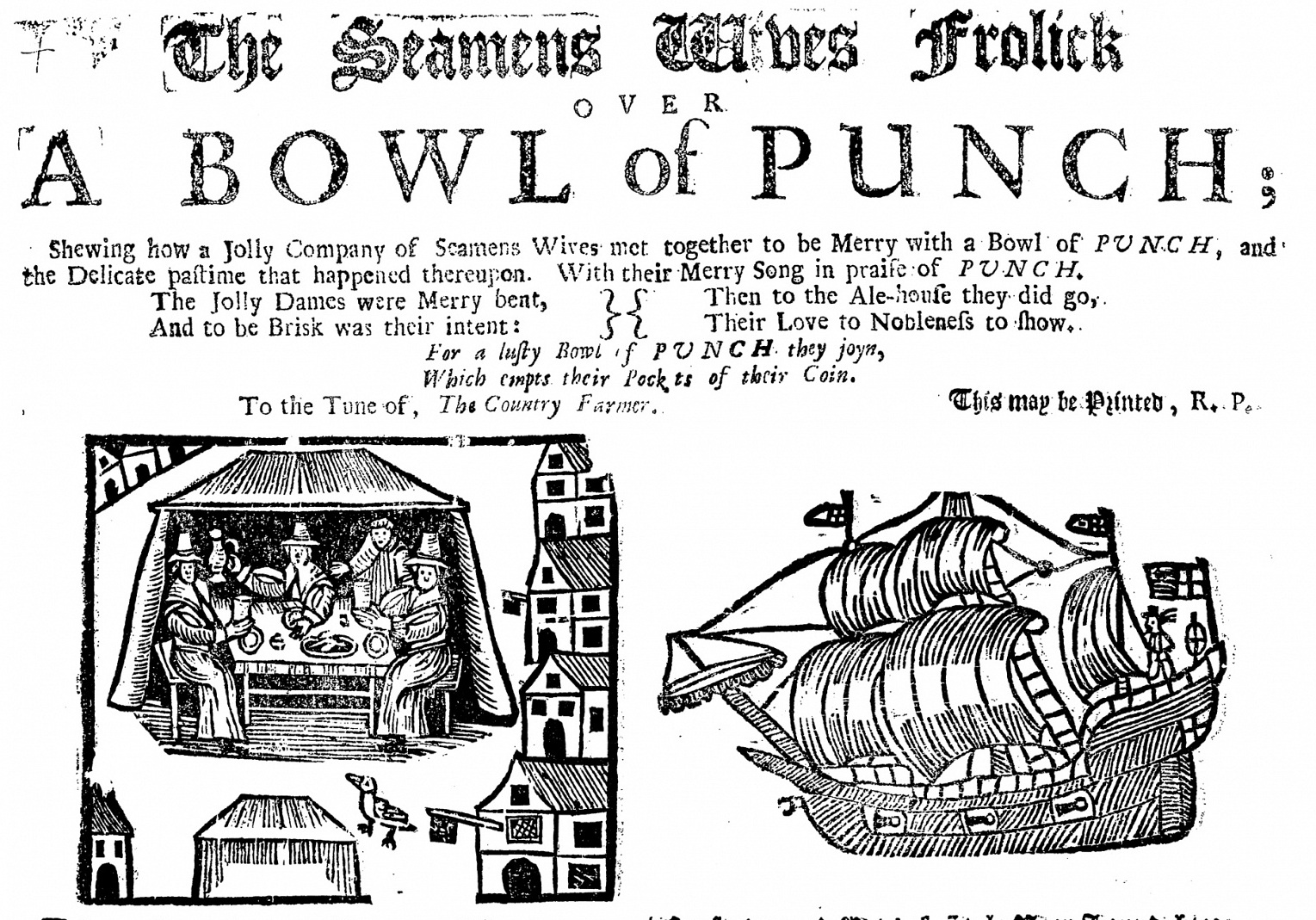
Detail from ‘The Seamens Wives Frolick Over A Bowl of Punch’ (1685-88), in Pepys Ballads, IV, p. 184, via EBBA.

One might be inclined to dismiss these as stereotypes played up by the balladeers trying to make a few extra pence, but there are also examples from the archives. The records of the High Court of Admiralty, for example, include depositions describing sailors such as Robert Oyle who habitually ‘debauch[ed] himselfe with drinke’, Frisby and Archer who spent ‘five dayes and nights together drinking and frequenting houses of lewd repute’, and Thomas Grove who returned aboard ‘much distempered with drink and began to curse and sweare’.

Are these cases typical? It’s hard to say at this point. All of the Admiralty examples come from the MarineLives project, a new group which is currently transcribing and publishing online a whole swathe of rich material from court records held at Kew. Perhaps once we have a complete set of cases over an extended period we’ll have a better idea of just how often 17th-century seamen had to ‘put him in the long-boat and make him bale her’ or ‘put him in the scuppers with a hose-pipe on him’, ‘earl-aye in the morning’.

In the meantime, the MarineLives team report that they are looking for a few more volunteers to join them to help uncover the rough lives of early modern seafarers, so if you’d like to help the world learn about a real ‘drunken sailor’ or two, do let them know.

Footnotes

¹ Mark Hailwood, ‘”It puts good reason into brains”: Popular Understandings of the Effects of Alcohol in Seventeenth-Century England’, Brewery History (forthcoming, January 2013).
Norwich Entertainments – Part IV: Surgeons on stage

Brodie Waddell

On the 8th of March, 1679, the Norwich Mayor’s Court ordered that

Mr Robert Bradford hath liberty to erect a Stage in the usual place to sell medical Druggs, & performe Chirurgicall Cures and he hath Lycence to doe this for the space of 3 weeks.¹

Medicine was big business in early modern England. Historians have shown us that the ‘medical marketplace’ was extensive and expanding, with many people we might now call ‘healthcare entrepreneurs’ earning a living by providing their services to eager consumers.² The fact that, as every schoolchild knows, ‘medicine’ in this period was as likely to hurt or kill as to cure does not seem to have dissuaded many patients.

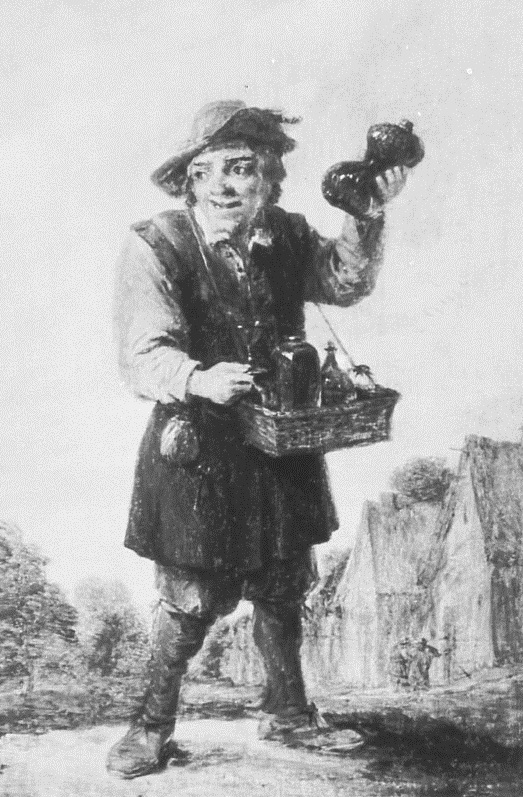
Peddler with apothecary bottles (17th c.). Source: Larsdatter.

That being the case, it should hardly surprise us that Mr Bradford would seek a licence from the civic authorities to hawk his ‘Druggs’ from a public stage in what must have been the centre of the city. This was a good spot to set up if he hoped to make a few shillings by attracting a sizable crowd of customers for his various elixirs.

But what about performing ‘Chirurgicall Cures’? On a stage? How can we explain this? Continue reading

Christopher Hill, class hatred and the many-headed monster

Brodie Waddell

In 1965, Christopher Hill published an essay entitled ‘The Many-Headed Monster’, from which this blog takes its name. The piece begins, of course, with a quote, but he then lays out much of the argument right on the first page:

Most writers about politics during the century before 1640 agreed that democracy was a bad thing … ‘The people’ were fickle, unstable, incapable of rational thought: the headless multitude, the many-headed monster.

According to Hill, the ‘class hostility’ of the propertied elite was deeply engrained in how they wrote and thought, so that ‘dread and hatred of the masses’ emerged in literature, philosophy and theatre.¹

It is difficult now to imagine that this was ever an important, novel argument. Today, historians of early modern England are well-aware of the distorting prejudices that shaped the way ‘the landed classes’ saw the actions of their supposed ‘inferiors’. We have, for a few decades at least, worked to read such sources ‘against the grain’ rather than to accept uncritically the words of the wealthy, educated men who provide so much of our source material.

‘Hydra’ from Edward Topsell’s The History of Four-Footed Beasts and Serpents (1658). Courtesy of Special Collections, University of Houston Libraries: UH Digital Library.

But in 1965 this was not the case. Certainly there were already many good historians who thought carefully about the biases inherent in their sources and I would be very surprised if Hill was the first to make this point about Tudor and Stuart elites, but the essay still served an important purpose. It surveyed the wide-reach of this paranoia amongst the ‘better sort’ of people, setting it out in clear and unambiguous detail. Indeed, one weakness of the essay is its repetition – one reads quote after quote from authors expressing their fear or hatred of the ‘lower orders’. How many times do we really need to hear seventeenth-century toffs denounce ‘the ruder sort’ as ‘a violent flood’ or ‘foolish flies’ or ‘untamed beasts’ or ‘vile caitiff wretches’?

Hill nonetheless performed a valuable service by implicitly critiquing those scholars who had ended up (perhaps unconsciously) adopting the distorted perspective of their sources. One of the more well-known examples is Max Beloff, whose discussion of later Stuart food riots clearly owed much to the harsh descriptions of the unrest recorded in the state papers. Although it was only in 1971 that E.P. Thompson made Beloff notorious by criticising him directly, Hill’s essay showed the dangers of failing to account for the ‘class hatred’ of the English gentleman.²

Beyond this methodological point, Hill went on to show how these stereotypes influenced the course of the ‘Great Rebellion’ of the 1640s. Fear of the ‘giddy multitude’, he argued, actually shaped historical events. But perhaps this is a topic for another time.

For now, I’ll just close with a question: Do our own biases (as educated, middle class professionals) mean that we continue to often unconsciously imbue those of our well-off predecessors? Or maybe has nearly half a century of ‘reading against the grain’ left us less able to understand the genuine anxiety of a seventeenth-century gentleman faced with a crowd of ‘base and disorderly people’?

Footnotes

¹ Unless otherwise noted, all quotations are taken from Christopher Hill, ‘The Many-Headed Monster’, in his Change and Continuity in Seventeenth-Century England (1975), pp. 181-204. It was first published in C.H. Carter (ed.), From the Renaissance to the Counter-Reformation: Essays in Honour of Garrett Mattingley (1965).

² E.P. Thompson, ‘The Moral Economy of the English Crowd in the Eighteenth Century’, Past and Present, 50 (1971), p. 76, citing Max Beloff, Public Order and Popular Disturbances, 1660-1714 (1938), p. 75.

On the merits of dust

Brodie Waddell

Mark’s recent post – and the related questions that come up at EMOB, Tim Hitchcock’s blog, and elsewhere – got me thinking a bit more ‘about the relative merits of (cheap, easy and efficient) access to digitised primary sources on one hand, and to (often expensive, labour intensive and time-consuming) hands-on access to original materials on the other’.

This is something that I’m conflicted about too. On the one hand, I have an emotional and aesthetic preference for the dusty originals. On the other, I often find at least as much useful material in the clean, searchable digitised sources.

At a practical level, I’m inclined to throw in my lot with the digitisers. Wonderful resources like EBBO, ECCO, TCP, EBBA, BHO, OBO and LL opened up new worlds to me (especially when I was a student in Canada) and to many other scholars. Without them, much of my work would be impossible or, at the very least, about ten times slower.

An information related to the theft of two pewter pots, from the Middlesex Sessions Papers, dated March 1760, digitised at London Lives.

Nonetheless, I believe that there is another consideration that is rarely mentioned in discussions like these: there is an undeniable tendency for digitisation to reinforce existing biases in source use. Before digitisation began, people tended to use printed works more than manuscripts and to use southern English (especially metropolitan) archives more than distant archives. This makes perfect sense: if you are based at Oxford or Cambridge or flying into London from North America, why wouldn’t you focus on the sources accessible there. Digitisation has made this bias even stronger. Print has been digitised before mss and southern/metropolitan archives have digitised more than less central ones. (See, e.g., the sites mentioned above and also TNA and the ERO.)

What this means is that one often finds historians extrapolating from the same types of evidence, with the same innate biases, rather than drawing on anything even approximating a ‘random sample’. Indeed, I often find myself doing this, so I don’t blame anyone else for doing the same.

In contrast, I’ve been privileged to have had the opportunity (i.e. time, funding) over the last few years to be able to regularly trek to a range of different county record offices and to simply dive into their material for a particular period to see what I find.  As a result, I feel like I’ve gained a genuinely stronger sense of what was going on than I would have had I been constrained by the limits of digitised material as it exists now or even as it continues to expand in the near future. I can see now that some previous historians may have mischaracterised events and periods purely because they were unable to explore a range of local material.

Obviously this isn’t something everyone, or even most historians, is able to do, so I unhesitatingly endorse all the good work that is going into digitising ever-more material and making it accessible to a much wider audience of researchers. Still, we must guard against the temptation to think that the great masses of sources that have been digitised somehow represent a more balanced source base merely because they are now so numerous. Biases remain and they may even be growing stronger.

PS: As Gavin Robinson is showing with his series blogging a soldier’s letters from the English Civil War, even when a manuscript source has previously been transcribed and printed (and will be eventually digitised), it’s often worth revisiting the original. Earlier editors sometimes made hilarious errors or took liberties with the text that can completely change the meaning.