

The next post in our Addressing Authority Online Symposium comes from Rebecca Tomlin, postdoctoral researcher at CRASSH, University of Cambridge. Here she examines responses to fires which burnt down much of the town of Tiverton in 1598 and 1612, showing how pamphlet descriptions contrasted with the petitions for aid that were recorded in official documents.
In 1598, when he reported on the recent disastrous fire in Devon, the writer of the pamphlet The True lamentable discourse of the burning of Teuerton told a story of terrible panic and distress that the fire had caused among the town’s inhabitants.[1] The fire, which started when two elderly women tried to use straw to cook themselves pancakes because they had no wood, spread rapidly through the prosperous market town, killing some one hundred people, destroying four hundred houses and property valued at £300,000 and £400,000. [2] The town was left without resources to shelter and feed its displaced inhabitants, who were also suffering what we would now describe as shock, and were left wandering on the outskirts of the town ‘more like Spirits and Ghostes then liuing creatures'(B2r). The writer emphasises the sensory qualities of the fire, particularly the noises and sights of the burning town and its aftermath to evoke horror in the reader, or listener; this is surely a pamphlet intended to be read aloud in terrible tones to a pitying audience. The disaster is blamed on Tiverton’s own ‘unmercifulnesse, & small regard of the poore, which were dayly seene to dye and perish in their streetes for lacke of reliefe’ (B2r) while the escape from the fire of twenty poor men’s cottages and the town’s alms houses is taken as proof of God’s providential intervention and intent.
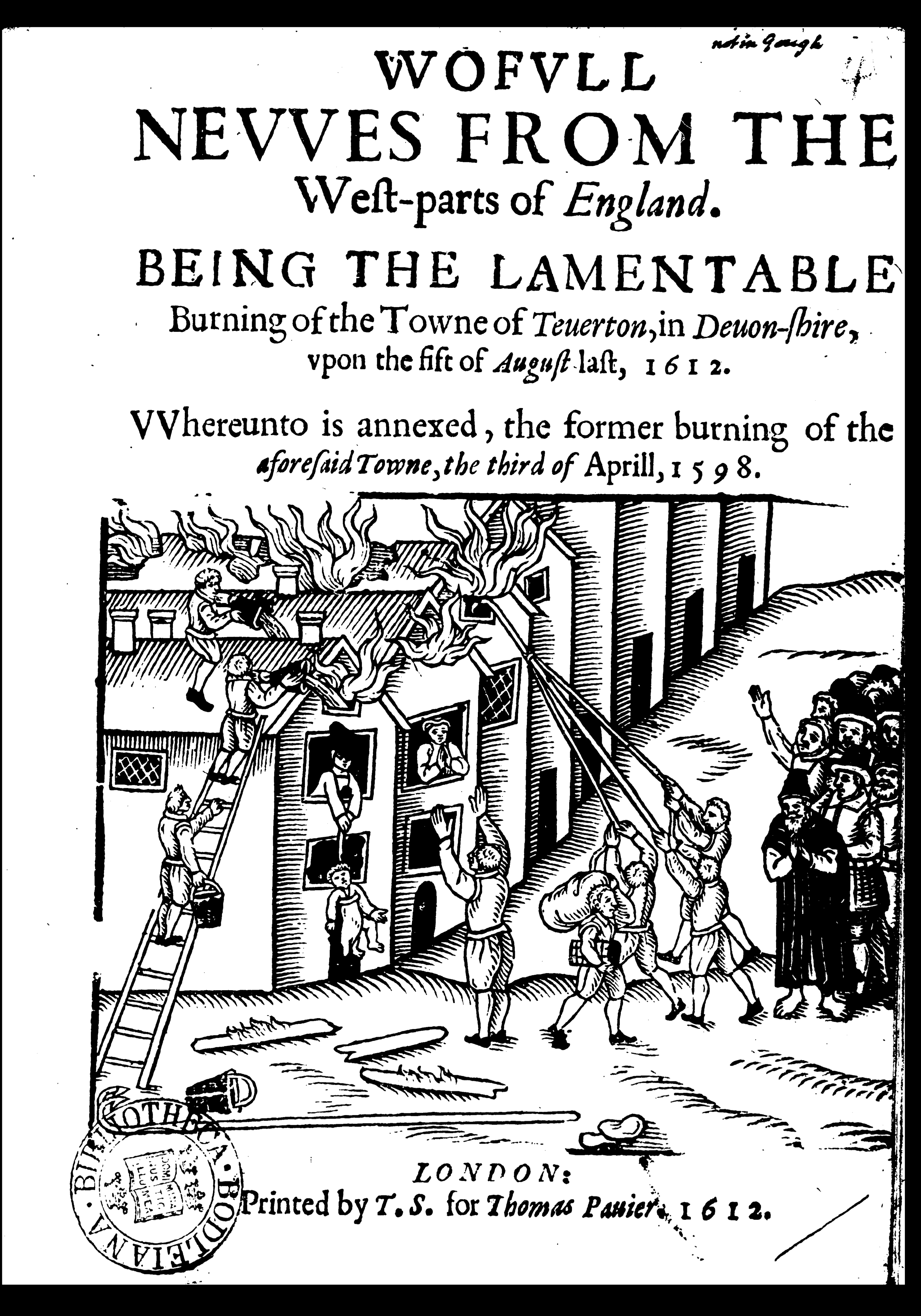 Unfortunately for Tiverton, it was revisited by fire in 1612. Another pamphlet was printed, which also incorporated a dramatic woodcut illustration of the attempts to fight the fire and a retelling of the story of the 1598 burning. The day of the 1612 fire, August 5th, was a holiday ordered by King James to celebrate his preservation from the Gowrie conspiracy. In Tiverton, an un-named dyer did not observe the holiday and put his boy in charge of the furnace so that they could continue to work. But the boy, eager to finish early so that he could join in with the holiday, stoked the fire too high and quickly lost control. This time the fire burned 300 houses, and some £50,000 worth of goods and animals were destroyed. Only the free school, the alms houses and some poor cottages were spared.
Wofull newes from the west parts England, Being the lamentable burning of the towne of Teuerton (1612) borrows much of its descriptive text from the 1598 account.[3] Further sensational descriptions are added, including some in terms which link the fire to the Gowrie conspirators; it is ‘a flame of confusion, a flame of subuersion, a spoyling flame (A4r). The fire is personified with intent: ‘a commanding Tyrant’ (A4v) which has ‘commanding power’ and ‘made conquest’ (B3v). As in 1598, the fire was interpreted as sign of God’s displeasure, in this case at the breaking of the Sabbath, and as a warning to other communities. In 1617 Thomas Beard included the story of the town in Devon that had twice suffered God’s displeasure in his The thunderbolt of Gods Wrath, adding that it was punished for rejecting a godly preacher and profaning the Sabbath.[4] The story of Tiverton and its two fires became an exemplary moral tale throughout the seventeenth century, used for example by a preacher taking his examples from Beard, and for a broadsheet compilation of the the ‘theatre of God’s judgement’ stories.[5]
What does all of this have to do with petitioning? Well, taking the two fires together we have a rare case where we can directly compare pamphlets and petitions which represent different ways of writing about the same disaster. The differences between the modes of writing in these different forms draw attention to the social and economic concerns of the petitions for large charitable collections made in the late sixteenth and early seventeenth centuries. Continue reading
 the many-headed monster