Unknown's avatar

About Brodie Waddell

Brodie is a Lecturer in Early Modern History at Birkbeck, University of London.

The future of ‘history from below’: an online symposium

Brodie Waddell

Those of us who think that historical research ought to consist of more than the study of kings, ministers and generals owe a great debt to the pioneers of ‘history from below’ . Foremost amongst them must be E.P. Thompson, who published his epic The Making of the English Working Class exactly half a century ago. The impressive wave of work that followed will be well-known to many of you and, if nothing else, I think most historians would agree that historical scholarship would be poorer if not for the intervention of these spirited men and women.

But what about the next fifty years? Has ‘history from below’, and perhaps social history more generally, outlived its usefulness? What, if anything, can it contribute to contemporary scholarship and the wider world? How should it be adapted or reoriented in the coming years? What new tools or techniques could strengthen it? Where will it fit in the wider academic and social landscape?

On 16 April 2013, eighteen of us gathered for a workshop at Birkbeck to try to figure out some answers to these questions. As is usually the case with these events, the discussion carried on in the pub afterwards and, although we certainly didn’t come up with any conclusive answers, we all agreed this was a conversation that needed to continue.

To that end, Mark and I invited the participants to contribute to an online symposium on the future of ‘history from below’. So, over the next few weeks we will be posting a series of short pieces by historians early in their academic careers that attempt to offer some possible answers to these questions. We hope that this will spur further discussion and open up the conversation to the rest of the world. Please leap in with your comments, suggestions and critiques. We welcome comments not only from ‘fellow travellers’ but also – perhaps especially – from sceptics and critics of ‘history from below’.

The first post will be published here on Monday, July 8th, with further posts following every two or three days. Links to each piece will be added here and join the conversation on twitter via #historyfrombelow.

Programme

Dead people’s stuff

Brodie Waddell

What do historians study? Do we study historical events and past societies through analysis of extant artefacts? Or do we study dead people by looking at their stuff? Tim Hitchcock argues that we do the latter:

In recent years I find myself using the terms Stuff and Dead People in talks and titles more and more.  And as a historian I find myself conceptualising my work as being about Stuff inherited from Dead People.  Both expressions just sound right. … They form an attempt to de-centre the language of historical and social science authority that underpins the professional claims of academic historians as a whole.  By refusing to use the categories and languages of authority we inherited, I am self-consciously rejecting the systems that underpin the professional academic practise of history.

It’s worth reading the whole post, if only for his astute remarks about Kissinger’s questionable place amongst the living, but I want to emphasize an overlapping issue: jargon-busting.

In my reading, Tim is, amongst other things, arguing that historians should think critically about the strange dialects adopted by our scholarly tribes. Rather than relying on traditional technical labels or snazzy new terms borrowed from other fields, we should try to find alternatives.

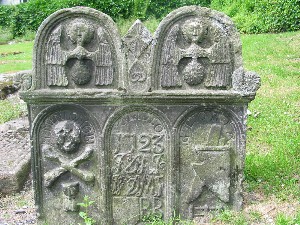
Tillicoultry churchyard

Dead people

More importantly, to my mind, his specific suggestions are not latinate neologisms invented to bemuse colleagues and confuse students (e.g. Derrida’s différance). They are deliberately common English words: the sort of words that can be found both in the KJB and in a 21st-century pub chatter. This has at least two key advantages over the Derridean approach.

First, as Tim implies, using words that seem blunt or imprecise can force us to think differently about what it is we are actually trying to label. ‘Stuff’ is much less specific than ‘text’, ‘image’, ‘object’ or ‘landscape’, but that is exactly the point: we don’t study each of those things in isolation any more. I can see how this technique might be useful in my own research. Whilst investigating the economic situation in the 1690s, I’ve come to the conclusion these were simply ‘hard times’. This phrase neatly includes all of the economic problems of this decade – increasing fiscal demands, war-time trade disruption, liquidity crisis, food price inflation, etc. – and, at the same time, reminds us that many people experienced these problems as a general calamity, not as separate challenges to be dealt with independently.

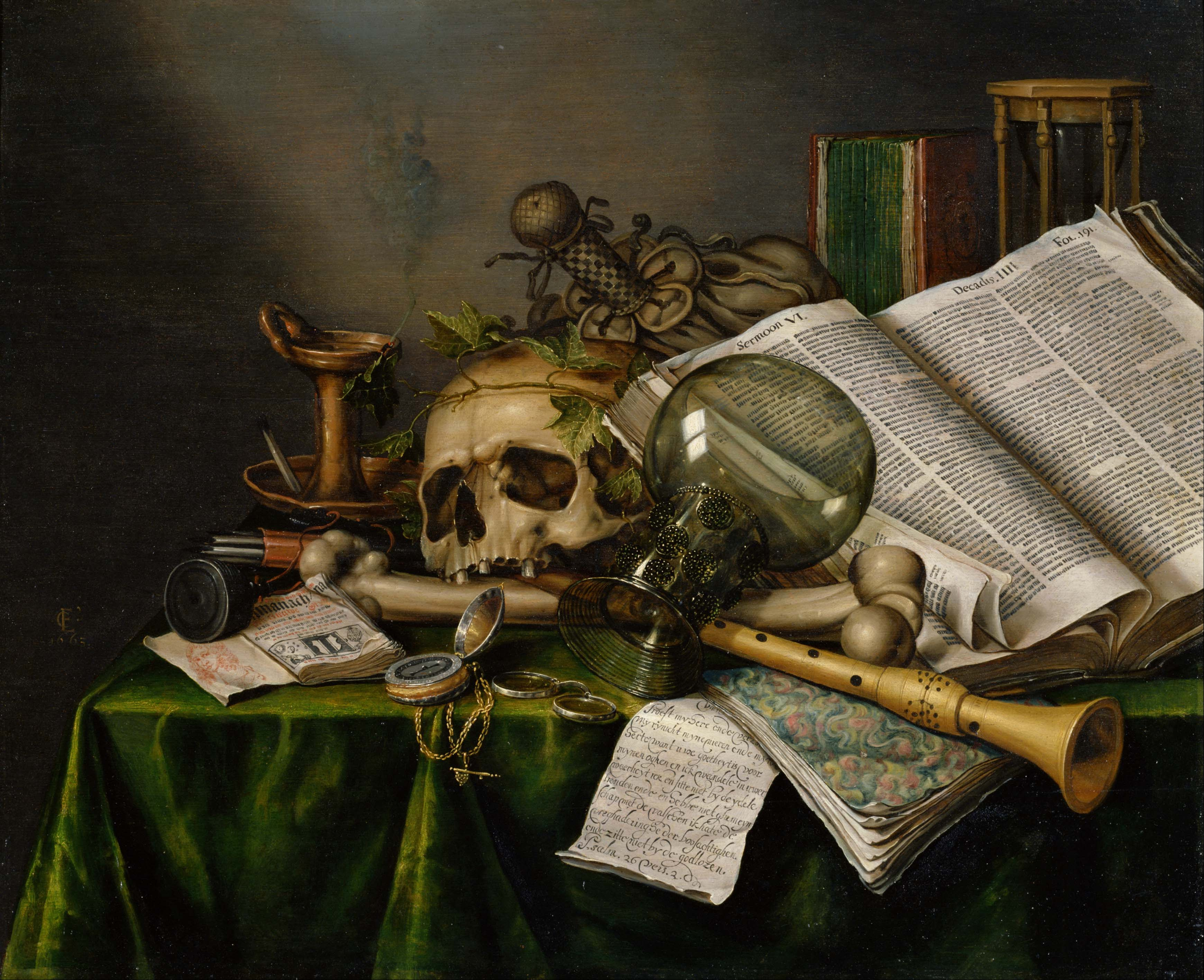
Dead people - Collier_-_Vanitas_-_Still_Life

Stuff

Second, using words like these has the advantage of making us much more understandable. ‘Dead people’ is a phrase that makes sense to everyone, whereas terms such as ‘historical actors’ or ‘active historical agents’ are not quite as obvious. Historians seem to be less intoxicated by technical jargon than many of our fellow academics.1 Nonetheless, there is still plenty of needlessly abstract, obscure vocabulary that could be profitably chucked. Replacing some of our quasi-scientific jargon words with more ‘vulgar’ alternatives would make it much easier to have the sort of fruitful conversations with non-academics that we all claim to want.

These two potential benefits – challenging outdated thinking habits and opening up scholarly discussions – seem to me to be reason enough consider how you might be able to do this in your own work. Perhaps the study of ‘dead people’s stuff’ won’t catch on, but it’s a great excuse to think hard about the words we use.

Footnote

1 One need only dip into a typical book of literary criticism or sociology to realise that it would have been much more difficult for Sokal to persuade a historical journal to publish his balderdash than it was for him to convince Social Text.

Examining the question and questioning the exam

Brodie Waddell

Tyler Cowen, a well-known blogger and economist at George Mason University, once tried a rather unusual approach to examining.

[He] walked into class the day of the final exam and said, “Here is the exam. Write your own questions. Write your own answers. Harder questions and better answers get more points.” Then he walked out.

The result, according to Cowen?

I would say that the variance of the test scores probably increased! I don’t recall if I ever did that again for a whole exam but most of my exams do that for at least one question.  It’s the question where you learn the most about the student.

With exam season now upon us, I’ve been mulling this over. I suspect the Birkbeck exam scrutiny panel wouldn’t like Cowen’s approach, but I think it could have real value. It would at least be a nice change from the usual drudgery of wading through 10 or 20 or even 50 answers to exactly the same question.

More to the point, it led me to think about some of the more unusual exam questions I’ve encountered over the years. The only one that strikes me as unconventional is one from Cambridge a few years ago for the early modern British social and economic history survey module:

Were any women and men practising witchcraft in early modern England?

Although it might not seem especially strange to a historian of the period, I suspect that laypeople would be alarmed to hear that Cambridge students were being examined on the existence of witches.

Do you have a favourite (or hated) history exam question?

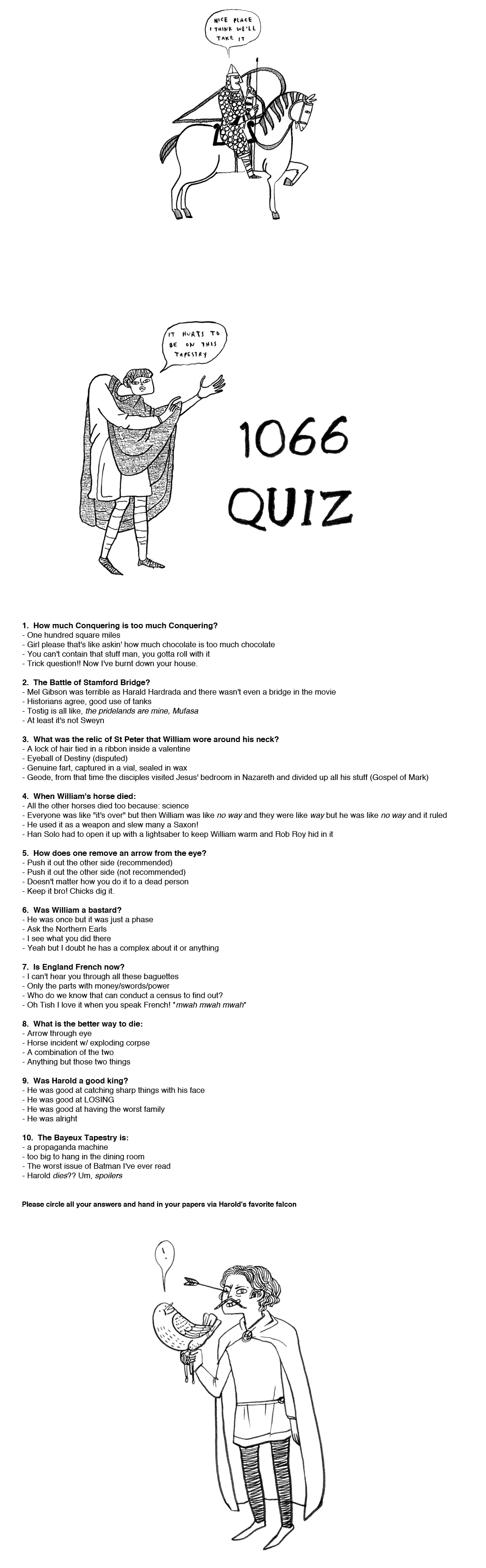
[Update (15/05/13): Kate Beaton, creator of ‘Hark, a vagrant’, offers an Elizabeth I quiz and a 1066 quiz that include such key questions as ‘Whither the Armada?’ and ‘How much Conquering is too much Conquering?’]

Carnivalesque 94: No bishop, no king

Brodie Waddell

Welcome to the 94th edition of Carnivaleque! Today we will be introducing you to a wonderfully motley menagerie of historical blogs and bloggers.

Finding any overall unifying theme is impossible with a collection of this sort, but there are a few key subjects that emerged from the nominations, each of which receives a section below:

  • The historian as detective
  • Bodily functions
  • A venerable criminal enterprise
  • Places, spaces and sites
  • Thinking about the historian’s craft

I think it is particularly interesting what’s not in the links below, namely kings and queens and ‘great battles’, the traditional material for popular histories. Not that political history and military history are entirely absent, just that they are approached from a different direction than usual. Although there are a few of gentlemen and noblewomen as well as a famous scientist, the vast majority of the nominated posts are focused on people who would have been largely excluded from textbooks written fifty years ago. What should we make of this? Is old-fashioned ‘top down’ history dying off? Or is it just that the type of people who read this blog and pay attention to Carnivaleque are predisposed against reading yet another story about Henry VIII and his wives or Charles I and his parliaments? I’d be interested to hear what you think.

However, before wandering into the carnival below, take a look at this truly heart-warming short animation that tells the tale of ‘the damnable life and death of one Stubbe Peeter, 1590’, a German werewolf. For more details, see the two posts at LOLManuscripts, but in the meantime, watch the video and be amazed.

Now, on with the show…

Continue reading

Monstrous readers

Brodie Waddell

In the wee hours of this morning, the Monster was viewed for the 10,000th time. Not a bad achievement for a blog dedicated to historical obscurities that only launched nine months ago. So, thanks to all of you for checking us out and thanks even more to our commenters who make posting so worthwhile!

Rather than fireworks, I thought it might be appropriate to celebrate by pulling back the curtain to reveal a few facts and statistics, following the example of Nick at Mercurius Politicus.

Since July 18th, 2012, we’ve had:

  • 53 posts
  • 205 comments
  • 10,004 views, around 40 per day
  • 74 different countries from which vistors have arrived
  • 260 views on a single day (September 2nd, thanks to a link to ‘A royal mistress’ from Two Nerdy History Girls)

We’ve received most of our readers via links from:

Perhaps most interesting are the search terms that have been used to find us. The most Young Sallypopular is, of course, ‘many-headed monster’. Interestingly, ‘archivist’ is in second place, perhaps thanks to the archival miscellany. Other unsurprising results include ‘what shall we do with a drunken sailor’, ‘civil war comic strip’ and ‘microhistory’. More unexpectedly, we also have a few readers who’ve found us by searching for ‘animated fireworks’, ‘hairy child’, ‘devil church’ and, most confusing of all, the nine clicks from ‘dirty mind of young sally’. I pity the poor saps who were looking for a local Satanist congregation or a 1973 ‘adult comedy’ only to find over-thought analysis of some early modern oddity.

Oh well, the more the merrier … Satanists and skin-flick fans, we welcome you!

Calling all bloggers and blog readers…

Every six weeks or so the historical blogosphere hosts a ‘carnival’ where a single blog publishes a ‘Carnivalesque’ miscellany of links to recent posts from around the web. This particular carnival focuses on ancient, medieval and early modern blogging. Previous editions have been hosted by Sharon Howard of Early Modern Notes and Thony C. of The Renaissance Mathematicus.

The many-headed monster will be hosting the next edition on April 27th and we’re looking for nominations. We’ve already had a few come through, but would welcome many more. The Carnivalesque nominations procedure is as follows:

We welcome perspectives from a variety of fields, especially (but not only) history, literary studies, archaeology, art history, or philosophy. You can nominate your own writing and/or that of other bloggers, but please try not to nominate more than 1-2 posts by any author for any single edition of the carnival.

Nominated blogging may be ‘academic’ or ‘popular’, so long as it is based on facts and evidence. Writing that engages with the past to discuss present issues should include significant historical content and analysis, not merely polemic. All nominations are vetted by the host of the edition, whose decision is final.

Nominated posts should have been published within the last 2-3 months. The normal channel is to send an email to the host using the nomination form at this site. Individual hosts may provide additional options. Please ensure you include the full URL of the post you are nominating, and ideally the post title and blog name.

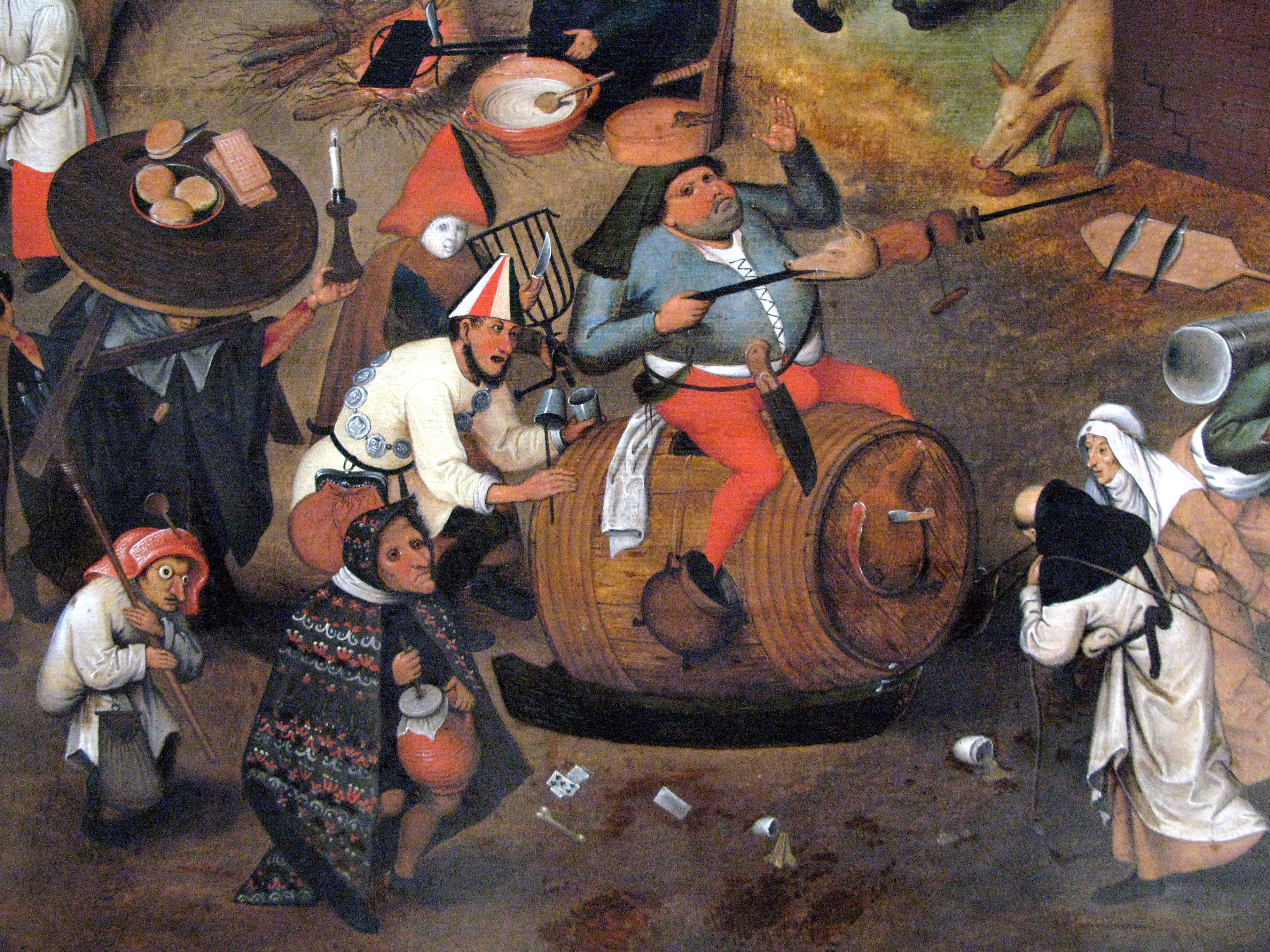
pieter_bruegel_ii-combat_de_carnaval_et_careme_img_1463

An Easter larceny, 1691

Brodie Waddell

I was browsing the Old Bailey Online for seasonal crimes, as one does, and came across this case from the Proceedings of 27 May 1691:

Rebekah Williams, Widow, was Tryed for Robbing Edward Veron , on Easter-day last, of Goods to a considerable value. Mr. Veron swore, That his Shop was broke open at Ipswich, and that the Prisoner offered several of the Goods to sale in London, at a Goldsmiths, where she was taken; but she proving her self a Married Woman, by vertue of the Covering she was Acquitted.

We have, in other words, a woman who allegedly participated in stealing from a shop on Easter, but escaped unpunished because she was married at the time.

Early Modern John recently described an Old Bailey case from around the same time as ‘both amazing and infuriating at the same time’ – and the case of Rebekah Williams undoubtedly falls into that same category. The record includes tantalising hints about the culture of the time, but also fails to explain the parts that seem to be most in need of explanation.

The first question is about the significance of the day of the crime. It is obvious why criminals might plan a break-in for ‘Easter-Day’ – presumably everyone else would be at church and the theft would be less likely to be detected. But what would the jurors think of such a crime? Would they be inclined to treat the accused more severely because the crime was both a theft and a profanation of the year’s holiest day? Would the prosecutor draw attention to this? Sadly, the record is entirely silent on this point.

The second issue is influence of Williams’ marital status. This seems to be a case of ‘feme covert’. As the OBO explains:

The legal principle of the feme covert, by which women could not be held responsible for crimes committed in the presence of their husbands (since they were presumed to be following their husbands’ commands) was not often applied, but it may have led juries to exonerate some married women, particularly when their husbands were convicted for the same crime.

The principle had a much more significant role in commerical affairs and inheritance than in criminal law, but it theoretically applied to cases of theft as well.1 But why, then, was Williams listed as a ‘widow’? How did she ‘prove’ her marriage? Why wasn’t her husband mentioned and, in fact, prosecuted? I’m inclined to imagine a scenario something like this … Williams and her husband robbed the shop in Ipswich, but only she was caught selling the goods in London. She admitted the crime but claimed that she was coerced by her husband, who – conveniently – died before the trial. But this is all merely speculation. Here too the record is silent.

In the end, what we are left with is a woman who seems to have committed a potentially capital crime on the most sacred day of the Christian calendar, and who walked away from the court unscathed.

Footnotes

1 For the significance of ‘feme covert’ in the economic sphere, see Joanne Bailey, ‘Favoured or oppressed? Married women, property and ‘coverture’ in England, 1660-1800′, Continuity and Change, 17:3 (2002), pp. 351-372 (ungated); and the work of Amy Erickson. For the role of gender in early modern crime, see Jenny Kermode and Garthine Walker (eds) Women, Crime and the Courts in Early Modern England (1994); Garthine Walker, Crime, Gender and Social Order in Early Modern England (2003). The law of coverture is also described on Wikipedia.

The wandering, pipe-smoking Jacobite

Brodie Waddell

King William III was a greedy, irreligious, oppressive usurper. Worse still, he was a Dutchman. Or at least these were the sort of things one might hear in many of the alehouses of northern England at the end of the seventeenth century.

Definitely a bit too Dutch for his own good.

I’m going to be giving a talk at the Institute of Historical Research on Thursday (March 14th) on ‘The Present State of England: Modernity and Memory in the Hard Times of the 1690s’, and I thought I’d share one of the many, many seditious denunciations of William III’s regime that I’ve come across during my research into this topic. Sadly, this one probably won’t make it into the talk, but I’ll be sure to include a couple of others.

This case comes from amongst the mess of unsorted and unnumbered despositions from the Palatinate of Lancaster held at The National Archives at Kew, specifically PL 27/2. In May of 1700, according to a chapman from Manchester named David Smith,

one James Scott a wandering person this day … did declare … that his present Majestie King William had noe more religion in him then his pipe in his hand & that all that he cared for was to please his people & to gett mony together & that he love a finger of King James’ hand more then he loved King Williams body

One needn’t have a detailed knowledge of later Stuart political culture to decipher the complaint. William III had a reputation as an aloof, cold monarch, which may partly explain why Scott had so much more ‘love’ for James II’s finger than for the current king. Likewise, the king’s continental Calvinism was regarded as somewhat suspect by many Church of England clergymen, which may help to explain Scott’s reference to his atheistical pipe.

However, I’d guess that Scott’s dislike come primarily from the other fault that he mentions here: ‘all he cared for was to please his people & to gett mony together’. This was surely a reference to William’s foreignness and his very aggressive fiscal policies: ‘his people’ were presumably the Dutch courtiers whom he brought over with him, and his need ‘to get mony together’ resulted in taxation more than doubling in less than a decade. As I’ll explain on Thursday, these were ‘hard times’ and, as a result, the king’s regime was widely resented for his foreignness, his favouritism and his predilection for expensive European wars.

If anyone else has come across similar material from this period, I’d love to hear about it.

A ‘Pancake Day’ blogroll update

Shrove Tuesday has arrived again. It’s time to fry up some pancakes (preferably slathered with Nutella), join the London apprentices in smashing up some bawdy houses, and then pull up a chair in front of your computer to gorge yourself on early modern history blogging.

To that end, we’ve just updated our blogroll. The mother of all historical blogrolls is Sharon Howard’s Early Modern Commons, but for those seeking a more selective list, our newly expanded set of links may be just the thing. In addition, we are also updating our even more selective sidebar of ‘Friends of the Monster’ to focus on those with whom we seem to interact most often in terms of links or comments.

Enjoy!

A miscellany: wandering woodcuts, Greifswald glosses, digital Defoes and Thompson tributes

Brodie Waddell

Several things have come to my attention over the last few weeks that deserve wider attention. Although I don’t have time to provide much commentary, I think our readers will find some of them of interest.

The first concerns the wonderfully rough images that so frequently appear in our posts: broadside ballad woodcuts. The Bodleian Library recently announced the launch of an image-matching tool that will allow researchers to easily search for the many versions of a specific image across the library’s whole collection of ballad sheets. Eleanor Shevlin discusses the new tool in more detail over at EMOB. In light of Mark’s posts on early modern representations of working people, it would be fascinating to know how particular ‘occupational’ images are reused and recycled in different contexts and perhaps given quite different meanings.

The second is Beat Kümin’s historical travelogue, Greifswald Glosses, exploring the largely autonomous parish communities in early modern Northern Germany. As a professor at Warwick, Beat is well-known to us here at the Monster and his blog offers a remarkable (and remarkably well-informed) look at the towns, churches, landscapes and even graffiti of this part of the former Holy Roman Empire. I think my personal favourite was the fourteenth-century gargoyle/collection-box at St Jacobi in Göttingen, but you may prefer the ruminations on low-ranked local football teams or the semi-fortified round churches of Bornholm.
The third is an amusing ‘pop history’ article in The Atlantic on Daniel Defoe’s A Journal of the Plague Year (1722). It’s a well-researched piece, based on an interview with the Defoe scholar Katherine Ellison and incorporating plenty of (anachronistic) pictures, but what makes it interesting to me it that it is written by the magazine’s tech writer. The short version of his argument is basically that Defoe was an early modern blogger and, unlike some of today’s bloggers, he approached the wealth of information provided by that era’s new technology (e.g. newspapers) with a critical eye. I’m not sure I’m actually convinced, but it’s great to see another side of early modern history (beyond Henry VIII, Shakespeare and Oliver Cromwell) receiving some thoughtful discussion in such a high profile outlet.

Finally, Katrina Navickas has a post at History and Today on E. P. Thompson’s The Making of the English Working Class (1963). There are, as she notes, a great many tributes and events happening this year to mark the fiftieth anniversary of its publication. However, what I enjoyed was hearing a little about her relationship with the materiality of the book itself, in all its tattered, dog-eared glory. I think I probably find myself reaching for Thompson’s Customs in Common (1991) more often than MEWC, yet I’m still strangely comforted to have a decent edition of the latter nearby. In her words, ‘despite my “digital humanism”, I still need those yellowed and annotated pages of the Penguin paperback to really get to the heart of Thompson’s writing’.

Shorter notices

Our very own Laura Sangha has set up a twitter feed for her students of ‘Religion, Society and Culture in Tudor England’: Tudorists rejoice! Grad students in and around London interested in early modern history really ought take a look at the talks hosted by the Birkbeck Early Modern society (and their tweets too). And lastly I belatedly wanted to thank the Birkbeck History PhD bloggers for reblogging one of our posts and recommend that all BBK doctoral students check them out.

[Update (07/02/13): Co-blogger Jonathan Willis is also tweeting (@CREMS_Bham) for Birmingham’s Centre for Reformation and Early Modern Studies.]