Unknown's avatar

About Jonathan Willis

Jonathan Willis is a Senior Lecturer in Early Modern History at the University of Birmingham, and is on twitter as @CREMS_Bham and @drjpwillis

‘For yee lead your liues in great ignorance’: Puritan Ponderings on the Patchwork of Popular Belief

Jonathan Willis

What exactly did people believe in post-reformation England?  That deceptively simple question really goes to the heart of much of the ‘post-revisionist’ scholarship currently being generated by historians of the English reformation.  Whether the object of study is angels, the landscape, music or death, one underlying questions remains the same: what does this thing, this practice, this shred of belief tell us about the broader tapestry of post-reformation religious identity?  Tapestry is a reasonable metaphor – I’m going to refrain on this occasion from extending it too far, and talking about warps and wefts – but patchwork 3388735664_a77e48d15a_zis a better one, the term coined by Tessa Watt in her brilliant book Cheap Print and Popular Piety.[1]  Once or twice when teaching this I have actually taken to drawing an imaginary ‘patchwork’ on the whiteboard.  So what do we call the hypothetical individual, who believes he will be justified by faith but also thinks that if he doesn’t confess his sins he could be condemned to hell for them?  What about his wife, who sings metrical psalms and hates the pope but believes God to be physically present in the consecrated host?  And however we define such individuals, can we also reasonably group them together?  It is possible to recognise their difference, and at the same time claim they are one and the same?

So tapestry is OK, patchwork is better: palimpsest works pretty well too.  Tangentially, I wonder why so much of the metaphorical language we use to describe identity formation (there’s another one) is rooted in the everyday materiality of art and craft.  Our ability to label individual belief in the past seems inversely proportional to the amount we know about it.  I suppose that is a fairly natural state of affairs.  Complexity breeds complexity, and moulds certainty into uncertainty.  But the job of the historian is (I think) not just to (re-)present the past, but also in some sense to try to make sense of it.  So, for AG Dickens the majority of people in Elizabethan England were recognisable as Protestants; for Eamon Duffy they were perhaps traumatised Catholics; for Christopher Haigh, stiff-necked Parish Anglicans; for Judith Maltby, committed Prayer-Book Protestants; for Watt, their culture was ‘distinctively post-Reformation, but not thoroughly Protestant’; while for Robert Delumeau, the people of early modern Europe were probably not even thoroughly Christian.

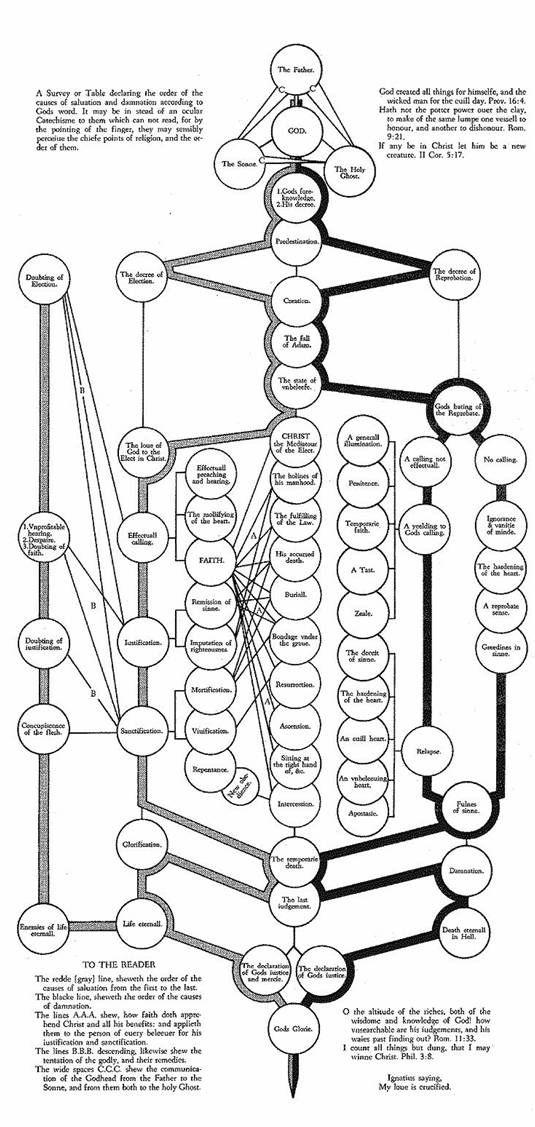
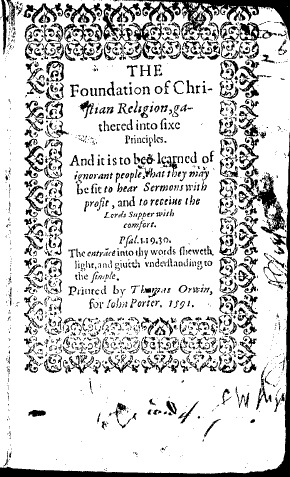
I was reminded of the value of taking a step back from all of this the other day, while reading a treatise by William Perkins that I had never looked at in detail before.  Perkins,Picture1 probably most famous as the author of A Golden Chaine, and more famous still for the infamous diagram of salvation contained within it, was a prolific writer of theological and devotional tracts: the work in question is his The foundation of Christian religion gathered into sixe principles.[2]  The work begins with an address ‘to all ignorant people that desire to be instructed’, followed by a list of almost 30 erroneous ‘common opinions’ which Perkins goes on, throughout the text, to correct.  Reproducing this list in its entirety would be a little excessive, but let me pick and talk about a dozen or so points which seem to me to be particularly pertinent to the present discussion:
1 That faith is a mans good meaning & his good seruing of God.

3 That yee haue beleeued in Christ euer since you could remember.

11 That it is an easier thing to please God than to please our neighbour.

12 That yee can keepe the Commandements, as well as God will giue you leaue.

Taken together, these points seem to express a frustration at the laity’s lack of intellectual engagement with the concept of faith.  That is not to say that their faith was not complex, but it was certainly not structured in the reflective, self-conscious way demanded by men such as Perkins.  Ironically, it seems that Puritan divines would have preferred a little less fiducia and a little more credentia from the laity: a faith based less in instinct, trust and emotion, and rather more in knowledge and intellectual acceptance.  The most difficult (and therefore the most important) aspect of religion from the laity’s perspective was in striving to live according to the principles of Christian charity: God, in whom they had faith from their earliest years, was a comforting constant.  And yet many of the laity had a strong sense that it was ultimately possible to be good and to do good things, and that such behaviour was pleasing to God.  Elsewhere, Perkins also complained about those who felt that by reciting the Decalogue they were praying, and serving God.

7 That, if anie be strangely visited, hee is either taken with a Planet, or bewitched.

This I think is a useful reminder that popular belief was not straightforwardly Christian: it contained a mixture of folklorish, traditional, pagan and other elements.  In this sense it was a true patchwork.

13 That it is the safest, to doo in Religion as most doo.

14 That merry ballads & bookes, as Scoggin, Beuis of Southampton, &c. are good to driue away time, & to remoue hart quames.

20 That drinking and bezeling in the alehouse or tauerne is good fellowship, & shews a good kinde nature.

Popular religion in the broadest sense was above all a communal activity, not an individual or even a family or household one.  The reformation did not fundamentally change this, except perhaps amongst those who were the most literate in the new religious language.  Even then, perhaps all it did was change the nature of the society with which those individuals of advanced faith sought to surround themselves.  Good religion was to be expressed in good fellowship and good cheer, as much in the alehouse as in the church, as much with a lusty ballad as a reverent Psalm.  ‘Hart quames’ for most people were to be banished with a merry ballad, not meditated upon as a means to repentance and the enrichment of a saving faith.

9 That a Preacher is a good man no longer than he is in the pulpet. They thinke all like themselues.

 18 That yee know al the Preacher can tell you: For he can say nothing, but that euery man is a sinner, that we must loue our neighbours as our selues, that euery man must bee saued by Christ: and all this ye can tell as well as he.

 17 That a man which commeth at no Sermons, may as welbeleeue, as he which heares all the sermons in the world.

 16 That a man neede not heare so many Sermons, except he could follow them better.

28 That a man need not haue any knowledg of religion, because he is not book learnd.

Finally, from the perspective of both the clergy and majority of the laity, a wide gulf existed between the two.  The reformation certainly contributed to a widespread anti-clericalism, that is to say, an opposition to the clerical pretensions of the new godly graduate clergy.  Complicated sermons were for educated people: the unlearned had nothing to gain thereby, because they already grasped the essentials of the faith: that all men were sinners, must be saved by Christ, and had an obligation to be charitable to their neighbours.  This was all well and good as far as it went, but of course for Perkins and others there were nuances, complexities, caveats and implications without which these broad truisms were worse than meaningless.  Such intellectual religion was unpopular in all senses: it was not for the great mass of people, who could profit more from each other’s good fellowship than a lengthy diatribe from the pulpit.
FoundationThe thing I’d like to draw from all this is that occasionally it is possible to lose sight of the wood for the trees.  While it can be extremely interesting to interrogate popular belief in minute theological and intellectual detail, it is not always the most productive path to follow (there are of course many, many exceptions).  For, by doing so, we can end up unwittingly forcing a resolutely anti-intellectual form of belief into a (for want of a better word) Perkinsian framework, and thereby doing it some violence, and just a little injustice.  We must remember that popular belief was both simple and complex, both patchwork and quilt.  It may be made up of innumerable diverse fragments, but it also had simple key priorities and a clearly defined basic form.  Each quilt may be unique, but quilts are also recognisably the same: a quilt is a quilt, and not a cushion cover, or a wall-hanging.  Identity is full of contradictions, but not all contradictions have to be resolved.  We each of us probably live with a series of competing and contradictory impulses and beliefs held in a kind of creative tension with one another, and the people of early modern England were probably no different.


[1] (Cambridge: CUP, 1991), p. 327.

[2] And it is to bee learned of ignorant people, that they may be fit to hear sermons with profit, and to receiue the Lords Supper with comfort (1591), STC2: 19710.

REED all about it III: Some musings on music and the micropolitics of Sabbath-breaking in Jacobethan Lancashire

Jonathan Willis

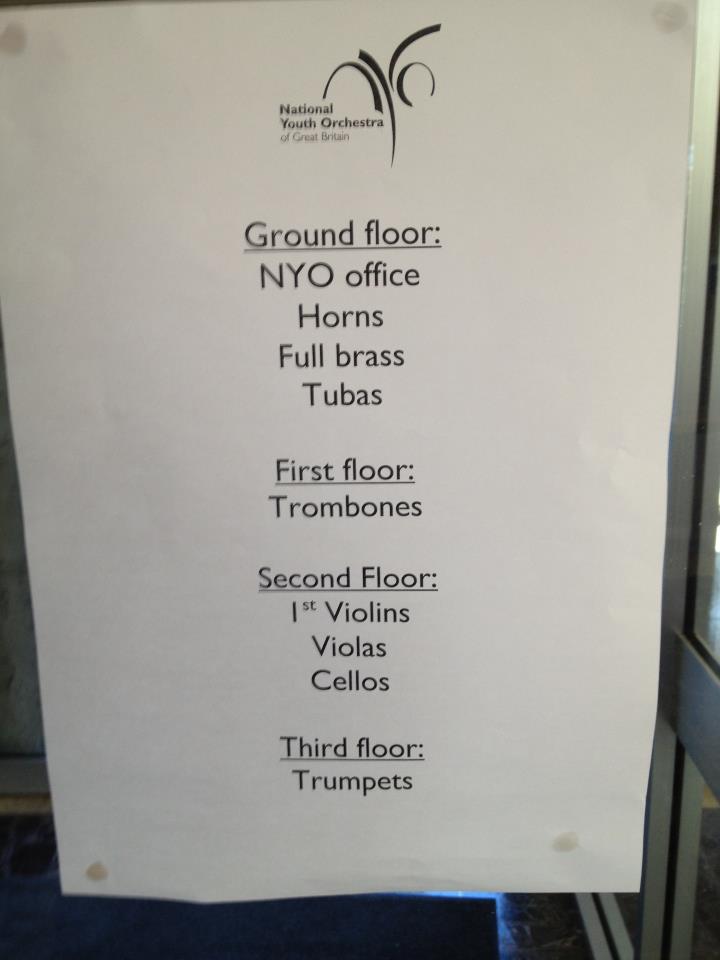
One sunny afternoon last July, the University of Birmingham’s Edgsbaston 295393_10151929538030109_359375196_ncampus played host to some rehearsals by the National Youth Orchestra of Great Britain.  Cellos, violas, tubas and trombones were scattered liberally throughout the Arts Building, and the history department itself played host to the trumpet section.  Hearing (fainter) strains of music in the department is not an uncommon occurrence, as there are student rehearsal rooms in other parts of the building.  This is usually quite enjoyable, even if it occasionally adds a melodramatic quality to meetings or supervisions.  Whether at work or home, we have all probably at some stage encountered some form of music which has permeated our environment uninvited.  Sometimes, as with the NYO or Birmingham’s budding undergraduate virtuosi, this can be an unexpected source of pleasure.  But in other situations, it can be distracting, disruptive, or downright offensive.  Uncleanness, the anthropologist Mary Douglas famously observed in her 1966 work on Purity and Danger, is ‘matter out of place’.[1]  In the same way, musical sound in the wrong spatial or chronological context can easily cross the rubicon of taste and order and become a provocative and clamorous noise.  If this is still true in the sound-proofed, double-glazed, cavity-wall insulated, noise-cancelling-headphone-wearing twenty-first century, then it was even truer in the sixteenth, where both welcome and rogue sounds must have travelled with much greater volume, clarity and conspicuousness. Continue reading

Call for Papers: Sin and Salvation in Reformation England

Jonathan Willis

As the tightly-sprung chaos of another academic term starts to unwind, and thoughts turn to the endless possibilities of a month of peaceful and unbroken research time (oh yes, and Christmas), my gift to you, Monster reader, is a call for papers.  But this isn’t just any call for papers!  Firstly, the vital statistics: Sin and Salvation in Reformation England is a major three-day conference taking place 26-28 June 2013 at the Shakespeare Institute, Stratford-upon-Avon.  I am organising the conference under the auspices of CREMS, the University of Birmingham’s Centre for Reformation and Early Modern Studies, with generous support from the Leverhulme Trust.  Contributions are invited from established scholars and postgraduate students alike, and it is my hope that the conference will give rise to an edited volume of essays. Themes for papers may include (but are not limited to): visual, literary, political, theological, historical, material, musical, polemical or any other treatments of the topics of sin and salvation in the context of reformation-era England. Please send abstracts of 250 words for 20-minute papers to me by 31 March 2013, and visit the CREMS website for more information.

Secondly, keynotes.  Every conference needs at least one keynote, and I’m delighted to say that we have managed to arrange an exceptional lineup of three of the most interesting and engaging scholars in the field.  Dr Arnold Hunt, has written on communion and extensively on preaching, and is currently involved with editing the parochial sermons of John Donne.  Professor Alec Ryrie has written extensively on the English reformation: his long-awaited monograph on Being Protestant in Reformation Britain is due out early next year, and he has already embarked on a new global history of Protestantism.  Professor Alexandra Walsham has written a series of ground-breaking books on the English reformation, on topics ranging from church papistry to providence and intolerance.  Her most recent work is a breathtaking account of the Reformation of the Landscape, and she is currently working on the impact of ageing and generational change on the English Reformation.

Thirdly, the conference blurb: Sin and Salvation were the two central religious preoccupations of men and women in sixteenth century England, and yet the reformation fundamentally reconfigured the theological, intellectual, social and cultural landscape in which these two conceptual landmarks were sited. The abolition of purgatory, the ending of intercessory prayer, the rejection of works of supererogation and the collapse of the medieval economy of salvation meant that it was impossible for attitudes, hopes, fears and expectations about sin and salvation to survive the reformation unchanged. This conference will explore some of the transformations and permutations which the concepts of sin and salvation underwent over the course of the reformation in England, as well as the practical consequences of these changes as lived.

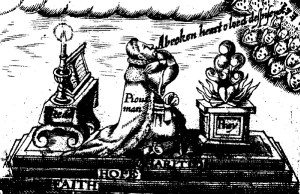
Fourthly, every call for papers needs a picture, so here is mine: part of the frontispiece from Lewis Bayly, The Practise of Pietie (1613).

Bayly[A pious man, kneeling upon a foundation of faith, hope and charity, turns from his study of the scriptures to pray: ‘A broken heart o Lord despise not’!]

Fifthly, finally, and as this is a blog entry rather than a traditional call for papers, I wanted to take a little more time to explain why I want to put this conference on, and what I hope to achieve.  I’m currently enjoying the third year of a Leverhulme Early Career Fellowship, working on ‘The Ten Commandments and the English Reformation’, and it was always my plan to host a conference during the final year of research.  Initially this was going to be a conference on the Ten Commandments, then it became one on the concept of God’s law, then on the use of the Old Testament during the reformation more broadly, then more generally on the bible.  Each successive iteration felt like I was getting closer, but I am not a biblical scholar, and so I kept putting it off and off as it didn’t quite feel right.  Finally it clicked: in a nutshell, the commandments were all about listing the things that you mustn’t do (i.e. sin), and enumerating the sort of deeds performance of which could be taken as a sign that an individual had been predestined to election (i.e. salvation).  One of many roles of the commandments in reformation England, therefore, was to help shape these fundamental concepts of sin and salvation as they slowly came to be understood by the great majority of people, through continual exposure through preaching, catechesis, the liturgy, and visual, musical, and other media.  Hopefully then, ‘Sin and Salvation in Reformation England’ will open up for exploration not only those vital concepts themselves, but also how they came to shape religious belief, practice and identity amongst the laity, and how they themselves were moulded by the experience.  A worthwhile enterprise, I’m sure you’ll agree: so, please take some time out from the sherry and mince pies, send those abstracts through to me now, and keep your eyes peeled for information about registration in the spring!

The impotence of being reviewed…

Jonathan Willis

Following Brodie’s post last month on ‘Twelve reasons to buy my book, or, The ancient art of self-promotion’, I started thinking about what is one of the most exciting stages of the subsequent post-publication process: that is, the point at which the first review appears. This post is therefore a reflection on my own experience of being reviewed.[1] The book in question is my Church Music and Protestantism in Post-Reformation England, which was published by Ashgate in their St Andrews Studies in Reformation History series in May 2010.[2] A modified version of my PhD thesis, the book charts the impact of the reformation on religious music, and the role of religious music in shaping the English reformation (OK, so I couldn’t resist a quick plug!).

A jog rather than a sprint

One of the inevitable by-products of the academic system is the development of a ‘feedback loop’. This starts at school, and continues through university, including the process of PhD supervision, and even the viva. I think most of us have a deep-seated desire to be told how well we’ve managed to perform a given task: I’m minded here of Lisa Simpson’s desperate plea to Marge when the teachers go on strike and Springfield Elementary closes: ‘Grade me…look at me…evaluate and rank me! Oh, I’m good, good, good, and oh so smart! Grade me!’ All of which is a slightly roundabout way of making the point that, once you’ve released a book into the world, it’s only natural to want to know how well it has been received. Well, you may be in for a bit of wait. Books have to be sent out to a journal, received, processed, allocated, sent out to a reviewer, received and read even before the review can be written, which can itself take a fair bit of time. Manuscripts have to be typed up, sent in, proof-read, and scheduled for publication in a particular issue. How many of us have ever taken more than the allocated time to submit a book review? Need I say more! My first review appeared just over a year after the book was published, which isn’t an especially long time by any means, and two and a half years in I suspect that there are still several more in the pipeline. Glance at the list of books available to review on the Sixteenth Century Journal website, and there are still plenty of titles from 2010 awaiting their reviewer…

More a trickle than a flood

Briefly, and for the same reasons outlined above, it therefore follows that different journals will take varying amounts of time to publish their review of your book. The rules here are slightly different for game-changing books by field-shaping authors. When Eamon Duffy or Alexandra Walsham release a new monograph, it’s a fair guarantee that the reviews will appear thick and fast, while journals vie with one another to ride the crest of the publication wave. But I think that the experience is different for the majority of (especially) first books and their authors. The sheer volume of work being produced in the field is so overwhelming that it might take a long time for your turn to come around. For example, the October 2012 issue of the Journal of Ecclesiastical History features reviews of several books published in 2009.

The Journal

Past and Present famously do not review books, of course, but most of us have an idea of the top journals in our particular area, and would probably like to see our book being reviewed there. But, and again for the reasons outlined above, it’s not wise to be too fussy, and it is frankly exciting to see a review of your work being published anywhere! My experience is of two reviews in major, large-circulation journals (History and the Journal of British Studies) and two in smaller, more specialist publications (Ecclesiology Today and Anglican and Episcopal History).

The Reviewer

Again, most of us would probably like to see our work being reviewed by one of the leading practitioners in our field, but the reality is that you could be reviewed by anybody, from the greenest PhD student to the loftiest of munros [for an explanation of this term, see this previous post by Laura Sangha]. The thing to remember is that a review is no less valuable for that! I feel lucky in that two people whose work I already knew and respected very much reviewed my book (Eric Carlson and Andrew Foster), but the other reviewers also brought valuable insights and have helped me see and think about the book in different ways, as well as addressing the concerns of a broader constituency of readers.

The Good News

I’m delighted to say that although it is at times a slow and frustrating process, my experience of being reviewed has been an entirely pleasurable one (so far). Everyone likes having nice things said about them, and a few positive reviews finally close the ‘feedback loop’ I mentioned at the start. I feel that it would be remiss of me to pass up the opportunity of quoting a few highlights(!): Eric Carlson commented that the book used ‘an exceptional range of sources’ and that ‘the prose has flashes of genuine wit and elegance’. Sarah Williams picked up on ‘careful and exhaustive archival research’. Andrew Foster wrote an extremely kind review, calling it a ‘truly exciting, ground-breaking book’, displaying ‘amazing erudition whilst also providing a compelling read’. And Jonathan Gray remarked that the book was ‘learned and thought-provoking … a detailed, meticulously researched monograph’.

The Bad News

Given that we research and write in a universe of finite time and resources, most of us are probably aware that even the most polished work has, if not shortcomings, at least areas of particular strength and therefore (by extension) of relative weakness. A good review will highlight these, but in a proportionate and constructive manner. To pick a few nuggets from my review sample, this was not (as one author pointed out, I imagine with eyebrow raised) an introductory textbook; another noted that it shed light on far more aspects of life in early modern England ‘than one might suppose from the title’ (ouch!). Finally, another commented that the final chapter was perhaps the ‘least satisfying’, because – as I would be among the first to admit – much archival work on parish music still remains to be done.

In Conclusion…

In conclusion, my experience of being reviewed is that it is a slow but ultimately rewarding process. It certainly isn’t the be-all and end-all though. If anything, the most rewarding feedback I’ve had has come in the form of unsolicited emails or personal approaches at conferences and elsewhere from people who have read and enjoyed the book. It’s also made me think very differently about how I review other people’s books. I’d be interested to hear what experiences monster readers have had, either as reviewees or reviewers. Is it always plain sailing…?


[1] My book has been reviewed four times so far since it came out in May 2010: by Eric Carlson in History, 96.323 (2011), p. 368; by Andrew Foster in Ecclesiology Today, 45 (2012); by Jonathan Michael Gray in Anglican and Episcopal History, 81.1 (2012), pp. 106-17; and by Sarah F. Williams in Journal of British Studies, 50.3 (2011), pp. 753-755.

[2] Jonathan Willis, Church Music and Protestantism in Post-Reformation England: Discourses, Sites and Identities (Farnham: Ashgate, 2010).

REED all about it – Part II: Angelic sheep-stealers, iconophobia, and the unaccountable longevity of ‘Merry England’?

Jonathan Willis

Last month I wrote a REED-related post about a minor scuffle at a church ale in Bere Regis in 1590, but this time I would like to highlight a more significant and well-known case, to my mind one of the real gems of the REED material: the controversy surrounding the performance of the Whitsun plays in Chester during the early 1570s.[1]  There was a rich history of sacred drama in Chester going back at least as far as the late fourteenth century, including plays to celebrate Easter, midsummer, and Corpus Christi.  By the sixteenth century, it was held that the ‘old and Antient Whitson playes’ held annually in the city were ‘first made Englished and published by one Randall Higden a monk of Chester Abbey, and sett forth and played at, and by the Citizens of chester charge In the time of Sir Iohn Arneway Knight, and Major of Chester Anno 1268’.[2]  In 1571-2 the plays were still going strong, and detailed guild accounts give a fascinating insight into both the performances themselves, and the degree of time, effort and resource which went into their preparation.  The Smiths, Cutlers and Plumbers’ Records for that year recorded 3d for equipment (a ‘touyle’), 1s 4d for casting costs (‘seekinge our players’), and 7s 8d worth of beef to sustain them ‘for our genrall rehearse’, along with two whole cheeses and spices for the meat.[3]   An amateur dramatics group, like an army, evidently marched on its stomach, as payments for bread over three separate rehearsal days totalled 4s 10d, and to quench the assembled thirst there was 10s worth of ale and 9d of small ‘beare’.  Alongside the players, payments were also made to musicians and minstrels, as well as 4s 2d ‘to the clergy for the songes’, implying a close relationship between the professional religious institutions of the city (quite possibly the choir of Chester Cathedral) and the amateur efforts of the trade guilds. Continue reading

REED all about it – Part I: Fiddling at the Church Ale…

Jonathan Willis

This wasn’t originally going to be the first utterance of this particular newly-sprouted head of the many-headed monster, but Brodie’s recent musings ‘On the merits of dust‘ and the lively debate it sparked set me to thinking about one of my favourite short-cuts to a treasure-trove of brilliant archival material, the Records of Early English Drama series. REED (for short), for those of you who haven’t come across it, is an international project with its home at the University of Toronto. Since 1975 they have published almost thirty edited volumes bringing together collections of transcribed documentary material relating to drama, secular music, and community ceremonial and entertainments from the middle ages until the middle of the seventeenth century. Organised variously by city, county or region, these reassuringly sturdy big red books would be a handsome edition to any library or bookshelf (no, I’m not on commission), and even better many of them are also available to download in PDF format, perfectly legally(!), through the Internet Archive website. This is a top-notch published collection of manuscript material, gathered from record offices up and down the country, which is not only available in university libraries but also on your laptop, desktop or tablet. Continue reading