

This post is part of our #AliceClark100 Online Reading Group. In it Laura Gowing offers some reflections on chapter five of The Working Life of Women in the Seventeenth Century, on ‘Crafts and Trades’. Laura is Professor of Early Modern History at King’s College London. You can access the book here.
Laura Gowing
When is a carpenter not a carpenter? When she is a seamstress. Guild or company records loomed large in Alice Clark’s survey of women in crafts and trades, yet their evidence was often confusing or ambivalent. This was particularly so in London, where the Custom of London from the early seventeenth century had enabled women and men with the Freedom of the City to engage in any city craft, not just the one of their own company. Hence, the girls apprenticed to Carpenters located by Clark’s research, who turn out to be apprenticed to seamstresses and silk-winders.
It is now evident that these female apprentices in the Carpenters’ were mirrored across the companies of late 17th century London, with artisans’ and merchants’ wives taking on apprentices in increasing numbers, almost always in sewing and keeping shops to sell the goods they made. Long before the mantua-makers of the late seventeenth century brought women up against tailors, women were sewing smocks, cuffs and bands for the London market, and girls were being apprenticed to learn from them.
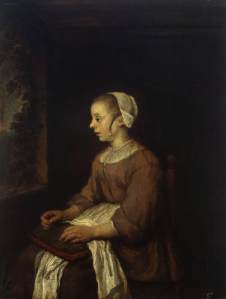
Philips Konnick, The Seamstress, 1671
Sewing dominated in the crafts and trades in which women worked, particularly in London. London’s particular customs thus brought skilled sewing work into guild management, not in terms of quality of work but as a means of incorporating training. By the late seventeenth century free single women and freemens’ wives and widows were taking apprentices in a range of seamstress and textile trades that reflected the specialised construction of garments, shoe and headwear: making children’s coats, periwigs, silk stockings, buttons, lace, gold and silver thread.
In other crafts, and outside London, Clark amassed a host of detail of the conflicts between guilds and the girls and women who found themselves on their margins. Carpenters’ wives being forbidden to unload timber, women bakers excluded from the trade for not having been apprenticed, pewterers ordered to buy no lead from women all reveal not only the arguments around inclusion, but the numbers of women working in trades which to modern eyes were ‘most unlikely’. Continue reading
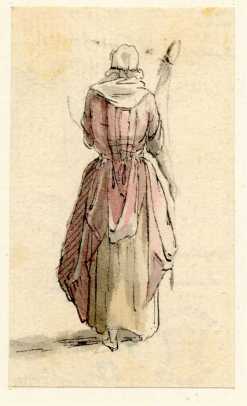 at spinning wheels that were used to illustrate early modern ballads. The term ‘hand-spinning’ describes spinning both by wheel and by distaff or drop spindle, a method which can be used while walking, as in Paul Sandby’s mid-18th century drawing of a woman carrying a distaff (courtesy of the trustees of the British Museum).
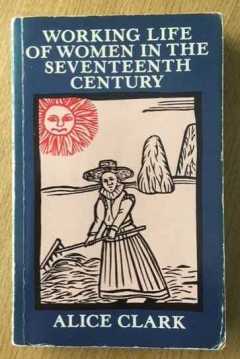 I’m reading the chapter in my 1982 edition of Alice Clark (the only history book I stole from my mother’s bookshelves), complete with a woodcut of a woman haymaking on the cover (although this image has been edited to remove the couple canoodling in the background which is present in the original below). Is this deeply significant? Probably not …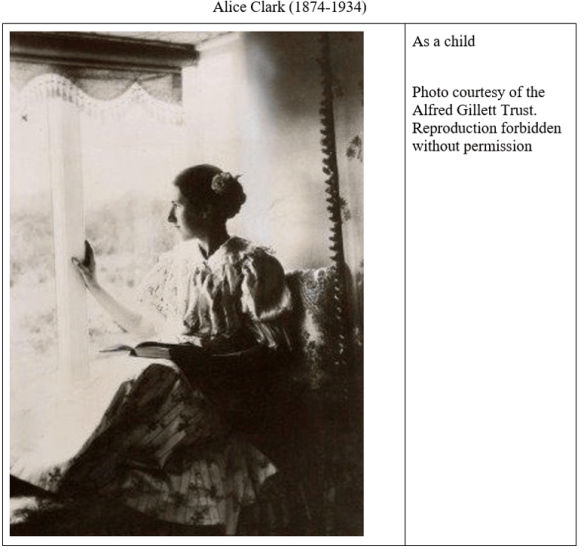
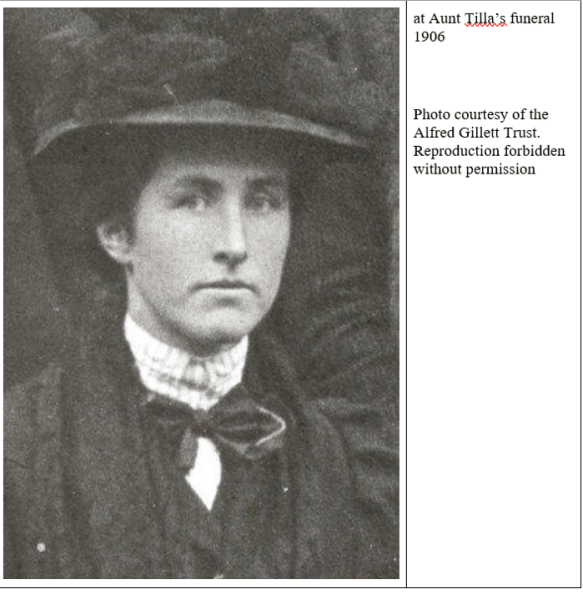
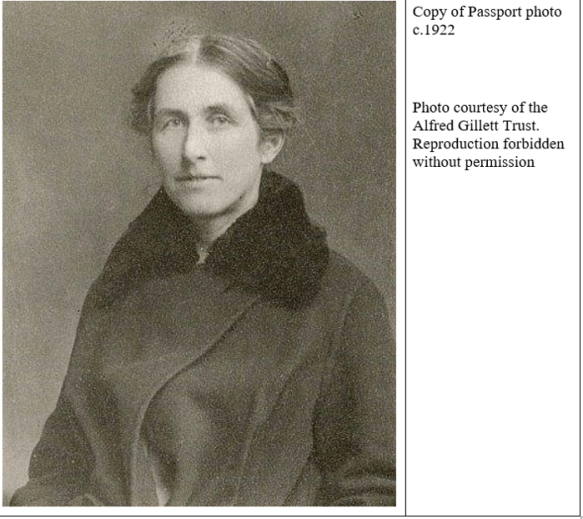
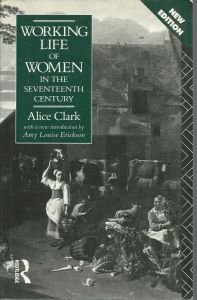 Those who have never read Alice Clark’s Working Life of Women might wonder why we would pay any attention to a work that is a hundred years old, and superseded by recent research on women. Yet anyone who works on the history of women, and particularly the history of women’s work, in early modern England owes a debt to Alice Clark’s work. It was reissued in 1982 with an introduction by Miranda Chaytor and Jane Lewis, and again in 1992 with an introduction by Amy Erickson. As Natalie Davis noted in a paper delivered at the Second Berkshire Conference in 1974, Clark consulted archives, differentiated among women, and had an overarching theory.
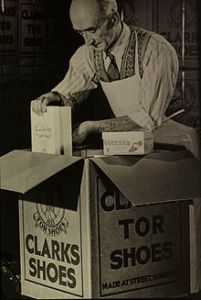 At first glance Alice Clark seems the most unlikely of historians. Due to ill health she managed only sporadic periods at school and she never went to university. She was a capitalist, not a scholar, spending most of her adult life as a director of the family business, known today as Clarks Shoes Ltd. Yet from a young age she was a voracious reader and would have joined her sister at Cambridge had her parents not felt strongly that the shoe company would benefit from the involvement of a female family member.
 the many-headed monster