The Woolcomber’s World, Part IV: Births, deaths, marriages and fighting cocks

Brodie Waddell

On 22 March 1697, ‘there were a great many fighting Cocks carried through Coxall on horsback in linen baggs’. So wrote Joseph Bufton in one of his eleven surviving notebooks.
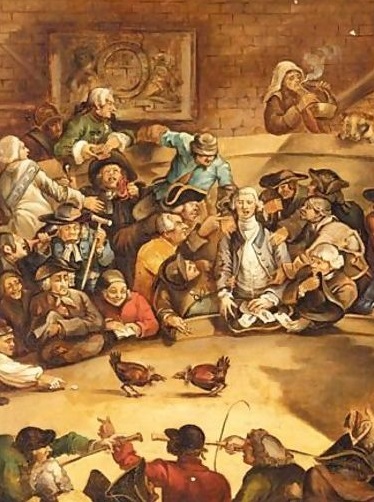
Watching to cocks tear eachother apart: not as much fun as you might imagine

Watching two birds tear each other apart: not as much fun as you might imagine

But this odd little memorandum was not an isolated scribbling. It was, in fact, just one of about 180 entries in his Coggeshall chronicle, which he began in February 1678 and continued to May 1697. In it, we find festive celebrations, church business, unusual weather, family injuries, highway robberies and much else besides.

The entries from 1693, a fairly typical year, give a sense of the whole:

  • 11 Jan. 1693, John Bufton went to combing.
  • 4 Feb. 1693, my cousin Sparhawk was carried to prison.
  • 15 Feb. 1693, there was a bonfire made by the Crown for the joy that Squire Honeywood got the day of Sir Eliab Harvey and was not cast out of the Parliament and when he came home from Chelmsford through Coxall the night after he was chosen abundance of candles were lighted for joy.
  • 24 Mar. 1693, King William went through Kelvedon and went back again through Kelvedon 28 Mar.
  • early 1693, the new king’s arms and the 10 commandments new writ were set up in the church.
  • 1693, the Quakers made a new burying place in Crouches
  • 1 May 1693, the soldiers set up a Maypole at the Woolpack door
  • 18 May 1693, the poor did rise because the Bakers would not bake, because some of their bread was cut out the day before for being too light.
  • May 1693, my cousin Sparhawk came home.
  • beginning of May 1693 Francis Clark broke.
  • end of May 1693 the same month the Poor had Badges given them to weare which tis said were made of Pewter and Coggeshall Poor 1693 set upon them.
  • 1693, Mr Mayhew sold Coxall Lordship to Mr Nehemiah Lyde of London. 11 May he came first for his rent and 5 Jun kept court and Counsellor Cox was his steward.
  • June 1693, our 4th bell was carried to Sudbury to be new shot and brought home and the other were chipt to make them tuneable. They were first rung 6 July.
  • 30 Oct. 1693, King William went through Kelvedon.
  • 2 Nov. 1693, John Ancil had hung himself but was cut down in time.
  • 1693, a new pound was set up on Grange hill and the shambles was repaired.
Continue reading

‘The Rabble that Cannot Read’? Ordinary People’s Literacy in Seventeenth-Century England

Mark Hailwood

Those of us historians intent on exploring the world of ordinary women and men in the sixteenth and seventeenth centuries conduct a lot of our research by looking at surviving examples of what such people read–for instance, cheap printed broadside ballads–or of what they wrote–take, say, Joseph Bufton’s notebooks. These materials are fascinating and undoubtedly useful, but regular readers of this blog might understandably find themselves wondering about the validity of this approach, and asking themselves a simple but important question: to what extent could the lower classes of England actually read and write in the seventeenth century?

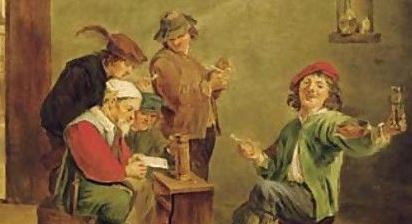
David Teniers the Younger 'Peasants Reading a Letter...' But could they?

David Teniers the Younger ‘Peasants Reading a Letter…’ But could they?

It’s a fair question, and has important implications. Does this material really provide a window into the minds of the most humble people in Tudor and Stuart society, or were reading and writing skills the preserve of the more affluent, or at least the middling, classes of society? After all, in 1691 the puritan writer Richard Baxter had described his lower-class neighbours as ‘the rabble that cannot read’. Was this fair? Continue reading

The Woolcomber’s World, Part III: Rich clothiers, poor combers and the obscurity of early modern occupations

Brodie Waddell

Whether you’re a historian, a hairdresser or a helicopter pilot, you may well define yourself by your occupation. The same was true in the early modern period, as when legal scribes added ‘labourer’, ‘weaver’ or ‘yeoman’ after each and every name in their records.

Joseph Bufton, the Essex diarist and sermon-goer, was no different in some ways. His father, John, was listed as a ‘clothier’ in at least four documents between 1645 and 1692. His brother, also John, was likewise a ‘clothier’ in 1671 and 1695. Joseph himself was described as a ‘clothier’ when he served as a trustee for a local charity in 1695 and again when he made up his will in 1718. He was, then, a clothier in a family of clothiers.

So why have I titled this series ‘The Woolcomber’s World’? I’ve used that label because Joseph Bufton was – I think – a woolcomber for most of his life, closely linked with the trades of fulling and combing throughout his time at Coggeshall.

Isaac van Swanenburg's 'The Removal of the Wool from the Skins and the Combing' (1595)

Isaac van Swanenburg’s ‘The Removal of the Wool from the Skins and the Combing’ (1595)

The evidence for this comes from yet another almanac-turned-notebook, a Goldsmith’s Almanack of 1686, which Bufton later described as the one which ‘has the orders in Comber’s book, &c.’. In it he recorded the ordinances of his guild, warrants from magistrates to protect the craft, the articles of the journeymen’s ‘purse’, and of course several lengthy poems lauding the glories of the trade. Continue reading

A Reformation Roundup

Jonathan Willis

Last week, I had the very great pleasure of organising and attending the annual meeting of the European Reformation Research Group, and attending and presenting at the bi-annual Reformation Studies Colloquium, back-to-back, at Murray Edwards College (formerly New Hall), Cambridge. I heard 36 papers over 72 hours (including my own), and on Wednesday alone I began conferencing at 9am, didn’t finish until nearly 9.45pm, and heard 14 different papers over the course of the day. What I want to do in this post is to reflect on some of what I heard, and on what it says about the exuberance of reformation studies today. I have three disclaimers. The first is the Colloquium at times had four sessions running in parallel, so my experience of the conference was incomplete, and tailored around my own interests as a historian of the English reformation. The second is that I think it would be a bit tedious to summarise every one even of the 36 papers I heard, and so I’m going to be selective, and pick out papers relating to a few of the themes that stuck out to me most prominently. That means I won’t be mentioning some brilliant work, but I don’t think that can be helped – it would be great if other delegates could add some of their highlights to the comments below! Finally, apologies if I’ve misrepresented anybody’s ideas in what follows. If that’s the case, just let me know, and I will correct it. Continue reading

Fantastic Thoresby – Part IV: An archive closure, a whale and a funny friend

Laura Sangha

This is my latest post in my long running series on the pious Leeds antiquarian Ralph Thoresby. My thanks to the Yorkshire Archeological Society for their permission to reproduce material from the Thoresby papers.

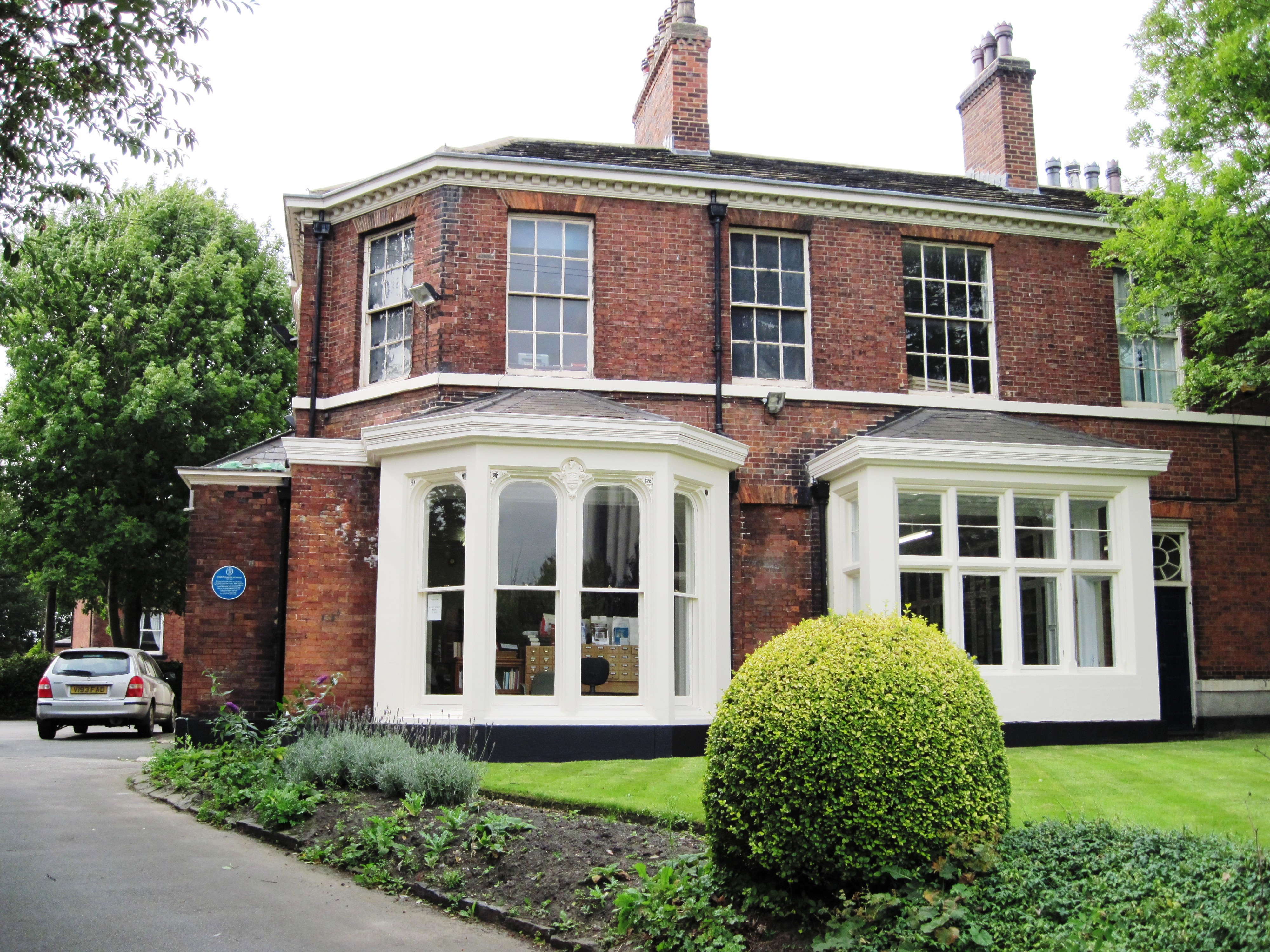
ClaremontI recently returned from an end of summer ‘smash and grab’ raid on the archive with a memory card stuffed full of hundreds of images of diary entries, correspondence and other bits and bobs from Ralph Thoresby’s papers. I consulted all of this material at the Yorkshire Archaeological Society (YAS) headquarters in Leeds, where the Thoresby Society is also currently located. Both are housed at Claremont, a splendid eighteenth-century merchants’ abode that is a delight for any student of history to work in, peaceful and accessible as it is. The staff and volunteers are very welcoming and knowledgeable, and the archivist Kirsty McHugh in particular went out of her way to accommodate me on my visit. Alas, Claremont will not provide such a salubrious environment to scholars for much longer, because lack of funds means that the Society’s Library and Historical Collections are to be moved, and Claremont is to be sold. Fortunately, the collection is to be loaned to the magnificent Brotherton Library of the University of Leeds, hopefully preserving the unique character and coherence of the whole, but nonetheless this is sad news for those who have sustained the YAS over the years, and particularly for those currently based there.

With the start of term only a week away, it is likely to be some time before I can digest the material that accompanied me back to the South West, but I did stumble across a couple of bits of found art that I wanted to share. Continue reading

The Woolcomber’s World, Part II: Finding God in seventeenth-century Essex

Brodie Waddell

Joseph Bufton spent a lot of time thinking about God. He assiduously went along to hear sermons by the local vicar and by travelling preachers. He read scores of books and pamphlets offering religious guidance. What’s more, he filled many volumes with notes and extracts from these sermons and published texts. He even tried his hand at spiritual poetry, with decidedly unimpressive results.

What, then, do we know about Bufton’s faith?

Bufton - Coggeshall parish church

The (mostly) 15th-century parish church in which Bufton spent many a Sunday

As I explained in my previous post on Bufton, almost all of our knowledge of this Essex woolcomber comes from the notes he scribbled in the margins and blank pages of eleven volumes of almanacs between the 1660s and the 1710s. As such we can learn a considerable amount about his exposure to diverse religious ideas and instruction.

However, there are limits. The volumes include only a few hints about his own personal thoughts on such matters, especially his place in the fraught religious politics of the later Stuart period. Still, the fact that eight of the eleven surviving volumes are mostly or entirely focused on spiritual concerns surely can tell us something about how a simple layman set about finding God in late seventeenth-century Coggeshall. Continue reading

The Woolcomber’s World, Part I: A life scribbled in the margins of almanacs

Brodie Waddell

On 8 August 1716, Joseph Bufton sat down to take stock of his little archive.

For about forty years, he had been filling the margins and blank pages of old almanacs with notes. He now had quite a collection and his terse list hints at their contents.

‘I reckon I have here 22 almanacks’, he wrote…

  • Seven volumes were ‘filled up chiefly with things taken out of other books’, including ‘out of a dictionary’.
  • Five were account books, some ‘of household stuff, &c.’, but others probably related to his work.
  • Three volumes were ‘out of Irish letters, &c.’, that is to say, copies of letters between Joseph and his brother John, who had removed to Ireland in 1678.
  • Two were ‘filled up with notes of sermons’ and ‘an account of funerall sermons’.
  • One was ‘filled chiefly with buriall and marriage’, chronicling the vital events of his family members and neighbours.
  • Another ‘I keep on my board and write in dayly’, though its precise contents remain a mystery.
  • One he ‘fill’d great part with Bellman’s verses’, short poems celebrating the chief annual religious and civic festivals such as Christmastide and the royal birthday.
  • A final volume recorded the rules of his trade in the form of ‘the orders in Comber’s book, &c.’

This extraordinary little library has only partly survived the ensuing centuries. Only eleven volumes – half the total noted by Bufton in 1716 – are known to remain. Eight of these are held in his native county at the Essex Record Office and another three can be found at the Brotherton Library in Leeds. Still, the fact that any escaped the rubbish heap is surely a sign of providential favour – most personal jottings of this sort were long ago destroyed by unfortunate fires, spring cleanings or damp basements.

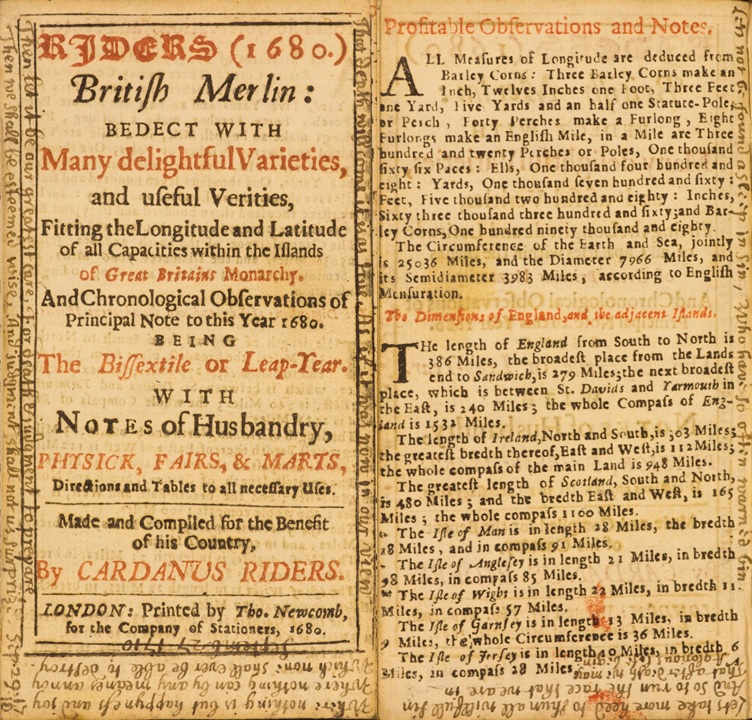
One of Bufton's almanacs, including a scrawl of notes in every available margin.

One of Bufton’s almanacs, including his scrawl of notes in every available margin.

This brings me to the question that I suspect most readers’ are now asking themselves: Who was Joseph Bufton and why should anyone care? Continue reading

Elizabethan ‘madmen’ Part III: Puritans, Plums, and a Cereal Complainer…

Jonathan Willis

I don’t know about you, but I’m always delighted and intrigued when I’m unexpectedly reminded of the humanity we share with the inhabitants of early modern England. I’ve been reading through a large quantity of godly lives recently (spiritual diaries, memoirs, biographies, books of remembrance, etc.), and if I’m honest the content is often rather unedifying – by which I mean, far, far too edifying! It’s therefore quite pleasing when, amidst the intensely personal but also strangely generic soul-searching, you come across something which gives you a flavour of the individual. This happened while I was reading the diary of Samuel Ward. Ward finished his career as a moderate, establishment puritan figure and Master of the recently founded puritan college, Sidney Sussex, Cambridge. In the 1590s, however, whilst a student (later Fellow) at Emmanuel, Ward was ‘a vigorous and outspoken puritan’.[1]

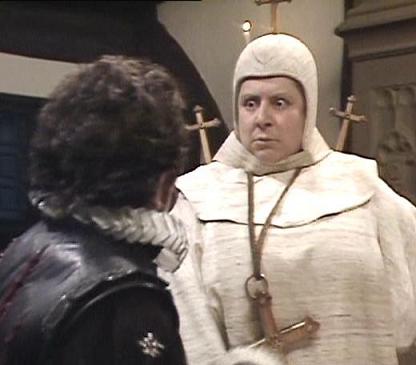
NOT historically accurate, but who can forget?  'Wicked child!'

NOT historically accurate, but who can forget? ‘Wicked child!’

Outspoken or not, though, his diary reveals his ongoing struggles with sin, and particularly with food and drink. In June 1595, for example, he recorded ‘to much drinking after supper’ on the 21st, ‘going to drink wyne, and that in the Taverne, befor I called upon God’ on the 27th, and ‘immoderate’ eating of cheese at 3 o’clock in the morning on the 22nd (perhaps a snack to satisfy the hunger cravings brought on by drinking too much the night before?). Cheese was a recurrent weakness. He recorded ‘immoderate eating of walnuts and cheese after supper’ on October 3 1595, and ‘intemperate eating of cheese after supper’ on August 13 1596. Perhaps the catalyst for this binge was the fact that, the day before, Ward recorded in his diary ‘my anger att Mr. Newhouse att supper for sayng he had eaten all the bread’. As well as bread, cheese and wine, Ward also hankered after fruit: references to damsons, plums, pears and raisins pepper his diary.[2] On 8 August 1596 Ward noted that after observing ‘my longing after damsens … I made my vow not to eat in the orchard. Oh that I could so long after Godes graces…’

Lovely cheese...

Lovely cheese…

Continue reading

Memorial and History, appendix i; in which Jonathan jumps on Laura’s bandwagon…

Jonathan Willis

This short post is inspired by Laura’s brilliant mini-series on ‘Memorial and History’, which took its own inspiration from her discovery of Exeter’s 1909 memorial to the Marian martyrs Thomas Benet and Agnes Prest.

Hearing Laura talk about Exeter made me curious about the city where I was born and raised, and which bears the somewhat ignominious dual-honour of being the location of the first documented case of medieval blood-libel (a false accusation of ritual murder against the Jewish community), and also of witnessing the execution of one of the first evangelical martyrs of the reformation. Continue reading