‘More acute and witty in his drink than at other times’…

Mark Hailwood

When Thomas Feilder was hauled before the Reading authorities in 1624, on a charge of beating up a town constable, he offered a straightforward explanation for his actions: ‘drink was the cause’, ‘he was not himself’, and ‘he knew not what he did’. But what did early modern English courts make of such claims? Was drunkenness understood to mitigate responsibility for the offence, or did such reckless inebriation compound the transgression into a double misdemeanour of assault and drunkenness?

Drinking Woodcut

This is just one of the questions I address in my latest article (that’s right, that opening vignette was just a snare to trap you into a self-promotional post). In the essay I ask – and attempt to answer, of course – a number of questions about seventeenth-century understandings of the effects of alcohol on mind and body. Did they share our concern about alcohol’s harmful impact on health, or was it considered ‘far better than any doctor in town’ for treating ailments? Was it used as an anaesthetic to numb the senses against the hardships of daily life, or did contemporaries guzzle booze because it was thought to ‘enrich all the faculties’ and act as a stimulant to mental activity? I’m dropping some clues here (let’s just say I’m not making those quotes up) but if you want to find out the full story then you should check out my ‘”It puts good reason into brains”: Popular Understandings of the Effects of Alcohol in Seventeenth-Century England’.

Cover thumbnailIt appears in a special edition of the journal Brewery History, edited by myself and Leicester lecturer Debbie Toner, under the banner of our Warwick Drinking Studies Network. It showcases the work of a number of early career scholars, and all the essays focus on aspects of early modern drinking culture, including the revolutionary introduction of hops to the brewing process (considered by some to mark the very origins of commercial capitalism. Well,WDSN Logo by me anyway); the important role played by the alewife in serving up the country’s favourite tipples; and the symbolic significance of being allowed to use the best silver at a guild feast. You can download the introduction for free here, and from here you can order a copy of the edition for the very reasonable price of £4.50.[1]


[1] An earlier draft of my article can be found on my academia.edu page, but please don’t cite from it.

Fantastic Thoresby – Part II: methinks I hear his very voice

Laura SanghaRalph Thoresby

A few posts ago I briefly introduced Ralph Thoresby, the Leeds antiquarian and diarist whose intellectual and religious pursuits have caught my attention. My intention is to make this a regular series where I offer up some little gems from the Thoresby diary, but in these initial posts I want to provide a bit of background for the entries and the reasons why they exist in the first place.

Previously I pondered in general terms why people keep diaries, and what sorts of information you might include in them, here I want to explore Thoresby’s inspiration in more depth. Continue reading

A miscellany: wandering woodcuts, Greifswald glosses, digital Defoes and Thompson tributes

Brodie Waddell

Several things have come to my attention over the last few weeks that deserve wider attention. Although I don’t have time to provide much commentary, I think our readers will find some of them of interest.

The first concerns the wonderfully rough images that so frequently appear in our posts: broadside ballad woodcuts. The Bodleian Library recently announced the launch of an image-matching tool that will allow researchers to easily search for the many versions of a specific image across the library’s whole collection of ballad sheets. Eleanor Shevlin discusses the new tool in more detail over at EMOB. In light of Mark’s posts on early modern representations of working people, it would be fascinating to know how particular ‘occupational’ images are reused and recycled in different contexts and perhaps given quite different meanings.

The second is Beat Kümin’s historical travelogue, Greifswald Glosses, exploring the largely autonomous parish communities in early modern Northern Germany. As a professor at Warwick, Beat is well-known to us here at the Monster and his blog offers a remarkable (and remarkably well-informed) look at the towns, churches, landscapes and even graffiti of this part of the former Holy Roman Empire. I think my personal favourite was the fourteenth-century gargoyle/collection-box at St Jacobi in Göttingen, but you may prefer the ruminations on low-ranked local football teams or the semi-fortified round churches of Bornholm.

The third is an amusing ‘pop history’ article in The Atlantic on Daniel Defoe’s A Journal of the Plague Year (1722). It’s a well-researched piece, based on an interview with the Defoe scholar Katherine Ellison and incorporating plenty of (anachronistic) pictures, but what makes it interesting to me it that it is written by the magazine’s tech writer. The short version of his argument is basically that Defoe was an early modern blogger and, unlike some of today’s bloggers, he approached the wealth of information provided by that era’s new technology (e.g. newspapers) with a critical eye. I’m not sure I’m actually convinced, but it’s great to see another side of early modern history (beyond Henry VIII, Shakespeare and Oliver Cromwell) receiving some thoughtful discussion in such a high profile outlet.

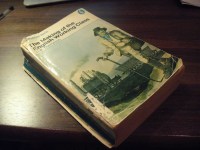
Finally, Katrina Navickas has a post at History and Today on E. P. Thompson’s The Making of the English Working Class (1963). There are, as she notes, a great many tributes and events happening this year to mark the fiftieth anniversary of its publication. However, what I enjoyed was hearing a little about her relationship with the materiality of the book itself, in all its tattered, dog-eared glory. I think I probably find myself reaching for Thompson’s Customs in Common (1991) more often than MEWC, yet I’m still strangely comforted to have a decent edition of the latter nearby. In her words, ‘despite my “digital humanism”, I still need those yellowed and annotated pages of the Penguin paperback to really get to the heart of Thompson’s writing’.

Shorter notices

Our very own Laura Sangha has set up a twitter feed for her students of ‘Religion, Society and Culture in Tudor England’: Tudorists rejoice! Grad students in and around London interested in early modern history really ought take a look at the talks hosted by the Birkbeck Early Modern society (and their tweets too). And lastly I belatedly wanted to thank the Birkbeck History PhD bloggers for reblogging one of our posts and recommend that all BBK doctoral students check them out.

[Update (07/02/13): Co-blogger Jonathan Willis is also tweeting (@CREMS_Bham) for Birmingham’s Centre for Reformation and Early Modern Studies.]

REED all about it III: Some musings on music and the micropolitics of Sabbath-breaking in Jacobethan Lancashire

Jonathan Willis

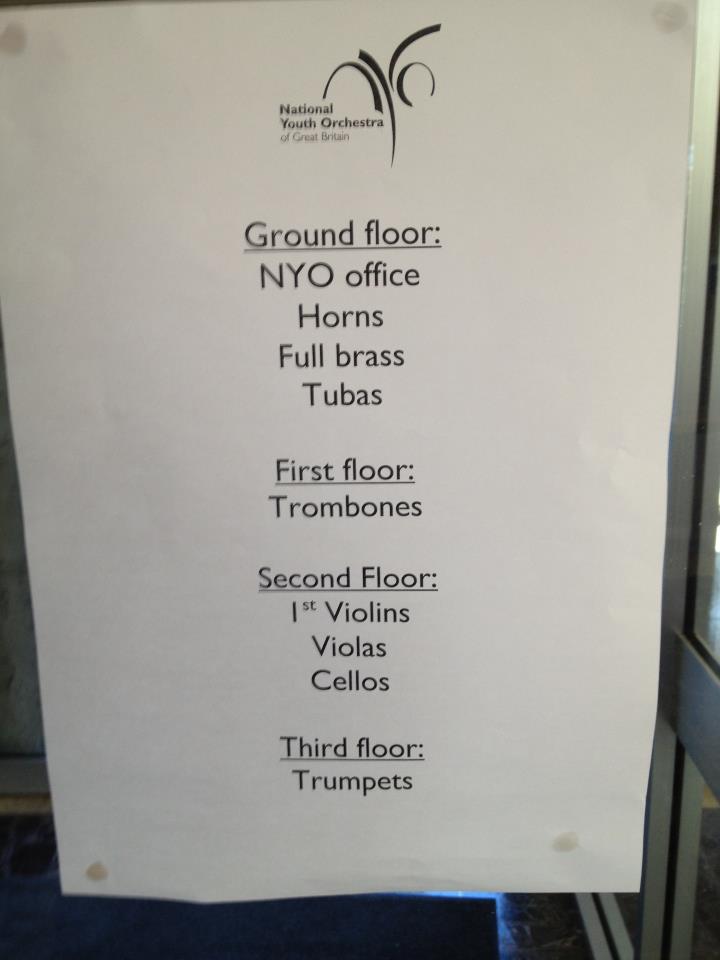
One sunny afternoon last July, the University of Birmingham’s Edgsbaston 295393_10151929538030109_359375196_ncampus played host to some rehearsals by the National Youth Orchestra of Great Britain.  Cellos, violas, tubas and trombones were scattered liberally throughout the Arts Building, and the history department itself played host to the trumpet section.  Hearing (fainter) strains of music in the department is not an uncommon occurrence, as there are student rehearsal rooms in other parts of the building.  This is usually quite enjoyable, even if it occasionally adds a melodramatic quality to meetings or supervisions.  Whether at work or home, we have all probably at some stage encountered some form of music which has permeated our environment uninvited.  Sometimes, as with the NYO or Birmingham’s budding undergraduate virtuosi, this can be an unexpected source of pleasure.  But in other situations, it can be distracting, disruptive, or downright offensive.  Uncleanness, the anthropologist Mary Douglas famously observed in her 1966 work on Purity and Danger, is ‘matter out of place’.[1]  In the same way, musical sound in the wrong spatial or chronological context can easily cross the rubicon of taste and order and become a provocative and clamorous noise.  If this is still true in the sound-proofed, double-glazed, cavity-wall insulated, noise-cancelling-headphone-wearing twenty-first century, then it was even truer in the sixteenth, where both welcome and rogue sounds must have travelled with much greater volume, clarity and conspicuousness. Continue reading

A civil war comic strip?

Brodie Waddell

Several months ago, inspired by a post by Gavin Robinson, I shared an image of a broadsheet called The Young-Mans Victory Over the Povver of the Devil that seemed to fit the definition of a comic strip. That one, dating from the 1690s, was the earliest I had found at the time and it remains my favourite of the genre, but I’ve since come across an earlier contender.

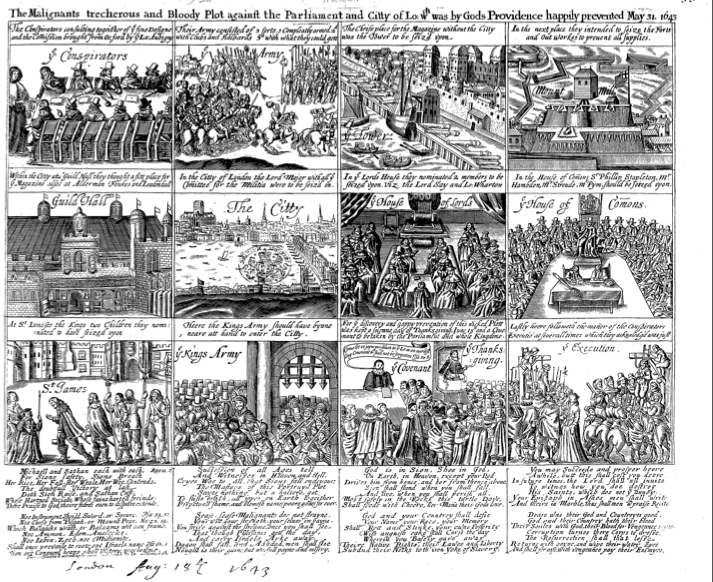
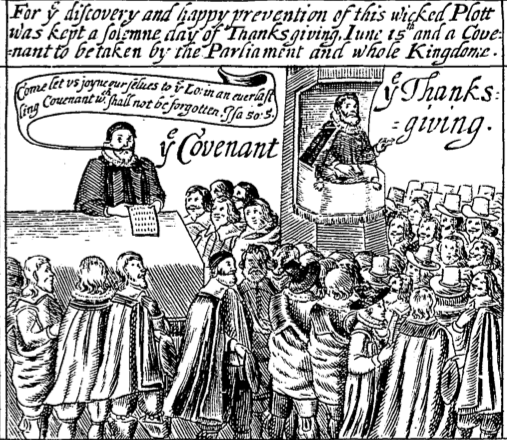
I discovered it on a wonderful blog called The 1640s Picturebook where Ian Dicker has posted dozens of images from the period along with detailed analysis of the costumes depicted. In June of last year, they posted an image of The Malignants Trecherous and Bloody Plot (1643), which depicted a plan apparently launched by the MP, Edmund Waller, bring an end to the first of the English Civil Wars. According to the confession of one of the plotters quoted in the ODNB, it began peaceably enough:

‘It came from Mr. Waller under this notion, that if we could make a moderate party here in London, to stand betwixt the gappe, and in the gappe, to unite the King and the Parliament, it would be a very acceptable work, for now the three Kingdomes lay a bleeding, and unlesse that were done there was no hopes to unite them.’

But the peace plan quickly turned to war: in its final form, the plot apparently called for an armed rising and seizure of the key points of the City in order to let the king’s army in.

The plot ended before it had begun when the plotters were betrayed and arrested. Somehow, seemingly through a mixture of powerful rhetoric and shameless bribery, Waller managed to escape the grisly punishment inflicted on some of his co-conspirators and was permitted to go into exile after only a year and a half in prison.

The Malignants Trecherous and Bloody Plot (1643) via The 1640s Picturebook.

The Malignants Trecherous and Bloody Plot (1643) via The 1640s Picturebook.

The upshot of all this was a detailed broadsheet published in August of 1643. It has twelve panels, each of which includes a running narration of the events as they unfolded, from the hatching of the conspiracy to the execution of some of the offenders.

The Malignants (1643) panel with Covenant

‘Come let us joyne our selves to the Lord in an everlasting Covenant which shall not be forgotten’, citing Jeremiah 50:5.

It even included some text in a speech bubble, said to be a key part of a ‘true’ comic strip – though as befits a seventeenth-century comic it is a quotation from scripture rather than a supervillain’s monologue.

So have we pushed the date of the first comic strip back still further? Or is this too much of a stretch?

Workers’ Representation Part Three: Mining and Modernity

Mark Hailwood

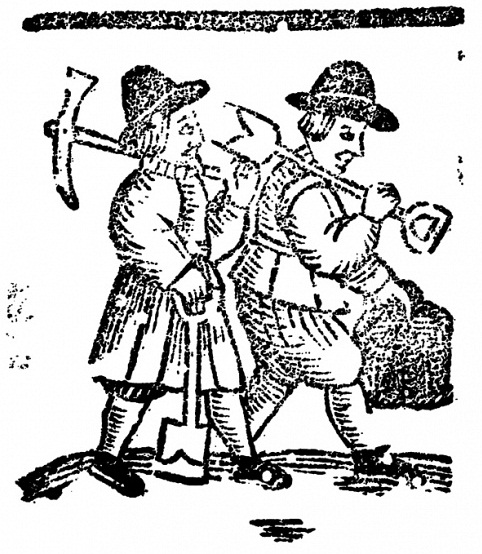
So, I thought it was about time to introduce another image of woodcut workers from my trawls through the English Broadside Ballad Archive, and what could be more appropriate than an image from a special new year’s ballad: A New-Years-Gift for Covetous Colliers, published sometime in the 1680s or 1690s. The ballad itself praises Parliament for acting against price-hiking colliers – those involved mainly in the distribution and sale of coal – but includes an image of the primary workers in the coal trade, miners:

miners

The image isn’t particularly remarkable. There is no evidence in this depiction of the hostile stereotype that miners were a ‘race apart’ from other workers; no coal-blackened faces to help symbolise this cultural otherness; no visual indicators that miners were, as Daniel Defoe put it, ‘subterranean wretches…a rude, boorish kind of people’.[1] Continue reading

A seventeenth-century Christmas: mince pies, jollity and witchcraft

Brodie Waddell

Between the large stack of papers to mark and an increasingly nocturnal ten-month-old, the planned post on microhistory has had to be postponed until the new year. However, the season calls for at least one celebratory tribute to the peculiarities of early modern Christmastide. The case of Oliver Cromwell and the mince pies has already been discussed at length elsewhere, so I suppose I’d better share another serendipitous discovery from the archives.

This time of year had long been a season of charity and hospitality. As Ronald Hutton has shown, the Twelve Days of Christmas were an occasion for feasting but also giving. He quotes Thomas Tusser, the sixteenth-century poet-farmer:

At Christmas we banquet, the rich and the poor,
Who then (but the miser) but openeth his door.1

The ‘better sort’, ranging from well-off villagers to the richest nobles, showed their generosity by inviting neighbours to dine with them and by giving alms to the poor. Or at least that is how it was supposed to work.

But a court case from Devon suggests that the season was not always so jolly. Here it seems a failure of seasonal good spirits had dire consequences. Sarah Byrd of Luppitt, testifying in 1693, tells the story: Continue reading

Call for Papers: Sin and Salvation in Reformation England

Jonathan Willis

As the tightly-sprung chaos of another academic term starts to unwind, and thoughts turn to the endless possibilities of a month of peaceful and unbroken research time (oh yes, and Christmas), my gift to you, Monster reader, is a call for papers.  But this isn’t just any call for papers!  Firstly, the vital statistics: Sin and Salvation in Reformation England is a major three-day conference taking place 26-28 June 2013 at the Shakespeare Institute, Stratford-upon-Avon.  I am organising the conference under the auspices of CREMS, the University of Birmingham’s Centre for Reformation and Early Modern Studies, with generous support from the Leverhulme Trust.  Contributions are invited from established scholars and postgraduate students alike, and it is my hope that the conference will give rise to an edited volume of essays. Themes for papers may include (but are not limited to): visual, literary, political, theological, historical, material, musical, polemical or any other treatments of the topics of sin and salvation in the context of reformation-era England. Please send abstracts of 250 words for 20-minute papers to me by 31 March 2013, and visit the CREMS website for more information.

Secondly, keynotes.  Every conference needs at least one keynote, and I’m delighted to say that we have managed to arrange an exceptional lineup of three of the most interesting and engaging scholars in the field.  Dr Arnold Hunt, has written on communion and extensively on preaching, and is currently involved with editing the parochial sermons of John Donne.  Professor Alec Ryrie has written extensively on the English reformation: his long-awaited monograph on Being Protestant in Reformation Britain is due out early next year, and he has already embarked on a new global history of Protestantism.  Professor Alexandra Walsham has written a series of ground-breaking books on the English reformation, on topics ranging from church papistry to providence and intolerance.  Her most recent work is a breathtaking account of the Reformation of the Landscape, and she is currently working on the impact of ageing and generational change on the English Reformation.

Thirdly, the conference blurb: Sin and Salvation were the two central religious preoccupations of men and women in sixteenth century England, and yet the reformation fundamentally reconfigured the theological, intellectual, social and cultural landscape in which these two conceptual landmarks were sited. The abolition of purgatory, the ending of intercessory prayer, the rejection of works of supererogation and the collapse of the medieval economy of salvation meant that it was impossible for attitudes, hopes, fears and expectations about sin and salvation to survive the reformation unchanged. This conference will explore some of the transformations and permutations which the concepts of sin and salvation underwent over the course of the reformation in England, as well as the practical consequences of these changes as lived.

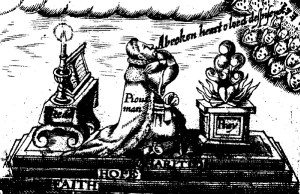
Fourthly, every call for papers needs a picture, so here is mine: part of the frontispiece from Lewis Bayly, The Practise of Pietie (1613).

Bayly[A pious man, kneeling upon a foundation of faith, hope and charity, turns from his study of the scriptures to pray: ‘A broken heart o Lord despise not’!]

Fifthly, finally, and as this is a blog entry rather than a traditional call for papers, I wanted to take a little more time to explain why I want to put this conference on, and what I hope to achieve.  I’m currently enjoying the third year of a Leverhulme Early Career Fellowship, working on ‘The Ten Commandments and the English Reformation’, and it was always my plan to host a conference during the final year of research.  Initially this was going to be a conference on the Ten Commandments, then it became one on the concept of God’s law, then on the use of the Old Testament during the reformation more broadly, then more generally on the bible.  Each successive iteration felt like I was getting closer, but I am not a biblical scholar, and so I kept putting it off and off as it didn’t quite feel right.  Finally it clicked: in a nutshell, the commandments were all about listing the things that you mustn’t do (i.e. sin), and enumerating the sort of deeds performance of which could be taken as a sign that an individual had been predestined to election (i.e. salvation).  One of many roles of the commandments in reformation England, therefore, was to help shape these fundamental concepts of sin and salvation as they slowly came to be understood by the great majority of people, through continual exposure through preaching, catechesis, the liturgy, and visual, musical, and other media.  Hopefully then, ‘Sin and Salvation in Reformation England’ will open up for exploration not only those vital concepts themselves, but also how they came to shape religious belief, practice and identity amongst the laity, and how they themselves were moulded by the experience.  A worthwhile enterprise, I’m sure you’ll agree: so, please take some time out from the sherry and mince pies, send those abstracts through to me now, and keep your eyes peeled for information about registration in the spring!

5 April 1666: ‘Sir William Penn is a total jerk’

Brodie Waddell

I’m planning to put together another post on microhistory in the next week or so, drawing on the responses to the original and my own muddled thoughts. Further comments are very welcome.

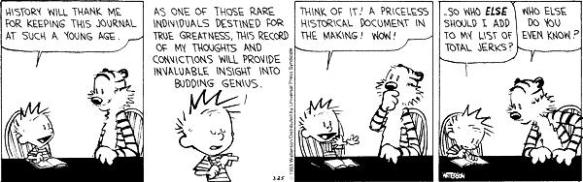
In the meantime, I thought a very brief addendum to Laura’s post on ‘dangerous diaries’ might not go amiss. As is so often the case, Bill Watterson’s Calvin and Hobbes provides valuable insights into historiographical controversies. (Even their names are historical!)

Calvin and Hobbes on journalsAs Laura pointed out, and as Calvin reminds us, it’s dangerous to take diaries at face value. Perhaps the quest for posthumous vengence explains why we find so many entries like this one, from April 1666, in Pepys’s diary:

To the office, where the falsenesse and impertinencies of Sir W. Pen would make a man mad to think of.

Beware the diarist with an axe to grind.

The Starlings Go to War

Laura Sangha

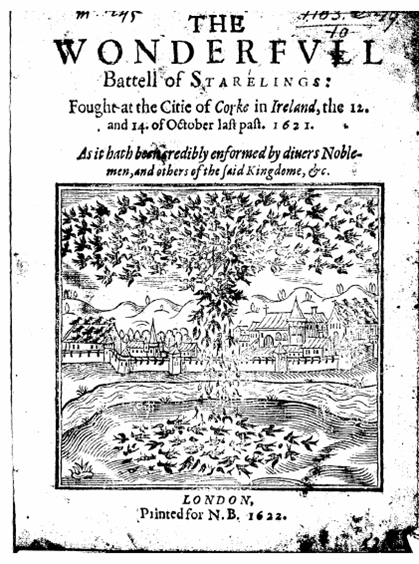
It’s that time of year when I am always reminded of one of my favourite providential pamphlets, The Wonderfull Battell of Starelings,fought at the Citie of Corke in Ireland, the 12. and 14. of October, 1621.[1] The pamphlet was published by a London printer in 1622, is short at nine pages, and it also has a wonderful woodcut that gives a graphic rendering of the events described in the text.
The pamphlet described howabout the seuenth of October last, 1621 there gathered together by degrees, an vnusual multitude of birds called Stares, in some Countries knowne by the name of Starlings’. The birds ‘mustered together … some foure of fiue daies, before they fought their battels, euery day more and more encreasing their armies with greater supplies, some came as from the East, others from the West, and so accordingly they placed themselues, and as it were encamped themselues eastward and westward about the citie’. Finally, on Saturday morning, at around nine o’clock:

vpon a strange sound and noise made as well on the one side as on the other, they forthwith at one instant tooke wing, and so mounting vp into the skyes, encountered one another, with such a terrible shocke, as the sound amazed the whole city and all the beholders. Vpon this sodaine and fierce encounter, there fell downe into the citie, and into the Riuers, multitudes of Starelings … some with wings broken, some with legs and necks broken, some with eies pickt out, some their bils thrust into the brests & sides of their aduersaries, in so strange a manner, that it were incredible except it were confirmed by letters of credit, and by eye-witnesses, with that assurance which is without all exception.

This ‘admirable and most violent battell’ continued with several more encounters between the two sides, before the birds seemed to vanish, so that on Sunday not one was seen about the city. On Monday the birds returned again for a final terrible assault, when many more wounded and dead birds fell into the streets of Cork. The pamphlet finishes with some rather brief and generic comments that the reader should not search out the reasons for such ‘ wonderfull workes of Almighty God’, but we should remember that ‘it doth prognosticate either Gods mercy to draw vs to repentance, or his iustice to punish our sinnes and wickednesse’.

The pamphlet’s description of strange events interpreted within a (loose) providential framework makes it typical for the time, and thanks to Alexandra Walsham, we can easily make sense of what at first seems to be a bizarre account.[2] We have already encountered this type of material on the monster. It is a great resource for teaching with, introducing students to the idea of the ‘difference’ of the early modern period – although there are lots of elements of this past society that seems familiar to us, material like this confronts us with the vast gap between the early modern outlook and mentality, and our own. They see God’s intervention in the world to create an unnatural event (birds aping human military activity), their interpretive framework, their means of making sense of the event is providential, it is religious.

What do we see? Probably we would see a ‘murmuration’: starlings gathering into large flocks in the autumn evenings – it is a natural event, spectacular, but perfectly normal. Our interpretive framework is not religious but scientific, the starlings are “always ready to optimally respond to an external perturbation, such as predator attack,” according to a Proceedings of the National Academy of Sciences paper.  When dead birds fall from our skies, we call in the veterinary inspectors, carry out tests, blame fireworks, the internet, UFOs – as you can see in this news report, our modern day equivalent of the early modern pamphlet.

Of course it isn’t as straightforward as that – it never is. Early modern people were not ignorant of bird behaviour, and they certainly knew about autumnal flocks, as you can see from this extract from an almanac of 1700:

Signs of Cold weather, or hard winter.

THE Suns setting in a Mist, looking Red, and Broader than usual.  The Clearness of the stars, and their much Twinkling.  Starlings, Feldefars, and other Birds of a Hot Nature, hastening in great Flocks or Flights from the Northern to the southern Climates. [3]

In fact, further investigation quickly uncovered further titbits about the birds: they were good mimics, valued for their singing, and could be caught and kept for pets.
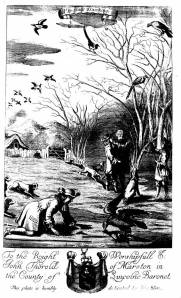
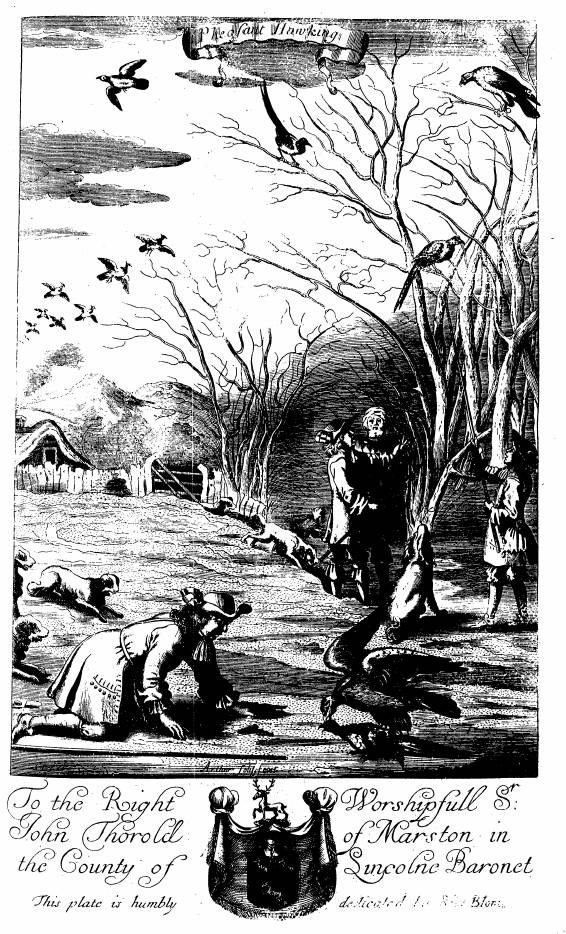
One of the many illustrations in R. Blome’s ‘Gentlemans Recreation’, this one depicts the practice of hawking.

R. Blome, The gentlemans recreation in two parts : the first being an encyclopedy of the arts and sciences … the second part treats of horsmanship, hawking, hunting, fowling, fishing, and agriculture (London, 1705).

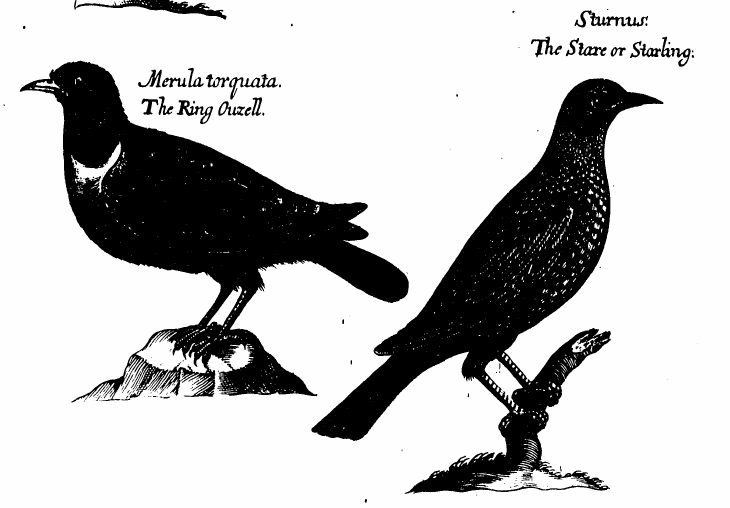
The STARLING.This is a very docile Bird, and if taken out of the Nest young is apt to learn both to walk and Whistle. ‘Tis a hardy Bird; their food is Sheeps-Hearts, or other raw Flesh, hard Eggs minced, Hemp-seed, wet Bread, and the like.

John Ray, The ornithology of Francis Willughby of Middleton in the county of Warwick Esq, fellow of the Royal Society in three books (London, 1678).

§. VII. How to take Stares with a limed string: out of Olina’s Uccelliera.Take a small string of a yard or thereabout long, bind it fast to the Tail of a Stare, having first carefully limed it all over, excepting one Palm next the bird. Having found a flock of Starlings, come as near to them as possible, holding your Stare by the wings as near as you can, and let her go to her fellows, which as soon as you shew your self to them, will presently take wing: Your tail-tied Stare endeavouring to secure her self of her liberty, thrusting her self into the middle of her fellows, will entangle many of them, and so not being able to fly, they will afford a pleasant spectacle in tumbling down to the ground: where you must be ready with a Brush or Besom to strike them down. Many other devices there are to take several sorts of birds with Lime-rods, &c. which I think needless to set down; it being not difficult for an ingenious Fowler to invent as good or better, when he shall have opportunity of taking those kinds of Birds.

Aside from this fascinating insight into just what these country folk were up to, this is a further reminder that early modern people were far from ignorant about the world around them, but that the battle of the starlings points to areas of divergence in underlying assumptions, outlooks, and technological and intellectual understandings between their society and ours. At certain moments, certain people would turn to a religious interpretation, though it is clear that this was not the only explanation on offer.
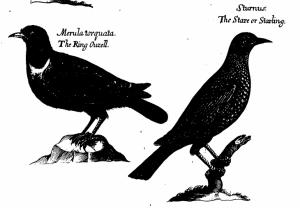
A sketch of a starling from John Ray’s ‘Ornithology’. Ray was a fellow of the Royal Society.

Of course, the significance of the battle has been attached by the pamphlet’s author, perhaps as a means to justify printing his entertaining report – a moral message makes it worthy of publication. Or maybe it was a way to appease the author’s printer Nicholas Blount, who seems to have adhered to Calvinist principles: Blount refused to print plays and other frivolous material, so the author’s religious framework was perhaps necessary concession with its roots in the world of commerce. They key thing is, that when we look beyond cheap printed pamphlets the interpretations might diversify.

The other thing that strikes me about all these birds mustering together and plummeting from the heavens, is that in some respects a certain amount of faith is needed to accept our scientific explanations. Scientists admit that starling flocks ‘transcend biology’, and that science has only a sketchy understanding of what the phenomena is all about – there is much more ‘still to be discovered’. Our modern confidence that we will eventually work it out contrasts with the early modern warning not too look into these mysteries too deeply, highlighting yet more difference. Yet there is also similarity: this clip was filmed recently in Ireland, and science alone might find it hard to explain the sense of awe in wonder inspired by the sight and sounds of the murmuration even today. The clip also makes it much easier for us to appreciate where the ‘battell’ interpretation came from. I strongly recommend that you watch the video (it gets really good about 50 seconds in), and perhaps let me know what you see.


[1] Anon, The wonderfull battell of starelings fought at the citie of Corke in Ireland, the 12. and 14. of October last past 1621 (London, 1622), STC (2nd ed.) / 5767.

[2] Alexandra Walsham, Providence in Early Modern England (Oxford: OUP, 1999).

[3] C.P., The sheepherd’s new kalender: or, The citizens & country man’s daily companion treating of most things that are useful, profitable, delightful, and advantageous to mankind (London, 1700), Wing (2nd ed.) / P11.