
This post in our After Iconophobia Online Symposium comes from Andrew Morrall, Professor and Chair of Academic Programs at the Bard Graduate Centre. Andrew has expertise and has published widely in a variety of fields, including early modern Northern European fine and applied arts, the reformation and the arts, the history and theory of ornament and the early history of collecting. Here he reflects upon the field of domestic imagery, and its relationship to Collinson’s thesis.
This contribution to the After Iconophobia workshop consisted chiefly in suggesting a number of perceived blind spots with regard to Collinson’s theory of “creeping aesthetic totalitarianism” in the sphere of Protestant visual culture in later Elizabethan England, in the light of subsequent scholarship.[1] Collinson’s argument is that between the years c.1570 to c.1600, there occurred a definitive and radical shift from a visual to a logo-centric culture, during which the religious image was apparently so completely removed from the culture that it was worth the author positing the question of the generation that grew up within those years:
“What do we know of the capacity to form mental pictures of someone who has never seen an actual picture? What would our mind’s eye of Christ be if we had been totally isolated from the Christian iconographical tradition”? (p. 296).


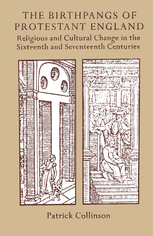 I began my undergraduate career convinced that I wanted to be a historian, but entirely unsure which bit of the past I should dedicate my life to unlocking. Patrick Collinson’s Birthpangs of Protestant England (1988) – of which a revised version of his Stenton Lecture From Iconoclasm to Iconophobia (1986) formed a part – was one of four books (the others being John Bossy’s Christianity in the West (1985), Robert Scribner’s For the Sake of Simple Folk (1981) and Alexandra Walsham’s Providence in Early Modern England (1999)) which convinced me that the Reformation was the thing for me. In each case I became so absorbed in reading them that all sense of time lapsed. I emerged from their pages to discover that day had become night and in one instance a grumpy porter had to inform me rather briskly that the library was now closing. Such was their power that over a decade later I can still remember exactly where in the Morrell Library at the University of York I was sitting when I first encountered each author: remarkable experiences in an otherwise unremarkable building.
 In 1985, Patrick Collinson delivered Reading University’s Stenton lecture on the topic ‘From Iconoclasm to Iconophobia: the Cultural Impact of the Second English Reformation.’ More than thiry years on, this essay (published in pamphlet form in 1986 and in revised form as Chapter 4 of The Birthpangs of Protestant England) has gone on to shape a generation of scholarly enquiry into the impact of religion on culture, and of culture on religion, in post-reformation England. Scholars have accepted, rejected, and modified Collinson’s arguments, but one way or another they continue to exert a powerful influence over reformation studies today.

