
This post in our After Iconophobia Online Symposium comes from Malcolm Jones, former senior lecturer in the Department of English Language and Linguistics at the University of Sheffield, and author of The Print in Early Modern England. Malcolm also has more than 70 Pinterest boards with examples of early modern visual culture. Here he reflects upon the implications that surviving single-sheet prints in the period c.1580-c.1620 have for Collinson’s ‘iconoclasm to iconophobia’ thesis.
When first I came across Patrick Collinson’s statement in From Iconoclasm to Iconophobia, that by ‘iconophobia’, in the period c.1580-c.1620,[1] his ‘Second Reformation’, he intended, “the total repudiation of all images” (p.8), I was non-plussed, but I assume he meant “the total repudiation of all religious images”, or “of all overtly representational religious images”, or something along those lines, rather than a quasi-Islamic ban on all representational imagery in those decades, and I have proceeded on that understanding.
His meaning is perhaps clarified in the final section of his lecture which is devoted to “pictorial art and its creeping disappearance as a means of communicating religious knowledge and arousing moral virtue”, but even here he specifically excludes from consideration emblems, and “secular didactic, decorative, ceremonial and heraldic” art (p.22). By apparently ruling out of consideration ‘decorative’ art, he thus glosses over the entire wealth of religious imagery which Tara Hamling has recently brought to our attention in “Decorating the ‘Godly’ Household”.


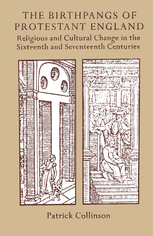 I began my undergraduate career convinced that I wanted to be a historian, but entirely unsure which bit of the past I should dedicate my life to unlocking. Patrick Collinson’s Birthpangs of Protestant England (1988) – of which a revised version of his Stenton Lecture From Iconoclasm to Iconophobia (1986) formed a part – was one of four books (the others being John Bossy’s Christianity in the West (1985), Robert Scribner’s For the Sake of Simple Folk (1981) and Alexandra Walsham’s Providence in Early Modern England (1999)) which convinced me that the Reformation was the thing for me. In each case I became so absorbed in reading them that all sense of time lapsed. I emerged from their pages to discover that day had become night and in one instance a grumpy porter had to inform me rather briskly that the library was now closing. Such was their power that over a decade later I can still remember exactly where in the Morrell Library at the University of York I was sitting when I first encountered each author: remarkable experiences in an otherwise unremarkable building.
 In 1985, Patrick Collinson delivered Reading University’s Stenton lecture on the topic ‘From Iconoclasm to Iconophobia: the Cultural Impact of the Second English Reformation.’ More than thiry years on, this essay (published in pamphlet form in 1986 and in revised form as Chapter 4 of The Birthpangs of Protestant England) has gone on to shape a generation of scholarly enquiry into the impact of religion on culture, and of culture on religion, in post-reformation England. Scholars have accepted, rejected, and modified Collinson’s arguments, but one way or another they continue to exert a powerful influence over reformation studies today.

 the many-headed monster