A civil war comic strip?

Brodie Waddell

Several months ago, inspired by a post by Gavin Robinson, I shared an image of a broadsheet called The Young-Mans Victory Over the Povver of the Devil that seemed to fit the definition of a comic strip. That one, dating from the 1690s, was the earliest I had found at the time and it remains my favourite of the genre, but I’ve since come across an earlier contender.

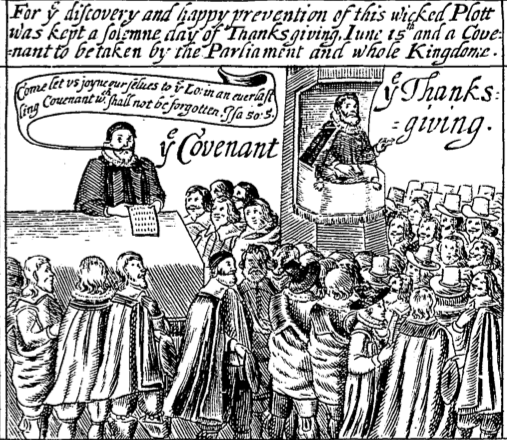
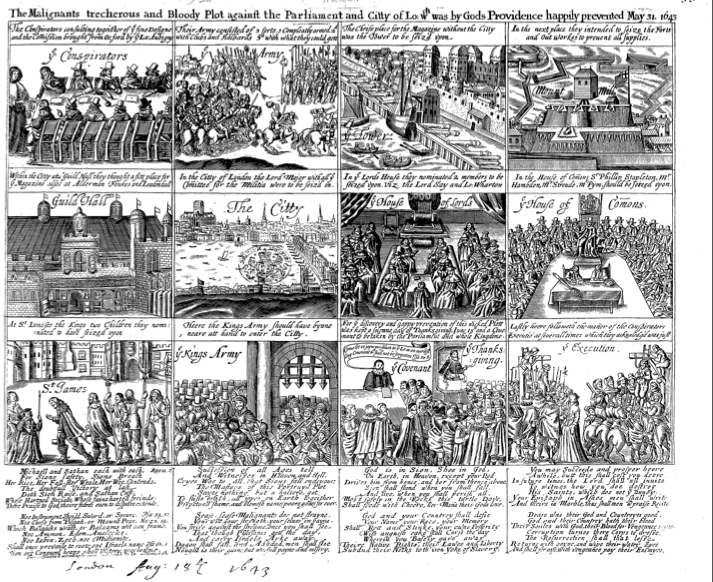
I discovered it on a wonderful blog called The 1640s Picturebook where Ian Dicker has posted dozens of images from the period along with detailed analysis of the costumes depicted. In June of last year, they posted an image of The Malignants Trecherous and Bloody Plot (1643), which depicted a plan apparently launched by the MP, Edmund Waller, bring an end to the first of the English Civil Wars. According to the confession of one of the plotters quoted in the ODNB, it began peaceably enough:

‘It came from Mr. Waller under this notion, that if we could make a moderate party here in London, to stand betwixt the gappe, and in the gappe, to unite the King and the Parliament, it would be a very acceptable work, for now the three Kingdomes lay a bleeding, and unlesse that were done there was no hopes to unite them.’

But the peace plan quickly turned to war: in its final form, the plot apparently called for an armed rising and seizure of the key points of the City in order to let the king’s army in.

The plot ended before it had begun when the plotters were betrayed and arrested. Somehow, seemingly through a mixture of powerful rhetoric and shameless bribery, Waller managed to escape the grisly punishment inflicted on some of his co-conspirators and was permitted to go into exile after only a year and a half in prison.

The Malignants Trecherous and Bloody Plot (1643) via The 1640s Picturebook.

The Malignants Trecherous and Bloody Plot (1643) via The 1640s Picturebook.

The upshot of all this was a detailed broadsheet published in August of 1643. It has twelve panels, each of which includes a running narration of the events as they unfolded, from the hatching of the conspiracy to the execution of some of the offenders.

The Malignants (1643) panel with Covenant

‘Come let us joyne our selves to the Lord in an everlasting Covenant which shall not be forgotten’, citing Jeremiah 50:5.

It even included some text in a speech bubble, said to be a key part of a ‘true’ comic strip – though as befits a seventeenth-century comic it is a quotation from scripture rather than a supervillain’s monologue.

So have we pushed the date of the first comic strip back still further? Or is this too much of a stretch?

Microhistory: subjects, sources, anti-fascists and Adam

Brodie Waddell

Microhistory is, it seems, a many-headed sort of beast.

In my previous post I suggested that, despite its name, ‘microhistories’ were not simply ‘small histories’ and asked what might make microhistorians distinct:

Is it their interest in ‘strange and bizarre events and socially marginal peoples’? Or the personal nature of their sources? Or their reflective and open discussions of methodology and the limits of historical knowledge? Or perhaps it is really a ‘continental thing’, well beyond the abilities of us depressingly practical Anglos on this side of the Channel?

The responses I received in comments (and by email) were very helpful as it soon became obvious that there were many other possibilities that had never occurred to me. Indeed, I received not just five responses, but at least double that number of potential ‘defining features’. Here, however, I will just focus on four issues.

The characteristic that came up most often was the notion of focusing on the ‘exceptional’, ‘unique’, and ‘extraordinary’. This is something that both Laura and Nancy emphasised in their comments as well as a point made one of the pioneers of the genre, Giovanni Levi, who claimed it involved taking seriously things regarded by others as quirky or deviant.1 In Nancy’s words, ‘these studies use the documentation of peculiarity as a point of entry into the ordinary, daily lives of marginal or low-status persons’.2 However, this feature of microhistory also opens it up to critique. As Steve Hindle pointed out in a recent talk (which he kindly passed along in response to my original post), discerning the relationship between ‘the particular’ and ‘the general’ is even more fraught in cases like these where one’s primary subject is undeniably ‘unrepresentative’.3

Another feature that several people mentioned was an explicit engagement with methodological issues. As Nick noted in his comment, microhistories often adapt interdisciplinary approaches, ‘read against the grain’ and acknowledge the important role of imaginative or speculative reconstructions in the absence of conclusive evidence. Laura too suggests that this might ‘be at the core of what “microhistory” is’. In Levi’s reflections on the genre, this forthright discussion of the ambiguities and partialities inherent in narrative sources – such as depositions in inquisitorial courts – is a key element in these histories.4

Perhaps these two recurring features, rather than their scale, are what give microhistories their distinctiveness.

But I think it is worth pushing further, because subjects and methods and even styles can only provide a rather ‘unhistorical’ definition of a historiographical genre. (Note: If you’re an undergrad looking for a straightforward definition of ‘microhistory’, you can stop reading now.)

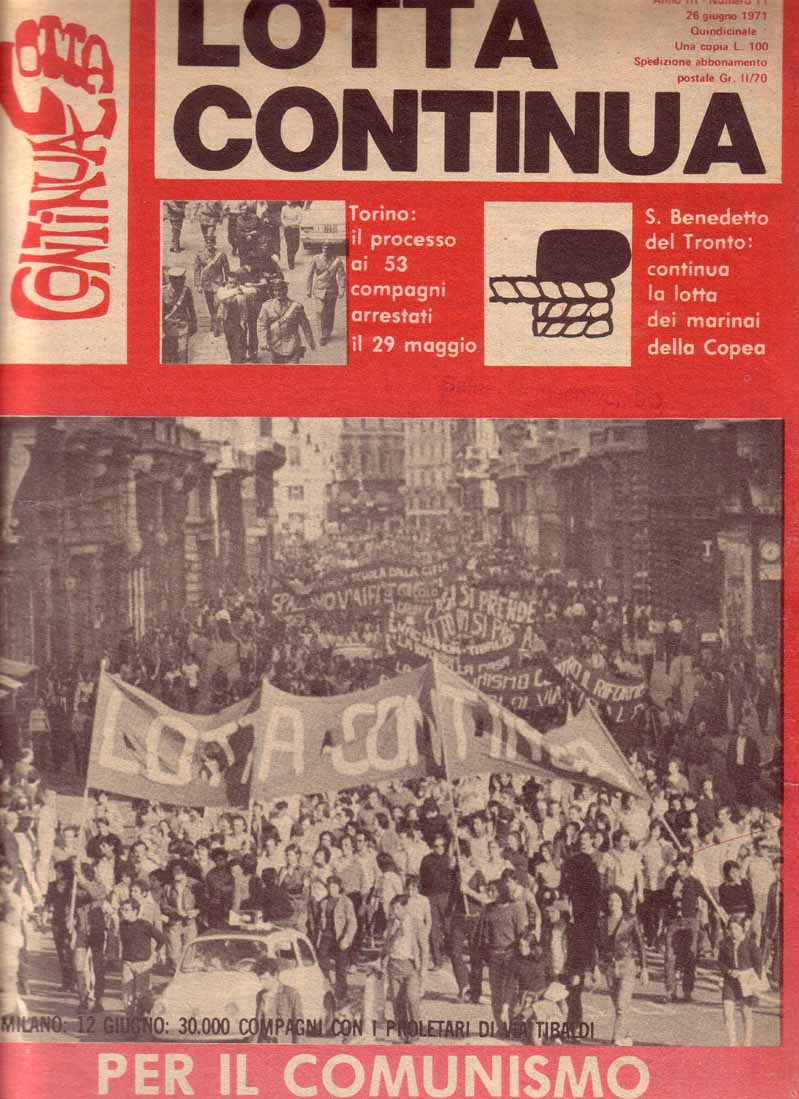
Let’s start with politics. Nick mentioned that he associated this type of history with ‘the Lotta Continua 1971left’, a link that I hadn’t considered. I think he may be right: the ‘founder’ of the genre, Carlo Ginzburg, wrote a whole book deconstructing and critiquing the murder trial of an activist linked to the Italian leftist group, ‘Lotta Continua’.5 Similarly, the other ‘founder’, Giovanni Levi, has suggested that innovative historical methods can help to explain continuities between the present and the past that ‘neoliberalism’ tries to suppress. In fact Ginzburg and Levi both appear to take some of their inspiration from their Jewish identity and militant anti-fascist heritage. I’d welcome comments from any readers who know of additional (or contrary) examples, but what I think this ought to remind us is that even historiographical traditions that are not explicitly politicised still emerge from specific historical – and thus political – contexts. Microhistory is no exception.

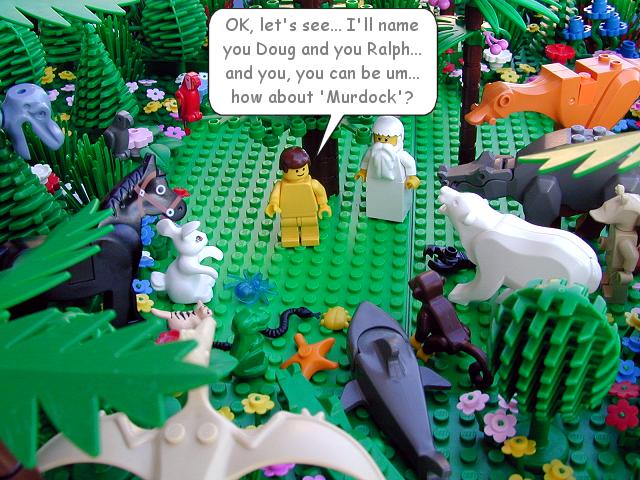
The second issue is nomenclature. For, as Laura pointed out, if we want to find a definition we also need to ask a question: Who decides what is and isn’t ‘proper microhistory’? The power to name things is a very great power indeed, one traditionally reserved for deities and patriarchs.6 Part of the genius of Ginzburg and Levi was simply

Genesis 2:19-20 at the Brick Testament

Genesis 2:19-20 via The Brick Testament

their ability to come up with a concise, memorable term (microstoria) for what they were doing and to convince others to go along with it. This becomes clear when one realises that the word itself had already been used by an American historian, George R. Stewart in the title of one of his books more than a decade before the Italians took it up.7 Stewart may have coined the term, but it was only when Ginzburg and Levi turned it into a ‘brand’ that it became a widely acknowledged and widely imitated genre of history. It was then that it moved beyond the literal notion of a ‘small history’ to acquire all of these associations with specific types of subjects, methods and politics.

Here, at last, we have an explanation for why certain works of history which seem to fit the literal definition of ‘microhistory’ – such as E. P. Thompson’s Whigs and Hunters (1975) or Wrightson and Levine’s Poverty and Piety (1979) – are rarely granted that label. Ultimately, it comes down to politics, power and a damn good marketing campaign.

Footnotes

1 Giovanni Levi, ‘On Microhistory’, in Peter Burke (ed.), New Perspectives on Historical Writing (1991). Thanks to Steve Hindle for drawing my attention to this.

2 For an excellent recent example of this approach (including some ‘microhistories’ and some not), see The Extraordinary and the Everyday in Early Modern England: Essays in Celebration of the Work of Bernard Capp, edited by Garthine Walker and Angela McShane (2009). If you are interested in the connection between ‘microhistory’ and its ‘extraordinary’ antecedents in eighteenth and nineteenth-century ‘compilations of crimes, trials and other strange-but-true stories’, you might want to apply for a fully-funded PhD studentship on that topic at Ghent University in Belgium.

3 Steve Hindle, ‘Reducing the Scale of Historical Observation: Micro-history, Alltagsgeschichte, Local History’, at Huntington Library, Early Modern Studies Institute, ‘Past Tense’, 19 October 2012. There should be a podcast of this talk available soon at which point I will update with a link.

4 Levi, ‘On Microhistory’.

5 Carlo Ginzburg, The Judge and the Historian: Marginal Notes and a Late-Twentieth-century Miscarriage of Justice (1999).

6 Genesis 2:19 – ‘And out of the ground the LORD God formed every beast of the field, and every fowl of the air; and brought them unto Adam to see what he would call them: and whatsoever Adam called every living creature, that was the name thereof.’ See also this interesting recent post by Daniel Little on the nomenclature of ‘the human sciences’.

7 George R. Stewart, Pickett’s Charge: A Microhistory of the Final Charge at Gettysburg, July 3, 1863 (1959).

Workers’ Representation Part Three: Mining and Modernity

Mark Hailwood

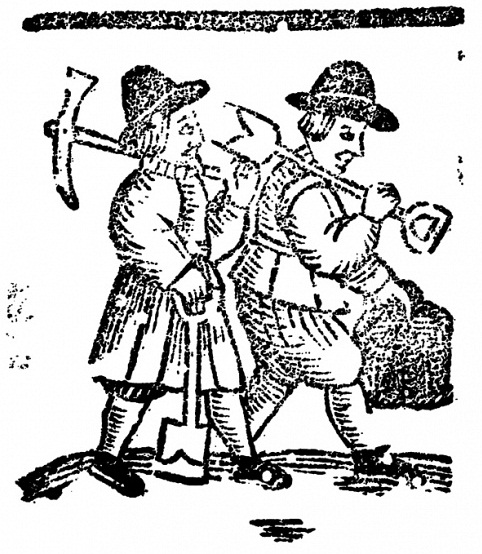
So, I thought it was about time to introduce another image of woodcut workers from my trawls through the English Broadside Ballad Archive, and what could be more appropriate than an image from a special new year’s ballad: A New-Years-Gift for Covetous Colliers, published sometime in the 1680s or 1690s. The ballad itself praises Parliament for acting against price-hiking colliers – those involved mainly in the distribution and sale of coal – but includes an image of the primary workers in the coal trade, miners:

miners

The image isn’t particularly remarkable. There is no evidence in this depiction of the hostile stereotype that miners were a ‘race apart’ from other workers; no coal-blackened faces to help symbolise this cultural otherness; no visual indicators that miners were, as Daniel Defoe put it, ‘subterranean wretches…a rude, boorish kind of people’.[1] Continue reading

A seventeenth-century Christmas: mince pies, jollity and witchcraft

Brodie Waddell

Between the large stack of papers to mark and an increasingly nocturnal ten-month-old, the planned post on microhistory has had to be postponed until the new year. However, the season calls for at least one celebratory tribute to the peculiarities of early modern Christmastide. The case of Oliver Cromwell and the mince pies has already been discussed at length elsewhere, so I suppose I’d better share another serendipitous discovery from the archives.

This time of year had long been a season of charity and hospitality. As Ronald Hutton has shown, the Twelve Days of Christmas were an occasion for feasting but also giving. He quotes Thomas Tusser, the sixteenth-century poet-farmer:

At Christmas we banquet, the rich and the poor,
Who then (but the miser) but openeth his door.1

The ‘better sort’, ranging from well-off villagers to the richest nobles, showed their generosity by inviting neighbours to dine with them and by giving alms to the poor. Or at least that is how it was supposed to work.

But a court case from Devon suggests that the season was not always so jolly. Here it seems a failure of seasonal good spirits had dire consequences. Sarah Byrd of Luppitt, testifying in 1693, tells the story: Continue reading

Call for Papers: Sin and Salvation in Reformation England

Jonathan Willis

As the tightly-sprung chaos of another academic term starts to unwind, and thoughts turn to the endless possibilities of a month of peaceful and unbroken research time (oh yes, and Christmas), my gift to you, Monster reader, is a call for papers.  But this isn’t just any call for papers!  Firstly, the vital statistics: Sin and Salvation in Reformation England is a major three-day conference taking place 26-28 June 2013 at the Shakespeare Institute, Stratford-upon-Avon.  I am organising the conference under the auspices of CREMS, the University of Birmingham’s Centre for Reformation and Early Modern Studies, with generous support from the Leverhulme Trust.  Contributions are invited from established scholars and postgraduate students alike, and it is my hope that the conference will give rise to an edited volume of essays. Themes for papers may include (but are not limited to): visual, literary, political, theological, historical, material, musical, polemical or any other treatments of the topics of sin and salvation in the context of reformation-era England. Please send abstracts of 250 words for 20-minute papers to me by 31 March 2013, and visit the CREMS website for more information.

Secondly, keynotes.  Every conference needs at least one keynote, and I’m delighted to say that we have managed to arrange an exceptional lineup of three of the most interesting and engaging scholars in the field.  Dr Arnold Hunt, has written on communion and extensively on preaching, and is currently involved with editing the parochial sermons of John Donne.  Professor Alec Ryrie has written extensively on the English reformation: his long-awaited monograph on Being Protestant in Reformation Britain is due out early next year, and he has already embarked on a new global history of Protestantism.  Professor Alexandra Walsham has written a series of ground-breaking books on the English reformation, on topics ranging from church papistry to providence and intolerance.  Her most recent work is a breathtaking account of the Reformation of the Landscape, and she is currently working on the impact of ageing and generational change on the English Reformation.

Thirdly, the conference blurb: Sin and Salvation were the two central religious preoccupations of men and women in sixteenth century England, and yet the reformation fundamentally reconfigured the theological, intellectual, social and cultural landscape in which these two conceptual landmarks were sited. The abolition of purgatory, the ending of intercessory prayer, the rejection of works of supererogation and the collapse of the medieval economy of salvation meant that it was impossible for attitudes, hopes, fears and expectations about sin and salvation to survive the reformation unchanged. This conference will explore some of the transformations and permutations which the concepts of sin and salvation underwent over the course of the reformation in England, as well as the practical consequences of these changes as lived.

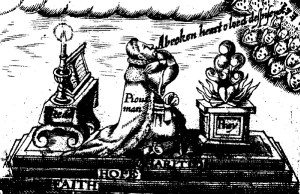
Fourthly, every call for papers needs a picture, so here is mine: part of the frontispiece from Lewis Bayly, The Practise of Pietie (1613).

Bayly[A pious man, kneeling upon a foundation of faith, hope and charity, turns from his study of the scriptures to pray: ‘A broken heart o Lord despise not’!]

Fifthly, finally, and as this is a blog entry rather than a traditional call for papers, I wanted to take a little more time to explain why I want to put this conference on, and what I hope to achieve.  I’m currently enjoying the third year of a Leverhulme Early Career Fellowship, working on ‘The Ten Commandments and the English Reformation’, and it was always my plan to host a conference during the final year of research.  Initially this was going to be a conference on the Ten Commandments, then it became one on the concept of God’s law, then on the use of the Old Testament during the reformation more broadly, then more generally on the bible.  Each successive iteration felt like I was getting closer, but I am not a biblical scholar, and so I kept putting it off and off as it didn’t quite feel right.  Finally it clicked: in a nutshell, the commandments were all about listing the things that you mustn’t do (i.e. sin), and enumerating the sort of deeds performance of which could be taken as a sign that an individual had been predestined to election (i.e. salvation).  One of many roles of the commandments in reformation England, therefore, was to help shape these fundamental concepts of sin and salvation as they slowly came to be understood by the great majority of people, through continual exposure through preaching, catechesis, the liturgy, and visual, musical, and other media.  Hopefully then, ‘Sin and Salvation in Reformation England’ will open up for exploration not only those vital concepts themselves, but also how they came to shape religious belief, practice and identity amongst the laity, and how they themselves were moulded by the experience.  A worthwhile enterprise, I’m sure you’ll agree: so, please take some time out from the sherry and mince pies, send those abstracts through to me now, and keep your eyes peeled for information about registration in the spring!

5 April 1666: ‘Sir William Penn is a total jerk’

Brodie Waddell

I’m planning to put together another post on microhistory in the next week or so, drawing on the responses to the original and my own muddled thoughts. Further comments are very welcome.

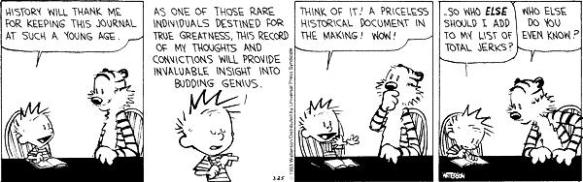
In the meantime, I thought a very brief addendum to Laura’s post on ‘dangerous diaries’ might not go amiss. As is so often the case, Bill Watterson’s Calvin and Hobbes provides valuable insights into historiographical controversies. (Even their names are historical!)

Calvin and Hobbes on journalsAs Laura pointed out, and as Calvin reminds us, it’s dangerous to take diaries at face value. Perhaps the quest for posthumous vengence explains why we find so many entries like this one, from April 1666, in Pepys’s diary:

To the office, where the falsenesse and impertinencies of Sir W. Pen would make a man mad to think of.

Beware the diarist with an axe to grind.

Microhistory: size matters

Brodie Waddell

Last week I had the privilege of attending a workshop on ‘Writing Microhistories’ at Jesus College, Cambridge. It was quite simply an excellent event, due partly to the healthy diversity of speakers – from eminent sages like Keith Wrightson to a gaggle of precocious grad students – and partly to the (uncharacteristically) loose, informal nature of the discussion. It was the questions and conversations, rather than just the papers themselves, that made the day so stimulating.

The workshop had a whole series of highlights, including Wrightson’s ruminations on famous Geordies and some juicy gossip with the grad students over post-workshop drinks. However, I’d like to hone in on one particular question that came up in a variety of forms that day: Are ‘microhistories’ about scale? 1

The term ‘microhistory’ will probably be very familiar to most of you, but I’ll borrow from the summary provided by Duane Corpis for an interesting looking course at Cornell as it’s a solid introduction and easily accessible:

Microhistory is a particular methodological approach to the study and writing of history. The aim of microhistory is to present especially peculiar moments in the past by focusing on the lives and activities of a discrete person or group of people. By illuminating the trials and tribulations of ordinary people in their everyday lives, microhistory aims to show both the extent of and the limits upon human agency, i.e. the ability of individuals to make meaningful choices and undertake meaningful actions in their lives. By analyzing what might often seem to modern readers as strange and bizarre events and socially marginal peoples, microhistory offers a more inclusive understanding of who and what matters within the discipline of history. By emphasizing everyday life, microhistory forces us to re-think traditional approaches to history that focus on seemingly more important political events and actors. Finally, by looking at the “micro” level of social activities and cultural meaning, microhistory challenges approaches to the study of history that emphasize the need to quantify, generalize, or naturalize human experience or to find and impose normative and abstract historical laws, structures, or processes on the historical changes of the past.2

The prefix that separates ‘microhistory’ from other ‘history’ suggests that its defining feature is its size, namely it is history on a small scale. Certainly the most famous studies with this label focus on only a single person or place. The book that supposedly started it all – Carlo Ginzburg’s The Cheese and the Worms (1976) – illuminates the peculiar world of a sixteenth-century Italian miller. Natalie Zemon Davis concentrated on a French peasant couple in The Return of Martin Guerre (1983) and Robert Darton’s ‘The Great Cat Massacre’ (1984) zoomed in on the actions of a small group of apprentices on a particular street in 1730s Paris. All of these studies share a scope that is severely and unapologetically limited when compared to more traditional histories.

The tools of the trade?

Yet etymology can be deceptive, because ‘microhistories’ seem to be more – or maybe less – than simply ‘small histories’. Although many of these histories centre on the lives of a single individual (Menocchio the miller, Bertrande the wife, Ralph the scrivener, Benedetta the nun), they are not biographies. Likewise, biographies of the great and the good are not microhistories despite the fact that they limit themselves to the story of a single life. Ian Gentle’s recent history of Oliver Cromwell may be academically rigorous and intellectually stimulating but it is somehow fundamentally different from Ginzburg’s Menocchio or Davis’s Bertrande.

In a related way, I think microhistory is distinct from local history. Here too similarities of scale mask innate differences. Emmanuel Le Roy Ladurie’s narrative of medieval Montaillou (1975) is the story of a whole village, not merely a single extraordinary individual or family – it explores the lives of all the villagers, heretical and orthodox alike. Yet Montaillou is almost always categorised as ‘microhistory’ whereas an equally famous and important local study, W.G. Hoskins’ book on Wigston Magna (1959), is not. The well-known histories of early modern Terling (1979) and Whickham (1992) by Keith Wrightson and David Levine went even further. Like ‘microhistories’, they were deeply analytical and challenged prevailing interpretations, almost the exact opposite of the antiquarianism of old-fashioned English local history. Nonetheless, they still appear to me to be essentially different from the explorations of Montereale, Artigat, Montaillou and la Rue Saint-Séverin offered by Ginzburg, Davis, Le Roy Ladurie and Darnton.

So, if ‘microhistories’ are not simply ‘small histories’, what makes them distinct? Is it their interest in ‘strange and bizarre events and socially marginal peoples’? Or the personal nature of their sources? Or their reflective and open discussions of methodology and the limits of historical knowledge? Or perhaps it is really a ‘continental thing’, well beyond the abilities of us depressingly practical Anglos on this side of the Channel?

I’d really like to hear your thoughts, which I hope will be the starting point for a subsequent post.

[Update: The follow-up is here]

Footnotes

1 I should also thank the MA students in my seminar at Birkbeck a couple of weeks ago, who had plenty of interesting things to say about the issue of ‘scale’, and two colleagues – Samantha Shave and Mark Hailwood – who discussed this with me over coffee.

2 Duane Corpis, course description for ‘Deviants, Outcasts & other “Others”: Microhistory and Marginality in Early Modern Europe’ (2010). See also the Wikipedia entry, which is a bit less helpful, or this article by Ginzburg (gated; ungated) and the many others available on JSTOR.

The Starlings Go to War

Laura Sangha

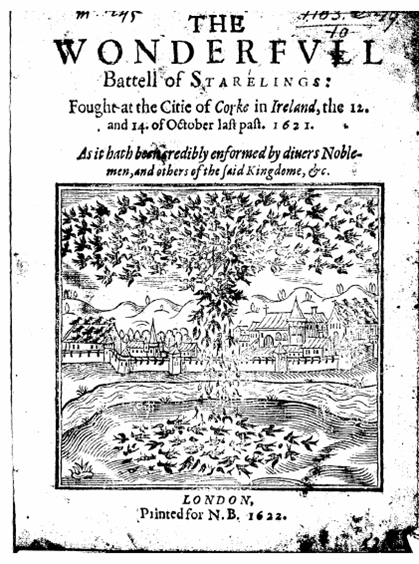
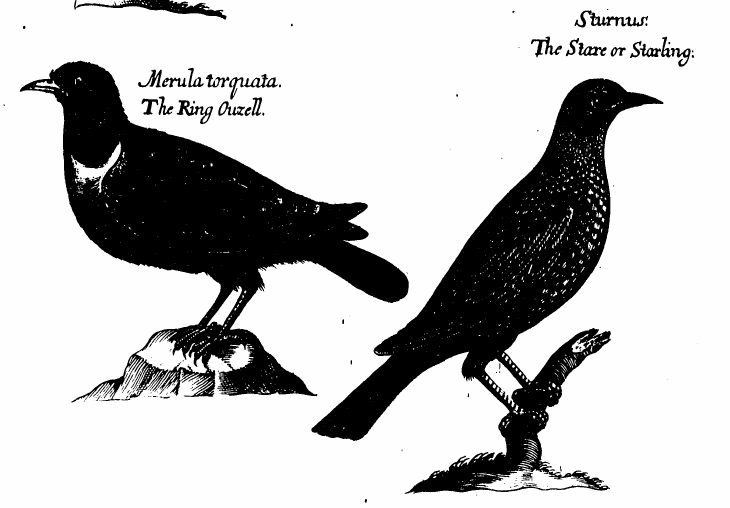
It’s that time of year when I am always reminded of one of my favourite providential pamphlets, The Wonderfull Battell of Starelings,fought at the Citie of Corke in Ireland, the 12. and 14. of October, 1621.[1] The pamphlet was published by a London printer in 1622, is short at nine pages, and it also has a wonderful woodcut that gives a graphic rendering of the events described in the text.
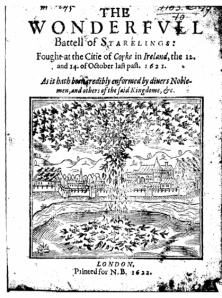
The pamphlet described howabout the seuenth of October last, 1621 there gathered together by degrees, an vnusual multitude of birds called Stares, in some Countries knowne by the name of Starlings’. The birds ‘mustered together … some foure of fiue daies, before they fought their battels, euery day more and more encreasing their armies with greater supplies, some came as from the East, others from the West, and so accordingly they placed themselues, and as it were encamped themselues eastward and westward about the citie’. Finally, on Saturday morning, at around nine o’clock:

vpon a strange sound and noise made as well on the one side as on the other, they forthwith at one instant tooke wing, and so mounting vp into the skyes, encountered one another, with such a terrible shocke, as the sound amazed the whole city and all the beholders. Vpon this sodaine and fierce encounter, there fell downe into the citie, and into the Riuers, multitudes of Starelings … some with wings broken, some with legs and necks broken, some with eies pickt out, some their bils thrust into the brests & sides of their aduersaries, in so strange a manner, that it were incredible except it were confirmed by letters of credit, and by eye-witnesses, with that assurance which is without all exception.

This ‘admirable and most violent battell’ continued with several more encounters between the two sides, before the birds seemed to vanish, so that on Sunday not one was seen about the city. On Monday the birds returned again for a final terrible assault, when many more wounded and dead birds fell into the streets of Cork. The pamphlet finishes with some rather brief and generic comments that the reader should not search out the reasons for such ‘ wonderfull workes of Almighty God’, but we should remember that ‘it doth prognosticate either Gods mercy to draw vs to repentance, or his iustice to punish our sinnes and wickednesse’.

The pamphlet’s description of strange events interpreted within a (loose) providential framework makes it typical for the time, and thanks to Alexandra Walsham, we can easily make sense of what at first seems to be a bizarre account.[2] We have already encountered this type of material on the monster. It is a great resource for teaching with, introducing students to the idea of the ‘difference’ of the early modern period – although there are lots of elements of this past society that seems familiar to us, material like this confronts us with the vast gap between the early modern outlook and mentality, and our own. They see God’s intervention in the world to create an unnatural event (birds aping human military activity), their interpretive framework, their means of making sense of the event is providential, it is religious.

What do we see? Probably we would see a ‘murmuration’: starlings gathering into large flocks in the autumn evenings – it is a natural event, spectacular, but perfectly normal. Our interpretive framework is not religious but scientific, the starlings are “always ready to optimally respond to an external perturbation, such as predator attack,” according to a Proceedings of the National Academy of Sciences paper.  When dead birds fall from our skies, we call in the veterinary inspectors, carry out tests, blame fireworks, the internet, UFOs – as you can see in this news report, our modern day equivalent of the early modern pamphlet.

Of course it isn’t as straightforward as that – it never is. Early modern people were not ignorant of bird behaviour, and they certainly knew about autumnal flocks, as you can see from this extract from an almanac of 1700:

Signs of Cold weather, or hard winter.

THE Suns setting in a Mist, looking Red, and Broader than usual.  The Clearness of the stars, and their much Twinkling.  Starlings, Feldefars, and other Birds of a Hot Nature, hastening in great Flocks or Flights from the Northern to the southern Climates. [3]

In fact, further investigation quickly uncovered further titbits about the birds: they were good mimics, valued for their singing, and could be caught and kept for pets.
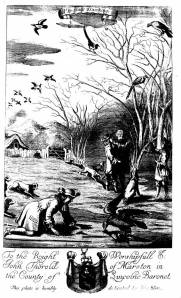
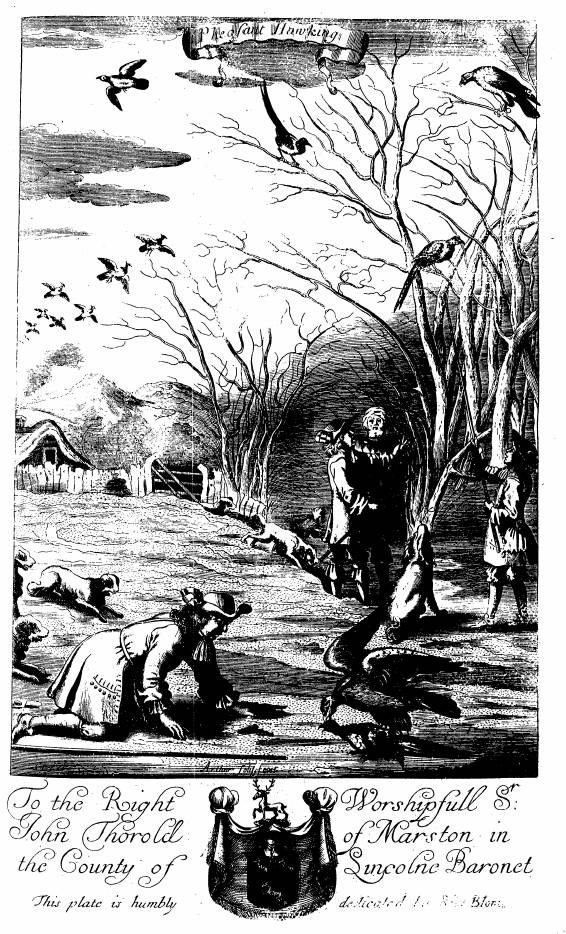
One of the many illustrations in R. Blome’s ‘Gentlemans Recreation’, this one depicts the practice of hawking.

R. Blome, The gentlemans recreation in two parts : the first being an encyclopedy of the arts and sciences … the second part treats of horsmanship, hawking, hunting, fowling, fishing, and agriculture (London, 1705).

The STARLING.This is a very docile Bird, and if taken out of the Nest young is apt to learn both to walk and Whistle. ‘Tis a hardy Bird; their food is Sheeps-Hearts, or other raw Flesh, hard Eggs minced, Hemp-seed, wet Bread, and the like.

John Ray, The ornithology of Francis Willughby of Middleton in the county of Warwick Esq, fellow of the Royal Society in three books (London, 1678).

§. VII. How to take Stares with a limed string: out of Olina’s Uccelliera.Take a small string of a yard or thereabout long, bind it fast to the Tail of a Stare, having first carefully limed it all over, excepting one Palm next the bird. Having found a flock of Starlings, come as near to them as possible, holding your Stare by the wings as near as you can, and let her go to her fellows, which as soon as you shew your self to them, will presently take wing: Your tail-tied Stare endeavouring to secure her self of her liberty, thrusting her self into the middle of her fellows, will entangle many of them, and so not being able to fly, they will afford a pleasant spectacle in tumbling down to the ground: where you must be ready with a Brush or Besom to strike them down. Many other devices there are to take several sorts of birds with Lime-rods, &c. which I think needless to set down; it being not difficult for an ingenious Fowler to invent as good or better, when he shall have opportunity of taking those kinds of Birds.

Aside from this fascinating insight into just what these country folk were up to, this is a further reminder that early modern people were far from ignorant about the world around them, but that the battle of the starlings points to areas of divergence in underlying assumptions, outlooks, and technological and intellectual understandings between their society and ours. At certain moments, certain people would turn to a religious interpretation, though it is clear that this was not the only explanation on offer.
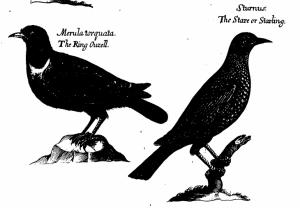
A sketch of a starling from John Ray’s ‘Ornithology’. Ray was a fellow of the Royal Society.

Of course, the significance of the battle has been attached by the pamphlet’s author, perhaps as a means to justify printing his entertaining report – a moral message makes it worthy of publication. Or maybe it was a way to appease the author’s printer Nicholas Blount, who seems to have adhered to Calvinist principles: Blount refused to print plays and other frivolous material, so the author’s religious framework was perhaps necessary concession with its roots in the world of commerce. They key thing is, that when we look beyond cheap printed pamphlets the interpretations might diversify.

The other thing that strikes me about all these birds mustering together and plummeting from the heavens, is that in some respects a certain amount of faith is needed to accept our scientific explanations. Scientists admit that starling flocks ‘transcend biology’, and that science has only a sketchy understanding of what the phenomena is all about – there is much more ‘still to be discovered’. Our modern confidence that we will eventually work it out contrasts with the early modern warning not too look into these mysteries too deeply, highlighting yet more difference. Yet there is also similarity: this clip was filmed recently in Ireland, and science alone might find it hard to explain the sense of awe in wonder inspired by the sight and sounds of the murmuration even today. The clip also makes it much easier for us to appreciate where the ‘battell’ interpretation came from. I strongly recommend that you watch the video (it gets really good about 50 seconds in), and perhaps let me know what you see.


[1] Anon, The wonderfull battell of starelings fought at the citie of Corke in Ireland, the 12. and 14. of October last past 1621 (London, 1622), STC (2nd ed.) / 5767.

[2] Alexandra Walsham, Providence in Early Modern England (Oxford: OUP, 1999).

[3] C.P., The sheepherd’s new kalender: or, The citizens & country man’s daily companion treating of most things that are useful, profitable, delightful, and advantageous to mankind (London, 1700), Wing (2nd ed.) / P11.

The impotence of being reviewed…

Jonathan Willis

Following Brodie’s post last month on ‘Twelve reasons to buy my book, or, The ancient art of self-promotion’, I started thinking about what is one of the most exciting stages of the subsequent post-publication process: that is, the point at which the first review appears. This post is therefore a reflection on my own experience of being reviewed.[1] The book in question is my Church Music and Protestantism in Post-Reformation England, which was published by Ashgate in their St Andrews Studies in Reformation History series in May 2010.[2] A modified version of my PhD thesis, the book charts the impact of the reformation on religious music, and the role of religious music in shaping the English reformation (OK, so I couldn’t resist a quick plug!).

A jog rather than a sprint

One of the inevitable by-products of the academic system is the development of a ‘feedback loop’. This starts at school, and continues through university, including the process of PhD supervision, and even the viva. I think most of us have a deep-seated desire to be told how well we’ve managed to perform a given task: I’m minded here of Lisa Simpson’s desperate plea to Marge when the teachers go on strike and Springfield Elementary closes: ‘Grade me…look at me…evaluate and rank me! Oh, I’m good, good, good, and oh so smart! Grade me!’ All of which is a slightly roundabout way of making the point that, once you’ve released a book into the world, it’s only natural to want to know how well it has been received. Well, you may be in for a bit of wait. Books have to be sent out to a journal, received, processed, allocated, sent out to a reviewer, received and read even before the review can be written, which can itself take a fair bit of time. Manuscripts have to be typed up, sent in, proof-read, and scheduled for publication in a particular issue. How many of us have ever taken more than the allocated time to submit a book review? Need I say more! My first review appeared just over a year after the book was published, which isn’t an especially long time by any means, and two and a half years in I suspect that there are still several more in the pipeline. Glance at the list of books available to review on the Sixteenth Century Journal website, and there are still plenty of titles from 2010 awaiting their reviewer…

More a trickle than a flood

Briefly, and for the same reasons outlined above, it therefore follows that different journals will take varying amounts of time to publish their review of your book. The rules here are slightly different for game-changing books by field-shaping authors. When Eamon Duffy or Alexandra Walsham release a new monograph, it’s a fair guarantee that the reviews will appear thick and fast, while journals vie with one another to ride the crest of the publication wave. But I think that the experience is different for the majority of (especially) first books and their authors. The sheer volume of work being produced in the field is so overwhelming that it might take a long time for your turn to come around. For example, the October 2012 issue of the Journal of Ecclesiastical History features reviews of several books published in 2009.

The Journal

Past and Present famously do not review books, of course, but most of us have an idea of the top journals in our particular area, and would probably like to see our book being reviewed there. But, and again for the reasons outlined above, it’s not wise to be too fussy, and it is frankly exciting to see a review of your work being published anywhere! My experience is of two reviews in major, large-circulation journals (History and the Journal of British Studies) and two in smaller, more specialist publications (Ecclesiology Today and Anglican and Episcopal History).

The Reviewer

Again, most of us would probably like to see our work being reviewed by one of the leading practitioners in our field, but the reality is that you could be reviewed by anybody, from the greenest PhD student to the loftiest of munros [for an explanation of this term, see this previous post by Laura Sangha]. The thing to remember is that a review is no less valuable for that! I feel lucky in that two people whose work I already knew and respected very much reviewed my book (Eric Carlson and Andrew Foster), but the other reviewers also brought valuable insights and have helped me see and think about the book in different ways, as well as addressing the concerns of a broader constituency of readers.

The Good News

I’m delighted to say that although it is at times a slow and frustrating process, my experience of being reviewed has been an entirely pleasurable one (so far). Everyone likes having nice things said about them, and a few positive reviews finally close the ‘feedback loop’ I mentioned at the start. I feel that it would be remiss of me to pass up the opportunity of quoting a few highlights(!): Eric Carlson commented that the book used ‘an exceptional range of sources’ and that ‘the prose has flashes of genuine wit and elegance’. Sarah Williams picked up on ‘careful and exhaustive archival research’. Andrew Foster wrote an extremely kind review, calling it a ‘truly exciting, ground-breaking book’, displaying ‘amazing erudition whilst also providing a compelling read’. And Jonathan Gray remarked that the book was ‘learned and thought-provoking … a detailed, meticulously researched monograph’.

The Bad News

Given that we research and write in a universe of finite time and resources, most of us are probably aware that even the most polished work has, if not shortcomings, at least areas of particular strength and therefore (by extension) of relative weakness. A good review will highlight these, but in a proportionate and constructive manner. To pick a few nuggets from my review sample, this was not (as one author pointed out, I imagine with eyebrow raised) an introductory textbook; another noted that it shed light on far more aspects of life in early modern England ‘than one might suppose from the title’ (ouch!). Finally, another commented that the final chapter was perhaps the ‘least satisfying’, because – as I would be among the first to admit – much archival work on parish music still remains to be done.

In Conclusion…

In conclusion, my experience of being reviewed is that it is a slow but ultimately rewarding process. It certainly isn’t the be-all and end-all though. If anything, the most rewarding feedback I’ve had has come in the form of unsolicited emails or personal approaches at conferences and elsewhere from people who have read and enjoyed the book. It’s also made me think very differently about how I review other people’s books. I’d be interested to hear what experiences monster readers have had, either as reviewees or reviewers. Is it always plain sailing…?


[1] My book has been reviewed four times so far since it came out in May 2010: by Eric Carlson in History, 96.323 (2011), p. 368; by Andrew Foster in Ecclesiology Today, 45 (2012); by Jonathan Michael Gray in Anglican and Episcopal History, 81.1 (2012), pp. 106-17; and by Sarah F. Williams in Journal of British Studies, 50.3 (2011), pp. 753-755.

[2] Jonathan Willis, Church Music and Protestantism in Post-Reformation England: Discourses, Sites and Identities (Farnham: Ashgate, 2010).

Norwich Entertainments – Part V: Ballad-singers and dangerous news, with coffee

Brodie Waddell

The people of late seventeenth-century Norwich did not get their entertainment solely from hairy children and pieces of plays. They also amused themselves with the ever-growing numbers of printed works that were pouring from the presses at that time.

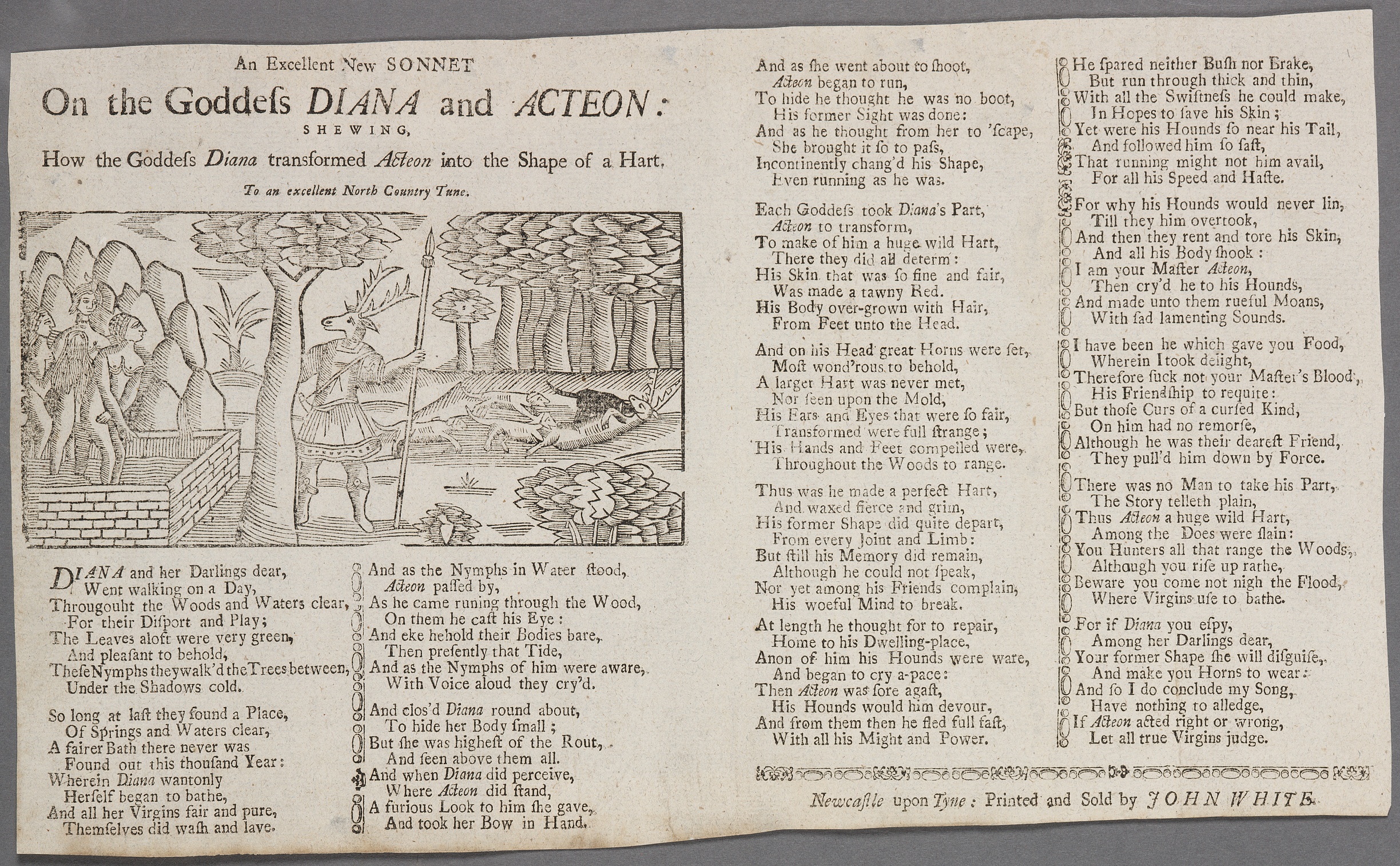
In June 1680, for example, the Norwich Mayor’s court ordered that ‘Twoe Ballad singers haveing Lycence to Sell ballads, pamphlets small bookes & other bookes Lycensed from the Office of the Revells have leave to doe soe until Monday senight [?seven-night]’.1

Ballad entitled ‘An Excellent New Sonnet On the Goddess Diana and Acteon’ (c.1725-69). EBBA.

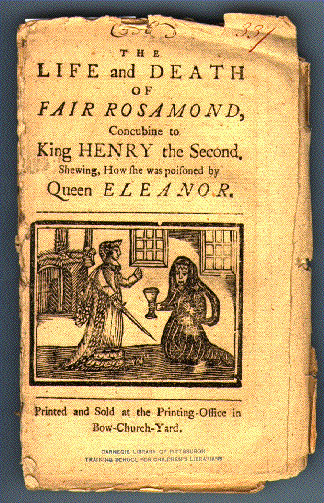
Title-page of a chapbook titled ‘The Life and Death of Fayr Rosamond’ (1755). SF.

These balladeers were just two of the hundreds that traipsed through the city streets and country lanes of early modern England, singing to advertise their wares. The exact contents of a peddler’s sack could be very diverse. In addition to all sorts of petty trinkets, they sold tales of drunken sailors, royal mistresses, industrious spinsters, and much else besides. Often these were in the form of broadside song sheets, but they might also be ‘pamphlets’ and ‘small books’, sometimes called chapbooks, written in prose to provide merriment or salvation for the price of penny or two. Margaret Spufford and Tessa Watt, among many others,  have discussed this ‘cheap print’ in much more detail, noting that ballad-sellers were often condemned by the authorities as vagrants. But in late seventeenth-century Norwich at least they seem to have been welcomed by both the townspeople and city officials.

Rather more unusual, however, was the license issued to a man a year earlier. In November 1679, the court declared that ‘Lawrence White is allowed to reade & sell Pamphlets on Horsebacke untill Wednesday next’.2 Continue reading