
We are pleased to introduce the latest post in the Postgraduate and Early Career Takeover, by Aaron Columbus. Aaron recently completed his PhD at Birkbeck, University of London and co-edits the blog We Hang Out a Lot in Cemeteries. Aaron’s thesis is focused on the response to plague and the poor in the suburban parishes of early modern London c. 1600-1650. Find him on Twitter @columbus_aaron .
Around ten o’clock on the evening of 30 May 1626 in Westminster, Thomas Powell, accompanied by a constable and watchman, arrived at the door of John Bonner with the pretext of asking for his landlord. Many ‘injurious wordes’ were made against Bonner and he was assaulted in his lodging. Powell, in a most ‘furious and barbarous manner’, then compelled the constable, watchman and others to take him to the local gatehouse.
Bonner gives his account of the incident in a petition to the Westminster Quarter Sessions in 1626, and states that Powell was acting on a grudge that had been conceived against him in his shop the Saturday before the incident. Bonner asked the Justices to take action against Powell and his associates, as he possessed no warrant and had wronged his ‘bodie and good name’. Bonner based this on the understanding of ‘most of the parishe’ that he had, as a ‘professor of phisicke’, willingly worked to cure ‘upon 500’ people of the plague in the 1625 epidemic.[1] Bonner’s petition suggests that the experience of plague might be used as a currency of sorts to further the cause of the petitioner, in much the same way that poverty was made explicit and given focus when seeking poor relief.
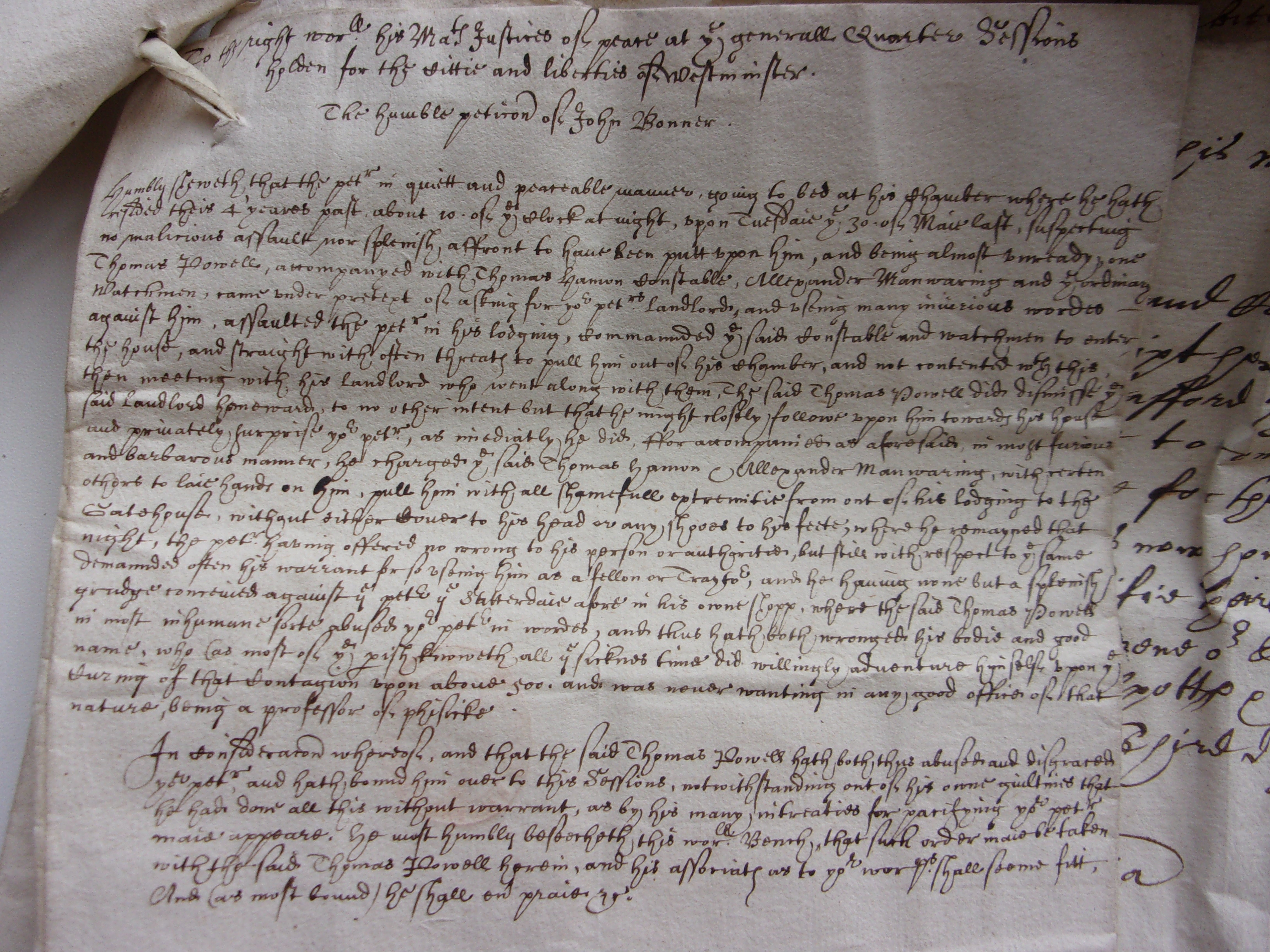
The Power of Petitioning project recently published transcriptions for 424 petitions to the Westminster City Quarter Sessions on British History Online. Over 150 of the petitions are dated to the period between 1620 and 1646. These mainly concern petty crime, imprisonment, apprenticeship and poor relief. I was interested to see if plague was mentioned in any of the petitions up to the 1640s.
Continue reading
 the many-headed monster