
This post is part of our #AliceClark100 Online Reading Group. In it Jane Whittle offers some reflections on the second main chapter of The Working Life of Women in the Seventeenth Century, on ‘Agriculture’. Jane is a Professor of Economic and Social History at the University of Exeter. You can access the book here.
Jane Whittle
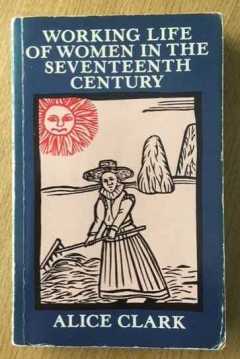 I’m reading the chapter in my 1982 edition of Alice Clark (the only history book I stole from my mother’s bookshelves), complete with a woodcut of a woman haymaking on the cover (although this image has been edited to remove the couple canoodling in the background which is present in the original below). Is this deeply significant? Probably not …
Alice Clark’s chapter on agriculture offers a microcosm of the book’s overall argument. As she concludes on the last page of the chapter, the ‘review of the whole position of women in Agriculture at this time, shows the existence of Family Industry at its best, and of Capitalism at its worst’ (p.92). As explained in her ‘Introductory’ to the book, she gives Family Industry and Capitalism quite precise meanings. Family Industry is ‘the form in which the family becomes the unit of production of goods to be sold and exchanged’ (p.6); whereas Capitalistic Industry (or Capitalism) is ‘the system by which production is controlled by the owners of capital, and the labourers or producers, men, women and children receive individual wages’ (p.7). For Clark, Family Industry, which in the agriculture chapter is represented by the lives of farmers, husbandmen and their families, represented everything that was good about the seventeenth-century economy. On the other hand, Capitalism, illustrated by the experience of wage earners, represents everything that was bad in what was to come. Continue reading
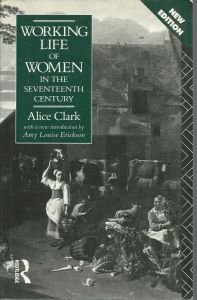 Those who have never read Alice Clark’s Working Life of Women might wonder why we would pay any attention to a work that is a hundred years old, and superseded by recent research on women. Yet anyone who works on the history of women, and particularly the history of women’s work, in early modern England owes a debt to Alice Clark’s work. It was reissued in 1982 with an introduction by Miranda Chaytor and Jane Lewis, and again in 1992 with an introduction by Amy Erickson. As Natalie Davis noted in a paper delivered at the Second Berkshire Conference in 1974, Clark consulted archives, differentiated among women, and had an overarching theory.
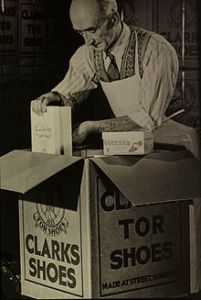 At first glance Alice Clark seems the most unlikely of historians. Due to ill health she managed only sporadic periods at school and she never went to university. She was a capitalist, not a scholar, spending most of her adult life as a director of the family business, known today as Clarks Shoes Ltd. Yet from a young age she was a voracious reader and would have joined her sister at Cambridge had her parents not felt strongly that the shoe company would benefit from the involvement of a female family member.
 The centenary of the publication of this seminal work presents a great opportunity to both celebrate the scholarship of Alice Clark, and to reflect on the current state of the history of early modern women’s work. And so, we would like to invite you, dear reader, to join an online reading group here on the many-headed monster that will do just that.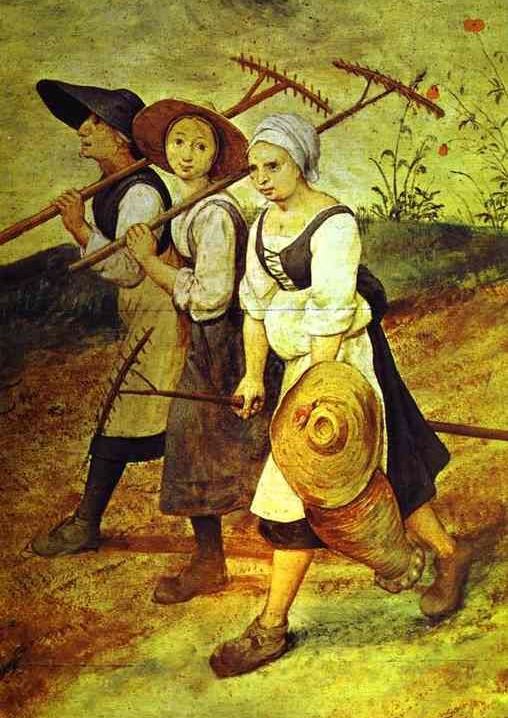


 the many-headed monster