5 April 1666: ‘Sir William Penn is a total jerk’

Brodie Waddell

I’m planning to put together another post on microhistory in the next week or so, drawing on the responses to the original and my own muddled thoughts. Further comments are very welcome.

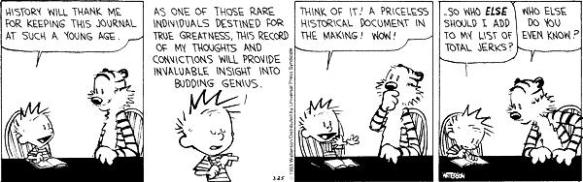
In the meantime, I thought a very brief addendum to Laura’s post on ‘dangerous diaries’ might not go amiss. As is so often the case, Bill Watterson’s Calvin and Hobbes provides valuable insights into historiographical controversies. (Even their names are historical!)

Calvin and Hobbes on journalsAs Laura pointed out, and as Calvin reminds us, it’s dangerous to take diaries at face value. Perhaps the quest for posthumous vengence explains why we find so many entries like this one, from April 1666, in Pepys’s diary:

To the office, where the falsenesse and impertinencies of Sir W. Pen would make a man mad to think of.

Beware the diarist with an axe to grind.

An archival miscellany: a warning, a rat, a blog and another warning

Brodie Waddell

October was a rather busy month. My first term of teaching and marking at Birkbeck has meant that I know a good deal more about eighteenth-century London infrastructure, English Civil War veterans, and the historiography of the Reformation than I did a few weeks ago, but research and blogging have been neglected.

I have, however, come across a few tasty tidbits that deserve to be shared with the world. This is, in some ways, simply a continuation of the conversation (here and here) we’ve been having about archives.

A warning

An archivist friend passed this on and, like all good jokes, it contains at least a kernel of truth.

Having worked in the Borthwick for a year, I can say with some certainty that it would be entirely possible to use the limbo between the public reading room and the strongroom to erase someone with a ‘misplaced’ inkblot or an ‘accidental’ torn page. So be sure to greet your archivist with a friendly smile … or risk the posthumous disappearance that befell some soviet dissidents.

A rat

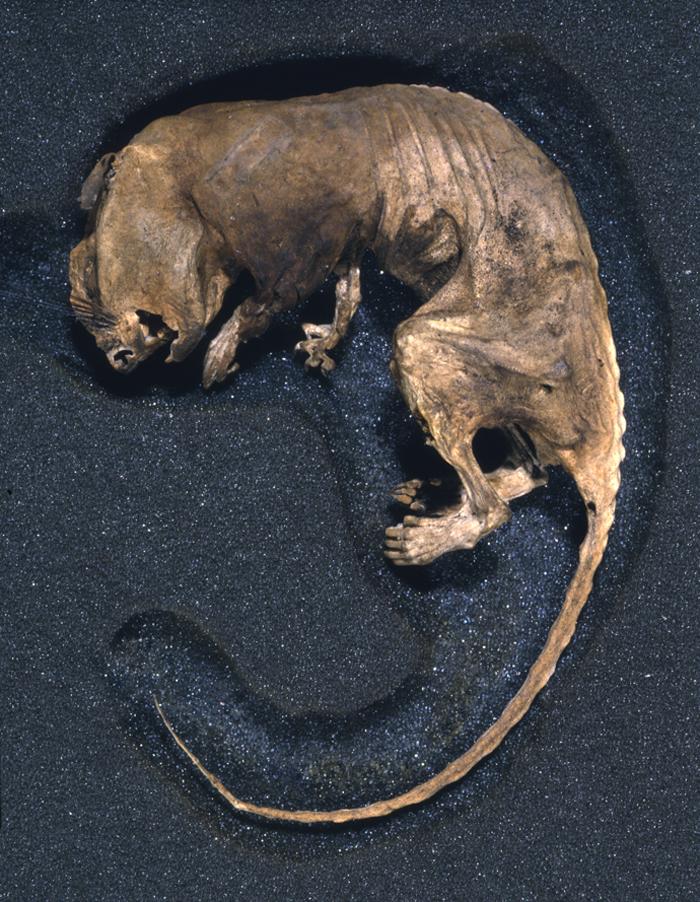
Or, to be more specific, Sir Henry Cole’s Rat (c.1830). As folks at the National Archives describe it…

At 15, Henry Cole, later to find fame as organiser of the Great Exhibition began working with the records of the British government. Shocked at their poor condition he pioneered reform of what became known as the Public Record Office – now The National Archives. This rat, with a stomach full of chewed document, was used as evidence for the poor condition of the records.

Sir Henry Cole’s Rat (c.1830): The National Archives, E 163/24/31

Yep, that’s right. We owe the wonderful institution that we once called the PRO, founded in 1838, to a rat stuffed with irreplaceable manuscripts. And archivists, being the dedicated – one might say obsessive – guardians of history that they are, created a special foam case to preserve this momentous rat for posterity.

A blog

Ever wanted to know what happens behind the scenes at a busy city archive? Of course you do! Well, if the Huntington’s Verso blog isn’t fulfilling all of your archive-blogging needs, check out the team at York who are describing their on-going project to catalogue the city’s immense civic records. Although not specifically ‘early modern’, it does have some fascinating ‘lucky dips’ (what we here call ‘found art’), including councilmen watching naughty films and railwaymen complaining of mouldy fish cakes, as well as some very pretty visual maps of the archives themselves.

If you’re a historian – professional or amateur – I think it can be immensely profitable to get a sense of how archives (and archivists) work. Sure, the difference between ‘functional’ and ‘structural’ arrangements may not sound especially interesting, but it can make a real difference to how you go about your research.

Another warning

This one comes from Tim Hitchcock, and is rather more serious. I think he makes the point I was trying to make here much more effectively than I ever could.

For both technical and legal reasons, in the rush to the online, we have given to the oldest of Western canons a new hyper-availability, and a new authority.  With the exception of the genealogical sites, which themselves reflect the Western bias of their source materials and audience, the most common sort of historical web resource is dedicated to posting the musings of some elite, dead, white, western male – some scientist, or man of letters; or more unusually, some equally elite, dead white woman of letters.  And for legal reasons as much as anything else, it is now much easier to consult the oldest forms of humanities scholarship instead of the more recent and fully engaged varieties.  It is easier to access work from the 1890s, imbued with all the contemporary relevance of the long dead, than it is to use that of the 1990s.

Without serious intent and political will – a determination to digitise the more difficult forms of the non-canonical, the non-Western, the non-elite and the quotidian – the materials that capture the lives and thoughts of the least powerful in society – we will have inadvertently turned a major area of scholarship, in to a fossilised irrelevance.

It would be a cruel irony to digitise vast new swathes of text and images only to discover that we’ve accentuated the very biases that scholars have been fighting against since at least the 1960s. That is not to say that we shouldn’t try to make ever-more sources freely and easily available online – just that we should beware the consequences of grabbing the ‘low-hanging fruit’ and neglecting less accessible sources. We must make a real effort to move beyond ‘the musings of some elite, dead, white, western male’ and save other voices ‘from the enormous condescension of posterity’.

Update (13/01/13): The York archives blog did a new ‘Lucky Dip’ post that early modernists might like which looks at a late seventeenth-century Chamberlain’s Account Book.

Twelve reasons to buy my book, or, The ancient art of self-promotion

Brodie Waddell

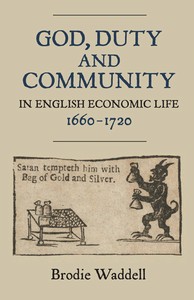
Brodie Waddell, God, Duty and Community in English Economic Life, 1660-1720

1. It was only officially released today, so if you buy it now, you’ll probably be the first kid on your block to have one!

2. It has seven pictures inside, a very respectable ratio of 1 for every 34 pages.

3. It has the word ‘God’ in the title, making it slightly more likely to be accidently recommended by your local Christian reading group.

4. It has a picture of Satan on the cover, making it slightly more likely to be accidently black-listed by your local Christian reading group.

5. Barack Obama called it ‘…the best book I’ve ever read on later Stuart economic culture…’ and Nelson Mandela said it was ‘… longer than I expected …’ (NB: Not actual quotes. Please don’t sue me!)

6. It has footnotes, not those horrible endnotes.

7. It cites a hell of a lot of broadside ballads.

8. I can’t think of a number eight.

9. It uses paper that apparently derives from ‘natural, recyclable products made from wood grown in sustainable forests’. You’re practically saving polar bears just by reading it.

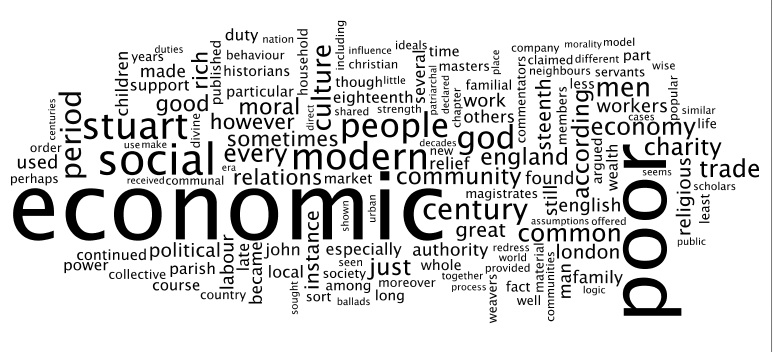
10. When you put the text through Wordle, you get this…God, Duty and Community via Wordle

11. I can’t think of a number eleven either.

12. I’ve heard that ‘this book explores the economic implications of many of the era’s key concepts, including Christian stewardship, divine providence, patriarchal power, paternal duty, local community, and collective identity. Brodie Waddell draws on a wide range of contemporary sources – from ballads and pamphlets to pauper petitions and guild regulations – to show that such ideas pervaded every aspect of social and economic relations during this crucial period.’

Available at Boydell & Brewer (UK), University of Rochester Press (USA), Amazon (everywhere), Powell’s (less evil) and other fine book-sellers.

UPDATE (19/10/12): I’ve only just discovered that it’s also available as an over-priced ebook. If you’d like a sample from the text, I’ve uploaded the table of contents, introductory sections, bibliography and index.

UPDATE (12/11/12): There is now a preview on googlebooks too.

Do I have to kill the snake?

Brodie Waddell

From McSweeney’s via The Edge:

FAQ: The “Snake Fight” Portion Of Your Thesis Defense

Q: Do I have to kill the snake?

A: University guidelines state that you have to “defeat” the snake. There are many ways to accomplish this. Lots of students choose to wrestle the snake. Some construct decoys and elaborate traps to confuse and then ensnare the snake. One student brought a flute and played a song to lull the snake to sleep. Then he threw the snake out a window.

I’m very grateful to my doctoral examiners, who told me at the start of my viva that the snake I would be fighting was rather small and hinted that it had a blindspot on its left side. That made the whole process much less stressful.

An (a)historical headache?

Mark Hailwood

We know that our ancestors inhabited a very different mental universe from our own – that they thought very differently from us – but a much harder question for historians to address is whether our ancestors lived in a world that felt physically different from our own. Are physical experiences ahistorical? Does the experience of stubbing a toe transcend all variations across time and space? Or were our ancestors hardier than us, less sensitive to pain perhaps?

Let’s try narrowing this question down a bit by focusing on one particular physical state that will be familiar to most of us: the hangover. But did our seventeenth-century forebears get them? They didn’t use the term (the Oxford English Dictionary suggests it is a twentieth-century Americanism), but they certainly suffered from them. A broadside ballad that warned against the dangers of drinking too much on the Sabbath day cautioned that men who did so often found themselves incapacitated for as many as two days after:

From Ale-house to Ale-house, they’d ramble and roam
And may be at night they’d come staggering home;
Their Wives have been careful to get them to bed,
Next morning the liquor has lain in their head;
So that beside all their vast charges and cost,
Both Monday and Tuesday they commonly lost.

If anything, we might wonder whether our ancestors experienced their hangovers even more severely than we do if they stretched over two days. But there is another explanation. In a ballad entitled ‘Monday’s Work‘ we hear of the symptoms that followed the morning after a Sunday drinking bout. They may sound familiar:

Last night I was shot
Through the braines with a Pot [of ale],
and now my stomacke doth wamble.*

*[Wamble, surely a word that should enjoy a renaissance, defined by the OED thus: ‘Of the stomach or its contents: To be felt to roll about (in nausea).’]

Yet this condition did not have these ballad drunkards opting for a ‘duvet day’. They had another remedy in mind:

A piece of salt Hogge,
And a haire of the old Dogge
is good to cure our drunken Noddles.

That often debated hangover cure – getting back on the bottle – dates back to at least the sixteenth-century. It might explain why Tuesday too was often a hangover day, but it was deemed effective by the famous diarist Samuel Pepys.  The morning after drinking ‘a great deal of wine’ at The Dolphin on Tuesday 2nd April 1661, Pepys awoke with his ‘head akeing from last night’s debauch’. No doubt he complained of this to the friends with whom he took lunch, for they encouraged him to ‘drink two drafts of sack [a Spanish white wine] to-day to cure me of last night’s disease,’ Pepys was sceptical at first, but the proposed tonic seemed to do the trick: ‘which I thought strange but I think find it true.’

So what does this tell us about the timelessness of physical experiences? Not much perhaps, but it is clear that finding an effective way of dealing with a hangover is one experience that unites us with our early modern forbears.