The Woolcomber’s World, Part II: Finding God in seventeenth-century Essex

Brodie Waddell

Joseph Bufton spent a lot of time thinking about God. He assiduously went along to hear sermons by the local vicar and by travelling preachers. He read scores of books and pamphlets offering religious guidance. What’s more, he filled many volumes with notes and extracts from these sermons and published texts. He even tried his hand at spiritual poetry, with decidedly unimpressive results.

What, then, do we know about Bufton’s faith?

Bufton - Coggeshall parish church

The (mostly) 15th-century parish church in which Bufton spent many a Sunday

As I explained in my previous post on Bufton, almost all of our knowledge of this Essex woolcomber comes from the notes he scribbled in the margins and blank pages of eleven volumes of almanacs between the 1660s and the 1710s. As such we can learn a considerable amount about his exposure to diverse religious ideas and instruction.

However, there are limits. The volumes include only a few hints about his own personal thoughts on such matters, especially his place in the fraught religious politics of the later Stuart period. Still, the fact that eight of the eleven surviving volumes are mostly or entirely focused on spiritual concerns surely can tell us something about how a simple layman set about finding God in late seventeenth-century Coggeshall. Continue reading

Elizabethan ‘madmen’ Part III: Puritans, Plums, and a Cereal Complainer…

Jonathan Willis

I don’t know about you, but I’m always delighted and intrigued when I’m unexpectedly reminded of the humanity we share with the inhabitants of early modern England. I’ve been reading through a large quantity of godly lives recently (spiritual diaries, memoirs, biographies, books of remembrance, etc.), and if I’m honest the content is often rather unedifying – by which I mean, far, far too edifying! It’s therefore quite pleasing when, amidst the intensely personal but also strangely generic soul-searching, you come across something which gives you a flavour of the individual. This happened while I was reading the diary of Samuel Ward. Ward finished his career as a moderate, establishment puritan figure and Master of the recently founded puritan college, Sidney Sussex, Cambridge. In the 1590s, however, whilst a student (later Fellow) at Emmanuel, Ward was ‘a vigorous and outspoken puritan’.[1]

NOT historically accurate, but who can forget?  'Wicked child!'

NOT historically accurate, but who can forget? ‘Wicked child!’

Outspoken or not, though, his diary reveals his ongoing struggles with sin, and particularly with food and drink. In June 1595, for example, he recorded ‘to much drinking after supper’ on the 21st, ‘going to drink wyne, and that in the Taverne, befor I called upon God’ on the 27th, and ‘immoderate’ eating of cheese at 3 o’clock in the morning on the 22nd (perhaps a snack to satisfy the hunger cravings brought on by drinking too much the night before?). Cheese was a recurrent weakness. He recorded ‘immoderate eating of walnuts and cheese after supper’ on October 3 1595, and ‘intemperate eating of cheese after supper’ on August 13 1596. Perhaps the catalyst for this binge was the fact that, the day before, Ward recorded in his diary ‘my anger att Mr. Newhouse att supper for sayng he had eaten all the bread’. As well as bread, cheese and wine, Ward also hankered after fruit: references to damsons, plums, pears and raisins pepper his diary.[2] On 8 August 1596 Ward noted that after observing ‘my longing after damsens … I made my vow not to eat in the orchard. Oh that I could so long after Godes graces…’

Lovely cheese...

Lovely cheese…

Continue reading

Memorial and History, appendix i; in which Jonathan jumps on Laura’s bandwagon…

Jonathan Willis

This short post is inspired by Laura’s brilliant mini-series on ‘Memorial and History’, which took its own inspiration from her discovery of Exeter’s 1909 memorial to the Marian martyrs Thomas Benet and Agnes Prest.

Hearing Laura talk about Exeter made me curious about the city where I was born and raised, and which bears the somewhat ignominious dual-honour of being the location of the first documented case of medieval blood-libel (a false accusation of ritual murder against the Jewish community), and also of witnessing the execution of one of the first evangelical martyrs of the reformation. Continue reading

Memorial and history, Part 5: in which history delivers a warning from history, and I talk about ‘feelings’

Laura Sangha

This is a final post in a short series relating to Exeter’s martyrs memorial, the others are on the following:

  1. The story of the two martyrs commemorated on the memorial, Thomas Benet and Agnes Prest.
  2. Our main source of information about Tudor martyrs, John Foxe’s Actes and Monuments, and it’s own role as a memorial to the past.
  3. Other English examples of monuments to martyrs and when and why they were erected.
  4. The remarkable Harry Hems, designer of Exeter’s monument and an important collector of historical artefacts in his own right.

In this final post I conclude with some thoughts on the ways that objects and places are invested with meaning, and the relationship between space, memory and history.

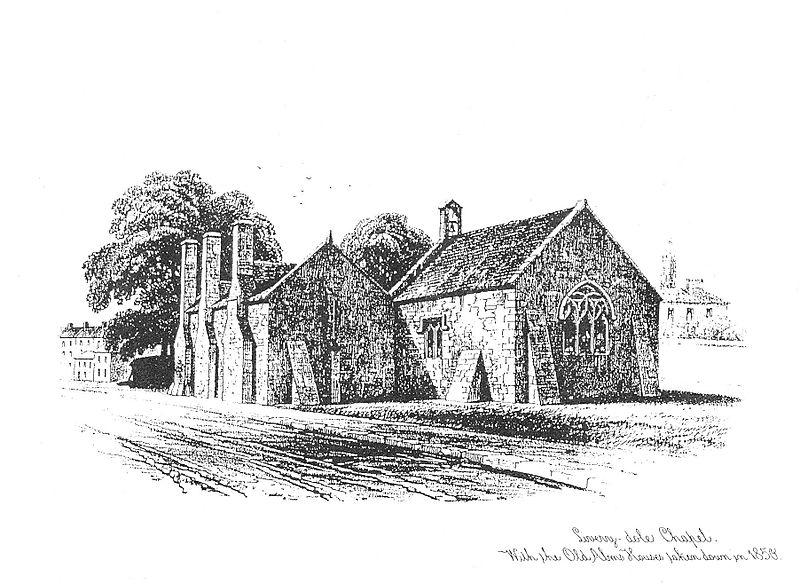
My final question about Exeter’s martyr memorial was: what is ‘Livery Dole’? The plaque on the monument stated that Thomas Benet had suffered at ‘Livery Dole’ but although I knew what an aircraft livery was, or could countenance a livery stable, otherwise I was drawing a blank. Exeter Memories came to my rescue again: Livery Dole is an ancient triangular site between what is now Heavitree Road and Magdalen Road. It was used as a place for executions – the last took place in 1818, when the unfortunate Samuel Holmyard was hanged for passing a forged City Bank one pound note.

W. Spreat lithograph from 1850 showing the Dennis almshouses before they were replaced.

W. Spreat lithograph from 1850 showing the Dennis almshouses before they were replaced.

Liverydole now made sense – it meant that the Exeter memorial had therefore been erected near to the spot where Thomas Benet had been burnt to death. Hence my final post is about the meanings and significance that are attached to particular places and features of the landscape. All of the Protestant monuments that I have uncovered are erected as close as possible to the original site of the martyrdom, they are a deliberate attempt to attach particular memories to those sites, for later generations to read. Nearby, Heavitree’s almshouses represent a similar attempt to shape historical memory – they were erected in 1591 by Sir Robert Dennis, by tradition in penance for the part his ancestor had played in the execution of Thomas Benet in 1531. The ancestor in question was Sir Thomas Dennis, who had been the Sheriff of Exeter at the time and who had sentenced Benet to death. This act of charity proved that the current Sir Dennis was now firmly on the side of the true Church, unlike his unenlightened Catholic ancestor. Continue reading

Memorial and history, Part 4: in which several fights break out and a man is murdered in the Solomon Islands

Laura Sangha

This is the fourth post in a series of posts relating to Exeter’s martyrs memorial, the others are on the following:

harry hems 1     ramm-04

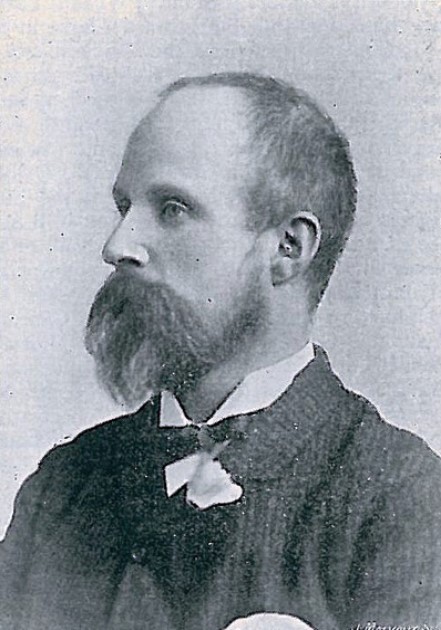
Today’s question is – what do we know about the creation and placing of Exeter’s martyr monument? The endlessly informative Exeter memories website furnished me with more details about the city’s own specimen. Funded by public conscription, it was designed by Exeter’s Harry Hems (above), a London born master sculptor and wood carver, who made Exeter his home. Continue reading

Memorial and history, Part 3: in which Mary Beard sits on a bench

Laura Sangha

This is the third in a series of posts relating to Exeter’s martyr memorial. The first post, contains the details of the martyrs themselves, the second, is on John Foxe’s Actes and Monuments.

What I really wanted to know about Exeter’s martyr monument, was who paid for and created it – when was it erected, how and why? A third plaque on the memorial yielded some information:

To the glory of God & in honour of his faithful witnesses who near this spot yielded their bodies to be burned for love to Christ and in vindication of the principles of the Protestant Reformation this monument was erected by public subscription AD 1909. They being dead yet speak.

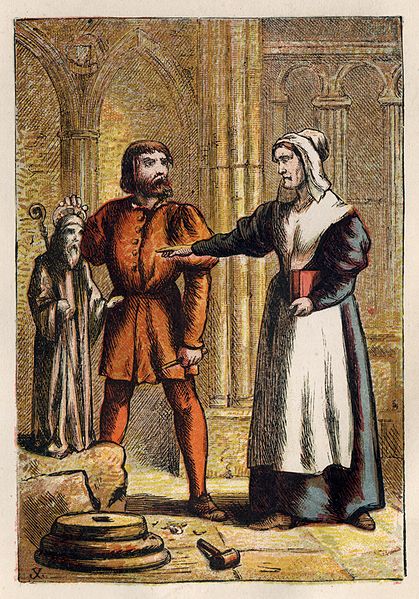
Thus the obelisk dates from the twentieth-century, which makes sense – the English Reformation was profoundly iconoclastic and it is hard to imagine money being spent on erecting monuments in an age when destruction of imagery was a mark of Protestant identity. In fact the image of Agnes Prest from the 1887 edition of Foxe that I mentioned prest and stonemasonin my previous post supports just this point. It depicts a visit that Prest paid to Exeter Cathedral, where she met a ‘cunning’ Dutch craftsmen who was apparently repairing the  images and sculptures that had been disfigured during the previous, iconoclastic reign of Edward VI. Prest supposedly said to the Dutchman ‘what a mad man art thou… to make them new noses, which within a few dayes shall all lose their heades’. In response to this rather prophetic prediction of further reform, the stonemason replied with a well thought out theological argument: ‘Thou art a whore!’. Quick as a flash, Prest replied ‘Nay, thy Images are whores, and thou art a whore hunter: for doth not God say you goe a whoring after straunge Gods, figures of your owne making?’ Continue reading

Memorial and history, Part 2: in which John Foxe reveals his sources

Laura Sangha

This is the second of a series of posts on issues relating to Exeter’s martyr memorial. The first post discusses the details of the martyrs themselves.

A monumental achievement

Foxe’s [?] monumental [?] achievement.

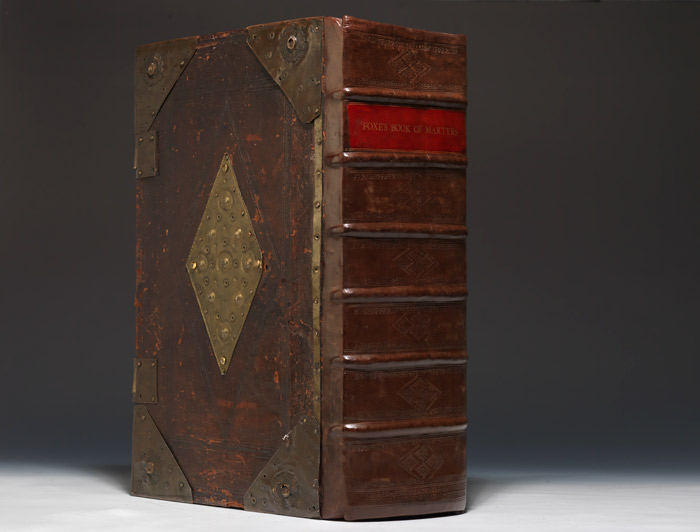
The information about Exeter’s martyrs that I related in yesterday’s post was taken from John Foxe’s Actes and Monuments, popularly known as the ‘Book of Martyrs’. Actes was first published in 1563, five years into the reign of Elizabeth I. It is a work of Protestant history and martyrology, mainly consisting of a polemical account of the sufferings of evangelicals under the Catholic Church.

I’ve previously discussed images of martyrdom on the monster, in this post I am more concerned with the text as a history of the ‘true’ Church. Continue reading

Memorial and history, Part I: in which two people meet a terrible end

Laura Sangha

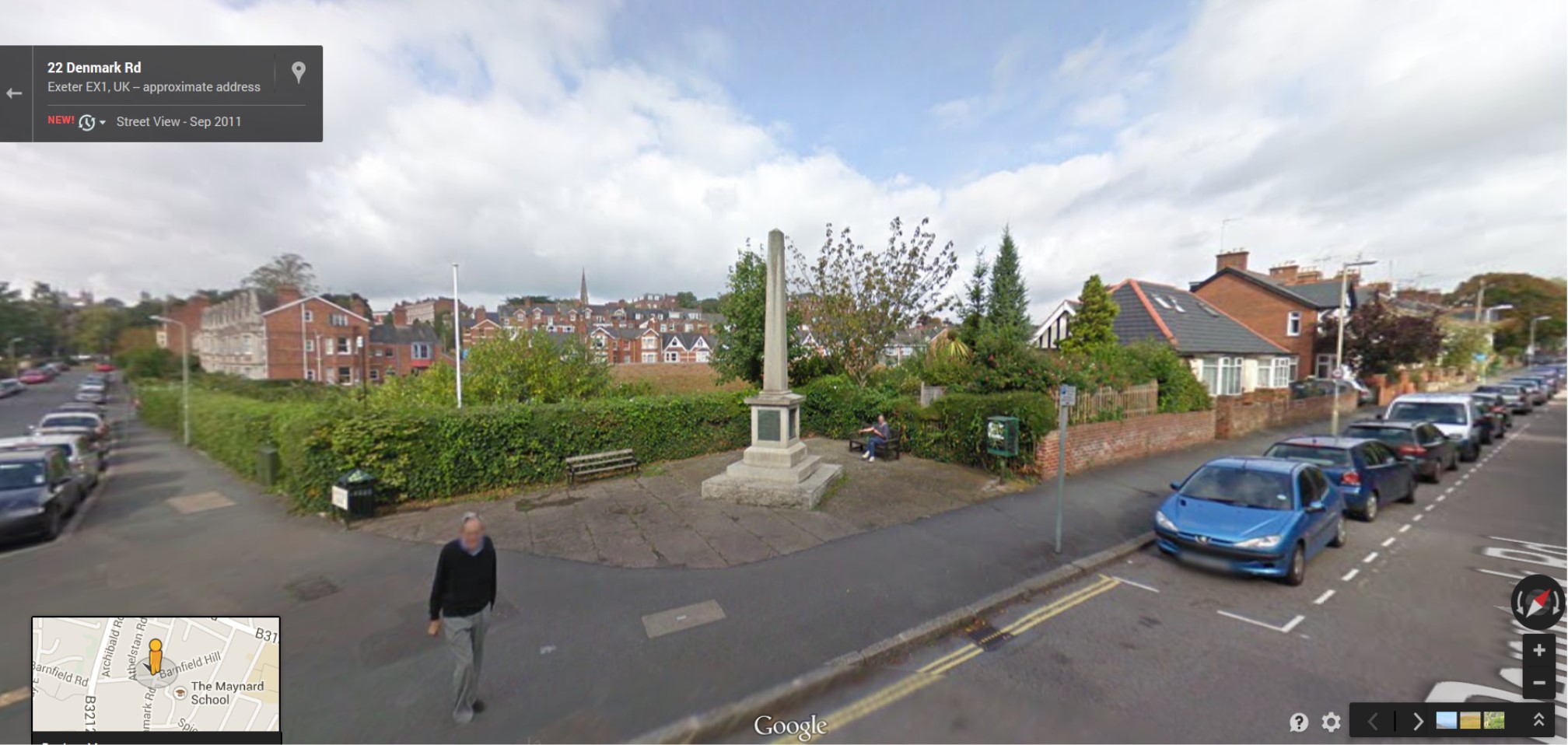
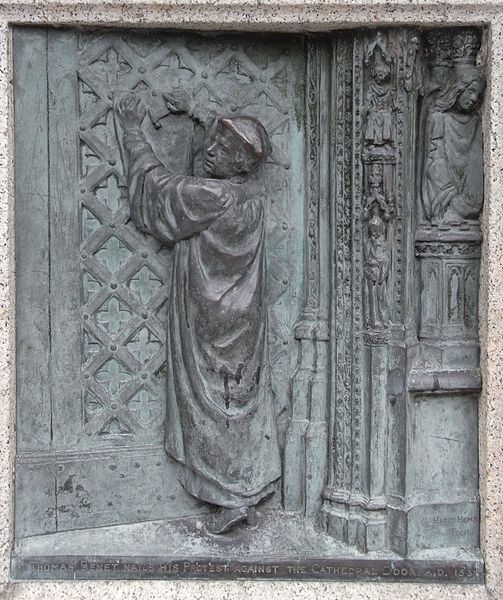
googlemapsA recent trip to the pub took me into a new part of Exeter, and on my way there I stumbled across a fascinating snapshot of its history. At the corner of Barnfield and Denmark roads I came to a memorial in the form of an obelisk of Dartmoor granite, with four bronze panels around its base. I assumed it was a twentieth-century war memorial, and went to have a closer look at the bronze reliefs – hey, I’m a historian, my profession compels me to! On examination, I was surprised to discover not a weary line thomas benet bronzeof soldiers in metal helmets, but instead what appeared to be a monk fixing a notice to a wooden door, and I didn’t need the inscription to tell me the door belonged to Exeter Cathedral – an angel from the first tier of sculptures on the West front is clearly depicted on the right hand side. What’s more, a second bronze showed a women chained to a post, clearly suffering a fiery death at the hands of the authorities. Reading the inscriptions, I realised that I had chanced upon a memorial to two sixteenth-century Protestant martyrs who had met their deaths in Exeter.

Firing up the computer on my return home, I soon disappeared down the rabbit hole of the city’s history and our memories, stories about and uses of our past. My initial idea for a brief post mutated into a series of linked musings on the tangled threads of the regional and national history, in all its venerable and unsavoury glory. I’ll be publishing one each day this week. Today I start with the story of the two martyrs commemorated on the memorial, Thomas Benet and Agnes Prest. Continue reading

Elizabethan ‘madmen’ Part II: Nightmare neighbours and Tudor ASBOs

Jonathan Willis

This post is, if not a follow-up, then perhaps a sequel to my investigation last month into the eccentric Elizabethan Miles Fry, aka Emmanuel Plantagenet, who claimed to be the secret lovechild of no less a coupling than Elizabeth I and God Himself. My next archival oddball is Goodwife Dannutt, from Rose Alley in London. Dannutt is described in the calendar of the Lansdowne manuscripts as ‘a poor distracted woman’, writing to Lord Burghley and ‘begging him for Jesus Christ’s sake to punish a constable and two watchmen, who are so noisy in the night she can take no rest’.[1]

Modern society seems more than a little preoccupied with the idea of nuisance neighbours. A quick google search reveals the website http://www.nfh.org.uk/ – designed to help embattled residents deal with, you guessed it, ‘Neighbours from Hell’. Newspapers, it appears, love to run stories about neighbours from hell; from the story of an academic whose experience of hellish neighbours may (the Telegraph speculates) have contributed to her tragic suicide, to the Mirror’s more risible account of Gywneth Paltrow and Chris Martin’s decision to install a nine-foot gate at the entrance to their $10,000,000 California mansion, ‘without permission’. The UK’s Channel 5 is currently screening a television series called The Nightmare Neighbour Next Door, which promises to reveal ‘the traumatic, shocking, humorous and occasionally bizarre experiences of nightmare neighbours’; that’s people who live ‘next door’, in case anybody was in any doubt. In recent years even governments have taken this sort of thing increasingly seriously with the advent of the ASBO, or ‘anti-social behaviour order’, such as that given to a noisy Burnley resident.

Gwyneth-Paltrow-and-Chris-Martin-3319352

Gwyneth and Chris – no longer a couple, but still neighbours from hell?

Elizabethan communities did not have to cope with electric gates, celebrity (ex-) couples, domestic cannabis farms, electronically amplified dance music or an influx of stag and hen parties to ‘party houses’ in affluent parts of Dorset. However, they were no less affected by noise. Just as Mary Douglas observed in Purity and Danger that ‘dirt’ was ‘matter out of place’, so we can usefully think of ‘noise’ as ‘sound out of place’. Sounds that might be acceptable, even appropriate, in one time or place or context could be deeply disturbing or offensive in others. I’ve written about this myself, in terms of religious music.[2] But clearly the principle can be extended to all forms of noise pollution.

The exact nature of the noise that disturbed Goodwife Dannutt is unknown, but in her frantic letter to William Cecil she noted that the time of the disturbance was ‘at one of the clocke at an unlawfull time’.[3] She requested Cecil ‘be so good unto me’ as to force her neighbour, ‘my good man Johnson’, to reveal ‘the counstables name that dwell next house’ and also the names of two watchmen, who were presumably responsible for the unseemly night time interruptions.

Dannutt’s desperation is palpable. She beseeched Burghley ‘for godes sake’ to help her, ‘for godes sake your honour’ and that she ‘may have some ende of it for cryste Jesus sake’. This sort of language, incidentally, would not have endeared her to any particularly religious neighbours, who would have viewed this sort of casual swearing as a serious breach of the Third Commandment.[4] Dannutt also requested that Burghley help her ‘have some ende upon it without gret expense’, suggesting that the constable and his accomplices request ‘pay every nighte’ and that she ‘can never take coste for them’. Quite what was going on here is unclear – some sort of nocturnal racket? – and if anybody has come across any similar cases I would be intrigued to hear about them.

No ‘nightmare neighbour’ story is complete without a sense of how powerless law-abiding citizens are to resolve their desperate situation. Not only was Dannutt complaining about a constable and a pair of watchmen, she also noted that ‘the judges of the Kinges Bench ar a kinde’ to the offenders, and that they have ‘so maney frendes that I coud never reste day nor nighte’. Reaching out to Cecil was therefore her last hope for peace, quiet, and a good night’s sleep.

Nightmare neighbours - not just a modern problem.

Nightmare neighbours – not just a modern problem.

The goodwife ended her letter on a strange note. She also claimed that ‘moste of the lands that the queen gave he meanes to kepe it from me’, and also lamented that ‘every one cossus me & decevses me’. There are perhaps two conclusions to be drawn. The first is that, like many neighbourly disputes, this one may well have concerned the more serious question of property rights, as well as the nuisance issue of antisocial behaviour. The second is that Dannutt appears to have been socially isolated, and therefore may not have been as innocent a party as she herself claimed. There is no evidence as to whether Burghley slapped whatever the Elizabethan equivalent of an ASBO was on to the noisy constable, or even whether or not Dannutt ever managed to get a decent forty winks. Even if this incident was resolved amicably, we can at least say for certain that the problem of noisy neighbours has unquestionably never gone away.


[1] Catalogue of the Lansdowne MS in the BL, p. 191.

[2] Jonathan Willis, Church Music and Protestantism in Post-Reformation England (2010), p. 225.

[3] Lansdowne vol. 99 no. 28, f. 77.

[4] John Dod, for example, forbade idle, curious, vain or unreverent speaking of God’s word titles, attributes or works. John Dod, A plaine and familiar exposition of the Ten commandements (1604), p. 92.

Samuel Clarke’s Martyrology: images of religious violence

Laura Sangha

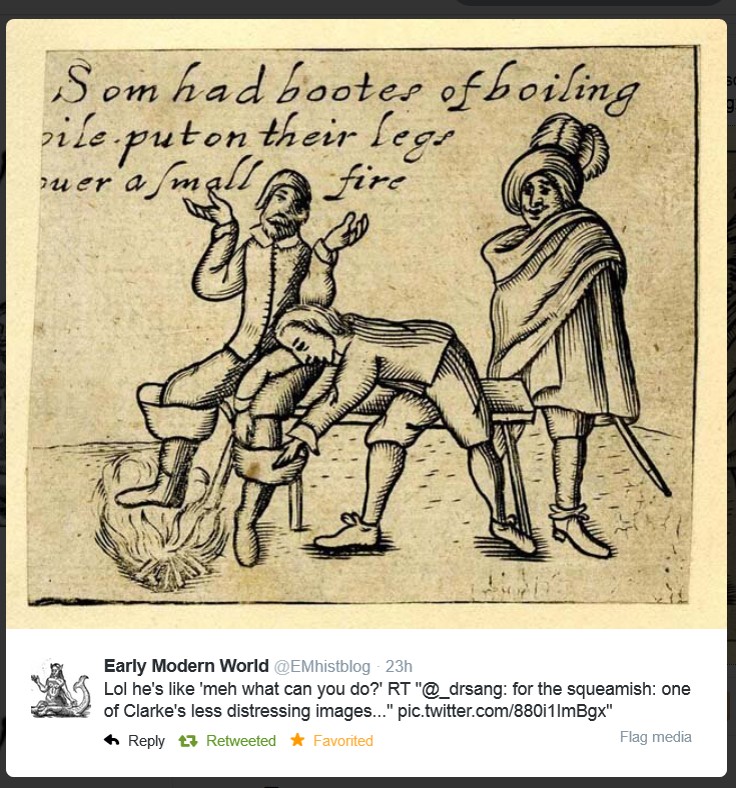
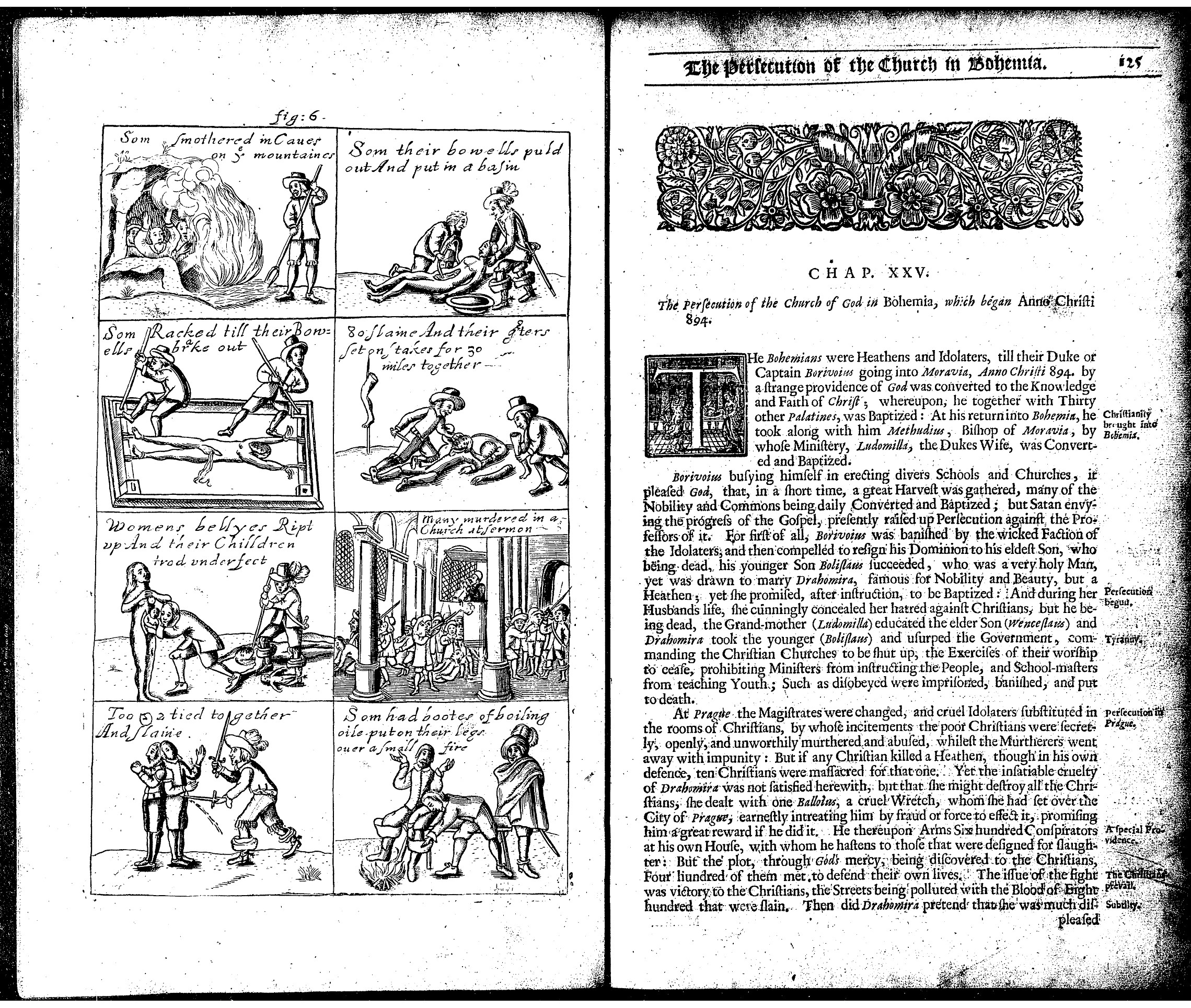
On Friday, one of my fellow tweeters, Early Modern World @EMhistblog, retweeted an image from a 1651 martyrology that I had originally posted last year. Here’s the tweet:
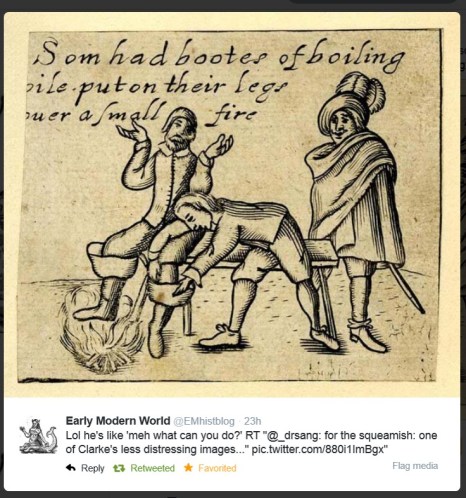
Original tweetIt proved popular, so I wanted to post the full details of the original work and author here (though I make no claim to be an expert on early modern martyrologies). Click on images for enlargements.

Clarke’s Martyrology

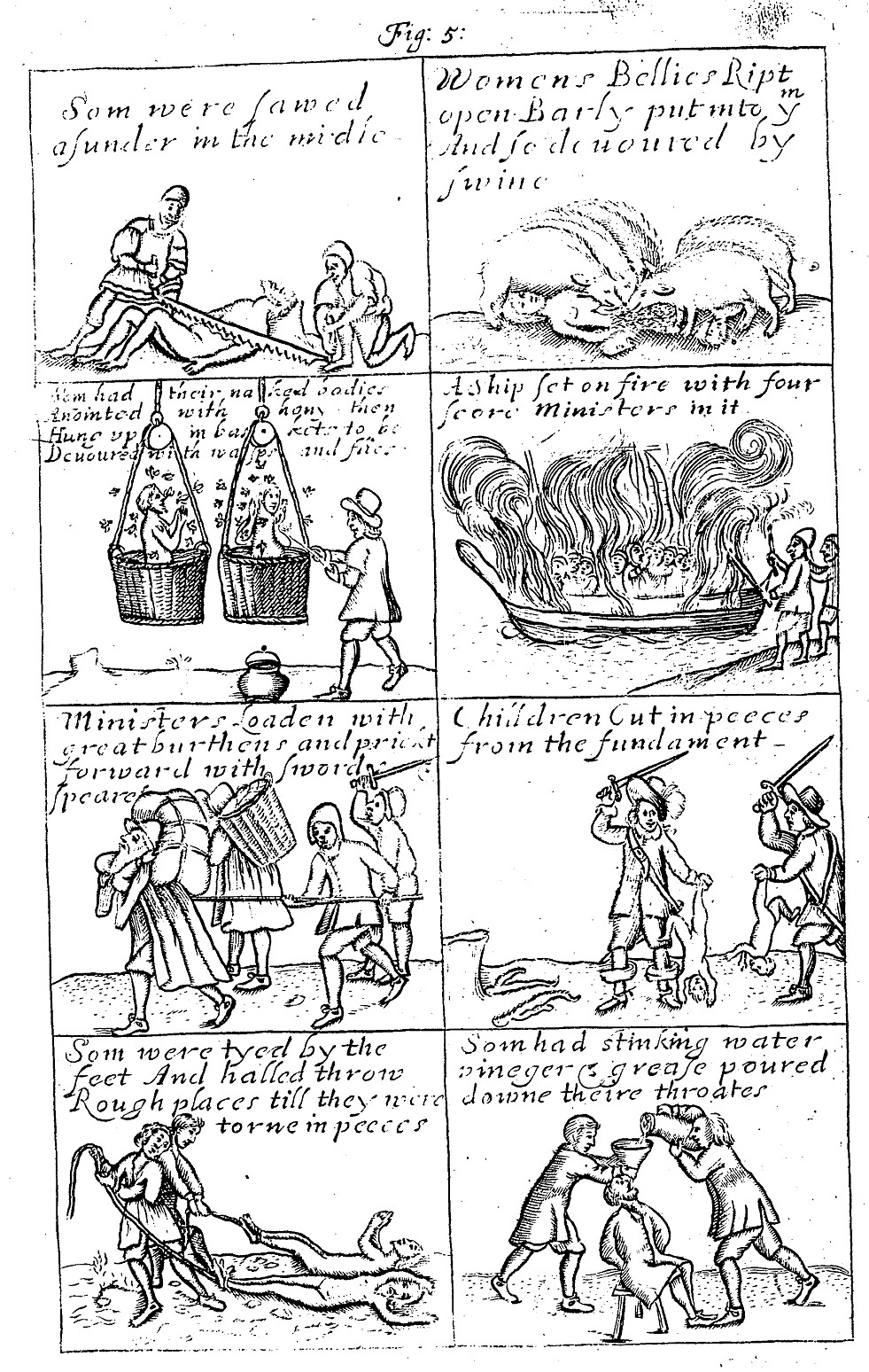
The image is one of many graphic illustrations in Samuel Clarke, A generall martyrologie containing a collection of all the greatest persecutions which have befallen the church of Christ from the creation to our present times (London, 1651), Wing / C4513. Clarke’s compilation was first published in 1651. A second edition in 1660, and a third in 1677 suggests that the work was popular. The Martyrology is almost entirely derived from John Foxe’s Actes and Monuments (1563). Indeed, in the preface to the third edition, Clarke defended himself against the claim that his work was a superfluous repetition of Foxe’s monumental work – Clark argued that Foxe’s was a general history of the church, not just a martyrology, and he also claimed that he had ‘turned over many other Authors’ to supply what was wanting in ‘Master Fox’ – although a cursory perusal of the work suggests this claim is false. Probably closer to the truth was Clarke’s assertion that:

in these times many want money to buy, and leasure to read larger Volumes, who yet may find both money, and time to purchase, and to peruse so small a Volume as this is. (Preface, A2r).

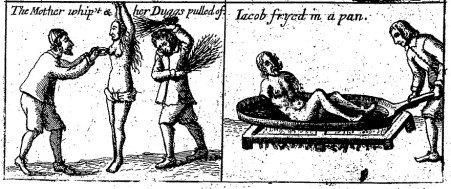
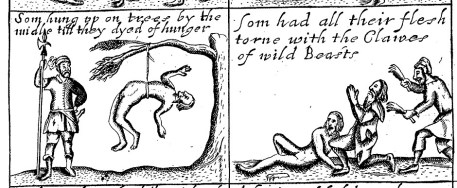
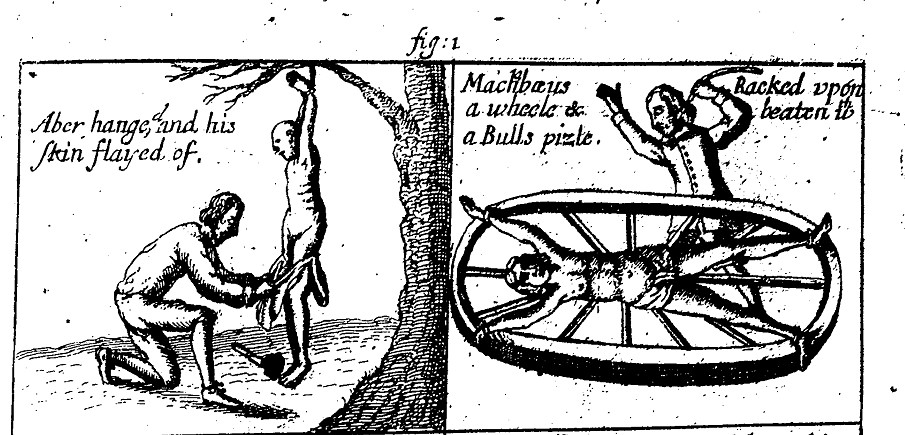
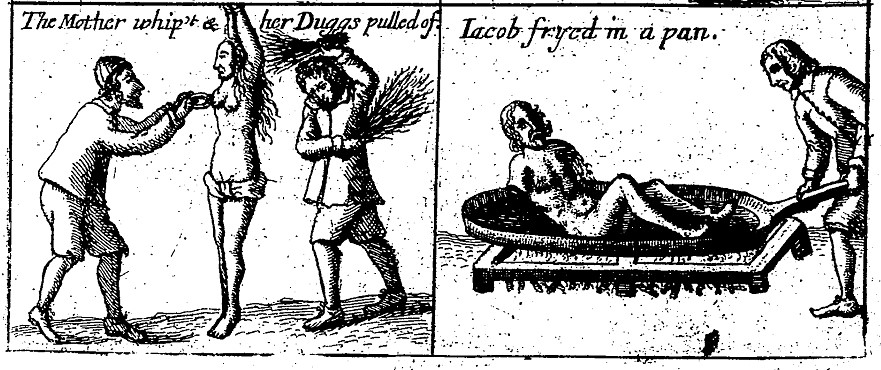
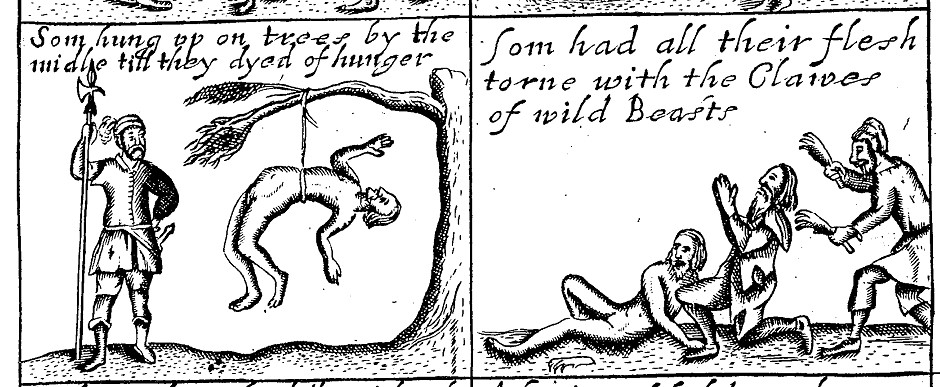
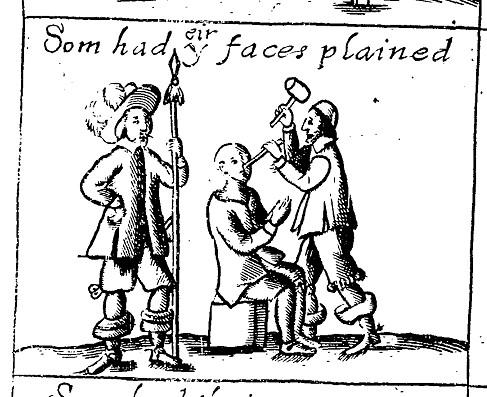
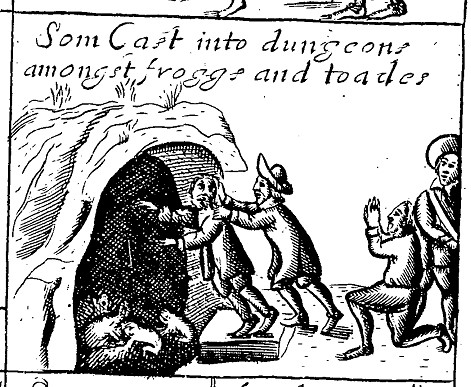
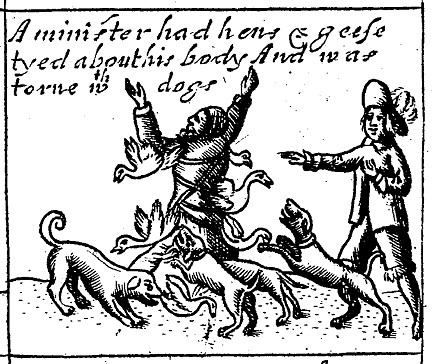
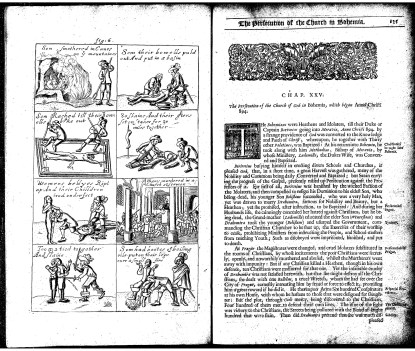
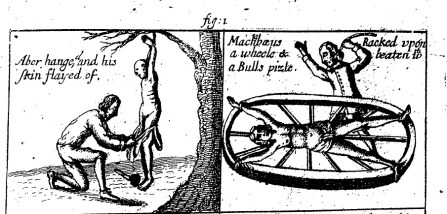
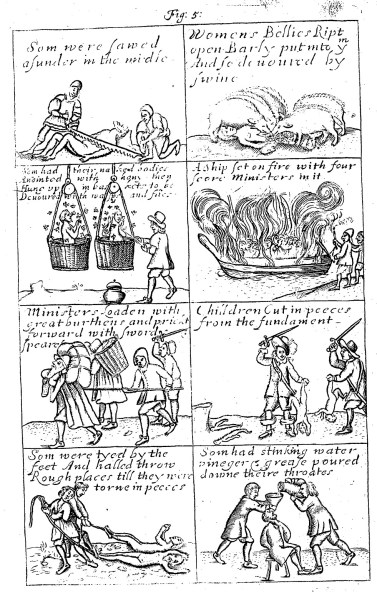
Though even this should be taken with a pinch of salt, because later editions of Clarke would have been reasonably expensive – the third edition was more than 700 pages long; and it contained many illustrations, making it an object of prestige as well as a marker of preferred churchmanship. That said, the images are certainly cruder and less sophisticated than in the large, expensive editions of Foxe. The original image that I tweeted can be seen in context here, bottom right (p. 125, 1677 edn.)Original pic in contextThere were twelve of these plates in the book, each depicting the sufferings of the martyrs in extremely graphic detail. The reader can gaze upon the brutality of religious persecution and be struck by the ingenious capacity of humans to inflict ever more horrible suffering upon their fellows. The enormous variety of types of torture, and the inventiveness of punishments is constantly surprising. Page 18Page 18bpage 52 hung and animal clawsFor the modern viewer, the crude images probably provoke a variety of conflicting emotions. Organised in (what looks to us) a comic book style, the presentation, and the poses and expressions of the victims and torturers often seem terribly mismatched against the outrageous violence that the images depict. The result is both shocking, but at the same time it can also be humorous – as with the nonchalant chap in the ‘boiling oil’ boots. We are used to a extraordinary level of realism in modern media: high definition reproductions of crime scenes, the aftermath of terrorist attacks, the devastating effects of modern warfare. Early modern efforts can seem basic, stiff and even silly, by comparison.
page 74 full page

ATROCITY PROPAGANDApage 242 papist hearts


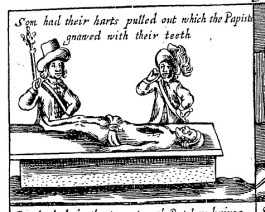
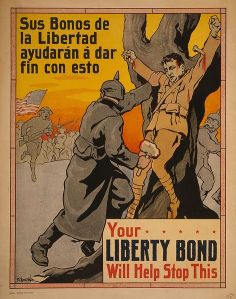
The images also provoke a sense of disbelief – we would prefer to think that this is religious polemic, on a par with the atrocity propaganda of the First World War. Surely no Catholics actually ate a Protestant heart, and the Hun didn’t really crucify a Canadian soldier in Belgium? Though we accept terrible violence happens, the presumption is often that these acts have been exaggerated for greater effect – though countless atrocities throughout history offer plenty of evidence to the contrary.

At other times, the violence is so absurd or extreme that humour is almost a logical response:
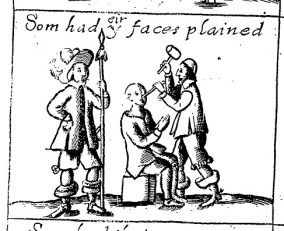
page 220 face plainedIt’s not really possible to ‘plain’ someone’s face off is it?
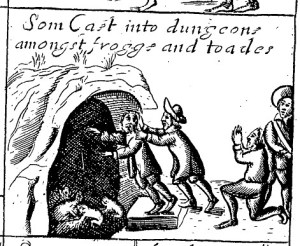
page 220 frogs and toadsBeing thrown in a cave with some toads and frogs hardly seems comparable to some of these other tortures, does it?
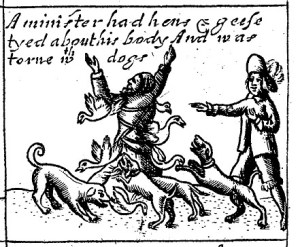
page 180 geeseHow long did it take them to tie those geese and hens on?

Undoubtedly martyrologies are a form of religious polemic and we shouldn’t assume that the atrocities they depict happened. As with all source material we must recognise the cultural dynamics that have shaped the content and presentation of the material. But of course we mustn’t assume that the viewing experience was the same for the early modern person. Early modernists were used to sub-standard or less accomplished woodcuts, and these visuals would presumably have represented the events they depicted to their imagination as effectively as a photograph does to us today. Early modern readings of these images would also have been informed by their own visceral experiences of religious violence – in the mid-seventeenth century, England had suffered about a 3.7 percent loss of population during the Civil Wars (more than during World War I, around 2 percent) and religious violence was part of everyday existence. Thus in their historical context, these images would perhaps have been just as affecting as Azadeh Akhlaghi recreations of Iran’s most notorious murders are to us today, though in the future they may also be seen as amateurish and slightly absurd.

The Author[1]

Samuel Clarke (1599-1682) was born in Sam Clarke headshotWarwickshire, the son of a vicar, and he grew up in a notably Puritan parish. He was well educated – first at Coventry school, and then Emmanuel College, Cambridge. In February 1626 he married Katherine Overton, with whom he had six children.
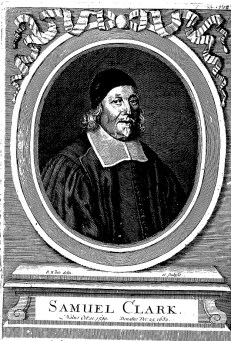
Following his education Clarke had a successful career as a clergyman. He was constantly in trouble for his nonconformity (his refusal to wear the surplice and omitting some of the ceremonies in the Book of Common Prayer), although he was pleased with the reformation that he achieved at Alcester in the 1630s – according to Clarke, as a result of his ministry the town ‘which before was called drunken Alcester, was now exemplary and eminent for religion’.[2]

Clarke campaigned against Laudian innovations in Church government and theology, and witnessed the suffering that the Civil War bought to the Midlands in the 1640s. In 1643 he moved to London, becoming minister at St Benet Fink and getting involved in London Presbyterian circles. In the 1650s he was a more moderate voice, prepared to work with the Cromwellian regime, and he initially welcomed the restoration of the monarchy in 1660. However, the religious settlement of 1662 was too conformist for Clarke’s tastes, and he was ejected from his position in the Church, along with two of his sons.

Excluded from the Church, Clarke then dedicated his time to writing and publishing works that would promote his religious beliefs, including A Generall martyrologie. Clarke specialised in compiling biographies, gathering his material from already published works and the manuscript writings of other godly ministers. His other works included: The Lives of Thirty-Two English Divines, appended to the third edition of A Generall Martyrology (1677) and Lives of Sundry Eminent Persons in this Later Age (1683).

[1] The information about Samuel Clarke is from: Ann Hughes, ‘S. Clarke (1599-1682)’, Oxford Dictionary of National Biography (OUP, 2004); online edn. May 2007 [http://0-www.oxforddnb.com.lib.exeter.ac.uk/view/article/5528, accessed 12 April 2014].

[2] S. Clark [S. Clarke], The lives of sundry eminent persons in this later age (1683), quoted in Hughes, ‘S. Clark (1599-1682)’.

I consulted all three editions of Clarke on Early English Books Online.