Carnivalesque 94: No bishop, no king

Brodie Waddell

Welcome to the 94th edition of Carnivaleque! Today we will be introducing you to a wonderfully motley menagerie of historical blogs and bloggers.

Finding any overall unifying theme is impossible with a collection of this sort, but there are a few key subjects that emerged from the nominations, each of which receives a section below:

  • The historian as detective
  • Bodily functions
  • A venerable criminal enterprise
  • Places, spaces and sites
  • Thinking about the historian’s craft

I think it is particularly interesting what’s not in the links below, namely kings and queens and ‘great battles’, the traditional material for popular histories. Not that political history and military history are entirely absent, just that they are approached from a different direction than usual. Although there are a few of gentlemen and noblewomen as well as a famous scientist, the vast majority of the nominated posts are focused on people who would have been largely excluded from textbooks written fifty years ago. What should we make of this? Is old-fashioned ‘top down’ history dying off? Or is it just that the type of people who read this blog and pay attention to Carnivaleque are predisposed against reading yet another story about Henry VIII and his wives or Charles I and his parliaments? I’d be interested to hear what you think.

However, before wandering into the carnival below, take a look at this truly heart-warming short animation that tells the tale of ‘the damnable life and death of one Stubbe Peeter, 1590’, a German werewolf. For more details, see the two posts at LOLManuscripts, but in the meantime, watch the video and be amazed.

Now, on with the show…
Continue reading

REED all about it III: Some musings on music and the micropolitics of Sabbath-breaking in Jacobethan Lancashire

Jonathan Willis

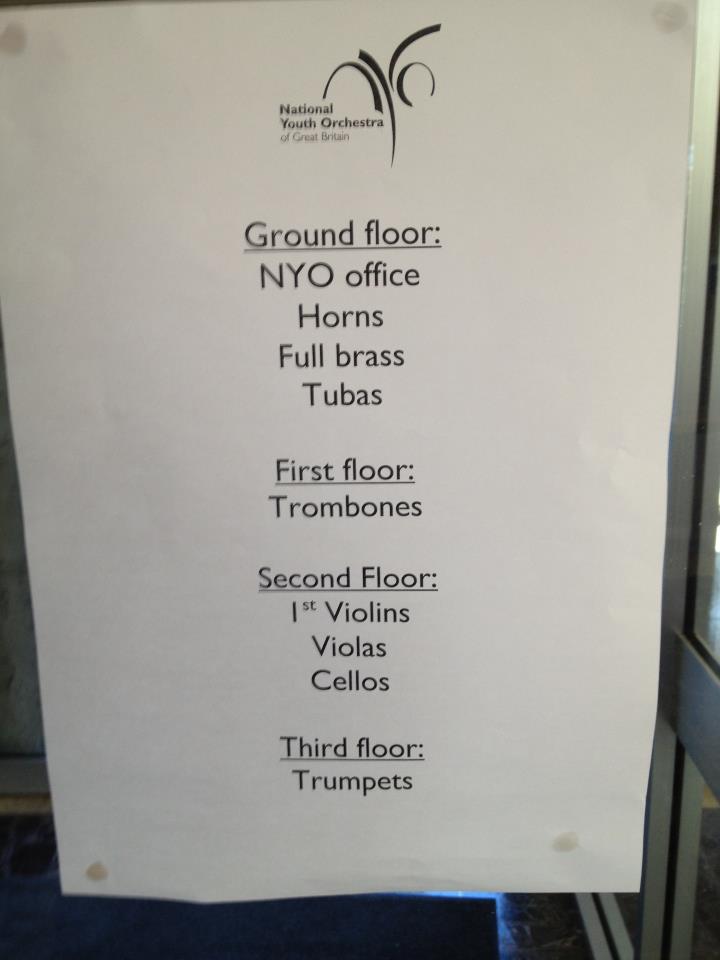
One sunny afternoon last July, the University of Birmingham’s Edgsbaston 295393_10151929538030109_359375196_ncampus played host to some rehearsals by the National Youth Orchestra of Great Britain.  Cellos, violas, tubas and trombones were scattered liberally throughout the Arts Building, and the history department itself played host to the trumpet section.  Hearing (fainter) strains of music in the department is not an uncommon occurrence, as there are student rehearsal rooms in other parts of the building.  This is usually quite enjoyable, even if it occasionally adds a melodramatic quality to meetings or supervisions.  Whether at work or home, we have all probably at some stage encountered some form of music which has permeated our environment uninvited.  Sometimes, as with the NYO or Birmingham’s budding undergraduate virtuosi, this can be an unexpected source of pleasure.  But in other situations, it can be distracting, disruptive, or downright offensive.  Uncleanness, the anthropologist Mary Douglas famously observed in her 1966 work on Purity and Danger, is ‘matter out of place’.[1]  In the same way, musical sound in the wrong spatial or chronological context can easily cross the rubicon of taste and order and become a provocative and clamorous noise.  If this is still true in the sound-proofed, double-glazed, cavity-wall insulated, noise-cancelling-headphone-wearing twenty-first century, then it was even truer in the sixteenth, where both welcome and rogue sounds must have travelled with much greater volume, clarity and conspicuousness. Continue reading

Norwich Entertainments – Part V: Ballad-singers and dangerous news, with coffee

Brodie Waddell

The people of late seventeenth-century Norwich did not get their entertainment solely from hairy children and pieces of plays. They also amused themselves with the ever-growing numbers of printed works that were pouring from the presses at that time.

In June 1680, for example, the Norwich Mayor’s court ordered that ‘Twoe Ballad singers haveing Lycence to Sell ballads, pamphlets small bookes & other bookes Lycensed from the Office of the Revells have leave to doe soe until Monday senight [?seven-night]’.1

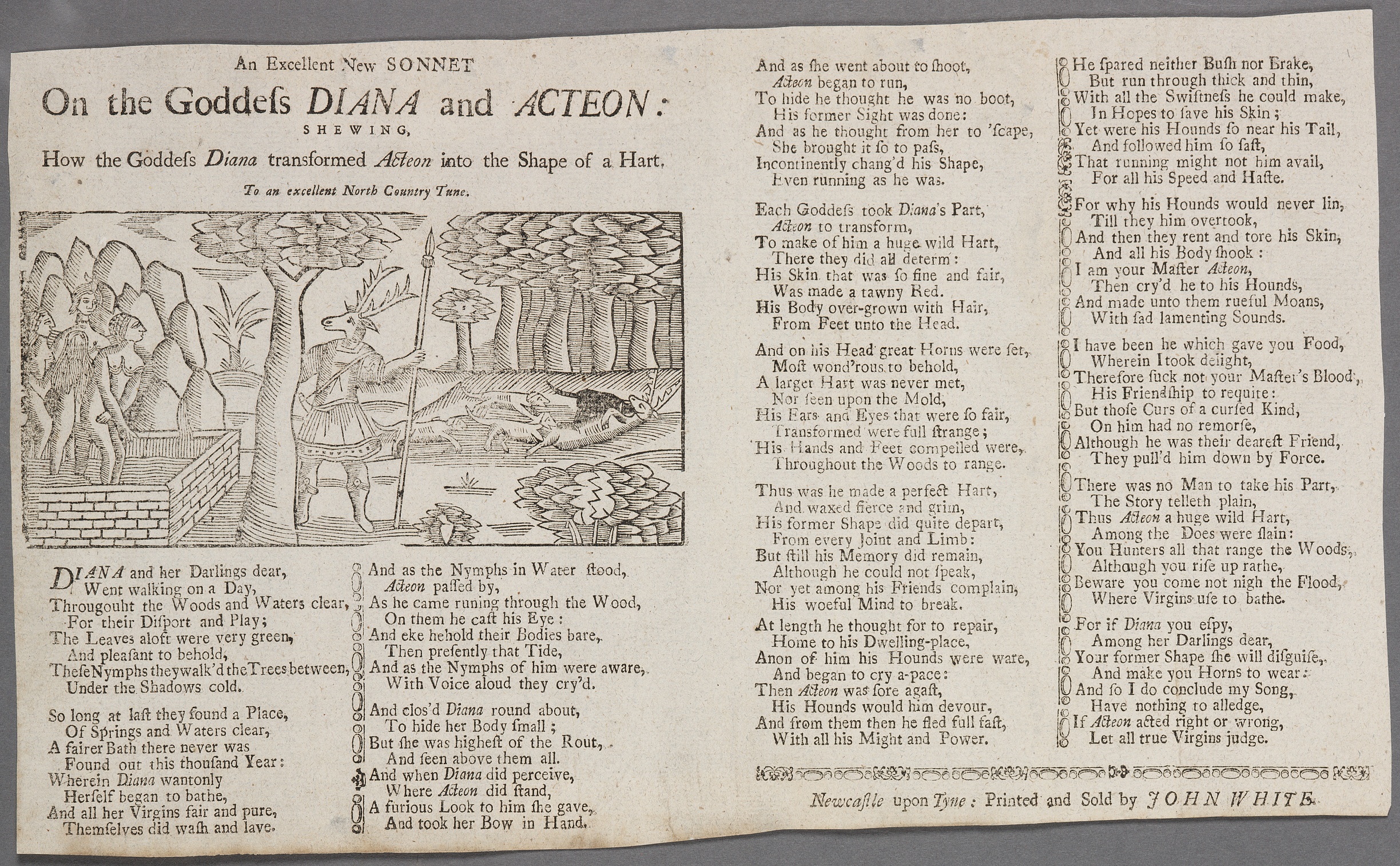
Ballad entitled ‘An Excellent New Sonnet On the Goddess Diana and Acteon’ (c.1725-69). EBBA.

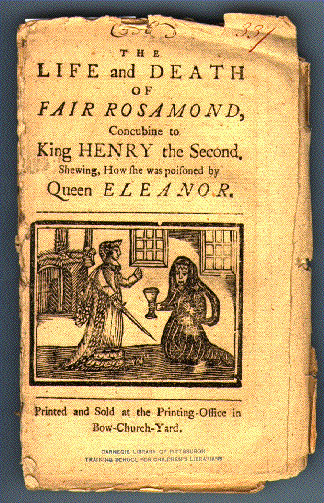
Title-page of a chapbook titled ‘The Life and Death of Fayr Rosamond’ (1755). SF.

These balladeers were just two of the hundreds that traipsed through the city streets and country lanes of early modern England, singing to advertise their wares. The exact contents of a peddler’s sack could be very diverse. In addition to all sorts of petty trinkets, they sold tales of drunken sailors, royal mistresses, industrious spinsters, and much else besides. Often these were in the form of broadside song sheets, but they might also be ‘pamphlets’ and ‘small books’, sometimes called chapbooks, written in prose to provide merriment or salvation for the price of penny or two. Margaret Spufford and Tessa Watt, among many others,  have discussed this ‘cheap print’ in much more detail, noting that ballad-sellers were often condemned by the authorities as vagrants. But in late seventeenth-century Norwich at least they seem to have been welcomed by both the townspeople and city officials.

Rather more unusual, however, was the license issued to a man a year earlier. In November 1679, the court declared that ‘Lawrence White is allowed to reade & sell Pamphlets on Horsebacke untill Wednesday next’.2 Continue reading

REED all about it – Part II: Angelic sheep-stealers, iconophobia, and the unaccountable longevity of ‘Merry England’?

Jonathan Willis

Last month I wrote a REED-related post about a minor scuffle at a church ale in Bere Regis in 1590, but this time I would like to highlight a more significant and well-known case, to my mind one of the real gems of the REED material: the controversy surrounding the performance of the Whitsun plays in Chester during the early 1570s.[1]  There was a rich history of sacred drama in Chester going back at least as far as the late fourteenth century, including plays to celebrate Easter, midsummer, and Corpus Christi.  By the sixteenth century, it was held that the ‘old and Antient Whitson playes’ held annually in the city were ‘first made Englished and published by one Randall Higden a monk of Chester Abbey, and sett forth and played at, and by the Citizens of chester charge In the time of Sir Iohn Arneway Knight, and Major of Chester Anno 1268’.[2]  In 1571-2 the plays were still going strong, and detailed guild accounts give a fascinating insight into both the performances themselves, and the degree of time, effort and resource which went into their preparation.  The Smiths, Cutlers and Plumbers’ Records for that year recorded 3d for equipment (a ‘touyle’), 1s 4d for casting costs (‘seekinge our players’), and 7s 8d worth of beef to sustain them ‘for our genrall rehearse’, along with two whole cheeses and spices for the meat.[3]   An amateur dramatics group, like an army, evidently marched on its stomach, as payments for bread over three separate rehearsal days totalled 4s 10d, and to quench the assembled thirst there was 10s worth of ale and 9d of small ‘beare’.  Alongside the players, payments were also made to musicians and minstrels, as well as 4s 2d ‘to the clergy for the songes’, implying a close relationship between the professional religious institutions of the city (quite possibly the choir of Chester Cathedral) and the amateur efforts of the trade guilds. Continue reading

What shall we do with a drunken sailor?

Brodie Waddell

Surely this was an age-old question. Although the traditional sea shanty was only recorded in the early 19th century, there were more than a few early modern seamen who over-indulged in drink.

Indeed, when ‘a crew of Jovial Blades’ met in an alehouse in one late 17th-century ballad, it was the sailor who took the lead over his landlocked companions:

A bonny Seaman was the first,
but newly come to Town,
And swore that he his Guts could burst
with Ale that was so brown.

In another song from this period, a group of cunning ‘Maidens’ from the London suburb of Poplar tricked ‘several young Seamen’ into eating a cat baked in a pasty. Once they realised their mistake, the feline feast ‘did force them to spew’, but they still ‘laughed and quaffed’ and ‘drank off the Liquor before they went out’. It seems the solution to eating ‘A Cat-Pasty’ is to get thoroughly drunk.

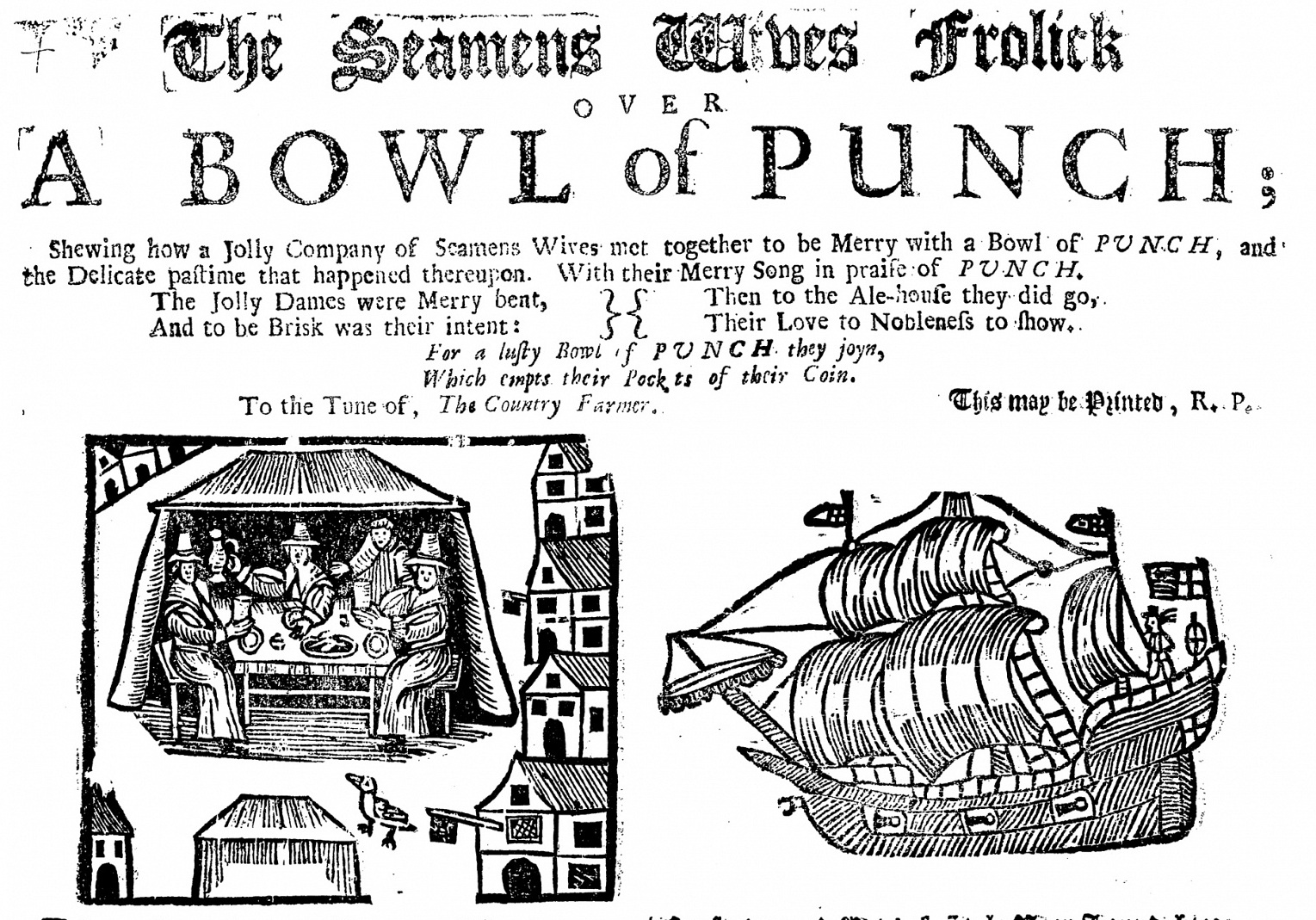
Even sailors’ wives were not averse to downing ‘a lusty Bowl of Punch’. According to another ballad, the ‘Jolly Company’ raced to the alehouse as soon as their ‘Seamen had newly left the Land’ and set on their task with gusto:

We Seamens brisk Wives are bonny and glad,
While our Men on the Ocean are sorry and sad;
We love our Liquor to drink it all up,
None of us but love a full Glass or a Cup

They went so far as to claim that the punch would ‘make our Noddles the quicker’, a suggestion that was not as far-fetched to their contemporaries as it might be to us. As unlikely as it sounds, Mark has shown that the idea of alcohol enhancing ‘wit’ and ‘reason’ was not unknown in early modern England.¹ A little of ‘haire of the old Dogge’ might also cure the resulting hang-over.

Detail from ‘The Seamens Wives Frolick Over A Bowl of Punch’ (1685-88), in Pepys Ballads, IV, p. 184, via EBBA.

One might be inclined to dismiss these as stereotypes played up by the balladeers trying to make a few extra pence, but there are also examples from the archives. The records of the High Court of Admiralty, for example, include depositions describing sailors such as Robert Oyle who habitually ‘debauch[ed] himselfe with drinke’, Frisby and Archer who spent ‘five dayes and nights together drinking and frequenting houses of lewd repute’, and Thomas Grove who returned aboard ‘much distempered with drink and began to curse and sweare’.

Are these cases typical? It’s hard to say at this point. All of the Admiralty examples come from the MarineLives project, a new group which is currently transcribing and publishing online a whole swathe of rich material from court records held at Kew. Perhaps once we have a complete set of cases over an extended period we’ll have a better idea of just how often 17th-century seamen had to ‘put him in the long-boat and make him bale her’ or ‘put him in the scuppers with a hose-pipe on him’, ‘earl-aye in the morning’.

In the meantime, the MarineLives team report that they are looking for a few more volunteers to join them to help uncover the rough lives of early modern seafarers, so if you’d like to help the world learn about a real ‘drunken sailor’ or two, do let them know.

Footnotes

¹ Mark Hailwood, ‘”It puts good reason into brains”: Popular Understandings of the Effects of Alcohol in Seventeenth-Century England’, Brewery History (forthcoming, January 2013).

REED all about it – Part I: Fiddling at the Church Ale…

Jonathan Willis

This wasn’t originally going to be the first utterance of this particular newly-sprouted head of the many-headed monster, but Brodie’s recent musings ‘On the merits of dust‘ and the lively debate it sparked set me to thinking about one of my favourite short-cuts to a treasure-trove of brilliant archival material, the Records of Early English Drama series. REED (for short), for those of you who haven’t come across it, is an international project with its home at the University of Toronto. Since 1975 they have published almost thirty edited volumes bringing together collections of transcribed documentary material relating to drama, secular music, and community ceremonial and entertainments from the middle ages until the middle of the seventeenth century. Organised variously by city, county or region, these reassuringly sturdy big red books would be a handsome edition to any library or bookshelf (no, I’m not on commission), and even better many of them are also available to download in PDF format, perfectly legally(!), through the Internet Archive website. This is a top-notch published collection of manuscript material, gathered from record offices up and down the country, which is not only available in university libraries but also on your laptop, desktop or tablet. Continue reading