The wandering, pipe-smoking Jacobite

Brodie Waddell

King William III was a greedy, irreligious, oppressive usurper. Worse still, he was a Dutchman. Or at least these were the sort of things one might hear in many of the alehouses of northern England at the end of the seventeenth century.

Definitely a bit too Dutch for his own good.

I’m going to be giving a talk at the Institute of Historical Research on Thursday (March 14th) on ‘The Present State of England: Modernity and Memory in the Hard Times of the 1690s’, and I thought I’d share one of the many, many seditious denunciations of William III’s regime that I’ve come across during my research into this topic. Sadly, this one probably won’t make it into the talk, but I’ll be sure to include a couple of others.

This case comes from amongst the mess of unsorted and unnumbered despositions from the Palatinate of Lancaster held at The National Archives at Kew, specifically PL 27/2. In May of 1700, according to a chapman from Manchester named David Smith,

one James Scott a wandering person this day … did declare … that his present Majestie King William had noe more religion in him then his pipe in his hand & that all that he cared for was to please his people & to gett mony together & that he love a finger of King James’ hand more then he loved King Williams body

One needn’t have a detailed knowledge of later Stuart political culture to decipher the complaint. William III had a reputation as an aloof, cold monarch, which may partly explain why Scott had so much more ‘love’ for James II’s finger than for the current king. Likewise, the king’s continental Calvinism was regarded as somewhat suspect by many Church of England clergymen, which may help to explain Scott’s reference to his atheistical pipe.

However, I’d guess that Scott’s dislike come primarily from the other fault that he mentions here: ‘all he cared for was to please his people & to gett mony together’. This was surely a reference to William’s foreignness and his very aggressive fiscal policies: ‘his people’ were presumably the Dutch courtiers whom he brought over with him, and his need ‘to get mony together’ resulted in taxation more than doubling in less than a decade. As I’ll explain on Thursday, these were ‘hard times’ and, as a result, the king’s regime was widely resented for his foreignness, his favouritism and his predilection for expensive European wars.

If anyone else has come across similar material from this period, I’d love to hear about it.

‘More acute and witty in his drink than at other times’…

Mark Hailwood

When Thomas Feilder was hauled before the Reading authorities in 1624, on a charge of beating up a town constable, he offered a straightforward explanation for his actions: ‘drink was the cause’, ‘he was not himself’, and ‘he knew not what he did’. But what did early modern English courts make of such claims? Was drunkenness understood to mitigate responsibility for the offence, or did such reckless inebriation compound the transgression into a double misdemeanour of assault and drunkenness?

Drinking Woodcut

This is just one of the questions I address in my latest article (that’s right, that opening vignette was just a snare to trap you into a self-promotional post). In the essay I ask – and attempt to answer, of course – a number of questions about seventeenth-century understandings of the effects of alcohol on mind and body. Did they share our concern about alcohol’s harmful impact on health, or was it considered ‘far better than any doctor in town’ for treating ailments? Was it used as an anaesthetic to numb the senses against the hardships of daily life, or did contemporaries guzzle booze because it was thought to ‘enrich all the faculties’ and act as a stimulant to mental activity? I’m dropping some clues here (let’s just say I’m not making those quotes up) but if you want to find out the full story then you should check out my ‘”It puts good reason into brains”: Popular Understandings of the Effects of Alcohol in Seventeenth-Century England’.

Cover thumbnailIt appears in a special edition of the journal Brewery History, edited by myself and Leicester lecturer Debbie Toner, under the banner of our Warwick Drinking Studies Network. It showcases the work of a number of early career scholars, and all the essays focus on aspects of early modern drinking culture, including the revolutionary introduction of hops to the brewing process (considered by some to mark the very origins of commercial capitalism. Well,WDSN Logo by me anyway); the important role played by the alewife in serving up the country’s favourite tipples; and the symbolic significance of being allowed to use the best silver at a guild feast. You can download the introduction for free here, and from here you can order a copy of the edition for the very reasonable price of £4.50.[1]


[1] An earlier draft of my article can be found on my academia.edu page, but please don’t cite from it.

A miscellany: wandering woodcuts, Greifswald glosses, digital Defoes and Thompson tributes

Brodie Waddell

Several things have come to my attention over the last few weeks that deserve wider attention. Although I don’t have time to provide much commentary, I think our readers will find some of them of interest.

The first concerns the wonderfully rough images that so frequently appear in our posts: broadside ballad woodcuts. The Bodleian Library recently announced the launch of an image-matching tool that will allow researchers to easily search for the many versions of a specific image across the library’s whole collection of ballad sheets. Eleanor Shevlin discusses the new tool in more detail over at EMOB. In light of Mark’s posts on early modern representations of working people, it would be fascinating to know how particular ‘occupational’ images are reused and recycled in different contexts and perhaps given quite different meanings.

The second is Beat Kümin’s historical travelogue, Greifswald Glosses, exploring the largely autonomous parish communities in early modern Northern Germany. As a professor at Warwick, Beat is well-known to us here at the Monster and his blog offers a remarkable (and remarkably well-informed) look at the towns, churches, landscapes and even graffiti of this part of the former Holy Roman Empire. I think my personal favourite was the fourteenth-century gargoyle/collection-box at St Jacobi in Göttingen, but you may prefer the ruminations on low-ranked local football teams or the semi-fortified round churches of Bornholm.

The third is an amusing ‘pop history’ article in The Atlantic on Daniel Defoe’s A Journal of the Plague Year (1722). It’s a well-researched piece, based on an interview with the Defoe scholar Katherine Ellison and incorporating plenty of (anachronistic) pictures, but what makes it interesting to me it that it is written by the magazine’s tech writer. The short version of his argument is basically that Defoe was an early modern blogger and, unlike some of today’s bloggers, he approached the wealth of information provided by that era’s new technology (e.g. newspapers) with a critical eye. I’m not sure I’m actually convinced, but it’s great to see another side of early modern history (beyond Henry VIII, Shakespeare and Oliver Cromwell) receiving some thoughtful discussion in such a high profile outlet.

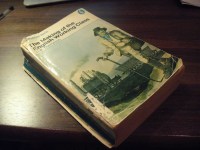
Finally, Katrina Navickas has a post at History and Today on E. P. Thompson’s The Making of the English Working Class (1963). There are, as she notes, a great many tributes and events happening this year to mark the fiftieth anniversary of its publication. However, what I enjoyed was hearing a little about her relationship with the materiality of the book itself, in all its tattered, dog-eared glory. I think I probably find myself reaching for Thompson’s Customs in Common (1991) more often than MEWC, yet I’m still strangely comforted to have a decent edition of the latter nearby. In her words, ‘despite my “digital humanism”, I still need those yellowed and annotated pages of the Penguin paperback to really get to the heart of Thompson’s writing’.

Shorter notices

Our very own Laura Sangha has set up a twitter feed for her students of ‘Religion, Society and Culture in Tudor England’: Tudorists rejoice! Grad students in and around London interested in early modern history really ought take a look at the talks hosted by the Birkbeck Early Modern society (and their tweets too). And lastly I belatedly wanted to thank the Birkbeck History PhD bloggers for reblogging one of our posts and recommend that all BBK doctoral students check them out.

[Update (07/02/13): Co-blogger Jonathan Willis is also tweeting (@CREMS_Bham) for Birmingham’s Centre for Reformation and Early Modern Studies.]

Call for Papers: Sin and Salvation in Reformation England

Jonathan Willis

As the tightly-sprung chaos of another academic term starts to unwind, and thoughts turn to the endless possibilities of a month of peaceful and unbroken research time (oh yes, and Christmas), my gift to you, Monster reader, is a call for papers.  But this isn’t just any call for papers!  Firstly, the vital statistics: Sin and Salvation in Reformation England is a major three-day conference taking place 26-28 June 2013 at the Shakespeare Institute, Stratford-upon-Avon.  I am organising the conference under the auspices of CREMS, the University of Birmingham’s Centre for Reformation and Early Modern Studies, with generous support from the Leverhulme Trust.  Contributions are invited from established scholars and postgraduate students alike, and it is my hope that the conference will give rise to an edited volume of essays. Themes for papers may include (but are not limited to): visual, literary, political, theological, historical, material, musical, polemical or any other treatments of the topics of sin and salvation in the context of reformation-era England. Please send abstracts of 250 words for 20-minute papers to me by 31 March 2013, and visit the CREMS website for more information.

Secondly, keynotes.  Every conference needs at least one keynote, and I’m delighted to say that we have managed to arrange an exceptional lineup of three of the most interesting and engaging scholars in the field.  Dr Arnold Hunt, has written on communion and extensively on preaching, and is currently involved with editing the parochial sermons of John Donne.  Professor Alec Ryrie has written extensively on the English reformation: his long-awaited monograph on Being Protestant in Reformation Britain is due out early next year, and he has already embarked on a new global history of Protestantism.  Professor Alexandra Walsham has written a series of ground-breaking books on the English reformation, on topics ranging from church papistry to providence and intolerance.  Her most recent work is a breathtaking account of the Reformation of the Landscape, and she is currently working on the impact of ageing and generational change on the English Reformation.

Thirdly, the conference blurb: Sin and Salvation were the two central religious preoccupations of men and women in sixteenth century England, and yet the reformation fundamentally reconfigured the theological, intellectual, social and cultural landscape in which these two conceptual landmarks were sited. The abolition of purgatory, the ending of intercessory prayer, the rejection of works of supererogation and the collapse of the medieval economy of salvation meant that it was impossible for attitudes, hopes, fears and expectations about sin and salvation to survive the reformation unchanged. This conference will explore some of the transformations and permutations which the concepts of sin and salvation underwent over the course of the reformation in England, as well as the practical consequences of these changes as lived.

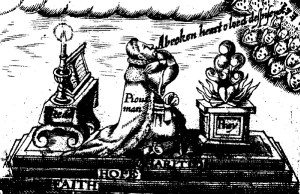
Fourthly, every call for papers needs a picture, so here is mine: part of the frontispiece from Lewis Bayly, The Practise of Pietie (1613).

Bayly[A pious man, kneeling upon a foundation of faith, hope and charity, turns from his study of the scriptures to pray: ‘A broken heart o Lord despise not’!]

Fifthly, finally, and as this is a blog entry rather than a traditional call for papers, I wanted to take a little more time to explain why I want to put this conference on, and what I hope to achieve.  I’m currently enjoying the third year of a Leverhulme Early Career Fellowship, working on ‘The Ten Commandments and the English Reformation’, and it was always my plan to host a conference during the final year of research.  Initially this was going to be a conference on the Ten Commandments, then it became one on the concept of God’s law, then on the use of the Old Testament during the reformation more broadly, then more generally on the bible.  Each successive iteration felt like I was getting closer, but I am not a biblical scholar, and so I kept putting it off and off as it didn’t quite feel right.  Finally it clicked: in a nutshell, the commandments were all about listing the things that you mustn’t do (i.e. sin), and enumerating the sort of deeds performance of which could be taken as a sign that an individual had been predestined to election (i.e. salvation).  One of many roles of the commandments in reformation England, therefore, was to help shape these fundamental concepts of sin and salvation as they slowly came to be understood by the great majority of people, through continual exposure through preaching, catechesis, the liturgy, and visual, musical, and other media.  Hopefully then, ‘Sin and Salvation in Reformation England’ will open up for exploration not only those vital concepts themselves, but also how they came to shape religious belief, practice and identity amongst the laity, and how they themselves were moulded by the experience.  A worthwhile enterprise, I’m sure you’ll agree: so, please take some time out from the sherry and mince pies, send those abstracts through to me now, and keep your eyes peeled for information about registration in the spring!

The impotence of being reviewed…

Jonathan Willis

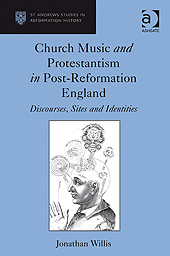
Following Brodie’s post last month on ‘Twelve reasons to buy my book, or, The ancient art of self-promotion’, I started thinking about what is one of the most exciting stages of the subsequent post-publication process: that is, the point at which the first review appears. This post is therefore a reflection on my own experience of being reviewed.[1] The book in question is my Church Music and Protestantism in Post-Reformation England, which was published by Ashgate in their St Andrews Studies in Reformation History series in May 2010.[2] A modified version of my PhD thesis, the book charts the impact of the reformation on religious music, and the role of religious music in shaping the English reformation (OK, so I couldn’t resist a quick plug!).
A jog rather than a sprint

One of the inevitable by-products of the academic system is the development of a ‘feedback loop’. This starts at school, and continues through university, including the process of PhD supervision, and even the viva. I think most of us have a deep-seated desire to be told how well we’ve managed to perform a given task: I’m minded here of Lisa Simpson’s desperate plea to Marge when the teachers go on strike and Springfield Elementary closes: ‘Grade me…look at me…evaluate and rank me! Oh, I’m good, good, good, and oh so smart! Grade me!’ All of which is a slightly roundabout way of making the point that, once you’ve released a book into the world, it’s only natural to want to know how well it has been received. Well, you may be in for a bit of wait. Books have to be sent out to a journal, received, processed, allocated, sent out to a reviewer, received and read even before the review can be written, which can itself take a fair bit of time. Manuscripts have to be typed up, sent in, proof-read, and scheduled for publication in a particular issue. How many of us have ever taken more than the allocated time to submit a book review? Need I say more! My first review appeared just over a year after the book was published, which isn’t an especially long time by any means, and two and a half years in I suspect that there are still several more in the pipeline. Glance at the list of books available to review on the Sixteenth Century Journal website, and there are still plenty of titles from 2010 awaiting their reviewer…

More a trickle than a flood

Briefly, and for the same reasons outlined above, it therefore follows that different journals will take varying amounts of time to publish their review of your book. The rules here are slightly different for game-changing books by field-shaping authors. When Eamon Duffy or Alexandra Walsham release a new monograph, it’s a fair guarantee that the reviews will appear thick and fast, while journals vie with one another to ride the crest of the publication wave. But I think that the experience is different for the majority of (especially) first books and their authors. The sheer volume of work being produced in the field is so overwhelming that it might take a long time for your turn to come around. For example, the October 2012 issue of the Journal of Ecclesiastical History features reviews of several books published in 2009.

The Journal

Past and Present famously do not review books, of course, but most of us have an idea of the top journals in our particular area, and would probably like to see our book being reviewed there. But, and again for the reasons outlined above, it’s not wise to be too fussy, and it is frankly exciting to see a review of your work being published anywhere! My experience is of two reviews in major, large-circulation journals (History and the Journal of British Studies) and two in smaller, more specialist publications (Ecclesiology Today and Anglican and Episcopal History).

The Reviewer

Again, most of us would probably like to see our work being reviewed by one of the leading practitioners in our field, but the reality is that you could be reviewed by anybody, from the greenest PhD student to the loftiest of munros [for an explanation of this term, see this previous post by Laura Sangha]. The thing to remember is that a review is no less valuable for that! I feel lucky in that two people whose work I already knew and respected very much reviewed my book (Eric Carlson and Andrew Foster), but the other reviewers also brought valuable insights and have helped me see and think about the book in different ways, as well as addressing the concerns of a broader constituency of readers.

The Good News

I’m delighted to say that although it is at times a slow and frustrating process, my experience of being reviewed has been an entirely pleasurable one (so far). Everyone likes having nice things said about them, and a few positive reviews finally close the ‘feedback loop’ I mentioned at the start. I feel that it would be remiss of me to pass up the opportunity of quoting a few highlights(!): Eric Carlson commented that the book used ‘an exceptional range of sources’ and that ‘the prose has flashes of genuine wit and elegance’. Sarah Williams picked up on ‘careful and exhaustive archival research’. Andrew Foster wrote an extremely kind review, calling it a ‘truly exciting, ground-breaking book’, displaying ‘amazing erudition whilst also providing a compelling read’. And Jonathan Gray remarked that the book was ‘learned and thought-provoking … a detailed, meticulously researched monograph’.

The Bad News

Given that we research and write in a universe of finite time and resources, most of us are probably aware that even the most polished work has, if not shortcomings, at least areas of particular strength and therefore (by extension) of relative weakness. A good review will highlight these, but in a proportionate and constructive manner. To pick a few nuggets from my review sample, this was not (as one author pointed out, I imagine with eyebrow raised) an introductory textbook; another noted that it shed light on far more aspects of life in early modern England ‘than one might suppose from the title’ (ouch!). Finally, another commented that the final chapter was perhaps the ‘least satisfying’, because – as I would be among the first to admit – much archival work on parish music still remains to be done.

In Conclusion…

In conclusion, my experience of being reviewed is that it is a slow but ultimately rewarding process. It certainly isn’t the be-all and end-all though. If anything, the most rewarding feedback I’ve had has come in the form of unsolicited emails or personal approaches at conferences and elsewhere from people who have read and enjoyed the book. It’s also made me think very differently about how I review other people’s books. I’d be interested to hear what experiences monster readers have had, either as reviewees or reviewers. Is it always plain sailing…?


[1] My book has been reviewed four times so far since it came out in May 2010: by Eric Carlson in History, 96.323 (2011), p. 368; by Andrew Foster in Ecclesiology Today, 45 (2012); by Jonathan Michael Gray in Anglican and Episcopal History, 81.1 (2012), pp. 106-17; and by Sarah F. Williams in Journal of British Studies, 50.3 (2011), pp. 753-755.

[2] Jonathan Willis, Church Music and Protestantism in Post-Reformation England: Discourses, Sites and Identities (Farnham: Ashgate, 2010).

Biographies of Drink: A Conference Call

Mark Hailwood

An August evening in 1609, in the Cheshire parish of Knutsford. A weary tinker,  with ‘pannes upon his Backe, & a Trumpett in his hande’, pushes open the door to a humble alehouse, to be greeted by a crowd of merry ‘pot-companions’. Their ring leader is quick to enlist the tinker in the revelry, and before long he is sounding his horn to call together ‘all the drunkards’ to this epicentre of drinking and ‘good fellowship’.

Beasts

I too would like to sound a trumpet call – not so much to ‘all the drunkards’, but instead to all those interested in the history of drinking. On a February weekend in 2013, in the Maths Building of the University of Warwick, a crowd of leading scholars in the field of drinking studies will gather to consider the role that alcohol consumption plays: in the lives of individuals; in the fortunes of families; in the creation and maintenance of communal identity; and in the concerns of governments and states. There may also be some revelry.

It is not an early modern conference, nor even just a history conference, and the papers range across time and discipline, from the material culture of Roman Britain to contemporary projects to use social media to influence alcohol consumption. If you think you might be interested you can take a look at the programme (and if that goes well, find a booking form) over at the website of the Warwick Drinking Studies Network:

go.warwick.ac.uk/wdsn

The deadline for booking is 14 December.

Twelve reasons to buy my book, or, The ancient art of self-promotion

Brodie Waddell

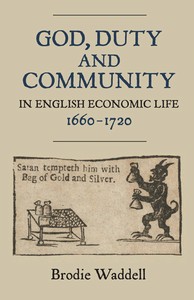
Brodie Waddell, God, Duty and Community in English Economic Life, 1660-1720

1. It was only officially released today, so if you buy it now, you’ll probably be the first kid on your block to have one!

2. It has seven pictures inside, a very respectable ratio of 1 for every 34 pages.

3. It has the word ‘God’ in the title, making it slightly more likely to be accidently recommended by your local Christian reading group.

4. It has a picture of Satan on the cover, making it slightly more likely to be accidently black-listed by your local Christian reading group.

5. Barack Obama called it ‘…the best book I’ve ever read on later Stuart economic culture…’ and Nelson Mandela said it was ‘… longer than I expected …’ (NB: Not actual quotes. Please don’t sue me!)

6. It has footnotes, not those horrible endnotes.

7. It cites a hell of a lot of broadside ballads.

8. I can’t think of a number eight.

9. It uses paper that apparently derives from ‘natural, recyclable products made from wood grown in sustainable forests’. You’re practically saving polar bears just by reading it.

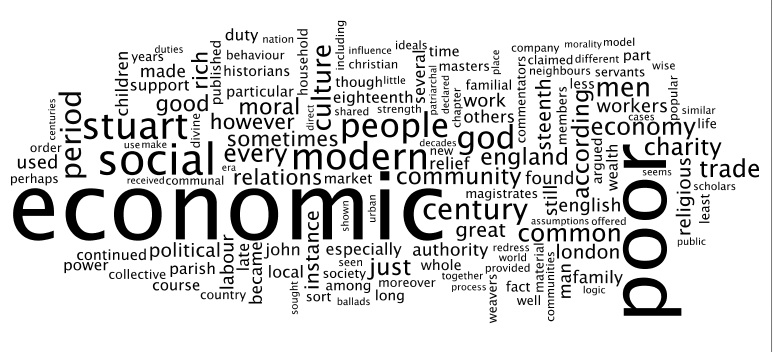
10. When you put the text through Wordle, you get this…God, Duty and Community via Wordle

11. I can’t think of a number eleven either.

12. I’ve heard that ‘this book explores the economic implications of many of the era’s key concepts, including Christian stewardship, divine providence, patriarchal power, paternal duty, local community, and collective identity. Brodie Waddell draws on a wide range of contemporary sources – from ballads and pamphlets to pauper petitions and guild regulations – to show that such ideas pervaded every aspect of social and economic relations during this crucial period.’

Available at Boydell & Brewer (UK), University of Rochester Press (USA), Amazon (everywhere), Powell’s (less evil) and other fine book-sellers.

UPDATE (19/10/12): I’ve only just discovered that it’s also available as an over-priced ebook. If you’d like a sample from the text, I’ve uploaded the table of contents, introductory sections, bibliography and index.

UPDATE (12/11/12): There is now a preview on googlebooks too.