The Woolcomber’s World, Part IV: Births, deaths, marriages and fighting cocks

Brodie Waddell

On 22 March 1697, ‘there were a great many fighting Cocks carried through Coxall on horsback in linen baggs’. So wrote Joseph Bufton in one of his eleven surviving notebooks.
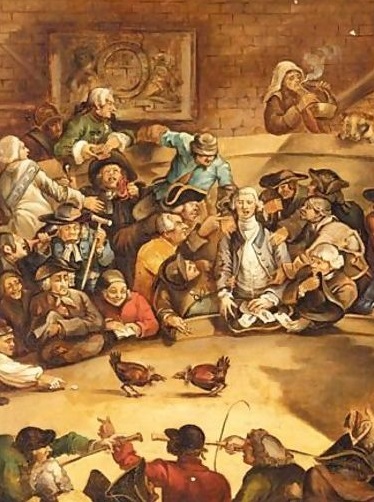
Watching to cocks tear eachother apart: not as much fun as you might imagine

Watching two birds tear each other apart: not as much fun as you might imagine

But this odd little memorandum was not an isolated scribbling. It was, in fact, just one of about 180 entries in his Coggeshall chronicle, which he began in February 1678 and continued to May 1697. In it, we find festive celebrations, church business, unusual weather, family injuries, highway robberies and much else besides.

The entries from 1693, a fairly typical year, give a sense of the whole:

  • 11 Jan. 1693, John Bufton went to combing.
  • 4 Feb. 1693, my cousin Sparhawk was carried to prison.
  • 15 Feb. 1693, there was a bonfire made by the Crown for the joy that Squire Honeywood got the day of Sir Eliab Harvey and was not cast out of the Parliament and when he came home from Chelmsford through Coxall the night after he was chosen abundance of candles were lighted for joy.
  • 24 Mar. 1693, King William went through Kelvedon and went back again through Kelvedon 28 Mar.
  • early 1693, the new king’s arms and the 10 commandments new writ were set up in the church.
  • 1693, the Quakers made a new burying place in Crouches
  • 1 May 1693, the soldiers set up a Maypole at the Woolpack door
  • 18 May 1693, the poor did rise because the Bakers would not bake, because some of their bread was cut out the day before for being too light.
  • May 1693, my cousin Sparhawk came home.
  • beginning of May 1693 Francis Clark broke.
  • end of May 1693 the same month the Poor had Badges given them to weare which tis said were made of Pewter and Coggeshall Poor 1693 set upon them.
  • 1693, Mr Mayhew sold Coxall Lordship to Mr Nehemiah Lyde of London. 11 May he came first for his rent and 5 Jun kept court and Counsellor Cox was his steward.
  • June 1693, our 4th bell was carried to Sudbury to be new shot and brought home and the other were chipt to make them tuneable. They were first rung 6 July.
  • 30 Oct. 1693, King William went through Kelvedon.
  • 2 Nov. 1693, John Ancil had hung himself but was cut down in time.
  • 1693, a new pound was set up on Grange hill and the shambles was repaired.
Continue reading

The political economy of racism: the Evil May Day riots of 1517 and the rise of UKIP

Brodie Waddell

The UK Independence Party is doing extremely well in the local and European elections held across England yesterday. It is, to put it mildly, an unpleasant sort of political party. It has more than its fair share of bigots and homophobes. But it is more than simply a tribe of disgruntled nostalgics. It’s also a protest party, and its particular brand of protest has venerable linage that goes back to at least the Evil May Day riots of 1517.

The anti-immigrant violence that erupted in London at that time is sometimes dismissed as a mere race riot, emerging from hatred and hardship and nothing more. But when we look more closely at the various accounts of these events, we see that it too was a political protest. One chronicler described how Londoners saw the foreigners in their midst:

the Genowayes, Frenchemen and other straungers sayde and boasted them selfes to be in suche favoure with the kyng and hys counsaill, that they set naughte by the rulers of the citie: And the multitude of straungers was so great about London, that the pore Englishe artificers coulde ska[r]ce get any living: And most of all the straungers were so proude, that they disdained, mocked and oppressed the Englishemen, whiche was the beginning of the grudge.

Locals complained that the ‘strangers’ from overseas flouted the law with impunity, engaging in theft, kidnapping and even murder without facing the punishments that would have been meted out to a common English criminal.

The political element becomes even clearer when we examine the rioters’ main targets. The crowds of hundreds, or possibly thousands, who rushed through the streets that night did not burn and loot indiscriminately. Instead, they attacked the house of a French merchant who was also a royal secretary, the homes of alien artisans at a site officially designated for foreigners, and two ambassadors who were supposed to be under the king’s protection. When the rioters were captured, at least 15 were hanged, drawn and quartered for ‘treason’ because their attacks on the strangers had ‘broken the truce and league’ between Henry VIII and the other princes of Europe.

So, in the eyes of Tudor Londoners, what made these immigrants so dangerous was the apparent alliance between ‘the multitude of straungers’ and ‘the kyng and hys counsaill’. That is to say, the foreign threat came not from poor or marginalised immigrants but from outsiders who enjoyed special privileges and had the support of the political elites.

It would be easy to multiply such examples by looking at other moments of heightened anti-foreigner sentiment in early modern England. One could cite, for example, the opposition to King James I’s favouritism towards his fellow Scots, the francophobic riots of Charles II’s francophile reign, or the anti-Dutch sentiment that bubbled up after William III took the throne in 1689. In each case there were very real resentments about the apparent social and economic impact of immigrant groups, but these were combined with a sense that the current political regime was in league with the foreigners.

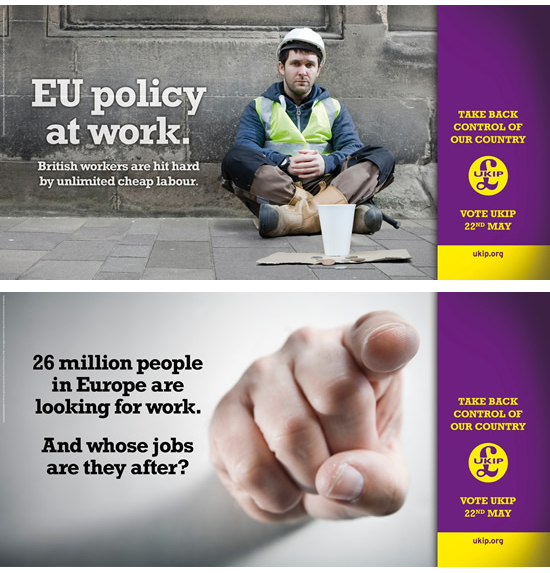
UKIP posters

A forlorn British worker, supposedly abondoned by Europhile political elites, and a big pointy hand.

UKIP offers a very similar argument. Unlike the BNP, its ideology is not built purely from racism. Instead, it incessantly attacks ‘the political establishment’ in Westminster and in Brussels for compromising British sovereignty by granting special privileges to immigrants. According to Nigel Farange, UKIP is simply providing voters with a weapon with which to attack this two-headed monster: ‘They [the voters] have made the connection. It took me bloody years to get immigration and Europe together, but I knew at the local elections this year it was now the same thing.’

Racism, then, is certainly an important ingredient in UKIP’s noisome ideology but it is not the only one. If we want to understand and counteract the rise of this dangerous party, we need to acknowledge that a vote for UKIP is as much a protest against the failures of Britain’s governing class as it is an anxious reaction against newcomers.

Sources

The events of 1517 are described several primary sources, all of which are freely available online: the chronicle of Edward Hall (1904 edition, edited by Charles Whibley, pp. 153-64, quote at 153-4), the chronicle of the Grey Friars and the Calendar of State Papers, Venetian.

Early modern history after Hobsbawm

Brodie Waddell

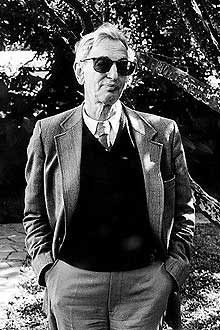
Eric Hobsbawm was not an early modernist. Although he wandered into the seventeenth century every once and awhile, his scholarship was focused on the nineteenth and twentieth centuries. Yet it would be unjust to dismiss him as irrelevant. Not only did he come up with some of the key concepts used by early modernists – such as ‘primitive rebels’, ‘invented traditions’ and even ‘the general crisis of the seventeenth century’ – he also very publically wrestled with the problem of politically informed and socially committed history.

The dude abides

The dude abides

Two weeks ago, a truly extraordinary gathering of historians met to explore these issues at the ‘History After Hobsbawm’ conference in London. I don’t exaggerate when I say this was a remarkable group – Sam Wetherell suggested the line-up was ‘like the Glastonbury of modern British history’, which seems about right. The result was a lot of great conversations at the event, online and of course at the pub afterwards. There are a bunch of reports, reviews, podcasts and tweets collected at the conference website.

I wanted to draw attention to a few of those pieces written by early modernists that may be of interest to our readers. If you have any comments or questions I’d encourage you to put them here as there are no comments on the conference blog. I’ll pass comments here on to the authors.

The ‘spectres of Marx’ that haunted many of the conference conservations were very visible in the commentaries from early modernists. Hillary Taylor discussed how Jane Whittle, Andy Wood and Lucy Robinson dealt with issues such as ‘class’ before the industrial revolution and ‘primitive rebels’ outside of formally organised protests. She suggested that some ‘ecumenical sampling’ of Marxist analysis – by both Marx himself as well as less well-known thinkers like Ferruccio Rossi-Landi and Nicos Poulantzas – can still illuminate key aspects of early modern society. Mark Hailwood agreed and suggested that the label ‘post-Marxist’ might be appropriate as such an approach is neither anti-Marxist nor even strictly non-Marxist, but instead ‘picking up some of the pieces’ left behind after the ‘purgatory of the 1990s’. Indeed, he noted that many so-called Marxists – including Hobsbawm – have been doing this all along. Dave Hitchcock looked specifically at Gareth Stedman Jones’s discussion of the supposed ‘paradox’ of ‘good Marxist history’. Jones seemed to claim that Marx was merely a distraction from the strength of the longer tradition of intellectual critique that preceded him. Dave, in contrast, argued strongly that without Marx and successors like Hobsbawm historians would have a much weaker awareness of the history of social experience and of the brutal realities of material existence.

The second major theme to emerge from these discussions was the link between past and present in historical scholarship. This was perhaps most prominent in Lucy Robinson’s talk, summarised by Hillary, as it focused on the ‘history’ of the 2010 Brighton school students protest, in which the ‘historian’ was amongst the crowd! However, it is also very relevant to early modernists. Hillary, Mark and Dave all noted the power of ‘socially committed’ scholars in bringing to light previously neglected topics such as protest and subordination. Moreover, the crushing defeats of organised labour and international communism in the 1980s clearly had an effect on how historians used concepts like ‘class’: the shifting political climate directly influenced academic debates and methodologies. The panellists discussed by Robert Stearn made this very clear in their analysis of the retreat of traditional ‘labour history’ over the last generation. Here, the impact of a changing political situation are plain to see. This final point was driven home for me in the panel I wrote about, in which John Elliot, Geoffrey Parker and Sanjay Subrahmanyham talked about ‘the seventeen-century crisis’. It is not difficult to find some of the momentous events of the twentieth century – namely the Depression, the World Wars, the rise of globalisation and the discovery of climate change – shaping the way scholars conceived of early modern society. It’s often said that we can’t escape the past, but it’s clear that even historians can’t escape the present either.

There are also some earlier thoughts on Hobsbawm from me and (in the comments) Mark, Jonathan, Laura and Newton Key, that might be relevant.

Samantha Shave, ‘History for below’

[This is the ninth piece in ‘The Future of History from Below’ online symposium (#historyfrombelow). Samantha Shave is a research associate at the University of Cambridge, working on the project ‘Inheritance, Families and the Market in Nineteenth and Twentieth-Century Britain’. She has recently published on paupers’ lives and poor law reform in the early nineteenth century.]

Historians of welfare and poverty have seemingly now found the sources which, in the words of Tim Hitchcock, provide a more ‘democratic’ history from below (Down and Out, p. 239). The voices of the poor are being found in court records, ballads, threatening letters and petitions for poor relief, to name just a few sources, and we are putting them at the centre of our analyses. The word ‘democratic’ here has always struck me though; it makes me wonder whether, whilst we have been busying ourselves with this task, history itself has – as a discipline – become less democratic? I asked the workshop at Birkbeck to think about whether there is a ‘history for below’. Indeed, the central contradiction here is that we produce histories of those who have either been silenced or marginalised or ignored, that we strive to re-create social worlds from, ‘enforced narratives’ (Carolyn Steedman, Feminism and Autobiography, p. 25), but those people in similar positions today are being increasingly denied the opportunity to study and write history at university.

We need to consider how people decide to study history, and how recent changes to the curriculum could leave a generation uninspired to take the subject further. Those who are not put off by ‘fact and date’ history may attempt to study the subject at university. That’s if they want to get into a phenomenal amount of debt. There are small reductions to fees for those with household incomes below £25,000 per annum, and a few charity-like pockets of money issued by universities, but the overall debt for any student who started university in 2012 from a working household will be huge. With fees at an average of £8,770 a year, the average student could graduate with over £50,000 of debt over the course of their degree. The immediate consequences of the fee rise can be seen in application figures. UK applicants to university were down 8.7% in 2012, and a further 6.5% for admission this year. Worryingly, last year applications from people aged over 19 years old declined by 11.8%. Continue reading

Simon Sandall, ‘History lessons from below?’

[This is the eighth piece in ‘The Future of History from Below’ online symposium (#historyfrombelow). Simon Sandall is a lecturer at the University of Winchester whose recent publications focus on custom, law, community and popular politics and popular protest in early modern England. His forthcoming book will be titled ‘Custom and Popular Memory in the Forest of Dean, c. 1550-1832’.]

Now, as much as at any time in the recent past, the study of labouring people and non-elites is crucial, not only in rescuing them from the ‘condescension of posterity’, but in forging a broader understanding of the historical context in which we enter the twenty-first century. As social services are being slashed, the terms of unemployment and disability benefits rendered untenable, sections of poorer communities pejoratively stereotyped in the name of austerity, the culpability of the super rich whitewashed, and Michael Gove’s attempts to hide any historical evidence to the contrary, this context is sorely needed.

Add to this the fact that a significant proportion of the British public draw their knowledge of the past from centre-right newspapers and other media, nuanced and critical histories ‘from below’ are clearly needed to restore balance to some of the more heated debates that pervade the current political climate. While the criteria of the Research Excellence Framework look to be developing an increased focus on wider dissemination of funded research, we should be thinking carefully about the nature of these studies and their impact. Gove’s current drive emphasises a simplified, top-down, political narrative which nods towards the benefits of British influence in the world, the development of stock trading, the banking industry, together with the associated rise of capitalism and industrialisation. As historians, our duty is surely to complicate these teleologies and work to emphasise the reality of contingency and agency, to advance our understanding of those in the lower echelons of societies past. At almost every one of these historical junctures, there have been passionately defended alternatives. A closer focus on the experiences of particular communities and broader histories from below reveals, also, that at each of these key transitional moments it has generally been the poor that have suffered to advance the interests of the rich and powerful. Continue reading

David Hitchcock, ‘Why history from below matters more than ever’

[This is the seventh piece in ‘The Future of History from Below’ online symposium (#historyfrombelow). David Hitchcock is an IAS Early Career Fellow at the University of Warwick and will be taking up a post at Canterbury Christ Church University in October. He has published on vagrancy in early modern England and blogs at Post.Hoc.]

As I write these words, Sohel Rana, the owner of an illegally constructed clothing factory and living complex in Bangladesh called the ‘Rana Plaza’, is probably sitting in a Dhaka jail. I have not the slightest clue what he’s thinking. But I hope he has time for a few regrets. Rana will be now be immortalised as the man who stood in front of a building that was literally cracking down its seams, and assured tenants and workers that it was perfectly safe to stay inside. Factory line managers in Rana’s clothing manufacturing operations on the top floors insisted that their workers continue their shifts, and clothing workers make up the bulk of the over 1,100 dead people in this particular tragedy.

As I write these words, Governor Rick Perry, the architect of modern Texas’ stunningly under-regulated industrial landscape, lambasts anyone but himself for the shameful practices at the West Texas fertilizer plant which recently exploded, levelling a town (which it was conveniently located right next to) and causing a 2.1 scale earthquake. The plant had not been inspected in twenty years. Fifteen people died, most were fire-fighters or first responders trying to control the blaze and to save others.

I’m choosing to begin this post on ‘History from Below’  with recent news stories about factory disasters on opposite ends of the world for one reason: to separate wheat from chaff. These kinds of stories should make you angry, they should make you think about why those factory workers felt they had to obey, and stayed at their posts in a factory that was literally crumbling around them, they should invite you to explore the sad history of industrial production, of ‘developing nation’ factory workers, and of brutal, naked economic exploitation in places like Bangladesh. I hope you want to understand why a place like Rana Plaza was openly permitted to exist. I hope you want to know what life was like for the approximately 1,150 people who died because they were not permitted to escape from an imploding building. Continue reading

The wandering, pipe-smoking Jacobite

Brodie Waddell

King William III was a greedy, irreligious, oppressive usurper. Worse still, he was a Dutchman. Or at least these were the sort of things one might hear in many of the alehouses of northern England at the end of the seventeenth century.

Definitely a bit too Dutch for his own good.

I’m going to be giving a talk at the Institute of Historical Research on Thursday (March 14th) on ‘The Present State of England: Modernity and Memory in the Hard Times of the 1690s’, and I thought I’d share one of the many, many seditious denunciations of William III’s regime that I’ve come across during my research into this topic. Sadly, this one probably won’t make it into the talk, but I’ll be sure to include a couple of others.

This case comes from amongst the mess of unsorted and unnumbered despositions from the Palatinate of Lancaster held at The National Archives at Kew, specifically PL 27/2. In May of 1700, according to a chapman from Manchester named David Smith,

one James Scott a wandering person this day … did declare … that his present Majestie King William had noe more religion in him then his pipe in his hand & that all that he cared for was to please his people & to gett mony together & that he love a finger of King James’ hand more then he loved King Williams body

One needn’t have a detailed knowledge of later Stuart political culture to decipher the complaint. William III had a reputation as an aloof, cold monarch, which may partly explain why Scott had so much more ‘love’ for James II’s finger than for the current king. Likewise, the king’s continental Calvinism was regarded as somewhat suspect by many Church of England clergymen, which may help to explain Scott’s reference to his atheistical pipe.

However, I’d guess that Scott’s dislike come primarily from the other fault that he mentions here: ‘all he cared for was to please his people & to gett mony together’. This was surely a reference to William’s foreignness and his very aggressive fiscal policies: ‘his people’ were presumably the Dutch courtiers whom he brought over with him, and his need ‘to get mony together’ resulted in taxation more than doubling in less than a decade. As I’ll explain on Thursday, these were ‘hard times’ and, as a result, the king’s regime was widely resented for his foreignness, his favouritism and his predilection for expensive European wars.

If anyone else has come across similar material from this period, I’d love to hear about it.

A civil war comic strip?

Brodie Waddell

Several months ago, inspired by a post by Gavin Robinson, I shared an image of a broadsheet called The Young-Mans Victory Over the Povver of the Devil that seemed to fit the definition of a comic strip. That one, dating from the 1690s, was the earliest I had found at the time and it remains my favourite of the genre, but I’ve since come across an earlier contender.

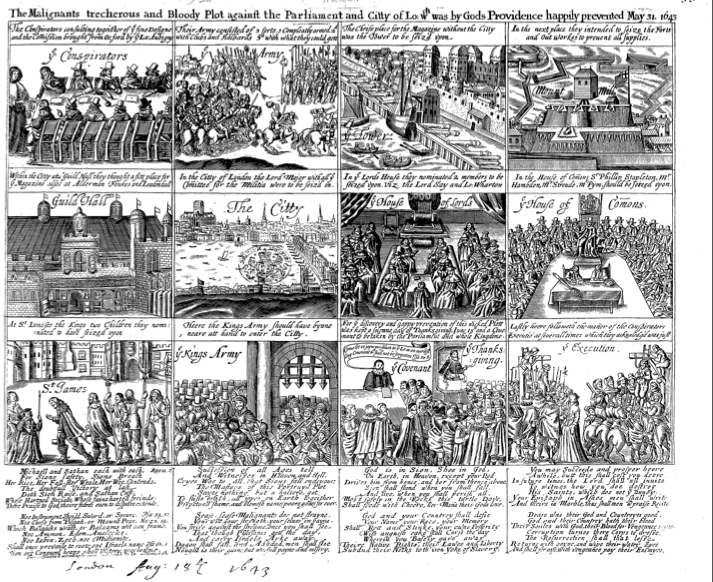
I discovered it on a wonderful blog called The 1640s Picturebook where Ian Dicker has posted dozens of images from the period along with detailed analysis of the costumes depicted. In June of last year, they posted an image of The Malignants Trecherous and Bloody Plot (1643), which depicted a plan apparently launched by the MP, Edmund Waller, bring an end to the first of the English Civil Wars. According to the confession of one of the plotters quoted in the ODNB, it began peaceably enough:

‘It came from Mr. Waller under this notion, that if we could make a moderate party here in London, to stand betwixt the gappe, and in the gappe, to unite the King and the Parliament, it would be a very acceptable work, for now the three Kingdomes lay a bleeding, and unlesse that were done there was no hopes to unite them.’

But the peace plan quickly turned to war: in its final form, the plot apparently called for an armed rising and seizure of the key points of the City in order to let the king’s army in.

The plot ended before it had begun when the plotters were betrayed and arrested. Somehow, seemingly through a mixture of powerful rhetoric and shameless bribery, Waller managed to escape the grisly punishment inflicted on some of his co-conspirators and was permitted to go into exile after only a year and a half in prison.

The Malignants Trecherous and Bloody Plot (1643) via The 1640s Picturebook.

The Malignants Trecherous and Bloody Plot (1643) via The 1640s Picturebook.

The upshot of all this was a detailed broadsheet published in August of 1643. It has twelve panels, each of which includes a running narration of the events as they unfolded, from the hatching of the conspiracy to the execution of some of the offenders.

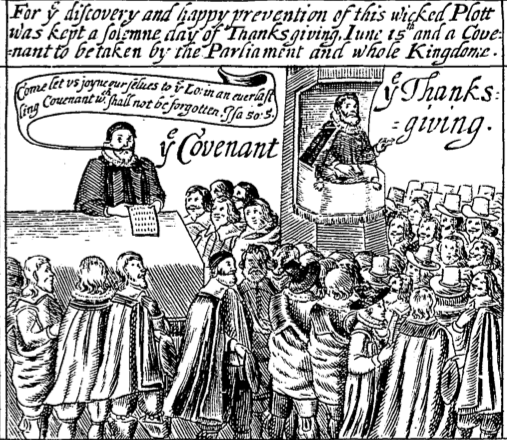
The Malignants (1643) panel with Covenant

‘Come let us joyne our selves to the Lord in an everlasting Covenant which shall not be forgotten’, citing Jeremiah 50:5.

It even included some text in a speech bubble, said to be a key part of a ‘true’ comic strip – though as befits a seventeenth-century comic it is a quotation from scripture rather than a supervillain’s monologue.

So have we pushed the date of the first comic strip back still further? Or is this too much of a stretch?

Norwich Entertainments – Part V: Ballad-singers and dangerous news, with coffee

Brodie Waddell

The people of late seventeenth-century Norwich did not get their entertainment solely from hairy children and pieces of plays. They also amused themselves with the ever-growing numbers of printed works that were pouring from the presses at that time.

In June 1680, for example, the Norwich Mayor’s court ordered that ‘Twoe Ballad singers haveing Lycence to Sell ballads, pamphlets small bookes & other bookes Lycensed from the Office of the Revells have leave to doe soe until Monday senight [?seven-night]’.1

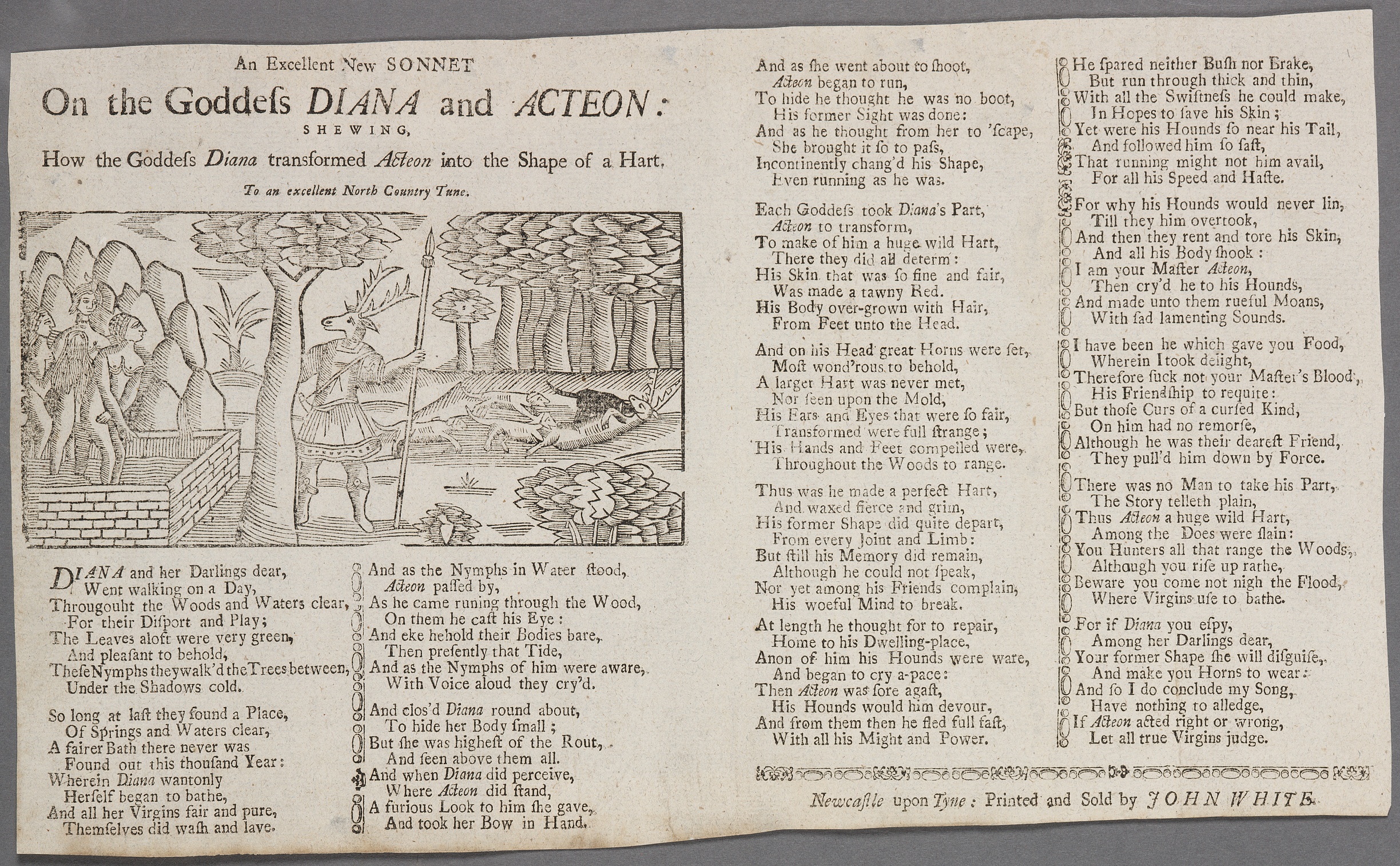
Ballad entitled ‘An Excellent New Sonnet On the Goddess Diana and Acteon’ (c.1725-69). EBBA.

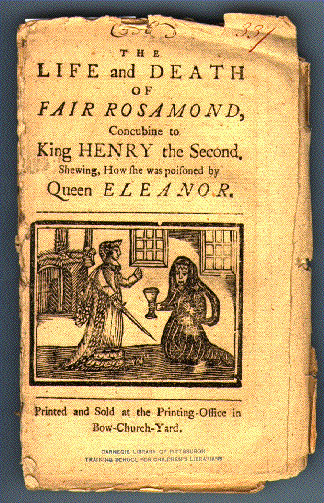
Title-page of a chapbook titled ‘The Life and Death of Fayr Rosamond’ (1755). SF.

These balladeers were just two of the hundreds that traipsed through the city streets and country lanes of early modern England, singing to advertise their wares. The exact contents of a peddler’s sack could be very diverse. In addition to all sorts of petty trinkets, they sold tales of drunken sailors, royal mistresses, industrious spinsters, and much else besides. Often these were in the form of broadside song sheets, but they might also be ‘pamphlets’ and ‘small books’, sometimes called chapbooks, written in prose to provide merriment or salvation for the price of penny or two. Margaret Spufford and Tessa Watt, among many others,  have discussed this ‘cheap print’ in much more detail, noting that ballad-sellers were often condemned by the authorities as vagrants. But in late seventeenth-century Norwich at least they seem to have been welcomed by both the townspeople and city officials.

Rather more unusual, however, was the license issued to a man a year earlier. In November 1679, the court declared that ‘Lawrence White is allowed to reade & sell Pamphlets on Horsebacke untill Wednesday next’.2 Continue reading