The Experience of Work in Early Modern England IV: Harvesters

This post is part of a series that marks the publication of The Experience of Work in Early Modern England. The book is co-authored by monster head Mark Hailwood, along with Jane Whittle, Hannah Robb, and Taylor Aucoin. It uses court depositions to explore everyday working life between 1500 and 1700, with a particular focus on how gender shaped work. It is an open access publication (i.e. it is available to view/download for free, here). The post first appeared on the ‘Women’s Work in Rural England, 1500-1700′ blog as a ‘work in progress’ piece in 2019 – it is reposted here to whet your appetite for finding out where the research ended up, which you can do by reading the book!

Mark Hailwood

As Clare Leighton put it so elegantly in her 1933 The Farmer’s Year, it is that time of year when ‘summer begins to tire’. For centuries of farmers it has been the time when ‘the supreme moment of his year is upon him’, and across the ‘vast sweep of landscape there is the golden glow of harvest.’ It is August, and ‘harvesting is due’.

Of course, it is not only the supreme moment of the year for the individual farmer: for our preindustrial forebears the harvest was, as Steve Hindle has put it, ‘the heartbeat of the whole economy’.[1] The economic fortunes of early modern societies were bound up with the quality and quantity of grain gathered from the fields at summer’s end.

The importance of the early modern harvest, a process so evocatively captured by Pieter Bruegel the Elder in 1565, can hardly be overstated, and when the time came to set it in motion it dominated men’s work schedules above all else: ‘the harvesting draws all men to it. Ploughboy and cowman, carter and shepherd, all are in the fields’ (Leighton again). But what of the role played by women in the ‘supreme moment’ of the agricultural cycle? It is another question our project can shed some light upon.

Continue reading

The Experience of Work in Early Modern England III: ‘Ploughmen go whistling to their toils’

This post is part of a series that marks the publication of The Experience of Work in Early Modern England. The book is co-authored by monster head Mark Hailwood, along with Jane Whittle, Hannah Robb, and Taylor Aucoin. It uses court depositions to explore everyday working life between 1500 and 1700, with a particular focus on how gender shaped work. It is an open access publication (i.e. it is available to view/download for free, here). The post first appeared on the ‘Women’s Work in Rural England, 1500-1700′ blog as a ‘work in progress’ piece in 2017 – it is reposted here to whet your appetite for finding out where the research ended up, which you can do by reading the book!

Mark Hailwood

leighton_november_1024x1024
Engraving from Clare Leighton’s wonderful book The Farmer’s Year

As a treat for surviving a long winter of data entry, I have indulged myself in recent days with some invigorating morning walks, enjoying the first signs of the turnover of the seasons (well, we have one daffodil out in the garden at least) a phase that the poet John Clare called ‘the thaw’ (the title of this post is borrowed from Clare too).[1] This time of year was a key watershed in the early modern agricultural year, of course, as thoughts drifted back to the fields after their dormant winter. With the passing of the frosts it was time to start ploughing the earth in preparation for sowing crops in the spring. It was time to set the agricultural cycle in motion once more.

It seems a reasonable assumption that it was not a favourite work task in the period, yoking the oxen (in the vast majority of our examples it was oxen rather than horses pulling the plough[2]) and heading out in inclement weather (Clare again: ‘March month of “many weathers” wildly comes’). There was certainly an element of danger involved. On 21st February 1564, James Treherne, a servant, was ‘driving six oxen of his master’s drawing a plough tilling the ground’ in Rowde, Wiltshire, when one of the oxen knocked him down, whereby he fell on an axe he was carrying and was fatally wounded. In 1651, Thomas Harding, of Bradninch, Devon, was giving testimony in a testamentary dispute when he recalled that the deceased, Thomas Potter of Broadhembury, had ‘died of a wound received by a ploughshare [blade] in his thigh as he was in a field at plough, which happened some days before his death’.

Continue reading

The Experience of Work in Early Modern England II: Family Fortunes

This post is part of a series that marks the publication of The Experience of Work in Early Modern England. The book is co-authored by monster head Mark Hailwood, along with Jane Whittle, Hannah Robb, and Taylor Aucoin. It uses court depositions to explore everyday working life between 1500 and 1700, with a particular focus on how gender shaped work. It is an open access publication (i.e. it is available to view/download for free, here). The post first appeared on the ‘Women’s Work in Rural England, 1500-1700′ blog as a ‘work in progress’ piece in 2016 – it is reposted here to whet your appetite for finding out where the research ended up, which you can do by reading the book!

Mark Hailwood

I often describe the main bulk of the work that underpins this project as ‘data entry’. But perhaps ‘data entry’ isn’t the best way to describe the harvesting process that has been our focus: reading thousands of depositions (I recently estimated that I’ve read somewhere between 6000-7000 individual depositions so far this year) and all of the stories of everyday life that they contain, and then carefully converting these complex qualitative sources into usable quantitative data, is a more varied and stimulating exercise than the term ‘data entry’ conjures up.

One of the upshots of this kind of work is that in among all the lengthy tithe and testamentary disputes that often turn out to be of little use to us, you occasional unearth a remarkably rich case that contains a veritable jackpot of work activities. And it is one such case that I want to discuss in this post.

‘Households in a landscape’

Step forward: the Conant Family of Moretonhampstead.

Continue reading

The Experience of Work in Early Modern England I: Winter is Coming

This post is part of a series that marks the publication of The Experience of Work in Early Modern England. The book is co-authored by monster head Mark Hailwood, along with Jane Whittle, Hannah Robb, and Taylor Aucoin. It uses court depositions to explore everyday working life between 1500 and 1700, with a particular focus on how gender shaped work. It is an open access publication (i.e. it is available to view/download for free, here). The post first appeared on the ‘Women’s Work in Rural England, 1500-1700′ blog as a ‘work in progress’ piece in 2015 – it is reposted here to whet your appetite for finding out where the research ended up, which you can do by reading the book!

Mark Hailwood

Brueghelian winter
Brueghelian winter

One aspect of the experience of work that our data sheds light on is seasonal patterns in work activities. As the English nights start to draw in, we ask: what tasks did early modern English workers do to make ready for the onset of winter?

A significant number of our examples from late November and early December relate to the replenishing of wood supplies to fuel much-needed winter fires. On the 25th of November 1591, Thomas Ven, an 80-year-old husbandman of King’s Brompton in Somerset, was up a ladder pruning an oak tree with an axe when he plummeted to his death. Locals must have started to wonder if evil spirits possessed the wood of Barlynch Grove, where Ven had fallen, for in December of the following year the 28-year-old Edward Norman met his end by falling out of an ash tree that he had climbed to cut branches from.

Continue reading

The ‘Lowest Sort’ in the Print Trade of 17th-Century England

Our latest post in the Postgraduate and Early Career Takeover is from Joe Saunders. Joe has just started a PhD at the University of York using wills to study the social networks of the print trade in England c.1557-1666. Find Joe on twitter at @joe_saunders1.

We are this year ‘working from home’; struggling with work-life balance; and have ‘Key Workers’ in our supermarkets, hospitals and care-homes. What constitutes important labour is a contemporary debate but also interests historians who seek to define and locate work. Histories of literature are a case-in-point, with focus oscillating between the labour of authors, readers and publishers. In recent decades we have come to know a great deal about text creation and circulation during the hand-press era with work on the producers and movers of texts; publishers, printers and booksellers as they turned an author’s ideas into something tangible and passed them to an audience. The transfer from the author’s mind to printed page and then to the reader required a significant amount of labour from a variety of actors in a myriad of roles from financing a text through to those who carried the finished products along country roads.

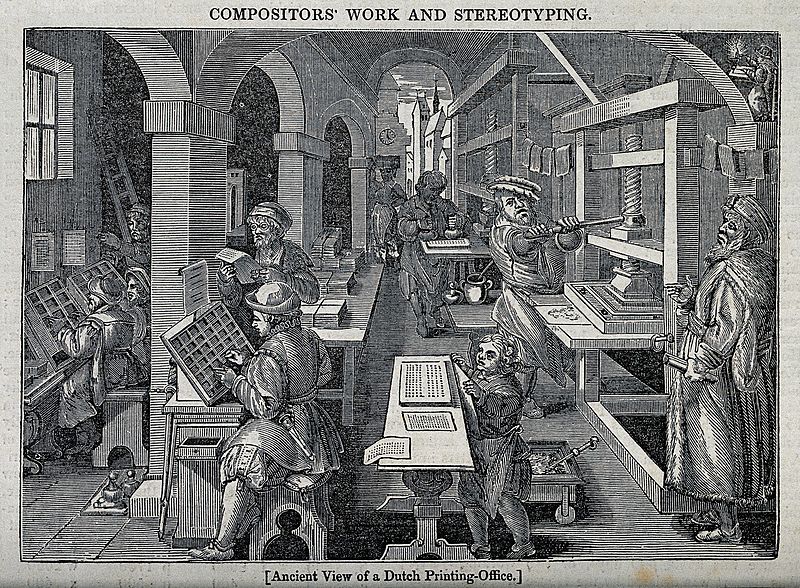
Men working at a printing press- Wellcome Collection. Attribution 4.0 International (CC BY 4.0)

Bertolt Brecht in his 1935 poem ‘A Worker Reads History’ imagined how the workers who built the great monuments of the world figured into histories dominated by great men. He asked ‘but was it kings who hauled the craggy blocks of stone?’. Of course, the answer is no, but their names adorn these structures nonetheless. Though the process of text creation and movement in early modern England was gendered, classed and regionalised research has necessarily focused on the better offs who left their names on imprints and records of the Company of Stationers; the livery company which held a theoretical control over the membership and products of the print trade. This is the case across the History of the Book where source survival means most work on reading and authorship is also done on the middling sorts and elites.

The 2020 publication Women’s Labour and the History of the Book in Early Modern England brought together a range of essays dealing with reading, authorship and production. The focus was more towards countesses than chapmen-or-women but an exception was Craig’s essay on the rag-women who collected material for papermakers. This research recovered the labour of people who were critical to the production of texts but are largely absent from the records and therefore from our understanding. It was argued implicitly that to look for the lowest sort of women in the trade is the first step to finding them.

Continue reading

Responding to a Crisis: the Black Death, COVID-19, and Universal Basic Income

In this guest post, Professor Jane Whittle of the University of Exeter looks at the governmental response to the Black Death, and advocates a revolutionary new social policy for our own period of crisis. 

Jane Whittle

Unprecedented episodes of disease, such as the current outbreak of COVID-19, are moments of fluidity when parts of existing societies are laid bare as not fit for purpose. Wars create similar moments of flux. The Second World War created the consensus that allowed the founding of the NHS and the Welfare State. Could our current state of crisis lead to something positive and long lasting, amid all the disruption, trauma, and loss?

My research focuses on another such moment, the consequences of Black Death of the fourteenth century. In the midst of the Black Death the English government made the significant decision not to strengthen the institution of serfdom but instead to increase the regulation of waged labour with the Ordinance of Labourers of 1349.

The Black Death was an outbreak of bubonic plague that raged across Europe between 1347 and 1349 and killed an estimated 50% of the English population. Fortunately the mortality rate of COVID-19 looks to be closer to 1% of those infected (and thus lower for the total population). Yet in our highly interconnected modern society its impact is already shaping up to be enormous. Historians have long puzzled over the fact that the immediate social and economic impact of the Black Death appears to have been remarkably slight. Social, economic, and political structures remained in place. However, this is to overlook the innovation of the labour laws. The Ordinance of Labourers of 1349 was a revolutionary piece of legislation. It marked the end of serfdom and beginning of an economy dependent on wage labour, but it signalled that the government’s attitude to wage workers would be far from lenient. Although initially announced as an emergency measure by the monarchy, when Parliament next met in 1351 it was enthusiastically endorsed. The measures remained in force until the early nineteenth century. Continue reading

Alice Clark 100 Reading Group: Conclusion

This post is part of our #AliceClark100 Online Reading Group. In it Susan D. Amussen offers some reflections on the ‘Conclusion’ of The Working Life of Women in the Seventeenth Century, as well as on the posts in this series as a whole. Susan is a Professor of History at UC Merced, and tweets as @susandamussen. You can access the book here.

Susan D. Amussen

Alice Clark ended Working Life of Women by summarizing her findings in terms of her central themes. What does it mean for women when the individual rather than the household is the primary actor in the modern economy? Why don’t women get as much specialized training as men?  As the essays in this series have shown, the story of women’s work is considerably more complicated than Clark’s argument allows.  But Clark raises two new issues in her conclusion.  First, the subordination of women.  She argues that capitalism is not the source of the subjection of women; instead, ‘the subjection of women to their husbands was the foundation stone of the structure of the community in which Capitalism first made its appearance.’ (p. 300)  Second, she raises questions about political theory.  She asks about the impact of the ‘mechanical state’, represented by the works of both Hobbes and Locke.  What does it matter when women are invisible in formulations of what the state means?  Clark argues that these issues draw attention to a much wider range of issues and a longer chronology than those which have been the focus of the book.

Reading her conclusion alongside the essays that have made this series so interesting demonstrates one reason we – and our students – keep reading Alice Clark: she raises big questions.  She understands women’s work, and women’s position in society, first in relation to the history of capitalism.  At the end, though, she tells us that the big question is part of two even bigger ones, about fundamental social structures and the history of political thought.   Both of these have been the focus of extensive research over the past 40 years.  The tension between women’s agency and their subordination has been a central theme in women’s history.  We have simultaneously demonstrated women’s agency not just as economic actors but as political ones while we have explored domestic and sexual violence.[1]  Allyson Poska’s suggestion that we consider what she calls “agentic gender norms” that co-exist with patriarchy and provide a counter-vailing set of norms may be a useful way of thinking about these tensions.[2]  Similarly, scholars in the history of political thought have unpacked the ways in which contract theory not only erased women, but made women’s political action far more complex.[3] Continue reading

Alice Clark 100 Reading Group: ‘Professions’

This post is part of our #AliceClark100 Online Reading Group. In it Mary Fissell offers some reflections on chapter six of The Working Life of Women in the Seventeenth Century, on ‘Professions’. Mary is Professor in the History of Medicine at The John Hopkins University. You can access the book here.

Mary Fissell

Alice Clark’s chapter on Professions is startlingly prescient in its view of early modern women’s medical work. Many of the themes, sources, and topics she includes have become central to our discussions of early-modern medicine over the past few decades, but were not any part of the history of medicine when I started graduate school 35 years ago. Equally, when I re-read her chapter this time, I was struck by how deeply Clark’s own experiences shaped her account of women’s healing work.

Clark repeatedly uncovered women’s healing work that was largely ignored in the literature until very recently. In 1919, most English people would have thought that nursing started with Nightingale. Clark drew upon records from London’s great ancient hospitals to show us women working as nurses and matrons in them, although she wasn’t very flattering, noting that they were not “the most efficient type of women”. In the countryside, Clark found traces of nursing in local payments from parishes or charities for nursing the poor. She unearthed records of a female surgeon or two, and recognized that women performed many tasks as domestic healers, including making medicines and preserving recipes, a substantial topic in today’s literature. Such women, she noted, were trained informally in female lineages, rather than the formal education their brothers might have enjoyed. She describes the work of “searchers”, older women who inspected bodies for signs of the plague, a category of medical work almost completely ignored until the late 1990s.

Midwifery is Clark’s paramount example of the narrative of loss familiar from other chapters, as men gained access to increasingly formal scientific and medical training that became ever more valuable as knowledge progressed. But she couldn’t help noting that midwives’ skills probably didn’t worsen over the course of the seventeenth century. Here Clark was bucking the trend; as obstetricians created their specialty in the later 19th and early 20th centuries, they engaged in a fair amount of midwife-bashing about the old “Sairey Gamp” type of practitioner, but Clark saw a lot of good in the early modern midwife, noting that some were “of a high level of intelligence” and possessed “considerable skill”.

What struck me the most, however, was the ways in which Clark’s understanding of women and medicine was deeply tied up with her own personal history. Continue reading

Alice Clark 100 Reading Group: ‘Crafts and Trades’

This post is part of our #AliceClark100 Online Reading Group. In it Laura Gowing offers some reflections on chapter five of The Working Life of Women in the Seventeenth Century, on ‘Crafts and Trades’. Laura is Professor of Early Modern History at King’s College London. You can access the book here.

Laura Gowing

When is a carpenter not a carpenter? When she is a seamstress. Guild or company records loomed large in Alice Clark’s survey of women in crafts and trades, yet their evidence was often confusing or ambivalent. This was particularly so in London, where the Custom of London from the early seventeenth century had enabled women and men with the Freedom of the City to engage in any city craft, not just the one of their own company. Hence, the girls apprenticed to Carpenters located by Clark’s research, who turn out to be apprenticed to seamstresses and silk-winders.

It is now evident that these female apprentices in the Carpenters’ were mirrored across the companies of late 17th century London, with artisans’ and merchants’ wives taking on apprentices in increasing numbers, almost always in sewing and keeping shops to sell the goods they made. Long before the mantua-makers of the late seventeenth century brought women up against tailors, women were sewing smocks, cuffs and bands for the London market, and girls were being apprenticed to learn from them.

Philips_Koninck_-_The_Seamstress_-_WGA12246

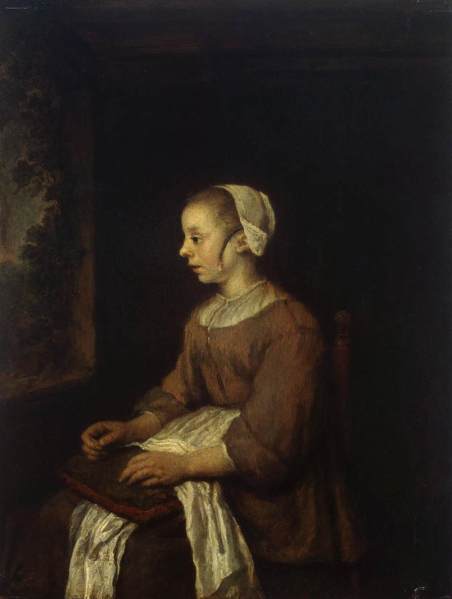
Philips Konnick, The Seamstress, 1671

Sewing dominated in the crafts and trades in which women worked, particularly in London. London’s particular customs thus brought skilled sewing work into guild management, not in terms of quality of work but as a means of incorporating training. By the late seventeenth century free single women and freemens’ wives and widows were taking apprentices in a range of seamstress and textile trades that reflected the specialised construction of garments, shoe and headwear: making children’s coats, periwigs, silk stockings, buttons, lace, gold and silver thread.

In other crafts, and outside London, Clark amassed a host of detail of the conflicts between guilds and the girls and women who found themselves on their margins. Carpenters’ wives being forbidden to unload timber, women bakers excluded from the trade for not having been apprenticed, pewterers ordered to buy no lead from women all reveal not only the arguments around inclusion, but the numbers of women working in trades which to modern eyes were ‘most unlikely’. Continue reading

Alice Clark 100 Reading Group: ‘Textiles’

This post is part of our #AliceClark100 Online Reading Group. In it Amy Erickson offers some reflections on the third main chapter of The Working Life of Women in the Seventeenth Century, on ‘Textiles’. Amy is a University Lecturer in British Economic and Social History 1500-1750 at the University of Cambridge. You can access the book here.

Amy Erickson

Alice Clark’s chapter on textiles concentrates on spinning, the textile production process which involved the most people, the overwhelming majority of whom were female. The production of cloth required several times more spinners than weavers (who were primarily male), whether the fibre in question was derived from a plant (flax or hemp) or an animal (wool or silk). As Clark puts it, ‘From the general economic standpoint, the textile industries rank second in importance to agriculture … but in the history of women’s economic development they hold a position which is quite unique.’ This was not only true of England: textiles were the principal export of most European countries over 300 years.

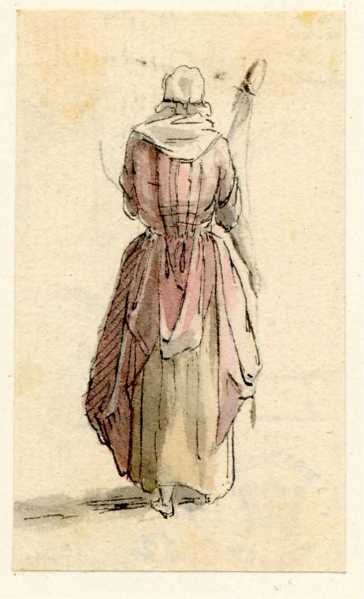
An early post on Many Headed Monster by Mark Hailwood explored the ubiquity of spinning and included two woodcut images of women sittingindex at spinning wheels that were used to illustrate early modern ballads. The term ‘hand-spinning’ describes spinning both by wheel and by distaff or drop spindle, a method which can be used while walking, as in Paul Sandby’s mid-18th century drawing of a woman carrying a distaff (courtesy of the trustees of the British Museum).

A decade after Working Life, Ivy Pinchbeck provided further evidence on spinning in the period 1750-1850, when hand spinning in the home was largely replaced by water-powered factory spinning. This transition from hand to machine, from home to factory, has recently received detailed attention. Craig Muldrew (2012) estimated that by the later 18th century hand spinning employed nearly 75% of all women over age 14, or 1,500,000 women. The transition to mechanisation, which not only increased productivity but also employed increasing numbers of men rather than women, would have caused mass female unemployment and thereby significant impoverishment. Continue reading