Understanding Sources: doing history by numbers

Picture1

To celebrate the launch of Understanding Early Modern Primary Sources the monster-heads have each written a brief post offering a personal perspective on the source type that they most like working with (the introductory post is here). Do tell us your own below the line, or on twitter #histsources


Brodie Waddell

It is remarkable that Peter Musgrave’s 200-page introduction to The Early Modern European Economy (1999) does not include a single table or graph. Although I’m a firm believer in qualitative methods and in exploring multiple facets of unique stories, images and objects, I also think that there ought to be a place for quantitative methods in our attempts to understand past societies. This is especially true of early modern economic life where if we elide the difference between a seventeenth-century ‘yeoman’ earning £15 per year and his neighbour earning £150 year we risk misunderstanding the structural inequalities in early modern society.

In my chapter for Understanding Early Modern Primary Sources, I try to make a balanced case for the value of both ‘quant’ and ‘qual’ approaches to history, and I review some of the key sources available to us. Here, I’d like to take a slightly closer look at one ‘quant’ source that I didn’t mention in the chapter: early modern books.

I’m hardly an expert at bibliometrics, but thanks to the online EEBO-TCP n-gram tool, anyone can have a stab at it. In my article on the ‘hard times’ of the 1690s, I looked at the frequency of certain ‘economic’ terms in the published texts of the era. What I found, pleasingly, is that there was a lot more talk of ‘trade’, ‘money’ and ‘tax’ in the 1690s, as I’d expected. But can such methods tell us anything else about the economy at this time? Continue reading
Class conflict in Elizabethan Norfolk?

Brodie Waddell

In early March 1601, four men got into an argument in the small village of Wicklewood, about eleven miles west of Norwich. Although no blows were exchanged, one of the men uttered words that were dangerous enough to lead to a legal examination by a local magistrate. It is only thanks to this brief deposition – which I’ve transcribed at the end of this post – that we have any knowledge of what was said that day.

I came across this document last summer at the Norfolk Record Office when I was searching through the county quarter sessions files looking for something else. I’d completely forgotten about it until Mark put up a post last week that discussed the history of conflict hidden in England’s rural landscape. That post reminded me that the argument recorded in this deposition might provide some further illumination of this oft-debated aspect of early modern history.

The story, as recorded on this small slip of paper, goes like this. Roger Wells of Wicklewood had hired John Chibocke and Richard Hamond of the neighbouring village of Morley ‘to worke with him’. But Chibocke and Hamond arrived very late and Wells was angry. He declared that if he paid them the wages they really deserved, they wouldn’t be pleased. The two workmen replied that Wells and his ilk ‘Cared not thoughe poore men wrought the[i]re harts out’ and wished ‘that wee might have warres againe, [for] then we should have Corne Cheaper’. At this point, William Seaborne – presumably a partner or employee of Wells – stepped in. He rebuked Chibock and Hamond for their rash words, saying ‘these be matters you understand not’. Yet this just incensed Chibock further. ‘If a thowsand mysters were deade’, he said, ‘we poore men should farre the better’. Continue reading

Women’s Work in Rural England, 1500-1700

Mark Hailwood

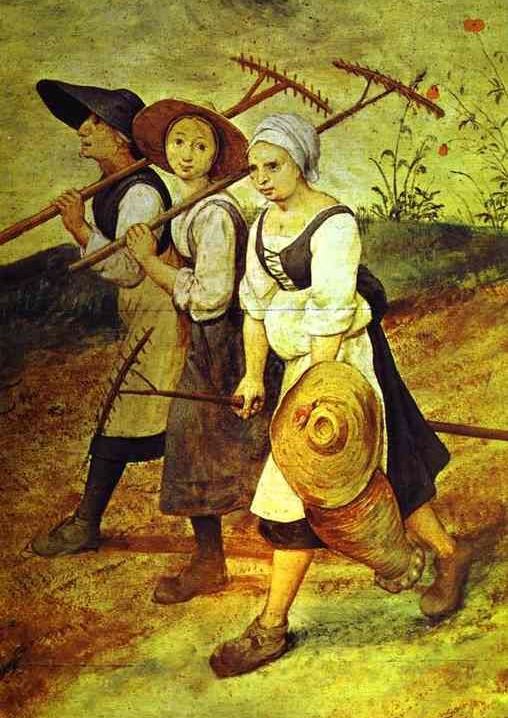
bruegel hay makersMany ‘monster readers will have already deduced that I recently started a new job. So I thought it would be a nice idea to write a very short post introducing the project that I’m now working on. It is based at the University of Exeter, funded by the Leverhulme Trust, and will run until the summer of 2018. The leader of the project is Professor Jane Whittle and I will be the main researcher. Our aim is to gather an unprecedented level of information about the everyday working lives of early modern English women by extracting incidental information about work activities from witness statements given in court cases (and a few other types of record too). We hope that this innovative methodology will help us to capture aspects of women’s work – for instance domestic and other types of unpaid work – that more conventional history of work sources – such as wage data – do not.

If you want to know more about the aims, methods and sources we will be using I have set up a website for the project here, that contains a lot more detail about what we will be doing. I’ll also be blogging over there about our progress from time to time, so if you are interested please do follow the project.

In fact, we already have a couple of blog posts up:

  • ‘What is Work?’ – project leader Jane Whittle challenges some of the more conventional definitions of work that historians use, and offers a more suitable alternative that we will be adopting for the project.
  • ‘Did Women Work in Agriculture?’ – in this post I examine some of our first archival gleanings, and use them to raise some questions about the gendered division of agricultural work in rural England.

Finally, I should mention that we are looking for a third person to complete our project team, and as such are offering a fully-funded PhD studentship at Exeter. So, if you like the sound of the project or know of someone who you think might like to apply, then all the relevant details can be found here. The deadline for applications is 1st June.

A large part of my job will be working through thousands of witness testimonies from quarter sessions and church courts, with their rich and fascinating vignettes of everyday life. In addition to the information I am after for the project this will turn up plenty of stories about the lives of ordinary men and women in early modern England for me to regale ‘monster readers with, so keep watching this space!

The Woolcomber’s World, Part III: Rich clothiers, poor combers and the obscurity of early modern occupations

Brodie Waddell

Whether you’re a historian, a hairdresser or a helicopter pilot, you may well define yourself by your occupation. The same was true in the early modern period, as when legal scribes added ‘labourer’, ‘weaver’ or ‘yeoman’ after each and every name in their records.

Joseph Bufton, the Essex diarist and sermon-goer, was no different in some ways. His father, John, was listed as a ‘clothier’ in at least four documents between 1645 and 1692. His brother, also John, was likewise a ‘clothier’ in 1671 and 1695. Joseph himself was described as a ‘clothier’ when he served as a trustee for a local charity in 1695 and again when he made up his will in 1718. He was, then, a clothier in a family of clothiers.

So why have I titled this series ‘The Woolcomber’s World’? I’ve used that label because Joseph Bufton was – I think – a woolcomber for most of his life, closely linked with the trades of fulling and combing throughout his time at Coggeshall.

Isaac van Swanenburg's 'The Removal of the Wool from the Skins and the Combing' (1595)

Isaac van Swanenburg’s ‘The Removal of the Wool from the Skins and the Combing’ (1595)

The evidence for this comes from yet another almanac-turned-notebook, a Goldsmith’s Almanack of 1686, which Bufton later described as the one which ‘has the orders in Comber’s book, &c.’. In it he recorded the ordinances of his guild, warrants from magistrates to protect the craft, the articles of the journeymen’s ‘purse’, and of course several lengthy poems lauding the glories of the trade. Continue reading

Norwich Entertainments – Part VII: The science of music

Brodie Waddell

I live in Cambridge, a well-touristed little town, and when the sun is out the streets are Cambridge bin buskerawash with buskers. Some are quite good. For instance, there’s the chap who strums tunes on his guitar from inside a litter bin who always makes me chuckle even when his playing isn’t brilliant.

But there are also some that are decidedly displeasing to the ear. If only – I find myself muttering – these unmusical musicians had been sufficiently trained in the science of music. Continue reading

Emma Griffin, ‘Working class autobiography in the industrial revolution’

[This is the fourteenth piece in ‘The Future of History from Below’ online symposium (#historyfrombelow). Emma Griffin is Professor of History at the University of East Anglia. Her research and publications focus on the impact of the industrial revolution on the lives of the working poor. Here, she brings our conversation about ‘history from below’ forward into the eighteenth and nineteenth centuries, and considers the light working class autobiography can shed on workers’ experiences of the British industrial revolution and argues that approaching this landmark historical development ‘from below’ can radically alter our perspective on it.]

The industrial revolution was possibly the single most significant event in our history.  But when we think about the men, women and children, who with their strong backs and nimble fingers did the most to power the industrial revolution, we tend to feel that there is little to celebrate.  The introduction of new working patterns which compelled men to work at the relentless pace of the machines.  Children forced into factories and down mines at ever younger ages.  Families squeezed into dark, disease-ridden cities.  And nothing but the workhouse for those who slipped through the net.  All the great Victorian commentators – Engels, Dickens, Blake – painted their industrial times in a very dark hue. And their dismal litany echoed throughout the twentieth century, as a succession of pioneering social historians – the Hammonds, Eric Hobsbawm, and of course E. P. Thompson – turned their attention to the devastating impact of the industrial revolution on the working poor.

Yet despite the frequency with which various versions of the bleak account of the industrial revolution have been retold, the claim that this period was worse than anything that has gone before has not received the kind of scrutiny it deserves.  In particular, it is remarkable that so little effort has been made to listen to what working people themselves had to say about their life and times.  Of course, it is usually countered that such an effort would be futile as working people did not leave behind much in the way of written sources.  But whilst it is certainly true that they wrote far less than their social superiors, it is not the case that they wrote nothing at all.  Less well known, but no less important, is a remarkable collection of autobiographies written by working people themselves.  And if we listen to these, we hear a story that is very different to the one that we are used to.

Continue reading

Simon Sandall, ‘History lessons from below?’

[This is the eighth piece in ‘The Future of History from Below’ online symposium (#historyfrombelow). Simon Sandall is a lecturer at the University of Winchester whose recent publications focus on custom, law, community and popular politics and popular protest in early modern England. His forthcoming book will be titled ‘Custom and Popular Memory in the Forest of Dean, c. 1550-1832’.]

Now, as much as at any time in the recent past, the study of labouring people and non-elites is crucial, not only in rescuing them from the ‘condescension of posterity’, but in forging a broader understanding of the historical context in which we enter the twenty-first century. As social services are being slashed, the terms of unemployment and disability benefits rendered untenable, sections of poorer communities pejoratively stereotyped in the name of austerity, the culpability of the super rich whitewashed, and Michael Gove’s attempts to hide any historical evidence to the contrary, this context is sorely needed.

Add to this the fact that a significant proportion of the British public draw their knowledge of the past from centre-right newspapers and other media, nuanced and critical histories ‘from below’ are clearly needed to restore balance to some of the more heated debates that pervade the current political climate. While the criteria of the Research Excellence Framework look to be developing an increased focus on wider dissemination of funded research, we should be thinking carefully about the nature of these studies and their impact. Gove’s current drive emphasises a simplified, top-down, political narrative which nods towards the benefits of British influence in the world, the development of stock trading, the banking industry, together with the associated rise of capitalism and industrialisation. As historians, our duty is surely to complicate these teleologies and work to emphasise the reality of contingency and agency, to advance our understanding of those in the lower echelons of societies past. At almost every one of these historical junctures, there have been passionately defended alternatives. A closer focus on the experiences of particular communities and broader histories from below reveals, also, that at each of these key transitional moments it has generally been the poor that have suffered to advance the interests of the rich and powerful. Continue reading

David Hitchcock, ‘Why history from below matters more than ever’

[This is the seventh piece in ‘The Future of History from Below’ online symposium (#historyfrombelow). David Hitchcock is an IAS Early Career Fellow at the University of Warwick and will be taking up a post at Canterbury Christ Church University in October. He has published on vagrancy in early modern England and blogs at Post.Hoc.]

As I write these words, Sohel Rana, the owner of an illegally constructed clothing factory and living complex in Bangladesh called the ‘Rana Plaza’, is probably sitting in a Dhaka jail. I have not the slightest clue what he’s thinking. But I hope he has time for a few regrets. Rana will be now be immortalised as the man who stood in front of a building that was literally cracking down its seams, and assured tenants and workers that it was perfectly safe to stay inside. Factory line managers in Rana’s clothing manufacturing operations on the top floors insisted that their workers continue their shifts, and clothing workers make up the bulk of the over 1,100 dead people in this particular tragedy.

As I write these words, Governor Rick Perry, the architect of modern Texas’ stunningly under-regulated industrial landscape, lambasts anyone but himself for the shameful practices at the West Texas fertilizer plant which recently exploded, levelling a town (which it was conveniently located right next to) and causing a 2.1 scale earthquake. The plant had not been inspected in twenty years. Fifteen people died, most were fire-fighters or first responders trying to control the blaze and to save others.

I’m choosing to begin this post on ‘History from Below’  with recent news stories about factory disasters on opposite ends of the world for one reason: to separate wheat from chaff. These kinds of stories should make you angry, they should make you think about why those factory workers felt they had to obey, and stayed at their posts in a factory that was literally crumbling around them, they should invite you to explore the sad history of industrial production, of ‘developing nation’ factory workers, and of brutal, naked economic exploitation in places like Bangladesh. I hope you want to understand why a place like Rana Plaza was openly permitted to exist. I hope you want to know what life was like for the approximately 1,150 people who died because they were not permitted to escape from an imploding building. Continue reading

William Farrell, ‘Global history from below?’

[This is the fourth piece in ‘The Future of History from Below’ online symposium (#historyfrombelow). William Farrell is a doctoral candidate at Birkbeck, University of London, exploring silk and globalization in eighteenth century London, which has resulted in several working papers.]

Could there be a meeting of global history and history from below?1 The participants at the Birkbeck workshop seemed sceptical I have to admit. The key works in global history have been Big History syntheses. The key works in history from below, on the other hand, have deliberately used a smaller scale.

Despite these signs of a dialogue of the deaf, I still think the potential for a ‘global history from below’ is there. We shouldn’t forget that micro-history is supposed to be a rich, empirical testing ground for arguments about wider social change. Equally, many of the articles in the Journal of Global History or Journal of World History do actually use a case study method. There should, therefore, be many places were these apparently contrasting traditions meet. Continue reading