Ruth Mather, ‘The Home-Making of the English Working Class’

[This is the second piece in ‘The Future of History from Below’ online symposium (#historyfrombelow). Ruth Mather is a doctoral candidate at Queen Mary, University of London, studying the links between working-class political identities and the home in the late eighteenth and early nineteenth centuries. She also blogs about her adventures in research.]

I became interested in ‘history from below’ as an undergraduate through the encouragement of Professor Robert Poole, who introduced me to E.P. Thompson’s The Making of the English Working Class. Thompson’s book, which reaches its half-century this year, showed me a new way of doing history, one which didn’t patronise working people, or subsume them in a narrative of progress, but instead constructed a story about thinking, feeling people with their own ideas about their lives and their own strategies for living them. It’s important that our histories show the humanity of our subjects  – in my case the English labouring classes in the late-eighteenth and early-nineteenth century. This is not about glorifying poverty or writing hero narratives, but simply attempting to understand the messy, complicated details of the real lives of ordinary people.

I’m not alone in thinking this is particularly crucial at the moment, when a new history curriculum threatens to take us back to stories of great men and Whiggish progress and welfare recipients are demonised for political gain. However, other participants in this symposium will be discussing the continued relevance of ‘history from (and for) below’ in much more detail over the coming weeks, and it is not difficult to find excellent explanations of why ‘history matters’ more generally. So, having outlined why ‘history from below’ is important to me, I’d like to focus on the question of how we can find sources that can help to uncover the domestic lives of ordinary people as part of this wider project of uncovering voices that have been underprivileged in the historical record. Continue reading

Richard Blakemore, ‘Finding fragments – the past and the future’

[This is the first piece in ‘The Future of History from Below’  online symposium (#historyfrombelow). Richard Blakemore is an Associate Research Fellow at the University of Exeter working on the ‘Sailing into modernity’ research project. His doctoral work and recent publications focus on early modern seafarers, especially those based in London during the civil wars. He also blogs at historywomble.]

If we want to get at history from below, where do we start looking? Traditionally social historians, at least of medieval and early modern Europe, have relied upon two kinds of records to recover the ‘voices’ of those people who did not deliberately create a lot of records themselves. The first kind is court records and other legal documents such as wills and inventories, contracts, and so on. Because many people encountered the legal machinery of the state in which they lived (which included, for much of European history, the church as well), and because states have tended to hold onto these documents, this is one place where we can catch traces and glimpses of our elusive subjects. The second is printed material, especially the printed material which circulated amongst the people ‘below’, such as pamphlets, newspapers, or ballads. Of course, neither of these sources offers a perspective that is uncomplicatedly ‘from below’. Law courts are usually dominated and directed by elites. Publications were often censored and may have repeated official as well as popular attitudes. We have to take account of these issues – but I have never really liked the simple above/below distinction too much anyway, and I think it is entirely possible that, in these sources, if we use them carefully, we can find the ‘voices’ of people from all directions. Continue reading

The future of ‘history from below’: an online symposium

Brodie Waddell

Those of us who think that historical research ought to consist of more than the study of kings, ministers and generals owe a great debt to the pioneers of ‘history from below’ . Foremost amongst them must be E.P. Thompson, who published his epic The Making of the English Working Class exactly half a century ago. The impressive wave of work that followed will be well-known to many of you and, if nothing else, I think most historians would agree that historical scholarship would be poorer if not for the intervention of these spirited men and women.

But what about the next fifty years? Has ‘history from below’, and perhaps social history more generally, outlived its usefulness? What, if anything, can it contribute to contemporary scholarship and the wider world? How should it be adapted or reoriented in the coming years? What new tools or techniques could strengthen it? Where will it fit in the wider academic and social landscape?

On 16 April 2013, eighteen of us gathered for a workshop at Birkbeck to try to figure out some answers to these questions. As is usually the case with these events, the discussion carried on in the pub afterwards and, although we certainly didn’t come up with any conclusive answers, we all agreed this was a conversation that needed to continue.

To that end, Mark and I invited the participants to contribute to an online symposium on the future of ‘history from below’. So, over the next few weeks we will be posting a series of short pieces by historians early in their academic careers that attempt to offer some possible answers to these questions. We hope that this will spur further discussion and open up the conversation to the rest of the world. Please leap in with your comments, suggestions and critiques. We welcome comments not only from ‘fellow travellers’ but also – perhaps especially – from sceptics and critics of ‘history from below’.

The first post will be published here on Monday, July 8th, with further posts following every two or three days. Links to each piece will be added here and join the conversation on twitter via #historyfrombelow.

Programme

Everyday Life and the Art of the Dutch Masters: A Social Historian’s Perspective

Mark Hailwood

The visual culture of the early modern period has been a prominent theme here on the many-headed monster, what with Jonathan’s recent post on what God looked like, and my own series of posts on woodcut workers, so I thought another contribution to these musings would be welcome.

So, below is an essay I was recently asked to write for a guidebook for an art exhibition being held at The Collection Museum, Lincoln. ‘Masterstrokes: Great Paintings from York Art Gallery’ runs until 26th August, and contains some of the highlights from York Art Gallery’s collection, on temporary display in Lincoln.

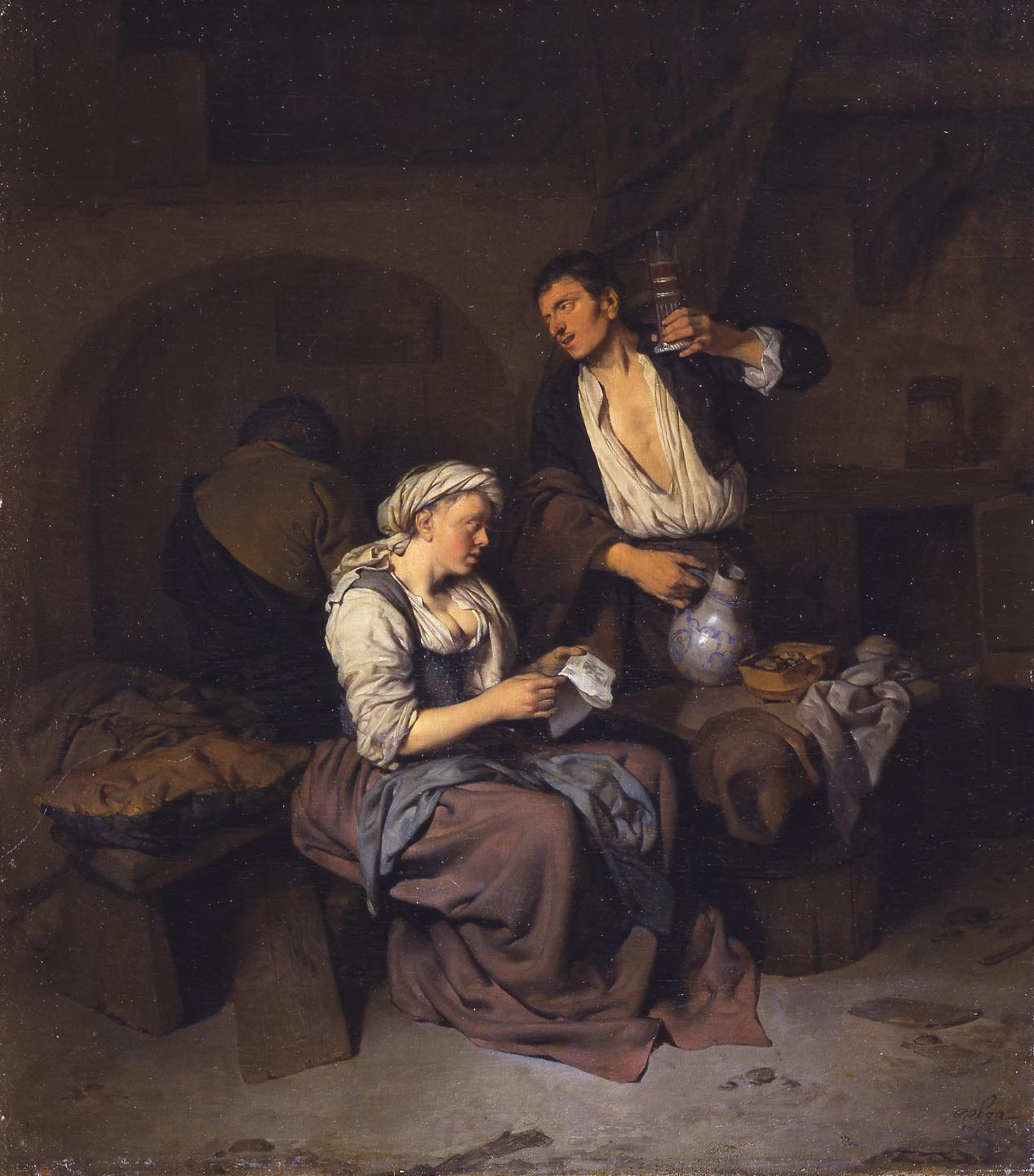
The painting I was asked to comment on is Cornelis Bega’s ‘Tavern Scene’, 1662, approaching it from the angle of what it might be able to tell a social historian. Here is what I came up with:

What is a social historian? The main thing that marks us out from our colleagues in political or economic history is that we are concerned not so much with the ‘great men’ or macro-economic developments—which have undoubtedly played their part in shaping our past and present—but with the everyday lives and experiences of ordinary men and women. We want to know what life was like in the past for the majority of our ancestors.

Recovering these experiences is far from straightforward. For the period that I study—the seventeenth century—the subjects of my research have rarely left behind any of their own accounts of what their lives were like. Only 30% of men, and 10% of women, were fully literate, and those that were tended to come from the upper ranks of society. As such, there are few letters or diaries surviving from humble men and women recording the fine details of their day-to-day trials and pleasures.

As a result, the social historian needs to be ‘omnivorous’ in their search for useful sources of evidence. They need to cast their net wide and glean what they can from surviving court records such as witness statements, from surviving popular ballads and songs, or from the indirect evidence provided by the extant writings of elite social groups. They might also be able to gain insights from the visual culture of the period they study.

In this regard, Dutch Golden Age paintings—such as Cornelis Bega’s ‘Tavern Scene’ on display here—are a tantalising prospect for the social historian. Many adopt a realist focus on the everyday life of seventeenth-century peasants and artisans. Moreover, many of them depict scenes of tavern culture, an aspect of everyday life that has increasingly come to attract the attention of social historians. There is a frustration here though for the historian of seventeenth-century England: there is no English equivalent in this century for the vibrant genre of everyday life paintings being produced in the Netherlands (I’m not quite sure why, but it is a common subject of speculation in conversation with my colleagues). So there is an obvious problem inherent in trying to use paintings of Dutch tavern culture to draw conclusions about English tavern culture, but if we put that to one side for the moment we might think about what sorts of questions a social historian could ask of paintings such as Bega’s ‘Tavern Scene’.

Thanks to York Art Gallery for permission to reproduce this image (YORAG782)

Thanks to York Art Gallery for permission to reproduce this image (YORAG782)

At first glance we might wonder if the utility of this painting lies more in what it tells us about contemporary attitudes towards tavern culture than what it can tell us about what actually took place in them from day to day. It could be taken to encapsulate a common negative stereotype of taverns that was most closely associated in England with Puritans—those who enthusiastically embraced the new Protestant religion—who were known to be particularly vociferous in condemning drunkenness as an ‘odious’ and ‘loathsome’ sin. Is the standing male character slightly off-balance perhaps, his shirt falling open as the decorum slips, drunkenly leering at the bosom of the… serving maid? Taverns were often criticised as sites of inappropriate sexual promiscuity, and we could read this depiction as a visual equivalent to the many sermons that were preached against the immorality of tavern culture in the period.

A closer look suggests that Bega is offering us much more than well-trodden moralising in his tavern scene. The social historian’s gaze is drawn to some of the more quotidian aspects in the painting. There seems, for instance, to be crumpled bedding laid out on the bench behind the central female character. This highlights an important fact about seventeenth-century taverns (or as they were more commonly called in England, alehouses) that the modern viewer may not appreciate: unlike the pubs of today, the primary purpose of an alehouse in this period was not to provide a location for recreational drinking. Rather, it had two main functions: one was to sell ale to local people who did not have the means to brew their own at home. Ale (usually weaker than our modern equivalent) was an important part of the daily diet and a key source of calories and nutrients, and was consumed with all meals by men, women and children. In this sense the alehouse was meant to serve more as an off-license. In practice, of course, many allowed drinking on site and they did become sites for recreational drinking and drunkenness, but this was forbidden in legislation.

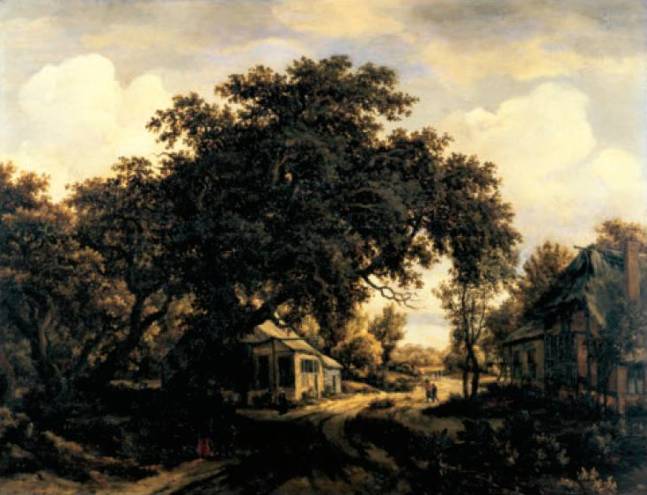
Their other (legitimate) purpose was to provide lodging to travellers. As such they were invariably situated on main roads, something we can see in another painting in this exhibition, Meindert Hobbema’s ‘A Wooded Landscape’. It looks like a drinking house on the left, identifiable by its ‘ale-post’, the ancestor of the pub sign, protruding into the road to show that ale was available.

Thanks to York Art Gallery for permissions (YORAG2005.608)

Thanks to York Art Gallery for permissions (YORAG2005.608)

With this is mind another reading of this tavern scene is possible. What we have is not a scene of drunken debauchery, but a party of travellers who have spent the night asleep on the alebench (alehouse accommodation was rarely plush, and often involved simply sleeping on a bench or sharing a bed with landlord and landlady!) The man with his back to us is still rousing himself from sleep. The standing character is not yet fully dressed, but is nonetheless taking his ‘morning draught’ of ale, the seventeenth-century equivalent of that first cup of coffee. What we might be seeing is the depiction of a morning routine after an overnight stay at the tavern, a far from untypical experience in an age when the lower orders did most of their travelling on foot, and only limited distances could be covered in a day.

We are also struck, of course, by the act of reading taking place at the centre of the scene. It is intriguing, given the statistics of female literacy, that it is the female character doing the reading. What is she reading? Could it be a broadside ballad? These were songs printed on a single (sometimes folded) sheet of paper that were sold cheaply—usually for a penny, the same price as a pint of ale—and often took the form of drinking songs to be sung in alehouses, or even pasted up on their walls. Is that one pasted up in the alcove on the back wall? Perhaps one discarded on the floor in the fore ground to the right? These drinking songs have received a lot of recent attention from social historians, who have mined them for insights they may offer into seventeenth-century tavern culture. Is this a depiction of one being performed? Is the standing male responding to a call that was common in these songs to raise a toast to his companions, or to raise a loyal toast to the King, another familiar feature of these songs?

Arguably the scene is too sedate to be a raucous rendition of a drinking song. Another interpretation may be that the reader is relaying the latest news from a printed newsheet—possibly news of a successful sea battle that is spurring the toast of her companion, or even a satirical political broadside that is the root of his mirth. Both of these were common subjects for cheap printed wares that circulated in taverns. Indeed, the discussion of news and politics in taverns was common and widespread long before the emergence of the coffeehouse in both England and the Netherlands from the mid-seventeenth century, the drinking establishment which is more commonly associated with a public thirst for news and politics. Is Bega looking to capture the fact that the politics of ‘great men’ were not as detached from the world of everyday tavern culture as historians have often thought?

It is, of course, beyond us to know for sure what Bega wanted us to take from his tavern scene, and at best it remains a somewhat indirect form of evidence of everyday life in the past for the social historian. That said, there are a number of aspects of his scene—the tavern as a place of lodging, the circulation of printed ware in these locations—that accord with the evidence of tavern culture in the seventeenth century that social historians have garnered from other sources. It reinforces our sense that tavern culture was about more than mindless drunkenness and sexual promiscuity, providing vital services and a venue for the dissemination and discussion of the issues of the day. Given these areas of overlap between Bega’s scene and what we can recover from other sources there may well be cause for optimism for social historians that such paintings can be a reliable guide to everyday life in the past. Or at the least, another component of our omnivorous diet of sources.

Idols of the mind; or, what on earth does God look like?

Jonathan Willis

Term has ended, I’m organising a big conference next week, and I also urgently need to start writing the paper I am giving at said conference; so what better time, I thought, to write a blog post on an entirely unrelated topic? Frankly, it was either this or finally write that book review I’ve been putting off for weeks…

This post is about God; or more specifically, about what God looks like; or, more specifically still, about how people may have thought about and/or visualised God in Reformation England. I’ve been thinking about this for some time, largely related to different aspects of my work on the ten commandments. First of all, the commandments as a whole derived much (let’s not beat around the bush, pretty much all) of their authority from the fact that they had been given by God himself. Exodus 19 describes how God came down upon mount Sinai in ‘thunders and lightnings, and a thick cloud upon the mount’. He ‘descended’ upon the mountain ‘in fire’ and delivered his commandments. Afterwards, Moses, Arron, Nadab, Abihu and seventy elders came up the mountain to see God, although only Moses himself was given leave to come near to God. Exodus 24:10 describes the supernatural encounter:

And they saw the God of Israel: and there was under his feet as it were a paved work of a sapphire stone, and as it were the body of heaven in his clearness.

Several chapters later, Exodus 31:18 describes another pivotal moment, the point at which the commandments were passed to Moses:

And he gave unto Moses, when he had made an end of communing with him upon mount Sinai, two tables of testimony, tables of stone, written with the finger of God.

william-blake-god-writing-the-commandments-boards_i-G-59-5923-ZI3RG00Z

Blake’s vision of God, writing the Commandments

God’s presence in Exodus is suitably awe-inspiring and mysterious, cloaked as it is in fire, earthquakes, trumpets and smoke. But for the careful reader and listener there are some rather intriguing human details. Firstly, God spoke. Now we in the twenty-first century have seen and read enough works of science-fiction and fantasy fiction to imagine a booming voice emitting from nowhere, or perhaps beaming telepathically directly into our heads. But for most early moderns, surely a voice would have implied a mouth, a tongue, a head… Exodus 24:10 talks of a sapphire pavement under God’s feet, and perhaps most crucially, the ten commandments are described as having been written with the finger of God.There is a marvellous depiction of God doing precisely that, engraving stone tablets with his right index finger extended like some sort of divine welding torch, by the romantic poet and painter William Blake. But such a depiction would have been unthinkable in Reformation England, because of the great weight placed upon the commandments themselves, and in particular the first, ‘Thou shalt have no other gods before me’, and the second. Exodus 20:4 stated quite clearly,

Thou shalt not make unto thee any graven image, or any likeness of any thing that is in heaven above, or that is in the earth beneath, or that is in the water under the earth.

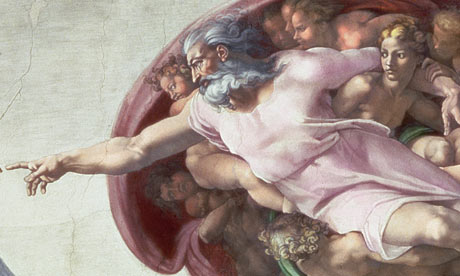
Michaelangelo's God as shown creating Adam on the ceiling of the Sistine Chapel

Michaelangelo’s God as shown creating Adam on the ceiling of the Sistine Chapel

This is in large part a familiar story. Depictions of God the Father as a white-bearded old man (like the rather famous one above) were out in Protestant Reformation England, and so imaginative painters, printmakers and carvers resorted to figurative alternatives like the Hebrew ‘tetragrammaton’:

YHWH, or 'Yaweh', in Hebrew

YHWH, or ‘Yaweh’, in Hebrew

People recognised this as a symbolic depiction of God, the newest element of a longstanding visual language which recognised that rays of light and prominent doves could function as representations of the holy spirit, and that indeed Christ could be represented as a lamb, or by the ‘holy monogram’ IHS and other Christograms.

But people recognised the lamb and the holy name as symbols. They did not think that Christ was a sheep – the bible was rather insistent on the fact that he had been both God and man. So when people saw the tetragrammaton, or heard references to God’s voice, and feet, and fingers, what could they do but picture somebody in the form of a man, a man old enough to be the ‘father’ of the ‘son’ who had died for their sins? It is therefore easy to see an unresolved tension in the way in which most writers discussed the second commandment, with its absolute ban on images of the divine directly contradicted by the partial painting of a picture of God in words, through references to hands, feet, mouth, voice, and other physical elements of fleshy human bodies.

While most ministers and godly authors like Samuel Purchas and John Brinsley were happy to speak of a law ‘renued by the voice and finger of God on Mount Sinai’,[1] or of ‘the Ten Commandements written by the Lords owne finger’,[2] others recognised this inherent contradiction and were more careful. Calvin, in his sermons on Deuteronomy, explained that while God had chosen to write his law on stone tables with his own finger, we should not believe

that God hath anie hands: but that the holy scripture speaketh so by a resemblance as if it were saide, the lawe was note written or ingrauen by mans hand: but God approoued and ratified it by way of miracle.[3]

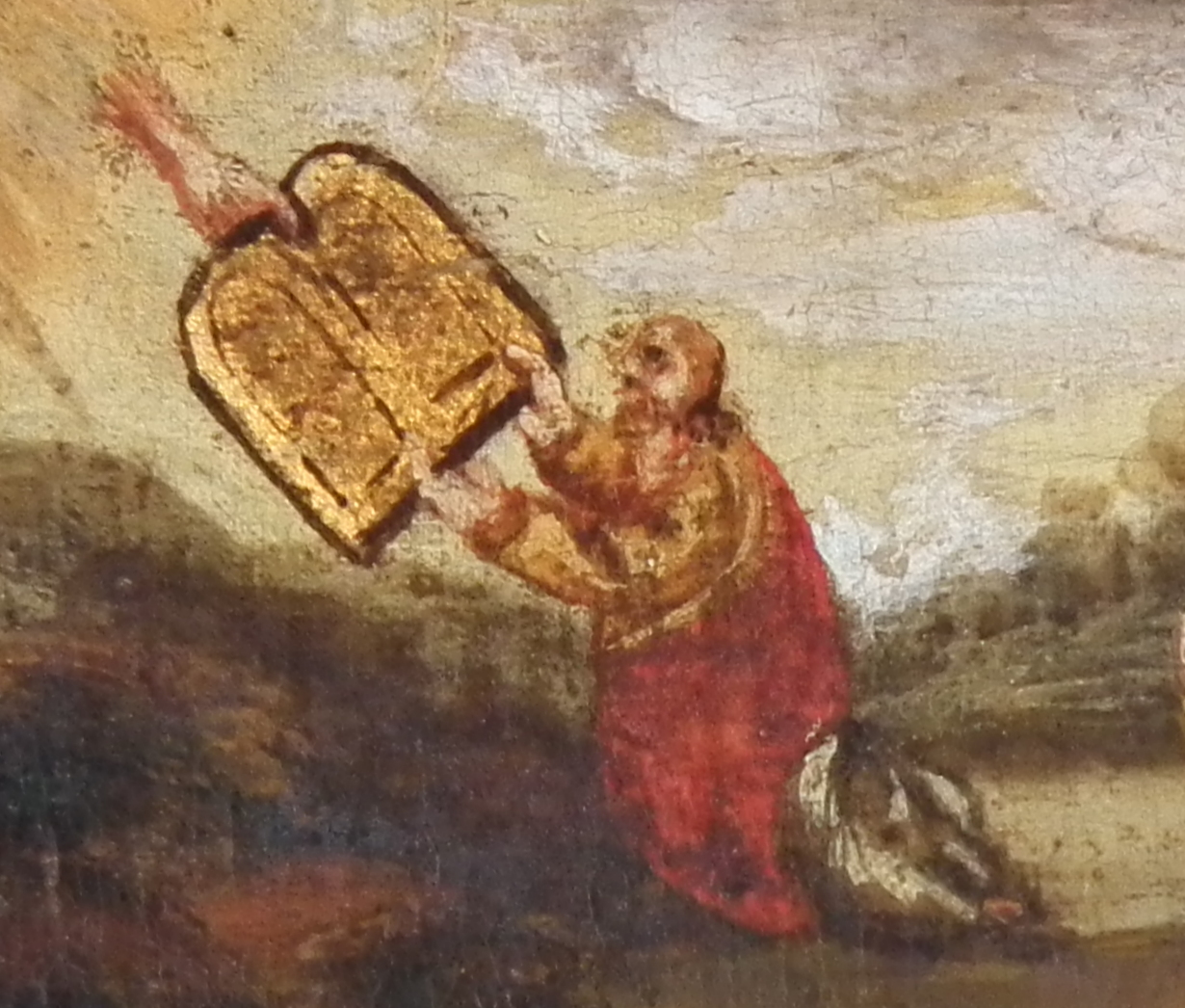
Not many people could maintain such a rigid division in their heads, however, and occasionally idols of the mind could be made partially manifest. I want to share just two examples today. The first, taken from a rare Elizabethan commandment board hanging in a Hampshire church, shows what is unmistakeably a divine hand, fully formed with four celestial fingers and a god-like thumb, handing the ten commandments out of the sky to a kneeling Moses.

Gravatar

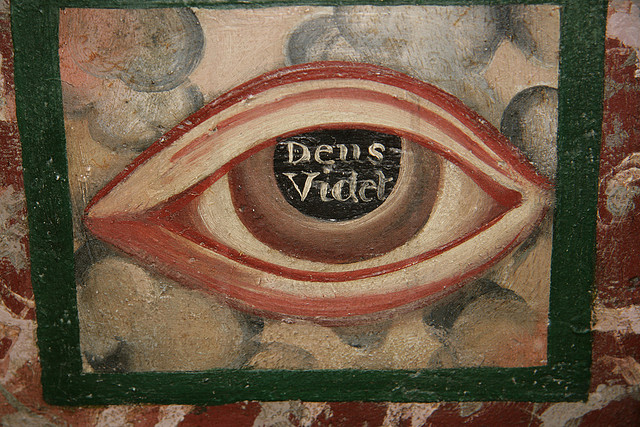
The second, knowledge of which I very gratefully owe to University of Birmingham PhD student Susan Orlik, is the baleful eye of God staring down at the occupants of an astonishing family pew in a Berkshire church, the pupil of which is inscribed with the words deus videt – God watches.

3780847851_57fff22182_z

If any monster readers have come across any interesting, unusual or incongruous representations or descriptions of, or references to, God, I’d be very interested to hear about them here!


[1] Samuel Purchas, Purchas his pilgrimage (1613), p. 17.

[2] John Brinsley, The fourth part of the true watch containing prayers and teares for the churches (1624), p. 78.

[3] Jean Calvin, The sermons of M. Iohn Caluin vpon the fifth booke of Moses called Deuteronomie, trans. Arthur Golding (1583), p. 391.

What’s your poison? The History of Intoxicants

Mark Hailwood

Regular readers of the monster will no doubt be aware from the content of many of my posts that I am a historian of drinking. This may sound like a rather niche or unusual subject for a historian to study, but I am certainly not alone in my interest in the history of intoxication – in fact it is a major growth area, especially in early modern history,[1] and you can now even get a job working specifically on ‘Intoxicants and Early Modernity: England c.1580-c.1740’ .

Why are historians so interested in intoxicants then?

Well, im9780679744382_p0_v1_s260x420portant changes in our relationship with intoxicating substances took place in the early modern period. In 1550 English men and women had a limited choice of substances they could turn to for a ‘psychoactive’ experience: ale for the poor, wine for the rich. In contrast, by 1750 ale and wine were joined by beer, gin, tobacco, tea, coffee, and chocolate, all of which were being mass consumed across the social scale.

This transformation in the range and quantity of intoxicants being ingested by the English population should not be seen simply as a footnote in our history: it was a historical development of wide-ranging significance that was intimately connected with major transformations in economics, politics, society and culture. Colonial expansion, the relationship between the state and the individual, gender roles and conventions, ideas about appropriate forms of behaviour or ‘manners’, class differences, and the role of public opinion in the political process, are all crucial aspects of English history in this period that cannot be understood without reference to the trade, regulation, and above all consumption, of intoxicants. Historians, including myself, are now arguing that we put intoxicants where they belong: at the centre of early modern English history.

liz So, with that in mind I thought I would offer a mini blog ‘carnival’ to draw attention to some recent posts that touch on aspects of the important history of intoxicants. I’ve said plenty on this blog about the history of drinking, so here are a few suggestions of other popular ‘poisons’ you might be interested in:

– Over at Early Modern Medicine, Jen Evans has been exploring the way people in the seventeenth-century thought about the health implications of new introductions such as coffee and tobacco, including some rather creative songs about the effect of tobacco on male virility.

– The history of tobacco has also been taken up in a recent blog over at History Today, which provides a useful introduction to the emergence and development of smoking habits, and reveals the rather surprising fact that tobacco’s initial success owed much to its perceived medicinal properties.

– And I also came across this interesting post recently which corrects a view I often get presented with: that people drank a lot of ale and beer in medieval and early modern England because they didn’t drink water, which was thought to be unsafe. According to Tim O’Neill, they did drink water – and ale and beer were more like an early version of energy drinks than an alternative to water.

So, pick your poison, and expect to hear more about the history of intoxicants as this field of study continues to expand.


[1] For a flavour of the recent work in this field check out the following: Phil Withington, ‘Intoxicants and Society in Early Modern England’, Historical Journal (2011), Mark Hailwood, ‘Sociability, Work and Labouring Identity in Seventeenth-Century England’, Cultural and Social History 8:1 (2011),  Alexandra Shepard, ‘Swil-bolls and tos-pots’: Drink Culture and Male Bonding in England, 1560–1640’ in Laura Gowing, Michael Hunter and Miri Rubin, eds., Love, Friendship and Faith in Europe, 1300–1800 (2005),  and the essays in Adam Smyth (ed.), A Pleasing Sinne: Drink and Conviviality in Seventeenth-century England (Cambridge, 2004).

Dead people’s stuff

Brodie Waddell

What do historians study? Do we study historical events and past societies through analysis of extant artefacts? Or do we study dead people by looking at their stuff? Tim Hitchcock argues that we do the latter:

In recent years I find myself using the terms Stuff and Dead People in talks and titles more and more.  And as a historian I find myself conceptualising my work as being about Stuff inherited from Dead People.  Both expressions just sound right. … They form an attempt to de-centre the language of historical and social science authority that underpins the professional claims of academic historians as a whole.  By refusing to use the categories and languages of authority we inherited, I am self-consciously rejecting the systems that underpin the professional academic practise of history.

It’s worth reading the whole post, if only for his astute remarks about Kissinger’s questionable place amongst the living, but I want to emphasize an overlapping issue: jargon-busting.

In my reading, Tim is, amongst other things, arguing that historians should think critically about the strange dialects adopted by our scholarly tribes. Rather than relying on traditional technical labels or snazzy new terms borrowed from other fields, we should try to find alternatives.

Tillicoultry churchyard

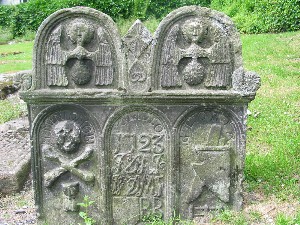
Dead people

More importantly, to my mind, his specific suggestions are not latinate neologisms invented to bemuse colleagues and confuse students (e.g. Derrida’s différance). They are deliberately common English words: the sort of words that can be found both in the KJB and in a 21st-century pub chatter. This has at least two key advantages over the Derridean approach.

First, as Tim implies, using words that seem blunt or imprecise can force us to think differently about what it is we are actually trying to label. ‘Stuff’ is much less specific than ‘text’, ‘image’, ‘object’ or ‘landscape’, but that is exactly the point: we don’t study each of those things in isolation any more. I can see how this technique might be useful in my own research. Whilst investigating the economic situation in the 1690s, I’ve come to the conclusion these were simply ‘hard times’. This phrase neatly includes all of the economic problems of this decade – increasing fiscal demands, war-time trade disruption, liquidity crisis, food price inflation, etc. – and, at the same time, reminds us that many people experienced these problems as a general calamity, not as separate challenges to be dealt with independently.

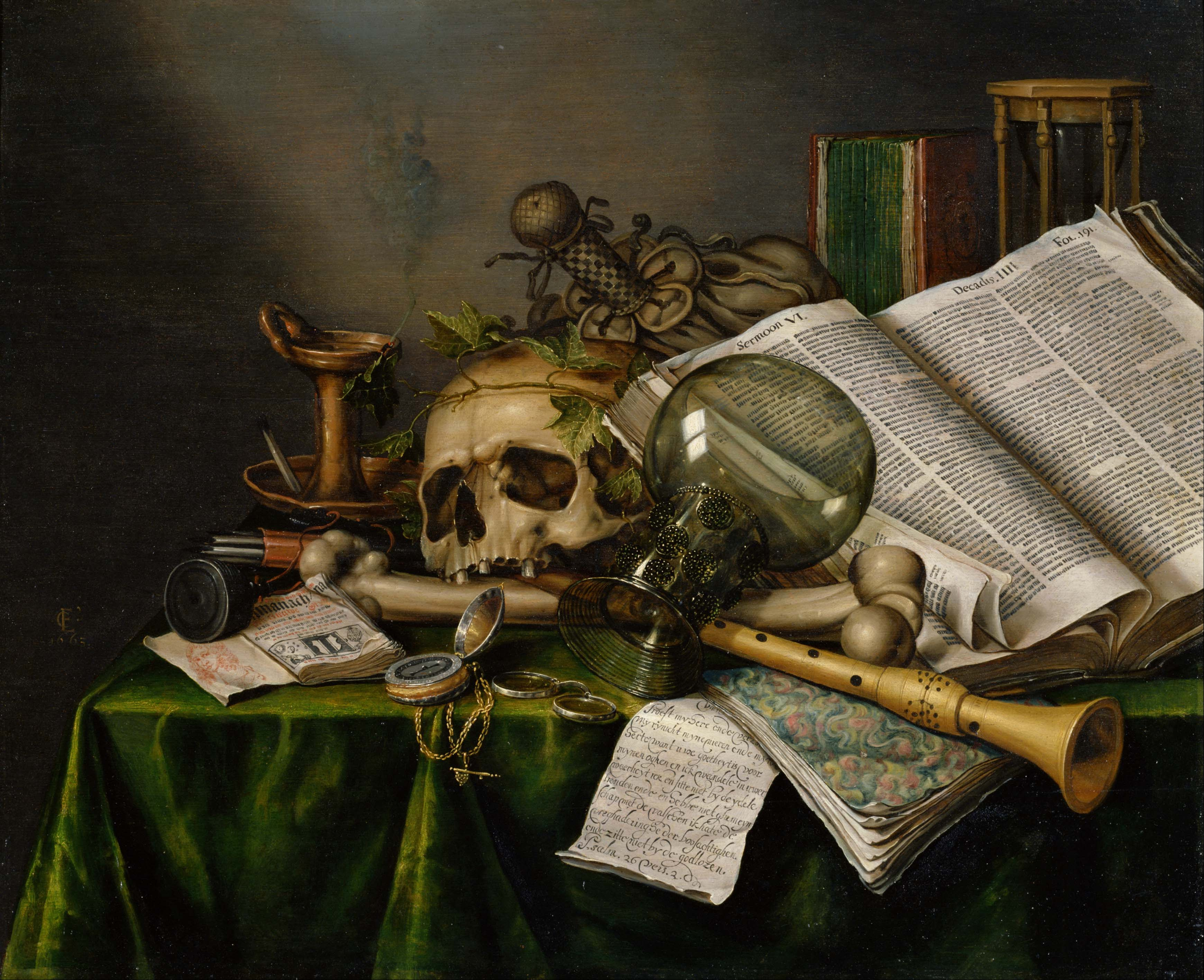
Dead people - Collier_-_Vanitas_-_Still_Life

Stuff

Second, using words like these has the advantage of making us much more understandable. ‘Dead people’ is a phrase that makes sense to everyone, whereas terms such as ‘historical actors’ or ‘active historical agents’ are not quite as obvious. Historians seem to be less intoxicated by technical jargon than many of our fellow academics.1 Nonetheless, there is still plenty of needlessly abstract, obscure vocabulary that could be profitably chucked. Replacing some of our quasi-scientific jargon words with more ‘vulgar’ alternatives would make it much easier to have the sort of fruitful conversations with non-academics that we all claim to want.

These two potential benefits – challenging outdated thinking habits and opening up scholarly discussions – seem to me to be reason enough consider how you might be able to do this in your own work. Perhaps the study of ‘dead people’s stuff’ won’t catch on, but it’s a great excuse to think hard about the words we use.

Footnote

1 One need only dip into a typical book of literary criticism or sociology to realise that it would have been much more difficult for Sokal to persuade a historical journal to publish his balderdash than it was for him to convince Social Text.

Examining the question and questioning the exam

Brodie Waddell

Tyler Cowen, a well-known blogger and economist at George Mason University, once tried a rather unusual approach to examining.

[He] walked into class the day of the final exam and said, “Here is the exam. Write your own questions. Write your own answers. Harder questions and better answers get more points.” Then he walked out.

The result, according to Cowen?

I would say that the variance of the test scores probably increased! I don’t recall if I ever did that again for a whole exam but most of my exams do that for at least one question.  It’s the question where you learn the most about the student.

With exam season now upon us, I’ve been mulling this over. I suspect the Birkbeck exam scrutiny panel wouldn’t like Cowen’s approach, but I think it could have real value. It would at least be a nice change from the usual drudgery of wading through 10 or 20 or even 50 answers to exactly the same question.

More to the point, it led me to think about some of the more unusual exam questions I’ve encountered over the years. The only one that strikes me as unconventional is one from Cambridge a few years ago for the early modern British social and economic history survey module:

Were any women and men practising witchcraft in early modern England?

Although it might not seem especially strange to a historian of the period, I suspect that laypeople would be alarmed to hear that Cambridge students were being examined on the existence of witches.

Do you have a favourite (or hated) history exam question?

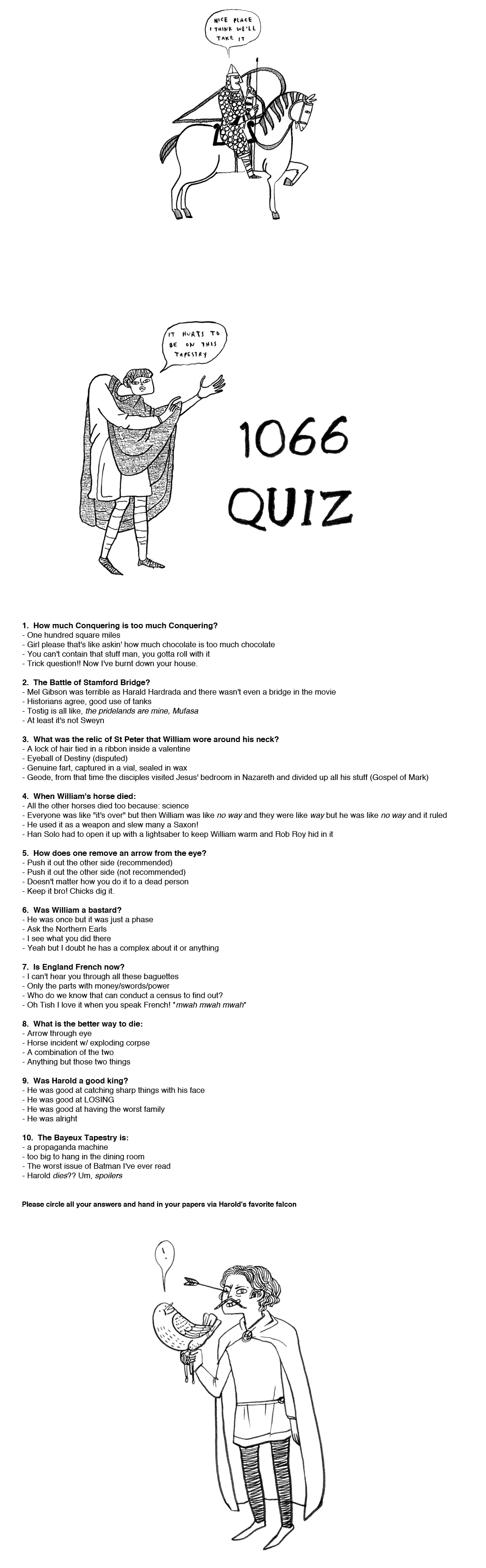
[Update (15/05/13): Kate Beaton, creator of ‘Hark, a vagrant’, offers an Elizabeth I quiz and a 1066 quiz that include such key questions as ‘Whither the Armada?’ and ‘How much Conquering is too much Conquering?’]

A post written in the stars

Laura Sangha

According to my horoscope, consulted on the website of a popular entertainment magazine, this will be a good week for me. With six planets in my sign, I’m ‘the one to watch!’. I might be feeling the pressure, but before the week is out, ‘luck will come’. Excellent news, I am sure you will agree. Look in most entertainment magazines and tabloid papers and you would hardly be surprised to find the similar revelations in the stars, tucked away somewhere between the week’s television and the latest suduko. You might be more interested to discover that, unlike wikipedia currently suggests, astrology did not gain broader consumer popularity through the influence of ‘regular mass media products’ in the twentieth century, but in fact had a ‘popular’ following many centuries before then.

The search for order and meaning in the sky is, of course, ancient. No one would deny that there is an obvious link between the sun and events on earth. As winter finally loosens its grip here in the UK you might be particularly aware of this right now. The northern hemisphere is slowly exposed to more direct sunlight because of the tilt of the earth’s axis, the days lengthen, the altitude of the sun changes, the sun feels hotter. As a result, animals change their behaviour, plants and trees burst into life, and Brits start donning shorts and having shivery picnics at the seaside.
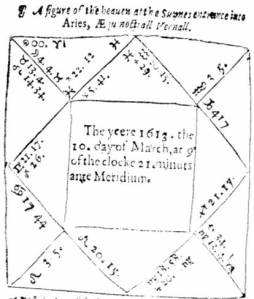
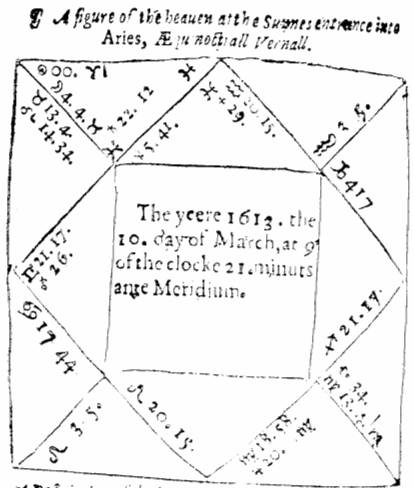
A diagram of the heavens from a 1613 almanac.The evident link between the celestial bodies and terrestrial events was no less obvious to our forebears, and it led very naturally to an interest in the heavens. It was common to wonder how else the celestial bodies might influence life on earth. Lunar cycles were being recorded on cave walls as early as 25,000 years ago; the first organised system of astrology arose in the second millennium BC in Babylon; it was developed by the Greeks and Romans, and refined by Arabic practitioners. By the early modern period it was a very well established scholarly tradition, backed up by scriptural references: Jesus’ birth was of course marked by the appearance of a new star in the sky that the wise men followed to Bethlehem (Matthew 2:1-2), and at the beginning of the world ‘God said, Let there be lights in the firmament of the heaven to divide the day from the night; and let them be for signs, and for seasons, and for days, and years’ (Genesis 1:14).

Thomas Blount gave a neat early modern definition in his 1656 Glossographia or a Dictionary (and note Blount’s qualification which preserves God’s omnipotence as well as man’s free will):

Astrology: Astrology is a Science which tels the Reasons of the Stars and Planets motions. Astrology doth promise by the motion and influence of Stars and Planets to foretel things to come, or it professeth to discover the influence and domination of the superior Globe over the inferior, and therefore may be tearmed a kind of natural divination, so long as it keeps it self in due limits, and arrogates not too much to its certainty; into which excess if it once break forth, it can then be no longer called natural Divination, but superstitious and wicked; for the Stars may incline, but not impose a necessity in particular things.
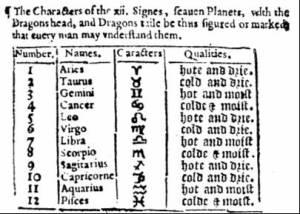
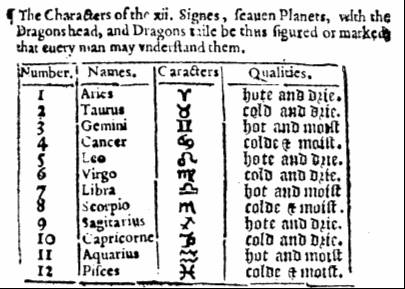
The characters of the xii signes... so that every man will understand them.

The characters of the xii signes… so that every man will understand them.

Natural astrology was concerned with the general character of planetary influences in such fields as agriculture and medicine; judicial astrology was the attempt to interpret these influences to make prediction and give advice (so tabloid stars are an example of this). Mastery of the science of astrology took skill and was intellectually demanding, and as a result, sixteenth-century astrology tended to be the domain of the learned and elite members of society. In seventeenth-century England however, this began to change, as a result of the emergence of handbooks which set out the basic rules of astrology and the rise of the ‘almanac’. Sorry wikipedia, but popular knowledge of the science was therefore probably greater in the Tudor and Stuart period than ever before or since.
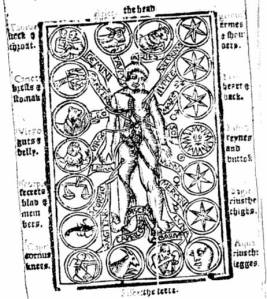
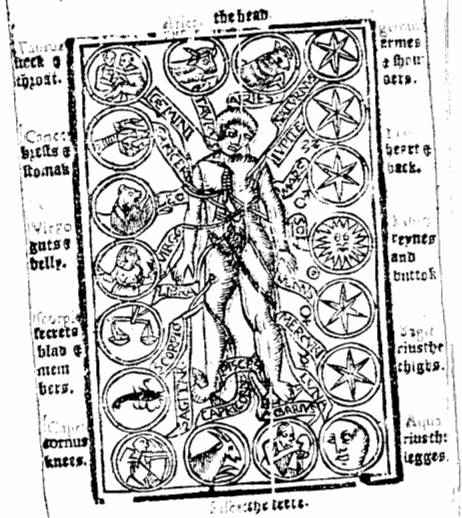
The anatomy of a mans body, as the parts thereof are governed by the 12 celestial signs

The anatomy of a mans body, as the parts thereof are governed by the 12 celestial signs.

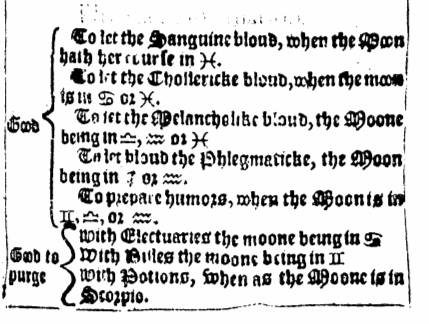
An almanac was an annual, short, cheap publication with a range of material in it. It fulfilled a variety of roles, offering religious, moral, practical as well as astrological advice. Usually the first section had a calendar and details of planetary motions and conjunctions. Along with the prognostications, there was often also an ‘Anatomy’ or ‘zodiacal man’, as well as information on local fairs, highways, the phases of the moon, feast days, medical and farming advice. Often almanacs had a secondary role as a notebook or diary (look at the front of your diary, mine still has ‘useful information’ including astronomical information), and therefore they were worth hanging on to, and many survive, luckily for us. Bernard Capp[1] has shown that the genre allowed astrology to take on a new social dimension. They served as handbooks that set out the basic rules to astrology in a clear and simple manner, for use by all sorts of people, from peers to serving-maids. Astrological terms passed into common usage: think ‘jovial’, ‘lunatic’, ‘mercurial’. And almanacs were really the starting point for this post – I was idling browsing a few from spring 1613, exactly 400 years ago, wondering what sort of things were going on back then, and I thought it would be an excellent idea to share some of that advice with monster readers, to set them up for the summer.[2] Enjoy!

WARNING: This stuff is a bit dated, for the most cutting edge advice you should probably turn to biodynamic gardening, where ‘gardeners plough, prepare, sow, plant, harvest and compost according to the phases of the moon and the constellations (signs) it passes through’.

1613 HISTORY: How many years is it since….
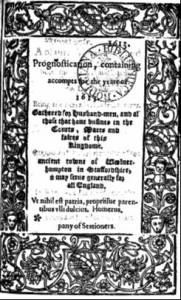
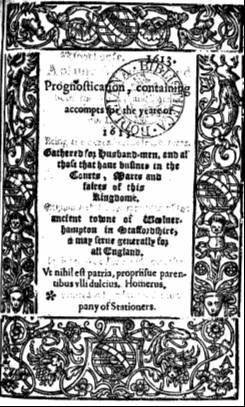
Frontispiece to John Woodhouse's alamanac for 1613.

Frontispiece to John Woodhouse’s alamanac for 1613.

  • The world began: 5562
  • Noah’s flood: 3906
  • Conquest of the Romans: 1664
  • Coming of the Saxons: 1163
  • Coming of the Danes: 774
  • Conquest of the Normans: 546
  • The Battle at Agincourt: 197
  • Printing first used: 153 [1460]
  • The first use of coaches in England: 58
  • Pauls Steeple burned with lightening: 52
  • The rebellion in the North: 44 [a reference to the 1569 Rebellion of the Northern Earls in reign of Elizabeth I]
  • The great snow: 34
  • The general earthquake: 33 [also known as the Dover Straits earthquake, 1580]
  • Tilburie Campe: 25 [a reference to the Spanish Armada, 1588]

PRACTICAL ADVICE:

What phase of the moon should I….

  • Cut hedges? Between the change and the full, from the end of Jan till the beginning of June
  • Geld cattle? In Aries, Libra and Sagittarius, the moon being past the full
  • ‘Dung land’ that weeds may not abound? In the old of the moon

How can I tell if there will be rain or foule weather?

If the sun is fiery at his rising. If he rise and a little after be covered with great black clouds. If the horns of the new moon are blunt. When bells are heard further than usual. When wainscot doors and wooden coverings open straighter than of custom. When swine and peacocks make a great noise. When birds be busy in washing themselves. Moles behaving busily. Cattle eating greedily, and licking their hooves.

What should I be doing in the outdoors at the moment?
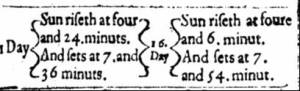
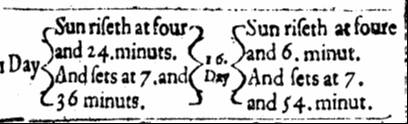
Working outside? You'll want to know when it will be light then.

Working outside? You’ll want to know when it will be light then.

In April you should sow barley, hemp, and flax, and some of your garden seeds, as cowcumbers, citrons, melons and artichokes. Good housewives should now begin to be busy about their Dairies, and tanners to pill barke.

In May you should sow barley, set and sow tender herbs and seeds, set stills to work, stir land for wheat and rye, stop lopping trees, weed winter corn, teach hops to climb, but cut off the superfluous branches, and watch your bees.

More generally, cold will diminish and living creatures will begin to recover their strength lost over the winter. Soon the earth will put on her new yearly ornaments, beasts, fowls and birds will make harmony.

When and where can I go to a fayre?

There are too many to mention, but on 1 May try Leicester, Brickhill, Reading, Warwick, Maidstone, Lichfield and Stanstead. On the 3 May try Waltham Abbey, Cowbridge, Benbigh, Knighton. In Rogation week: Beverly, Engfield, Horsham. On Ascension Day: Kidderminster, Bishops-Stratford, Wigan, Burton, Bridgend.

MORAL ADVICE: What good deeds shall I do this season?

The deeds of hospitality would be useful: feed the hungry, cloth the naked, be good to the widow and the fatherless. Remember:

Hast thou 2 Loafs, 2 Coats, give one of each
To him that pines and starves (I thee beseech)
Alas! (Rich man) thou know’st not what thy
May come unto, when thou art dead and gone.
Farmers! give th’ poor some corn. Shepherds give
Some cloth the back, some fill the Belly full
Doctors, give Physick for mere Charity:
Millers, be sure ye grind their Corn toll-free.

HEALTH

April is a good month to have a spring clean – not only of your house, but also of your body. It is the fittest time of year to ease diseased bodies, and to restore by means of evacuation and blood letting. Remember with this simple rhyme:
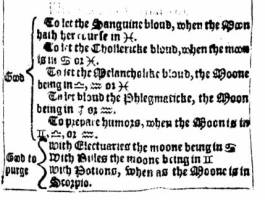
Learn the most ausipcious times to let blood with this simple guide.

Learn the most auspicious times to let blood with this simple guide.

This month all things their strength renew,
by letting of blood, you shall not rue
The pores open and blood abounds,
or purging, also no harme redounds.

And finally, beware. The sicknesses of spring are melancholy, madness, the falling sickness, nosebleeds, coughs, itch, scabs, ulcers , gout, pain in the joints, and also, ‘some strange diseases’….


[1] Bernard Capp, Astrology and the Popular Press (London, 1979).

[2] The extracts are taking from the following almanacs: John Dade, A new almanacke and prognostication, 1613; John Johnson, An almanacke and prognostication for this yeere of our lord and sauiour Iesus Christ 1613; William Mathew, 1613 a new almanacke and prognostication, for the yeare of our Lord God; John Woodhouse, A plaine almanacke and prognostication, 1613; John Bucknall, The Shepherds Almanack, being a diary or register for the year 1676.

Carnivalesque 94: No bishop, no king

Brodie Waddell

Welcome to the 94th edition of Carnivaleque! Today we will be introducing you to a wonderfully motley menagerie of historical blogs and bloggers.

Finding any overall unifying theme is impossible with a collection of this sort, but there are a few key subjects that emerged from the nominations, each of which receives a section below:

  • The historian as detective
  • Bodily functions
  • A venerable criminal enterprise
  • Places, spaces and sites
  • Thinking about the historian’s craft

I think it is particularly interesting what’s not in the links below, namely kings and queens and ‘great battles’, the traditional material for popular histories. Not that political history and military history are entirely absent, just that they are approached from a different direction than usual. Although there are a few of gentlemen and noblewomen as well as a famous scientist, the vast majority of the nominated posts are focused on people who would have been largely excluded from textbooks written fifty years ago. What should we make of this? Is old-fashioned ‘top down’ history dying off? Or is it just that the type of people who read this blog and pay attention to Carnivaleque are predisposed against reading yet another story about Henry VIII and his wives or Charles I and his parliaments? I’d be interested to hear what you think.

However, before wandering into the carnival below, take a look at this truly heart-warming short animation that tells the tale of ‘the damnable life and death of one Stubbe Peeter, 1590’, a German werewolf. For more details, see the two posts at LOLManuscripts, but in the meantime, watch the video and be amazed.

Now, on with the show…

Continue reading