Monstrous readers

Brodie Waddell

In the wee hours of this morning, the Monster was viewed for the 10,000th time. Not a bad achievement for a blog dedicated to historical obscurities that only launched nine months ago. So, thanks to all of you for checking us out and thanks even more to our commenters who make posting so worthwhile!

Rather than fireworks, I thought it might be appropriate to celebrate by pulling back the curtain to reveal a few facts and statistics, following the example of Nick at Mercurius Politicus.

Since July 18th, 2012, we’ve had:

  • 53 posts
  • 205 comments
  • 10,004 views, around 40 per day
  • 74 different countries from which vistors have arrived
  • 260 views on a single day (September 2nd, thanks to a link to ‘A royal mistress’ from Two Nerdy History Girls)

We’ve received most of our readers via links from:

Perhaps most interesting are the search terms that have been used to find us. The most Young Sallypopular is, of course, ‘many-headed monster’. Interestingly, ‘archivist’ is in second place, perhaps thanks to the archival miscellany. Other unsurprising results include ‘what shall we do with a drunken sailor’, ‘civil war comic strip’ and ‘microhistory’. More unexpectedly, we also have a few readers who’ve found us by searching for ‘animated fireworks’, ‘hairy child’, ‘devil church’ and, most confusing of all, the nine clicks from ‘dirty mind of young sally’. I pity the poor saps who were looking for a local Satanist congregation or a 1973 ‘adult comedy’ only to find over-thought analysis of some early modern oddity.

Oh well, the more the merrier … Satanists and skin-flick fans, we welcome you!

Calling all bloggers and blog readers…

Every six weeks or so the historical blogosphere hosts a ‘carnival’ where a single blog publishes a ‘Carnivalesque’ miscellany of links to recent posts from around the web. This particular carnival focuses on ancient, medieval and early modern blogging. Previous editions have been hosted by Sharon Howard of Early Modern Notes and Thony C. of The Renaissance Mathematicus.

The many-headed monster will be hosting the next edition on April 27th and we’re looking for nominations. We’ve already had a few come through, but would welcome many more. The Carnivalesque nominations procedure is as follows:

We welcome perspectives from a variety of fields, especially (but not only) history, literary studies, archaeology, art history, or philosophy. You can nominate your own writing and/or that of other bloggers, but please try not to nominate more than 1-2 posts by any author for any single edition of the carnival.

Nominated blogging may be ‘academic’ or ‘popular’, so long as it is based on facts and evidence. Writing that engages with the past to discuss present issues should include significant historical content and analysis, not merely polemic. All nominations are vetted by the host of the edition, whose decision is final.

Nominated posts should have been published within the last 2-3 months. The normal channel is to send an email to the host using the nomination form at this site. Individual hosts may provide additional options. Please ensure you include the full URL of the post you are nominating, and ideally the post title and blog name.

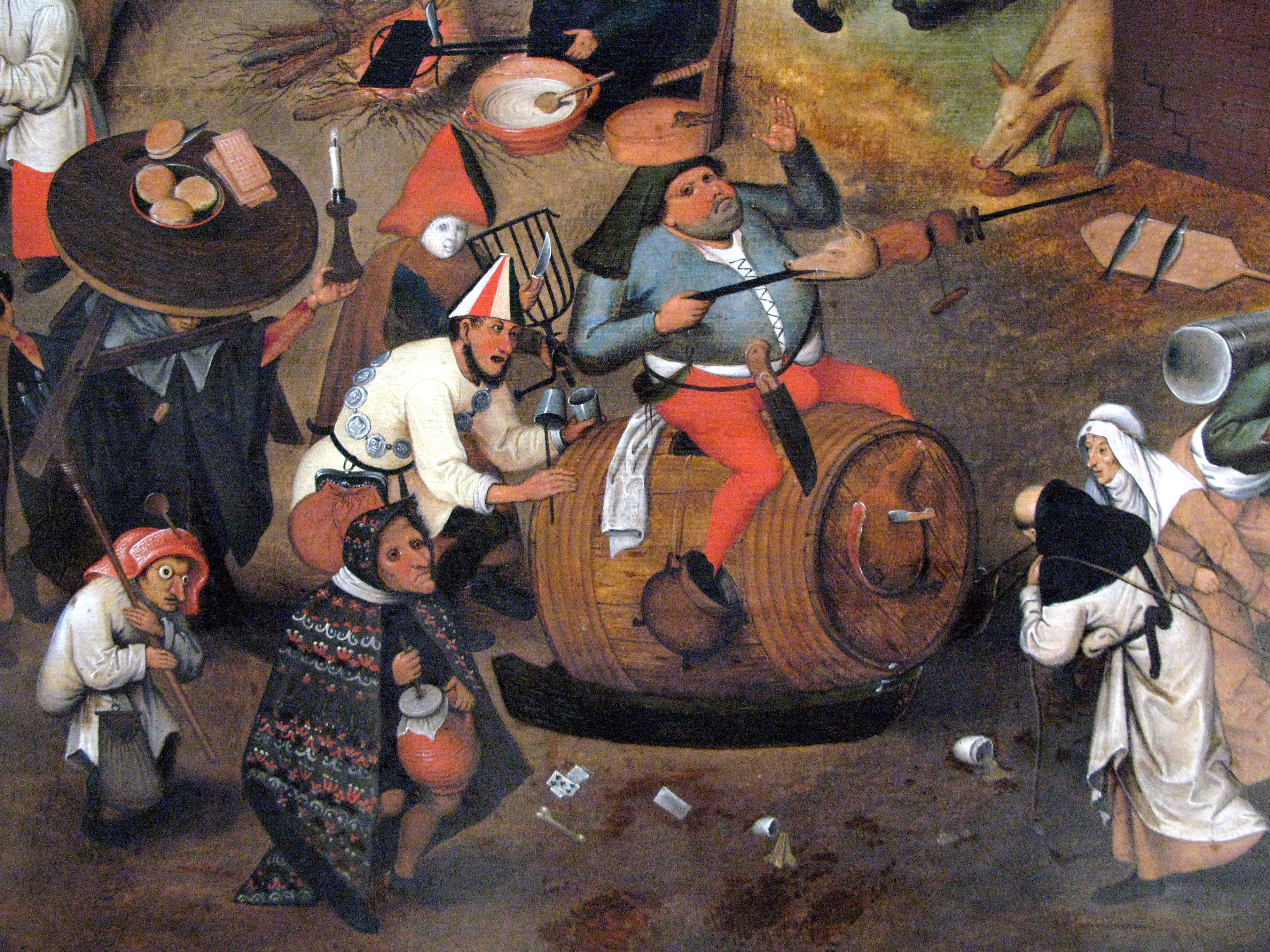
pieter_bruegel_ii-combat_de_carnaval_et_careme_img_1463

An Easter larceny, 1691

Brodie Waddell

I was browsing the Old Bailey Online for seasonal crimes, as one does, and came across this case from the Proceedings of 27 May 1691:

Rebekah Williams, Widow, was Tryed for Robbing Edward Veron , on Easter-day last, of Goods to a considerable value. Mr. Veron swore, That his Shop was broke open at Ipswich, and that the Prisoner offered several of the Goods to sale in London, at a Goldsmiths, where she was taken; but she proving her self a Married Woman, by vertue of the Covering she was Acquitted.

We have, in other words, a woman who allegedly participated in stealing from a shop on Easter, but escaped unpunished because she was married at the time.

Early Modern John recently described an Old Bailey case from around the same time as ‘both amazing and infuriating at the same time’ – and the case of Rebekah Williams undoubtedly falls into that same category. The record includes tantalising hints about the culture of the time, but also fails to explain the parts that seem to be most in need of explanation.

The first question is about the significance of the day of the crime. It is obvious why criminals might plan a break-in for ‘Easter-Day’ – presumably everyone else would be at church and the theft would be less likely to be detected. But what would the jurors think of such a crime? Would they be inclined to treat the accused more severely because the crime was both a theft and a profanation of the year’s holiest day? Would the prosecutor draw attention to this? Sadly, the record is entirely silent on this point.

The second issue is influence of Williams’ marital status. This seems to be a case of ‘feme covert’. As the OBO explains:

The legal principle of the feme covert, by which women could not be held responsible for crimes committed in the presence of their husbands (since they were presumed to be following their husbands’ commands) was not often applied, but it may have led juries to exonerate some married women, particularly when their husbands were convicted for the same crime.

The principle had a much more significant role in commerical affairs and inheritance than in criminal law, but it theoretically applied to cases of theft as well.1 But why, then, was Williams listed as a ‘widow’? How did she ‘prove’ her marriage? Why wasn’t her husband mentioned and, in fact, prosecuted? I’m inclined to imagine a scenario something like this … Williams and her husband robbed the shop in Ipswich, but only she was caught selling the goods in London. She admitted the crime but claimed that she was coerced by her husband, who – conveniently – died before the trial. But this is all merely speculation. Here too the record is silent.

In the end, what we are left with is a woman who seems to have committed a potentially capital crime on the most sacred day of the Christian calendar, and who walked away from the court unscathed.

Footnotes

1 For the significance of ‘feme covert’ in the economic sphere, see Joanne Bailey, ‘Favoured or oppressed? Married women, property and ‘coverture’ in England, 1660-1800′, Continuity and Change, 17:3 (2002), pp. 351-372 (ungated); and the work of Amy Erickson. For the role of gender in early modern crime, see Jenny Kermode and Garthine Walker (eds) Women, Crime and the Courts in Early Modern England (1994); Garthine Walker, Crime, Gender and Social Order in Early Modern England (2003). The law of coverture is also described on Wikipedia.

Something for Good Friday (it would be Rood not to)…

Jonathan Willis

Just a little something for Good Friday: I don’t know how many of you know the parish church of St Catherine, Ludham, Norfolk, but like so many of the county’s churches it has a solid medieval pedigree and is really worth a visit!

20130329-090718.jpg
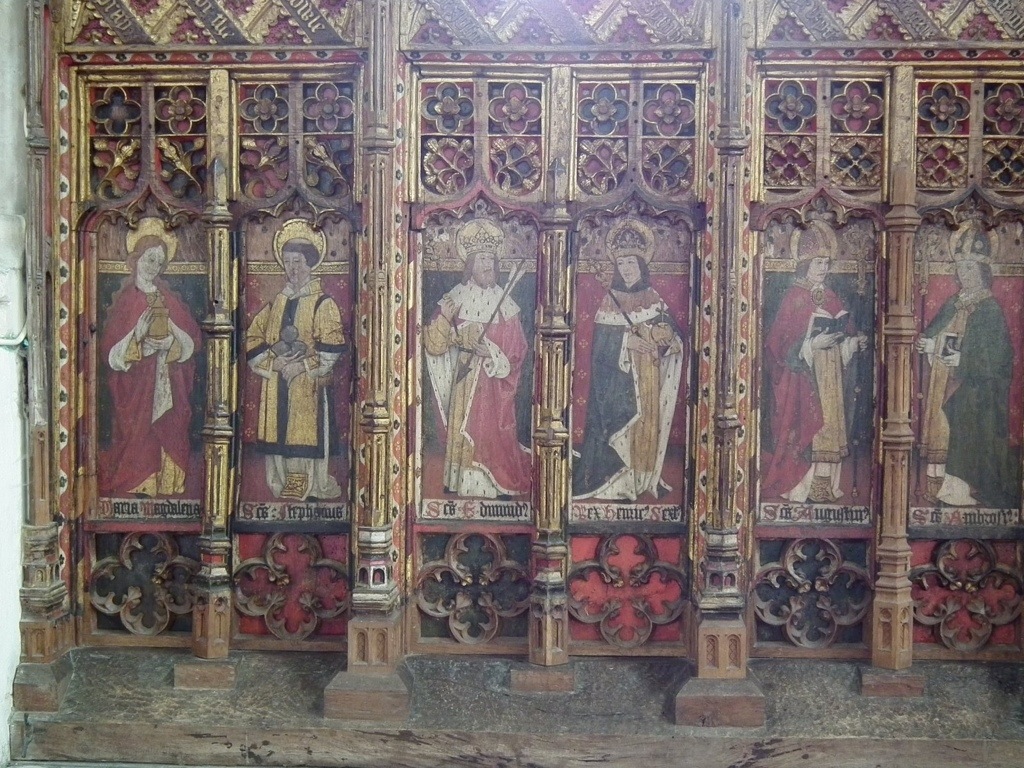
I went there last summer (remember summer?!) on the trail of an early commandment board, and while I’m still not convinced that I found one there, I did come across something rather special. Ludham has one of those vast, flint-clad churches so characteristic of East Anglia, a result of huge wealth generated by a thriving local economy, and particularly the strength of the cloth trade. Anyway, one of the main attractions is its beautiful, intricate medieval painted screen:

20130329-091344.jpg
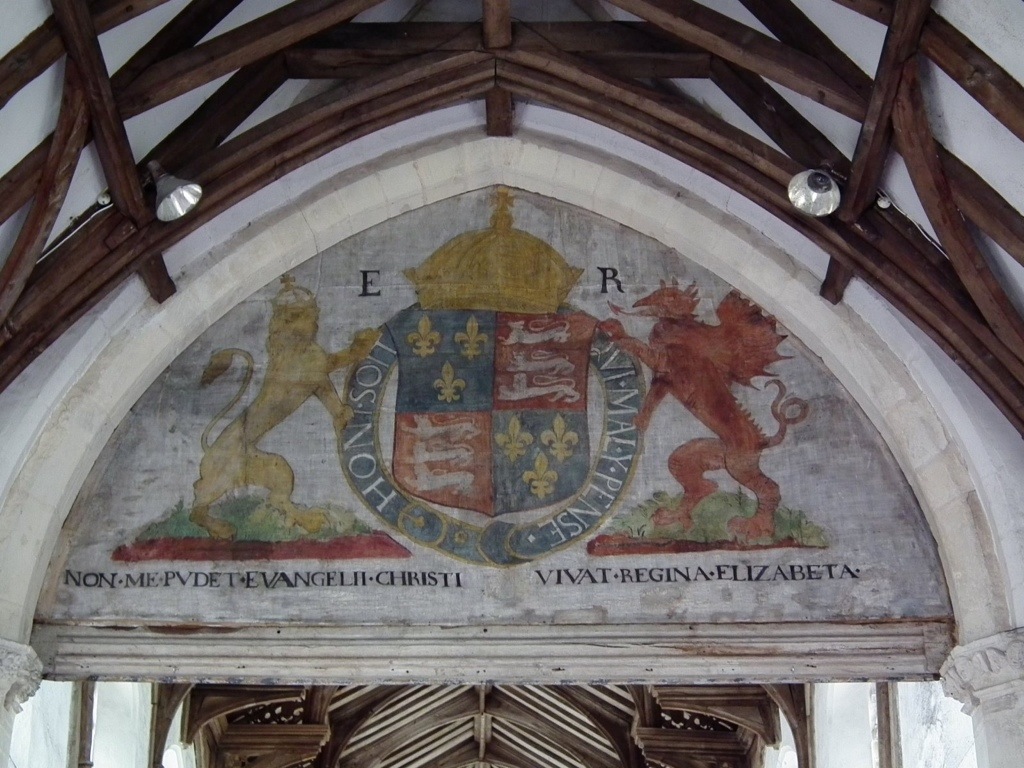
But more interesting I think, at least from an early modern perspective, is the contents of the chancel arch. Viewed from the nave, it contains a striking, early example of an Elizabethan Royal Arms, declaring Vivat Regina Elizabeta alongside the motto Non me pudet evangilium Christi, ‘Let me not be ashamed of the Gospel of Christ’.

20130329-092339.jpg
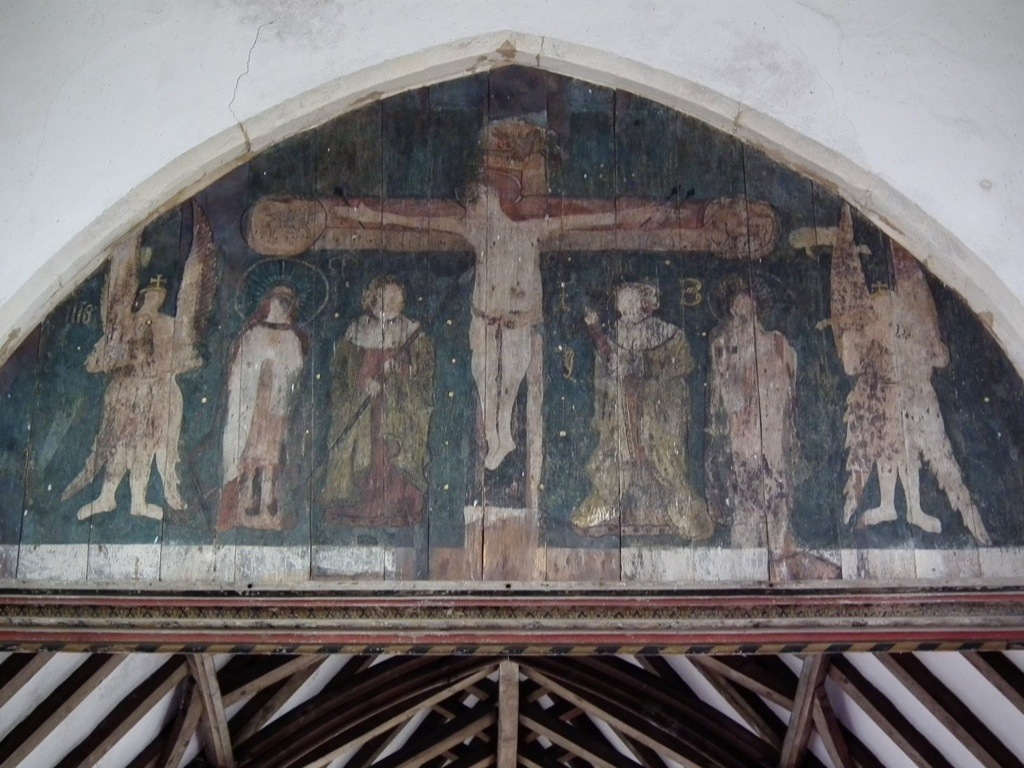
Arms like this are rare enough, and I’ve not come across any other examples with this particular motto, but on the reverse side, facing into the Chancel, is something quite spectacular: a rare survival from the Catholic restoration of the reign of Mary I, a painted Rood. Christ crucified in the centre is surmounted (I think) by the dove of the Holy Spirit, and flanked by (probably) Mary and John the Baptist, two other saints, and two crowned, winged figures who I think are unmistakably angels:

20130329-093026.jpg
Beyond that, the rest is speculation. We have very little to compare either example to, and it may be that Ludham was just an extremely compliant parish when it came to obeying the capricious religious policies of the Tudor monarchs. Perhaps this Rood was nothing special, just a rare example of the sort of stop-gap measure adopted by hundreds of churches across the country, and which the death of Mary prevented from achieving greater permanence. But (and this is surely the reformation historian inside me) it is also tempting to read a more polemical narrative into the actions of Ludham. Was their strident Elizabethan declaration not to be ashamed of the gospel in part a defence against charges of conservatism of the type embodied by their Marian Rood? Both Rood and Arms survive today purely by chance, hidden away until they were rediscovered at the end of the nineteenth century. How fortunate for us that they do: now we just have to figure out what to make of them!

Eating Animals: A Bit of History

Mark Hailwood

The recent horsemeat scandal – demonstrating just how crooked much of the meat industry is – has provided vegetarians with some potent new ammunition for those well-trodden dinner-table debates with their carnivorous cousins. But who can claim to have history on their side? Both parties offer up arguments based on our historical relationship with eating animals: meat-eaters often reach all the way back to our hunter-gatherer origins to suggest that quaffing down animal flesh is an inherent part of human nature; veggies refute the necessity of eating meat, pointing out that for most of human history the vast majority of the population have subsisted well enough on the peasant diet of bread, beer, cheese and vegetable stew, with meat being both an elite luxury and a rarity until the twentieth century.

Meat-munching caveman

Meat-munching caveman

Bruegel's Peasant Wedding: beer and broth all round! (via wikimedia commons)

Bruegel’s Peasant Wedding: beer and broth all round! (via wikimedia commons)

What do early modern English sources suggest about the history of eating animals? Elites were certainly capable of putting their meat away, and both quantity and variety were the order of the day. At the wedding of his daughter in 1582, Lord Burghley served up the following over three days of feasting: 6 veal calves, 26 deer, 15 pigs, 14 sheep, 16 lambs, 4 kids, 6 hares, 36 swans, 2 storks, 41 turkeys, over 370 poultry, 49 curlews, 135 mallards, 354 teals, 1,049 plovers, 124 knots, 280 stints, 109 pheasants, 277 partridges, 615 cocks, 485 snipe, 840 larks, 21 gulls, 71 rabbits, 23 pigeons and 2 sturgeon. No horse though.[1]

More surprisingly, Craig Muldrew has recently shown that even the poorer members of society were eating considerable amounts of meat—those involved in physical labour such as farm servants or agricultural labourers routinely consumed between 1 and 2 pounds of meat a day in the seventeenth century, the equivalent of a 16 ounce steak or two! [2] One mid-eighteenth century guide to running a farm advised that workers be served at breakfast with ‘minced Meat left the Day before’ with ‘a mixture of shred Onions and Parsley’; at lunch some ‘Broad Beans and Bacon or Pork one day, Beef with Carrots… another day’; and after some bread and cheese in the afternoon a dinner of ‘pickled Pork boiled hot with Broad Beans’.[3]

Hogarth's 'O the Roast Beef' (via wikimedia commons)

Hogarth’s ‘O the Roast Beef’ (via wikimedia commons)

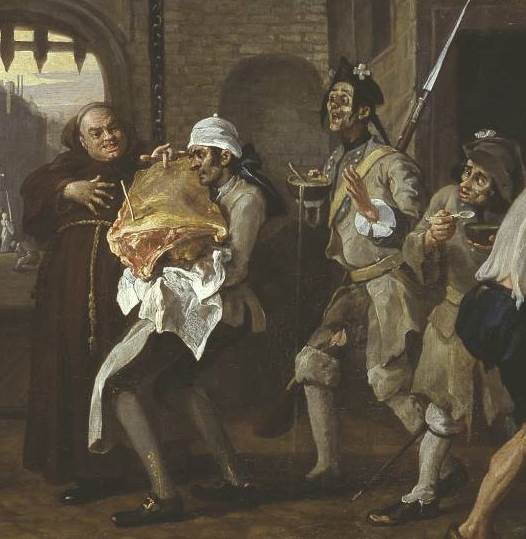
The range of meats consumed by the ‘peasants’ was not as extensive as that served up at aristocratic feasts – the staples for the lower orders were pork, bacon, mutton, and most of all, beef. Indeed, the idea that beef was a particularly central foodstuff to both the English diet and identity dates from at least the sixteenth century. The physician Andrew Boorde wrote in 1542 that ‘Beefe is a good meate for an Englysshe man’ and ‘it doth make an Englysshe man stronge’, [4] and this association of the English with beef was well-entrenched by the time William Hogarth produced his 1748 painting, ‘O the Roast Beef of Old England’, which you can see depicted an English innkeeper lugging a huge hunk of beef past an envious looking French monk and a group of hungry-looking French soldiers eating a watery broth. Continue reading

The wandering, pipe-smoking Jacobite

Brodie Waddell

King William III was a greedy, irreligious, oppressive usurper. Worse still, he was a Dutchman. Or at least these were the sort of things one might hear in many of the alehouses of northern England at the end of the seventeenth century.

Definitely a bit too Dutch for his own good.

I’m going to be giving a talk at the Institute of Historical Research on Thursday (March 14th) on ‘The Present State of England: Modernity and Memory in the Hard Times of the 1690s’, and I thought I’d share one of the many, many seditious denunciations of William III’s regime that I’ve come across during my research into this topic. Sadly, this one probably won’t make it into the talk, but I’ll be sure to include a couple of others.

This case comes from amongst the mess of unsorted and unnumbered despositions from the Palatinate of Lancaster held at The National Archives at Kew, specifically PL 27/2. In May of 1700, according to a chapman from Manchester named David Smith,

one James Scott a wandering person this day … did declare … that his present Majestie King William had noe more religion in him then his pipe in his hand & that all that he cared for was to please his people & to gett mony together & that he love a finger of King James’ hand more then he loved King Williams body

One needn’t have a detailed knowledge of later Stuart political culture to decipher the complaint. William III had a reputation as an aloof, cold monarch, which may partly explain why Scott had so much more ‘love’ for James II’s finger than for the current king. Likewise, the king’s continental Calvinism was regarded as somewhat suspect by many Church of England clergymen, which may help to explain Scott’s reference to his atheistical pipe.

However, I’d guess that Scott’s dislike come primarily from the other fault that he mentions here: ‘all he cared for was to please his people & to gett mony together’. This was surely a reference to William’s foreignness and his very aggressive fiscal policies: ‘his people’ were presumably the Dutch courtiers whom he brought over with him, and his need ‘to get mony together’ resulted in taxation more than doubling in less than a decade. As I’ll explain on Thursday, these were ‘hard times’ and, as a result, the king’s regime was widely resented for his foreignness, his favouritism and his predilection for expensive European wars.

If anyone else has come across similar material from this period, I’d love to hear about it.

‘For yee lead your liues in great ignorance’: Puritan Ponderings on the Patchwork of Popular Belief

Jonathan Willis

What exactly did people believe in post-reformation England?  That deceptively simple question really goes to the heart of much of the ‘post-revisionist’ scholarship currently being generated by historians of the English reformation.  Whether the object of study is angels, the landscape, music or death, one underlying questions remains the same: what does this thing, this practice, this shred of belief tell us about the broader tapestry of post-reformation religious identity?  Tapestry is a reasonable metaphor – I’m going to refrain on this occasion from extending it too far, and talking about warps and wefts – but patchwork 3388735664_a77e48d15a_zis a better one, the term coined by Tessa Watt in her brilliant book Cheap Print and Popular Piety.[1]  Once or twice when teaching this I have actually taken to drawing an imaginary ‘patchwork’ on the whiteboard.  So what do we call the hypothetical individual, who believes he will be justified by faith but also thinks that if he doesn’t confess his sins he could be condemned to hell for them?  What about his wife, who sings metrical psalms and hates the pope but believes God to be physically present in the consecrated host?  And however we define such individuals, can we also reasonably group them together?  It is possible to recognise their difference, and at the same time claim they are one and the same?
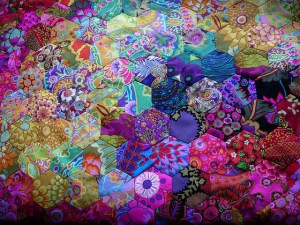
So tapestry is OK, patchwork is better: palimpsest works pretty well too.  Tangentially, I wonder why so much of the metaphorical language we use to describe identity formation (there’s another one) is rooted in the everyday materiality of art and craft.  Our ability to label individual belief in the past seems inversely proportional to the amount we know about it.  I suppose that is a fairly natural state of affairs.  Complexity breeds complexity, and moulds certainty into uncertainty.  But the job of the historian is (I think) not just to (re-)present the past, but also in some sense to try to make sense of it.  So, for AG Dickens the majority of people in Elizabethan England were recognisable as Protestants; for Eamon Duffy they were perhaps traumatised Catholics; for Christopher Haigh, stiff-necked Parish Anglicans; for Judith Maltby, committed Prayer-Book Protestants; for Watt, their culture was ‘distinctively post-Reformation, but not thoroughly Protestant’; while for Robert Delumeau, the people of early modern Europe were probably not even thoroughly Christian.

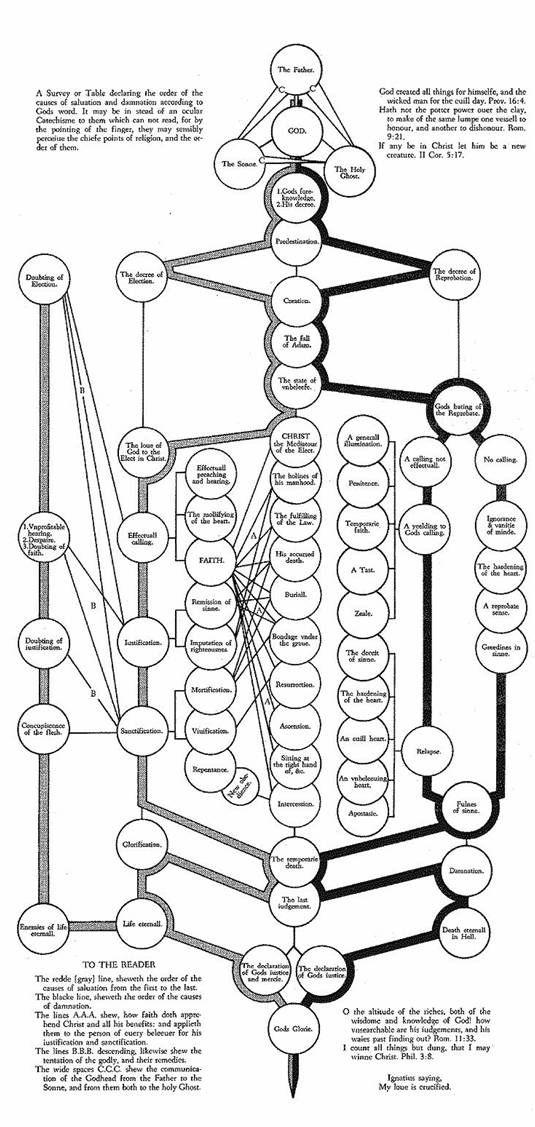
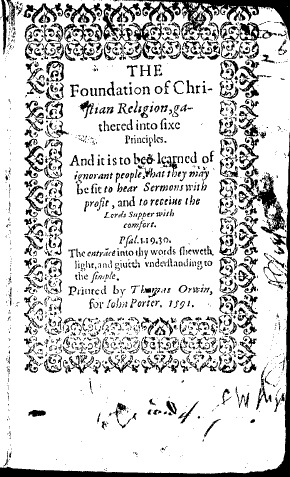
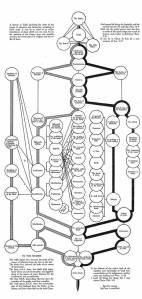
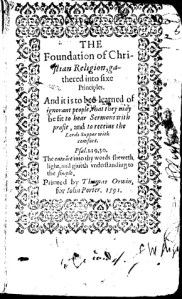
I was reminded of the value of taking a step back from all of this the other day, while reading a treatise by William Perkins that I had never looked at in detail before.  Perkins,Picture1 probably most famous as the author of A Golden Chaine, and more famous still for the infamous diagram of salvation contained within it, was a prolific writer of theological and devotional tracts: the work in question is his The foundation of Christian religion gathered into sixe principles.[2]  The work begins with an address ‘to all ignorant people that desire to be instructed’, followed by a list of almost 30 erroneous ‘common opinions’ which Perkins goes on, throughout the text, to correct.  Reproducing this list in its entirety would be a little excessive, but let me pick and talk about a dozen or so points which seem to me to be particularly pertinent to the present discussion:
1 That faith is a mans good meaning & his good seruing of God.

3 That yee haue beleeued in Christ euer since you could remember.

11 That it is an easier thing to please God than to please our neighbour.

12 That yee can keepe the Commandements, as well as God will giue you leaue.

Taken together, these points seem to express a frustration at the laity’s lack of intellectual engagement with the concept of faith.  That is not to say that their faith was not complex, but it was certainly not structured in the reflective, self-conscious way demanded by men such as Perkins.  Ironically, it seems that Puritan divines would have preferred a little less fiducia and a little more credentia from the laity: a faith based less in instinct, trust and emotion, and rather more in knowledge and intellectual acceptance.  The most difficult (and therefore the most important) aspect of religion from the laity’s perspective was in striving to live according to the principles of Christian charity: God, in whom they had faith from their earliest years, was a comforting constant.  And yet many of the laity had a strong sense that it was ultimately possible to be good and to do good things, and that such behaviour was pleasing to God.  Elsewhere, Perkins also complained about those who felt that by reciting the Decalogue they were praying, and serving God.

7 That, if anie be strangely visited, hee is either taken with a Planet, or bewitched.

This I think is a useful reminder that popular belief was not straightforwardly Christian: it contained a mixture of folklorish, traditional, pagan and other elements.  In this sense it was a true patchwork.

13 That it is the safest, to doo in Religion as most doo.

14 That merry ballads & bookes, as Scoggin, Beuis of Southampton, &c. are good to driue away time, & to remoue hart quames.

20 That drinking and bezeling in the alehouse or tauerne is good fellowship, & shews a good kinde nature.

Popular religion in the broadest sense was above all a communal activity, not an individual or even a family or household one.  The reformation did not fundamentally change this, except perhaps amongst those who were the most literate in the new religious language.  Even then, perhaps all it did was change the nature of the society with which those individuals of advanced faith sought to surround themselves.  Good religion was to be expressed in good fellowship and good cheer, as much in the alehouse as in the church, as much with a lusty ballad as a reverent Psalm.  ‘Hart quames’ for most people were to be banished with a merry ballad, not meditated upon as a means to repentance and the enrichment of a saving faith.

9 That a Preacher is a good man no longer than he is in the pulpet. They thinke all like themselues.

 18 That yee know al the Preacher can tell you: For he can say nothing, but that euery man is a sinner, that we must loue our neighbours as our selues, that euery man must bee saued by Christ: and all this ye can tell as well as he.

 17 That a man which commeth at no Sermons, may as welbeleeue, as he which heares all the sermons in the world.

 16 That a man neede not heare so many Sermons, except he could follow them better.

28 That a man need not haue any knowledg of religion, because he is not book learnd.

Finally, from the perspective of both the clergy and majority of the laity, a wide gulf existed between the two.  The reformation certainly contributed to a widespread anti-clericalism, that is to say, an opposition to the clerical pretensions of the new godly graduate clergy.  Complicated sermons were for educated people: the unlearned had nothing to gain thereby, because they already grasped the essentials of the faith: that all men were sinners, must be saved by Christ, and had an obligation to be charitable to their neighbours.  This was all well and good as far as it went, but of course for Perkins and others there were nuances, complexities, caveats and implications without which these broad truisms were worse than meaningless.  Such intellectual religion was unpopular in all senses: it was not for the great mass of people, who could profit more from each other’s good fellowship than a lengthy diatribe from the pulpit.
FoundationThe thing I’d like to draw from all this is that occasionally it is possible to lose sight of the wood for the trees.  While it can be extremely interesting to interrogate popular belief in minute theological and intellectual detail, it is not always the most productive path to follow (there are of course many, many exceptions).  For, by doing so, we can end up unwittingly forcing a resolutely anti-intellectual form of belief into a (for want of a better word) Perkinsian framework, and thereby doing it some violence, and just a little injustice.  We must remember that popular belief was both simple and complex, both patchwork and quilt.  It may be made up of innumerable diverse fragments, but it also had simple key priorities and a clearly defined basic form.  Each quilt may be unique, but quilts are also recognisably the same: a quilt is a quilt, and not a cushion cover, or a wall-hanging.  Identity is full of contradictions, but not all contradictions have to be resolved.  We each of us probably live with a series of competing and contradictory impulses and beliefs held in a kind of creative tension with one another, and the people of early modern England were probably no different.


[1] (Cambridge: CUP, 1991), p. 327.

[2] And it is to bee learned of ignorant people, that they may be fit to hear sermons with profit, and to receiue the Lords Supper with comfort (1591), STC2: 19710.


‘More acute and witty in his drink than at other times’…

Mark Hailwood

When Thomas Feilder was hauled before the Reading authorities in 1624, on a charge of beating up a town constable, he offered a straightforward explanation for his actions: ‘drink was the cause’, ‘he was not himself’, and ‘he knew not what he did’. But what did early modern English courts make of such claims? Was drunkenness understood to mitigate responsibility for the offence, or did such reckless inebriation compound the transgression into a double misdemeanour of assault and drunkenness?

Drinking Woodcut

This is just one of the questions I address in my latest article (that’s right, that opening vignette was just a snare to trap you into a self-promotional post). In the essay I ask – and attempt to answer, of course – a number of questions about seventeenth-century understandings of the effects of alcohol on mind and body. Did they share our concern about alcohol’s harmful impact on health, or was it considered ‘far better than any doctor in town’ for treating ailments? Was it used as an anaesthetic to numb the senses against the hardships of daily life, or did contemporaries guzzle booze because it was thought to ‘enrich all the faculties’ and act as a stimulant to mental activity? I’m dropping some clues here (let’s just say I’m not making those quotes up) but if you want to find out the full story then you should check out my ‘”It puts good reason into brains”: Popular Understandings of the Effects of Alcohol in Seventeenth-Century England’.

Cover thumbnailIt appears in a special edition of the journal Brewery History, edited by myself and Leicester lecturer Debbie Toner, under the banner of our Warwick Drinking Studies Network. It showcases the work of a number of early career scholars, and all the essays focus on aspects of early modern drinking culture, including the revolutionary introduction of hops to the brewing process (considered by some to mark the very origins of commercial capitalism. Well,WDSN Logo by me anyway); the important role played by the alewife in serving up the country’s favourite tipples; and the symbolic significance of being allowed to use the best silver at a guild feast. You can download the introduction for free here, and from here you can order a copy of the edition for the very reasonable price of £4.50.[1]


[1] An earlier draft of my article can be found on my academia.edu page, but please don’t cite from it.

A ‘Pancake Day’ blogroll update

Shrove Tuesday has arrived again. It’s time to fry up some pancakes (preferably slathered with Nutella), join the London apprentices in smashing up some bawdy houses, and then pull up a chair in front of your computer to gorge yourself on early modern history blogging.

To that end, we’ve just updated our blogroll. The mother of all historical blogrolls is Sharon Howard’s Early Modern Commons, but for those seeking a more selective list, our newly expanded set of links may be just the thing. In addition, we are also updating our even more selective sidebar of ‘Friends of the Monster’ to focus on those with whom we seem to interact most often in terms of links or comments.

Enjoy!