Unknown's avatar

About Brodie Waddell

Brodie is a Lecturer in Early Modern History at Birkbeck, University of London.

A civil war comic strip?

Brodie Waddell

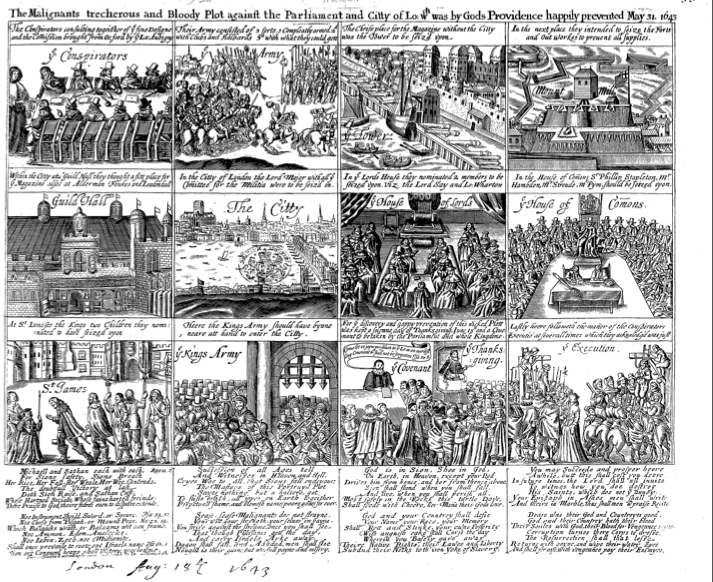
Several months ago, inspired by a post by Gavin Robinson, I shared an image of a broadsheet called The Young-Mans Victory Over the Povver of the Devil that seemed to fit the definition of a comic strip. That one, dating from the 1690s, was the earliest I had found at the time and it remains my favourite of the genre, but I’ve since come across an earlier contender.

I discovered it on a wonderful blog called The 1640s Picturebook where Ian Dicker has posted dozens of images from the period along with detailed analysis of the costumes depicted. In June of last year, they posted an image of The Malignants Trecherous and Bloody Plot (1643), which depicted a plan apparently launched by the MP, Edmund Waller, bring an end to the first of the English Civil Wars. According to the confession of one of the plotters quoted in the ODNB, it began peaceably enough:

‘It came from Mr. Waller under this notion, that if we could make a moderate party here in London, to stand betwixt the gappe, and in the gappe, to unite the King and the Parliament, it would be a very acceptable work, for now the three Kingdomes lay a bleeding, and unlesse that were done there was no hopes to unite them.’

But the peace plan quickly turned to war: in its final form, the plot apparently called for an armed rising and seizure of the key points of the City in order to let the king’s army in.

The plot ended before it had begun when the plotters were betrayed and arrested. Somehow, seemingly through a mixture of powerful rhetoric and shameless bribery, Waller managed to escape the grisly punishment inflicted on some of his co-conspirators and was permitted to go into exile after only a year and a half in prison.

The Malignants Trecherous and Bloody Plot (1643) via The 1640s Picturebook.

The Malignants Trecherous and Bloody Plot (1643) via The 1640s Picturebook.

The upshot of all this was a detailed broadsheet published in August of 1643. It has twelve panels, each of which includes a running narration of the events as they unfolded, from the hatching of the conspiracy to the execution of some of the offenders.

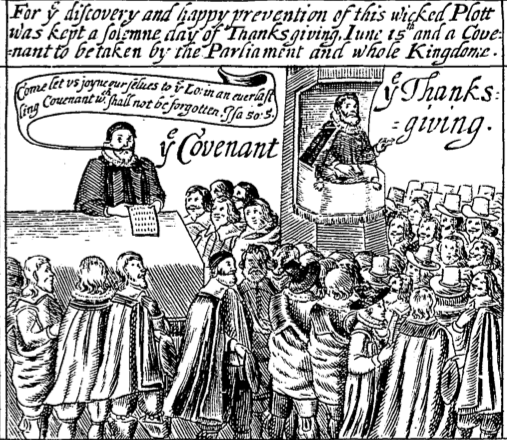
The Malignants (1643) panel with Covenant

‘Come let us joyne our selves to the Lord in an everlasting Covenant which shall not be forgotten’, citing Jeremiah 50:5.

It even included some text in a speech bubble, said to be a key part of a ‘true’ comic strip – though as befits a seventeenth-century comic it is a quotation from scripture rather than a supervillain’s monologue.

So have we pushed the date of the first comic strip back still further? Or is this too much of a stretch?

Microhistory: subjects, sources, anti-fascists and Adam

Brodie Waddell

Microhistory is, it seems, a many-headed sort of beast.

In my previous post I suggested that, despite its name, ‘microhistories’ were not simply ‘small histories’ and asked what might make microhistorians distinct:

Is it their interest in ‘strange and bizarre events and socially marginal peoples’? Or the personal nature of their sources? Or their reflective and open discussions of methodology and the limits of historical knowledge? Or perhaps it is really a ‘continental thing’, well beyond the abilities of us depressingly practical Anglos on this side of the Channel?

The responses I received in comments (and by email) were very helpful as it soon became obvious that there were many other possibilities that had never occurred to me. Indeed, I received not just five responses, but at least double that number of potential ‘defining features’. Here, however, I will just focus on four issues.

The characteristic that came up most often was the notion of focusing on the ‘exceptional’, ‘unique’, and ‘extraordinary’. This is something that both Laura and Nancy emphasised in their comments as well as a point made one of the pioneers of the genre, Giovanni Levi, who claimed it involved taking seriously things regarded by others as quirky or deviant.1 In Nancy’s words, ‘these studies use the documentation of peculiarity as a point of entry into the ordinary, daily lives of marginal or low-status persons’.2 However, this feature of microhistory also opens it up to critique. As Steve Hindle pointed out in a recent talk (which he kindly passed along in response to my original post), discerning the relationship between ‘the particular’ and ‘the general’ is even more fraught in cases like these where one’s primary subject is undeniably ‘unrepresentative’.3

Another feature that several people mentioned was an explicit engagement with methodological issues. As Nick noted in his comment, microhistories often adapt interdisciplinary approaches, ‘read against the grain’ and acknowledge the important role of imaginative or speculative reconstructions in the absence of conclusive evidence. Laura too suggests that this might ‘be at the core of what “microhistory” is’. In Levi’s reflections on the genre, this forthright discussion of the ambiguities and partialities inherent in narrative sources – such as depositions in inquisitorial courts – is a key element in these histories.4

Perhaps these two recurring features, rather than their scale, are what give microhistories their distinctiveness.

But I think it is worth pushing further, because subjects and methods and even styles can only provide a rather ‘unhistorical’ definition of a historiographical genre. (Note: If you’re an undergrad looking for a straightforward definition of ‘microhistory’, you can stop reading now.)

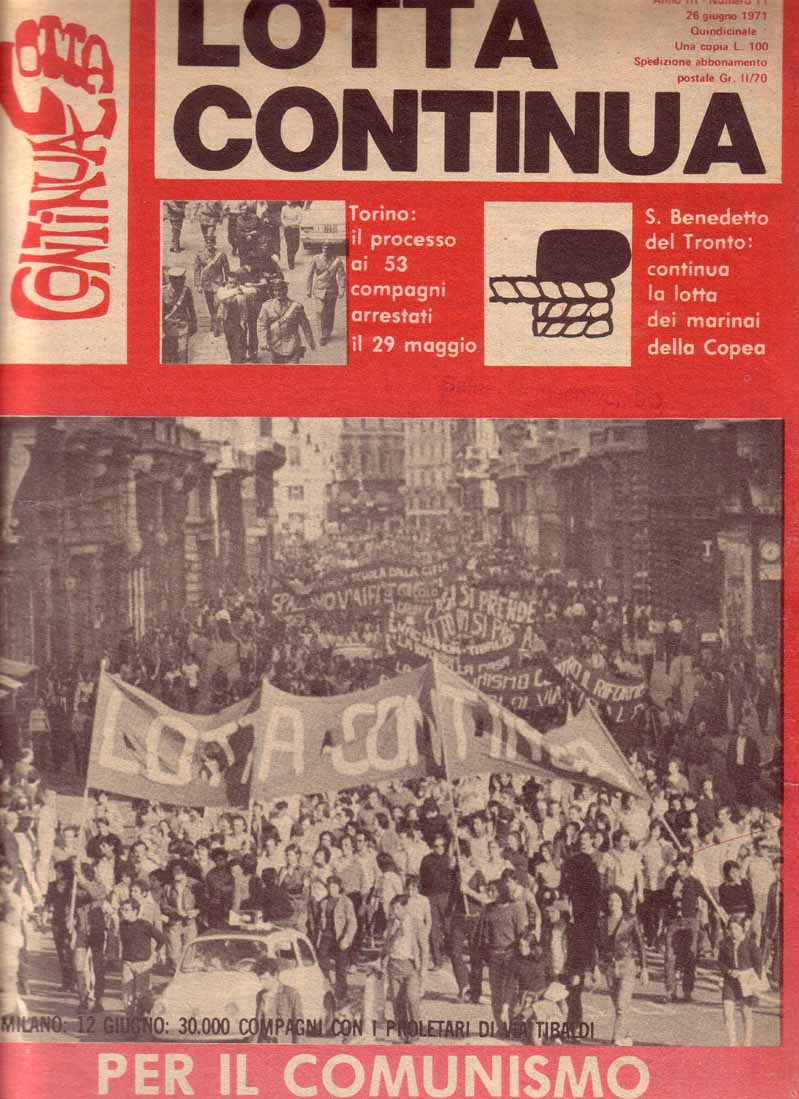
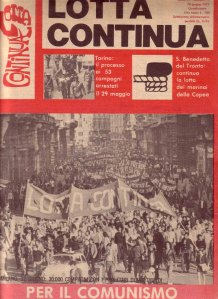
Let’s start with politics. Nick mentioned that he associated this type of history with ‘the Lotta Continua 1971left’, a link that I hadn’t considered. I think he may be right: the ‘founder’ of the genre, Carlo Ginzburg, wrote a whole book deconstructing and critiquing the murder trial of an activist linked to the Italian leftist group, ‘Lotta Continua’.5 Similarly, the other ‘founder’, Giovanni Levi, has suggested that innovative historical methods can help to explain continuities between the present and the past that ‘neoliberalism’ tries to suppress. In fact Ginzburg and Levi both appear to take some of their inspiration from their Jewish identity and militant anti-fascist heritage. I’d welcome comments from any readers who know of additional (or contrary) examples, but what I think this ought to remind us is that even historiographical traditions that are not explicitly politicised still emerge from specific historical – and thus political – contexts. Microhistory is no exception.
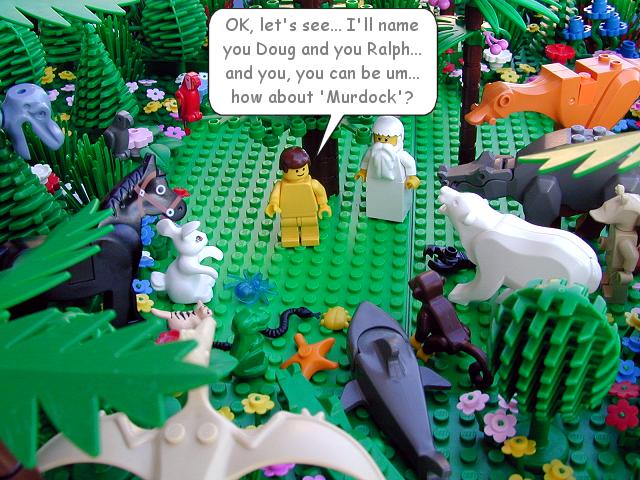
The second issue is nomenclature. For, as Laura pointed out, if we want to find a definition we also need to ask a question: Who decides what is and isn’t ‘proper microhistory’? The power to name things is a very great power indeed, one traditionally reserved for deities and patriarchs.6 Part of the genius of Ginzburg and Levi was simply

Genesis 2:19-20 at the Brick Testament

Genesis 2:19-20 via The Brick Testament

their ability to come up with a concise, memorable term (microstoria) for what they were doing and to convince others to go along with it. This becomes clear when one realises that the word itself had already been used by an American historian, George R. Stewart in the title of one of his books more than a decade before the Italians took it up.7 Stewart may have coined the term, but it was only when Ginzburg and Levi turned it into a ‘brand’ that it became a widely acknowledged and widely imitated genre of history. It was then that it moved beyond the literal notion of a ‘small history’ to acquire all of these associations with specific types of subjects, methods and politics.

Here, at last, we have an explanation for why certain works of history which seem to fit the literal definition of ‘microhistory’ – such as E. P. Thompson’s Whigs and Hunters (1975) or Wrightson and Levine’s Poverty and Piety (1979) – are rarely granted that label. Ultimately, it comes down to politics, power and a damn good marketing campaign.

Footnotes

1 Giovanni Levi, ‘On Microhistory’, in Peter Burke (ed.), New Perspectives on Historical Writing (1991). Thanks to Steve Hindle for drawing my attention to this.

2 For an excellent recent example of this approach (including some ‘microhistories’ and some not), see The Extraordinary and the Everyday in Early Modern England: Essays in Celebration of the Work of Bernard Capp, edited by Garthine Walker and Angela McShane (2009). If you are interested in the connection between ‘microhistory’ and its ‘extraordinary’ antecedents in eighteenth and nineteenth-century ‘compilations of crimes, trials and other strange-but-true stories’, you might want to apply for a fully-funded PhD studentship on that topic at Ghent University in Belgium.

3 Steve Hindle, ‘Reducing the Scale of Historical Observation: Micro-history, Alltagsgeschichte, Local History’, at Huntington Library, Early Modern Studies Institute, ‘Past Tense’, 19 October 2012. There should be a podcast of this talk available soon at which point I will update with a link.

4 Levi, ‘On Microhistory’.

5 Carlo Ginzburg, The Judge and the Historian: Marginal Notes and a Late-Twentieth-century Miscarriage of Justice (1999).

6 Genesis 2:19 – ‘And out of the ground the LORD God formed every beast of the field, and every fowl of the air; and brought them unto Adam to see what he would call them: and whatsoever Adam called every living creature, that was the name thereof.’ See also this interesting recent post by Daniel Little on the nomenclature of ‘the human sciences’.

7 George R. Stewart, Pickett’s Charge: A Microhistory of the Final Charge at Gettysburg, July 3, 1863 (1959).

A seventeenth-century Christmas: mince pies, jollity and witchcraft

Brodie Waddell

Between the large stack of papers to mark and an increasingly nocturnal ten-month-old, the planned post on microhistory has had to be postponed until the new year. However, the season calls for at least one celebratory tribute to the peculiarities of early modern Christmastide. The case of Oliver Cromwell and the mince pies has already been discussed at length elsewhere, so I suppose I’d better share another serendipitous discovery from the archives.

This time of year had long been a season of charity and hospitality. As Ronald Hutton has shown, the Twelve Days of Christmas were an occasion for feasting but also giving. He quotes Thomas Tusser, the sixteenth-century poet-farmer:

At Christmas we banquet, the rich and the poor,
Who then (but the miser) but openeth his door.1

The ‘better sort’, ranging from well-off villagers to the richest nobles, showed their generosity by inviting neighbours to dine with them and by giving alms to the poor. Or at least that is how it was supposed to work.

But a court case from Devon suggests that the season was not always so jolly. Here it seems a failure of seasonal good spirits had dire consequences. Sarah Byrd of Luppitt, testifying in 1693, tells the story: Continue reading

5 April 1666: ‘Sir William Penn is a total jerk’

Brodie Waddell

I’m planning to put together another post on microhistory in the next week or so, drawing on the responses to the original and my own muddled thoughts. Further comments are very welcome.

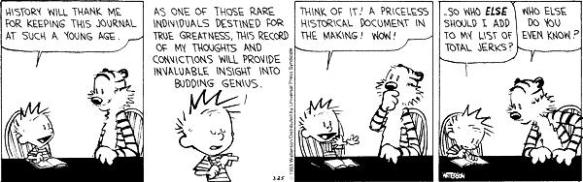
In the meantime, I thought a very brief addendum to Laura’s post on ‘dangerous diaries’ might not go amiss. As is so often the case, Bill Watterson’s Calvin and Hobbes provides valuable insights into historiographical controversies. (Even their names are historical!)

Calvin and Hobbes on journalsAs Laura pointed out, and as Calvin reminds us, it’s dangerous to take diaries at face value. Perhaps the quest for posthumous vengence explains why we find so many entries like this one, from April 1666, in Pepys’s diary:

To the office, where the falsenesse and impertinencies of Sir W. Pen would make a man mad to think of.

Beware the diarist with an axe to grind.

Microhistory: size matters

Brodie Waddell

Last week I had the privilege of attending a workshop on ‘Writing Microhistories’ at Jesus College, Cambridge. It was quite simply an excellent event, due partly to the healthy diversity of speakers – from eminent sages like Keith Wrightson to a gaggle of precocious grad students – and partly to the (uncharacteristically) loose, informal nature of the discussion. It was the questions and conversations, rather than just the papers themselves, that made the day so stimulating.

The workshop had a whole series of highlights, including Wrightson’s ruminations on famous Geordies and some juicy gossip with the grad students over post-workshop drinks. However, I’d like to hone in on one particular question that came up in a variety of forms that day: Are ‘microhistories’ about scale? 1

The term ‘microhistory’ will probably be very familiar to most of you, but I’ll borrow from the summary provided by Duane Corpis for an interesting looking course at Cornell as it’s a solid introduction and easily accessible:

Microhistory is a particular methodological approach to the study and writing of history. The aim of microhistory is to present especially peculiar moments in the past by focusing on the lives and activities of a discrete person or group of people. By illuminating the trials and tribulations of ordinary people in their everyday lives, microhistory aims to show both the extent of and the limits upon human agency, i.e. the ability of individuals to make meaningful choices and undertake meaningful actions in their lives. By analyzing what might often seem to modern readers as strange and bizarre events and socially marginal peoples, microhistory offers a more inclusive understanding of who and what matters within the discipline of history. By emphasizing everyday life, microhistory forces us to re-think traditional approaches to history that focus on seemingly more important political events and actors. Finally, by looking at the “micro” level of social activities and cultural meaning, microhistory challenges approaches to the study of history that emphasize the need to quantify, generalize, or naturalize human experience or to find and impose normative and abstract historical laws, structures, or processes on the historical changes of the past.2

The prefix that separates ‘microhistory’ from other ‘history’ suggests that its defining feature is its size, namely it is history on a small scale. Certainly the most famous studies with this label focus on only a single person or place. The book that supposedly started it all – Carlo Ginzburg’s The Cheese and the Worms (1976) – illuminates the peculiar world of a sixteenth-century Italian miller. Natalie Zemon Davis concentrated on a French peasant couple in The Return of Martin Guerre (1983) and Robert Darton’s ‘The Great Cat Massacre’ (1984) zoomed in on the actions of a small group of apprentices on a particular street in 1730s Paris. All of these studies share a scope that is severely and unapologetically limited when compared to more traditional histories.

The tools of the trade?

Yet etymology can be deceptive, because ‘microhistories’ seem to be more – or maybe less – than simply ‘small histories’. Although many of these histories centre on the lives of a single individual (Menocchio the miller, Bertrande the wife, Ralph the scrivener, Benedetta the nun), they are not biographies. Likewise, biographies of the great and the good are not microhistories despite the fact that they limit themselves to the story of a single life. Ian Gentle’s recent history of Oliver Cromwell may be academically rigorous and intellectually stimulating but it is somehow fundamentally different from Ginzburg’s Menocchio or Davis’s Bertrande.

In a related way, I think microhistory is distinct from local history. Here too similarities of scale mask innate differences. Emmanuel Le Roy Ladurie’s narrative of medieval Montaillou (1975) is the story of a whole village, not merely a single extraordinary individual or family – it explores the lives of all the villagers, heretical and orthodox alike. Yet Montaillou is almost always categorised as ‘microhistory’ whereas an equally famous and important local study, W.G. Hoskins’ book on Wigston Magna (1959), is not. The well-known histories of early modern Terling (1979) and Whickham (1992) by Keith Wrightson and David Levine went even further. Like ‘microhistories’, they were deeply analytical and challenged prevailing interpretations, almost the exact opposite of the antiquarianism of old-fashioned English local history. Nonetheless, they still appear to me to be essentially different from the explorations of Montereale, Artigat, Montaillou and la Rue Saint-Séverin offered by Ginzburg, Davis, Le Roy Ladurie and Darnton.

So, if ‘microhistories’ are not simply ‘small histories’, what makes them distinct? Is it their interest in ‘strange and bizarre events and socially marginal peoples’? Or the personal nature of their sources? Or their reflective and open discussions of methodology and the limits of historical knowledge? Or perhaps it is really a ‘continental thing’, well beyond the abilities of us depressingly practical Anglos on this side of the Channel?

I’d really like to hear your thoughts, which I hope will be the starting point for a subsequent post.

[Update: The follow-up is here]

Footnotes

1 I should also thank the MA students in my seminar at Birkbeck a couple of weeks ago, who had plenty of interesting things to say about the issue of ‘scale’, and two colleagues – Samantha Shave and Mark Hailwood – who discussed this with me over coffee.

2 Duane Corpis, course description for ‘Deviants, Outcasts & other “Others”: Microhistory and Marginality in Early Modern Europe’ (2010). See also the Wikipedia entry, which is a bit less helpful, or this article by Ginzburg (gated; ungated) and the many others available on JSTOR.

Norwich Entertainments – Part V: Ballad-singers and dangerous news, with coffee

Brodie Waddell

The people of late seventeenth-century Norwich did not get their entertainment solely from hairy children and pieces of plays. They also amused themselves with the ever-growing numbers of printed works that were pouring from the presses at that time.

In June 1680, for example, the Norwich Mayor’s court ordered that ‘Twoe Ballad singers haveing Lycence to Sell ballads, pamphlets small bookes & other bookes Lycensed from the Office of the Revells have leave to doe soe until Monday senight [?seven-night]’.1

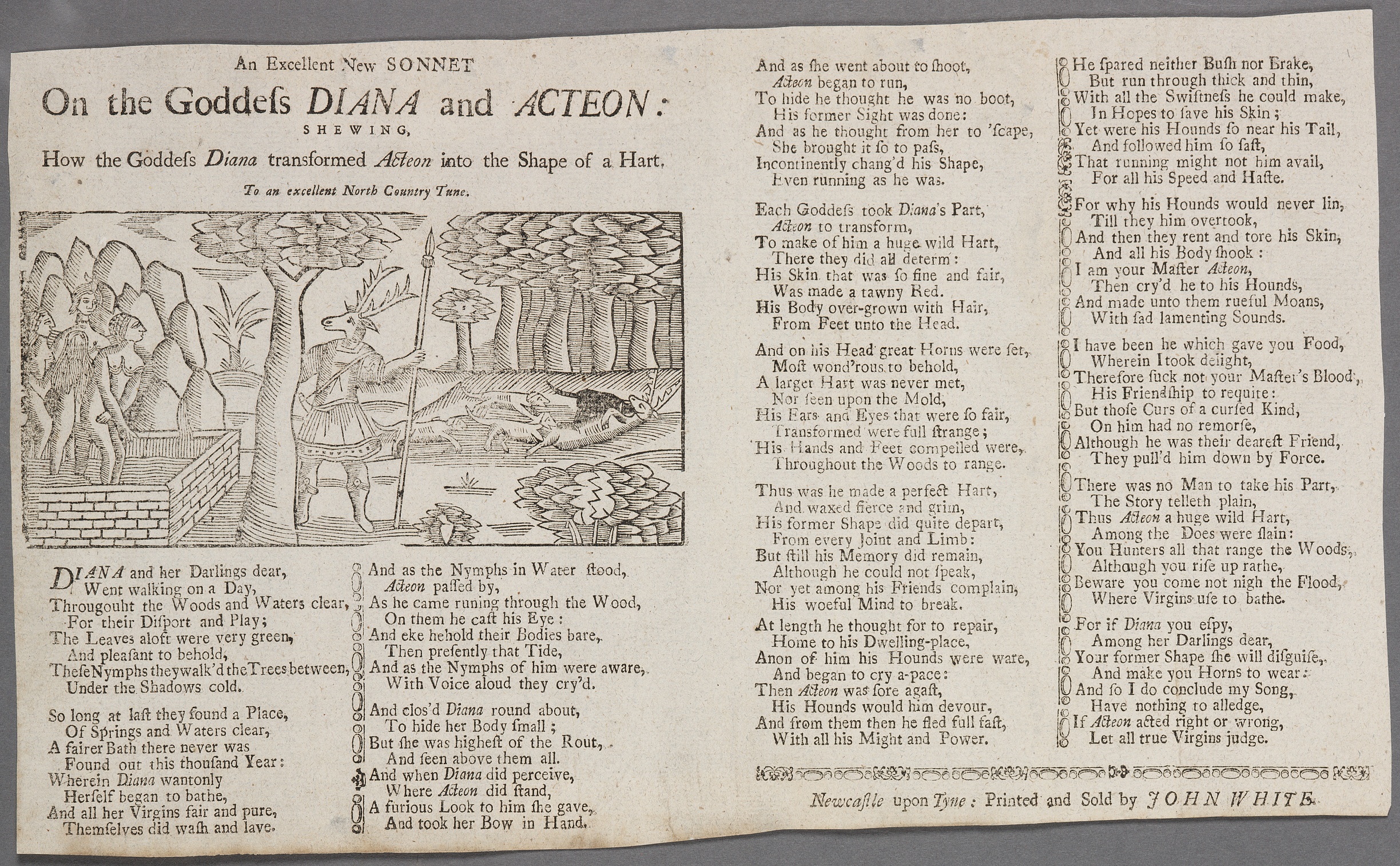
Ballad entitled ‘An Excellent New Sonnet On the Goddess Diana and Acteon’ (c.1725-69). EBBA.

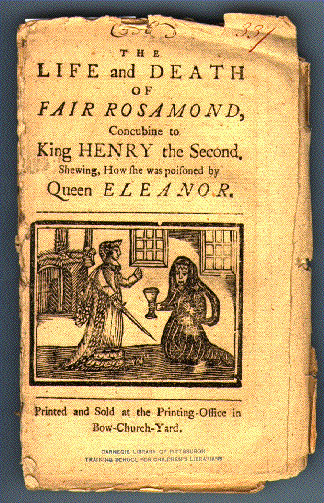
Title-page of a chapbook titled ‘The Life and Death of Fayr Rosamond’ (1755). SF.

These balladeers were just two of the hundreds that traipsed through the city streets and country lanes of early modern England, singing to advertise their wares. The exact contents of a peddler’s sack could be very diverse. In addition to all sorts of petty trinkets, they sold tales of drunken sailors, royal mistresses, industrious spinsters, and much else besides. Often these were in the form of broadside song sheets, but they might also be ‘pamphlets’ and ‘small books’, sometimes called chapbooks, written in prose to provide merriment or salvation for the price of penny or two. Margaret Spufford and Tessa Watt, among many others,  have discussed this ‘cheap print’ in much more detail, noting that ballad-sellers were often condemned by the authorities as vagrants. But in late seventeenth-century Norwich at least they seem to have been welcomed by both the townspeople and city officials.

Rather more unusual, however, was the license issued to a man a year earlier. In November 1679, the court declared that ‘Lawrence White is allowed to reade & sell Pamphlets on Horsebacke untill Wednesday next’.2 Continue reading

An archival miscellany: a warning, a rat, a blog and another warning

Brodie Waddell

October was a rather busy month. My first term of teaching and marking at Birkbeck has meant that I know a good deal more about eighteenth-century London infrastructure, English Civil War veterans, and the historiography of the Reformation than I did a few weeks ago, but research and blogging have been neglected.

I have, however, come across a few tasty tidbits that deserve to be shared with the world. This is, in some ways, simply a continuation of the conversation (here and here) we’ve been having about archives.

A warning

An archivist friend passed this on and, like all good jokes, it contains at least a kernel of truth.

Having worked in the Borthwick for a year, I can say with some certainty that it would be entirely possible to use the limbo between the public reading room and the strongroom to erase someone with a ‘misplaced’ inkblot or an ‘accidental’ torn page. So be sure to greet your archivist with a friendly smile … or risk the posthumous disappearance that befell some soviet dissidents.

A rat

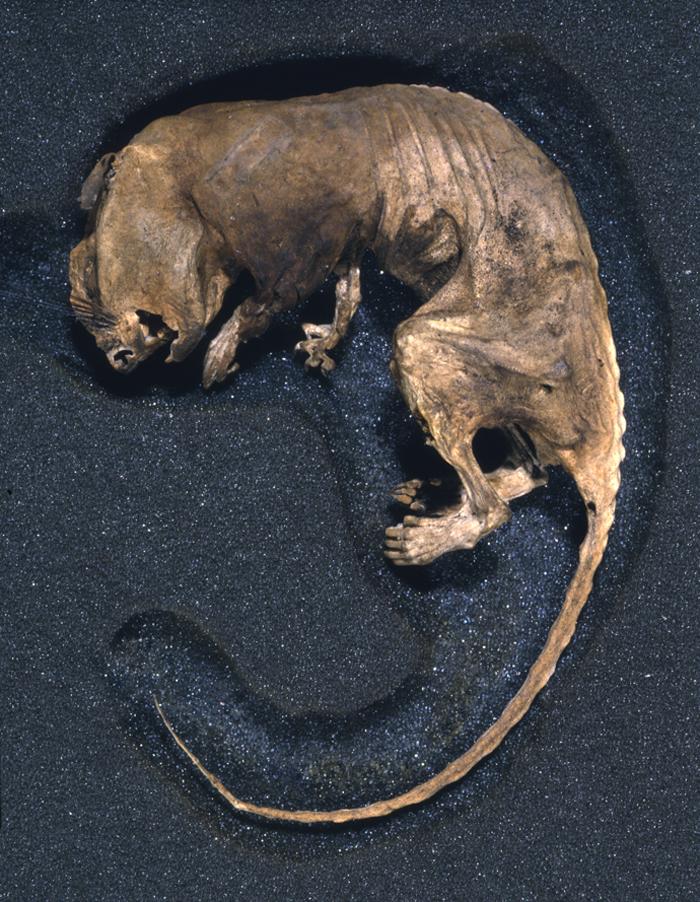
Or, to be more specific, Sir Henry Cole’s Rat (c.1830). As folks at the National Archives describe it…

At 15, Henry Cole, later to find fame as organiser of the Great Exhibition began working with the records of the British government. Shocked at their poor condition he pioneered reform of what became known as the Public Record Office – now The National Archives. This rat, with a stomach full of chewed document, was used as evidence for the poor condition of the records.

Sir Henry Cole’s Rat (c.1830): The National Archives, E 163/24/31

Yep, that’s right. We owe the wonderful institution that we once called the PRO, founded in 1838, to a rat stuffed with irreplaceable manuscripts. And archivists, being the dedicated – one might say obsessive – guardians of history that they are, created a special foam case to preserve this momentous rat for posterity.

A blog

Ever wanted to know what happens behind the scenes at a busy city archive? Of course you do! Well, if the Huntington’s Verso blog isn’t fulfilling all of your archive-blogging needs, check out the team at York who are describing their on-going project to catalogue the city’s immense civic records. Although not specifically ‘early modern’, it does have some fascinating ‘lucky dips’ (what we here call ‘found art’), including councilmen watching naughty films and railwaymen complaining of mouldy fish cakes, as well as some very pretty visual maps of the archives themselves.

If you’re a historian – professional or amateur – I think it can be immensely profitable to get a sense of how archives (and archivists) work. Sure, the difference between ‘functional’ and ‘structural’ arrangements may not sound especially interesting, but it can make a real difference to how you go about your research.

Another warning

This one comes from Tim Hitchcock, and is rather more serious. I think he makes the point I was trying to make here much more effectively than I ever could.

For both technical and legal reasons, in the rush to the online, we have given to the oldest of Western canons a new hyper-availability, and a new authority.  With the exception of the genealogical sites, which themselves reflect the Western bias of their source materials and audience, the most common sort of historical web resource is dedicated to posting the musings of some elite, dead, white, western male – some scientist, or man of letters; or more unusually, some equally elite, dead white woman of letters.  And for legal reasons as much as anything else, it is now much easier to consult the oldest forms of humanities scholarship instead of the more recent and fully engaged varieties.  It is easier to access work from the 1890s, imbued with all the contemporary relevance of the long dead, than it is to use that of the 1990s.

Without serious intent and political will – a determination to digitise the more difficult forms of the non-canonical, the non-Western, the non-elite and the quotidian – the materials that capture the lives and thoughts of the least powerful in society – we will have inadvertently turned a major area of scholarship, in to a fossilised irrelevance.

It would be a cruel irony to digitise vast new swathes of text and images only to discover that we’ve accentuated the very biases that scholars have been fighting against since at least the 1960s. That is not to say that we shouldn’t try to make ever-more sources freely and easily available online – just that we should beware the consequences of grabbing the ‘low-hanging fruit’ and neglecting less accessible sources. We must make a real effort to move beyond ‘the musings of some elite, dead, white, western male’ and save other voices ‘from the enormous condescension of posterity’.

Update (13/01/13): The York archives blog did a new ‘Lucky Dip’ post that early modernists might like which looks at a late seventeenth-century Chamberlain’s Account Book.

Twelve reasons to buy my book, or, The ancient art of self-promotion

Brodie Waddell

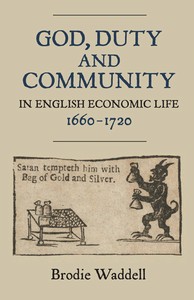
Brodie Waddell, God, Duty and Community in English Economic Life, 1660-1720

1. It was only officially released today, so if you buy it now, you’ll probably be the first kid on your block to have one!

2. It has seven pictures inside, a very respectable ratio of 1 for every 34 pages.

3. It has the word ‘God’ in the title, making it slightly more likely to be accidently recommended by your local Christian reading group.

4. It has a picture of Satan on the cover, making it slightly more likely to be accidently black-listed by your local Christian reading group.

5. Barack Obama called it ‘…the best book I’ve ever read on later Stuart economic culture…’ and Nelson Mandela said it was ‘… longer than I expected …’ (NB: Not actual quotes. Please don’t sue me!)

6. It has footnotes, not those horrible endnotes.

7. It cites a hell of a lot of broadside ballads.

8. I can’t think of a number eight.

9. It uses paper that apparently derives from ‘natural, recyclable products made from wood grown in sustainable forests’. You’re practically saving polar bears just by reading it.

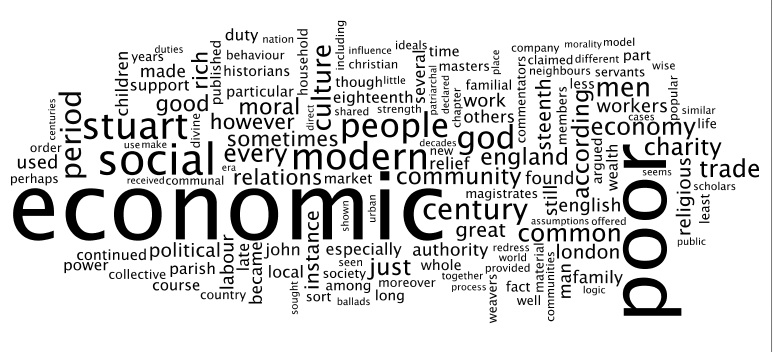
10. When you put the text through Wordle, you get this…God, Duty and Community via Wordle

11. I can’t think of a number eleven either.

12. I’ve heard that ‘this book explores the economic implications of many of the era’s key concepts, including Christian stewardship, divine providence, patriarchal power, paternal duty, local community, and collective identity. Brodie Waddell draws on a wide range of contemporary sources – from ballads and pamphlets to pauper petitions and guild regulations – to show that such ideas pervaded every aspect of social and economic relations during this crucial period.’

Available at Boydell & Brewer (UK), University of Rochester Press (USA), Amazon (everywhere), Powell’s (less evil) and other fine book-sellers.

UPDATE (19/10/12): I’ve only just discovered that it’s also available as an over-priced ebook. If you’d like a sample from the text, I’ve uploaded the table of contents, introductory sections, bibliography and index.

UPDATE (12/11/12): There is now a preview on googlebooks too.

Eric Hobsbawm: some personal reflections

Brodie Waddell

Busy though I may be, I can’t help but note the death of Eric Hobsbawm and offer a few thoughts.

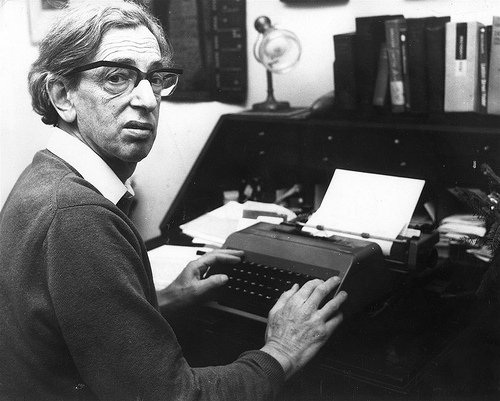
No doubt our readers will already be familiar with Hobsbawm and his work. If not, the lengthy obituary in the Guardian or this article by the historian Mark Mulholland will make clear his perhaps unmatched contributions to historical knowledge, both popular and academic.¹

Eric Hobsbawm at his typewriter. Source: John Brown via Jacobin.

Rather than recount his fascinating life or delve into his most famous works, I’d like mention how he (unknowingly) touched my life at a couple of important moments.

The first took the form of his book Uncommon People: Resistance, Rebellion and Jazz (1998) which I received as a gift for, I believe, my seventeenth or eighteenth birthday from my infinitely thoughtful uncles. At the time, I was vaguely interested in history but my contact with truly artful historical writing was negligible. Then I opened this book and found an essay entitled ‘Political Shoemakers’:

The political radicalism of nineteenth-century shoemakers is proverbial. Social historians of a variety of persuasions have described the phenomenon and assumed it needed no explanation. A historian of the German revolution of 1848, for example, concluded that it was “not accidental” that shoemakers “played a dominant role in the activities of the people”. Historians of the “Swing” riots in England referred to the shoemakers’ “notorious radicalism” and Jacques Rougerie accounted for the shoemakers’ prominence in the Paris Commune by referring to their “traditional militancy”. Even so heterodox a writer as Theodore Zeldin accepts the common view on this point. The present paper attempts to account for the remarkable reputation of shoemakers as political radicals.²

The essay goes on to provide plenty of colourful examples drawn from across the globe, but by the time I’d read the first sentence I was already hooked. The image of the militant shoemaker, writing radical manifestos and taking to the barricades, was simply too wonderful for a nerdy teenager to forget.³

Not long after receiving Uncommon People, perhaps in my first or second year as an undergraduate, I came across his Primitive Rebels (1959) in a used book store. I think this may have been the first time I found a work of history that was not only interesting and politically appealing, but also made an important argument about the nature of past societies. Indeed, the book almost single-handedly created a whole new analytical category: ‘social crime’.⁴ I’m not going to claim it was the light on the road to Damascus that turned me into a budding historian, but in retrospect I think it helped to push me in that direction. It’s no accident that the undergrad module I put together for this year includes a week focusing on the debate that this concept spawned.

Hobsbawm’s writing room, reassuringly messy. Source: Eamon McCabe via the Gaurdian.

And then, many years later, whilst looking around for something to do at the expiration of my fellowship at Cambridge, imagine my delight at being invited for an interview for a post at Birkbeck. Founded in a tavern as the London Mechanics’ Institute back in 1823, this was the place that Hobsbawm made his academic home when become a lecturer there in 1947. He was still its nominal President when I applied there last year and, despite being in his nineties, my colleagues recount vivid memories of him still occasionally strolling into the department to chat and of course frequently showing up at conferences to engage in conversation (and disputation) with historians less than half his age. I am saddened to have never met him myself, but I hope that in some very small way I can help carry on his legacy at this wonderfully unusual institution.

I would be very curious to hear how some of the monster’s other heads or perhaps some of our readers encountered Hobsbawm’s work. Does anyone have any stories to share?

Footnotes

¹ See also this nice little collection of quotations from the great man himself. The final one ‘On his writing room’s bookshelves’ is particularly pleasing.

² ‘Political Shoemakers’ was co-authored with Joan Wallach Scott and originally published in Past & Present, no. 89 (1980), pp. 86-114

³ Note that this also means, strangely, that I read Hobsbawm before reading E.P. Thompson or Christopher Hill, two other members of the Communist Party Historians Working Group, whose work I cite infinitely more often.

⁴ The Wikipedia article on ‘social bandits’ isn’t bad, but for a more detailed recent discussion, see John Lea, ‘Social Crime Revisited’, Theoretical Criminality, 3:3 (1999) [ungated]. For early modernists, the work on this by Douglas Hay, Peter Linebaugh and E.P. Thompson, especially but not exclusively Albion’s Fatal Tree (1975) and the responses it provoked, is essential reading.

What shall we do with a drunken sailor?

Brodie Waddell

Surely this was an age-old question. Although the traditional sea shanty was only recorded in the early 19th century, there were more than a few early modern seamen who over-indulged in drink.

Indeed, when ‘a crew of Jovial Blades’ met in an alehouse in one late 17th-century ballad, it was the sailor who took the lead over his landlocked companions:

A bonny Seaman was the first,
but newly come to Town,
And swore that he his Guts could burst
with Ale that was so brown.

In another song from this period, a group of cunning ‘Maidens’ from the London suburb of Poplar tricked ‘several young Seamen’ into eating a cat baked in a pasty. Once they realised their mistake, the feline feast ‘did force them to spew’, but they still ‘laughed and quaffed’ and ‘drank off the Liquor before they went out’. It seems the solution to eating ‘A Cat-Pasty’ is to get thoroughly drunk.

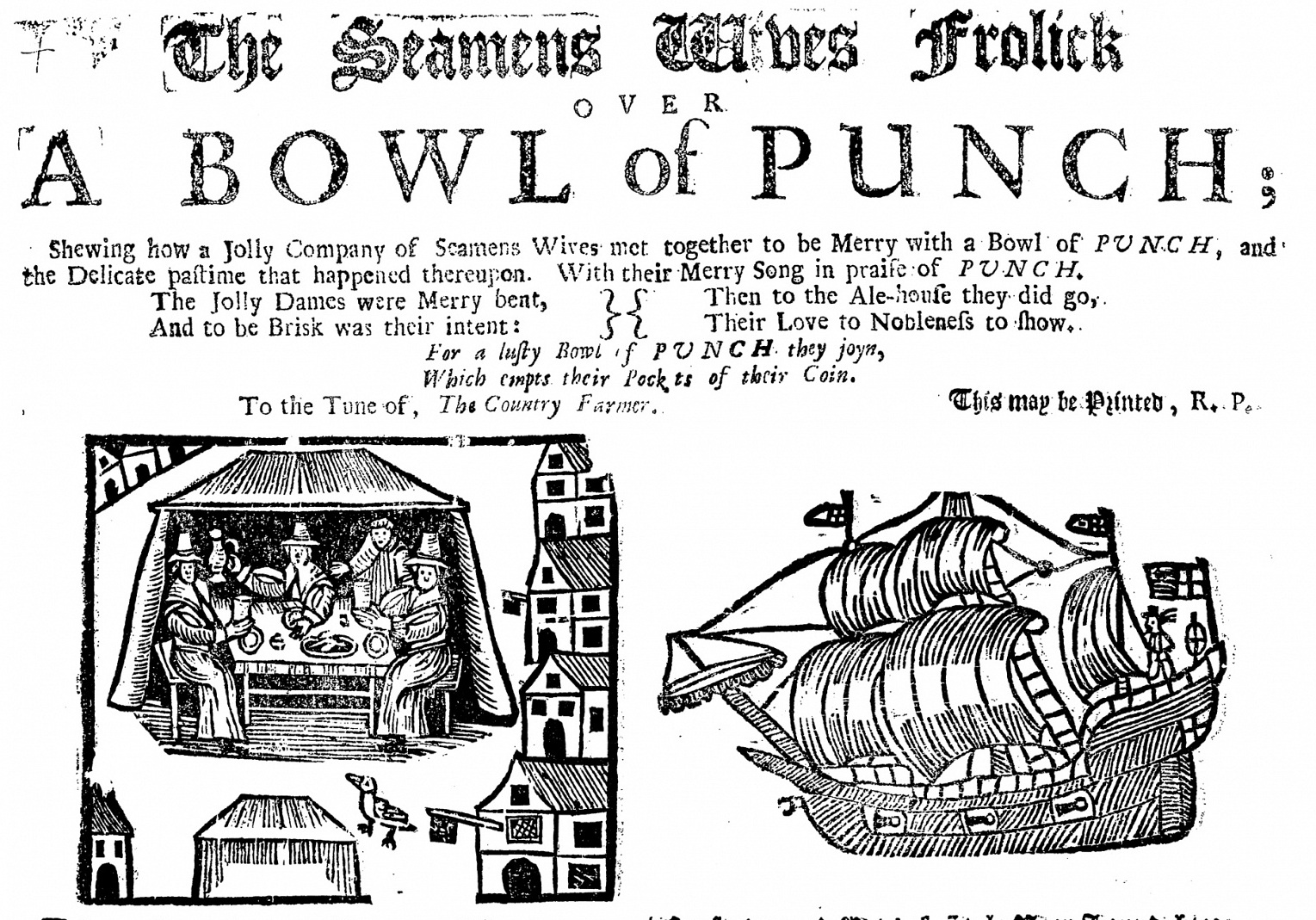
Even sailors’ wives were not averse to downing ‘a lusty Bowl of Punch’. According to another ballad, the ‘Jolly Company’ raced to the alehouse as soon as their ‘Seamen had newly left the Land’ and set on their task with gusto:

We Seamens brisk Wives are bonny and glad,
While our Men on the Ocean are sorry and sad;
We love our Liquor to drink it all up,
None of us but love a full Glass or a Cup

They went so far as to claim that the punch would ‘make our Noddles the quicker’, a suggestion that was not as far-fetched to their contemporaries as it might be to us. As unlikely as it sounds, Mark has shown that the idea of alcohol enhancing ‘wit’ and ‘reason’ was not unknown in early modern England.¹ A little of ‘haire of the old Dogge’ might also cure the resulting hang-over.

Detail from ‘The Seamens Wives Frolick Over A Bowl of Punch’ (1685-88), in Pepys Ballads, IV, p. 184, via EBBA.

One might be inclined to dismiss these as stereotypes played up by the balladeers trying to make a few extra pence, but there are also examples from the archives. The records of the High Court of Admiralty, for example, include depositions describing sailors such as Robert Oyle who habitually ‘debauch[ed] himselfe with drinke’, Frisby and Archer who spent ‘five dayes and nights together drinking and frequenting houses of lewd repute’, and Thomas Grove who returned aboard ‘much distempered with drink and began to curse and sweare’.

Are these cases typical? It’s hard to say at this point. All of the Admiralty examples come from the MarineLives project, a new group which is currently transcribing and publishing online a whole swathe of rich material from court records held at Kew. Perhaps once we have a complete set of cases over an extended period we’ll have a better idea of just how often 17th-century seamen had to ‘put him in the long-boat and make him bale her’ or ‘put him in the scuppers with a hose-pipe on him’, ‘earl-aye in the morning’.

In the meantime, the MarineLives team report that they are looking for a few more volunteers to join them to help uncover the rough lives of early modern seafarers, so if you’d like to help the world learn about a real ‘drunken sailor’ or two, do let them know.

Footnotes

¹ Mark Hailwood, ‘”It puts good reason into brains”: Popular Understandings of the Effects of Alcohol in Seventeenth-Century England’, Brewery History (forthcoming, January 2013).