

We are pleased to introduce the latest post in the Postgraduate and Early Career Takeover, by Hannah Reeve. It offers a new entry to our ‘Understanding Sources’ series that we began in 2016. Hannah is in her third year of her AHRC-funded PhD at Newcastle University, where she is currently researching the Hanoverian parish. Follow her on Twitter @Hannah_Reeve_.
Back in my MA days I stumbled across the Cause Papers. Fast forward five years and I still use them – almost daily – as part of my PhD thesis on the early modern parish. Misbehaving clergy? Check. Decayed and dilapidated churches? Check. Squabbles over pews? Check. Boozing during divine service? Check. Really, they have it all. In this short post, I want to share with you what makes the Cause Papers such a unique source and why almost anyone interested in early modern England should explore them.
First, however, the nitty-gritty. The Church courts functioned from the middle ages to the nineteenth century to hear cases on a whole host of matters relating to the Church, and these have survived to form the Cause Papers. Anything from cases of defamation to tithe disputes were heard, where plaintiffs (the person making the complaint) would bring their grievance to the attention of the judge and ask for the defendant (the offender) to be cited to court. Once in court, each party were to produce proof to support their version of events, and these usually took the form of witness statements. Each statement usually began (in Latin) with a personal description of the witness (such as name, where they were from, age and profession). The one below, for instance, is for twenty-seven-year-old James Smith, a York based bell-founder.[1]
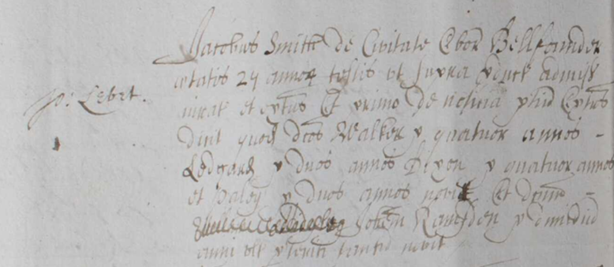
The rest of the statement followed – usually in English – to describe the witness’s version of events. Once all the evidence had been gathered, the case would eventually move toward final sentencing, though some reconciled or admitted guilt prior to the final verdict. In some cases, a verdict of excommunication was decided, where the defendant would be expelled from the Church of England. Francis Milburne, for instance, was caught digging up the “dead bodys, and the bones and sculls of several dead men and women” in the churchyard of St Michael-Le-Belfry (York). In 1664, Milburne was presented to the courts to explain why these corpses had been “heaped against” the side of the church, causing a “filthy noysome smell” for the inhabitants of the parish and those attending divine service. In Milburne’s failure to desist in his shady undertakings, the Church courts excommunicated him in a last ditch attempt to save his soul and deter others from following in his footsteps.[2]
Despite the extensive paper-trail left behind, the Cause Papers remain an underused source. The following will therefore share six reasons why anyone with an interest in the early modern period should utilise them and hopefully draw attention to their potential for future projects.
Continue reading

 the many-headed monster