Unknown's avatar

About manyheadedmonster

The many-headed monster is a collaborative blog focusing on English society and culture in the early modern period, very broadly conceived.

Evading the hounds: online scholarly collaboration and crowdsourced harassment

The latest post in our #SchOnline: Scholarly Communities Online series addresses the urgent issue of online harassment and abuse. 

Elizabeth Watts

Taking our scholarly collaborations online has opened up a world of conversation – at least for those who have the health and energy for it in a global pandemic, and those who are not impeded by barriers such as inaccessible digital materials or organisers’ time zones. Yet in grounding our collaboration in spaces which are subject to rampant organised harassment and surveillance, the well-known threats that marginalised scholars at in-person events face from individuals are exchanged for the instantaneous threat of abuse at menacing, escalating scale.

Online abuse has been an endemic aspect of public scholarship, above all for women of colour, since social media started collapsing digital communication into a handful of massive, searchable platforms. Marginalised and feminist scholars have been ever more vulnerable to forms of online violence aimed at hounding them and their knowledge out of the public sphere since the 2014 #GamerGate campaign (when anti-feminist internet users subjected them to the same tactics of doxxing and swarm harassment they were already turning on Black women journalists), which some writers argue was even instrumentalised by Steve Bannon to help elect Donald Trump.

Besides these organised campaigns, the ease with which high-profile public figures can expose individuals with much lower public profiles to a mass of followers in derogatory ways creates an intimidating atmosphere for any scholar who has experienced or even witnessed the spontaneous harassment that can result. In my own case, as a white mid-career scholar with an ongoing contract, I was privileged and secure enough that abuse from accounts that did not appear to be linked to any identifiable offline people was no big deal. Coming to the attention of individuals with a wide reach on social media, offline positions of power and the capacity to use their influence to cause me material detriment has been a different level of threat altogether, leaving me anxious that I would not be able to keep up with my core job during another episode. With consciousness that my family’s peace and privacy would also be at risk (an even greater threat for scholars whose families are not cis/heteronormatively traditional), my online life has had to become much more defensive and constrained. Continue reading
#SchOnline: Scholarly Communities Online

In the spring of 2020, as much of the world was plunged into ‘lockdown’ by the advance of a global pandemic, regular forms of face-to-face interaction were swiftly replaced by online alternatives. We all found ourselves coming up with new ways to recreate our scholarly activities online, as the classroom morphed into the online seminar; the conference trip was replaced by a day tucked away in a corner of the bedroom staring at Zoom; the common-room catch-up was transferred to the Departmental WhatsApp group.

As the UK lockdown eased at the end of June, we invited our readers to contribute to this ongoing mini-series reflecting on the best way to build communities online.

Contents

> Laura Sangha & Mark Hailwood, ‘The Virtual Parish: Scholarly Communities Online’

Laura and Mark introduce the series and reflect on eight years of running this blog as an online scholarly community. What do we gain from taking our conversations online? What do we lose? What needs to be improved?

> Will Pooley, ‘Online Conferences: Four Reflections’

Will examines his experience of co-organising an online Zoom conference during a global pandemic. He discusses how things were adapted, what online spaces had to offer, and accessibility.

> Clare Griffin, ‘Time Zones Still Exist’

Many of us are facing the prospect of teaching across time zones in the autumn of 2020. Here Clare Griffin reminds us of the access implications of time zones for online events, and suggests that the move online could provide an opportunity to improve the experience of delegates across the globe.

> Jennifer Farrell, ‘The Digital Delegate: attending on online international conference’

What is it like to attend a huge international conference from the comfort of your own home? Jennifer considers reduced costs, technology, trolls and community.

> Brodie Waddell, ‘Teaching Microhistory: small things, big questions and a global pandemic’

How can we teach students the value in studying small things to answer big questions, online, during a pandemic? Brodie explains what it was like to teach an online MA module on theory and methodology, and gives away the handbook for free!

> Elizabeth Watts, ‘Evading the Hounds: Online Scholarly Collaboration and Crowd Sourced Harrassment’

Taking our scholarly communities online has opened up a world of conversation. Yet in grounding our collaboration in spaces which are subject to rampant organised harassment and surveillance, the well-known threats that marginalised scholars at in-person events face from individuals are exchanged for the instantaneous threat of abuse at menacing, escalating scale. In this post Elizabeth shares her own experience as a victim of online of such online abuse.

> Marianne C.E. Gillion, ‘Cultivating a (Virtual) Conference Community

Marianne discusses what it was like to rise to the challenge of hosting a major conference online. The 2020 Medieval and Renaissance Music Conference created a virtual environment that facilitated the unique combination of scholarship, music, networking, and the sociability integral to the annual event. 

> Laura Sangha, “‘You’re on mute!’: How can we make online meetings better?”

Online meetings have become a common feature of our working lives this year, but many people are frustrated at the amount of time they take up. How do they compare with a face-to-face version – beyond the potential technical pitfalls, might they be an improvement? And what can we do to make them more accesible, inclusive and effective?

> Brodie Waddell, ‘How are we going to teach in Autumn 2020? A Survey of UK Historians.

It’s August, but in many UK institutions there is still much uncertainty about what form teaching will take when term starts next month. Here Brodie offers some thoughts based on a quick informal survey of scholars based in 26 different UK history departments, asking them what proportion of teaching they are planning to conduct face-to-face in the autumn.

> Mark Liebenrood, ‘Serendipities of Online Community’

In this post Mark Liebenrood reminds us that serendipity is not the preserve of archival research: it can be one of the great strengths of online scholarly communities too.

The digital delegate: attending an international online conference

We are delighted to welcome our next guest blogger for our #SchOnline series (scholarly conversations online). Here Jennifer Farrell (@dr_j_farrell) reflects on her experience as a delegate of an online conference.

Jennifer Farrell

Last week saw the return of the International Medieval Congress (IMC) at the University of Leeds. This annual conference attracts thousands of medievalists from all over the world, eager to network with one another, to road-test their research, and to enjoy hearing about the work being done by others in their field. I have attended the IMC numerous times in the past, both as a delegate and as a speaker, but the major difference this year was that I did so from the comfort of my own living room!

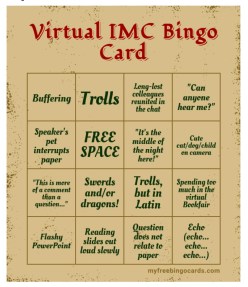
Bingo Card

Sadly moving a conference online will still not stop you spending too much time at the book stalls.

The Covid pandemic has impacted researchers in various ways, but one of the major changes we are seeing is the willingness and indeed tenacity of conference organisers to find ways of facilitating networking and the sharing of research via online platforms. The sheer scale of the IMC means that its move to a virtual conference was nothing short of heroic.  This year the virtual IMC supported the delivery of c.530 research papers, attended by c.3,200 delegates from across 60 countries. The organisers, moderators, panellists, and facilitators deserve to be commended for this.

Speaking purely from the perspective of a delegate, with no need to worry about my paper being interrupted by poor internet connection, bad sound, disruption from trolls, or just the generally odd sensation of talking about your research to a computer screen, my own experiences of the vIMC were very positive. Of course, a virtual environment is by no means the same as experiencing the conference in person, but that is not necessarily a bad thing.  Like many of the changes that have occurred to our working conditions on account of Covid, there are good and bad sides. Continue reading

Time Zones Still Exist

In this guest post in our #SchOnline series (scholarly conversations online), Clare Griffin (@balalaichnitsa) calls for the organisers of online events to think about the access implications of time zones. 

Clare Griffin 

In the brave new world of virtual conferencing, there has been something of a sense that this is more open, more inclusive. After all, we don’t have to travel for hours to get to a physical venue. But there are still a number of accessibility issues, one of which I want to address here.

Time zones still exist.

A substantial number of these virtual events are being held live. That’s great, if you are in that time zone or a neighbouring one. Less so if you are not.

Many such English-language events are being held in North America and Western Europe, so are most directly accessible to academics based in those regions. What about those of us in other time zones? I am in Kazakhstan. There are academics interested in English-language events based in Australia, Singapore, India, and many other places.

Technically, we can still take part in such live virtual events, if we are prepared to get up in the small hours of the morning, or stay up until midnight.

When we were in the era of in-person events, I would regularly be flying multiple hours, crossing several time zones, to get to an event. And would be exhausted. Now, to take part in live virtual events I would often have to disrupt my sleep. And be exhausted.

Sleep is important for everyone, and we shouldn’t expect people to disrupt it to do their job.

Sleep is a particular issue for me, as sleep disruption is a major trigger for one of my conditions, a bipolar spectrum disorder. I am less well if I disrupt my sleep. If I try and participate in live events in time zones far to the West or East of me, I will harm myself. And weren’t well all supposed to be more concerned about our colleagues’ well-being during the pandemic? Continue reading

Online Conferences: Four Reflections

In this guest post in our #SchOnline series (scholarly conversations online), Will Pooley (@willpooley) reflects on hosting an online workshop. 

Will Pooley

There is something odd about the effect the pandemic is having on online academic work, collaboration, discussion, and teaching. The lockdowns imposed in many parts of the world have given a renewed impetus to some forms of doing history online. The pressures of the current situation have provided momentary distractions from longstanding problems with the platforms and tools that historians have found themselves most drawn to, such as Twitter and blogging.

The challenges of the #SchOnline moment involve addressing these legitimate criticisms around issues including accessibility, abuse and harassment.

One big change has been the adoption – almost overnight – of teleconferencing software such as Zoom and Skype, to replace face-to-face meetings and events. Jan Machielsen and I decided to give an online workshop a go, to bring together people interested in talking about the broad issues of the supposed ‘decline of magic’.

I have four reflections on this.

Something Old?

The first thing I want to mention is something that Jan and I agreed on from when we first discussed the idea: an online ‘conference’ or ‘seminar’ cannot just simulate a face-to-face equivalent. It’s very hard to broadcast a 20 or 50-minute talk, especially given the unreliability of the technology, and the fact that none of us are media professionals. The videos that professional Youtubers, for instance, put out involve specialist equipment and a whole production team. Academics need to be realistic about what we can do using an old work laptop in a poorly-lit makeshift space.

Something New

The second point I would make about this is that different does not have to mean worse. Continue reading

Responding to a Crisis: the Black Death, COVID-19, and Universal Basic Income

In this guest post, Professor Jane Whittle of the University of Exeter looks at the governmental response to the Black Death, and advocates a revolutionary new social policy for our own period of crisis. 

Jane Whittle

Unprecedented episodes of disease, such as the current outbreak of COVID-19, are moments of fluidity when parts of existing societies are laid bare as not fit for purpose. Wars create similar moments of flux. The Second World War created the consensus that allowed the founding of the NHS and the Welfare State. Could our current state of crisis lead to something positive and long lasting, amid all the disruption, trauma, and loss?

My research focuses on another such moment, the consequences of Black Death of the fourteenth century. In the midst of the Black Death the English government made the significant decision not to strengthen the institution of serfdom but instead to increase the regulation of waged labour with the Ordinance of Labourers of 1349.

The Black Death was an outbreak of bubonic plague that raged across Europe between 1347 and 1349 and killed an estimated 50% of the English population. Fortunately the mortality rate of COVID-19 looks to be closer to 1% of those infected (and thus lower for the total population). Yet in our highly interconnected modern society its impact is already shaping up to be enormous. Historians have long puzzled over the fact that the immediate social and economic impact of the Black Death appears to have been remarkably slight. Social, economic, and political structures remained in place. However, this is to overlook the innovation of the labour laws. The Ordinance of Labourers of 1349 was a revolutionary piece of legislation. It marked the end of serfdom and beginning of an economy dependent on wage labour, but it signalled that the government’s attitude to wage workers would be far from lenient. Although initially announced as an emergency measure by the monarchy, when Parliament next met in 1351 it was enthusiastically endorsed. The measures remained in force until the early nineteenth century. Continue reading

Not what it used to be? Nostalgia in Early Modern England

In this guest post Dr Francis Young examines the relationship between history and nostalgia, particularly how and why nostalgic rhetoric is deployed. Dr Young is a UK-based historian and folklorist specialising in the history of religion and supernatural belief. You can find out more about his work on his website.

The phenomenon of nostalgia – which may be defined, briefly, as a longing for an imagined past supposedly better than an unsatisfactory present – seems to be attested in every age. Clearly, nostalgia is not the same thing as history, since nostalgia celebrates or exploits an imagined past that may never have existed, without studying the evidence. Conservative societies undergoing little change have fewer reasons to be nostalgic, but societies in flux often become sentimental about an imagined former ‘Golden Age’. This was certainly true of early modern England, which was a society obsessed with the past. However, early modern nostalgia was not just an effect produced by a changing society: ironically, early modern nostalgia drove the process of change itself. By longing for the past, people brought in the future.

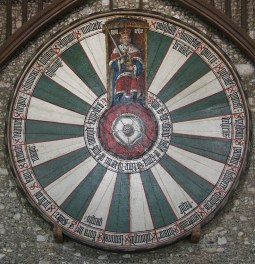
800px-Winchester_RoundTable

The Winchester Round Table. Image: Martin Kraft (photo.martinkraft.com) License: CC BY-SA 3.0 via Wikimedia Commons

Throughout the Middle Ages, it was commonplace for new monarchs to associate themselves with the ‘good old days’, whether they did this by invoking the laws of St Edward the Confessor, the liberties guaranteed by Magna Carta, or an imagined age of chivalry and the deeds of King Arthur. Perhaps no early modern reign was more infected with this kind of nostalgia than that of Henry VIII, who even had a painted wooden replica of King Arthur’s round table made for him in 1522, which now hangs in Winchester Castle. In a Latin poem to mark Henry’s coronation, Thomas More wrote, ‘When previously order utterly decayed, at once all order was restored in him … what are his virtues had been those of any of his ancestors’. More then went even further and declared Henry’s accession to be the restoration of the Golden Age prophesied by Plato: ‘The golden ages first return to you, prince; o! Plato may thus far be a prophet!’ Continue reading

Alice Clark 100 Reading Group: Conclusion

This post is part of our #AliceClark100 Online Reading Group. In it Susan D. Amussen offers some reflections on the ‘Conclusion’ of The Working Life of Women in the Seventeenth Century, as well as on the posts in this series as a whole. Susan is a Professor of History at UC Merced, and tweets as @susandamussen. You can access the book here.

Susan D. Amussen

Alice Clark ended Working Life of Women by summarizing her findings in terms of her central themes. What does it mean for women when the individual rather than the household is the primary actor in the modern economy? Why don’t women get as much specialized training as men?  As the essays in this series have shown, the story of women’s work is considerably more complicated than Clark’s argument allows.  But Clark raises two new issues in her conclusion.  First, the subordination of women.  She argues that capitalism is not the source of the subjection of women; instead, ‘the subjection of women to their husbands was the foundation stone of the structure of the community in which Capitalism first made its appearance.’ (p. 300)  Second, she raises questions about political theory.  She asks about the impact of the ‘mechanical state’, represented by the works of both Hobbes and Locke.  What does it matter when women are invisible in formulations of what the state means?  Clark argues that these issues draw attention to a much wider range of issues and a longer chronology than those which have been the focus of the book.

Reading her conclusion alongside the essays that have made this series so interesting demonstrates one reason we – and our students – keep reading Alice Clark: she raises big questions.  She understands women’s work, and women’s position in society, first in relation to the history of capitalism.  At the end, though, she tells us that the big question is part of two even bigger ones, about fundamental social structures and the history of political thought.   Both of these have been the focus of extensive research over the past 40 years.  The tension between women’s agency and their subordination has been a central theme in women’s history.  We have simultaneously demonstrated women’s agency not just as economic actors but as political ones while we have explored domestic and sexual violence.[1]  Allyson Poska’s suggestion that we consider what she calls “agentic gender norms” that co-exist with patriarchy and provide a counter-vailing set of norms may be a useful way of thinking about these tensions.[2]  Similarly, scholars in the history of political thought have unpacked the ways in which contract theory not only erased women, but made women’s political action far more complex.[3] Continue reading

Alice Clark 100 Reading Group: ‘Professions’

This post is part of our #AliceClark100 Online Reading Group. In it Mary Fissell offers some reflections on chapter six of The Working Life of Women in the Seventeenth Century, on ‘Professions’. Mary is Professor in the History of Medicine at The John Hopkins University. You can access the book here.

Mary Fissell

Alice Clark’s chapter on Professions is startlingly prescient in its view of early modern women’s medical work. Many of the themes, sources, and topics she includes have become central to our discussions of early-modern medicine over the past few decades, but were not any part of the history of medicine when I started graduate school 35 years ago. Equally, when I re-read her chapter this time, I was struck by how deeply Clark’s own experiences shaped her account of women’s healing work.

Clark repeatedly uncovered women’s healing work that was largely ignored in the literature until very recently. In 1919, most English people would have thought that nursing started with Nightingale. Clark drew upon records from London’s great ancient hospitals to show us women working as nurses and matrons in them, although she wasn’t very flattering, noting that they were not “the most efficient type of women”. In the countryside, Clark found traces of nursing in local payments from parishes or charities for nursing the poor. She unearthed records of a female surgeon or two, and recognized that women performed many tasks as domestic healers, including making medicines and preserving recipes, a substantial topic in today’s literature. Such women, she noted, were trained informally in female lineages, rather than the formal education their brothers might have enjoyed. She describes the work of “searchers”, older women who inspected bodies for signs of the plague, a category of medical work almost completely ignored until the late 1990s.

Midwifery is Clark’s paramount example of the narrative of loss familiar from other chapters, as men gained access to increasingly formal scientific and medical training that became ever more valuable as knowledge progressed. But she couldn’t help noting that midwives’ skills probably didn’t worsen over the course of the seventeenth century. Here Clark was bucking the trend; as obstetricians created their specialty in the later 19th and early 20th centuries, they engaged in a fair amount of midwife-bashing about the old “Sairey Gamp” type of practitioner, but Clark saw a lot of good in the early modern midwife, noting that some were “of a high level of intelligence” and possessed “considerable skill”.

What struck me the most, however, was the ways in which Clark’s understanding of women and medicine was deeply tied up with her own personal history. Continue reading

Alice Clark 100 Reading Group: ‘Crafts and Trades’

This post is part of our #AliceClark100 Online Reading Group. In it Laura Gowing offers some reflections on chapter five of The Working Life of Women in the Seventeenth Century, on ‘Crafts and Trades’. Laura is Professor of Early Modern History at King’s College London. You can access the book here.

Laura Gowing

When is a carpenter not a carpenter? When she is a seamstress. Guild or company records loomed large in Alice Clark’s survey of women in crafts and trades, yet their evidence was often confusing or ambivalent. This was particularly so in London, where the Custom of London from the early seventeenth century had enabled women and men with the Freedom of the City to engage in any city craft, not just the one of their own company. Hence, the girls apprenticed to Carpenters located by Clark’s research, who turn out to be apprenticed to seamstresses and silk-winders.

It is now evident that these female apprentices in the Carpenters’ were mirrored across the companies of late 17th century London, with artisans’ and merchants’ wives taking on apprentices in increasing numbers, almost always in sewing and keeping shops to sell the goods they made. Long before the mantua-makers of the late seventeenth century brought women up against tailors, women were sewing smocks, cuffs and bands for the London market, and girls were being apprenticed to learn from them.

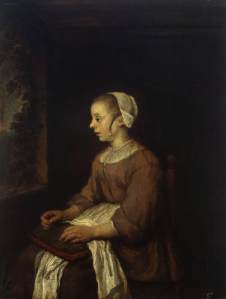
Philips_Koninck_-_The_Seamstress_-_WGA12246

Philips Konnick, The Seamstress, 1671

Sewing dominated in the crafts and trades in which women worked, particularly in London. London’s particular customs thus brought skilled sewing work into guild management, not in terms of quality of work but as a means of incorporating training. By the late seventeenth century free single women and freemens’ wives and widows were taking apprentices in a range of seamstress and textile trades that reflected the specialised construction of garments, shoe and headwear: making children’s coats, periwigs, silk stockings, buttons, lace, gold and silver thread.

In other crafts, and outside London, Clark amassed a host of detail of the conflicts between guilds and the girls and women who found themselves on their margins. Carpenters’ wives being forbidden to unload timber, women bakers excluded from the trade for not having been apprenticed, pewterers ordered to buy no lead from women all reveal not only the arguments around inclusion, but the numbers of women working in trades which to modern eyes were ‘most unlikely’. Continue reading