‘For yee lead your liues in great ignorance’: Puritan Ponderings on the Patchwork of Popular Belief

Jonathan Willis

What exactly did people believe in post-reformation England?  That deceptively simple question really goes to the heart of much of the ‘post-revisionist’ scholarship currently being generated by historians of the English reformation.  Whether the object of study is angels, the landscape, music or death, one underlying questions remains the same: what does this thing, this practice, this shred of belief tell us about the broader tapestry of post-reformation religious identity?  Tapestry is a reasonable metaphor – I’m going to refrain on this occasion from extending it too far, and talking about warps and wefts – but patchwork 3388735664_a77e48d15a_zis a better one, the term coined by Tessa Watt in her brilliant book Cheap Print and Popular Piety.[1]  Once or twice when teaching this I have actually taken to drawing an imaginary ‘patchwork’ on the whiteboard.  So what do we call the hypothetical individual, who believes he will be justified by faith but also thinks that if he doesn’t confess his sins he could be condemned to hell for them?  What about his wife, who sings metrical psalms and hates the pope but believes God to be physically present in the consecrated host?  And however we define such individuals, can we also reasonably group them together?  It is possible to recognise their difference, and at the same time claim they are one and the same?

So tapestry is OK, patchwork is better: palimpsest works pretty well too.  Tangentially, I wonder why so much of the metaphorical language we use to describe identity formation (there’s another one) is rooted in the everyday materiality of art and craft.  Our ability to label individual belief in the past seems inversely proportional to the amount we know about it.  I suppose that is a fairly natural state of affairs.  Complexity breeds complexity, and moulds certainty into uncertainty.  But the job of the historian is (I think) not just to (re-)present the past, but also in some sense to try to make sense of it.  So, for AG Dickens the majority of people in Elizabethan England were recognisable as Protestants; for Eamon Duffy they were perhaps traumatised Catholics; for Christopher Haigh, stiff-necked Parish Anglicans; for Judith Maltby, committed Prayer-Book Protestants; for Watt, their culture was ‘distinctively post-Reformation, but not thoroughly Protestant’; while for Robert Delumeau, the people of early modern Europe were probably not even thoroughly Christian.

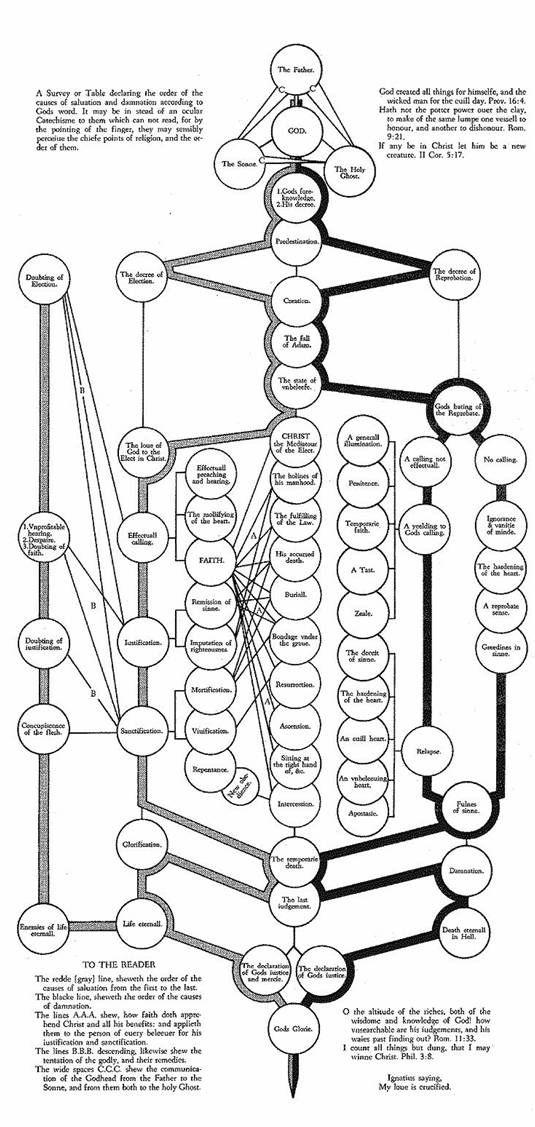
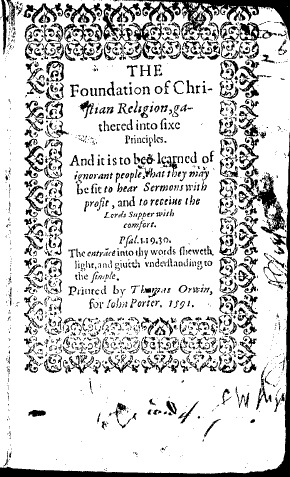
I was reminded of the value of taking a step back from all of this the other day, while reading a treatise by William Perkins that I had never looked at in detail before.  Perkins,Picture1 probably most famous as the author of A Golden Chaine, and more famous still for the infamous diagram of salvation contained within it, was a prolific writer of theological and devotional tracts: the work in question is his The foundation of Christian religion gathered into sixe principles.[2]  The work begins with an address ‘to all ignorant people that desire to be instructed’, followed by a list of almost 30 erroneous ‘common opinions’ which Perkins goes on, throughout the text, to correct.  Reproducing this list in its entirety would be a little excessive, but let me pick and talk about a dozen or so points which seem to me to be particularly pertinent to the present discussion:
1 That faith is a mans good meaning & his good seruing of God.

3 That yee haue beleeued in Christ euer since you could remember.

11 That it is an easier thing to please God than to please our neighbour.

12 That yee can keepe the Commandements, as well as God will giue you leaue.

Taken together, these points seem to express a frustration at the laity’s lack of intellectual engagement with the concept of faith.  That is not to say that their faith was not complex, but it was certainly not structured in the reflective, self-conscious way demanded by men such as Perkins.  Ironically, it seems that Puritan divines would have preferred a little less fiducia and a little more credentia from the laity: a faith based less in instinct, trust and emotion, and rather more in knowledge and intellectual acceptance.  The most difficult (and therefore the most important) aspect of religion from the laity’s perspective was in striving to live according to the principles of Christian charity: God, in whom they had faith from their earliest years, was a comforting constant.  And yet many of the laity had a strong sense that it was ultimately possible to be good and to do good things, and that such behaviour was pleasing to God.  Elsewhere, Perkins also complained about those who felt that by reciting the Decalogue they were praying, and serving God.

7 That, if anie be strangely visited, hee is either taken with a Planet, or bewitched.

This I think is a useful reminder that popular belief was not straightforwardly Christian: it contained a mixture of folklorish, traditional, pagan and other elements.  In this sense it was a true patchwork.

13 That it is the safest, to doo in Religion as most doo.

14 That merry ballads & bookes, as Scoggin, Beuis of Southampton, &c. are good to driue away time, & to remoue hart quames.

20 That drinking and bezeling in the alehouse or tauerne is good fellowship, & shews a good kinde nature.

Popular religion in the broadest sense was above all a communal activity, not an individual or even a family or household one.  The reformation did not fundamentally change this, except perhaps amongst those who were the most literate in the new religious language.  Even then, perhaps all it did was change the nature of the society with which those individuals of advanced faith sought to surround themselves.  Good religion was to be expressed in good fellowship and good cheer, as much in the alehouse as in the church, as much with a lusty ballad as a reverent Psalm.  ‘Hart quames’ for most people were to be banished with a merry ballad, not meditated upon as a means to repentance and the enrichment of a saving faith.

9 That a Preacher is a good man no longer than he is in the pulpet. They thinke all like themselues.

 18 That yee know al the Preacher can tell you: For he can say nothing, but that euery man is a sinner, that we must loue our neighbours as our selues, that euery man must bee saued by Christ: and all this ye can tell as well as he.

 17 That a man which commeth at no Sermons, may as welbeleeue, as he which heares all the sermons in the world.

 16 That a man neede not heare so many Sermons, except he could follow them better.

28 That a man need not haue any knowledg of religion, because he is not book learnd.

Finally, from the perspective of both the clergy and majority of the laity, a wide gulf existed between the two.  The reformation certainly contributed to a widespread anti-clericalism, that is to say, an opposition to the clerical pretensions of the new godly graduate clergy.  Complicated sermons were for educated people: the unlearned had nothing to gain thereby, because they already grasped the essentials of the faith: that all men were sinners, must be saved by Christ, and had an obligation to be charitable to their neighbours.  This was all well and good as far as it went, but of course for Perkins and others there were nuances, complexities, caveats and implications without which these broad truisms were worse than meaningless.  Such intellectual religion was unpopular in all senses: it was not for the great mass of people, who could profit more from each other’s good fellowship than a lengthy diatribe from the pulpit.
FoundationThe thing I’d like to draw from all this is that occasionally it is possible to lose sight of the wood for the trees.  While it can be extremely interesting to interrogate popular belief in minute theological and intellectual detail, it is not always the most productive path to follow (there are of course many, many exceptions).  For, by doing so, we can end up unwittingly forcing a resolutely anti-intellectual form of belief into a (for want of a better word) Perkinsian framework, and thereby doing it some violence, and just a little injustice.  We must remember that popular belief was both simple and complex, both patchwork and quilt.  It may be made up of innumerable diverse fragments, but it also had simple key priorities and a clearly defined basic form.  Each quilt may be unique, but quilts are also recognisably the same: a quilt is a quilt, and not a cushion cover, or a wall-hanging.  Identity is full of contradictions, but not all contradictions have to be resolved.  We each of us probably live with a series of competing and contradictory impulses and beliefs held in a kind of creative tension with one another, and the people of early modern England were probably no different.


[1] (Cambridge: CUP, 1991), p. 327.

[2] And it is to bee learned of ignorant people, that they may be fit to hear sermons with profit, and to receiue the Lords Supper with comfort (1591), STC2: 19710.

A miscellany: wandering woodcuts, Greifswald glosses, digital Defoes and Thompson tributes

Brodie Waddell

Several things have come to my attention over the last few weeks that deserve wider attention. Although I don’t have time to provide much commentary, I think our readers will find some of them of interest.

The first concerns the wonderfully rough images that so frequently appear in our posts: broadside ballad woodcuts. The Bodleian Library recently announced the launch of an image-matching tool that will allow researchers to easily search for the many versions of a specific image across the library’s whole collection of ballad sheets. Eleanor Shevlin discusses the new tool in more detail over at EMOB. In light of Mark’s posts on early modern representations of working people, it would be fascinating to know how particular ‘occupational’ images are reused and recycled in different contexts and perhaps given quite different meanings.

The second is Beat Kümin’s historical travelogue, Greifswald Glosses, exploring the largely autonomous parish communities in early modern Northern Germany. As a professor at Warwick, Beat is well-known to us here at the Monster and his blog offers a remarkable (and remarkably well-informed) look at the towns, churches, landscapes and even graffiti of this part of the former Holy Roman Empire. I think my personal favourite was the fourteenth-century gargoyle/collection-box at St Jacobi in Göttingen, but you may prefer the ruminations on low-ranked local football teams or the semi-fortified round churches of Bornholm.
The third is an amusing ‘pop history’ article in The Atlantic on Daniel Defoe’s A Journal of the Plague Year (1722). It’s a well-researched piece, based on an interview with the Defoe scholar Katherine Ellison and incorporating plenty of (anachronistic) pictures, but what makes it interesting to me it that it is written by the magazine’s tech writer. The short version of his argument is basically that Defoe was an early modern blogger and, unlike some of today’s bloggers, he approached the wealth of information provided by that era’s new technology (e.g. newspapers) with a critical eye. I’m not sure I’m actually convinced, but it’s great to see another side of early modern history (beyond Henry VIII, Shakespeare and Oliver Cromwell) receiving some thoughtful discussion in such a high profile outlet.

Finally, Katrina Navickas has a post at History and Today on E. P. Thompson’s The Making of the English Working Class (1963). There are, as she notes, a great many tributes and events happening this year to mark the fiftieth anniversary of its publication. However, what I enjoyed was hearing a little about her relationship with the materiality of the book itself, in all its tattered, dog-eared glory. I think I probably find myself reaching for Thompson’s Customs in Common (1991) more often than MEWC, yet I’m still strangely comforted to have a decent edition of the latter nearby. In her words, ‘despite my “digital humanism”, I still need those yellowed and annotated pages of the Penguin paperback to really get to the heart of Thompson’s writing’.
Shorter notices

Our very own Laura Sangha has set up a twitter feed for her students of ‘Religion, Society and Culture in Tudor England’: Tudorists rejoice! Grad students in and around London interested in early modern history really ought take a look at the talks hosted by the Birkbeck Early Modern society (and their tweets too). And lastly I belatedly wanted to thank the Birkbeck History PhD bloggers for reblogging one of our posts and recommend that all BBK doctoral students check them out.

[Update (07/02/13): Co-blogger Jonathan Willis is also tweeting (@CREMS_Bham) for Birmingham’s Centre for Reformation and Early Modern Studies.]

REED all about it III: Some musings on music and the micropolitics of Sabbath-breaking in Jacobethan Lancashire

Jonathan Willis

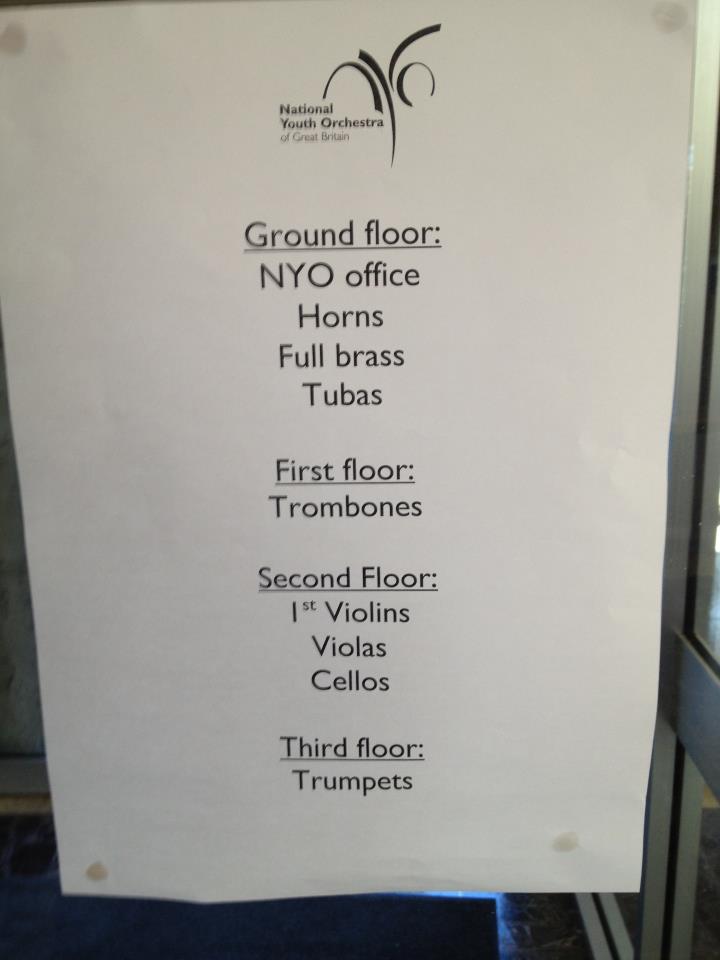
One sunny afternoon last July, the University of Birmingham’s Edgsbaston 295393_10151929538030109_359375196_ncampus played host to some rehearsals by the National Youth Orchestra of Great Britain.  Cellos, violas, tubas and trombones were scattered liberally throughout the Arts Building, and the history department itself played host to the trumpet section.  Hearing (fainter) strains of music in the department is not an uncommon occurrence, as there are student rehearsal rooms in other parts of the building.  This is usually quite enjoyable, even if it occasionally adds a melodramatic quality to meetings or supervisions.  Whether at work or home, we have all probably at some stage encountered some form of music which has permeated our environment uninvited.  Sometimes, as with the NYO or Birmingham’s budding undergraduate virtuosi, this can be an unexpected source of pleasure.  But in other situations, it can be distracting, disruptive, or downright offensive.  Uncleanness, the anthropologist Mary Douglas famously observed in her 1966 work on Purity and Danger, is ‘matter out of place’.[1]  In the same way, musical sound in the wrong spatial or chronological context can easily cross the rubicon of taste and order and become a provocative and clamorous noise.  If this is still true in the sound-proofed, double-glazed, cavity-wall insulated, noise-cancelling-headphone-wearing twenty-first century, then it was even truer in the sixteenth, where both welcome and rogue sounds must have travelled with much greater volume, clarity and conspicuousness. Continue reading

Microhistory: subjects, sources, anti-fascists and Adam

Brodie Waddell

Microhistory is, it seems, a many-headed sort of beast.

In my previous post I suggested that, despite its name, ‘microhistories’ were not simply ‘small histories’ and asked what might make microhistorians distinct:

Is it their interest in ‘strange and bizarre events and socially marginal peoples’? Or the personal nature of their sources? Or their reflective and open discussions of methodology and the limits of historical knowledge? Or perhaps it is really a ‘continental thing’, well beyond the abilities of us depressingly practical Anglos on this side of the Channel?

The responses I received in comments (and by email) were very helpful as it soon became obvious that there were many other possibilities that had never occurred to me. Indeed, I received not just five responses, but at least double that number of potential ‘defining features’. Here, however, I will just focus on four issues.

The characteristic that came up most often was the notion of focusing on the ‘exceptional’, ‘unique’, and ‘extraordinary’. This is something that both Laura and Nancy emphasised in their comments as well as a point made one of the pioneers of the genre, Giovanni Levi, who claimed it involved taking seriously things regarded by others as quirky or deviant.1 In Nancy’s words, ‘these studies use the documentation of peculiarity as a point of entry into the ordinary, daily lives of marginal or low-status persons’.2 However, this feature of microhistory also opens it up to critique. As Steve Hindle pointed out in a recent talk (which he kindly passed along in response to my original post), discerning the relationship between ‘the particular’ and ‘the general’ is even more fraught in cases like these where one’s primary subject is undeniably ‘unrepresentative’.3

Another feature that several people mentioned was an explicit engagement with methodological issues. As Nick noted in his comment, microhistories often adapt interdisciplinary approaches, ‘read against the grain’ and acknowledge the important role of imaginative or speculative reconstructions in the absence of conclusive evidence. Laura too suggests that this might ‘be at the core of what “microhistory” is’. In Levi’s reflections on the genre, this forthright discussion of the ambiguities and partialities inherent in narrative sources – such as depositions in inquisitorial courts – is a key element in these histories.4

Perhaps these two recurring features, rather than their scale, are what give microhistories their distinctiveness.

But I think it is worth pushing further, because subjects and methods and even styles can only provide a rather ‘unhistorical’ definition of a historiographical genre. (Note: If you’re an undergrad looking for a straightforward definition of ‘microhistory’, you can stop reading now.)

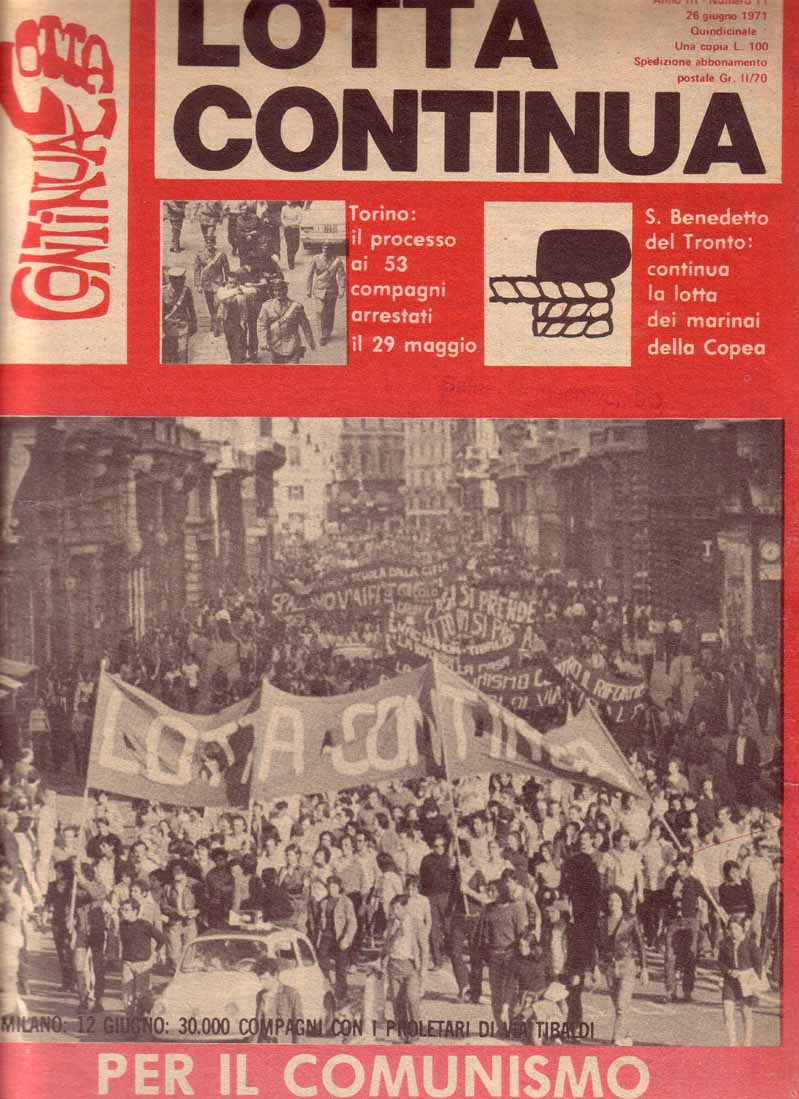
Let’s start with politics. Nick mentioned that he associated this type of history with ‘the Lotta Continua 1971left’, a link that I hadn’t considered. I think he may be right: the ‘founder’ of the genre, Carlo Ginzburg, wrote a whole book deconstructing and critiquing the murder trial of an activist linked to the Italian leftist group, ‘Lotta Continua’.5 Similarly, the other ‘founder’, Giovanni Levi, has suggested that innovative historical methods can help to explain continuities between the present and the past that ‘neoliberalism’ tries to suppress. In fact Ginzburg and Levi both appear to take some of their inspiration from their Jewish identity and militant anti-fascist heritage. I’d welcome comments from any readers who know of additional (or contrary) examples, but what I think this ought to remind us is that even historiographical traditions that are not explicitly politicised still emerge from specific historical – and thus political – contexts. Microhistory is no exception.

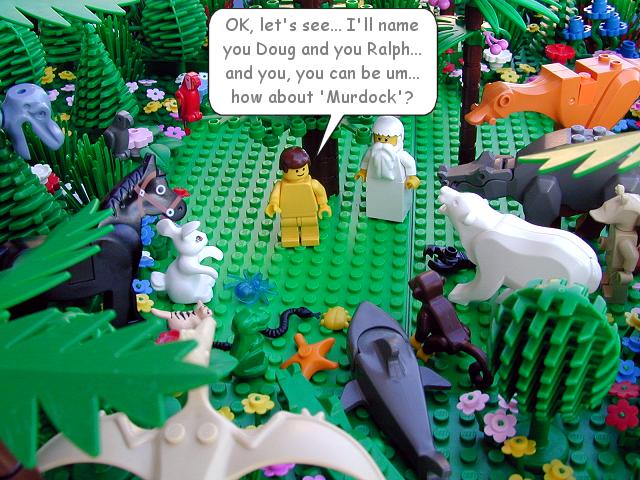
The second issue is nomenclature. For, as Laura pointed out, if we want to find a definition we also need to ask a question: Who decides what is and isn’t ‘proper microhistory’? The power to name things is a very great power indeed, one traditionally reserved for deities and patriarchs.6 Part of the genius of Ginzburg and Levi was simply

Genesis 2:19-20 at the Brick Testament

Genesis 2:19-20 via The Brick Testament

their ability to come up with a concise, memorable term (microstoria) for what they were doing and to convince others to go along with it. This becomes clear when one realises that the word itself had already been used by an American historian, George R. Stewart in the title of one of his books more than a decade before the Italians took it up.7 Stewart may have coined the term, but it was only when Ginzburg and Levi turned it into a ‘brand’ that it became a widely acknowledged and widely imitated genre of history. It was then that it moved beyond the literal notion of a ‘small history’ to acquire all of these associations with specific types of subjects, methods and politics.

Here, at last, we have an explanation for why certain works of history which seem to fit the literal definition of ‘microhistory’ – such as E. P. Thompson’s Whigs and Hunters (1975) or Wrightson and Levine’s Poverty and Piety (1979) – are rarely granted that label. Ultimately, it comes down to politics, power and a damn good marketing campaign.

Footnotes

1 Giovanni Levi, ‘On Microhistory’, in Peter Burke (ed.), New Perspectives on Historical Writing (1991). Thanks to Steve Hindle for drawing my attention to this.

2 For an excellent recent example of this approach (including some ‘microhistories’ and some not), see The Extraordinary and the Everyday in Early Modern England: Essays in Celebration of the Work of Bernard Capp, edited by Garthine Walker and Angela McShane (2009). If you are interested in the connection between ‘microhistory’ and its ‘extraordinary’ antecedents in eighteenth and nineteenth-century ‘compilations of crimes, trials and other strange-but-true stories’, you might want to apply for a fully-funded PhD studentship on that topic at Ghent University in Belgium.

3 Steve Hindle, ‘Reducing the Scale of Historical Observation: Micro-history, Alltagsgeschichte, Local History’, at Huntington Library, Early Modern Studies Institute, ‘Past Tense’, 19 October 2012. There should be a podcast of this talk available soon at which point I will update with a link.

4 Levi, ‘On Microhistory’.

5 Carlo Ginzburg, The Judge and the Historian: Marginal Notes and a Late-Twentieth-century Miscarriage of Justice (1999).

6 Genesis 2:19 – ‘And out of the ground the LORD God formed every beast of the field, and every fowl of the air; and brought them unto Adam to see what he would call them: and whatsoever Adam called every living creature, that was the name thereof.’ See also this interesting recent post by Daniel Little on the nomenclature of ‘the human sciences’.

7 George R. Stewart, Pickett’s Charge: A Microhistory of the Final Charge at Gettysburg, July 3, 1863 (1959).

Microhistory: size matters

Brodie Waddell

Last week I had the privilege of attending a workshop on ‘Writing Microhistories’ at Jesus College, Cambridge. It was quite simply an excellent event, due partly to the healthy diversity of speakers – from eminent sages like Keith Wrightson to a gaggle of precocious grad students – and partly to the (uncharacteristically) loose, informal nature of the discussion. It was the questions and conversations, rather than just the papers themselves, that made the day so stimulating.

The workshop had a whole series of highlights, including Wrightson’s ruminations on famous Geordies and some juicy gossip with the grad students over post-workshop drinks. However, I’d like to hone in on one particular question that came up in a variety of forms that day: Are ‘microhistories’ about scale? 1

The term ‘microhistory’ will probably be very familiar to most of you, but I’ll borrow from the summary provided by Duane Corpis for an interesting looking course at Cornell as it’s a solid introduction and easily accessible:

Microhistory is a particular methodological approach to the study and writing of history. The aim of microhistory is to present especially peculiar moments in the past by focusing on the lives and activities of a discrete person or group of people. By illuminating the trials and tribulations of ordinary people in their everyday lives, microhistory aims to show both the extent of and the limits upon human agency, i.e. the ability of individuals to make meaningful choices and undertake meaningful actions in their lives. By analyzing what might often seem to modern readers as strange and bizarre events and socially marginal peoples, microhistory offers a more inclusive understanding of who and what matters within the discipline of history. By emphasizing everyday life, microhistory forces us to re-think traditional approaches to history that focus on seemingly more important political events and actors. Finally, by looking at the “micro” level of social activities and cultural meaning, microhistory challenges approaches to the study of history that emphasize the need to quantify, generalize, or naturalize human experience or to find and impose normative and abstract historical laws, structures, or processes on the historical changes of the past.2

The prefix that separates ‘microhistory’ from other ‘history’ suggests that its defining feature is its size, namely it is history on a small scale. Certainly the most famous studies with this label focus on only a single person or place. The book that supposedly started it all – Carlo Ginzburg’s The Cheese and the Worms (1976) – illuminates the peculiar world of a sixteenth-century Italian miller. Natalie Zemon Davis concentrated on a French peasant couple in The Return of Martin Guerre (1983) and Robert Darton’s ‘The Great Cat Massacre’ (1984) zoomed in on the actions of a small group of apprentices on a particular street in 1730s Paris. All of these studies share a scope that is severely and unapologetically limited when compared to more traditional histories.

The tools of the trade?

Yet etymology can be deceptive, because ‘microhistories’ seem to be more – or maybe less – than simply ‘small histories’. Although many of these histories centre on the lives of a single individual (Menocchio the miller, Bertrande the wife, Ralph the scrivener, Benedetta the nun), they are not biographies. Likewise, biographies of the great and the good are not microhistories despite the fact that they limit themselves to the story of a single life. Ian Gentle’s recent history of Oliver Cromwell may be academically rigorous and intellectually stimulating but it is somehow fundamentally different from Ginzburg’s Menocchio or Davis’s Bertrande.

In a related way, I think microhistory is distinct from local history. Here too similarities of scale mask innate differences. Emmanuel Le Roy Ladurie’s narrative of medieval Montaillou (1975) is the story of a whole village, not merely a single extraordinary individual or family – it explores the lives of all the villagers, heretical and orthodox alike. Yet Montaillou is almost always categorised as ‘microhistory’ whereas an equally famous and important local study, W.G. Hoskins’ book on Wigston Magna (1959), is not. The well-known histories of early modern Terling (1979) and Whickham (1992) by Keith Wrightson and David Levine went even further. Like ‘microhistories’, they were deeply analytical and challenged prevailing interpretations, almost the exact opposite of the antiquarianism of old-fashioned English local history. Nonetheless, they still appear to me to be essentially different from the explorations of Montereale, Artigat, Montaillou and la Rue Saint-Séverin offered by Ginzburg, Davis, Le Roy Ladurie and Darnton.

So, if ‘microhistories’ are not simply ‘small histories’, what makes them distinct? Is it their interest in ‘strange and bizarre events and socially marginal peoples’? Or the personal nature of their sources? Or their reflective and open discussions of methodology and the limits of historical knowledge? Or perhaps it is really a ‘continental thing’, well beyond the abilities of us depressingly practical Anglos on this side of the Channel?

I’d really like to hear your thoughts, which I hope will be the starting point for a subsequent post.

[Update: The follow-up is here]

Footnotes

1 I should also thank the MA students in my seminar at Birkbeck a couple of weeks ago, who had plenty of interesting things to say about the issue of ‘scale’, and two colleagues – Samantha Shave and Mark Hailwood – who discussed this with me over coffee.

2 Duane Corpis, course description for ‘Deviants, Outcasts & other “Others”: Microhistory and Marginality in Early Modern Europe’ (2010). See also the Wikipedia entry, which is a bit less helpful, or this article by Ginzburg (gated; ungated) and the many others available on JSTOR.

The impotence of being reviewed…

Jonathan Willis

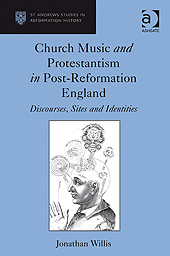
Following Brodie’s post last month on ‘Twelve reasons to buy my book, or, The ancient art of self-promotion’, I started thinking about what is one of the most exciting stages of the subsequent post-publication process: that is, the point at which the first review appears. This post is therefore a reflection on my own experience of being reviewed.[1] The book in question is my Church Music and Protestantism in Post-Reformation England, which was published by Ashgate in their St Andrews Studies in Reformation History series in May 2010.[2] A modified version of my PhD thesis, the book charts the impact of the reformation on religious music, and the role of religious music in shaping the English reformation (OK, so I couldn’t resist a quick plug!).

A jog rather than a sprint

One of the inevitable by-products of the academic system is the development of a ‘feedback loop’. This starts at school, and continues through university, including the process of PhD supervision, and even the viva. I think most of us have a deep-seated desire to be told how well we’ve managed to perform a given task: I’m minded here of Lisa Simpson’s desperate plea to Marge when the teachers go on strike and Springfield Elementary closes: ‘Grade me…look at me…evaluate and rank me! Oh, I’m good, good, good, and oh so smart! Grade me!’ All of which is a slightly roundabout way of making the point that, once you’ve released a book into the world, it’s only natural to want to know how well it has been received. Well, you may be in for a bit of wait. Books have to be sent out to a journal, received, processed, allocated, sent out to a reviewer, received and read even before the review can be written, which can itself take a fair bit of time. Manuscripts have to be typed up, sent in, proof-read, and scheduled for publication in a particular issue. How many of us have ever taken more than the allocated time to submit a book review? Need I say more! My first review appeared just over a year after the book was published, which isn’t an especially long time by any means, and two and a half years in I suspect that there are still several more in the pipeline. Glance at the list of books available to review on the Sixteenth Century Journal website, and there are still plenty of titles from 2010 awaiting their reviewer…

More a trickle than a flood

Briefly, and for the same reasons outlined above, it therefore follows that different journals will take varying amounts of time to publish their review of your book. The rules here are slightly different for game-changing books by field-shaping authors. When Eamon Duffy or Alexandra Walsham release a new monograph, it’s a fair guarantee that the reviews will appear thick and fast, while journals vie with one another to ride the crest of the publication wave. But I think that the experience is different for the majority of (especially) first books and their authors. The sheer volume of work being produced in the field is so overwhelming that it might take a long time for your turn to come around. For example, the October 2012 issue of the Journal of Ecclesiastical History features reviews of several books published in 2009.

The Journal

Past and Present famously do not review books, of course, but most of us have an idea of the top journals in our particular area, and would probably like to see our book being reviewed there. But, and again for the reasons outlined above, it’s not wise to be too fussy, and it is frankly exciting to see a review of your work being published anywhere! My experience is of two reviews in major, large-circulation journals (History and the Journal of British Studies) and two in smaller, more specialist publications (Ecclesiology Today and Anglican and Episcopal History).

The Reviewer

Again, most of us would probably like to see our work being reviewed by one of the leading practitioners in our field, but the reality is that you could be reviewed by anybody, from the greenest PhD student to the loftiest of munros [for an explanation of this term, see this previous post by Laura Sangha]. The thing to remember is that a review is no less valuable for that! I feel lucky in that two people whose work I already knew and respected very much reviewed my book (Eric Carlson and Andrew Foster), but the other reviewers also brought valuable insights and have helped me see and think about the book in different ways, as well as addressing the concerns of a broader constituency of readers.

The Good News

I’m delighted to say that although it is at times a slow and frustrating process, my experience of being reviewed has been an entirely pleasurable one (so far). Everyone likes having nice things said about them, and a few positive reviews finally close the ‘feedback loop’ I mentioned at the start. I feel that it would be remiss of me to pass up the opportunity of quoting a few highlights(!): Eric Carlson commented that the book used ‘an exceptional range of sources’ and that ‘the prose has flashes of genuine wit and elegance’. Sarah Williams picked up on ‘careful and exhaustive archival research’. Andrew Foster wrote an extremely kind review, calling it a ‘truly exciting, ground-breaking book’, displaying ‘amazing erudition whilst also providing a compelling read’. And Jonathan Gray remarked that the book was ‘learned and thought-provoking … a detailed, meticulously researched monograph’.

The Bad News

Given that we research and write in a universe of finite time and resources, most of us are probably aware that even the most polished work has, if not shortcomings, at least areas of particular strength and therefore (by extension) of relative weakness. A good review will highlight these, but in a proportionate and constructive manner. To pick a few nuggets from my review sample, this was not (as one author pointed out, I imagine with eyebrow raised) an introductory textbook; another noted that it shed light on far more aspects of life in early modern England ‘than one might suppose from the title’ (ouch!). Finally, another commented that the final chapter was perhaps the ‘least satisfying’, because – as I would be among the first to admit – much archival work on parish music still remains to be done.

In Conclusion…

In conclusion, my experience of being reviewed is that it is a slow but ultimately rewarding process. It certainly isn’t the be-all and end-all though. If anything, the most rewarding feedback I’ve had has come in the form of unsolicited emails or personal approaches at conferences and elsewhere from people who have read and enjoyed the book. It’s also made me think very differently about how I review other people’s books. I’d be interested to hear what experiences monster readers have had, either as reviewees or reviewers. Is it always plain sailing…?


[1] My book has been reviewed four times so far since it came out in May 2010: by Eric Carlson in History, 96.323 (2011), p. 368; by Andrew Foster in Ecclesiology Today, 45 (2012); by Jonathan Michael Gray in Anglican and Episcopal History, 81.1 (2012), pp. 106-17; and by Sarah F. Williams in Journal of British Studies, 50.3 (2011), pp. 753-755.

[2] Jonathan Willis, Church Music and Protestantism in Post-Reformation England: Discourses, Sites and Identities (Farnham: Ashgate, 2010).

An archival miscellany: a warning, a rat, a blog and another warning

Brodie Waddell

October was a rather busy month. My first term of teaching and marking at Birkbeck has meant that I know a good deal more about eighteenth-century London infrastructure, English Civil War veterans, and the historiography of the Reformation than I did a few weeks ago, but research and blogging have been neglected.

I have, however, come across a few tasty tidbits that deserve to be shared with the world. This is, in some ways, simply a continuation of the conversation (here and here) we’ve been having about archives.

A warning

An archivist friend passed this on and, like all good jokes, it contains at least a kernel of truth.

Having worked in the Borthwick for a year, I can say with some certainty that it would be entirely possible to use the limbo between the public reading room and the strongroom to erase someone with a ‘misplaced’ inkblot or an ‘accidental’ torn page. So be sure to greet your archivist with a friendly smile … or risk the posthumous disappearance that befell some soviet dissidents.

A rat

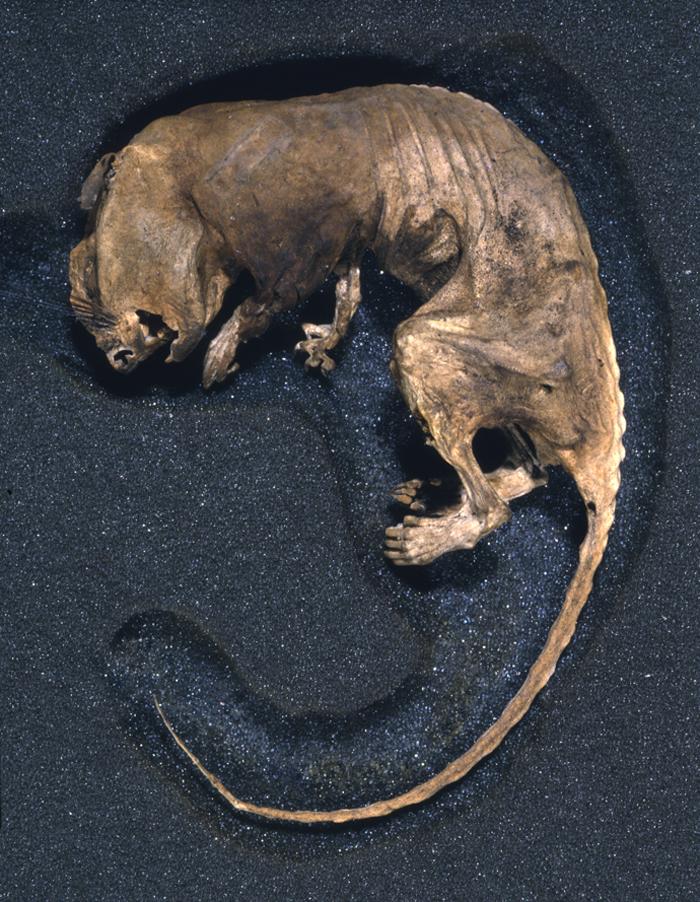
Or, to be more specific, Sir Henry Cole’s Rat (c.1830). As folks at the National Archives describe it…

At 15, Henry Cole, later to find fame as organiser of the Great Exhibition began working with the records of the British government. Shocked at their poor condition he pioneered reform of what became known as the Public Record Office – now The National Archives. This rat, with a stomach full of chewed document, was used as evidence for the poor condition of the records.

Sir Henry Cole’s Rat (c.1830): The National Archives, E 163/24/31

Yep, that’s right. We owe the wonderful institution that we once called the PRO, founded in 1838, to a rat stuffed with irreplaceable manuscripts. And archivists, being the dedicated – one might say obsessive – guardians of history that they are, created a special foam case to preserve this momentous rat for posterity.

A blog

Ever wanted to know what happens behind the scenes at a busy city archive? Of course you do! Well, if the Huntington’s Verso blog isn’t fulfilling all of your archive-blogging needs, check out the team at York who are describing their on-going project to catalogue the city’s immense civic records. Although not specifically ‘early modern’, it does have some fascinating ‘lucky dips’ (what we here call ‘found art’), including councilmen watching naughty films and railwaymen complaining of mouldy fish cakes, as well as some very pretty visual maps of the archives themselves.

If you’re a historian – professional or amateur – I think it can be immensely profitable to get a sense of how archives (and archivists) work. Sure, the difference between ‘functional’ and ‘structural’ arrangements may not sound especially interesting, but it can make a real difference to how you go about your research.

Another warning

This one comes from Tim Hitchcock, and is rather more serious. I think he makes the point I was trying to make here much more effectively than I ever could.

For both technical and legal reasons, in the rush to the online, we have given to the oldest of Western canons a new hyper-availability, and a new authority.  With the exception of the genealogical sites, which themselves reflect the Western bias of their source materials and audience, the most common sort of historical web resource is dedicated to posting the musings of some elite, dead, white, western male – some scientist, or man of letters; or more unusually, some equally elite, dead white woman of letters.  And for legal reasons as much as anything else, it is now much easier to consult the oldest forms of humanities scholarship instead of the more recent and fully engaged varieties.  It is easier to access work from the 1890s, imbued with all the contemporary relevance of the long dead, than it is to use that of the 1990s.

Without serious intent and political will – a determination to digitise the more difficult forms of the non-canonical, the non-Western, the non-elite and the quotidian – the materials that capture the lives and thoughts of the least powerful in society – we will have inadvertently turned a major area of scholarship, in to a fossilised irrelevance.

It would be a cruel irony to digitise vast new swathes of text and images only to discover that we’ve accentuated the very biases that scholars have been fighting against since at least the 1960s. That is not to say that we shouldn’t try to make ever-more sources freely and easily available online – just that we should beware the consequences of grabbing the ‘low-hanging fruit’ and neglecting less accessible sources. We must make a real effort to move beyond ‘the musings of some elite, dead, white, western male’ and save other voices ‘from the enormous condescension of posterity’.

Update (13/01/13): The York archives blog did a new ‘Lucky Dip’ post that early modernists might like which looks at a late seventeenth-century Chamberlain’s Account Book.

REED all about it – Part II: Angelic sheep-stealers, iconophobia, and the unaccountable longevity of ‘Merry England’?

Jonathan Willis

Last month I wrote a REED-related post about a minor scuffle at a church ale in Bere Regis in 1590, but this time I would like to highlight a more significant and well-known case, to my mind one of the real gems of the REED material: the controversy surrounding the performance of the Whitsun plays in Chester during the early 1570s.[1]  There was a rich history of sacred drama in Chester going back at least as far as the late fourteenth century, including plays to celebrate Easter, midsummer, and Corpus Christi.  By the sixteenth century, it was held that the ‘old and Antient Whitson playes’ held annually in the city were ‘first made Englished and published by one Randall Higden a monk of Chester Abbey, and sett forth and played at, and by the Citizens of chester charge In the time of Sir Iohn Arneway Knight, and Major of Chester Anno 1268’.[2]  In 1571-2 the plays were still going strong, and detailed guild accounts give a fascinating insight into both the performances themselves, and the degree of time, effort and resource which went into their preparation.  The Smiths, Cutlers and Plumbers’ Records for that year recorded 3d for equipment (a ‘touyle’), 1s 4d for casting costs (‘seekinge our players’), and 7s 8d worth of beef to sustain them ‘for our genrall rehearse’, along with two whole cheeses and spices for the meat.[3]   An amateur dramatics group, like an army, evidently marched on its stomach, as payments for bread over three separate rehearsal days totalled 4s 10d, and to quench the assembled thirst there was 10s worth of ale and 9d of small ‘beare’.  Alongside the players, payments were also made to musicians and minstrels, as well as 4s 2d ‘to the clergy for the songes’, implying a close relationship between the professional religious institutions of the city (quite possibly the choir of Chester Cathedral) and the amateur efforts of the trade guilds. Continue reading

Fantastic Thoresby – Part I: Dangerous Diaries

Laura Sangha

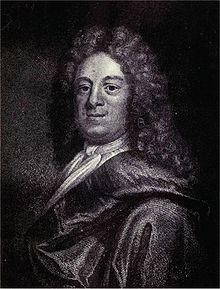
Ralph Thoresby, 1658-1724.

The time has come to introduce many-headed monster readers to my current historical obsession: Ralph Thoresby (1658-1725). Thoresby, the son of a wool merchant, was a well respected antiquarian and topographer, a dissenter who conformed to the Church of England later in life, a husband, a father, a historian, a fellow of the Royal Society, the owner of a museum, a prolific correspondent, and a diarist. Over the summer, I had the pleasure of delving into Thoresby’s diary, which was transcribed and published by the Reverend Joseph Hunter in 1830. Future posts will deal with the content of the diary, which reveal a likeable, pious, and reflective man, but reading it also got me thinking about the ‘diary’ as a historical document, and it is this that I will deal with in this initial post. Continue reading

Eric Hobsbawm: some personal reflections

Brodie Waddell

Busy though I may be, I can’t help but note the death of Eric Hobsbawm and offer a few thoughts.

No doubt our readers will already be familiar with Hobsbawm and his work. If not, the lengthy obituary in the Guardian or this article by the historian Mark Mulholland will make clear his perhaps unmatched contributions to historical knowledge, both popular and academic.¹

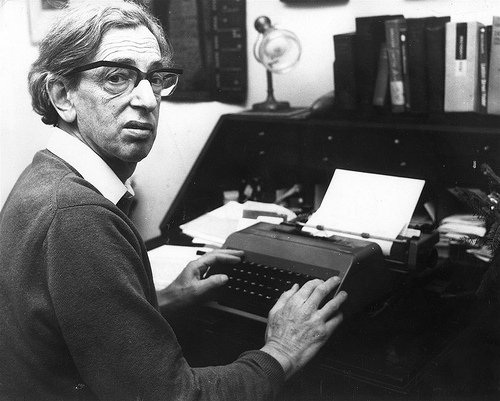
Eric Hobsbawm at his typewriter. Source: John Brown via Jacobin.

Rather than recount his fascinating life or delve into his most famous works, I’d like mention how he (unknowingly) touched my life at a couple of important moments.

The first took the form of his book Uncommon People: Resistance, Rebellion and Jazz (1998) which I received as a gift for, I believe, my seventeenth or eighteenth birthday from my infinitely thoughtful uncles. At the time, I was vaguely interested in history but my contact with truly artful historical writing was negligible. Then I opened this book and found an essay entitled ‘Political Shoemakers’:

The political radicalism of nineteenth-century shoemakers is proverbial. Social historians of a variety of persuasions have described the phenomenon and assumed it needed no explanation. A historian of the German revolution of 1848, for example, concluded that it was “not accidental” that shoemakers “played a dominant role in the activities of the people”. Historians of the “Swing” riots in England referred to the shoemakers’ “notorious radicalism” and Jacques Rougerie accounted for the shoemakers’ prominence in the Paris Commune by referring to their “traditional militancy”. Even so heterodox a writer as Theodore Zeldin accepts the common view on this point. The present paper attempts to account for the remarkable reputation of shoemakers as political radicals.²

The essay goes on to provide plenty of colourful examples drawn from across the globe, but by the time I’d read the first sentence I was already hooked. The image of the militant shoemaker, writing radical manifestos and taking to the barricades, was simply too wonderful for a nerdy teenager to forget.³

Not long after receiving Uncommon People, perhaps in my first or second year as an undergraduate, I came across his Primitive Rebels (1959) in a used book store. I think this may have been the first time I found a work of history that was not only interesting and politically appealing, but also made an important argument about the nature of past societies. Indeed, the book almost single-handedly created a whole new analytical category: ‘social crime’.⁴ I’m not going to claim it was the light on the road to Damascus that turned me into a budding historian, but in retrospect I think it helped to push me in that direction. It’s no accident that the undergrad module I put together for this year includes a week focusing on the debate that this concept spawned.

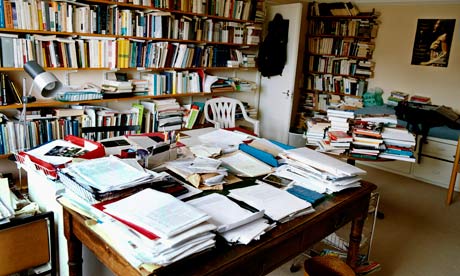
Hobsbawm’s writing room, reassuringly messy. Source: Eamon McCabe via the Gaurdian.

And then, many years later, whilst looking around for something to do at the expiration of my fellowship at Cambridge, imagine my delight at being invited for an interview for a post at Birkbeck. Founded in a tavern as the London Mechanics’ Institute back in 1823, this was the place that Hobsbawm made his academic home when become a lecturer there in 1947. He was still its nominal President when I applied there last year and, despite being in his nineties, my colleagues recount vivid memories of him still occasionally strolling into the department to chat and of course frequently showing up at conferences to engage in conversation (and disputation) with historians less than half his age. I am saddened to have never met him myself, but I hope that in some very small way I can help carry on his legacy at this wonderfully unusual institution.

I would be very curious to hear how some of the monster’s other heads or perhaps some of our readers encountered Hobsbawm’s work. Does anyone have any stories to share?

Footnotes

¹ See also this nice little collection of quotations from the great man himself. The final one ‘On his writing room’s bookshelves’ is particularly pleasing.

² ‘Political Shoemakers’ was co-authored with Joan Wallach Scott and originally published in Past & Present, no. 89 (1980), pp. 86-114

³ Note that this also means, strangely, that I read Hobsbawm before reading E.P. Thompson or Christopher Hill, two other members of the Communist Party Historians Working Group, whose work I cite infinitely more often.

⁴ The Wikipedia article on ‘social bandits’ isn’t bad, but for a more detailed recent discussion, see John Lea, ‘Social Crime Revisited’, Theoretical Criminality, 3:3 (1999) [ungated]. For early modernists, the work on this by Douglas Hay, Peter Linebaugh and E.P. Thompson, especially but not exclusively Albion’s Fatal Tree (1975) and the responses it provoked, is essential reading.