Jonathan Willis
Marooned on an Island Monographs: an English Reformation Summer Reading List
14

Jonathan Willis
Mark Hailwood
The ‘monster now has a number of long running ‘mini-series’ – collections of posts that are grouped around a particular theme, topic, or source collection. For your delectation we now bring you a list of the said mini-series, with a brief description of the contents of each. For future reference the link is just up there, on the right end of the menu bar. Happy browsing!
Laura Sangha
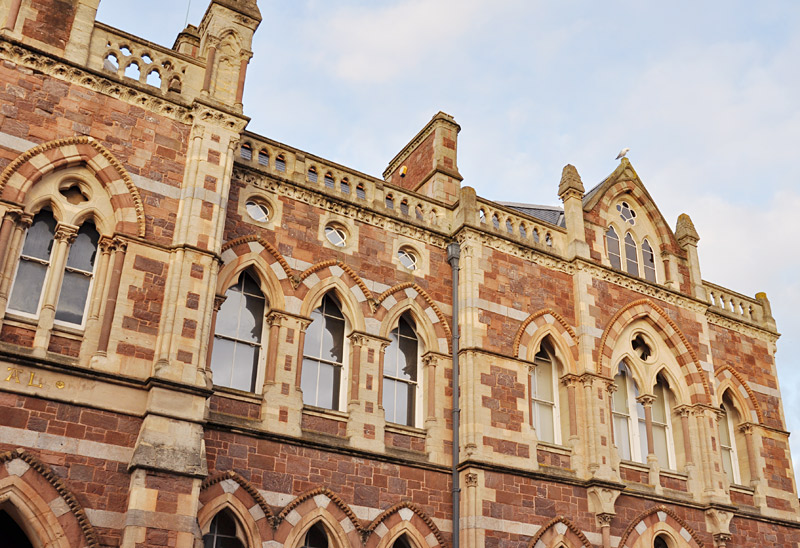
In November I had the pleasure of visiting a wonderful new exhibition at Exeter’s recently refurbished Royal Albert Memorial Museum. Titled ‘West Country to World’s End: the South West in the Tudor Age’, the publicity describes it as ‘celebrating the spirit of adventure and enterprise of south west people’ during the Elizabethan ‘Golden Age’.
In this mini-series of blogs I take monster readers through a virtual tour of some of the exhibition’s objects and images, exploring what they tell us about the history of the early modern South West.
‘West Country to World’s End: the South West in the Tudor Age’ runs until 2 March 2014 at Exeter’s RoyalAlbertMemorialMuseum. You can find all the details about the museum, it’s opening times, it’s wonderful café and more on their website.
Laura Sangha
This is a final post in a short series relating to Exeter’s martyrs memorial, the others are on the following:
In this final post I conclude with some thoughts on the ways that objects and places are invested with meaning, and the relationship between space, memory and history.
My final question about Exeter’s martyr memorial was: what is ‘Livery Dole’? The plaque on the monument stated that Thomas Benet had suffered at ‘Livery Dole’ but although I knew what an aircraft livery was, or could countenance a livery stable, otherwise I was drawing a blank. Exeter Memories came to my rescue again: Livery Dole is an ancient triangular site between what is now Heavitree Road and Magdalen Road. It was used as a place for executions – the last took place in 1818, when the unfortunate Samuel Holmyard was hanged for passing a forged City Bank one pound note.
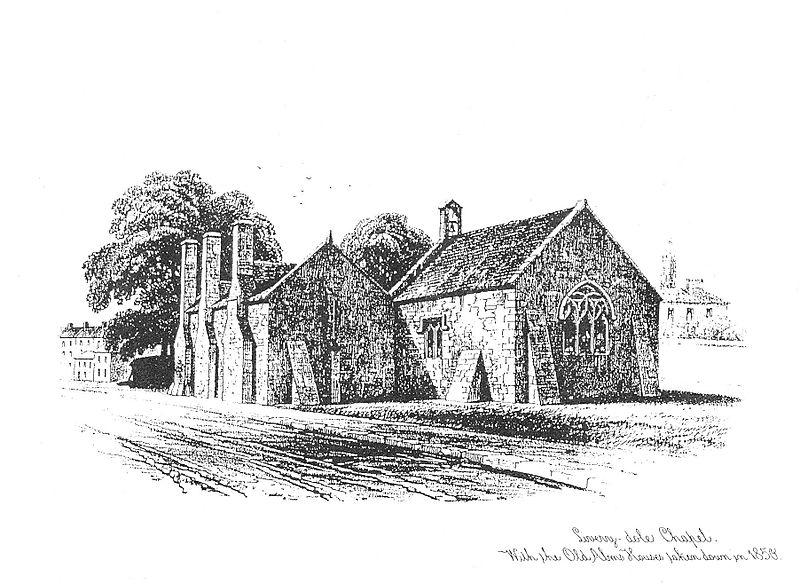
W. Spreat lithograph from 1850 showing the Dennis almshouses before they were replaced.
Liverydole now made sense – it meant that the Exeter memorial had therefore been erected near to the spot where Thomas Benet had been burnt to death. Hence my final post is about the meanings and significance that are attached to particular places and features of the landscape. All of the Protestant monuments that I have uncovered are erected as close as possible to the original site of the martyrdom, they are a deliberate attempt to attach particular memories to those sites, for later generations to read. Nearby, Heavitree’s almshouses represent a similar attempt to shape historical memory – they were erected in 1591 by Sir Robert Dennis, by tradition in penance for the part his ancestor had played in the execution of Thomas Benet in 1531. The ancestor in question was Sir Thomas Dennis, who had been the Sheriff of Exeter at the time and who had sentenced Benet to death. This act of charity proved that the current Sir Dennis was now firmly on the side of the true Church, unlike his unenlightened Catholic ancestor. Continue reading
Laura Sangha
This is the fourth post in a series of posts relating to Exeter’s martyrs memorial, the others are on the following:
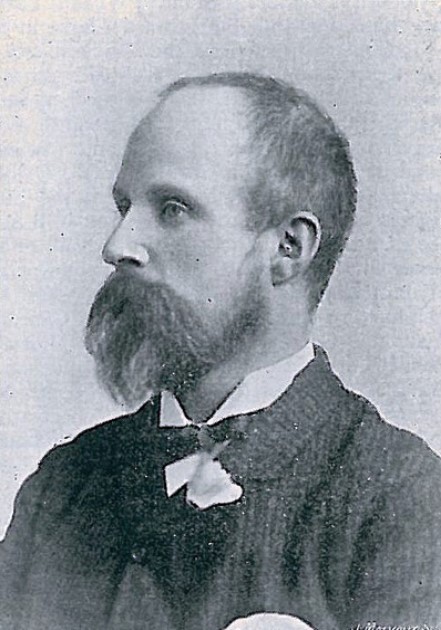
Today’s question is – what do we know about the creation and placing of Exeter’s martyr monument? The endlessly informative Exeter memories website furnished me with more details about the city’s own specimen. Funded by public conscription, it was designed by Exeter’s Harry Hems (above), a London born master sculptor and wood carver, who made Exeter his home. Continue reading
Laura Sangha
This is the third in a series of posts relating to Exeter’s martyr memorial. The first post, contains the details of the martyrs themselves, the second, is on John Foxe’s Actes and Monuments.
What I really wanted to know about Exeter’s martyr monument, was who paid for and created it – when was it erected, how and why? A third plaque on the memorial yielded some information:
To the glory of God & in honour of his faithful witnesses who near this spot yielded their bodies to be burned for love to Christ and in vindication of the principles of the Protestant Reformation this monument was erected by public subscription AD 1909. They being dead yet speak.
Thus the obelisk dates from the twentieth-century, which makes sense – the English Reformation was profoundly iconoclastic and it is hard to imagine money being spent on erecting monuments in an age when destruction of imagery was a mark of Protestant identity. In fact the image of Agnes Prest from the 1887 edition of Foxe that I mentioned 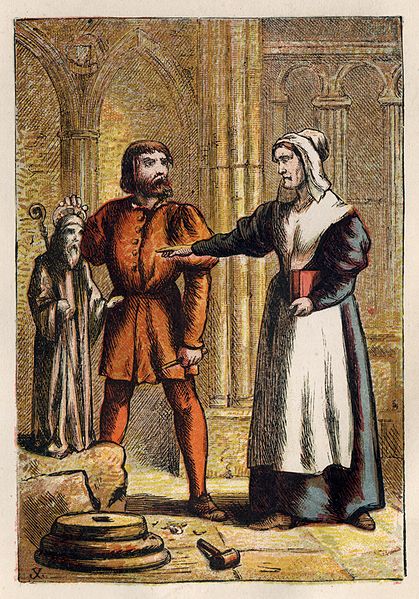 in my previous post supports just this point. It depicts a visit that Prest paid to Exeter Cathedral, where she met a ‘cunning’ Dutch craftsmen who was apparently repairing the images and sculptures that had been disfigured during the previous, iconoclastic reign of Edward VI. Prest supposedly said to the Dutchman ‘what a mad man art thou… to make them new noses, which within a few dayes shall all lose their heades’. In response to this rather prophetic prediction of further reform, the stonemason replied with a well thought out theological argument: ‘Thou art a whore!’. Quick as a flash, Prest replied ‘Nay, thy Images are whores, and thou art a whore hunter: for doth not God say you goe a whoring after straunge Gods, figures of your owne making?’ Continue reading
Laura Sangha
This is the second of a series of posts on issues relating to Exeter’s martyr memorial. The first post discusses the details of the martyrs themselves.
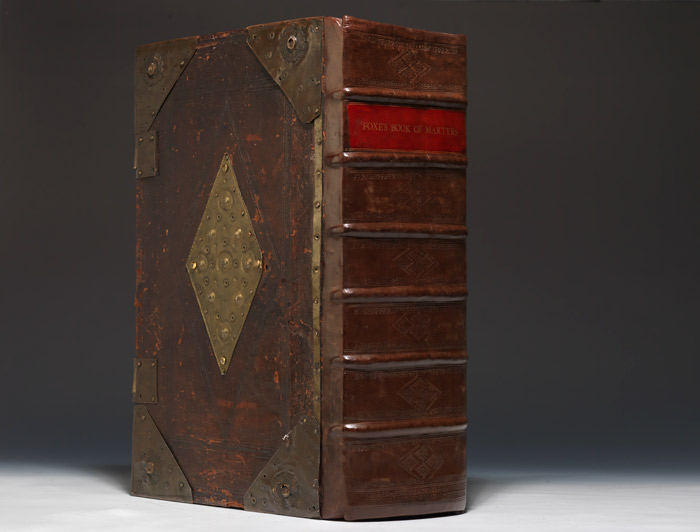
Foxe’s [?] monumental [?] achievement.
I’ve previously discussed images of martyrdom on the monster, in this post I am more concerned with the text as a history of the ‘true’ Church. Continue reading
Laura Sangha
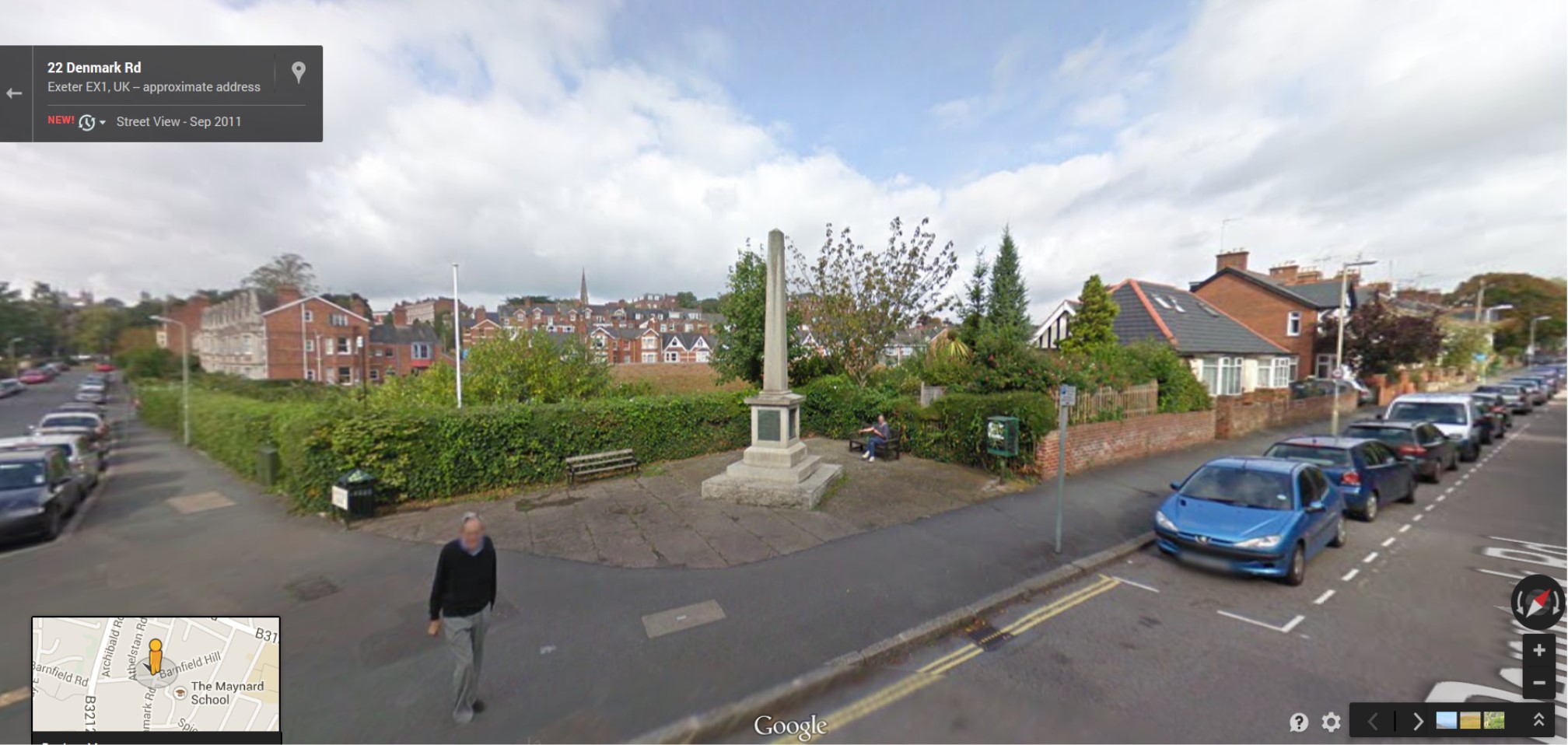 A recent trip to the pub took me into a new part of Exeter, and on my way there I stumbled across a fascinating snapshot of its history. At the corner of Barnfield and Denmark roads I came to a memorial in the form of an obelisk of Dartmoor granite, with four bronze panels around its base. I assumed it was a twentieth-century war memorial, and went to have a closer look at the bronze reliefs – hey, I’m a historian, my profession compels me to! On examination, I was surprised to discover not a weary line
 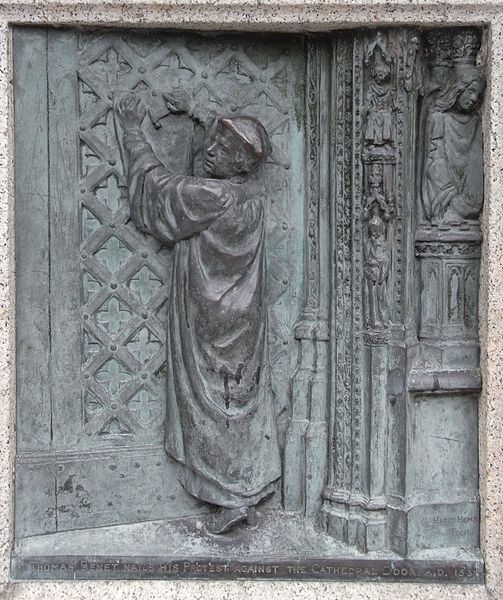 of soldiers in metal helmets, but instead what appeared to be a monk fixing a notice to a wooden door, and I didn’t need the inscription to tell me the door belonged to Exeter Cathedral – an angel from the first tier of sculptures on the West front is clearly depicted on the right hand side. What’s more, a second bronze showed a women chained to a post, clearly suffering a fiery death at the hands of the authorities. Reading the inscriptions, I realised that I had chanced upon a memorial to two sixteenth-century Protestant martyrs who had met their deaths in Exeter.
Firing up the computer on my return home, I soon disappeared down the rabbit hole of the city’s history and our memories, stories about and uses of our past. My initial idea for a brief post mutated into a series of linked musings on the tangled threads of the regional and national history, in all its venerable and unsavoury glory. I’ll be publishing one each day this week. Today I start with the story of the two martyrs commemorated on the memorial, Thomas Benet and Agnes Prest. Continue reading
Brodie Waddell
The UK Independence Party is doing extremely well in the local and European elections held across England yesterday. It is, to put it mildly, an unpleasant sort of political party. It has more than its fair share of bigots and homophobes. But it is more than simply a tribe of disgruntled nostalgics. It’s also a protest party, and its particular brand of protest has venerable linage that goes back to at least the Evil May Day riots of 1517.
The anti-immigrant violence that erupted in London at that time is sometimes dismissed as a mere race riot, emerging from hatred and hardship and nothing more. But when we look more closely at the various accounts of these events, we see that it too was a political protest. One chronicler described how Londoners saw the foreigners in their midst:
the Genowayes, Frenchemen and other straungers sayde and boasted them selfes to be in suche favoure with the kyng and hys counsaill, that they set naughte by the rulers of the citie: And the multitude of straungers was so great about London, that the pore Englishe artificers coulde ska[r]ce get any living: And most of all the straungers were so proude, that they disdained, mocked and oppressed the Englishemen, whiche was the beginning of the grudge.
Locals complained that the ‘strangers’ from overseas flouted the law with impunity, engaging in theft, kidnapping and even murder without facing the punishments that would have been meted out to a common English criminal.
The political element becomes even clearer when we examine the rioters’ main targets. The crowds of hundreds, or possibly thousands, who rushed through the streets that night did not burn and loot indiscriminately. Instead, they attacked the house of a French merchant who was also a royal secretary, the homes of alien artisans at a site officially designated for foreigners, and two ambassadors who were supposed to be under the king’s protection. When the rioters were captured, at least 15 were hanged, drawn and quartered for ‘treason’ because their attacks on the strangers had ‘broken the truce and league’ between Henry VIII and the other princes of Europe.
So, in the eyes of Tudor Londoners, what made these immigrants so dangerous was the apparent alliance between ‘the multitude of straungers’ and ‘the kyng and hys counsaill’. That is to say, the foreign threat came not from poor or marginalised immigrants but from outsiders who enjoyed special privileges and had the support of the political elites.
It would be easy to multiply such examples by looking at other moments of heightened anti-foreigner sentiment in early modern England. One could cite, for example, the opposition to King James I’s favouritism towards his fellow Scots, the francophobic riots of Charles II’s francophile reign, or the anti-Dutch sentiment that bubbled up after William III took the throne in 1689. In each case there were very real resentments about the apparent social and economic impact of immigrant groups, but these were combined with a sense that the current political regime was in league with the foreigners.

A forlorn British worker, supposedly abondoned by Europhile political elites, and a big pointy hand.
UKIP offers a very similar argument. Unlike the BNP, its ideology is not built purely from racism. Instead, it incessantly attacks ‘the political establishment’ in Westminster and in Brussels for compromising British sovereignty by granting special privileges to immigrants. According to Nigel Farange, UKIP is simply providing voters with a weapon with which to attack this two-headed monster: ‘They [the voters] have made the connection. It took me bloody years to get immigration and Europe together, but I knew at the local elections this year it was now the same thing.’
Racism, then, is certainly an important ingredient in UKIP’s noisome ideology but it is not the only one. If we want to understand and counteract the rise of this dangerous party, we need to acknowledge that a vote for UKIP is as much a protest against the failures of Britain’s governing class as it is an anxious reaction against newcomers.
Sources
The events of 1517 are described several primary sources, all of which are freely available online: the chronicle of Edward Hall (1904 edition, edited by Charles Whibley, pp. 153-64, quote at 153-4), the chronicle of the Grey Friars and the Calendar of State Papers, Venetian.
the history of 'the unruly sort of clowns' and other early modern peculiarities
the history of 'the unruly sort of clowns' and other early modern peculiarities
An Open Access Graduate Course on Utopian Thought.
A blog about bodies and medicine c.1500 - 1780
Adventures in the world of history
history/folklore/writing
stories from a nineteenth-century prison
the history of 'the unruly sort of clowns' and other early modern peculiarities
Leverhulme Funded Project at University of Exeter: Adopting a New Methodological Approach to Early Modern Women's Work
Early Modern Material Culture
'Making good use of the things that we find / Things that the everyday folk leave behind': ramblings of an early modern historian
A blog (mostly) about early modern history
crime, women, digital history...
 the many-headed monster