The 100th Post

You are currently reading post number 100 on the many-headed monster. On realising this (statistically) significant event was approaching, we monster heads decided it would be worth marking in some way. The blog has been enormously rewarding as an arena to think through our ideas and to share our archival discoveries, but also as a way to connect with you, the reader. Since our first post in July 2012, we have had more than 40,000 views and 541 comments, and we are enormously grateful that so many people have read our musings and engaged with us on the blog. Thus, this is a round-up of some pearls from the blog archive: our most popular posts, collectively and individually,  alongside a nominated personal favourite from each contributor. Enjoy, and we look forward to continuing to work with you in the future!

Our heaviest traffic on the ‘monster comes from the ‘The Future of History From Below Online Symposium’, a collection of multi-authored papers based on two conferences on the topic. For the heads, this has become an important resource for research and teaching, and was also responsible for our busiest day in July 2013 when we received a spectacular 481 views.

Mark Hailwood

Most popular post: The Immersive Turn: Or, what did a seventeenth-century drinking song sound like? (Nov. 2013)

Nominated post: “many of my favourite ‘monster posts are those that have generated a lot of debate about aspects of ‘the craft’ – digital v archival sources; the use of jargon etc – but the post I would like to nominate here does something rather different: it’s one of Brodie’s ‘Norwich Entertainments’ series, ‘Ballad-singers and dangerous news, with coffee‘ (Nov. 2012). Historians of early modern England now make a lot of use of printed materials like ballads and pamphlets, but we know less than we would like about their dissemination and consumption. This fascinating little post provides us with some valuable insight into the social history of print in an early modern city.”

Laura Sangha

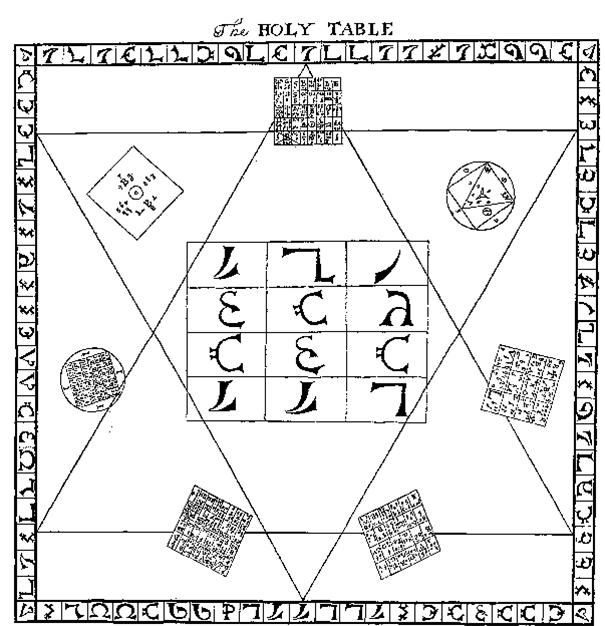
Holy TableMost popular post: John Dee’s conversations with Angels (Nov. 2012)

Nominated post: “Jonathan’s Idols of the mind, or What does God look like? (June 2013) tackles a ticklish question: how did people in the past visualise God? The delightful post explores this central and controversial aspect of the early modern mentality, taking in some wonderful illustrations along the way.”

Brodie WaddellDante_Gabriel_Rossetti_-_Fair_Rosamund

Most popular post: Norwich Entertainments – Part III: A medieval royal mistress in the 17th century and beyond (Aug. 2012)

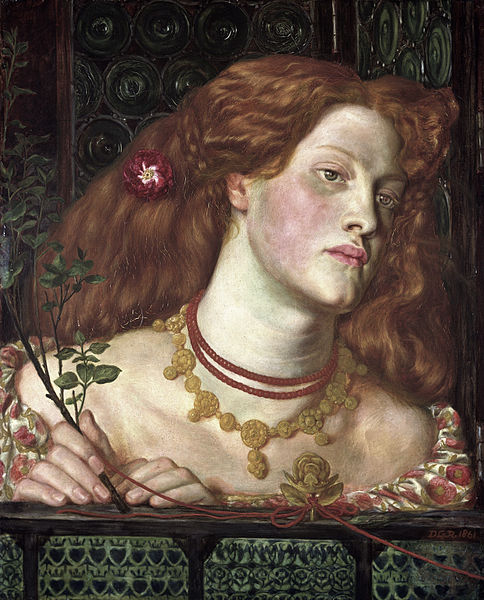
Nominated post: “Laura’s two History and Analogy posts (Sept. 2013). A light-hearted look at one of the least-discussed but most-important aspects of historical writing and teaching. Some of the examples, including some offered in the comments, got me chuckling.”

Jonathan Willis

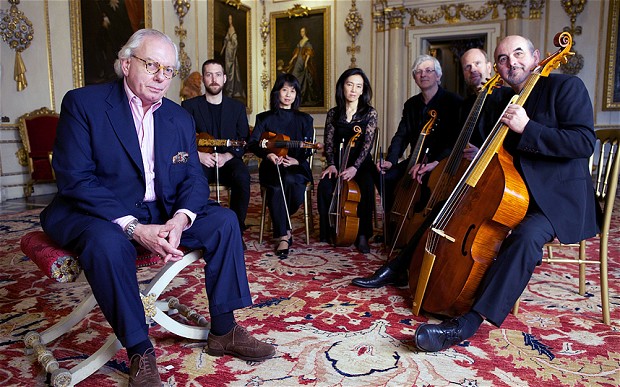
david-starkey_2622826bMost popular post: Tudor history on TV, and a partial review of David Starkey’s ‘Music and Monarchy’ (Aug. 2013)

Nominated post: “Mark’s three-part ‘Workers Representation’ series. As someone who’s worked on ballads primarily as musical and textual artefacts (and for the evidence they provide about religious identity), the use of ballad images for information about occupational identity had never really occurred to me and these are a fascinating series of discussions. If I had to pick just one of the three, I think I’d go for ‘spinning a yarn’ (Sept. 2012): one of my favourite quotes has to be ‘a woman of lower or middling status didn’t need to wear the highest quality clothing to win a man’s heart – she needed to be able to make it’.”

Measuring misery?

Brodie Waddell

In the late sixteenth century, the famed Elizabethan poor laws commanded every parish in the kingdom to relieve their poor residents though local taxation rather than private charity. By around 1800, England’s parishes were spending more than £4 million per year on poor relief.

One of my current research projects is an attempt to examine the nature of this massive expansion in formal, institutional support for the most vulnerable members of the community – that is to say, the rise of the so-called ‘parish welfare state’. I’ve been doing this by looking at the amounts spent by local officers – the overseers of the poor – in a set of sample parishes from across the country. Jonathan Healey at Oxford has been doing much the same, and we have recently decided to work together, combine our data and attempt to come up with a new analysis of this oft-noted development.

I will be discussing some of the early findings from this project at a talk on Friday, February 28th, at the Institute for Historical Research in London, so please do come along if you are interested. However, I thought I might offer one image from the talk here as I think it raises some potentially interesting questions.

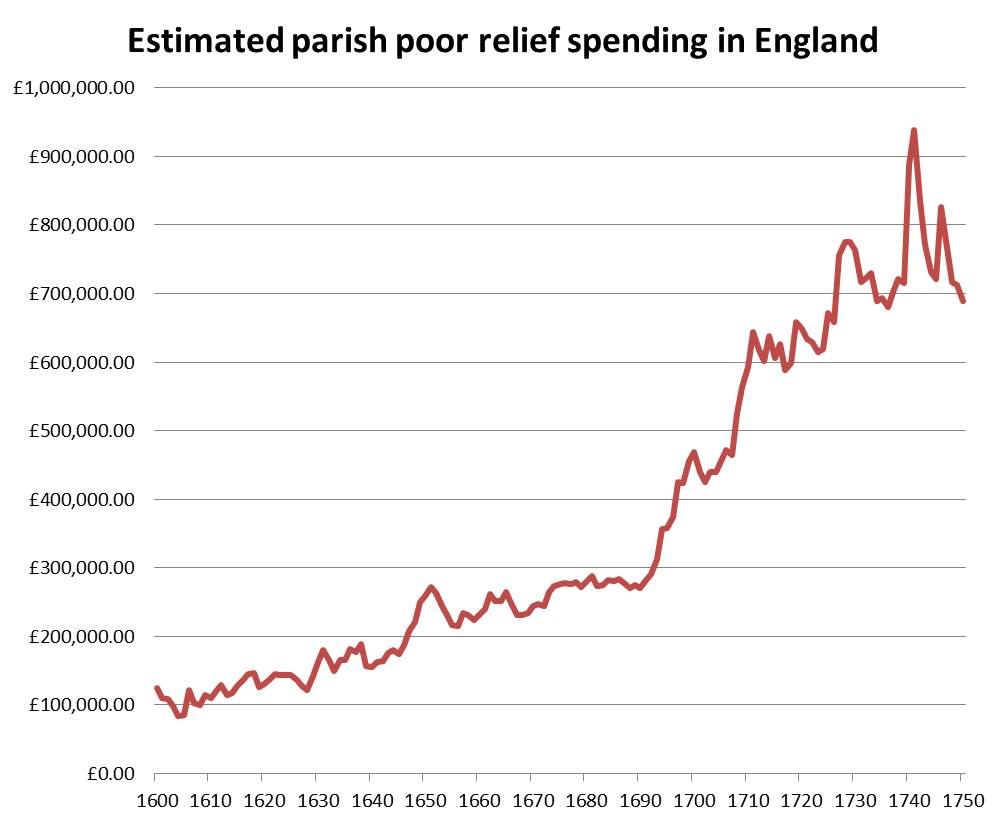
Poor relief spending, 1600-1750 (81 parishes, 24-02-14)What you see above is an estimate for national annual spending on poor relief based on my sample of 81 parishes. There are some significant methodological problems with these estimates – especially for the first few decades – that I will discuss in my talk. But, for the sake of argument, if we assume that this is actually an accurate measure of relief spending in England, the question then becomes: What does this tell us?

It seems to tell us that there was not simply steady growth in relief in the 17th and 18th centuries. Instead, we see periods of extraordinary expansion, of stability and of retrenchment. We also seem to see a shift in the trajectory of the rise sometime in the decades around 1700, when growth seems to have accelerated markedly.

Yet, this graph is also extremely opaque. There is much that it does not tell us.

For example, what about non-parochial poor relief, such as formal charitable bequests or informal personal giving? Did this follow a similar pattern? Or was it working in the opposite direction?

What, too, about regional differences? Was there similar growth in sleepy country villages as in booming industrial towns?

Even more significantly, this graph tells us little about why parish welfare was expanding in this period. Although we can speculate based what we know about the periods of greatest expansion, the raw numbers in themselves cannot reveal short-term economic pressures or changing legal contexts.

Finally, and perhaps most importantly, this bare line may obscure the nature of relief, which was after all a relationship between human beings who normally knew each other – not simply an anonymous financial transaction.

Did those who received relief actively demand it or passively accept it? Did those who distributed it do so gladly, grudgingly or fearfully – as an act of Christian charity, or out of mere legal obligation, or to stave of the threat of disorder? Was such relief considered the poor’s rightful entitlement? Or was it conditional upon their obedience and reputation for morality?

In other words, whilst this chart may offer a useful bird’s eye view of the emergence of perhaps the world’s first nation-wide welfare system, its lack of a human dimension may also actively mislead us about the nature of this system. For that, we must look to records in which real individuals – such as Mary Stevens, the 101-year-old vagrant – step out of the page to meet us.

Acknowledgements

The 81 sample parishes upon which the chart is based include 24 whose totals were generously provided by other historians. I am therefore very grateful to the late Joan Kent via Steve King (for 9 parishes), Henry French (7 parishes), Jeremy Boulton (3 parishes), Tim Hitchcock & Bob Shoemaker (2 parishes), John Broad (2 parishes) and Steve Hindle (1 parish). If you or any of your colleagues have data on parish poor relief before 1834 that you are willing to share, please get in touch!

Fantastic Thoresby – Part III: historic storms, floods and corpses washed out of graves

Laura Sangha

This post is part of an occasional series on antiquarian, topographer and dissenter Ralph Thoresby (1658-1725).

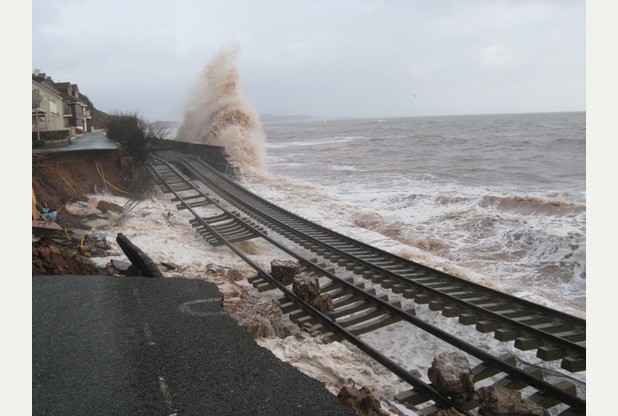
dawlish railwayIt’s been a little wet in the south of England this winter, as some of you may have noticed. Storm has followed storm, houses have been flooded, villages cut off, and here in the south west the railway at Dawlish washed away. This has precipitated a deluge of news stories dragging out all sorts of beloved clichés as the media bandwagon has careered on its merry way. Predictably a political row about the causes of flooding has erupted where Conservatives have blamed Labour for previous policy mistakes and Labour have accused the government of ignoring climate change. But the storms have proven to be a delightfully flexible concept, allowing for commentary on all sorts of social issues, including: the storm blitz spirit, the storms and austerity, the storms and the royal family, the storms and the proposed high speed rail link, the storms and the under-equipped army, and my personal favourite, the storms and the mysterious case of the python that was battered to death in the night-time.

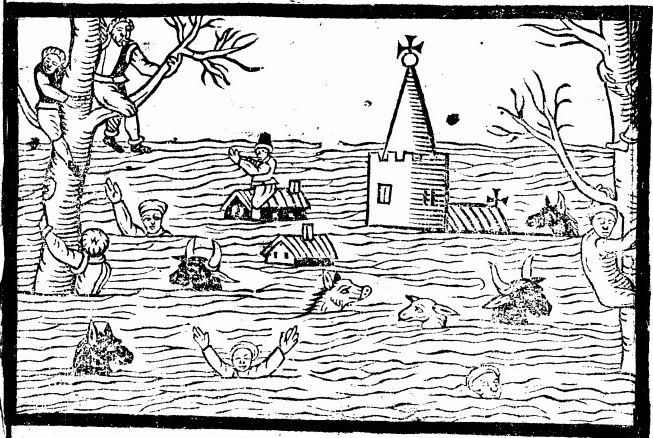
1607 FloodPerhaps more interestingly, the storms have also prompted some writing on historic bad weather and its consequences – I am sure I am not the only early modern historian who was delighted to see a seventeenth century woodcut on the front page of the Guardian’s website on February 12. We were also offered some timely musings on Daniel Defoe’s The Storm, his memorial to the hurricane that pummelled northern Europe in 1703, and this blog on eighteenth-century ‘climate change advocates’ provided some interesting historical context. Continue reading

History from below at NACBS

We don’t generally advertise events, but given the recent interest on the Monster in ‘history from below’, we thought we’d pass along a request from a colleague:

We are looking to put together a panel – provisionally entitled ‘New approaches to History from Below in Early Modern England, c. 1500-1800’ – for the upcoming North American Conference on British Studies in Minneapolis, MN, 7-9 November 2014.

We invite papers that:
– offer methodologically innovative approaches to understanding the continued relevance and significance of history from below
– suggest potential new directions and future possibilities of history from below
– consider what history from below can tell us and the significance of the different worlds it can reveal

Papers could take the form of case studies; discussions of the historiography of history from below in early modern England; explorations of the interaction between different analytical categories (e.g. class and gender); theoretical treatments; etc.

Please submit a 300 word abstract and one-page CV to hillary.taylor@yale.edu by Tuesday February 25th for the March 1st NACBS submission deadline. Proposals from graduate students and established scholars are equally welcome.

Feel free to be in touch with any questions.

All best,

Jason Rozumalski (PhD candidate, Berkeley)
Hillary Taylor (PhD candidate, Yale)

Dead white men

Brodie Waddell

There has been rather a lot discussion on this blog of two pioneering historians: E.P. Thompson and Eric Hobsbawm.

For those of you who are keen to hear more about these two, I’d like to mention a couple of events that will be of interest. For those of you who are tired of me blathering on about dead white men, I can promise that both of these events are actually focused on the impact of Thompson and Hobsbawm’s ideas – rather than on the men themselves – and that after this post I’ll shut up about them for a while.

The first event was a panel on the legacy of Thompson’s The Making of the English Working Class (1963). The talks and discussion were recorded, and the podcasts are now freely available here. I believe the slides will also be available for download at some point soon.

There were three panellists. Professor Sander Gilman (Emory) focused on the ‘Englishness’ of The Making and the problematic place of Jews in this story. Professor Jane Humphries (Oxford) presented a wonderfully incisive look at the how the ‘sentimentalist’ and ‘pessimistic’ interpretation of the Industrial Revolution has been recently reinvigorated by rigorous quantitative research, including her own book on Childhood and Child Labour British Industrial Revolution (2011). Last, and definitely least, I expanded on some of the ideas that I had presented in my earlier piece on the future of ‘history from below’, drawing on the wider discussion in our online symposium, particularly the contributions from Mark Hailwood and Samantha Shave.

Hobsbawm image_previewThe second event I’d like to mention is the huge conference on ‘History after Hobsbawm’ that will be held at Birkbeck at the end of April. It’s going to be quite an occasion – I don’t think I’ve ever seen so many big-name ‘Munros’ from the world of history on a single programme. Although the event will partly be a celebration of Hobsbawm’s legacy, it also promises to be a forum for leading historians to tackle big issues such as nationalism, protest, class, environment, and so on. I won’t attempt to list all the speakers except to say that I’m particularly looking forward to the panels on ‘the crisis of the 17th century’ (Sanjay Subrahmanyam, Geoffrey Parker, John Elliott), on ‘Marxist and post-Marxist social history’ (Andy Wood, Jane Whittle, Lucy Robinson), and on ‘Frameworks of historical explanation’ (Peter Burke, Joanna Innes, Renaud Morieux). I hope to see some of you there.

Mary Stevens, vagrant, age 101

Brodie Waddell

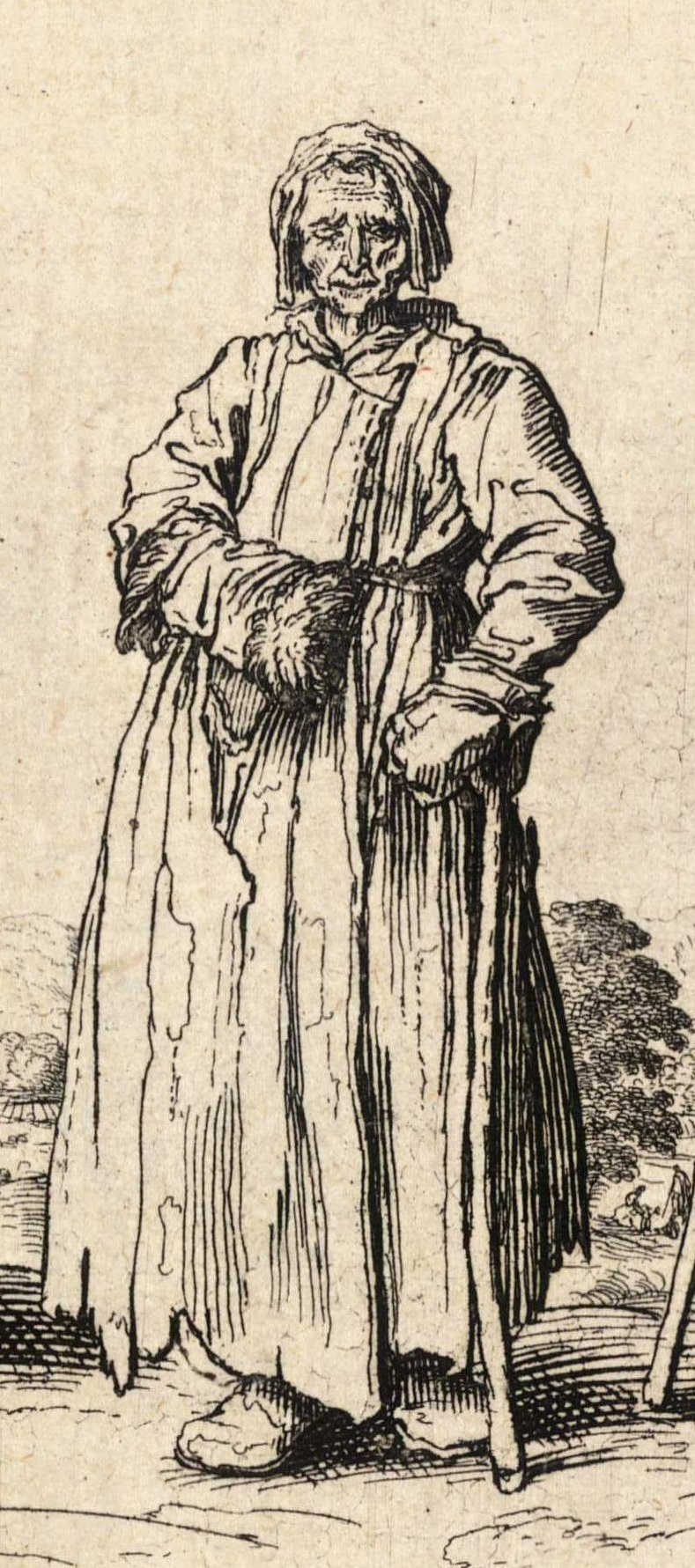
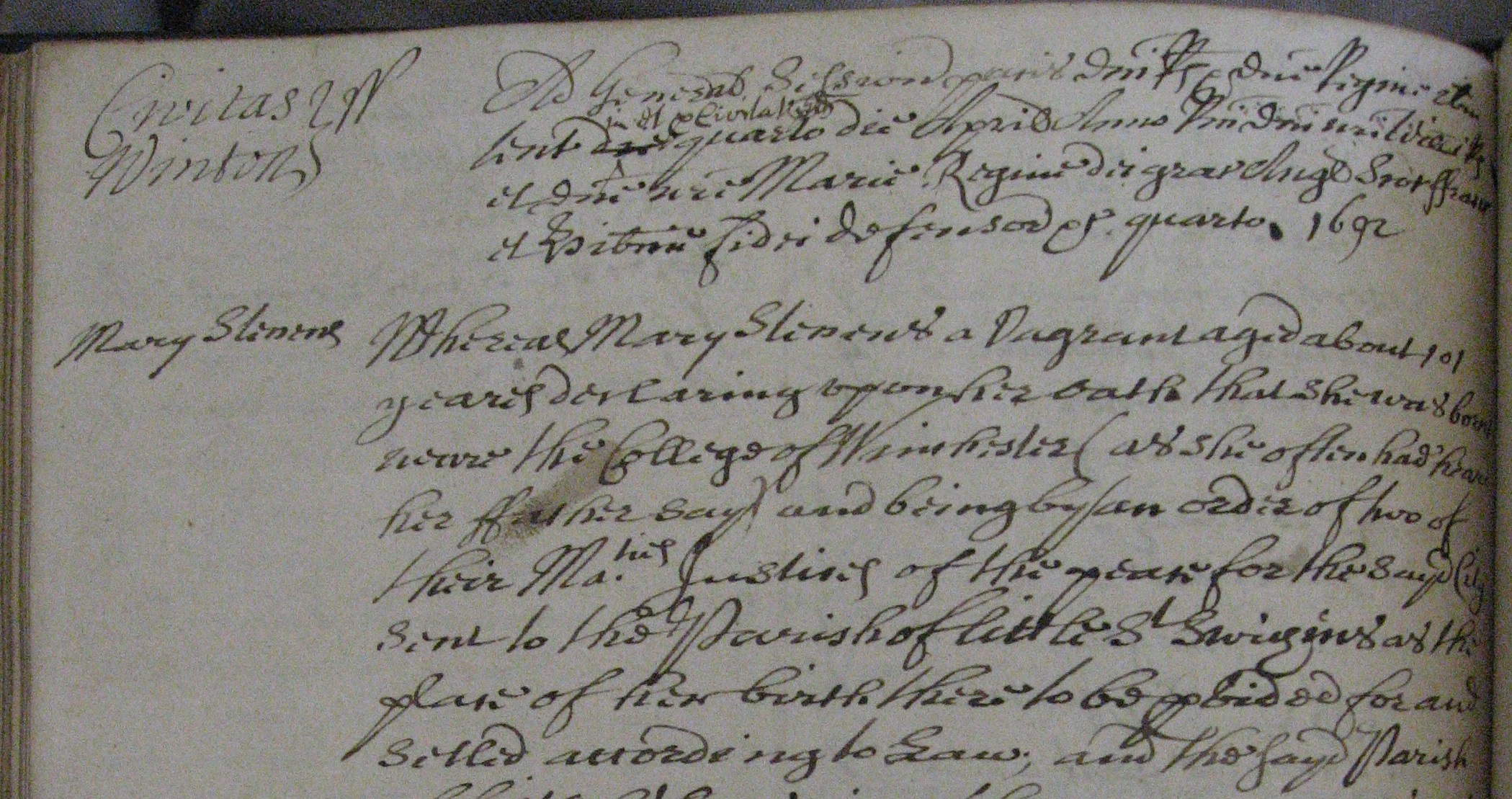
On the fourth of April 1692, the city fathers of Winchester assembled at one of their splendid quarterly courts to judge criminals, hear disputes and resolve pressing civic concerns. As was often the case, one of the poor souls who found herself standing before them was an alleged vagrant. The magistrates probably examined dozens of vagrants in a typical year, but this one was a bit different – she was over 100 years old.

From Wenceslaus Hollar, ‘Men and Women Beggars’ (1625-77)

From Wenceslaus Hollar, ‘Men and Women Beggars’ (1625-77)

The clerk described her as ‘Mary Stevens a Vagrant aged about 101 yeares’ and noted that she swore ‘upon her oath that she was born neare the College of Winchester (as she often had heard her Father say)’.

In other words, this was a woman had apparently been born sometime around 1591, in the final decade of the reign of Elizabeth I, only a few streets away from the court where she now stood. She had outlived four monarchs and Oliver Cromwell. She had survived a decade of civil wars, another decade of republican rule, the country’s last great visitation of the plague, and then yet another revolution only three years earlier. And, given her description as a ‘vagrant’, she had probably spent many months or years on the road and seen the effects of these upheavals with her own eyes. Yet here she was, back in Winchester.

So why had she come back? The examination does not tell us. Perhaps she had come on her own accord. Or perhaps had been sent back from somewhere further afield, whether a neighbouring village or halfway across the country.

This wouldn’t have been unusual. Beggars and paupers were regularly seized by the constables and brought before the local Justices of the Peace. If they were accused of ‘vagrancy’ – a criminal offence usually defined as ‘wandering and begging’ – they could be punished by whipping or imprisonment in the local house of correction, before being expelled to their place of birth. In other cases, they might be defined as one of the ‘deserving poor’ and escape punishment, but still be sent to a ‘home’ they had long-since abandoned.

What we do know is that once Mary Stevens had arrived back in the area, she was then sent back and forth between the city of Winchester and the parish of ‘little St Swigins’ (St Swithuns) next to Winchester College, presumably just outside the city’s jurisdiction. Neither the city nor St Swithuns wanted to pay the cost of supporting her.

We can only hope that the new order issued by the Winchester authorities – sending her to St Swithuns ‘to be provided for and setled according to Law’ – was the conclusion of this petty jurisdictional argument. There she may have finally become a ‘lawfull & settled Inhabitant’.

With luck, Mary Stevens’ days of ‘wandering and begging’ were over. At age 101, she deserved a rest.

Mary Stevens, vagrant, age 101 IMG_3977Source
Hampshire Record Office, W/D3/1, fol. 79: examination of Mary Stevens, 4 April 1692

Some Further Reading
A.L. Beier, Masterless Men: The Vagrancy Problem in England 1560-1640 (1985)
Steve Hindle, On the Parish? The Micro-Politics of Poor Relief in Rural England, c. 1550-1750 (2004)
David Hitchcock (ed.), ‘Poverty and Mobility in England, 1600-1850’, Rural History, 24:1 (April 2013), special issue.
Tim Hitchcock, Down and Out in Eighteenth-Century London (2004)

The Tudor South West at Exeter’s Royal Albert Memorial Museum: Part 5 – Parting thoughts

Laura Sangha

This is the fifth post in a week long series about an exhibition at Exeter’s museum.

In this final post I offer some brief parting thoughts on the success of the exhibition as an exploration of a complicated and dynamic society.

A skilled society

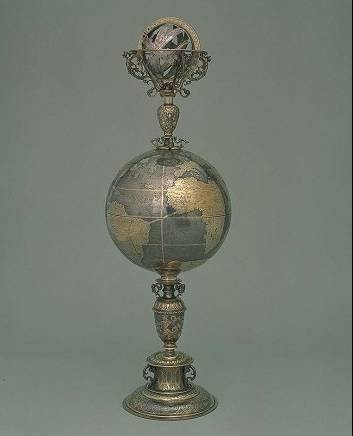
It was clear that this was a highly creative drakes cup editsociety, with many accomplished practitioners of the arts and crafts. Perhaps this is overemphasised by the very nature of museum exhibitions that are likely to contain a preponderance of manufactured objects and paintings, but that does not detract from the quality of the items on display. There are more prestigious objects such as the Drake Cup (c. 1595). By tradition it was given to Drake by Elizabeth I after he circumnavigated the globe, its silver gilt engraved with a map of the world, complete with names of continents, islands and seas in Latin, plus sailing ships, whales and dolphins. Its hard to imagine anyone actually drinking out of this (it’s enormous and unwieldy for a start), but the same is certainly not true of more everyday objects such as the glazed stoneware drinking vessels and delicate silver spoons also in the collection – whilst important indicators of status and often treasured family possessions, these items were made to be used, not rest on a shelf.

An intellectual society

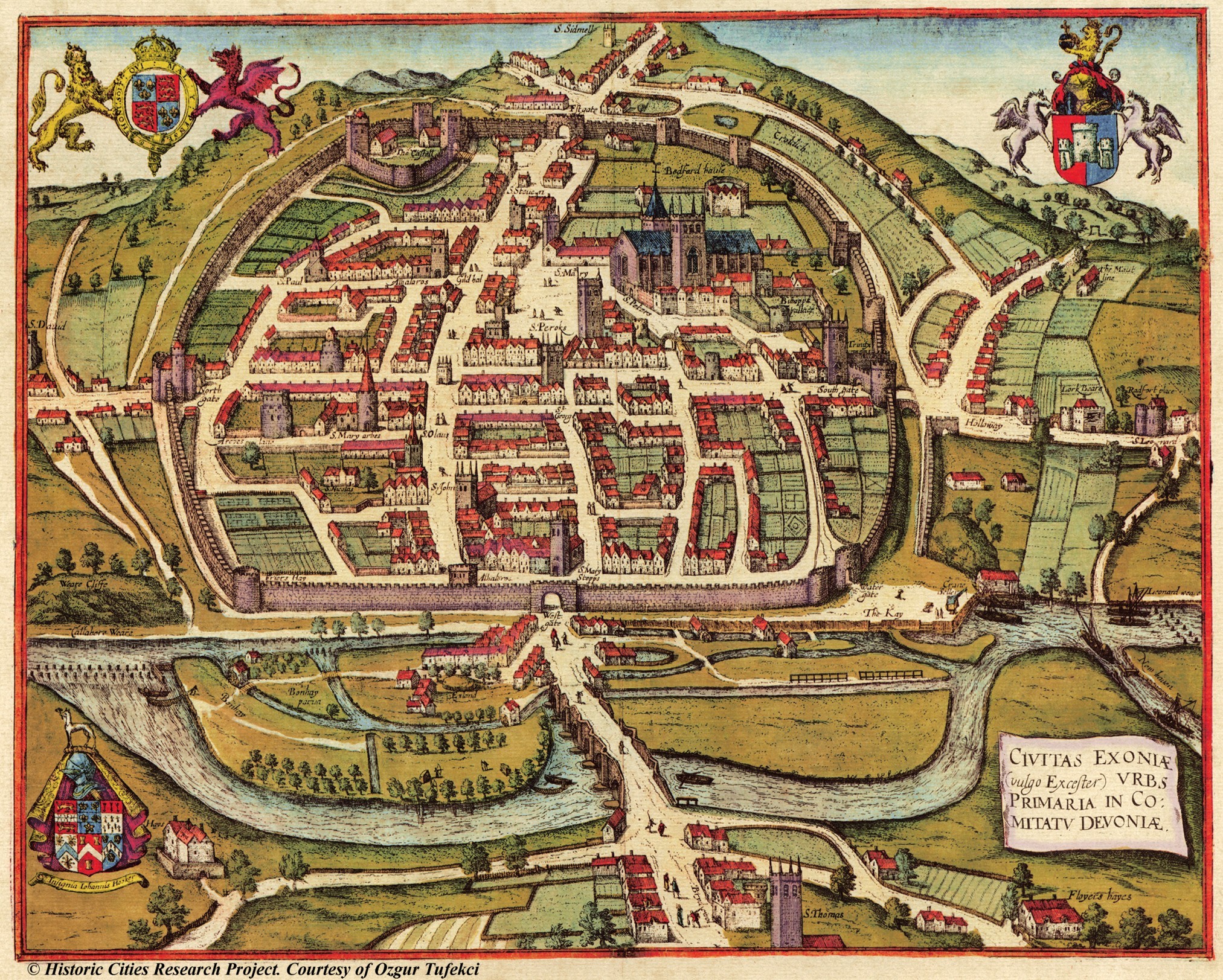
As ever, I am left to marvel at the intellectual sophistication of people in the distant past, in an era that most people now would think of as the technological dark ages. In terms of intellectual activity the pre-modern period was not backwards or uncivilised, this was a society that exhibited civic pride (for more see day 1: a map of Exeter), where renaissance style and learning was spreading, and where important topographers (such as mapmaker John Norden) and antiquarians (such as Richard Carew) were beginning to make their mark. Another nugget that I learned at the exhibition – Sir Thomas Bodley, the founder of Oxford’s Bodleian library, was born in Exeter.

A Protestant society

As a religious historian I am particularly sensitive to the Protestantism that underpins late Tudor society, but I think few historians would disagree that the Reformation’s repercussions were also to be cathedralfelt in every sphere of daily life. From the goldsmiths who prospered when reshaping church plate for a new liturgy (for more see day 3: a Devon communion cup), to the soldiers engaged in an epic struggle against the antichrist and international Catholicism (for more see day 4: the Spanish Armadas), to those for whom scripture became deeply embedded in their ways of expressing themselves and in guiding their everyday activities (for more see day 2: domestic decoration), Protestantism was key. We can’t even begin to understand this society without considering it.

An ambitious society

On his talking tour, exhibition curator and Exeter Professor Sam Smiles described Francis Drake as the Neil Armstrong of his age, and the analogy struck a chord with me that kept reverberating. Partly because it immediately suggested the celebrity of the man – how many contemporaries knew Drake’s name? Current scholarship has a tendency to be picture-astronaut-walking-legsceptical about the importance of exploration for sixteenth century societies, with claims that few people were aware of new discoveries which made little impact on ordinary people’s lives. But the Armstrong analogy is intriguing because of what it suggests about the mentality of the Elizabethans. Clearly some were ambitious, self-confident, cocky even, heading into the unknown on the uncertain hope of economic rewards and a boost for their honour and all important reputation. This was a society where political success and innovation or entrepreneurship were occasionally linked. And it is undoubtedly true that whilst precedent, custom and tradition were revered this was not to the exclusion of novelty.

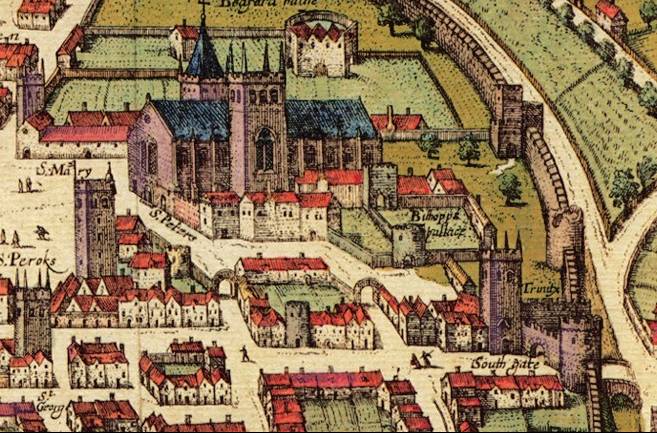
Two maps in the exhibition really capture this duality. The first is the map of Exeter that I discussed in my first post.

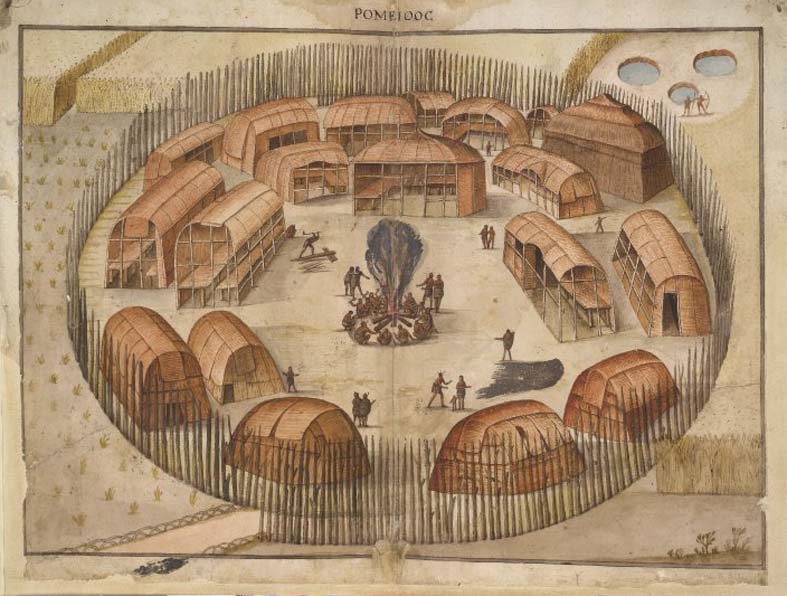
braun_hogenberg_VIThe second is a map of the North America village of Pomeiooc, on Roanoke Island (1585-93).

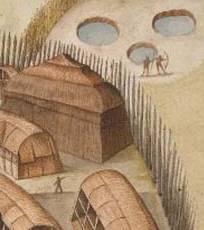
the-village-of-pomeiooc1Placed next to each other, the similarities between early modern Exeter and Pomeiooc are striking. Pomeiooc is presented as a well ordered settlement, encased in a wooden palisade for defence, it’s inhabitants are hunters, fishers and farmers. Sophisticated visual techniques are again on display – some of the houses are ‘cut away’ to reveal their inner organisation, and there is even a chap practising his archery by the fishing pools in the top right corner, just like in the map of Exeter. As before, this might tell us just as much about the European who painted the map as it does the native Americans that it depicts. It might reveal the tendency of archerEuropeans to impose their own understandings and framework on the new cultures and societies that they encountered in far away places. It might be propaganda, designed to support overseas settlement by enticing potential settlers to the New World – like Exeter, Pomeiooc looks like a productive and fertile community (though I do wonder, what is that wooden fence keeping out…?). It certainly suggests that not all Europeans dismissed these people as barbaric savages, and that they could identify similarities between their own society and non-European counterparts.

An impressive society, an excellent exhibition

All in all, I was deeply impressed by both the achievements and complexity of the Tudor south west, as well as the exhibition’s capacity to capture and explore it. The Golden Age is here in all it’s glory – crafts, art, architecture, entrepreneurs, discovery, military triumph, intellectual development.

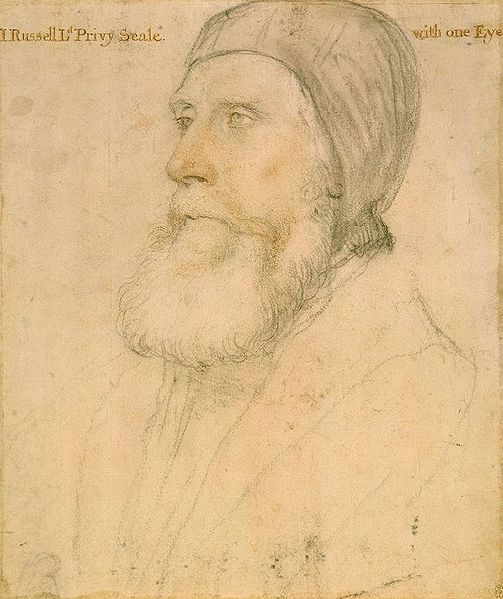
My only remaining niggle is that the difficulties, the struggles and the violence of the age are largely absent. Here we see the middling and upper sections of Elizabethan society, but these objects are largely silent about the lower sorts, the people suffering in the hardships of the 1590s, the people resisting religious change and suffering due to economic trends. We do come face to face with Lord John Russell, 1st earl of Bedford,John_Russell_Earl_of_Bedford_Hans_Holbein_the_Younger in a sketch by Holbein the younger. Russell was in charge of the forces that brutally suppressed the West Country or Prayer Book Rebellion in 1549, slaughtering hundreds in a number of bloody encounters around Exeter. But here his image must serve as the only reference to the scars left on the south west by that tragic rebellion. Of course, it would be strange to linger on these more troubling aspects of the period in an exhibition that is intended as a pointer to the south west’s ‘manifold contribution to the Tudor age’, and these comments are not intended as a (horribly unfair) criticism of the exhibition. They are included here as representative of my worry that perhaps there is too little space for the lower sorts in our museums and a reminder that we should fight hard to make sure they can find a place.

In summary, this is undoubtedly an excellent exhibition that certainly fulfils its remit of revealing the intellectual, artistic and economic importance of south west in the Tudor Age. The sophistication of this society is perhaps the most striking impression that one is left with: despite being a geographically-peripheral region, this was by no means a provincial backwater. Head to the RAMM to see for yourself.

‘West Country to World’s End: the South West in the Tudor Age’ runs until 2 March 2014 at Exeter’s Royal Albert Memorial Museum. You can find all the details about the museum, it’s opening times, it’s wonderful café and more here

The Tudor South West at Exeter’s Royal Albert Memorial Museum: Part 4 – The Spanish Armadas

Laura Sangha

This is the fourth post in a week long series about an exhibition at Exeter’s museum. Click on pictures for enlargements.

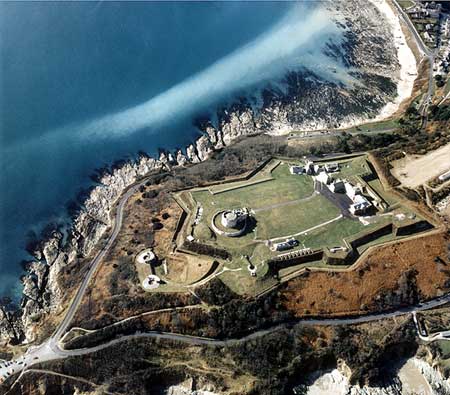
Pendennis Castle, Cornwall.

Pendennis Castle, Cornwall.

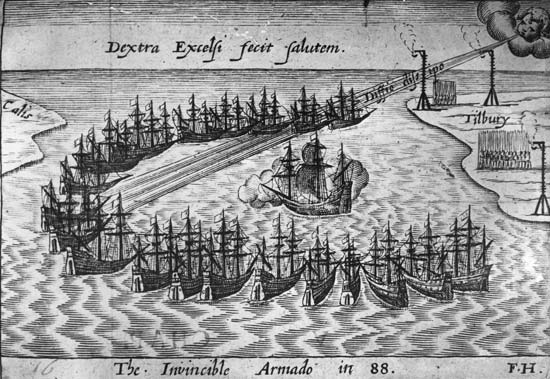
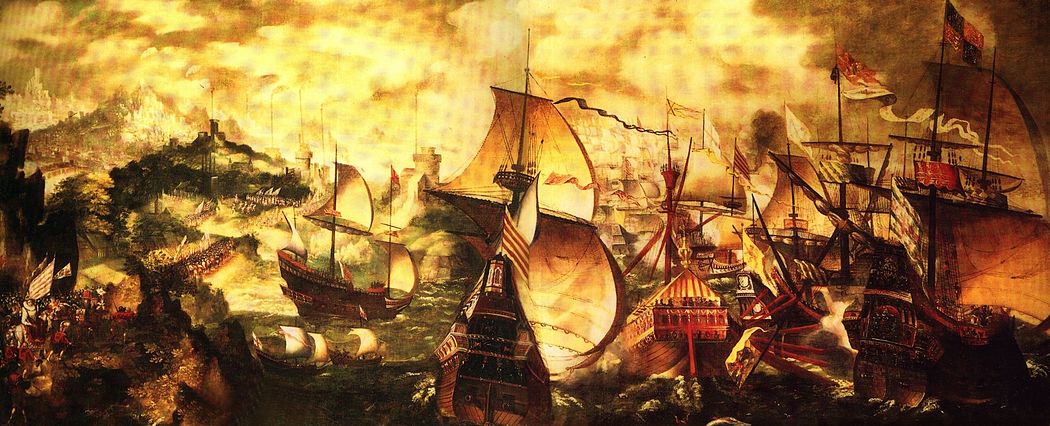
Politically, the south west was of crucial importance during Elizabeth’s reign when hostilities with Spain put Devon and Cornwall in the front line. This drew the region into events of national importance, but these events were also experienced on a local level and were of particular significance for the region. The 1588 Spanish Armada is probably the best known event of Elizabeth’s realm, and is certainly the most iconic, but for the south west things didn’t end there: two more invasion fleets sailed for Britain in 1596 and 1597. From the exhibition catalogue I learned that the region had in fact had been repeatedly strengthened militarily during the Tudor era – forts were constructed at western harbours in the reign of Henry VIIII, including the impressive examples at St Mawes (1543) and Pendennis (1546). In Elizabeth’s reign, Plymouth’s St Nicholas Island was heavily fortified in 1583-85 and Sir Richard Grenville was given command of the defence of Devon and Cornwall in March 1587, when he readied the equipment and defences of the peninsula. Anxieties remained high throughout the 1590s, Plymouth received more fortifications, and a small force landed at Mousehole, Newlyn and Penryn in 1595, doing extensive damage when they set them afire.

But it was the 1588 Spanish Armada that really became embedded in national consciousness and whose memory has endured. This is surely because the failed invasion was accorded with such importance at the time. Special forms of prayer were issued by the government giving thanks for the nation’s deliverance, and celebrations wind-blowing-on-armadamarking the defeat became a regular fixture in a rapidly developing new national ‘Protestant’ calendar, as David Cressy has documented. In the epic struggle between Catholicism and Protestantism, God appeared to have revealed his hand, assisting the numerically inferior and poorer Protestant forces to miraculously defeat the mighty fleet of a Catholic superpower. This was not a mere fluke convergence of bad weather and inspired naval leadership, this was a providential deliverance. The ‘Protestant wind’ that sent the Spanish ships into disarray was proof of God’s special care and protection of his chosen people, those Protestants who professed the ‘true’ faith.

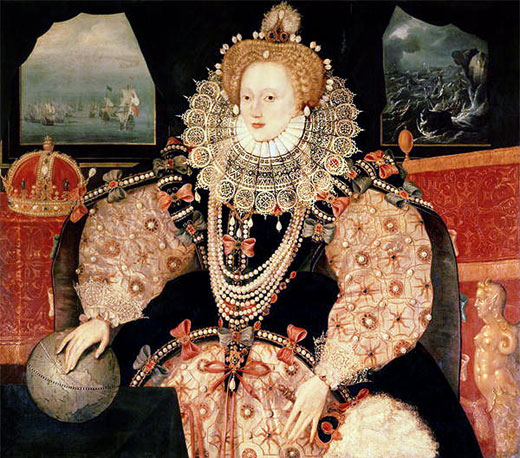
ELIZ portraitEven at the time the iconography of the Armada was well developed (again giving lie to the ‘iconophobia’ discussed in a previous post). If you see a crescent of tall masted ships you are probably looking at a representation of the Armada of 1588, and there a few examples of these crescents in the RAMM’s exhibition. Most obviously, there is the ‘Armada Portrait’ of Elizabeth I, so called because the queen is framed by two images of the naval action. Above the queen’s left shoulder the English ships are shown bravely sailing towards a confrontation with the Spanish fleet in its distinctive crescent formation; over her right shoulder a wreckage strewn seascape represents the remains of the once proud Spanish fleet.

Augustine Ryther engraving, note Exeter top right.

Augustine Ryther engraving, note Exeter top left.

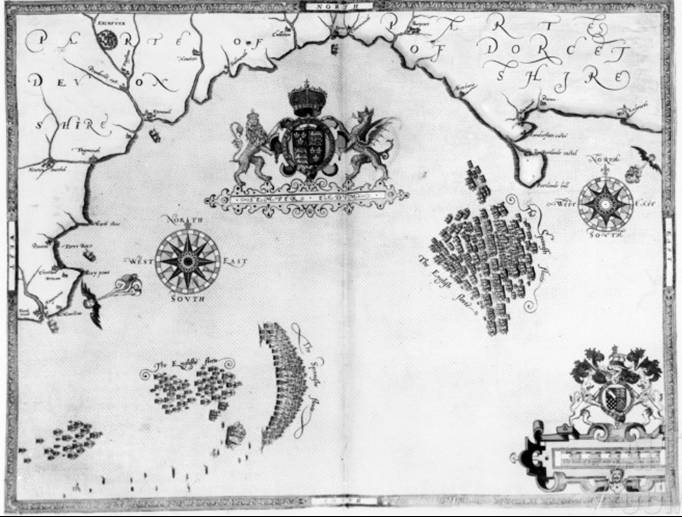
The exhibition also houses a wonderful series of exquisite hand coloured engravings, telling the story of the engagements off the Devon and Cornish coasts. The engravings were produced by Augustine Ryther from charts which recorded the route of the Armada around the coast. They really do provide the story of the events – this black and white copy shows the recognisable crescent shape of the fleet, and collapses the timing of the events so that two parts of the action are shown simultaneously, creating an easily understood narrative. This is a technique that I often encounter when examining early printed material with my students, particularly those ballads and broadsheets that seem to be aimed at the least literate members of society.

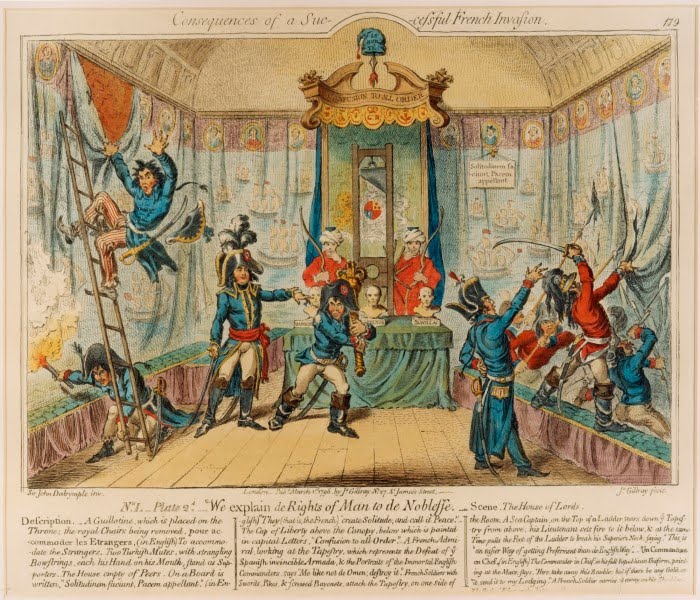
cartoon with tapestriesThe prints are similar to the tapestries that were hung in Parliament in 1650. Commissioned in 1592, the ten tapestries were enormously expensive, costing £1,582 (the equivalent of 87 years wages for a labourer in 1590); and enormous in size: we think they measured 14 feet in height and between 17 and 28 feet in width. In 1650 they found their way into the Houses of Parliament, where they were mentioned in debate on several occasions. As if further evidence were needed of the longevity and significance of the Spanish Armada, in 1798 when there were concerns about a possible French invasion, the artist James Gillray was commissioned to produce images that would rouse patriotic fervour in the English people – the series of satirical prints he produced included one (above) depicting a French Admiral ordering his men to destroy the Armada tapestries.

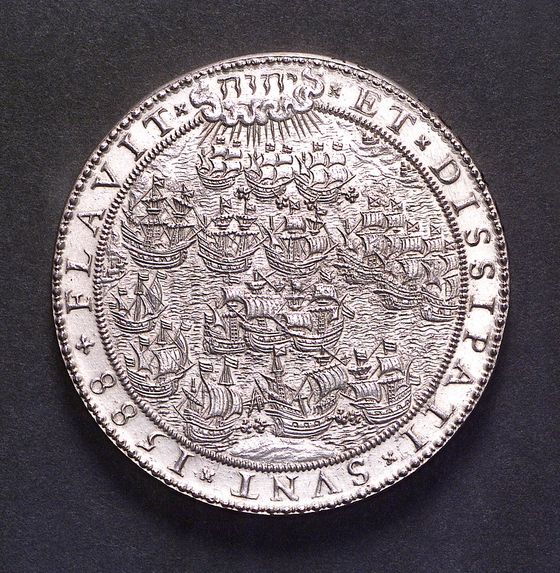
medalFinally, amongst other Armada memorabilia in the collection there is also a commemorative medal similar to the one in the picture. These were not only produced in England but also in other Protestant nations, indicating the way that the defeat of Catholic Spain reverberated throughout Europe, an important symbolic victory for international Protestantism. The medal in the RAMM collection is from the Netherlands. In the 1580s the Dutch United Provinces were in revolt against Catholic Spain, and Spanish hostilities against the English were in part an attempt to stop the English aiding their European Protestant allies.

The museum medal depicts the Armada in its familiar crescent shape. It bears the famous inscription ‘Flavit Jehovah et Dissipati Sunt’ (with ‘Jehovah’ in Hebrew letters, the Tetragrammaton יהוה): ‘Jehovah blew with His wind and they were scattered’. It is a reference to Job 4: 8-11:

Even as I have seen, they that plow iniquity, and sow wickedness, reap the same.

By the blast of God they perish, and by the breath of his nostrils are they consumed.

 The roaring of the lion, and the voice of the fierce lion, and the teeth of the young lions, are broken.

The old lion perisheth for lack of prey, and the stout lion’s whelps are scattered abroad. [King James Version]

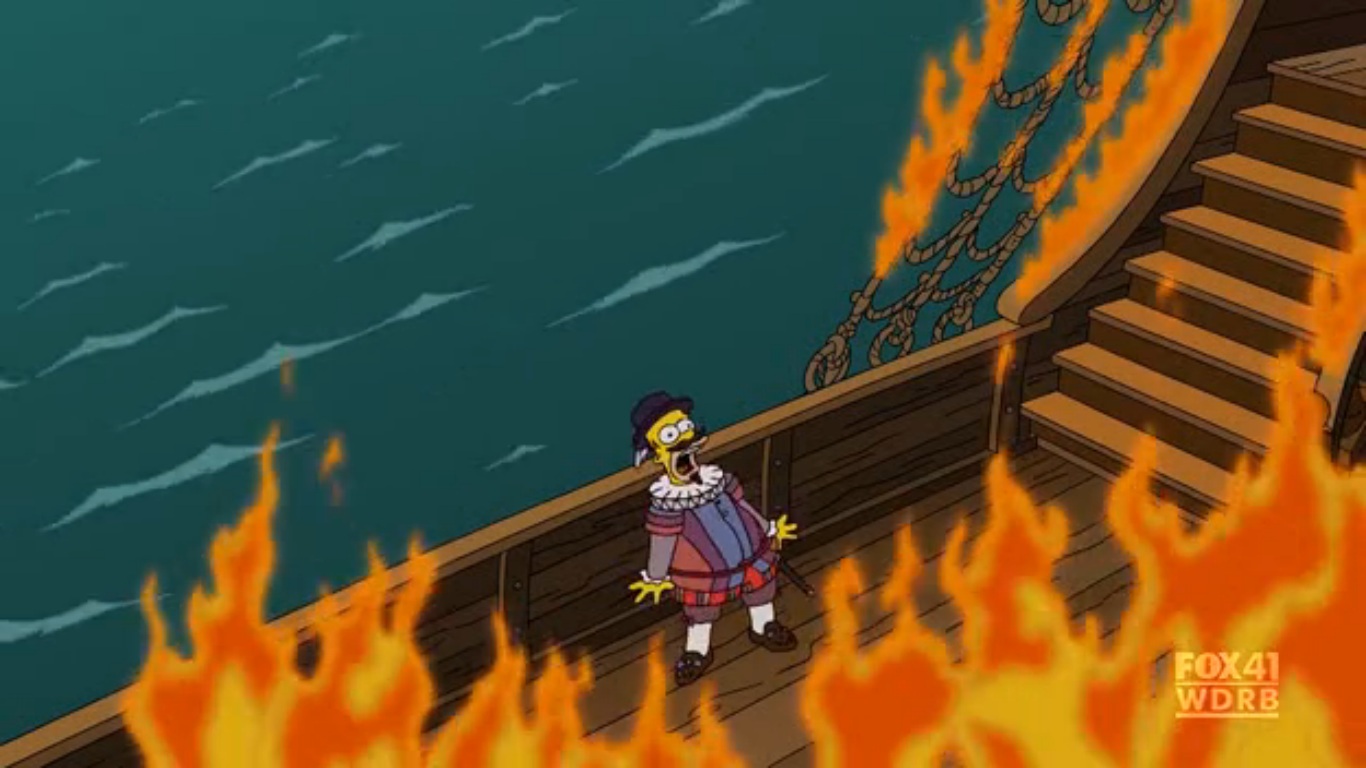
Spanish Armada - so famous it made it into the Simpsons.

Spanish Armada – so famous it made it into the Simpsons.

References like this are deeply suggestive of one of the ways that Protestantism was changing English society. Scriptural allusions were commonplace, and from the way that they are used (casually, briefly) it strongly suggests that people were expected to recognise them and the deeper religious truths that they stood for. Job has of course already cropped up in this series of posts (see day two, domestic decoration), here the brief quotation serves a similar purpose as an image: a reminder, a prompt to reflection, a stepping stone to a more profound appreciation of one’s own faith.

In the final post tomorrow: a round up of the prominent themes.

‘West Country to World’s End: the South West in the Tudor Age’ runs until 2 March 2014 at Exeter’s Royal Albert Memorial Museum. You can find all the details about the museum, it’s opening times, it’s wonderful café and more here

Further reading:

Sam Smiles (ed.), West Country to World’s End: The South West in the Tudor Age [essays to accompany the RAMM exhibition].

David Cressy, ‘The Spanish Armada: Celebration, Myth and Memory’, in J. Doyle and B. Moore (eds), England and the Spanish Armada (Canberra, 1990) or Bonfires and Bells: National Memory and the Protestant Calendar in Elizabethan and Stuart England (London, 1989).

The Tudor South West at Exeter’s Royal Albert Memorial Museum: Part 3 – Goldsmiths and urban redevelopment

Laura Sangha

This is the third post in a week long series about an exhibition at Exeter’s museum.

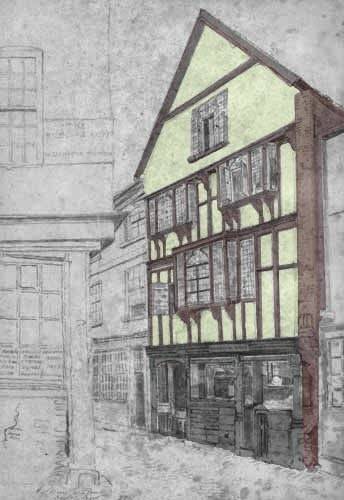
Today I want to talk filthy lucre. One of the things I learnt at the RAMM was that Exeter was an important centre for the goldsmith trade from as early as the thirteenth century, and this set off a train of thought that ended up in the surprisingly short-term world of town planning. I’ll try to recreate the train here.

The goldsmiths golden age

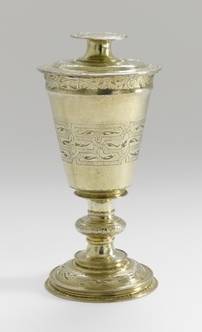
cup editMany of Exeter’s early modern artisans had their workshops in Goldsmith Street, an impressive thoroughfare that had a church at either end, almshouses, and a handsome hall used by the Company of Tailors. The exhibition houses a variety of related items, but the one that took my eye was a communion cup made by John Jones, one of the wealthiest goldsmiths in early modern Exeter. It is indicative of the fact that in this society, ‘fine art’ did not necessarily mean paintings (though there are some wonderful Holbeins in the exhibition, if that’s your thing). This cup, manufactured from silver with delicate engraving around the gilt-edged rim and foot, is extremely accomplished, in fact I was rather surprised by quite how fancy it was, given that this was over ten years into the Calvinist-inspired Elizabethan reign. The cup is still a thing of beauty, it could easily be a lot plainer and less ostentatious.

The uniqueness of the Church of England

My first thought was that perhaps this is proof that the Elizabethan Settlement acted as a ‘broad umbrella’, incorporating a number of different types of Protestants and a range of churchmanship? Christopher Haigh has argued that the adjustments made to the Prayer Book at the start of Elizabeth’s reign, particularly additions to the words used during the administration of the Lord’ Supper, deliberately introduced ambiguity into the ceremony, encouraging a range of opinion about what actually happened during the sacrament to survive or evolve. Diarmaid MacCulloch has argued along similar lines, suggesting that these changes were to bring the English Reformation in line with what was happening in the rest of Europe, particularly in Germany and Geneva. It is entirely plausible that the fancy cup could be a part of these processes – the use of a silver work of art, rather than a plain wooden cup, would have been deeply suggestive to a congregation versed in the ritual and symbolic importance of the liturgy.

The impact of the Reformation

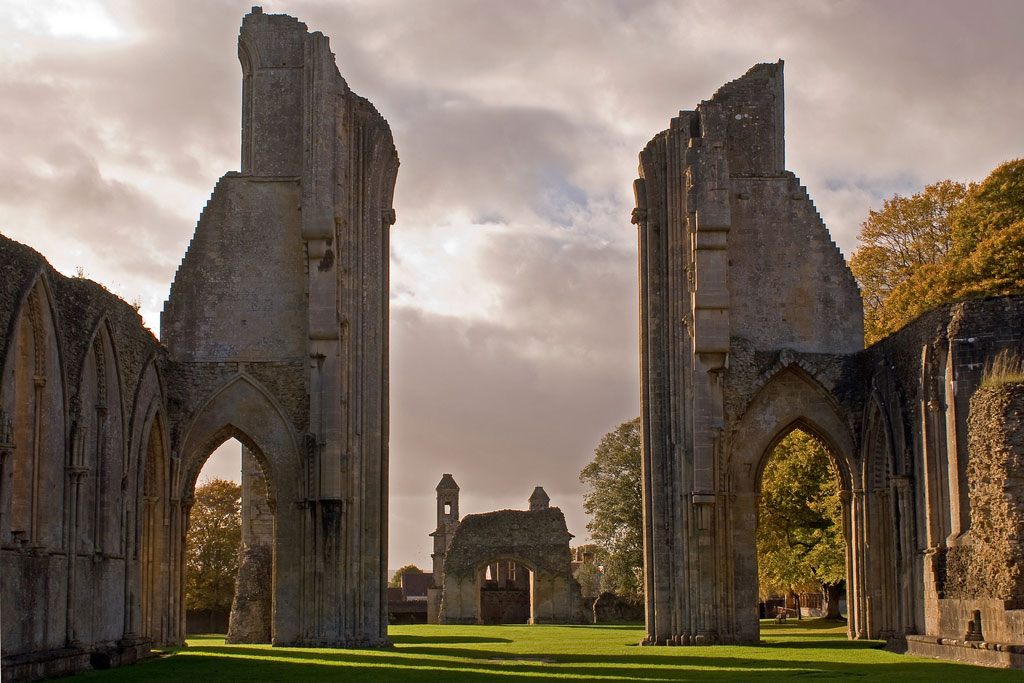
Beyond the sometimes obscure and Glastonbury2always complicated world of Reformation theology, the goldsmiths can also tell us much about the way in which changes in belief left a deep and enduring imprint on early modern society. For part of the reason for the continued success and prestige of the goldsmith community in Exeter was the dissolution of the City’s priory and friaries in 1538 and ongoing changes in religious policy that sent a lot of work their way. Historians have discovered that far from being isolated and cut off from their local communities, monasteries were in many ways integral to the social and economic functions of their local region, providing charity and education, and as producers and consumers. Following their abrupt closure, the shock waves were swift, reshaping the landscapes of local communities physically as well as spiritually. Large, imposing buildings were torn down or their functions changed, and Henry VIII quickly appropriated the vast riches of these institutions. This not only meant that the crown took control of church lands, they also seized their more moveable treasures. For the large group of goldsmiths in Exeter, this would have meant a very welcome steady source of work and income, as church plate was confiscated, some of which had to be melted down and reworked in a more acceptable shape, suitable to the new reformed liturgy. This was a lucrative business, as at each stage of the process the participants could take their cut, not to mention that the parishes had to buy new plate from the goldsmiths to replace the old throughout the Tudor era. Similar processes happened in parish churches – the RAMM’s information card tells us that the churchwarden accounts of St Petrock’s church in Exeter show that Jones was paid £1 15s 5d in 1572 for ‘converting’ this communion cup to make it suitable for Protestant worship. Thus the redistribution of wealth that the dissolution triggered is not restricted to the property market but bought benefits and profits to other groups that can easily be overlooked.

Heritage and Urban Planning

Exeter's Goldsmith's Street as it once was.

Exeter’s Goldsmith’s Street as it once was.

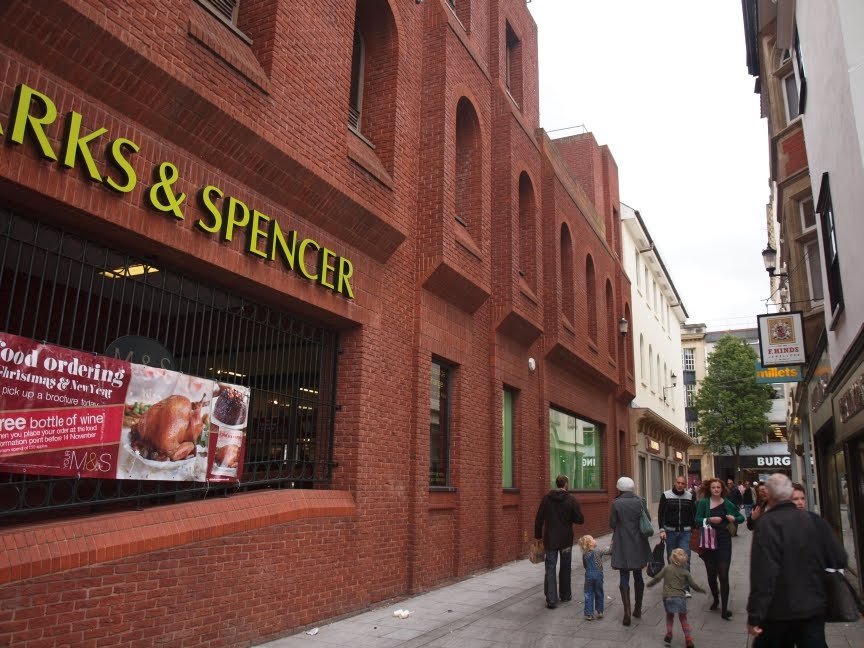
Finally, I was also interested to discover the fate of Goldsmith Street – the majority of the historic buildings there were demolished by the City Council in the 1970s to make way for redevelopment – today you will find Marks and Spencer and Millets where the goldsmiths used to ply their trade. Although one of our enduring national myths is that bombing raids in World War II were responsible for the destruction of much of our pre-modern urban architecture, more recently historians have begun to question this narrative. They have drawn attention to the fact that many cities were already undergoing a programme of redevelopment that included sweeping away inconveniently narrow medieval streets that were seen as obstacles to modern infrastructure and progress. Though the blitz did account for damage in many historic centres, our society’s own decision to prioritise the needs of economic and industrial advancement over our historic past may be the real explanation of urban change. A recent article on the BBC website revealed that this is even true of Coventry, which suffered devastating destruction in a terrible air raid in 1940, but where demolition had actually started before the war and continued after it. Exeter too suffered, in a severe raid in 1942 1,500 houses were destroyed, 2,700 were seriously damaged, and the Cathedral itself was hit, narrowly escaping the destruction of the nave. But much of value was left, though not all of it was subsequently retained – wiped away just as Goldsmiths was to make way for shopping centres and fast food joints.

The shock of the new

Exeter's Goldsmith Street now.

Exeter’s Goldsmith Street now.

In many ways modern redevelopment of our urban landscapes is now just as shocking and significant as the deliberate destruction of the monasteries and the properties of the parish churches in the 1500s, and increasingly we are now beginning to see it that way. Each was an iconoclastic act, signalling a rejection of and moving away from the past. They were both inspired by a shift in the prevailing ideology and the emergence of something new: Protestantism, capitalism, modernity. Each are shocking to us now because these acts display a complete lack of respect for the past and for beautiful treasures which can now never be recreated. Each seems to have been driven by ‘the authorities’ in the face of limited public resistance, and in many cases the public seem unable to prevent the change even where they disagree with it. Perhaps this can helps us to understand the ‘compliance conundrum’ – the question of why there was a relative lack of any widespread resistance to the dissolution, despite the commitment that most English women and men had previously shown to the institutions. Perhaps they felt as helpless as we do in the face of development, perhaps they also felt a sense in which they were swimming against the tide in trying to preserve the past or stand in the way of state sponsored change. Or perhaps they came to terms with and even embraced the changes, regretting the passing of the old ways and the destruction of beautiful things, but eager to make the most of the opportunities that the new future offered them, and keen to create new and more beautiful – but different – things to replace those that had been lost.

In tomorrow’s post: the Spanish Armada arrives off the south west coast.

‘West Country to World’s End: the South West in the Tudor Age’ runs until 2 March 2014 at Exeter’s Royal Albert Memorial Museum. You can find all the details about the museum, it’s opening times, it’s wonderful café and more here

The Tudor South West at Exeter’s Royal Albert Memorial Museum: Part 2 – Domestic Decoration

Laura Sangha

This is the second post in a week long series about an exhibition at Exeter’s museum. View the first post on a map of Exeter here.

In early modern England the population was expanding incredibly rapidly and massive inflation led to the deterioration of living standards for many of the lower sorts. In contrast, changes in income tended to increase the number of middling groups in society, those merchants, artisans and gentry who benefited from rising property prices. In the west country, the prosperous cloth trade and various mercantile enterprises meant that the middling sorts had money to invest in the arts. You are perhaps already aware of the National Portrait Gallery’s current exhibition on Elizabeth I and her People, and if that is your sort of thing, there are lots of paintings at the RAMM too, including ‘The Armada Portrait’ of Elizabeth I; several from the school of Holbein; numerous works by Exeter’s most significant artist to date, the miniature-painter Nicholas Hilliard; and a huge piece that tells the story of the arrival of Armada in the South West in 1588. Click on images for enlargements.
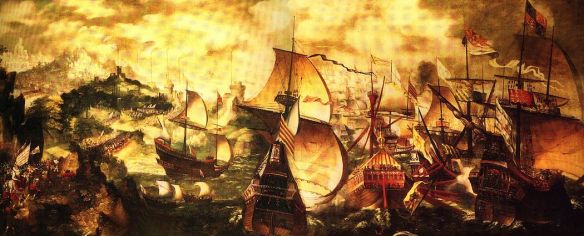
attributed hilliard armardaAll are deeply impressive, but the artistic accomplishment of the south west is also to be found in the crafts – in the production of jewellery, elaborate drinking vessels, church plate (more on that in tomorrow’s post), household utensils, decorative plasterwork, moveable furniture, architectural stone and woodwork, and fine needlework. Some of these were functional, but all displayed the taste, wealth and status of their owners in this society.

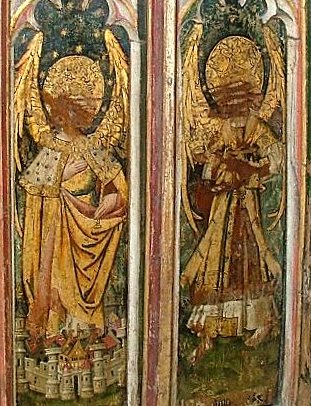
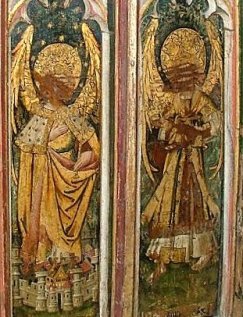
Two of my favourite objects in the exhibition seem to be less about status, but certainly fall within the category of the decorative arts. They are a set of boards with an image painted on each them. Both are reasonably small – perhaps the size of an A3 sheet of paper – and one depicts Moses, the other Job. Each has a scriptural extract painted above the image. On loan from the V&A, they are part of a series of Old Testament figures. The drawings are plain but relatively accomplished: Job wears a long red tunic, cinched at the waist with a belt with a tasseled pouch hanging from it. He has a long brown pointed beard and wears a small turban and long boots, an interesting suggestion of ethnic stereotyping. He looks as if he is walking somewhere, and his hands are together and raised in supplication. The figure stands on some scraggly grass, and it is against a black background, in contrast to the scriptural text in black letter against a white background that forms a strip across the top of the board. It reads: ‘I ame sure that my redemer liveth and that I shall rise [oute?] of the earth at the latter day. Job [19?].’

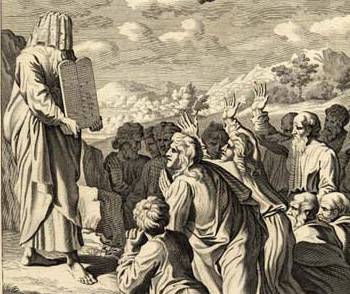
Moses wears a white tunic and his extra long, brownish belt flaps around his legs as if in a breeze. He has tights tucked into his high brown boots, and wears a warm looking hat. He has a brown beard, much shorter than Job’s, and he also looks like he is walking. In his arms is a large tablet divided in two, dashed lines across it representing the Commandments. There is a skull between his feet, and I was intrigued to see that Moses is blindfolded – I am assuming this represents the Lord’s impartial justice but would be delighted to hear of other examples of this. His inscription reads ‘The Lord will stirr up amonge the brethren a Profet, like unto me. Deutrinomy 18’.

The RAMM’s information card informs us that the boards might have been displayed in a church or private house near Plymouth, but immediately my little grey cells started humming. I doubted that it was the former in Elizabethan England, where the work of iconoclasm in parish churches was relatively complete. To me, these images were a surprise – what were images of scriptural figures doing here, in an era when images had been rejected by the reformers as leading to wrong belief and wrong practice?
When iconoclasts attack.

When iconoclasts attack.

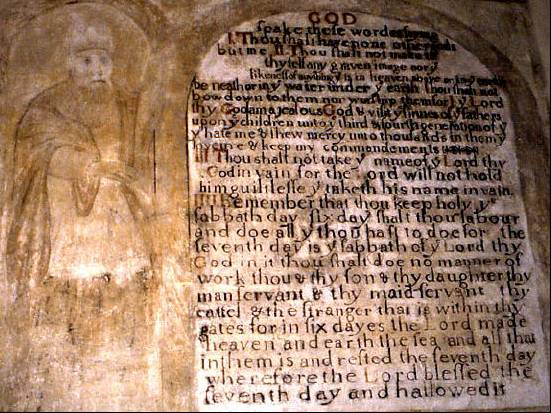
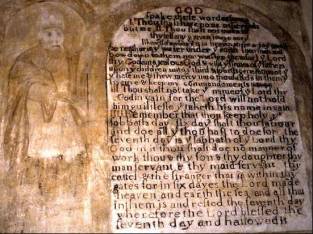
The scholarship on visual culture in early modern England can help to answer this question, as it has been rapidly developing in recent years. Earlier historians had to an extent been won over by Patrick Collinson’s argument that throughout Elizabeth’s reign, English Protestantism became less, not more popular in character. Crudely summarised, Collinson asserted that the first generation of Protestant publicists and propagandists made polemical use of cultural vehicles (songs, drama, cheap print, the visual arts), using these forms to transmit the evangelical message with the aim of converting the English people to Protestantism. Protestant plays were written and produced, godly ballads were published and sung, images were used to attack Catholicism and to commend their own religious beliefs and values. But around 1580 Collinson thought that a new generation of evangelicals began to reject visual and performative culture, judging it to be unsuitable for their religious message. This later generation of Protestants thought that plays, songs and images were distracting the audience and confusing the religious message. Worse, the arts mixed sacred ideas with filthy ‘popular’ forms, doing violence to religious truth by associating it with base, bawdy and inappropriate behaviour and language. In this new world, Collinson argued that Protestants came to completely refuse any appeal to the senses in religious matters. All images were ‘Popish’, most Elizabethan and Jacobean bibles therefore had no illustrations, the only decoration in the parish church was to be the Royal Arms and perhaps a table of the ten commandments. England had moved from iconoclasm in the first stages of reform (rejection of abused, dangerous and false images), to complete iconophobia (rejection of all images).

And yet…, whilst Collinson’s argument is enormously useful in thinking about the continuing repercussions of religious change, it is perhaps more useful for thinking about reforming clergymen than it is English society more broadly. Objections have been raised, and work is afoot to provide a corrective to the ‘iconophobia’ argument. It is easy to point to the continued existence of images in England – British Printed Images to 1700 is a website that hosts a database of several thousand printed images produced in Protestant Britain, and much decorated medieval furniture can be found in parish churches across the country to this day (though of course some of this may have been restored during a later era). Our Moses and Job boards are of course another example of later imagery.
Images persisted despite reforming disapproval. So how can we explain Moses and Job? Are these a rare surviving example of something from the bottom of the Tessa Watt’s ‘ladder of sanctity’ – inoffensive Old Testament figures that Protestants were comfortable displaying in a secular context? Watt has taught us that those scriptural figures who were the least sacred in the Catholic tradition, those that did not have cults associated with them and who were therefore unlikely to be the focus of devotion, were often still depicted in post-Reformation England. Moses and Job fit the bill – they are Old Testament figures, and both are strongly associated with moral teaching and practices. You are not meant to worship them but to learn from their stories and they were probably a new element of visual language in the post-Reformation church – there are no wall paintings of Job in Anne Marshall’s excellent catalogue of medieval wall paintings, and only one of Moses – which was painted after the Reformation.

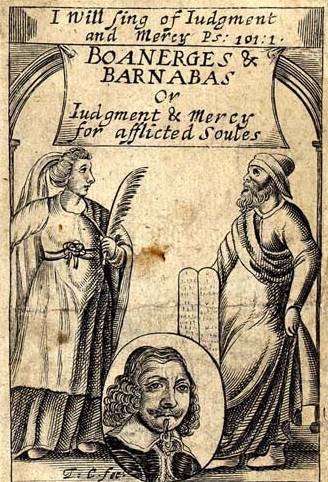
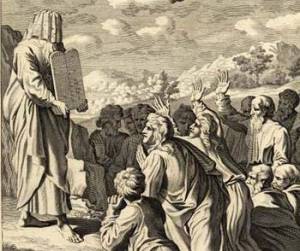
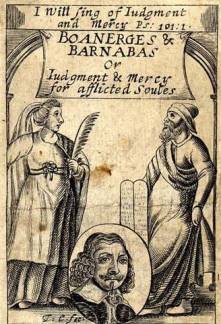
Watt’s theory therefore helps us to explain images that survived in the face of fierce criticism of the Catholic use of imagery in worship. It seems that the purposes of post-Reformation images were usually didactic, images were used symbolically to recall to mind important beliefs or Christian principles. Here the scriptural texts above the images suggest that these figures were intended as an aid to memory, representative of bigger theological and moral truths. Job stood for the trials, temptations and suffering that an ordinary family man might face in everyday life, the text the hope of release from them. Moses would call to mind the Ten Commandments (perhaps displayed for all to see in the parish church) and their Picture1importance as the basis of Christian morality and behaviour. Both are eminently suitable for display in a secular sphere such as the household, reminders of everyday Christian beliefs that could comfort and guide people as they went about their lives. Incidentally the British Printed Images database throws up eight images of Moses and two of Job, all from the seventeenth century, suggesting that these images might be less suitable for publication than for display in the household. Often these images are found in the frontispiece: Drexel’s School of Patience (1640) has an image of Job with the caption ‘Patience’; in Francis Quarles 1646 collection of miscellaneous reflections Boanerges and Barnabas Moses represents justice (in opposition to mercy) and wears a similar outfit to that depicted on our boards (see below); whilst a 1695 edition of Richard Allestree’s Works shows the prophet wearing a veil. Does the latter represent squeamishness over showing Moses’ face, or is it just because the book contains a section on the topic of veiling?
quarles mosesIt appears then that Moses and Job need not have been out of place in the Elizabethan south west after all. Tara Hamling’s recent work on domestic decoration supports such an interpretation, and these boards indeed suggest that Elizabethan England ‘still contained many images to help its inhabitants in converting the words of the Protestant religion into a visualised experience’, as Tessa Watt has argued. These images were complementing and supporting preaching and reading, those activities more traditionally seen as the heart of Protestant practice. The physical environments that people inhabited had also been changed as a result of reform, reconfigured to encourage the development of the Godly society that the evangelicals strove to create.

In tomorrow’s post: musings on the impact of the Reformation, goldsmiths and contemporary urban redevelopment.

‘West Country to World’s End: the South West in the Tudor Age’ runs until 2 March 2014 at Exeter’s Royal Albert Memorial Museum. You can find all the details about the museum, it’s opening times, it’s wonderful café and more here

Further reading:

Patrick Collinson, ‘From Iconoclasm to Iconophobia: the Cultural Impact of the Second English Reformation’, The Stenton Lecture 1985 (University of Reading:1986). Reprinted in Peter Marshall (ed.), The Impact of the English Reformation (London, 1997).

Tessa Watt, Cheap Print and Popular Piety (Cambridge, 1991), chapter 4, ‘Idols in the frontispiece’.

Tara Hamling, Decorating the ‘Godly’ Household: Religious Art in Post-Reformation Britain (London, 2010).