Simon Sandall, ‘History lessons from below?’

[This is the eighth piece in ‘The Future of History from Below’ online symposium (#historyfrombelow). Simon Sandall is a lecturer at the University of Winchester whose recent publications focus on custom, law, community and popular politics and popular protest in early modern England. His forthcoming book will be titled ‘Custom and Popular Memory in the Forest of Dean, c. 1550-1832’.]

Now, as much as at any time in the recent past, the study of labouring people and non-elites is crucial, not only in rescuing them from the ‘condescension of posterity’, but in forging a broader understanding of the historical context in which we enter the twenty-first century. As social services are being slashed, the terms of unemployment and disability benefits rendered untenable, sections of poorer communities pejoratively stereotyped in the name of austerity, the culpability of the super rich whitewashed, and Michael Gove’s attempts to hide any historical evidence to the contrary, this context is sorely needed.

Add to this the fact that a significant proportion of the British public draw their knowledge of the past from centre-right newspapers and other media, nuanced and critical histories ‘from below’ are clearly needed to restore balance to some of the more heated debates that pervade the current political climate. While the criteria of the Research Excellence Framework look to be developing an increased focus on wider dissemination of funded research, we should be thinking carefully about the nature of these studies and their impact. Gove’s current drive emphasises a simplified, top-down, political narrative which nods towards the benefits of British influence in the world, the development of stock trading, the banking industry, together with the associated rise of capitalism and industrialisation. As historians, our duty is surely to complicate these teleologies and work to emphasise the reality of contingency and agency, to advance our understanding of those in the lower echelons of societies past. At almost every one of these historical junctures, there have been passionately defended alternatives. A closer focus on the experiences of particular communities and broader histories from below reveals, also, that at each of these key transitional moments it has generally been the poor that have suffered to advance the interests of the rich and powerful. Continue reading

David Hitchcock, ‘Why history from below matters more than ever’

[This is the seventh piece in ‘The Future of History from Below’ online symposium (#historyfrombelow). David Hitchcock is an IAS Early Career Fellow at the University of Warwick and will be taking up a post at Canterbury Christ Church University in October. He has published on vagrancy in early modern England and blogs at Post.Hoc.]

As I write these words, Sohel Rana, the owner of an illegally constructed clothing factory and living complex in Bangladesh called the ‘Rana Plaza’, is probably sitting in a Dhaka jail. I have not the slightest clue what he’s thinking. But I hope he has time for a few regrets. Rana will be now be immortalised as the man who stood in front of a building that was literally cracking down its seams, and assured tenants and workers that it was perfectly safe to stay inside. Factory line managers in Rana’s clothing manufacturing operations on the top floors insisted that their workers continue their shifts, and clothing workers make up the bulk of the over 1,100 dead people in this particular tragedy.

As I write these words, Governor Rick Perry, the architect of modern Texas’ stunningly under-regulated industrial landscape, lambasts anyone but himself for the shameful practices at the West Texas fertilizer plant which recently exploded, levelling a town (which it was conveniently located right next to) and causing a 2.1 scale earthquake. The plant had not been inspected in twenty years. Fifteen people died, most were fire-fighters or first responders trying to control the blaze and to save others.

I’m choosing to begin this post on ‘History from Below’  with recent news stories about factory disasters on opposite ends of the world for one reason: to separate wheat from chaff. These kinds of stories should make you angry, they should make you think about why those factory workers felt they had to obey, and stayed at their posts in a factory that was literally crumbling around them, they should invite you to explore the sad history of industrial production, of ‘developing nation’ factory workers, and of brutal, naked economic exploitation in places like Bangladesh. I hope you want to understand why a place like Rana Plaza was openly permitted to exist. I hope you want to know what life was like for the approximately 1,150 people who died because they were not permitted to escape from an imploding building. Continue reading

Mark Hailwood, ‘Who is below?’

[This is the sixth piece in ‘’The Future of History from Below’’ online symposium (#historyfrombelow). Mark Hailwood is a historian of early modern England and one of the founders of the many-headed monster.]

The posts that have appeared so far in this symposium have suggested a number of interesting directions for the future of ‘history from below’: a future that opens up new avenues for research through explorations of material culture, of the landscape, and of global connections and comparisons, with a critical but ultimately optimistic disposition regarding the possibilities of drawing together fragmentary evidence, potentially through the use of digital databases. All of this excites and encourages me. And yet, there is one particular problem that I think we all need to address if ‘history from below’ is to have a coherent future: how to define its subjects.

I’m not so much concerned here with who should ‘qualify’ as an appropriate subject for ‘history from below’ – I’m not sure prescriptive precision here is possible or helpful, but maybe someone would like to take this up in the comments section – so much as with the labels we use to refer to those that are generally accepted to fall within its remit. Let’s start with that classic statement of the ‘history from below’ agenda found in Thompson’s preface to The Making… ‘I am seeking to rescue the poor stockinger, the Luddite cropper, the “obsolete” hand-loom weaver, the “Utopian” artisan, and even the deluded follower of Joanna Southcott, from the enormous condescension of posterity.’ Continue reading

Matthew Jackson, ‘Relocating history from below: places, spaces and databases’

[This is the fifth piece in ‘The Future of History from Below’ online symposium (#historyfrombelow). Matthew Jackson is a doctoral student at the University of Warwick undertaking a comparative study of drinking culture in early modern Bristol and Bordeaux. He recently published an article on the contested character of female publicans.]

Three interrelated issues arose at the recent workshop at Birkbeck that stood out for me as central to the current condition and future directions of the field of ‘history from below’: studying dispersed geographical places, investigating specific physical spaces, and using large-scale online databases.

Let’s begin with the debates about comparative, transnational and global approaches to ‘history from below’, spurred by remarks at the workshop from William Farrell and Tawny Paul. The idea that global history – typically vast geographical transactions of people and commodities – can combine with social history – prioritising analytical depth over geographical breadth – poses methodological challenges for historians, and the issue was the focus of some provocative debate at the workshop. How, though, might social historians ‘from below’ consider larger comparative examinations without diluting the detail and depth of their own approaches to the subject? Continue reading

William Farrell, ‘Global history from below?’

[This is the fourth piece in ‘The Future of History from Below’ online symposium (#historyfrombelow). William Farrell is a doctoral candidate at Birkbeck, University of London, exploring silk and globalization in eighteenth century London, which has resulted in several working papers.]

Could there be a meeting of global history and history from below?1 The participants at the Birkbeck workshop seemed sceptical I have to admit. The key works in global history have been Big History syntheses. The key works in history from below, on the other hand, have deliberately used a smaller scale.

Despite these signs of a dialogue of the deaf, I still think the potential for a ‘global history from below’ is there. We shouldn’t forget that micro-history is supposed to be a rich, empirical testing ground for arguments about wider social change. Equally, many of the articles in the Journal of Global History or Journal of World History do actually use a case study method. There should, therefore, be many places were these apparently contrasting traditions meet. Continue reading

Nicola Whyte, ‘Landscape history from below’

[This is the third piece in the ‘Future of History from Below’ online symposium (#historyfrombelow). Nicola Whyte is a senior lecturer at the University of Exeter whose research focuses on the interface of early modern social history and post medieval landscape studies. Her publications include Inhabiting the Landscape: Place, Custom and Memory, 1500-1800 (Oxford, 2009), and she is currently part of an interdisciplinary team studying ‘The Past in its Place’.]

The field of landscape history and archaeology in Britain is a divided one. Fault lines separate proponents of the traditional, ‘empirical school’ from those who advocate more theoretically informed landscape research. I want to argue that this division is unhelpful for not only does it reduce interpretation to a set of binaries (objective/subjective, physical/cognitive, economic/symbolic), it also detracts from the importance of landscape research in addressing current concerns about environmental change and sustainability, and how research can engage people outside the university. In this brief piece I want to advocate an interdisciplinary approach to ‘history from below’ from a landscape perspective, which takes on board recent theoretical scholarship but retains empirical research at its core. Continue reading

Ruth Mather, ‘The Home-Making of the English Working Class’

[This is the second piece in ‘The Future of History from Below’ online symposium (#historyfrombelow). Ruth Mather is a doctoral candidate at Queen Mary, University of London, studying the links between working-class political identities and the home in the late eighteenth and early nineteenth centuries. She also blogs about her adventures in research.]

I became interested in ‘history from below’ as an undergraduate through the encouragement of Professor Robert Poole, who introduced me to E.P. Thompson’s The Making of the English Working Class. Thompson’s book, which reaches its half-century this year, showed me a new way of doing history, one which didn’t patronise working people, or subsume them in a narrative of progress, but instead constructed a story about thinking, feeling people with their own ideas about their lives and their own strategies for living them. It’s important that our histories show the humanity of our subjects  – in my case the English labouring classes in the late-eighteenth and early-nineteenth century. This is not about glorifying poverty or writing hero narratives, but simply attempting to understand the messy, complicated details of the real lives of ordinary people.

I’m not alone in thinking this is particularly crucial at the moment, when a new history curriculum threatens to take us back to stories of great men and Whiggish progress and welfare recipients are demonised for political gain. However, other participants in this symposium will be discussing the continued relevance of ‘history from (and for) below’ in much more detail over the coming weeks, and it is not difficult to find excellent explanations of why ‘history matters’ more generally. So, having outlined why ‘history from below’ is important to me, I’d like to focus on the question of how we can find sources that can help to uncover the domestic lives of ordinary people as part of this wider project of uncovering voices that have been underprivileged in the historical record. Continue reading

Richard Blakemore, ‘Finding fragments – the past and the future’

[This is the first piece in ‘The Future of History from Below’  online symposium (#historyfrombelow). Richard Blakemore is an Associate Research Fellow at the University of Exeter working on the ‘Sailing into modernity’ research project. His doctoral work and recent publications focus on early modern seafarers, especially those based in London during the civil wars. He also blogs at historywomble.]

If we want to get at history from below, where do we start looking? Traditionally social historians, at least of medieval and early modern Europe, have relied upon two kinds of records to recover the ‘voices’ of those people who did not deliberately create a lot of records themselves. The first kind is court records and other legal documents such as wills and inventories, contracts, and so on. Because many people encountered the legal machinery of the state in which they lived (which included, for much of European history, the church as well), and because states have tended to hold onto these documents, this is one place where we can catch traces and glimpses of our elusive subjects. The second is printed material, especially the printed material which circulated amongst the people ‘below’, such as pamphlets, newspapers, or ballads. Of course, neither of these sources offers a perspective that is uncomplicatedly ‘from below’. Law courts are usually dominated and directed by elites. Publications were often censored and may have repeated official as well as popular attitudes. We have to take account of these issues – but I have never really liked the simple above/below distinction too much anyway, and I think it is entirely possible that, in these sources, if we use them carefully, we can find the ‘voices’ of people from all directions. Continue reading

The future of ‘history from below’: an online symposium

Brodie Waddell

Those of us who think that historical research ought to consist of more than the study of kings, ministers and generals owe a great debt to the pioneers of ‘history from below’ . Foremost amongst them must be E.P. Thompson, who published his epic The Making of the English Working Class exactly half a century ago. The impressive wave of work that followed will be well-known to many of you and, if nothing else, I think most historians would agree that historical scholarship would be poorer if not for the intervention of these spirited men and women.

But what about the next fifty years? Has ‘history from below’, and perhaps social history more generally, outlived its usefulness? What, if anything, can it contribute to contemporary scholarship and the wider world? How should it be adapted or reoriented in the coming years? What new tools or techniques could strengthen it? Where will it fit in the wider academic and social landscape?

On 16 April 2013, eighteen of us gathered for a workshop at Birkbeck to try to figure out some answers to these questions. As is usually the case with these events, the discussion carried on in the pub afterwards and, although we certainly didn’t come up with any conclusive answers, we all agreed this was a conversation that needed to continue.

To that end, Mark and I invited the participants to contribute to an online symposium on the future of ‘history from below’. So, over the next few weeks we will be posting a series of short pieces by historians early in their academic careers that attempt to offer some possible answers to these questions. We hope that this will spur further discussion and open up the conversation to the rest of the world. Please leap in with your comments, suggestions and critiques. We welcome comments not only from ‘fellow travellers’ but also – perhaps especially – from sceptics and critics of ‘history from below’.

The first post will be published here on Monday, July 8th, with further posts following every two or three days. Links to each piece will be added here and join the conversation on twitter via #historyfrombelow.

Programme

Everyday Life and the Art of the Dutch Masters: A Social Historian’s Perspective

Mark Hailwood

The visual culture of the early modern period has been a prominent theme here on the many-headed monster, what with Jonathan’s recent post on what God looked like, and my own series of posts on woodcut workers, so I thought another contribution to these musings would be welcome.

So, below is an essay I was recently asked to write for a guidebook for an art exhibition being held at The Collection Museum, Lincoln. ‘Masterstrokes: Great Paintings from York Art Gallery’ runs until 26th August, and contains some of the highlights from York Art Gallery’s collection, on temporary display in Lincoln.

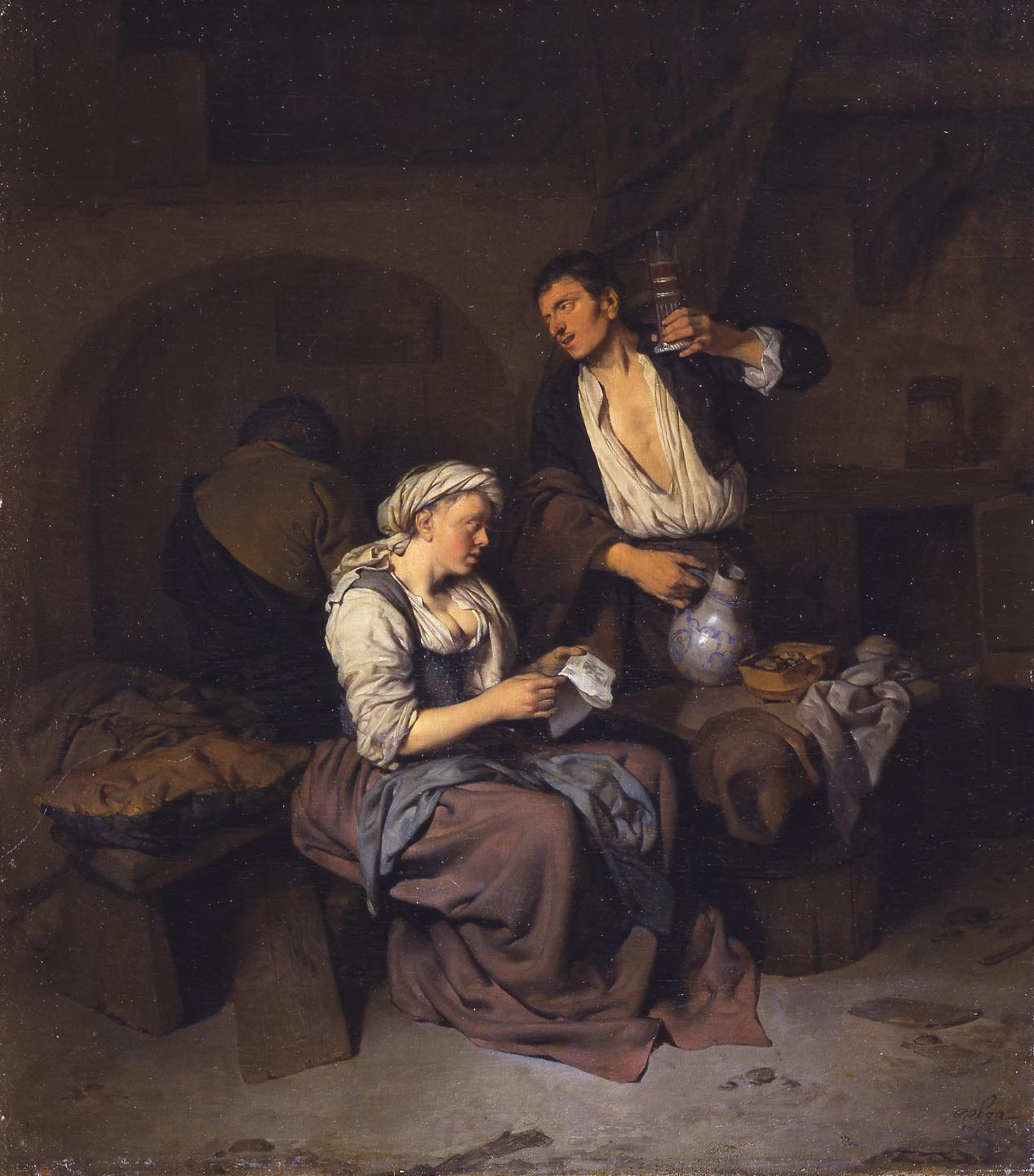
The painting I was asked to comment on is Cornelis Bega’s ‘Tavern Scene’, 1662, approaching it from the angle of what it might be able to tell a social historian. Here is what I came up with:

What is a social historian? The main thing that marks us out from our colleagues in political or economic history is that we are concerned not so much with the ‘great men’ or macro-economic developments—which have undoubtedly played their part in shaping our past and present—but with the everyday lives and experiences of ordinary men and women. We want to know what life was like in the past for the majority of our ancestors.

Recovering these experiences is far from straightforward. For the period that I study—the seventeenth century—the subjects of my research have rarely left behind any of their own accounts of what their lives were like. Only 30% of men, and 10% of women, were fully literate, and those that were tended to come from the upper ranks of society. As such, there are few letters or diaries surviving from humble men and women recording the fine details of their day-to-day trials and pleasures.

As a result, the social historian needs to be ‘omnivorous’ in their search for useful sources of evidence. They need to cast their net wide and glean what they can from surviving court records such as witness statements, from surviving popular ballads and songs, or from the indirect evidence provided by the extant writings of elite social groups. They might also be able to gain insights from the visual culture of the period they study.

In this regard, Dutch Golden Age paintings—such as Cornelis Bega’s ‘Tavern Scene’ on display here—are a tantalising prospect for the social historian. Many adopt a realist focus on the everyday life of seventeenth-century peasants and artisans. Moreover, many of them depict scenes of tavern culture, an aspect of everyday life that has increasingly come to attract the attention of social historians. There is a frustration here though for the historian of seventeenth-century England: there is no English equivalent in this century for the vibrant genre of everyday life paintings being produced in the Netherlands (I’m not quite sure why, but it is a common subject of speculation in conversation with my colleagues). So there is an obvious problem inherent in trying to use paintings of Dutch tavern culture to draw conclusions about English tavern culture, but if we put that to one side for the moment we might think about what sorts of questions a social historian could ask of paintings such as Bega’s ‘Tavern Scene’.

Thanks to York Art Gallery for permission to reproduce this image (YORAG782)

Thanks to York Art Gallery for permission to reproduce this image (YORAG782)

At first glance we might wonder if the utility of this painting lies more in what it tells us about contemporary attitudes towards tavern culture than what it can tell us about what actually took place in them from day to day. It could be taken to encapsulate a common negative stereotype of taverns that was most closely associated in England with Puritans—those who enthusiastically embraced the new Protestant religion—who were known to be particularly vociferous in condemning drunkenness as an ‘odious’ and ‘loathsome’ sin. Is the standing male character slightly off-balance perhaps, his shirt falling open as the decorum slips, drunkenly leering at the bosom of the… serving maid? Taverns were often criticised as sites of inappropriate sexual promiscuity, and we could read this depiction as a visual equivalent to the many sermons that were preached against the immorality of tavern culture in the period.

A closer look suggests that Bega is offering us much more than well-trodden moralising in his tavern scene. The social historian’s gaze is drawn to some of the more quotidian aspects in the painting. There seems, for instance, to be crumpled bedding laid out on the bench behind the central female character. This highlights an important fact about seventeenth-century taverns (or as they were more commonly called in England, alehouses) that the modern viewer may not appreciate: unlike the pubs of today, the primary purpose of an alehouse in this period was not to provide a location for recreational drinking. Rather, it had two main functions: one was to sell ale to local people who did not have the means to brew their own at home. Ale (usually weaker than our modern equivalent) was an important part of the daily diet and a key source of calories and nutrients, and was consumed with all meals by men, women and children. In this sense the alehouse was meant to serve more as an off-license. In practice, of course, many allowed drinking on site and they did become sites for recreational drinking and drunkenness, but this was forbidden in legislation.

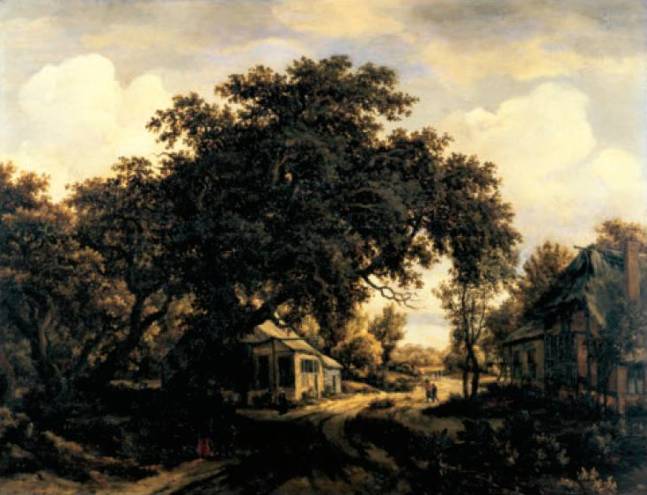
Their other (legitimate) purpose was to provide lodging to travellers. As such they were invariably situated on main roads, something we can see in another painting in this exhibition, Meindert Hobbema’s ‘A Wooded Landscape’. It looks like a drinking house on the left, identifiable by its ‘ale-post’, the ancestor of the pub sign, protruding into the road to show that ale was available.

Thanks to York Art Gallery for permissions (YORAG2005.608)

Thanks to York Art Gallery for permissions (YORAG2005.608)

With this is mind another reading of this tavern scene is possible. What we have is not a scene of drunken debauchery, but a party of travellers who have spent the night asleep on the alebench (alehouse accommodation was rarely plush, and often involved simply sleeping on a bench or sharing a bed with landlord and landlady!) The man with his back to us is still rousing himself from sleep. The standing character is not yet fully dressed, but is nonetheless taking his ‘morning draught’ of ale, the seventeenth-century equivalent of that first cup of coffee. What we might be seeing is the depiction of a morning routine after an overnight stay at the tavern, a far from untypical experience in an age when the lower orders did most of their travelling on foot, and only limited distances could be covered in a day.

We are also struck, of course, by the act of reading taking place at the centre of the scene. It is intriguing, given the statistics of female literacy, that it is the female character doing the reading. What is she reading? Could it be a broadside ballad? These were songs printed on a single (sometimes folded) sheet of paper that were sold cheaply—usually for a penny, the same price as a pint of ale—and often took the form of drinking songs to be sung in alehouses, or even pasted up on their walls. Is that one pasted up in the alcove on the back wall? Perhaps one discarded on the floor in the fore ground to the right? These drinking songs have received a lot of recent attention from social historians, who have mined them for insights they may offer into seventeenth-century tavern culture. Is this a depiction of one being performed? Is the standing male responding to a call that was common in these songs to raise a toast to his companions, or to raise a loyal toast to the King, another familiar feature of these songs?

Arguably the scene is too sedate to be a raucous rendition of a drinking song. Another interpretation may be that the reader is relaying the latest news from a printed newsheet—possibly news of a successful sea battle that is spurring the toast of her companion, or even a satirical political broadside that is the root of his mirth. Both of these were common subjects for cheap printed wares that circulated in taverns. Indeed, the discussion of news and politics in taverns was common and widespread long before the emergence of the coffeehouse in both England and the Netherlands from the mid-seventeenth century, the drinking establishment which is more commonly associated with a public thirst for news and politics. Is Bega looking to capture the fact that the politics of ‘great men’ were not as detached from the world of everyday tavern culture as historians have often thought?

It is, of course, beyond us to know for sure what Bega wanted us to take from his tavern scene, and at best it remains a somewhat indirect form of evidence of everyday life in the past for the social historian. That said, there are a number of aspects of his scene—the tavern as a place of lodging, the circulation of printed ware in these locations—that accord with the evidence of tavern culture in the seventeenth century that social historians have garnered from other sources. It reinforces our sense that tavern culture was about more than mindless drunkenness and sexual promiscuity, providing vital services and a venue for the dissemination and discussion of the issues of the day. Given these areas of overlap between Bega’s scene and what we can recover from other sources there may well be cause for optimism for social historians that such paintings can be a reliable guide to everyday life in the past. Or at the least, another component of our omnivorous diet of sources.