Ruth Mather, ‘The Home-Making of the English Working Class’

[This is the second piece in ‘The Future of History from Below’ online symposium (#historyfrombelow). Ruth Mather is a doctoral candidate at Queen Mary, University of London, studying the links between working-class political identities and the home in the late eighteenth and early nineteenth centuries. She also blogs about her adventures in research.]

I became interested in ‘history from below’ as an undergraduate through the encouragement of Professor Robert Poole, who introduced me to E.P. Thompson’s The Making of the English Working Class. Thompson’s book, which reaches its half-century this year, showed me a new way of doing history, one which didn’t patronise working people, or subsume them in a narrative of progress, but instead constructed a story about thinking, feeling people with their own ideas about their lives and their own strategies for living them. It’s important that our histories show the humanity of our subjects  – in my case the English labouring classes in the late-eighteenth and early-nineteenth century. This is not about glorifying poverty or writing hero narratives, but simply attempting to understand the messy, complicated details of the real lives of ordinary people.

I’m not alone in thinking this is particularly crucial at the moment, when a new history curriculum threatens to take us back to stories of great men and Whiggish progress and welfare recipients are demonised for political gain. However, other participants in this symposium will be discussing the continued relevance of ‘history from (and for) below’ in much more detail over the coming weeks, and it is not difficult to find excellent explanations of why ‘history matters’ more generally. So, having outlined why ‘history from below’ is important to me, I’d like to focus on the question of how we can find sources that can help to uncover the domestic lives of ordinary people as part of this wider project of uncovering voices that have been underprivileged in the historical record. Continue reading
An Easter larceny, 1691

Brodie Waddell

I was browsing the Old Bailey Online for seasonal crimes, as one does, and came across this case from the Proceedings of 27 May 1691:

Rebekah Williams, Widow, was Tryed for Robbing Edward Veron , on Easter-day last, of Goods to a considerable value. Mr. Veron swore, That his Shop was broke open at Ipswich, and that the Prisoner offered several of the Goods to sale in London, at a Goldsmiths, where she was taken; but she proving her self a Married Woman, by vertue of the Covering she was Acquitted.

We have, in other words, a woman who allegedly participated in stealing from a shop on Easter, but escaped unpunished because she was married at the time.

Early Modern John recently described an Old Bailey case from around the same time as ‘both amazing and infuriating at the same time’ – and the case of Rebekah Williams undoubtedly falls into that same category. The record includes tantalising hints about the culture of the time, but also fails to explain the parts that seem to be most in need of explanation.

The first question is about the significance of the day of the crime. It is obvious why criminals might plan a break-in for ‘Easter-Day’ – presumably everyone else would be at church and the theft would be less likely to be detected. But what would the jurors think of such a crime? Would they be inclined to treat the accused more severely because the crime was both a theft and a profanation of the year’s holiest day? Would the prosecutor draw attention to this? Sadly, the record is entirely silent on this point.

The second issue is influence of Williams’ marital status. This seems to be a case of ‘feme covert’. As the OBO explains:

The legal principle of the feme covert, by which women could not be held responsible for crimes committed in the presence of their husbands (since they were presumed to be following their husbands’ commands) was not often applied, but it may have led juries to exonerate some married women, particularly when their husbands were convicted for the same crime.

The principle had a much more significant role in commerical affairs and inheritance than in criminal law, but it theoretically applied to cases of theft as well.1 But why, then, was Williams listed as a ‘widow’? How did she ‘prove’ her marriage? Why wasn’t her husband mentioned and, in fact, prosecuted? I’m inclined to imagine a scenario something like this … Williams and her husband robbed the shop in Ipswich, but only she was caught selling the goods in London. She admitted the crime but claimed that she was coerced by her husband, who – conveniently – died before the trial. But this is all merely speculation. Here too the record is silent.

In the end, what we are left with is a woman who seems to have committed a potentially capital crime on the most sacred day of the Christian calendar, and who walked away from the court unscathed.

Footnotes

1 For the significance of ‘feme covert’ in the economic sphere, see Joanne Bailey, ‘Favoured or oppressed? Married women, property and ‘coverture’ in England, 1660-1800′, Continuity and Change, 17:3 (2002), pp. 351-372 (ungated); and the work of Amy Erickson. For the role of gender in early modern crime, see Jenny Kermode and Garthine Walker (eds) Women, Crime and the Courts in Early Modern England (1994); Garthine Walker, Crime, Gender and Social Order in Early Modern England (2003). The law of coverture is also described on Wikipedia.

Workers’ Representation Part Two: Making Hay

Mark Hailwood

Herein lies the second installment of my blog series on woodcut images of workers

As I sit here in fenland fog, my mind drifts back to sun-baked Californian afternoons at the Huntington Library. Often I would avail myself of a short break from such wonders as the Ashby-de-la-Zouch manor court records, and pop upstairs to the office of the Director of Research, Steve Hindle (who also happens to have been my PhD supervisor) to either pick his brains or raid his bookshelves.

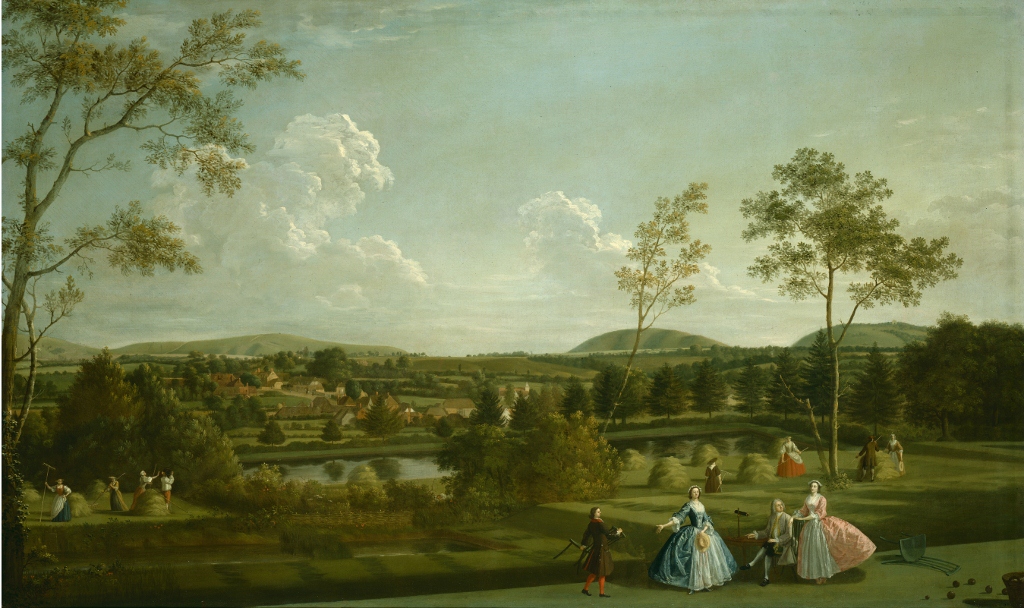
On one such afternoon we fell to discussing the following painting that hangs upon his office wall, a depiction of the Montagu family at their Sandleford Priory estate in Berkshire, by Edward Haytley, commissioned in 1743:

The Montagus at Sandleford Priory
Source: hayinart

At first I was a bit worried – what was this flag bearer of ‘history from below’ doing with an aggrandising portrait of the rural gentry in pride of place on his wall? Continue reading

Workers’ Representation Part One: Spinning a Yarn

Mark Hailwood

As Christopher Thompson rightly notes over at Early Modern History, one of the great things about working at The Huntington is the people you get to meet over coffee. Last week I had the pleasure of meeting for the first time Patricia Fumerton, from the University of California Santa Barbara. Paddy is the pioneer of the online ballad database, EBBA, a digital resource that has been indispensable to my own research, and has been linked to on this blog numerous times already.

This gave me the chance to tell Paddy how great I think the site is, and in particular to praise its latest function that I have been playing around with: the ability to search, by category, the woodcut illustrations that adorn most seventeenth-century broadside ballads. I’ve been working on an article on representations of workers in these ballads – in particular artisan tradesmen – but my focus has been on how they were represented in the text of these ballads: how they were described and characterised. I hadn’t been paying too much attention to looking at the pictures – but might these too be a useful source for the kind of cultural history of work and workers that I am interested in? I entered a search for woodcuts that had been categorised as depicting ‘occupation / trade’, and spent some time perusing the 122 results that came up.

I’m not sure I have the skills or training to confidently deploy this kind of visual evidence in a formal historical paper or article, but I do find it fascinating, and thought I would offer up some of my thoughts in a series of blogposts entitled ‘Workers’ Representation’.

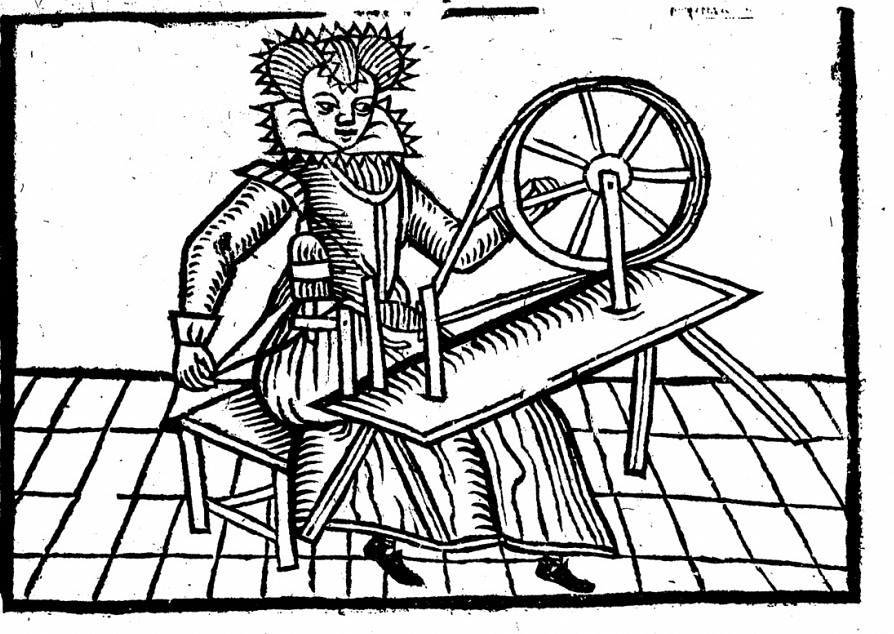
One of the first things that caught my eye was the common depiction of a key category of women’s work: spinning.

A woodcut taken from the ballad ‘Whipping Cheare’, from the Pepys collection, vol. I, no.208-109, c.1625. Source: EBBA

Continue reading