‘For yee lead your liues in great ignorance’: Puritan Ponderings on the Patchwork of Popular Belief

Jonathan Willis

What exactly did people believe in post-reformation England?  That deceptively simple question really goes to the heart of much of the ‘post-revisionist’ scholarship currently being generated by historians of the English reformation.  Whether the object of study is angels, the landscape, music or death, one underlying questions remains the same: what does this thing, this practice, this shred of belief tell us about the broader tapestry of post-reformation religious identity?  Tapestry is a reasonable metaphor – I’m going to refrain on this occasion from extending it too far, and talking about warps and wefts – but patchwork 3388735664_a77e48d15a_zis a better one, the term coined by Tessa Watt in her brilliant book Cheap Print and Popular Piety.[1]  Once or twice when teaching this I have actually taken to drawing an imaginary ‘patchwork’ on the whiteboard.  So what do we call the hypothetical individual, who believes he will be justified by faith but also thinks that if he doesn’t confess his sins he could be condemned to hell for them?  What about his wife, who sings metrical psalms and hates the pope but believes God to be physically present in the consecrated host?  And however we define such individuals, can we also reasonably group them together?  It is possible to recognise their difference, and at the same time claim they are one and the same?

So tapestry is OK, patchwork is better: palimpsest works pretty well too.  Tangentially, I wonder why so much of the metaphorical language we use to describe identity formation (there’s another one) is rooted in the everyday materiality of art and craft.  Our ability to label individual belief in the past seems inversely proportional to the amount we know about it.  I suppose that is a fairly natural state of affairs.  Complexity breeds complexity, and moulds certainty into uncertainty.  But the job of the historian is (I think) not just to (re-)present the past, but also in some sense to try to make sense of it.  So, for AG Dickens the majority of people in Elizabethan England were recognisable as Protestants; for Eamon Duffy they were perhaps traumatised Catholics; for Christopher Haigh, stiff-necked Parish Anglicans; for Judith Maltby, committed Prayer-Book Protestants; for Watt, their culture was ‘distinctively post-Reformation, but not thoroughly Protestant’; while for Robert Delumeau, the people of early modern Europe were probably not even thoroughly Christian.

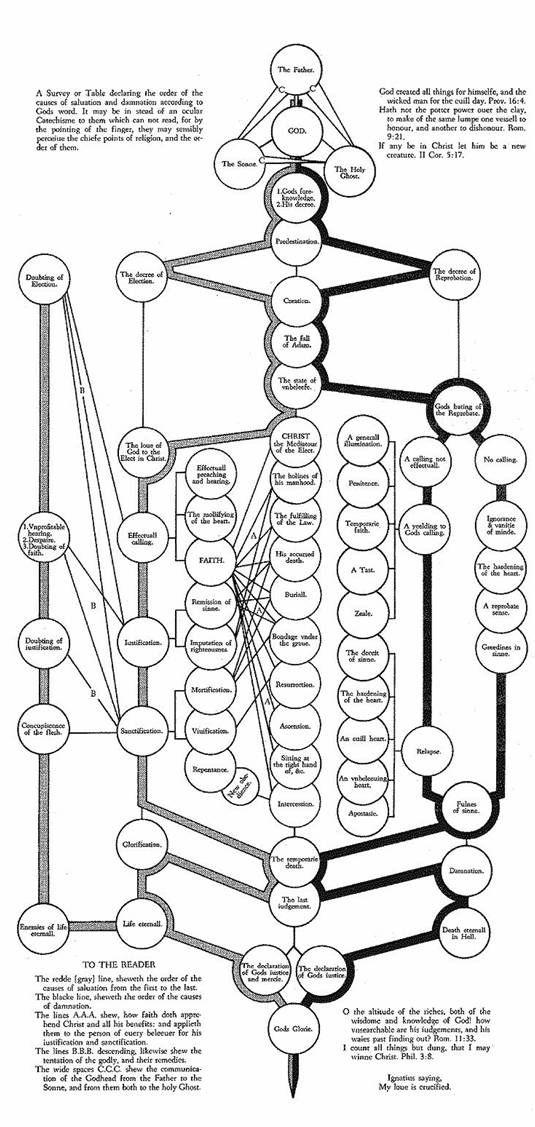
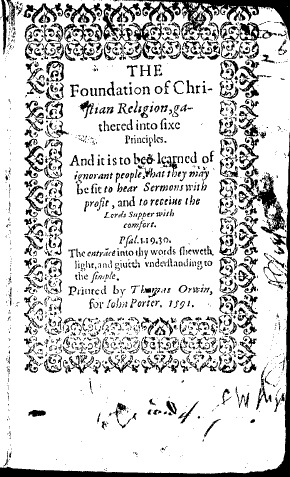
I was reminded of the value of taking a step back from all of this the other day, while reading a treatise by William Perkins that I had never looked at in detail before.  Perkins,Picture1 probably most famous as the author of A Golden Chaine, and more famous still for the infamous diagram of salvation contained within it, was a prolific writer of theological and devotional tracts: the work in question is his The foundation of Christian religion gathered into sixe principles.[2]  The work begins with an address ‘to all ignorant people that desire to be instructed’, followed by a list of almost 30 erroneous ‘common opinions’ which Perkins goes on, throughout the text, to correct.  Reproducing this list in its entirety would be a little excessive, but let me pick and talk about a dozen or so points which seem to me to be particularly pertinent to the present discussion:
1 That faith is a mans good meaning & his good seruing of God.

3 That yee haue beleeued in Christ euer since you could remember.

11 That it is an easier thing to please God than to please our neighbour.

12 That yee can keepe the Commandements, as well as God will giue you leaue.

Taken together, these points seem to express a frustration at the laity’s lack of intellectual engagement with the concept of faith.  That is not to say that their faith was not complex, but it was certainly not structured in the reflective, self-conscious way demanded by men such as Perkins.  Ironically, it seems that Puritan divines would have preferred a little less fiducia and a little more credentia from the laity: a faith based less in instinct, trust and emotion, and rather more in knowledge and intellectual acceptance.  The most difficult (and therefore the most important) aspect of religion from the laity’s perspective was in striving to live according to the principles of Christian charity: God, in whom they had faith from their earliest years, was a comforting constant.  And yet many of the laity had a strong sense that it was ultimately possible to be good and to do good things, and that such behaviour was pleasing to God.  Elsewhere, Perkins also complained about those who felt that by reciting the Decalogue they were praying, and serving God.

7 That, if anie be strangely visited, hee is either taken with a Planet, or bewitched.

This I think is a useful reminder that popular belief was not straightforwardly Christian: it contained a mixture of folklorish, traditional, pagan and other elements.  In this sense it was a true patchwork.

13 That it is the safest, to doo in Religion as most doo.

14 That merry ballads & bookes, as Scoggin, Beuis of Southampton, &c. are good to driue away time, & to remoue hart quames.

20 That drinking and bezeling in the alehouse or tauerne is good fellowship, & shews a good kinde nature.

Popular religion in the broadest sense was above all a communal activity, not an individual or even a family or household one.  The reformation did not fundamentally change this, except perhaps amongst those who were the most literate in the new religious language.  Even then, perhaps all it did was change the nature of the society with which those individuals of advanced faith sought to surround themselves.  Good religion was to be expressed in good fellowship and good cheer, as much in the alehouse as in the church, as much with a lusty ballad as a reverent Psalm.  ‘Hart quames’ for most people were to be banished with a merry ballad, not meditated upon as a means to repentance and the enrichment of a saving faith.

9 That a Preacher is a good man no longer than he is in the pulpet. They thinke all like themselues.

 18 That yee know al the Preacher can tell you: For he can say nothing, but that euery man is a sinner, that we must loue our neighbours as our selues, that euery man must bee saued by Christ: and all this ye can tell as well as he.

 17 That a man which commeth at no Sermons, may as welbeleeue, as he which heares all the sermons in the world.

 16 That a man neede not heare so many Sermons, except he could follow them better.

28 That a man need not haue any knowledg of religion, because he is not book learnd.

Finally, from the perspective of both the clergy and majority of the laity, a wide gulf existed between the two.  The reformation certainly contributed to a widespread anti-clericalism, that is to say, an opposition to the clerical pretensions of the new godly graduate clergy.  Complicated sermons were for educated people: the unlearned had nothing to gain thereby, because they already grasped the essentials of the faith: that all men were sinners, must be saved by Christ, and had an obligation to be charitable to their neighbours.  This was all well and good as far as it went, but of course for Perkins and others there were nuances, complexities, caveats and implications without which these broad truisms were worse than meaningless.  Such intellectual religion was unpopular in all senses: it was not for the great mass of people, who could profit more from each other’s good fellowship than a lengthy diatribe from the pulpit.
FoundationThe thing I’d like to draw from all this is that occasionally it is possible to lose sight of the wood for the trees.  While it can be extremely interesting to interrogate popular belief in minute theological and intellectual detail, it is not always the most productive path to follow (there are of course many, many exceptions).  For, by doing so, we can end up unwittingly forcing a resolutely anti-intellectual form of belief into a (for want of a better word) Perkinsian framework, and thereby doing it some violence, and just a little injustice.  We must remember that popular belief was both simple and complex, both patchwork and quilt.  It may be made up of innumerable diverse fragments, but it also had simple key priorities and a clearly defined basic form.  Each quilt may be unique, but quilts are also recognisably the same: a quilt is a quilt, and not a cushion cover, or a wall-hanging.  Identity is full of contradictions, but not all contradictions have to be resolved.  We each of us probably live with a series of competing and contradictory impulses and beliefs held in a kind of creative tension with one another, and the people of early modern England were probably no different.


[1] (Cambridge: CUP, 1991), p. 327.

[2] And it is to bee learned of ignorant people, that they may be fit to hear sermons with profit, and to receiue the Lords Supper with comfort (1591), STC2: 19710.

Fantastic Thoresby – Part II: methinks I hear his very voice

Laura SanghaRalph Thoresby

A few posts ago I briefly introduced Ralph Thoresby, the Leeds antiquarian and diarist whose intellectual and religious pursuits have caught my attention. My intention is to make this a regular series where I offer up some little gems from the Thoresby diary, but in these initial posts I want to provide a bit of background for the entries and the reasons why they exist in the first place.

Previously I pondered in general terms why people keep diaries, and what sorts of information you might include in them, here I want to explore Thoresby’s inspiration in more depth. Continue reading

REED all about it III: Some musings on music and the micropolitics of Sabbath-breaking in Jacobethan Lancashire

Jonathan Willis

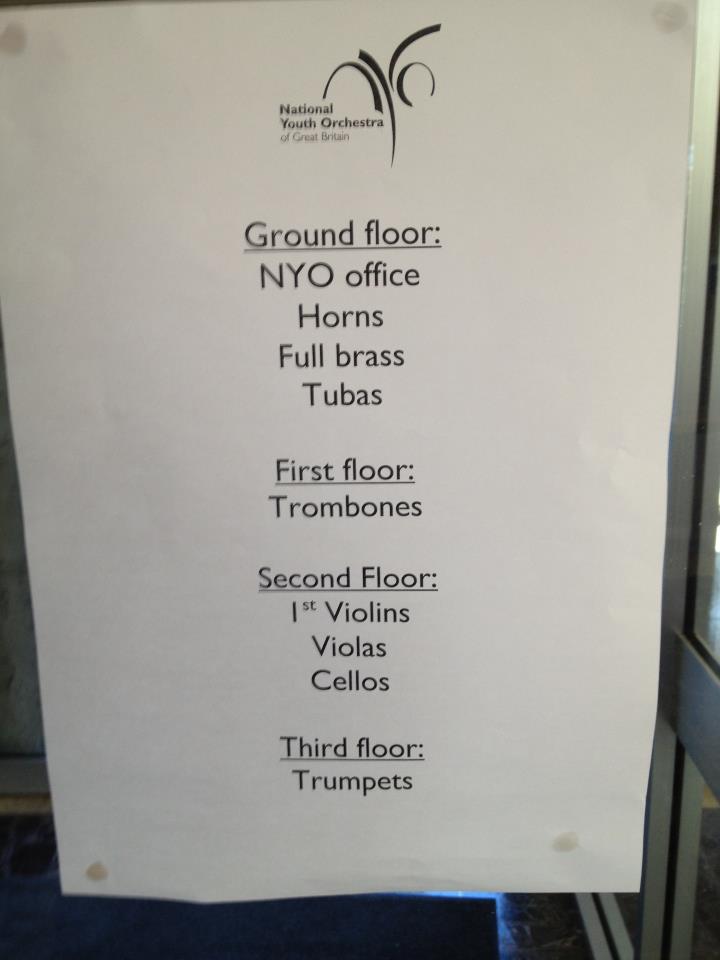
One sunny afternoon last July, the University of Birmingham’s Edgsbaston 295393_10151929538030109_359375196_ncampus played host to some rehearsals by the National Youth Orchestra of Great Britain.  Cellos, violas, tubas and trombones were scattered liberally throughout the Arts Building, and the history department itself played host to the trumpet section.  Hearing (fainter) strains of music in the department is not an uncommon occurrence, as there are student rehearsal rooms in other parts of the building.  This is usually quite enjoyable, even if it occasionally adds a melodramatic quality to meetings or supervisions.  Whether at work or home, we have all probably at some stage encountered some form of music which has permeated our environment uninvited.  Sometimes, as with the NYO or Birmingham’s budding undergraduate virtuosi, this can be an unexpected source of pleasure.  But in other situations, it can be distracting, disruptive, or downright offensive.  Uncleanness, the anthropologist Mary Douglas famously observed in her 1966 work on Purity and Danger, is ‘matter out of place’.[1]  In the same way, musical sound in the wrong spatial or chronological context can easily cross the rubicon of taste and order and become a provocative and clamorous noise.  If this is still true in the sound-proofed, double-glazed, cavity-wall insulated, noise-cancelling-headphone-wearing twenty-first century, then it was even truer in the sixteenth, where both welcome and rogue sounds must have travelled with much greater volume, clarity and conspicuousness. Continue reading

Call for Papers: Sin and Salvation in Reformation England

Jonathan Willis

As the tightly-sprung chaos of another academic term starts to unwind, and thoughts turn to the endless possibilities of a month of peaceful and unbroken research time (oh yes, and Christmas), my gift to you, Monster reader, is a call for papers.  But this isn’t just any call for papers!  Firstly, the vital statistics: Sin and Salvation in Reformation England is a major three-day conference taking place 26-28 June 2013 at the Shakespeare Institute, Stratford-upon-Avon.  I am organising the conference under the auspices of CREMS, the University of Birmingham’s Centre for Reformation and Early Modern Studies, with generous support from the Leverhulme Trust.  Contributions are invited from established scholars and postgraduate students alike, and it is my hope that the conference will give rise to an edited volume of essays. Themes for papers may include (but are not limited to): visual, literary, political, theological, historical, material, musical, polemical or any other treatments of the topics of sin and salvation in the context of reformation-era England. Please send abstracts of 250 words for 20-minute papers to me by 31 March 2013, and visit the CREMS website for more information.

Secondly, keynotes.  Every conference needs at least one keynote, and I’m delighted to say that we have managed to arrange an exceptional lineup of three of the most interesting and engaging scholars in the field.  Dr Arnold Hunt, has written on communion and extensively on preaching, and is currently involved with editing the parochial sermons of John Donne.  Professor Alec Ryrie has written extensively on the English reformation: his long-awaited monograph on Being Protestant in Reformation Britain is due out early next year, and he has already embarked on a new global history of Protestantism.  Professor Alexandra Walsham has written a series of ground-breaking books on the English reformation, on topics ranging from church papistry to providence and intolerance.  Her most recent work is a breathtaking account of the Reformation of the Landscape, and she is currently working on the impact of ageing and generational change on the English Reformation.

Thirdly, the conference blurb: Sin and Salvation were the two central religious preoccupations of men and women in sixteenth century England, and yet the reformation fundamentally reconfigured the theological, intellectual, social and cultural landscape in which these two conceptual landmarks were sited. The abolition of purgatory, the ending of intercessory prayer, the rejection of works of supererogation and the collapse of the medieval economy of salvation meant that it was impossible for attitudes, hopes, fears and expectations about sin and salvation to survive the reformation unchanged. This conference will explore some of the transformations and permutations which the concepts of sin and salvation underwent over the course of the reformation in England, as well as the practical consequences of these changes as lived.

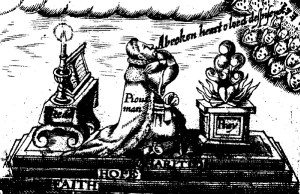
Fourthly, every call for papers needs a picture, so here is mine: part of the frontispiece from Lewis Bayly, The Practise of Pietie (1613).

Bayly[A pious man, kneeling upon a foundation of faith, hope and charity, turns from his study of the scriptures to pray: ‘A broken heart o Lord despise not’!]

Fifthly, finally, and as this is a blog entry rather than a traditional call for papers, I wanted to take a little more time to explain why I want to put this conference on, and what I hope to achieve.  I’m currently enjoying the third year of a Leverhulme Early Career Fellowship, working on ‘The Ten Commandments and the English Reformation’, and it was always my plan to host a conference during the final year of research.  Initially this was going to be a conference on the Ten Commandments, then it became one on the concept of God’s law, then on the use of the Old Testament during the reformation more broadly, then more generally on the bible.  Each successive iteration felt like I was getting closer, but I am not a biblical scholar, and so I kept putting it off and off as it didn’t quite feel right.  Finally it clicked: in a nutshell, the commandments were all about listing the things that you mustn’t do (i.e. sin), and enumerating the sort of deeds performance of which could be taken as a sign that an individual had been predestined to election (i.e. salvation).  One of many roles of the commandments in reformation England, therefore, was to help shape these fundamental concepts of sin and salvation as they slowly came to be understood by the great majority of people, through continual exposure through preaching, catechesis, the liturgy, and visual, musical, and other media.  Hopefully then, ‘Sin and Salvation in Reformation England’ will open up for exploration not only those vital concepts themselves, but also how they came to shape religious belief, practice and identity amongst the laity, and how they themselves were moulded by the experience.  A worthwhile enterprise, I’m sure you’ll agree: so, please take some time out from the sherry and mince pies, send those abstracts through to me now, and keep your eyes peeled for information about registration in the spring!

The Starlings Go to War

Laura Sangha

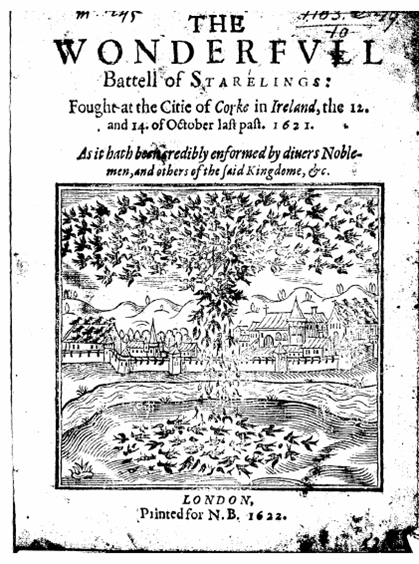
It’s that time of year when I am always reminded of one of my favourite providential pamphlets, The Wonderfull Battell of Starelings,fought at the Citie of Corke in Ireland, the 12. and 14. of October, 1621.[1] The pamphlet was published by a London printer in 1622, is short at nine pages, and it also has a wonderful woodcut that gives a graphic rendering of the events described in the text.

The pamphlet described howabout the seuenth of October last, 1621 there gathered together by degrees, an vnusual multitude of birds called Stares, in some Countries knowne by the name of Starlings’. The birds ‘mustered together … some foure of fiue daies, before they fought their battels, euery day more and more encreasing their armies with greater supplies, some came as from the East, others from the West, and so accordingly they placed themselues, and as it were encamped themselues eastward and westward about the citie’. Finally, on Saturday morning, at around nine o’clock:

vpon a strange sound and noise made as well on the one side as on the other, they forthwith at one instant tooke wing, and so mounting vp into the skyes, encountered one another, with such a terrible shocke, as the sound amazed the whole city and all the beholders. Vpon this sodaine and fierce encounter, there fell downe into the citie, and into the Riuers, multitudes of Starelings … some with wings broken, some with legs and necks broken, some with eies pickt out, some their bils thrust into the brests & sides of their aduersaries, in so strange a manner, that it were incredible except it were confirmed by letters of credit, and by eye-witnesses, with that assurance which is without all exception.

This ‘admirable and most violent battell’ continued with several more encounters between the two sides, before the birds seemed to vanish, so that on Sunday not one was seen about the city. On Monday the birds returned again for a final terrible assault, when many more wounded and dead birds fell into the streets of Cork. The pamphlet finishes with some rather brief and generic comments that the reader should not search out the reasons for such ‘ wonderfull workes of Almighty God’, but we should remember that ‘it doth prognosticate either Gods mercy to draw vs to repentance, or his iustice to punish our sinnes and wickednesse’.

The pamphlet’s description of strange events interpreted within a (loose) providential framework makes it typical for the time, and thanks to Alexandra Walsham, we can easily make sense of what at first seems to be a bizarre account.[2] We have already encountered this type of material on the monster. It is a great resource for teaching with, introducing students to the idea of the ‘difference’ of the early modern period – although there are lots of elements of this past society that seems familiar to us, material like this confronts us with the vast gap between the early modern outlook and mentality, and our own. They see God’s intervention in the world to create an unnatural event (birds aping human military activity), their interpretive framework, their means of making sense of the event is providential, it is religious.

What do we see? Probably we would see a ‘murmuration’: starlings gathering into large flocks in the autumn evenings – it is a natural event, spectacular, but perfectly normal. Our interpretive framework is not religious but scientific, the starlings are “always ready to optimally respond to an external perturbation, such as predator attack,” according to a Proceedings of the National Academy of Sciences paper.  When dead birds fall from our skies, we call in the veterinary inspectors, carry out tests, blame fireworks, the internet, UFOs – as you can see in this news report, our modern day equivalent of the early modern pamphlet.

Of course it isn’t as straightforward as that – it never is. Early modern people were not ignorant of bird behaviour, and they certainly knew about autumnal flocks, as you can see from this extract from an almanac of 1700:

Signs of Cold weather, or hard winter.

THE Suns setting in a Mist, looking Red, and Broader than usual.  The Clearness of the stars, and their much Twinkling.  Starlings, Feldefars, and other Birds of a Hot Nature, hastening in great Flocks or Flights from the Northern to the southern Climates. [3]

In fact, further investigation quickly uncovered further titbits about the birds: they were good mimics, valued for their singing, and could be caught and kept for pets.

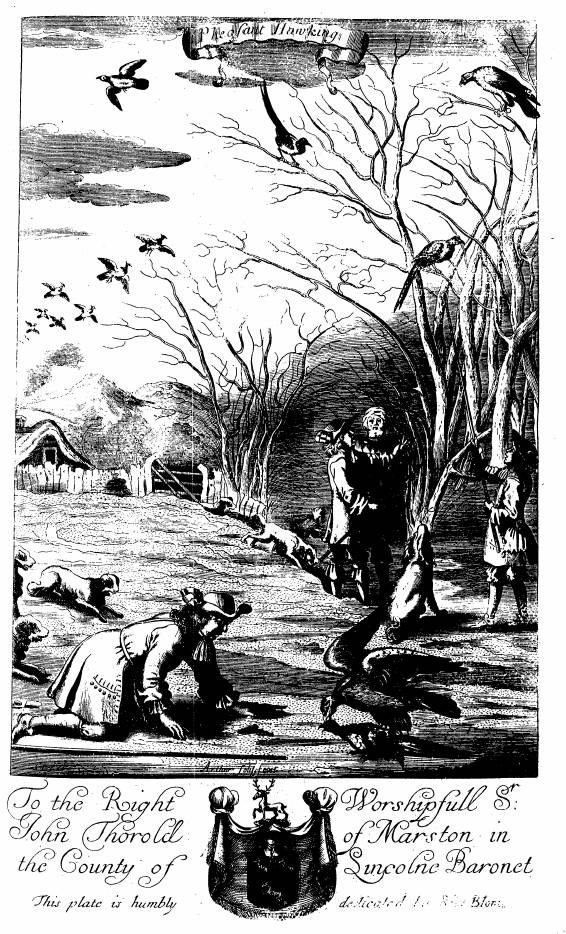
One of the many illustrations in R. Blome’s ‘Gentlemans Recreation’, this one depicts the practice of hawking.

R. Blome, The gentlemans recreation in two parts : the first being an encyclopedy of the arts and sciences … the second part treats of horsmanship, hawking, hunting, fowling, fishing, and agriculture (London, 1705).

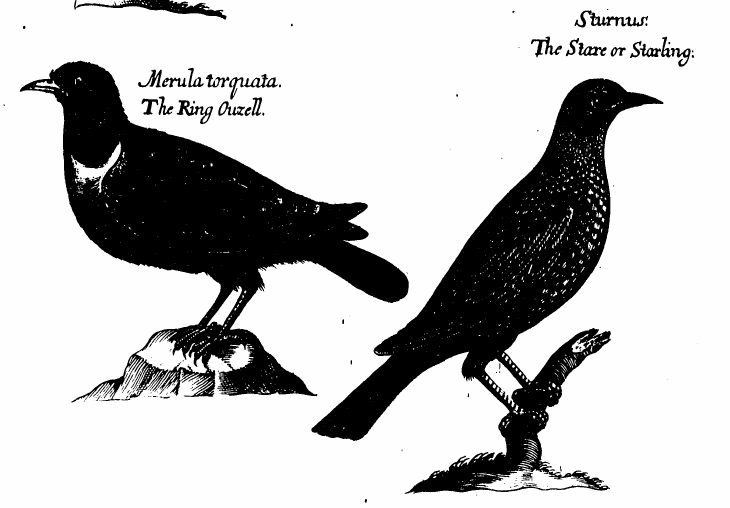
The STARLING.This is a very docile Bird, and if taken out of the Nest young is apt to learn both to walk and Whistle. ‘Tis a hardy Bird; their food is Sheeps-Hearts, or other raw Flesh, hard Eggs minced, Hemp-seed, wet Bread, and the like.

John Ray, The ornithology of Francis Willughby of Middleton in the county of Warwick Esq, fellow of the Royal Society in three books (London, 1678).

§. VII. How to take Stares with a limed string: out of Olina’s Uccelliera.Take a small string of a yard or thereabout long, bind it fast to the Tail of a Stare, having first carefully limed it all over, excepting one Palm next the bird. Having found a flock of Starlings, come as near to them as possible, holding your Stare by the wings as near as you can, and let her go to her fellows, which as soon as you shew your self to them, will presently take wing: Your tail-tied Stare endeavouring to secure her self of her liberty, thrusting her self into the middle of her fellows, will entangle many of them, and so not being able to fly, they will afford a pleasant spectacle in tumbling down to the ground: where you must be ready with a Brush or Besom to strike them down. Many other devices there are to take several sorts of birds with Lime-rods, &c. which I think needless to set down; it being not difficult for an ingenious Fowler to invent as good or better, when he shall have opportunity of taking those kinds of Birds.

Aside from this fascinating insight into just what these country folk were up to, this is a further reminder that early modern people were far from ignorant about the world around them, but that the battle of the starlings points to areas of divergence in underlying assumptions, outlooks, and technological and intellectual understandings between their society and ours. At certain moments, certain people would turn to a religious interpretation, though it is clear that this was not the only explanation on offer.

A sketch of a starling from John Ray’s ‘Ornithology’. Ray was a fellow of the Royal Society.

Of course, the significance of the battle has been attached by the pamphlet’s author, perhaps as a means to justify printing his entertaining report – a moral message makes it worthy of publication. Or maybe it was a way to appease the author’s printer Nicholas Blount, who seems to have adhered to Calvinist principles: Blount refused to print plays and other frivolous material, so the author’s religious framework was perhaps necessary concession with its roots in the world of commerce. They key thing is, that when we look beyond cheap printed pamphlets the interpretations might diversify.

The other thing that strikes me about all these birds mustering together and plummeting from the heavens, is that in some respects a certain amount of faith is needed to accept our scientific explanations. Scientists admit that starling flocks ‘transcend biology’, and that science has only a sketchy understanding of what the phenomena is all about – there is much more ‘still to be discovered’. Our modern confidence that we will eventually work it out contrasts with the early modern warning not too look into these mysteries too deeply, highlighting yet more difference. Yet there is also similarity: this clip was filmed recently in Ireland, and science alone might find it hard to explain the sense of awe in wonder inspired by the sight and sounds of the murmuration even today. The clip also makes it much easier for us to appreciate where the ‘battell’ interpretation came from. I strongly recommend that you watch the video (it gets really good about 50 seconds in), and perhaps let me know what you see.


[1] Anon, The wonderfull battell of starelings fought at the citie of Corke in Ireland, the 12. and 14. of October last past 1621 (London, 1622), STC (2nd ed.) / 5767.

[2] Alexandra Walsham, Providence in Early Modern England (Oxford: OUP, 1999).

[3] C.P., The sheepherd’s new kalender: or, The citizens & country man’s daily companion treating of most things that are useful, profitable, delightful, and advantageous to mankind (London, 1700), Wing (2nd ed.) / P11.

John Dee’s conversations with Angels

Laura Sangha

Question: Why would you want to have a conversation with angels? More specifically, why would you want to have a conversation with angels if you were a sixteenth-century mathematician, philosopher, court astrologer and magus? And how would you go about doing it?

Sections of Dee’s record of his conversations with angels were published by Protestant minister Meric Casaubon in 1659.

Elizabethan John Dee had some very clear answers to these questions, as is evident from the records he left us of hundreds of conversations conducted with angels between 1583 and 1587. The earliest record of his angelic conferences is prefaced by a prayer in which he outlined his motivation. He confessed how he had prayed since his youth for ‘pure and sound wisdom and understanding of your [God’s] truths natural and artificial’, truths which were to be used for the honour of god and the benefit of humankind. However, although he had studied long and hard, in many books and places, and conferred with many men, he had become disillusioned with conventional routes to knowledge and what he called ‘vulgar scholar’. His lifelong struggle to acquire a universal wisdom from dogged researches in mathematics, astrology, optics, geography, navigation, history and other disciplines had not yielded the results that he was hoping for – true wisdom remained elusive. All was not lost though, as Dee came to the conclusion that there was another way to attain the better understanding that he sought, and that was through direct consultation with angels.

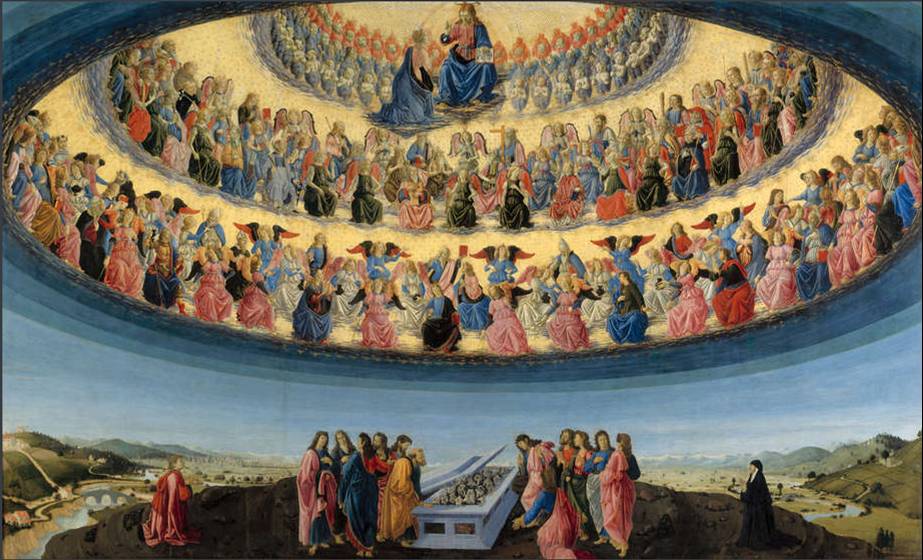
Botticini’s ‘Assumption of the Virign’ (1475) depicts the 3 orders of the angelic hierarchy in all their glory.

Early modern folk understood that angels were the next step down from God in the universal hierarchy, and this nearness meant that they were endued with a special knowledge, much superior to the cloudy understanding of mankind. Dee knew that in the past God had sent his angels to men like Enoch and Moses, to ‘satisfy their desires, dowtes and questions of thy secrets’, giving them access to this true wisdom that had originally come directly from God. Conversations with angels therefore had a firm scriptural precedent, and could give man access to an ancient esoteric wisdom that had originally been communicated to Adam, but which had been lost and forgotten over the course of human history. The arts of divination and magic were fragments of this original, pristine knowledge, and the angels had the potential to fill in the missing gaps. Dee’s reasons for conversing with angels were therefore, in his mind, spiritually and intellectually sound. They were the culmination of his lifelong efforts to decipher the book of nature and to discover a universal science that could bridge the gap between heavenly wisdom and faulty human perception. His dialogues were designed to build a Jacob’s ladder to the other world. Importantly, as well as seeking this recondite knowledge, Dee was also looking for signs of his own salvation, as every good Protestant should, and he thought that his conversations were proof that he and his assistant (or scryer) were, like Enoch and Moses, the specially chosen recipients of divine knowledge. For Dee, his actions were thus a type of religious experience sanctioned by scriptural precedence.

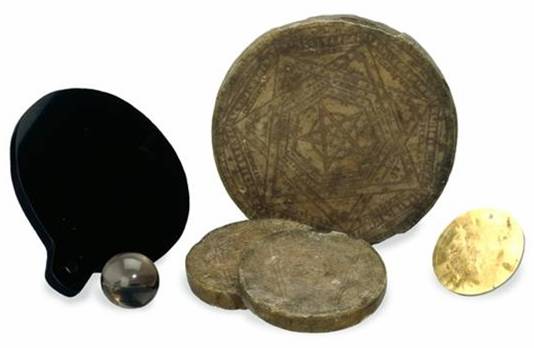
The practicalities of Dee’s conversations reinforce this idea. The ceremonies began in the simple religious atmosphere of an oratory, a chamber in Dee’s house that had been set aside for the purpose of conducting the conversations. He and his scryer, Edward Kelly, began with a period of silent prayer. Most often Dee would humbly petition God to send his angels, addressing God and Jesus as the embodiment of wisdom, and asking that Dee and Kelly be worthy of divine aid in understanding. Dee was acutely aware of this need to be worthy, he placed great emphasis on approaching the conversations in a proper spirit of piety, and the angels themselves delivered frequent homilies on Dee and Kelly’s sins, the nature of salvation, and the necessity of complete obedience to God as a prerequisite of receiving the whole revelation. But unlike with medieval magic, initially there were no elaborate ritual preparations or ceremonies, no incantations, hymns, purifying fumigations, candles or talismans to attract the influences of the planetary angels. The one piece of magical apparatus that Dee and Kelly did have was a ‘shew-stone’ through which the scryer saw the visions of angels.

You can see the shew-stones and wax discs Dee used in his conversations at the British Museum.

Dee never saw or spoke to the angels himself, they appeared to Kelly, who related the information back to him – an angel told them that Kelly saw the angels ‘in sight’, whereas Dee could only see them ‘in faith’. The original shew-stone was probably a circular flat black mirror of polished obsidian, but there were several others, including one which was delivered by the angels themselves, as described by Dee:

I cam within 2 feet of it, I saw nowthing, then I saw like a shadow… on the ground.. hard by my books under the west window. The shadow was roundish, and less than the palm of my hand. I put my hand down upon it, and I felt a thing cold and hard, which taking up, I perceived to be the stone before mentioned.

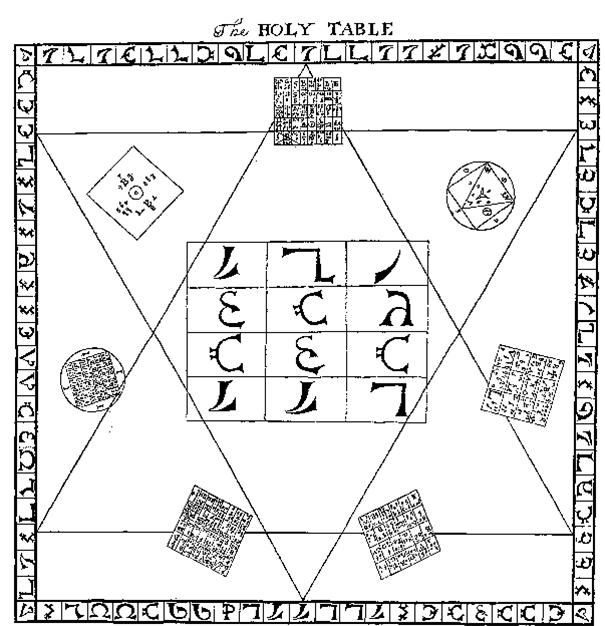
The scrying stone was the bridge between the divine and earthly worlds. Over time, other new ritual elements began to creep into the conversations, bringing a greater ‘magical’ aura to proceedings. The angels gave direction for a table of practice decorated with various mystical symbols, and for a seal of God to be inscribed on wax discs which were then placed under the legs of the table and beneath the shew-stone on the table.

The holy table used in the conversations. The angels instructed Dee in its design.

So did it work? Did Dee achieve his aims? It certainly wasn’t a complete failure – numerous spirits appeared to Kelly and extensive conversations were conducted. Most often the visitors were the archangels Michael, Gabriel, Raphael and Urial, although another, Madimi was also a regular visitor. The apparitions appeared in a variety of guises: they might look like a young girl, or a husbandman in red apparel, a yellow haired women who was like an old maid, or on one occasion just like ‘a big tall creature’. During the conversations with these celestials, two main forms of knowledge were conveyed to Dee. Firstly, the angels provided many grid like tables purporting to be an angelic alphabet.

One of the grids relating to the angelic alphabet. The angels selected letters from the grids to make words and sentences.

This represented a divine language, which if mastered would allow Dee to know the true nature of all things. Secondly, the angels provided information about the names and responsibilities of the angels – the sections of the air that they ruled, the angelic tribes that they belonged to, and the number of subordinates that they controlled.

In the first Air: the ninth, eleventh, and seventh Angel of the Tribes, bear rule and govern. Unto the ninth, 7000. and 200. and 9 ministering Angels are subject…. The whole sum of this Government amounteth to 14931

This information about the angelic hierarchy would eventually give Dee command over the angels and would allow him to participate in the society of angels. Unfortunately for Dee, his attempt to use religious magic as a means to ascend up the universal hierarchy was ultimately a failure. The angelic language and spiritual hierarchies that he learned from the angels were not the pristine knowledge that he sought, they were just the means to access that knowledge, and the language and hierarchy were only partially complete in any case. Dee went to his grave without having unlocked the secrets of nature, though fortunately for us he recorded his endeavours in great detail, giving us an insight into the pious, rational, yet strange and alien world of the Elizabethan intellectual elite.

Want to know more? [*endorsement alert*] I discuss many of the other beliefs associated with angels in my recent book. If you want to know more about John Dee try these:

  • M. Casaubon, A True and Faithful Relation of what passed for many yeers between Dr. John Dee … and some spirits (London, 1659).
  • N. Clulee, John Dee’s Natural Philosophy: Between Science and Religion (London, 1988)
  • D. Harkness, John Dee’s Conversations with Angels: Cabala, Alchemy, and the End of Nature (Cambridge, 1999)
  • W.H. Sherman, John Dee: The Politics of Reading and Writing in the Renaissance (Amherst and Boston, MA, 1995)
  • G. Szonyi, John Dee’s Occultism: Magical Exaltation through Powerful Signs (Albany, NY, 2004)

REED all about it – Part II: Angelic sheep-stealers, iconophobia, and the unaccountable longevity of ‘Merry England’?

Jonathan Willis

Last month I wrote a REED-related post about a minor scuffle at a church ale in Bere Regis in 1590, but this time I would like to highlight a more significant and well-known case, to my mind one of the real gems of the REED material: the controversy surrounding the performance of the Whitsun plays in Chester during the early 1570s.[1]  There was a rich history of sacred drama in Chester going back at least as far as the late fourteenth century, including plays to celebrate Easter, midsummer, and Corpus Christi.  By the sixteenth century, it was held that the ‘old and Antient Whitson playes’ held annually in the city were ‘first made Englished and published by one Randall Higden a monk of Chester Abbey, and sett forth and played at, and by the Citizens of chester charge In the time of Sir Iohn Arneway Knight, and Major of Chester Anno 1268’.[2]  In 1571-2 the plays were still going strong, and detailed guild accounts give a fascinating insight into both the performances themselves, and the degree of time, effort and resource which went into their preparation.  The Smiths, Cutlers and Plumbers’ Records for that year recorded 3d for equipment (a ‘touyle’), 1s 4d for casting costs (‘seekinge our players’), and 7s 8d worth of beef to sustain them ‘for our genrall rehearse’, along with two whole cheeses and spices for the meat.[3]   An amateur dramatics group, like an army, evidently marched on its stomach, as payments for bread over three separate rehearsal days totalled 4s 10d, and to quench the assembled thirst there was 10s worth of ale and 9d of small ‘beare’.  Alongside the players, payments were also made to musicians and minstrels, as well as 4s 2d ‘to the clergy for the songes’, implying a close relationship between the professional religious institutions of the city (quite possibly the choir of Chester Cathedral) and the amateur efforts of the trade guilds. Continue reading

Fantastic Thoresby – Part I: Dangerous Diaries

Laura Sangha

Ralph Thoresby, 1658-1724.

The time has come to introduce many-headed monster readers to my current historical obsession: Ralph Thoresby (1658-1725). Thoresby, the son of a wool merchant, was a well respected antiquarian and topographer, a dissenter who conformed to the Church of England later in life, a husband, a father, a historian, a fellow of the Royal Society, the owner of a museum, a prolific correspondent, and a diarist. Over the summer, I had the pleasure of delving into Thoresby’s diary, which was transcribed and published by the Reverend Joseph Hunter in 1830. Future posts will deal with the content of the diary, which reveal a likeable, pious, and reflective man, but reading it also got me thinking about the ‘diary’ as a historical document, and it is this that I will deal with in this initial post. Continue reading

REED all about it – Part I: Fiddling at the Church Ale…

Jonathan Willis

This wasn’t originally going to be the first utterance of this particular newly-sprouted head of the many-headed monster, but Brodie’s recent musings ‘On the merits of dust‘ and the lively debate it sparked set me to thinking about one of my favourite short-cuts to a treasure-trove of brilliant archival material, the Records of Early English Drama series. REED (for short), for those of you who haven’t come across it, is an international project with its home at the University of Toronto. Since 1975 they have published almost thirty edited volumes bringing together collections of transcribed documentary material relating to drama, secular music, and community ceremonial and entertainments from the middle ages until the middle of the seventeenth century. Organised variously by city, county or region, these reassuringly sturdy big red books would be a handsome edition to any library or bookshelf (no, I’m not on commission), and even better many of them are also available to download in PDF format, perfectly legally(!), through the Internet Archive website. This is a top-notch published collection of manuscript material, gathered from record offices up and down the country, which is not only available in university libraries but also on your laptop, desktop or tablet. Continue reading

The Devil’s Church

Mark Hailwood

Early modern moralists were quick to condemn alehouses as ‘nests of Satan’, or as ‘the Devil’s church’ – places where impiety and irreligion were rife. The reality, as I will be demonstrating in my book, was that alehouse-haunting and godliness were not necessarily incompatible features of early modern life.

Whilst many ministers perceived themselves as locked in a ‘Battle for the Sabbath’, competing with the local alehouse to put bums-on-seats (or rather bums on pews and ale-benches) during Sunday services, the majority of parishioners seem to have found no great problem – or contradiction – in using their Sundays to congregate both at church and at the local drinking hole. Two diaries from relatively devout Christians—the Yorkshire yeoman Adam Eyre, written in the 1640s, and the Lancashire mercer Roger Lowe, written in the 1660s—both detail routine behaviour of stopping off for drinks either on the way to, or the way back from, a sermon or service. When faced with the seemingly existential choice between church and pub, the most common response was… both.

In fact, religion was a common topic of conversation around the ale-bench, and it is a couple of particularly striking examples of such exchanges that I want to share here, and invite your thoughts on.

The first took place on a December morning in 1656, in a Nottingham alehouse. William Bradshaw, a felt-maker, was discoursing with his companions about food and drink, when the conversation turned to what scripture had to say on the issue. Bradshaw said that ‘there was a saying in scripture that our Saviour fed 5000 men with 5 loaves and 2 fishes, which was as arrant a lie as ever was spoken’.

Jumping forward to 1681, and to the Somerset parish of East Pennard, near Glastonbury, the vicar of the parish, Mr Alisbury, was drinking in an alehouse with Joshua Swetnam, a local farmer. Their discussion came on to the subject of the Old and New Testaments, whereupon Alisbury offered his view that ‘they were not good but were both false and that there was not a good book but the common prayer book’.

We have two expressions here of unorthodox religious belief – but how unorthodox were they? Was Bradshaw’s denial of the miracle of the feeding of the five thousand an instance of truculent plebeian cynicism, demonstrating a healthy dose of mistrust of authoritative discourses? Or was this felt-maker ‘pushing the envelope’ of Protestant theology, taking the official Protestant distrust of the possibility of contemporary miracles to its extreme, and denying the possibility of any of Christ’s miracles? And what about the vicar Alisbury’s rubbishing of both the Old and New Testaments? Was he just a confused drunkard (he did have a reputation for imbibing) who failed to see the contradictions in his statement, or was he simply a ‘hotter sort’ of ‘Prayer Book Protestant’ who exalted the book above even the Bible itself? Would his view have been shared by some of his parishioners, or were these the ramblings of a lone voice?

I’d love to hear from religious historians here – do these views chime with any of the broader trends in religious debates in the mid-to-late seventeenth century, or are these isolated outbursts of unorthodoxy whose origins will remain obscure?

There is a broader question about popular religion at stake here I think – what we might call, after Ginzburg’s famous ‘The Cheese and the Worms’, the Menocchio question – do discoveries such as these help historians of popular culture to tap into hidden veins of belief held by ordinary people, or do they represent the unrepresentative, and lead us up the garden path?