Twelve reasons to buy my book, or, The ancient art of self-promotion

Brodie Waddell

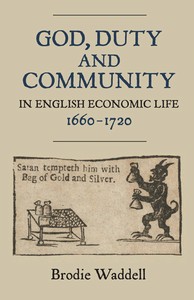
Brodie Waddell, God, Duty and Community in English Economic Life, 1660-1720

1. It was only officially released today, so if you buy it now, you’ll probably be the first kid on your block to have one!

2. It has seven pictures inside, a very respectable ratio of 1 for every 34 pages.

3. It has the word ‘God’ in the title, making it slightly more likely to be accidently recommended by your local Christian reading group.

4. It has a picture of Satan on the cover, making it slightly more likely to be accidently black-listed by your local Christian reading group.

5. Barack Obama called it ‘…the best book I’ve ever read on later Stuart economic culture…’ and Nelson Mandela said it was ‘… longer than I expected …’ (NB: Not actual quotes. Please don’t sue me!)

6. It has footnotes, not those horrible endnotes.

7. It cites a hell of a lot of broadside ballads.

8. I can’t think of a number eight.

9. It uses paper that apparently derives from ‘natural, recyclable products made from wood grown in sustainable forests’. You’re practically saving polar bears just by reading it.

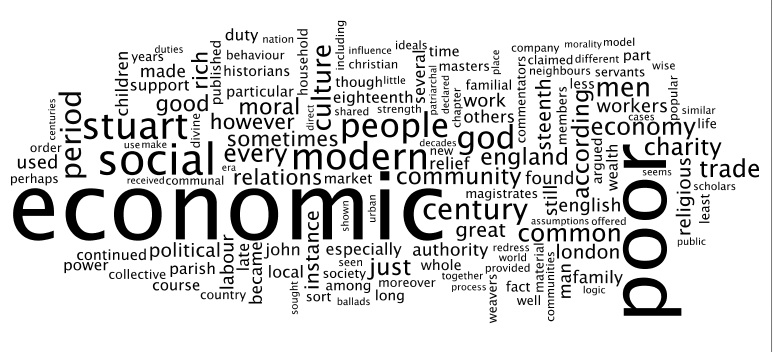
10. When you put the text through Wordle, you get this…God, Duty and Community via Wordle
11. I can’t think of a number eleven either.

12. I’ve heard that ‘this book explores the economic implications of many of the era’s key concepts, including Christian stewardship, divine providence, patriarchal power, paternal duty, local community, and collective identity. Brodie Waddell draws on a wide range of contemporary sources – from ballads and pamphlets to pauper petitions and guild regulations – to show that such ideas pervaded every aspect of social and economic relations during this crucial period.’

Available at Boydell & Brewer (UK), University of Rochester Press (USA), Amazon (everywhere), Powell’s (less evil) and other fine book-sellers.

UPDATE (19/10/12): I’ve only just discovered that it’s also available as an over-priced ebook. If you’d like a sample from the text, I’ve uploaded the table of contents, introductory sections, bibliography and index.

UPDATE (12/11/12): There is now a preview on googlebooks too.

Buried Heads

If you are wondering why it’s gone a bit quiet here at the many-headed monster there is a simple explanation: with the arrival of freshers on campuses across the land all heads are currently buried in start of term business. Rest assured though that there are some interesting new posts in the pipeline – lazy labourers, more music, and the adventures of a Yorkshire antiquarian, will all feature soon.

In the meantime, I wanted to share a couple of interesting items I’ve come across: readers of my Huntington Library Treasures post should check out the Huntington’s own blog, ‘Verso,’ especially this post by Bert Rinderle on the incredible efforts that go in to managing their awesome manuscript collections.

Early modern historians based in the glorious South West of England might also check out ‘A Cuppe of Newes‘, which is a great resource for information about upcoming events and ongoing projects, including the regular Centre for Early Modern Studies seminar series at Exeter.

The monster sprouts two new heads

Brodie Waddell and Mark Hailwood

For the last couple of months we have been a very strange sort of ‘many-headed monster’: a creature with only two heads.

That is all well and good for muppets, but we – as pedants scholars – believe that ‘many’ ought to denote at least three and preferably four.

It is thus with great relief that we welcome two new authors to the blog: Laura Sangha and Jonathan Willis. Like us, they are both historians of early modern England and hold PhDs from Warwick.¹ But unlike us, they are also well-established in their fields, with lectureships at Exeter and Birmingham respectively. Their research has focused on cultural and social history, especially the Reformation and the changing nature of religious practices and beliefs in the sixteenth and seventeenth centuries. You can find out a bit more at our About Us page.

Footnotes

¹ Although we were all Warwickers, they had a different doctoral supervisor, so I suppose one might call them Marshallians rather than Hindleites.

The people love us

Brodie Waddell and Mark Hailwood

At some point around midnight on Saturday, September 1st, the many-headed monster received its thousandth hit. This calls for a celebratory cheesy animated gif…

Not bad for only a month and a half of blogging. Thanks to our readers for taking an interest in our thoughts an d little discoveries. And keep the comments coming. This place works best when you share your own interpretations and experiences alongside ours.

Also, on a more technical matter, we have now split up the ‘manyheadedmonster’ user into its component parts (manyheadedhailwoodbrodiewaddell), so it will now be possible to click on the author’s name at the top of each new post and see all of their other posts, except for those published before today.

UPDATE (03/09/12): Apparently the people love us even more than we could have hoped, because yesterday we jumped from around 1,000 total views to over 1,250. Thanks to Loretta Chase and Isabella Bradford for linking to us.

Update (14/09/12): Today we hit 2,000. When we make it 10K, we’ll have to break out the bubbly.

Welcome!

We are the many-headed headed monster.

We’re two historians of early modern England who’ve decided to share our historiographical exploits with the world. In time, we may come up with a proper mission statement, but for now we’ll just refer you to our About page.

We welcome comments and questions on almost anything, just don’t expect us to respond politely to queries about Henry VIII’s wives.