The ‘Lowest Sort’ in the Print Trade of 17th-Century England

Our latest post in the Postgraduate and Early Career Takeover is from Joe Saunders. Joe has just started a PhD at the University of York using wills to study the social networks of the print trade in England c.1557-1666. Find Joe on twitter at @joe_saunders1.

We are this year ‘working from home’; struggling with work-life balance; and have ‘Key Workers’ in our supermarkets, hospitals and care-homes. What constitutes important labour is a contemporary debate but also interests historians who seek to define and locate work. Histories of literature are a case-in-point, with focus oscillating between the labour of authors, readers and publishers. In recent decades we have come to know a great deal about text creation and circulation during the hand-press era with work on the producers and movers of texts; publishers, printers and booksellers as they turned an author’s ideas into something tangible and passed them to an audience. The transfer from the author’s mind to printed page and then to the reader required a significant amount of labour from a variety of actors in a myriad of roles from financing a text through to those who carried the finished products along country roads.
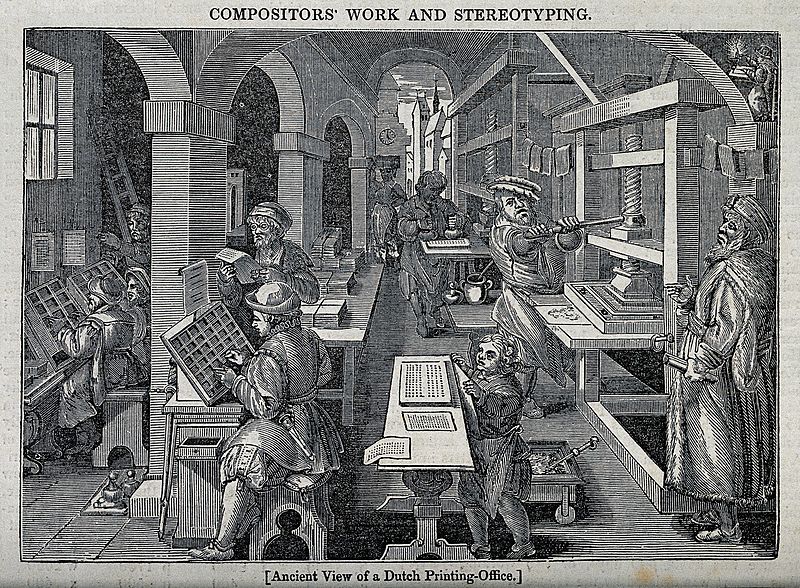
Men working at a printing press- Wellcome Collection. Attribution 4.0 International (CC BY 4.0)

Bertolt Brecht in his 1935 poem ‘A Worker Reads History’ imagined how the workers who built the great monuments of the world figured into histories dominated by great men. He asked ‘but was it kings who hauled the craggy blocks of stone?’. Of course, the answer is no, but their names adorn these structures nonetheless. Though the process of text creation and movement in early modern England was gendered, classed and regionalised research has necessarily focused on the better offs who left their names on imprints and records of the Company of Stationers; the livery company which held a theoretical control over the membership and products of the print trade. This is the case across the History of the Book where source survival means most work on reading and authorship is also done on the middling sorts and elites.

The 2020 publication Women’s Labour and the History of the Book in Early Modern England brought together a range of essays dealing with reading, authorship and production. The focus was more towards countesses than chapmen-or-women but an exception was Craig’s essay on the rag-women who collected material for papermakers. This research recovered the labour of people who were critical to the production of texts but are largely absent from the records and therefore from our understanding. It was argued implicitly that to look for the lowest sort of women in the trade is the first step to finding them.

Continue reading
A Poor Hand-Maid’s Tale: Love, Petitioning and Print in Seventeenth-Century England

The second post in our Postgraduate and Early Career Takeover comes from Scott Eaton, an ECR interested in early modern witchcraft, religion, art and print cultures. His book on the witch-finder John Stearne is available from Routledge now. You can follow him on twitter: @StjEaton.

On 22 August 1651 Christopher Love was executed for treason for conspiring with Royalists to restore the King, Charles II, to the throne. His wife, Mary Love, had worked tirelessly to try and save him. While he was being held in the Tower of London, Love petitioned, ‘stood dailie’ at Parliament’s doors and even sent messages to Cromwell in Scotland (at the cost of £100!) in the hope she might secure her husband’s release. Unfortunately, she failed in her efforts. Shortly after Christopher’s death, however, Mary published her petitions and included letters they had written to each other before he was executed. Her publications can provide insight into petitioning, print and gender roles in seventeenth-century England.  

Petitioning was an acceptable way for the ‘ruled’ to address the authorities and make their voices heard, whether seeking action, intercession or mercy, like Love. The 1640s saw a breakdown over censorship of the press and a rise of female assertiveness in the political arena, allowing printed petitions attributed to women to proliferation more widely than before. Mary Love’s printed petitions obviously came after these events had happened, giving her a precedent to follow.

The Resolution of the Women of London to the Parliament (1642), EEBO
Continue reading

‘The devil will tear me in pieces’: Self-destruction and sympathy in a seventeenth-century witchcraft case

We are delighted to launch our Postgraduate and Early Career Takeover with this post from Imogen Knox. Imogen is an M4C funded doctoral researcher at the University of Warwick whose work focuses on suicide, self-harm and the supernatural in Britain, 1560-1735. Find her on twitter at @Imogen_Knox.

CONTENT WARNING: this post contains discussion of suicide.

Self-destruction was interwoven with the roles of both witch and bewitched in early modern Britain. Witches committed spiritual suicide in signing themselves over to the devil, and in turn the devil tempted his imprisoned servants to self-destruction to secure his grip on their souls. The spiritual and actual suicide of witches, like criminals, reinforced their guilt in the contemporary imagination. Witches also tormented their victims with temptation to self-destruction.

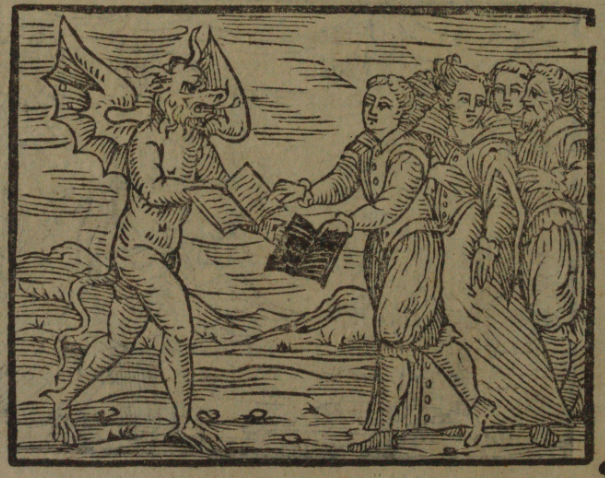
Witches making a pact with the devil. Compendium maleficarum. Wellcome Collection. Attribution 4.0 International (CC BY 4.0)

Both those afflicted by witchcraft and witches themselves expressed self-destructive temptations. One such admission would produce sympathy, the other scorn. In this post I examine the case of the witchcraft of Anne Bodenham and her victim Anne Styles to show how, by mirroring each other’s self-destructive behaviours, the women negotiated contemporary ideas around innocence, guilt, female nature, and spirituality. One would emerge as an innocent victim, the other an unrepentant sinner.

Dr John Lambe, Anne Bodenham’s reputed tutor. John Lambe, an infamous medical practitioner and magician. Wood engraving. Wellcome Collection. Attribution 4.0 International (CC BY 4.0)

Anne Bodenham, of Fisherton Anger, near Salisbury, was a reputed cunning woman. It was her ability to locate stolen goods that first brought Anne Styles to her in 1653. Styles, a young woman employed as a maid in the Goddard household, was illiterate and ‘altogether ignorant of the Fundamentall grounds of Religion’ according to the court clerk Edmund Bower. In contrast, the eighty-year-old Bodenham owned ‘a great many notable books’ and claimed to have been taught by the infamous Dr Lambe. Styles made multiple visits to Bodenham, to consult on various issues for the Goddard family, chief among the fear of Styles’ mistress that she was to be poisoned. After several visits, Bodenham offered to take Styles on, ‘to live with her’ and ‘teach her to doe as she did’. However, when Bodenham transformed herself into a cat, Styles was ‘very much affrighted’. Bodenham, seeing that she had misjudged the situation, let Styles go. To ensure that Styles would not ‘discover her’, Bodenham had Styles sign her name in blood in a book, while two conjured spirits looked on.

Continue reading

the many-headed monster postgrad and early career takeover!

***NOW CLOSED TO SUBMISSIONS***
[But we will be back with future editions, so watch this space…]

We monster heads still strongly believe in the value of the blog format, but sadly life has conspired to mean none of us can post as often as we used to. The site remains popular though, and we receive an average of around 5,000 views per month. So rather than having this platform sit here twiddling its thumbs, we put our monstrous heads together to think about how we could make the most of it at the current time. The answer was obvious: for at least the next six months we want to make the monster a platform for our postgraduate and early career readers to showcase their research, and to voice their views on academic life.

We hope there will be a number of benefits. Obviously the takeover will give early career scholars the chance to bring the fruits of their research to a wide audience, but it is also an opportunity for writers to give blogging a try and for us to share some of the insights we have gained over the years. Of course with lockdowns still in place in many parts of the globe, and with further postponements of conferences and symposia, the takeover is also intended as an alternative way of encountering and engaging with current research and work in progress – and in a digestible format that can fit in around online teaching, caring duties, daily exercise and lying on the floor in a darkened room breathing deeply, etc.

So if you are a budding historian who does not have a permanent academic job (our deliberately baggy definition of postgrad/early career), then please consider writing a blog for us. You can download our simple guidelines and style guide here: Submission Guidelines For Authors.

The rest of this post provides a gloss on the guidelines, familiarising potential contributors (or anyone else thinking of venturing into blog writing) with the reasons why we have come to write for the monster in the way that we do. As you will see, most of them relate to our sense of who reads the blog, when and why.

Continue reading