The future of ‘history from below’: an online symposium

Brodie Waddell

Those of us who think that historical research ought to consist of more than the study of kings, ministers and generals owe a great debt to the pioneers of ‘history from below’ . Foremost amongst them must be E.P. Thompson, who published his epic The Making of the English Working Class exactly half a century ago. The impressive wave of work that followed will be well-known to many of you and, if nothing else, I think most historians would agree that historical scholarship would be poorer if not for the intervention of these spirited men and women.

But what about the next fifty years? Has ‘history from below’, and perhaps social history more generally, outlived its usefulness? What, if anything, can it contribute to contemporary scholarship and the wider world? How should it be adapted or reoriented in the coming years? What new tools or techniques could strengthen it? Where will it fit in the wider academic and social landscape?

On 16 April 2013, eighteen of us gathered for a workshop at Birkbeck to try to figure out some answers to these questions. As is usually the case with these events, the discussion carried on in the pub afterwards and, although we certainly didn’t come up with any conclusive answers, we all agreed this was a conversation that needed to continue.

To that end, Mark and I invited the participants to contribute to an online symposium on the future of ‘history from below’. So, over the next few weeks we will be posting a series of short pieces by historians early in their academic careers that attempt to offer some possible answers to these questions. We hope that this will spur further discussion and open up the conversation to the rest of the world. Please leap in with your comments, suggestions and critiques. We welcome comments not only from ‘fellow travellers’ but also – perhaps especially – from sceptics and critics of ‘history from below’.

The first post will be published here on Monday, July 8th, with further posts following every two or three days. Links to each piece will be added here and join the conversation on twitter via #historyfrombelow.

Programme

Everyday Life and the Art of the Dutch Masters: A Social Historian’s Perspective

Mark Hailwood

The visual culture of the early modern period has been a prominent theme here on the many-headed monster, what with Jonathan’s recent post on what God looked like, and my own series of posts on woodcut workers, so I thought another contribution to these musings would be welcome.

So, below is an essay I was recently asked to write for a guidebook for an art exhibition being held at The Collection Museum, Lincoln. ‘Masterstrokes: Great Paintings from York Art Gallery’ runs until 26th August, and contains some of the highlights from York Art Gallery’s collection, on temporary display in Lincoln.

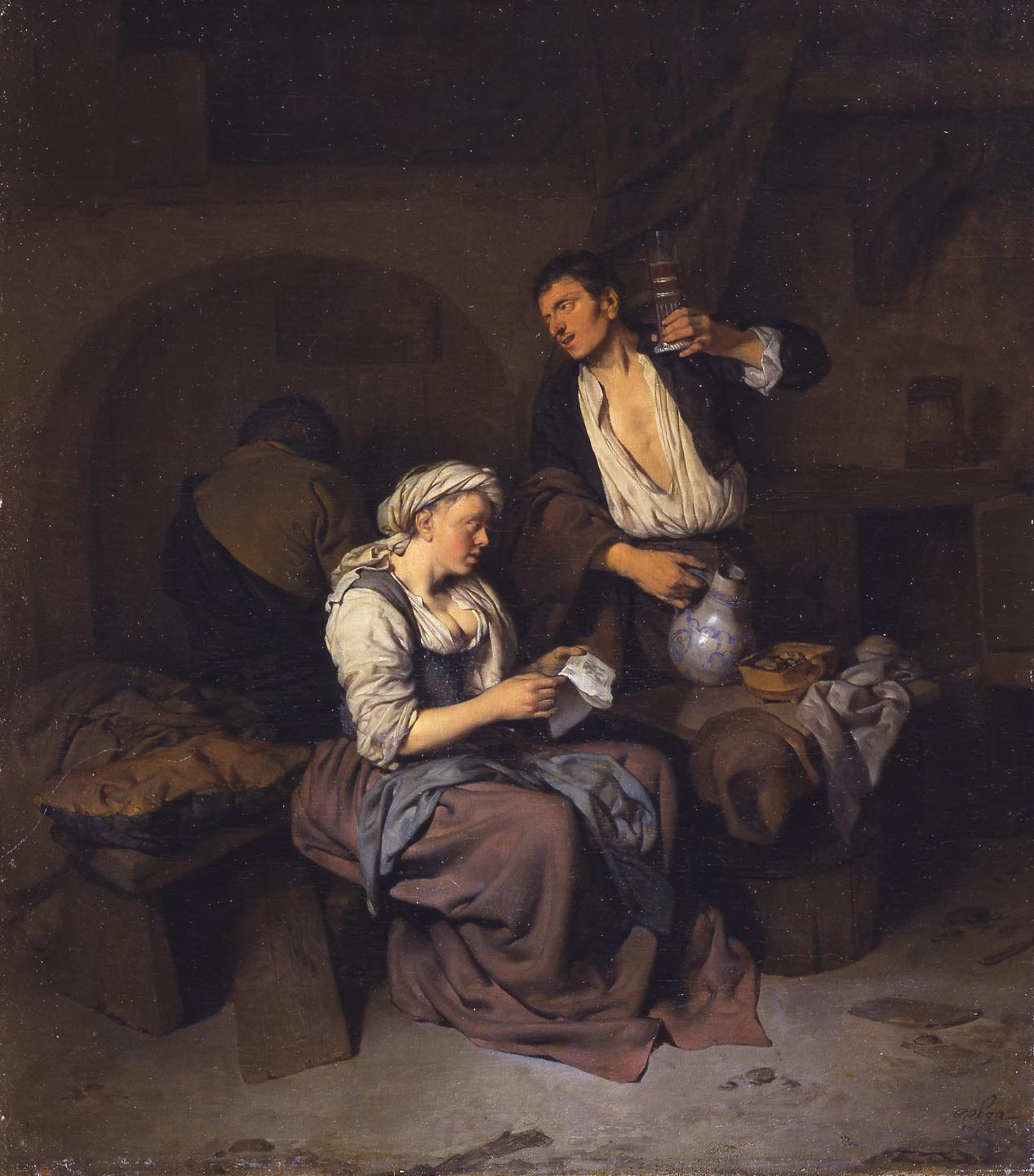
The painting I was asked to comment on is Cornelis Bega’s ‘Tavern Scene’, 1662, approaching it from the angle of what it might be able to tell a social historian. Here is what I came up with:

What is a social historian? The main thing that marks us out from our colleagues in political or economic history is that we are concerned not so much with the ‘great men’ or macro-economic developments—which have undoubtedly played their part in shaping our past and present—but with the everyday lives and experiences of ordinary men and women. We want to know what life was like in the past for the majority of our ancestors.

Recovering these experiences is far from straightforward. For the period that I study—the seventeenth century—the subjects of my research have rarely left behind any of their own accounts of what their lives were like. Only 30% of men, and 10% of women, were fully literate, and those that were tended to come from the upper ranks of society. As such, there are few letters or diaries surviving from humble men and women recording the fine details of their day-to-day trials and pleasures.

As a result, the social historian needs to be ‘omnivorous’ in their search for useful sources of evidence. They need to cast their net wide and glean what they can from surviving court records such as witness statements, from surviving popular ballads and songs, or from the indirect evidence provided by the extant writings of elite social groups. They might also be able to gain insights from the visual culture of the period they study.

In this regard, Dutch Golden Age paintings—such as Cornelis Bega’s ‘Tavern Scene’ on display here—are a tantalising prospect for the social historian. Many adopt a realist focus on the everyday life of seventeenth-century peasants and artisans. Moreover, many of them depict scenes of tavern culture, an aspect of everyday life that has increasingly come to attract the attention of social historians. There is a frustration here though for the historian of seventeenth-century England: there is no English equivalent in this century for the vibrant genre of everyday life paintings being produced in the Netherlands (I’m not quite sure why, but it is a common subject of speculation in conversation with my colleagues). So there is an obvious problem inherent in trying to use paintings of Dutch tavern culture to draw conclusions about English tavern culture, but if we put that to one side for the moment we might think about what sorts of questions a social historian could ask of paintings such as Bega’s ‘Tavern Scene’.

Thanks to York Art Gallery for permission to reproduce this image (YORAG782)

Thanks to York Art Gallery for permission to reproduce this image (YORAG782)

At first glance we might wonder if the utility of this painting lies more in what it tells us about contemporary attitudes towards tavern culture than what it can tell us about what actually took place in them from day to day. It could be taken to encapsulate a common negative stereotype of taverns that was most closely associated in England with Puritans—those who enthusiastically embraced the new Protestant religion—who were known to be particularly vociferous in condemning drunkenness as an ‘odious’ and ‘loathsome’ sin. Is the standing male character slightly off-balance perhaps, his shirt falling open as the decorum slips, drunkenly leering at the bosom of the… serving maid? Taverns were often criticised as sites of inappropriate sexual promiscuity, and we could read this depiction as a visual equivalent to the many sermons that were preached against the immorality of tavern culture in the period.

A closer look suggests that Bega is offering us much more than well-trodden moralising in his tavern scene. The social historian’s gaze is drawn to some of the more quotidian aspects in the painting. There seems, for instance, to be crumpled bedding laid out on the bench behind the central female character. This highlights an important fact about seventeenth-century taverns (or as they were more commonly called in England, alehouses) that the modern viewer may not appreciate: unlike the pubs of today, the primary purpose of an alehouse in this period was not to provide a location for recreational drinking. Rather, it had two main functions: one was to sell ale to local people who did not have the means to brew their own at home. Ale (usually weaker than our modern equivalent) was an important part of the daily diet and a key source of calories and nutrients, and was consumed with all meals by men, women and children. In this sense the alehouse was meant to serve more as an off-license. In practice, of course, many allowed drinking on site and they did become sites for recreational drinking and drunkenness, but this was forbidden in legislation.

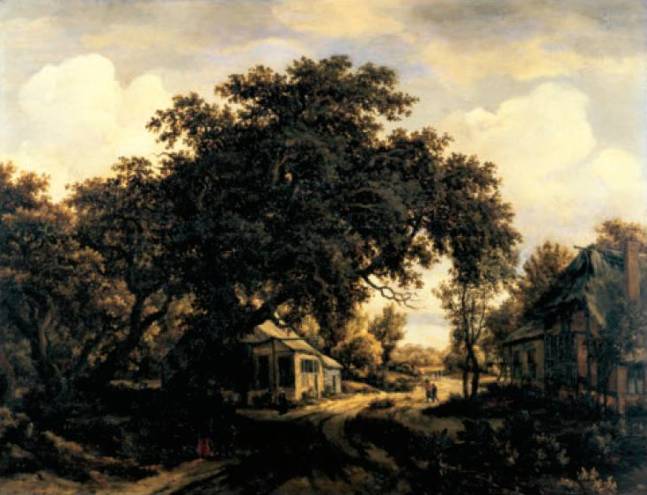
Their other (legitimate) purpose was to provide lodging to travellers. As such they were invariably situated on main roads, something we can see in another painting in this exhibition, Meindert Hobbema’s ‘A Wooded Landscape’. It looks like a drinking house on the left, identifiable by its ‘ale-post’, the ancestor of the pub sign, protruding into the road to show that ale was available.

Thanks to York Art Gallery for permissions (YORAG2005.608)

Thanks to York Art Gallery for permissions (YORAG2005.608)

With this is mind another reading of this tavern scene is possible. What we have is not a scene of drunken debauchery, but a party of travellers who have spent the night asleep on the alebench (alehouse accommodation was rarely plush, and often involved simply sleeping on a bench or sharing a bed with landlord and landlady!) The man with his back to us is still rousing himself from sleep. The standing character is not yet fully dressed, but is nonetheless taking his ‘morning draught’ of ale, the seventeenth-century equivalent of that first cup of coffee. What we might be seeing is the depiction of a morning routine after an overnight stay at the tavern, a far from untypical experience in an age when the lower orders did most of their travelling on foot, and only limited distances could be covered in a day.

We are also struck, of course, by the act of reading taking place at the centre of the scene. It is intriguing, given the statistics of female literacy, that it is the female character doing the reading. What is she reading? Could it be a broadside ballad? These were songs printed on a single (sometimes folded) sheet of paper that were sold cheaply—usually for a penny, the same price as a pint of ale—and often took the form of drinking songs to be sung in alehouses, or even pasted up on their walls. Is that one pasted up in the alcove on the back wall? Perhaps one discarded on the floor in the fore ground to the right? These drinking songs have received a lot of recent attention from social historians, who have mined them for insights they may offer into seventeenth-century tavern culture. Is this a depiction of one being performed? Is the standing male responding to a call that was common in these songs to raise a toast to his companions, or to raise a loyal toast to the King, another familiar feature of these songs?

Arguably the scene is too sedate to be a raucous rendition of a drinking song. Another interpretation may be that the reader is relaying the latest news from a printed newsheet—possibly news of a successful sea battle that is spurring the toast of her companion, or even a satirical political broadside that is the root of his mirth. Both of these were common subjects for cheap printed wares that circulated in taverns. Indeed, the discussion of news and politics in taverns was common and widespread long before the emergence of the coffeehouse in both England and the Netherlands from the mid-seventeenth century, the drinking establishment which is more commonly associated with a public thirst for news and politics. Is Bega looking to capture the fact that the politics of ‘great men’ were not as detached from the world of everyday tavern culture as historians have often thought?

It is, of course, beyond us to know for sure what Bega wanted us to take from his tavern scene, and at best it remains a somewhat indirect form of evidence of everyday life in the past for the social historian. That said, there are a number of aspects of his scene—the tavern as a place of lodging, the circulation of printed ware in these locations—that accord with the evidence of tavern culture in the seventeenth century that social historians have garnered from other sources. It reinforces our sense that tavern culture was about more than mindless drunkenness and sexual promiscuity, providing vital services and a venue for the dissemination and discussion of the issues of the day. Given these areas of overlap between Bega’s scene and what we can recover from other sources there may well be cause for optimism for social historians that such paintings can be a reliable guide to everyday life in the past. Or at the least, another component of our omnivorous diet of sources.

Dead people’s stuff

Brodie Waddell

What do historians study? Do we study historical events and past societies through analysis of extant artefacts? Or do we study dead people by looking at their stuff? Tim Hitchcock argues that we do the latter:

In recent years I find myself using the terms Stuff and Dead People in talks and titles more and more.  And as a historian I find myself conceptualising my work as being about Stuff inherited from Dead People.  Both expressions just sound right. … They form an attempt to de-centre the language of historical and social science authority that underpins the professional claims of academic historians as a whole.  By refusing to use the categories and languages of authority we inherited, I am self-consciously rejecting the systems that underpin the professional academic practise of history.

It’s worth reading the whole post, if only for his astute remarks about Kissinger’s questionable place amongst the living, but I want to emphasize an overlapping issue: jargon-busting.

In my reading, Tim is, amongst other things, arguing that historians should think critically about the strange dialects adopted by our scholarly tribes. Rather than relying on traditional technical labels or snazzy new terms borrowed from other fields, we should try to find alternatives.

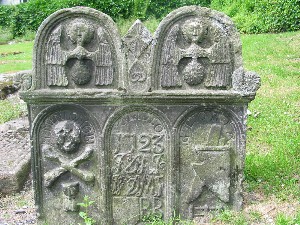
Tillicoultry churchyard

Dead people

More importantly, to my mind, his specific suggestions are not latinate neologisms invented to bemuse colleagues and confuse students (e.g. Derrida’s différance). They are deliberately common English words: the sort of words that can be found both in the KJB and in a 21st-century pub chatter. This has at least two key advantages over the Derridean approach.

First, as Tim implies, using words that seem blunt or imprecise can force us to think differently about what it is we are actually trying to label. ‘Stuff’ is much less specific than ‘text’, ‘image’, ‘object’ or ‘landscape’, but that is exactly the point: we don’t study each of those things in isolation any more. I can see how this technique might be useful in my own research. Whilst investigating the economic situation in the 1690s, I’ve come to the conclusion these were simply ‘hard times’. This phrase neatly includes all of the economic problems of this decade – increasing fiscal demands, war-time trade disruption, liquidity crisis, food price inflation, etc. – and, at the same time, reminds us that many people experienced these problems as a general calamity, not as separate challenges to be dealt with independently.

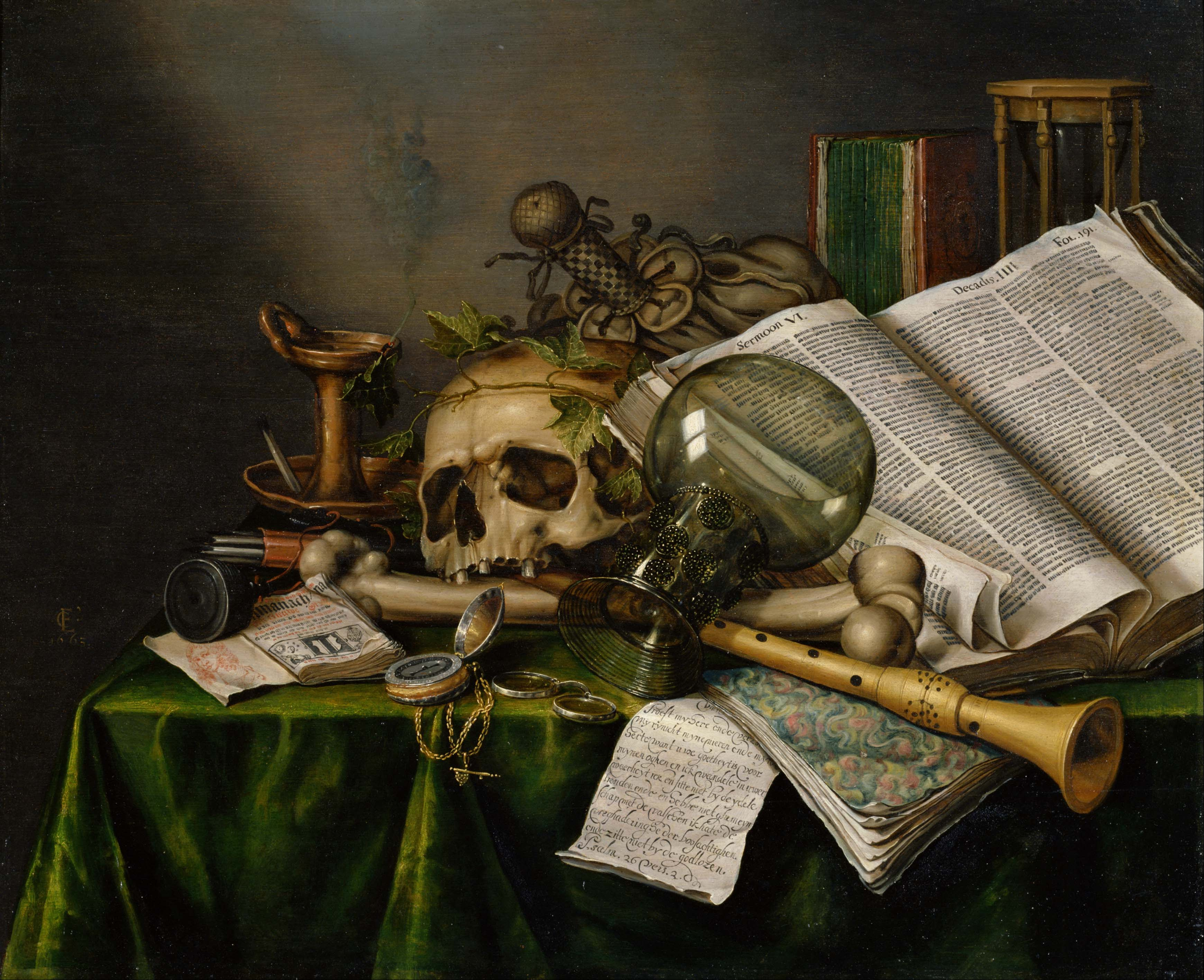
Dead people - Collier_-_Vanitas_-_Still_Life

Stuff

Second, using words like these has the advantage of making us much more understandable. ‘Dead people’ is a phrase that makes sense to everyone, whereas terms such as ‘historical actors’ or ‘active historical agents’ are not quite as obvious. Historians seem to be less intoxicated by technical jargon than many of our fellow academics.1 Nonetheless, there is still plenty of needlessly abstract, obscure vocabulary that could be profitably chucked. Replacing some of our quasi-scientific jargon words with more ‘vulgar’ alternatives would make it much easier to have the sort of fruitful conversations with non-academics that we all claim to want.

These two potential benefits – challenging outdated thinking habits and opening up scholarly discussions – seem to me to be reason enough consider how you might be able to do this in your own work. Perhaps the study of ‘dead people’s stuff’ won’t catch on, but it’s a great excuse to think hard about the words we use.

Footnote

1 One need only dip into a typical book of literary criticism or sociology to realise that it would have been much more difficult for Sokal to persuade a historical journal to publish his balderdash than it was for him to convince Social Text.

Examining the question and questioning the exam

Brodie Waddell

Tyler Cowen, a well-known blogger and economist at George Mason University, once tried a rather unusual approach to examining.

[He] walked into class the day of the final exam and said, “Here is the exam. Write your own questions. Write your own answers. Harder questions and better answers get more points.” Then he walked out.

The result, according to Cowen?

I would say that the variance of the test scores probably increased! I don’t recall if I ever did that again for a whole exam but most of my exams do that for at least one question.  It’s the question where you learn the most about the student.

With exam season now upon us, I’ve been mulling this over. I suspect the Birkbeck exam scrutiny panel wouldn’t like Cowen’s approach, but I think it could have real value. It would at least be a nice change from the usual drudgery of wading through 10 or 20 or even 50 answers to exactly the same question.

More to the point, it led me to think about some of the more unusual exam questions I’ve encountered over the years. The only one that strikes me as unconventional is one from Cambridge a few years ago for the early modern British social and economic history survey module:

Were any women and men practising witchcraft in early modern England?

Although it might not seem especially strange to a historian of the period, I suspect that laypeople would be alarmed to hear that Cambridge students were being examined on the existence of witches.

Do you have a favourite (or hated) history exam question?

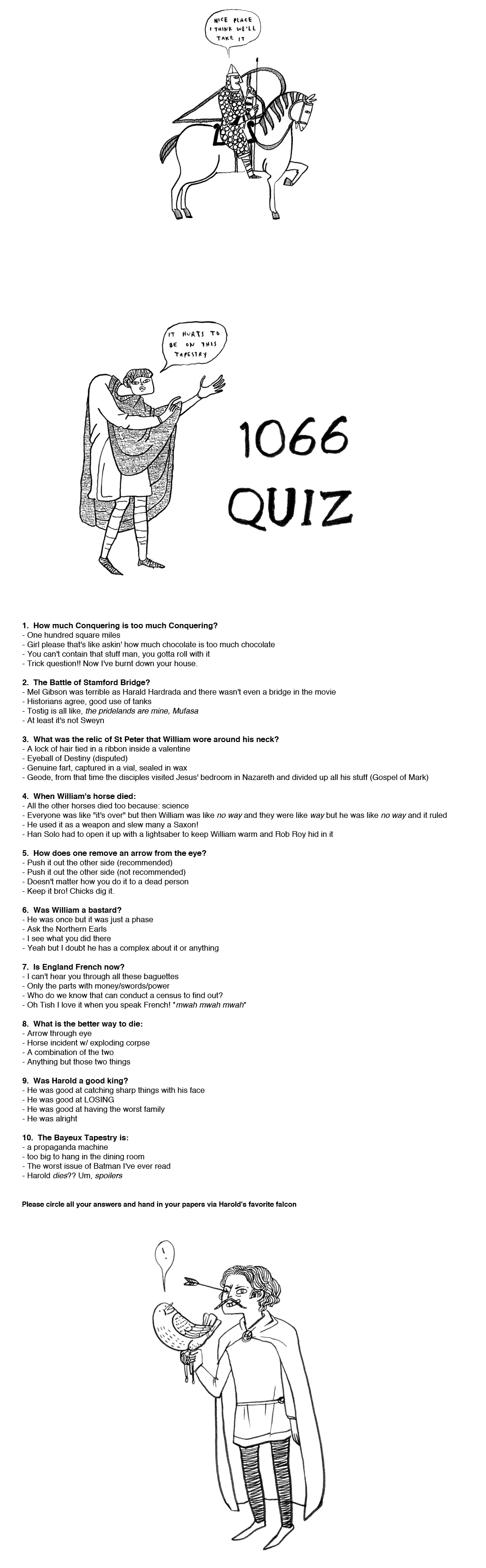
[Update (15/05/13): Kate Beaton, creator of ‘Hark, a vagrant’, offers an Elizabeth I quiz and a 1066 quiz that include such key questions as ‘Whither the Armada?’ and ‘How much Conquering is too much Conquering?’]

Carnivalesque 94: No bishop, no king

Brodie Waddell

Welcome to the 94th edition of Carnivaleque! Today we will be introducing you to a wonderfully motley menagerie of historical blogs and bloggers.

Finding any overall unifying theme is impossible with a collection of this sort, but there are a few key subjects that emerged from the nominations, each of which receives a section below:

  • The historian as detective
  • Bodily functions
  • A venerable criminal enterprise
  • Places, spaces and sites
  • Thinking about the historian’s craft

I think it is particularly interesting what’s not in the links below, namely kings and queens and ‘great battles’, the traditional material for popular histories. Not that political history and military history are entirely absent, just that they are approached from a different direction than usual. Although there are a few of gentlemen and noblewomen as well as a famous scientist, the vast majority of the nominated posts are focused on people who would have been largely excluded from textbooks written fifty years ago. What should we make of this? Is old-fashioned ‘top down’ history dying off? Or is it just that the type of people who read this blog and pay attention to Carnivaleque are predisposed against reading yet another story about Henry VIII and his wives or Charles I and his parliaments? I’d be interested to hear what you think.

However, before wandering into the carnival below, take a look at this truly heart-warming short animation that tells the tale of ‘the damnable life and death of one Stubbe Peeter, 1590’, a German werewolf. For more details, see the two posts at LOLManuscripts, but in the meantime, watch the video and be amazed.

Now, on with the show…

Continue reading

‘For yee lead your liues in great ignorance’: Puritan Ponderings on the Patchwork of Popular Belief

Jonathan Willis

What exactly did people believe in post-reformation England?  That deceptively simple question really goes to the heart of much of the ‘post-revisionist’ scholarship currently being generated by historians of the English reformation.  Whether the object of study is angels, the landscape, music or death, one underlying questions remains the same: what does this thing, this practice, this shred of belief tell us about the broader tapestry of post-reformation religious identity?  Tapestry is a reasonable metaphor – I’m going to refrain on this occasion from extending it too far, and talking about warps and wefts – but patchwork 3388735664_a77e48d15a_zis a better one, the term coined by Tessa Watt in her brilliant book Cheap Print and Popular Piety.[1]  Once or twice when teaching this I have actually taken to drawing an imaginary ‘patchwork’ on the whiteboard.  So what do we call the hypothetical individual, who believes he will be justified by faith but also thinks that if he doesn’t confess his sins he could be condemned to hell for them?  What about his wife, who sings metrical psalms and hates the pope but believes God to be physically present in the consecrated host?  And however we define such individuals, can we also reasonably group them together?  It is possible to recognise their difference, and at the same time claim they are one and the same?
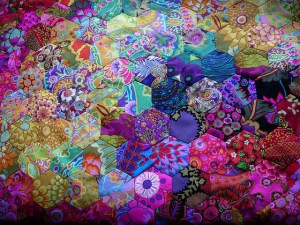
So tapestry is OK, patchwork is better: palimpsest works pretty well too.  Tangentially, I wonder why so much of the metaphorical language we use to describe identity formation (there’s another one) is rooted in the everyday materiality of art and craft.  Our ability to label individual belief in the past seems inversely proportional to the amount we know about it.  I suppose that is a fairly natural state of affairs.  Complexity breeds complexity, and moulds certainty into uncertainty.  But the job of the historian is (I think) not just to (re-)present the past, but also in some sense to try to make sense of it.  So, for AG Dickens the majority of people in Elizabethan England were recognisable as Protestants; for Eamon Duffy they were perhaps traumatised Catholics; for Christopher Haigh, stiff-necked Parish Anglicans; for Judith Maltby, committed Prayer-Book Protestants; for Watt, their culture was ‘distinctively post-Reformation, but not thoroughly Protestant’; while for Robert Delumeau, the people of early modern Europe were probably not even thoroughly Christian.

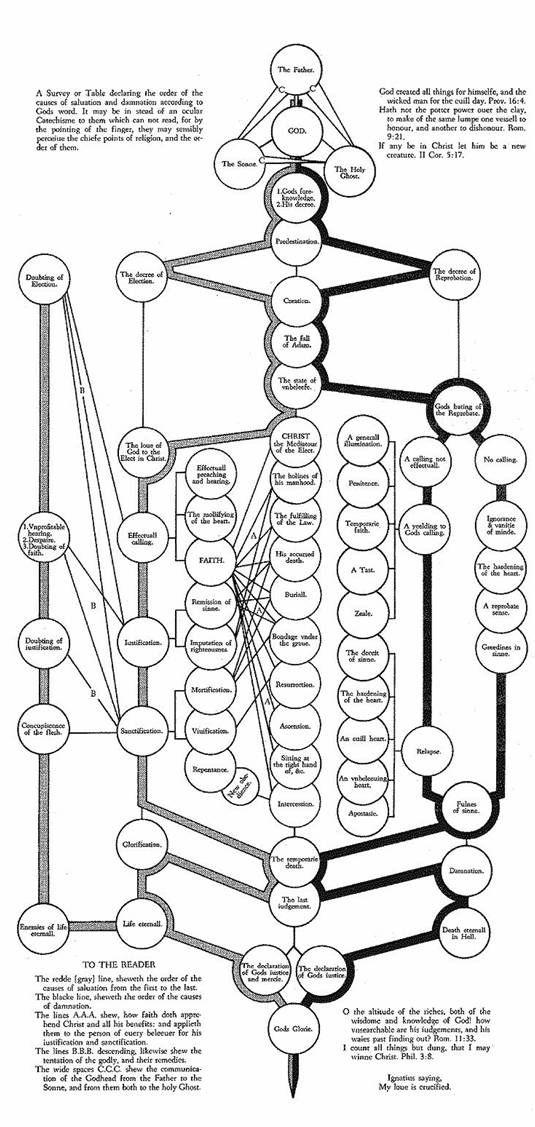
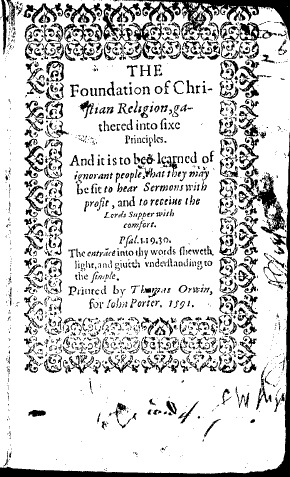
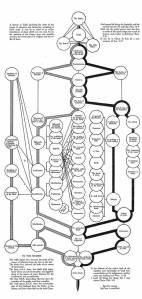
I was reminded of the value of taking a step back from all of this the other day, while reading a treatise by William Perkins that I had never looked at in detail before.  Perkins,Picture1 probably most famous as the author of A Golden Chaine, and more famous still for the infamous diagram of salvation contained within it, was a prolific writer of theological and devotional tracts: the work in question is his The foundation of Christian religion gathered into sixe principles.[2]  The work begins with an address ‘to all ignorant people that desire to be instructed’, followed by a list of almost 30 erroneous ‘common opinions’ which Perkins goes on, throughout the text, to correct.  Reproducing this list in its entirety would be a little excessive, but let me pick and talk about a dozen or so points which seem to me to be particularly pertinent to the present discussion:
1 That faith is a mans good meaning & his good seruing of God.

3 That yee haue beleeued in Christ euer since you could remember.

11 That it is an easier thing to please God than to please our neighbour.

12 That yee can keepe the Commandements, as well as God will giue you leaue.

Taken together, these points seem to express a frustration at the laity’s lack of intellectual engagement with the concept of faith.  That is not to say that their faith was not complex, but it was certainly not structured in the reflective, self-conscious way demanded by men such as Perkins.  Ironically, it seems that Puritan divines would have preferred a little less fiducia and a little more credentia from the laity: a faith based less in instinct, trust and emotion, and rather more in knowledge and intellectual acceptance.  The most difficult (and therefore the most important) aspect of religion from the laity’s perspective was in striving to live according to the principles of Christian charity: God, in whom they had faith from their earliest years, was a comforting constant.  And yet many of the laity had a strong sense that it was ultimately possible to be good and to do good things, and that such behaviour was pleasing to God.  Elsewhere, Perkins also complained about those who felt that by reciting the Decalogue they were praying, and serving God.

7 That, if anie be strangely visited, hee is either taken with a Planet, or bewitched.

This I think is a useful reminder that popular belief was not straightforwardly Christian: it contained a mixture of folklorish, traditional, pagan and other elements.  In this sense it was a true patchwork.

13 That it is the safest, to doo in Religion as most doo.

14 That merry ballads & bookes, as Scoggin, Beuis of Southampton, &c. are good to driue away time, & to remoue hart quames.

20 That drinking and bezeling in the alehouse or tauerne is good fellowship, & shews a good kinde nature.

Popular religion in the broadest sense was above all a communal activity, not an individual or even a family or household one.  The reformation did not fundamentally change this, except perhaps amongst those who were the most literate in the new religious language.  Even then, perhaps all it did was change the nature of the society with which those individuals of advanced faith sought to surround themselves.  Good religion was to be expressed in good fellowship and good cheer, as much in the alehouse as in the church, as much with a lusty ballad as a reverent Psalm.  ‘Hart quames’ for most people were to be banished with a merry ballad, not meditated upon as a means to repentance and the enrichment of a saving faith.

9 That a Preacher is a good man no longer than he is in the pulpet. They thinke all like themselues.

 18 That yee know al the Preacher can tell you: For he can say nothing, but that euery man is a sinner, that we must loue our neighbours as our selues, that euery man must bee saued by Christ: and all this ye can tell as well as he.

 17 That a man which commeth at no Sermons, may as welbeleeue, as he which heares all the sermons in the world.

 16 That a man neede not heare so many Sermons, except he could follow them better.

28 That a man need not haue any knowledg of religion, because he is not book learnd.

Finally, from the perspective of both the clergy and majority of the laity, a wide gulf existed between the two.  The reformation certainly contributed to a widespread anti-clericalism, that is to say, an opposition to the clerical pretensions of the new godly graduate clergy.  Complicated sermons were for educated people: the unlearned had nothing to gain thereby, because they already grasped the essentials of the faith: that all men were sinners, must be saved by Christ, and had an obligation to be charitable to their neighbours.  This was all well and good as far as it went, but of course for Perkins and others there were nuances, complexities, caveats and implications without which these broad truisms were worse than meaningless.  Such intellectual religion was unpopular in all senses: it was not for the great mass of people, who could profit more from each other’s good fellowship than a lengthy diatribe from the pulpit.
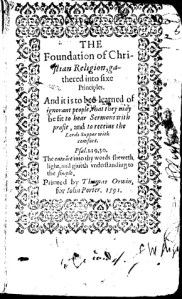
FoundationThe thing I’d like to draw from all this is that occasionally it is possible to lose sight of the wood for the trees.  While it can be extremely interesting to interrogate popular belief in minute theological and intellectual detail, it is not always the most productive path to follow (there are of course many, many exceptions).  For, by doing so, we can end up unwittingly forcing a resolutely anti-intellectual form of belief into a (for want of a better word) Perkinsian framework, and thereby doing it some violence, and just a little injustice.  We must remember that popular belief was both simple and complex, both patchwork and quilt.  It may be made up of innumerable diverse fragments, but it also had simple key priorities and a clearly defined basic form.  Each quilt may be unique, but quilts are also recognisably the same: a quilt is a quilt, and not a cushion cover, or a wall-hanging.  Identity is full of contradictions, but not all contradictions have to be resolved.  We each of us probably live with a series of competing and contradictory impulses and beliefs held in a kind of creative tension with one another, and the people of early modern England were probably no different.


[1] (Cambridge: CUP, 1991), p. 327.

[2] And it is to bee learned of ignorant people, that they may be fit to hear sermons with profit, and to receiue the Lords Supper with comfort (1591), STC2: 19710.

A miscellany: wandering woodcuts, Greifswald glosses, digital Defoes and Thompson tributes

Brodie Waddell

Several things have come to my attention over the last few weeks that deserve wider attention. Although I don’t have time to provide much commentary, I think our readers will find some of them of interest.

The first concerns the wonderfully rough images that so frequently appear in our posts: broadside ballad woodcuts. The Bodleian Library recently announced the launch of an image-matching tool that will allow researchers to easily search for the many versions of a specific image across the library’s whole collection of ballad sheets. Eleanor Shevlin discusses the new tool in more detail over at EMOB. In light of Mark’s posts on early modern representations of working people, it would be fascinating to know how particular ‘occupational’ images are reused and recycled in different contexts and perhaps given quite different meanings.

The second is Beat Kümin’s historical travelogue, Greifswald Glosses, exploring the largely autonomous parish communities in early modern Northern Germany. As a professor at Warwick, Beat is well-known to us here at the Monster and his blog offers a remarkable (and remarkably well-informed) look at the towns, churches, landscapes and even graffiti of this part of the former Holy Roman Empire. I think my personal favourite was the fourteenth-century gargoyle/collection-box at St Jacobi in Göttingen, but you may prefer the ruminations on low-ranked local football teams or the semi-fortified round churches of Bornholm.
The third is an amusing ‘pop history’ article in The Atlantic on Daniel Defoe’s A Journal of the Plague Year (1722). It’s a well-researched piece, based on an interview with the Defoe scholar Katherine Ellison and incorporating plenty of (anachronistic) pictures, but what makes it interesting to me it that it is written by the magazine’s tech writer. The short version of his argument is basically that Defoe was an early modern blogger and, unlike some of today’s bloggers, he approached the wealth of information provided by that era’s new technology (e.g. newspapers) with a critical eye. I’m not sure I’m actually convinced, but it’s great to see another side of early modern history (beyond Henry VIII, Shakespeare and Oliver Cromwell) receiving some thoughtful discussion in such a high profile outlet.

Finally, Katrina Navickas has a post at History and Today on E. P. Thompson’s The Making of the English Working Class (1963). There are, as she notes, a great many tributes and events happening this year to mark the fiftieth anniversary of its publication. However, what I enjoyed was hearing a little about her relationship with the materiality of the book itself, in all its tattered, dog-eared glory. I think I probably find myself reaching for Thompson’s Customs in Common (1991) more often than MEWC, yet I’m still strangely comforted to have a decent edition of the latter nearby. In her words, ‘despite my “digital humanism”, I still need those yellowed and annotated pages of the Penguin paperback to really get to the heart of Thompson’s writing’.
Shorter notices

Our very own Laura Sangha has set up a twitter feed for her students of ‘Religion, Society and Culture in Tudor England’: Tudorists rejoice! Grad students in and around London interested in early modern history really ought take a look at the talks hosted by the Birkbeck Early Modern society (and their tweets too). And lastly I belatedly wanted to thank the Birkbeck History PhD bloggers for reblogging one of our posts and recommend that all BBK doctoral students check them out.

[Update (07/02/13): Co-blogger Jonathan Willis is also tweeting (@CREMS_Bham) for Birmingham’s Centre for Reformation and Early Modern Studies.]

Microhistory: subjects, sources, anti-fascists and Adam

Brodie Waddell

Microhistory is, it seems, a many-headed sort of beast.

In my previous post I suggested that, despite its name, ‘microhistories’ were not simply ‘small histories’ and asked what might make microhistorians distinct:

Is it their interest in ‘strange and bizarre events and socially marginal peoples’? Or the personal nature of their sources? Or their reflective and open discussions of methodology and the limits of historical knowledge? Or perhaps it is really a ‘continental thing’, well beyond the abilities of us depressingly practical Anglos on this side of the Channel?

The responses I received in comments (and by email) were very helpful as it soon became obvious that there were many other possibilities that had never occurred to me. Indeed, I received not just five responses, but at least double that number of potential ‘defining features’. Here, however, I will just focus on four issues.

The characteristic that came up most often was the notion of focusing on the ‘exceptional’, ‘unique’, and ‘extraordinary’. This is something that both Laura and Nancy emphasised in their comments as well as a point made one of the pioneers of the genre, Giovanni Levi, who claimed it involved taking seriously things regarded by others as quirky or deviant.1 In Nancy’s words, ‘these studies use the documentation of peculiarity as a point of entry into the ordinary, daily lives of marginal or low-status persons’.2 However, this feature of microhistory also opens it up to critique. As Steve Hindle pointed out in a recent talk (which he kindly passed along in response to my original post), discerning the relationship between ‘the particular’ and ‘the general’ is even more fraught in cases like these where one’s primary subject is undeniably ‘unrepresentative’.3

Another feature that several people mentioned was an explicit engagement with methodological issues. As Nick noted in his comment, microhistories often adapt interdisciplinary approaches, ‘read against the grain’ and acknowledge the important role of imaginative or speculative reconstructions in the absence of conclusive evidence. Laura too suggests that this might ‘be at the core of what “microhistory” is’. In Levi’s reflections on the genre, this forthright discussion of the ambiguities and partialities inherent in narrative sources – such as depositions in inquisitorial courts – is a key element in these histories.4

Perhaps these two recurring features, rather than their scale, are what give microhistories their distinctiveness.

But I think it is worth pushing further, because subjects and methods and even styles can only provide a rather ‘unhistorical’ definition of a historiographical genre. (Note: If you’re an undergrad looking for a straightforward definition of ‘microhistory’, you can stop reading now.)

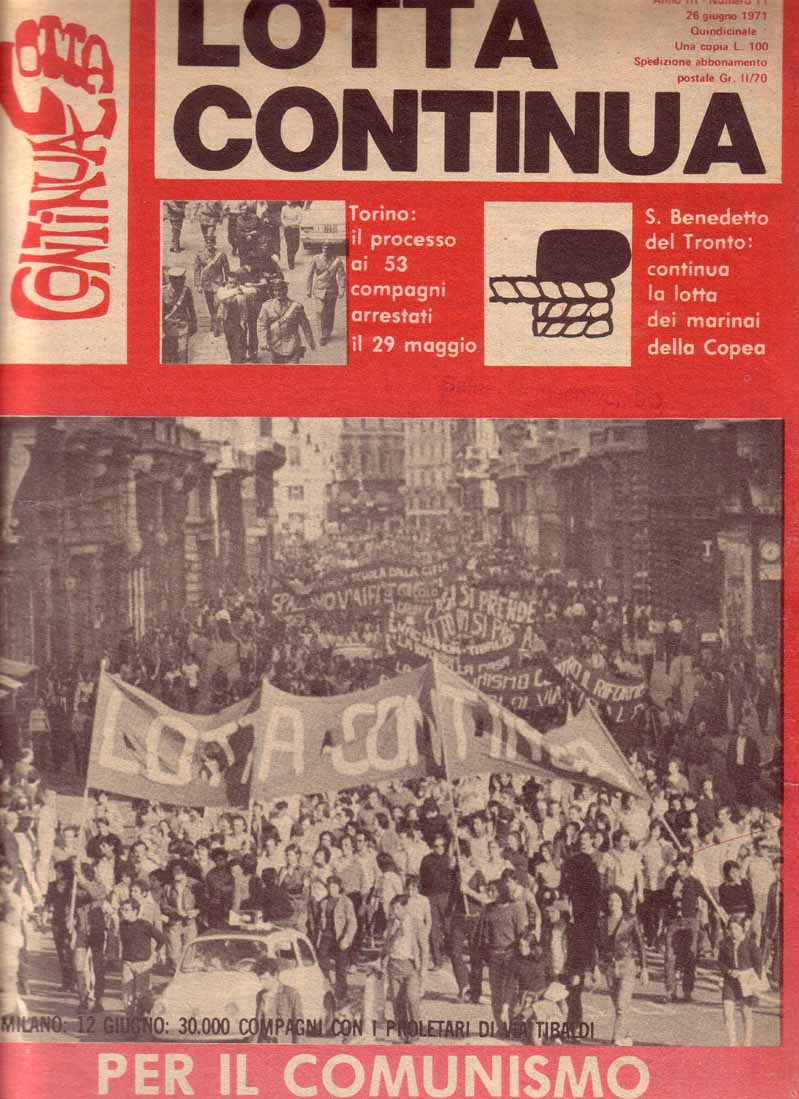
Let’s start with politics. Nick mentioned that he associated this type of history with ‘the Lotta Continua 1971left’, a link that I hadn’t considered. I think he may be right: the ‘founder’ of the genre, Carlo Ginzburg, wrote a whole book deconstructing and critiquing the murder trial of an activist linked to the Italian leftist group, ‘Lotta Continua’.5 Similarly, the other ‘founder’, Giovanni Levi, has suggested that innovative historical methods can help to explain continuities between the present and the past that ‘neoliberalism’ tries to suppress. In fact Ginzburg and Levi both appear to take some of their inspiration from their Jewish identity and militant anti-fascist heritage. I’d welcome comments from any readers who know of additional (or contrary) examples, but what I think this ought to remind us is that even historiographical traditions that are not explicitly politicised still emerge from specific historical – and thus political – contexts. Microhistory is no exception.

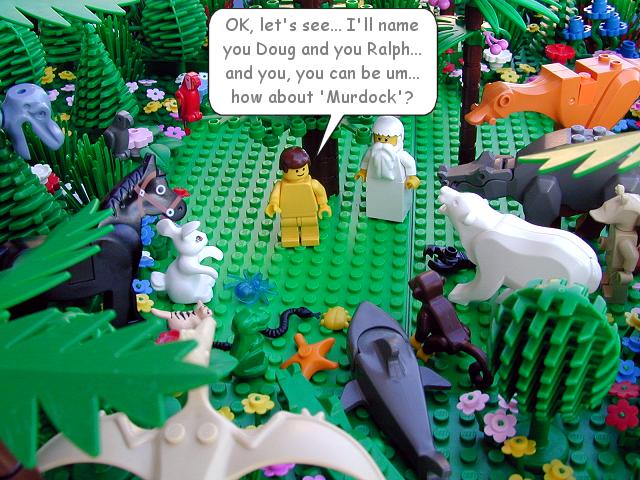
The second issue is nomenclature. For, as Laura pointed out, if we want to find a definition we also need to ask a question: Who decides what is and isn’t ‘proper microhistory’? The power to name things is a very great power indeed, one traditionally reserved for deities and patriarchs.6 Part of the genius of Ginzburg and Levi was simply

Genesis 2:19-20 at the Brick Testament

Genesis 2:19-20 via The Brick Testament

their ability to come up with a concise, memorable term (microstoria) for what they were doing and to convince others to go along with it. This becomes clear when one realises that the word itself had already been used by an American historian, George R. Stewart in the title of one of his books more than a decade before the Italians took it up.7 Stewart may have coined the term, but it was only when Ginzburg and Levi turned it into a ‘brand’ that it became a widely acknowledged and widely imitated genre of history. It was then that it moved beyond the literal notion of a ‘small history’ to acquire all of these associations with specific types of subjects, methods and politics.

Here, at last, we have an explanation for why certain works of history which seem to fit the literal definition of ‘microhistory’ – such as E. P. Thompson’s Whigs and Hunters (1975) or Wrightson and Levine’s Poverty and Piety (1979) – are rarely granted that label. Ultimately, it comes down to politics, power and a damn good marketing campaign.

Footnotes

1 Giovanni Levi, ‘On Microhistory’, in Peter Burke (ed.), New Perspectives on Historical Writing (1991). Thanks to Steve Hindle for drawing my attention to this.

2 For an excellent recent example of this approach (including some ‘microhistories’ and some not), see The Extraordinary and the Everyday in Early Modern England: Essays in Celebration of the Work of Bernard Capp, edited by Garthine Walker and Angela McShane (2009). If you are interested in the connection between ‘microhistory’ and its ‘extraordinary’ antecedents in eighteenth and nineteenth-century ‘compilations of crimes, trials and other strange-but-true stories’, you might want to apply for a fully-funded PhD studentship on that topic at Ghent University in Belgium.

3 Steve Hindle, ‘Reducing the Scale of Historical Observation: Micro-history, Alltagsgeschichte, Local History’, at Huntington Library, Early Modern Studies Institute, ‘Past Tense’, 19 October 2012. There should be a podcast of this talk available soon at which point I will update with a link.

4 Levi, ‘On Microhistory’.

5 Carlo Ginzburg, The Judge and the Historian: Marginal Notes and a Late-Twentieth-century Miscarriage of Justice (1999).

6 Genesis 2:19 – ‘And out of the ground the LORD God formed every beast of the field, and every fowl of the air; and brought them unto Adam to see what he would call them: and whatsoever Adam called every living creature, that was the name thereof.’ See also this interesting recent post by Daniel Little on the nomenclature of ‘the human sciences’.

7 George R. Stewart, Pickett’s Charge: A Microhistory of the Final Charge at Gettysburg, July 3, 1863 (1959).

Call for Papers: Sin and Salvation in Reformation England

Jonathan Willis

As the tightly-sprung chaos of another academic term starts to unwind, and thoughts turn to the endless possibilities of a month of peaceful and unbroken research time (oh yes, and Christmas), my gift to you, Monster reader, is a call for papers.  But this isn’t just any call for papers!  Firstly, the vital statistics: Sin and Salvation in Reformation England is a major three-day conference taking place 26-28 June 2013 at the Shakespeare Institute, Stratford-upon-Avon.  I am organising the conference under the auspices of CREMS, the University of Birmingham’s Centre for Reformation and Early Modern Studies, with generous support from the Leverhulme Trust.  Contributions are invited from established scholars and postgraduate students alike, and it is my hope that the conference will give rise to an edited volume of essays. Themes for papers may include (but are not limited to): visual, literary, political, theological, historical, material, musical, polemical or any other treatments of the topics of sin and salvation in the context of reformation-era England. Please send abstracts of 250 words for 20-minute papers to me by 31 March 2013, and visit the CREMS website for more information.

Secondly, keynotes.  Every conference needs at least one keynote, and I’m delighted to say that we have managed to arrange an exceptional lineup of three of the most interesting and engaging scholars in the field.  Dr Arnold Hunt, has written on communion and extensively on preaching, and is currently involved with editing the parochial sermons of John Donne.  Professor Alec Ryrie has written extensively on the English reformation: his long-awaited monograph on Being Protestant in Reformation Britain is due out early next year, and he has already embarked on a new global history of Protestantism.  Professor Alexandra Walsham has written a series of ground-breaking books on the English reformation, on topics ranging from church papistry to providence and intolerance.  Her most recent work is a breathtaking account of the Reformation of the Landscape, and she is currently working on the impact of ageing and generational change on the English Reformation.

Thirdly, the conference blurb: Sin and Salvation were the two central religious preoccupations of men and women in sixteenth century England, and yet the reformation fundamentally reconfigured the theological, intellectual, social and cultural landscape in which these two conceptual landmarks were sited. The abolition of purgatory, the ending of intercessory prayer, the rejection of works of supererogation and the collapse of the medieval economy of salvation meant that it was impossible for attitudes, hopes, fears and expectations about sin and salvation to survive the reformation unchanged. This conference will explore some of the transformations and permutations which the concepts of sin and salvation underwent over the course of the reformation in England, as well as the practical consequences of these changes as lived.

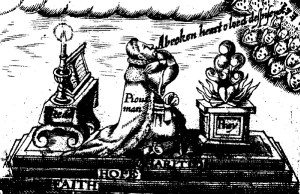
Fourthly, every call for papers needs a picture, so here is mine: part of the frontispiece from Lewis Bayly, The Practise of Pietie (1613).

Bayly[A pious man, kneeling upon a foundation of faith, hope and charity, turns from his study of the scriptures to pray: ‘A broken heart o Lord despise not’!]

Fifthly, finally, and as this is a blog entry rather than a traditional call for papers, I wanted to take a little more time to explain why I want to put this conference on, and what I hope to achieve.  I’m currently enjoying the third year of a Leverhulme Early Career Fellowship, working on ‘The Ten Commandments and the English Reformation’, and it was always my plan to host a conference during the final year of research.  Initially this was going to be a conference on the Ten Commandments, then it became one on the concept of God’s law, then on the use of the Old Testament during the reformation more broadly, then more generally on the bible.  Each successive iteration felt like I was getting closer, but I am not a biblical scholar, and so I kept putting it off and off as it didn’t quite feel right.  Finally it clicked: in a nutshell, the commandments were all about listing the things that you mustn’t do (i.e. sin), and enumerating the sort of deeds performance of which could be taken as a sign that an individual had been predestined to election (i.e. salvation).  One of many roles of the commandments in reformation England, therefore, was to help shape these fundamental concepts of sin and salvation as they slowly came to be understood by the great majority of people, through continual exposure through preaching, catechesis, the liturgy, and visual, musical, and other media.  Hopefully then, ‘Sin and Salvation in Reformation England’ will open up for exploration not only those vital concepts themselves, but also how they came to shape religious belief, practice and identity amongst the laity, and how they themselves were moulded by the experience.  A worthwhile enterprise, I’m sure you’ll agree: so, please take some time out from the sherry and mince pies, send those abstracts through to me now, and keep your eyes peeled for information about registration in the spring!

5 April 1666: ‘Sir William Penn is a total jerk’

Brodie Waddell

I’m planning to put together another post on microhistory in the next week or so, drawing on the responses to the original and my own muddled thoughts. Further comments are very welcome.

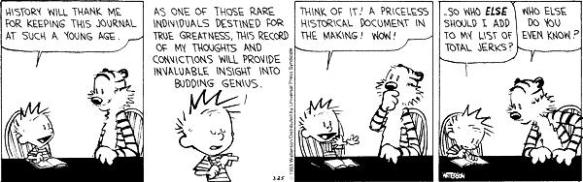
In the meantime, I thought a very brief addendum to Laura’s post on ‘dangerous diaries’ might not go amiss. As is so often the case, Bill Watterson’s Calvin and Hobbes provides valuable insights into historiographical controversies. (Even their names are historical!)

Calvin and Hobbes on journalsAs Laura pointed out, and as Calvin reminds us, it’s dangerous to take diaries at face value. Perhaps the quest for posthumous vengence explains why we find so many entries like this one, from April 1666, in Pepys’s diary:

To the office, where the falsenesse and impertinencies of Sir W. Pen would make a man mad to think of.

Beware the diarist with an axe to grind.