Another Page in the Life of Joseph Bufton: Some Verses of My Owne Making

[In our mini-series ‘A Page in the Life’, each post briefly introduces a new writer and a page from their manuscript. In this post, Brodie Waddell explores the wider implications of a rather clumsy poem about the cloth industry written by a seventeenth-century tradesman.]

The Essex town of Coggeshall was not known for literary genius. It inspired no Hamlet nor Paradise Lost nor even a Pilgrim’s Progress. Its only published authors were two clergymen who spent a few years there in the 1640s.

However, in the late seventeenth century, it was home to a tradesman named Joseph Bufton, who filled up notebook after notebook with a diverse array of writings. He devoted a great many pages to chronicling his local community and the state of the nation as a whole, a practice which I discussed in an earlier post.

But he also filled many volumes with other sorts of writing, including devotional texts, financial accounts and even a bit of poetry. I’ve just published a new article in the Journal of Social History that looks at what Bufton and others like him can tell us about literacy, work and social identity in early modern England, so I thought I would mark the occasion by offering another page from his notebooks that illuminates some of these themes. Continue reading
Alice Clark 100 Reading Group: ‘Agriculture’

This post is part of our #AliceClark100 Online Reading Group. In it Jane Whittle offers some reflections on the second main chapter of The Working Life of Women in the Seventeenth Century, on ‘Agriculture’. Jane is a Professor of Economic and Social History at the University of Exeter. You can access the book here.

Jane Whittle

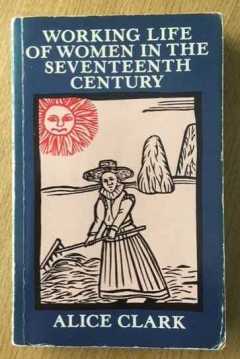
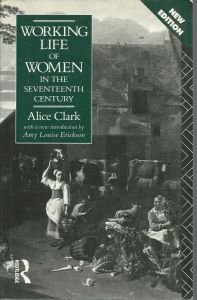
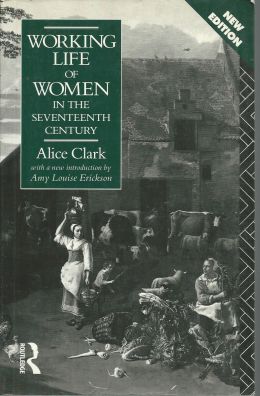
index1I’m reading the chapter in my 1982 edition of Alice Clark (the only history book I stole from my mother’s bookshelves), complete with a woodcut of a woman haymaking on the cover (although this image has been edited to remove the couple canoodling in the background which is present in the original below). Is this deeply significant? Probably not …
Alice Clark’s chapter on agriculture offers a microcosm of the book’s overall argument. As she concludes on the last page of the chapter, the ‘review of the whole position of women in Agriculture at this time, shows the existence of Family Industry at its best, and of Capitalism at its worst’ (p.92). As explained in her ‘Introductory’ to the book, she gives Family Industry and Capitalism quite precise meanings. Family Industry is ‘the form in which the family becomes the unit of production of goods to be sold and exchanged’ (p.6); whereas Capitalistic Industry (or Capitalism) is ‘the system by which production is controlled by the owners of capital, and the labourers or producers, men, women and children receive individual wages’ (p.7). For Clark, Family Industry, which in the agriculture chapter is represented by the lives of farmers, husbandmen and their families, represented everything that was good about the seventeenth-century economy. On the other hand, Capitalism, illustrated by the experience of wage earners, represents everything that was bad in what was to come. Continue reading

Alice Clark 100 Reading Group: ‘Capitalists’

This post is part of our #AliceClark100 Online Reading Group. In it Amy M. Froide offers some reflections on the first main chapter of The Working Life of Women in the Seventeenth Century, on ‘Capitalists’. Amy is a Professor of History at University of Maryland, Baltimore County. You can access the book here.

Amy M. Froide

When we were organizing this blog project I very quickly claimed Clark’s chapter on capitalists (and I may have even said I was willing to fight Amy Erickson or Laura Gowing for the privilege of writing about this chapter. When we made up our schedule I found that this post would be due right at the end of term, and it was then I realized why the wily Erickson and Gowing so graciously ceded the field to me).  This anecdote does contain a salient point: many of us early modern historians have chosen to study issues pertinent to women and work and this group is a marker of Alice Clark’s influence and legacy.

It is notable that the first body chapter of Clark’s book is on the topic of capitalists. As Tim Stretton noted in his biographical post on Alice Clark, she herself was a capitalist, a director of the family firm that is now Clarks Shoes Ltd. (It is good to know that the money I have shelled out to that company over the years is in a way a homage to Clark). Despite her personal knowledge, Clark eschews a detailed definition of capitalism in this chapter and instead simply equates it with the control of wealth.  She also notes that in seventeenth–century England, capitalists included those who had obtained their wealth through commerce and trade but also the aristocracy who had long controlled wealth in the form of land. The latter are in fact the primary focus of her chapter. Continue reading

Alice Clark 100 Reading Group: ‘Introductory’

This post is part of our #AliceClark100 Online Reading Group. In it Susan D. Amussen offers some reflections on the opening ‘Introductory’ chapter of The Working Life of Women in the Seventeenth Century. Susan is a Professor of History at UC Merced, and tweets as @susandamussen. You can access the book here.

Susan D. Amussen

s-l1600Those who have never read Alice Clark’s Working Life of Women might wonder why we would pay any attention to a work that is a hundred years old, and superseded by recent research on women.   Yet anyone who works on the history of women, and particularly the history of women’s work, in early modern England owes a debt to Alice Clark’s work. It was reissued in 1982 with an introduction by Miranda Chaytor and Jane Lewis, and again in 1992 with an introduction by Amy Erickson. As Natalie Davis noted in a paper delivered at the Second Berkshire Conference in 1974, Clark consulted archives, differentiated among women, and had an overarching theory.[1] For me, Clark’s work is one of the two or three books that have fundamentally shaped my understanding of early modern British history, even as I know more and more about the limitations of her work.
Clark’s ‘Introductory’ raises the key thesis of her work, that industrialization fundamentally changed women’s roles and experience; that women were better integrated into the economy under household and family systems of production than in industrial systems.  She admitted how little she knew – her discussion of medieval women’s work “rests chiefly on conjecture” (p. 4); Tim Stretton has noted that her modern comparison was not the 18th century, but her own experience.  As we will see over the coming months in this roundtable, Clark didn’t get it all right.  But she got it enough right that it helps. Continue reading

A Biography of Alice Clark (1874-1934)

To kick off our #AliceClark100 Online Reading Group – marking 100 years since the publication of her groundbreaking Working Life of Women in the Seventeenth Century – Tim Stretton provides some valuable context in this short biography of Alice Clark. Tim is a Professor of History at Saint Mary’s University, Canada, and has contributed a chapter on Alice Clark to a recent book on Generations of Women Historians. The next post – discussing the Introduction – will follow next week. So get reading!

Tim Stretton

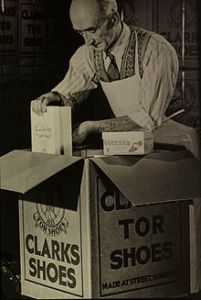
Clarks_vintage_photograph_-_man_packing_Clarks_Tor_ShoesAt first glance Alice Clark seems the most unlikely of historians. Due to ill health she managed only sporadic periods at school and she never went to university. She was a capitalist, not a scholar, spending most of her adult life as a director of the family business, known today as Clarks Shoes Ltd.  Yet from a young age she was a voracious reader and would have joined her sister at Cambridge had her parents not felt strongly that the shoe company would benefit from the involvement of a female family member.
In common with almost every one of her relations, she was also a lifelong activist for good causes and I think Working Life of Women is best understood as serving the project to achieve votes and greater equality for women. Her initial subject, when she moved to London in 1912 to work on the suffragist campaign, was not women’s work, but the history of Quaker ideas about gender equality. What puzzled her was the contrast between the striking levels of autonomy 17th century Quaker women experienced––in tandem with the defiance they showed in the face of persecution––and the deep conservatism of Quaker authorities in the 19th and 20th centuries. The organization’s gender segregated meetings and prolonged reluctance to endorse the cause of female suffrage left Clark disillusioned and she set herself the goal of understanding the causes behind this decline in female independence. Continue reading

Alice Clark’s *Working Life of Women in the 17th Century* at 100: An Online Reading Group

Mark Hailwood

The conditions under which the obscure mass of women live and fulfil their duties as human beings, have a vital influence upon the destinies of the human race…

Alice Clark, 1919

It was this conviction that drove Alice Clark to write her pioneering study of the working life of women in seventeenth-century England. One hundred years later, few historians would now contest such a statement, and as a consequence the obscurity of women’s lives in the early modern past is less acute than in Clark’s time. But how far have we come in our understanding of women’s work? How have historians added to, and revised, the picture mapped out by Alice Clark?

s-l1600The centenary of the publication of this seminal work presents a great opportunity to both celebrate the scholarship of Alice Clark, and to reflect on the current state of the history of early modern women’s work. And so, we would like to invite you, dear reader, to join an online reading group here on the many-headed monster that will do just that.
Between now and October of this year we will read one chapter a month of Working Life of Women in the Seventeenth Century (freely available on archive.org here). For each chapter a leading historian will offer their reflections on it in a blog post, which will serve as a starting point for discussion ‘below the line’ in the comments section (and/or on twitter, no doubt).

The blog posts will be published at the start of each month, on the following schedule, with a double-header in early April to kick us off: Continue reading

A Page in the Life of William Kempster: Master Mason and Scribbling Accountant

[In our mini-series ‘A Page in the Life’, each post briefly introduces a new writer and a page from their manuscript. In this post, Dr Judy Stephenson (@judyzara) of University College London explores the possibilities for historians created by a master mason’s messy account book.]

Early modern writers may be sought after by social and cultural historians for their descriptions of daily life or for their literary endeavours, but most economic historians are interested in them for something more prosaic: the prices they paid for goods and the money they earned.

Wages and prices are the backbone of all long run data sets in economic history. The long-suffering work of E. Thorold Rogers over seven centuries of manuscript records still offer most researchers their first sources before 1800. Rogers gathered prices from places like Westminster Abbey, and Oxford and Cambridge colleges which had long run accounts. Until recently, all long run wage series have been based on the prices unearthed by him of ‘day work’ paid to masons, carpenters, bricklayers and their labourers.

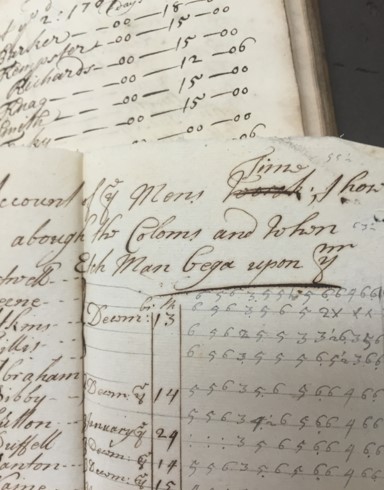
Private account books that state wages are rare because not many people in the early modern world were paid a weekly or daily wage.  When they do exist, they are almost never those of the sort of wage earners thought ‘representative’ by economists. Recently, however, I came across some individual account books that were very representative, because they showed that the actual wages paid to craftsmen on a big London building site – St Paul’s Cathedral – were different to the ‘day rates’ recorded in the institutional accounts. They were lower, because building contractors took a mark-up on selling their work and services, and they were much more varied.

The manuscripts were the ‘day books’ of William Kempster. Kempster was the son of Christopher ‘Kit’ Kempster who was Christopher Wren’s most favoured mason and assistant on Tom Tower and many City churches. The family hailed from Burford in Oxfordshire, where they quarried and increasingly contracted for stonework. William started contracting at St Paul’s Cathedral in late 1700 and became Master Mason there in 1714.

Account of the Mens Time: The National Archives

Account of the Mens Time: The National Archives

My analysis of the day books in a recent article has created all sorts of controversies about wages, but the books also give us a wonderful insight into an early modern businessman as a writer and accountant, and offer some useful insight for quantitative historians about how to turn such sources into meaningful data.

Continue reading

A Page in the Life of Thomas Parsons: Masculinity and the Lifecycle in a Stonemason’s Diary

[In our mini-series ‘A Page in the Life’, each post briefly introduces a new writer and a single page from their manuscript. In this post, Tawny Paul introduces us to a frustrated eighteenth-century artisan whose life she explores in more detail in her new article on ‘Accounting for Men’s Work’.]

In 1769, Thomas Parsons, a young stonemason in Bath, penned a daily account of his life. He may have written quite a lot over the years, but only one volume of his diary survives, covering a period of eight months. Though relatively modest in size, the text provides an entry into the world of a young man at a formative stage of life.

Parsons was twenty-five years old when he produced the diary. At this age, many young people in the eighteenth century married, finished training, assumed occupational status, and became more independent. Parsons’ diary therefore gives us insights into many themes related to lifecycle. This makes the text extremely valuable, because while histories of women have done remarkable work in uncovering the nuances of female lifecycle experiences, we know rather less about how men transitioned through life’s stages.

His entry for 13 April 1769 shows this in vivid detail as it centres on his struggles with his father: Continue reading

Alexandra Shepard’s *Accounting for Oneself* and early modern social categorisation

Brodie Waddell

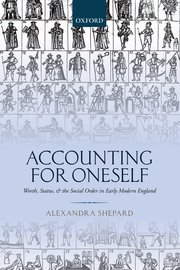
Sorting people into groups is something that we, as scholars, spend a lot of time doing. As Alexandra Shepard shows in her powerful recent book, Accounting for Oneself, it is something that early modern people constantly did too.

9780199600793This is not the place for proper review of the book as there are already plenty of those available, including a substantial analysis by my co-blogger Mark. However, I would like to look slightly more closely at one particular aspect of the book which speaks directly to an issue that we have struggled with repeatedly on this blog: how do we divide up early modern society?

Historians have been debating this question for decades and many models have been proposed. For example, is it a binary society, split between the elite and everyone else? If so, what should we call these groups? The patricians and the plebs? The elite and the people? The gentry and the commonalty? The better and the worser sort of people? Or perhaps it is a tripartite society. If so, is it ‘richer’, ‘middling’ and ‘poorer’? Or simply ‘upper-class’, ‘middle class’ and ‘working class’? Or maybe a society of three ‘estates’ (clergy, aristocracy, commons)? Or a hierarchy of ‘degrees’ and ‘ranks’ (peers, gentry, merchants, yeomen, husbandmen, labourers, vagrants)? Continue reading

Understanding Sources: Court Depositions

Picture1
To celebrate the launch of Understanding Early Modern Primary Sources the monster-heads have each written a brief post offering a personal perspective on the source type that they most like working with (the introductory post is here). Do tell us your own below the line, or on twitter #histsources


Mark Hailwood

My favourite early modern primary source? When you have spent the last year working almost exclusively with one type of source you come to either love it or loathe it. In the case of the court depositions I have been reading extensively for the Women’s Work Project I’m glad to say it’s the former. They undoubtedly top my list.

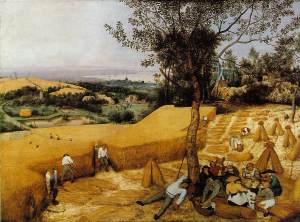
harvesters

Scenes of everyday life

For a historian driven above all by a desire to recover the everyday lives of ordinary women and men in the past the witness statements they gave in their tens of thousands before the courts of the sixteenth and seventeenth centuries represent a rich seam indeed. In recounting the details surrounding cases in criminal, civil and ecclesiastical courts, deponents provide accounts of myriad aspects of day-to-day experience. They tell us about their working lives of course – about mowing corn, spinning yarn or shearing sheep at the time of witnessing a crime, say – but also how they spent their leisure time – about trips to the alehouse describing who they drank with, how much they drank, and who subsequently fell out with who. Continue reading