Unknown's avatar

About Brodie Waddell

Brodie is a Lecturer in Early Modern History at Birkbeck, University of London.

On periodisation: two ‘early modern’ Englands?

Links to the other posts in the ‘On Periodisation’ series:

Brodie Waddell

Last week I had the privilege of attending Laura Gowing’s inaugural lecture on ‘A Trade of One’s Own’. She told the fascinating story of women’s changing relationship with London and its livery companies over the course of the seventeenth century.

It was a brilliant lecture in all sorts of ways, but what caught my ear was the way she implicitly divided her story into two periods. From my recollection, there were relatively few formal changes in the way the companies dealt with women over the course of the sixteenth, seventeenth and eighteenth centuries – yet Gowing showed that unofficial norms shifted substantially. Specifically, she showed that the number of women as mistresses and apprentices rose from the 1640s onwards and resulted in a new landscape in which – for example – about 40 percent of the shops in the Royal Exchange were owned by women by the end of the century.
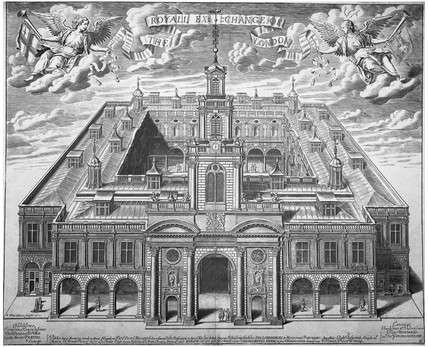
The Royal Exchange, 1671

The Royal Exchange, 1671

Although Gowing did not discuss the reasons for this shift in detail, she alluded to the disruptions of the Civil Wars, the rise of new women-made fashions such as the mantua gown, and the increasing preponderance of women among migrants to the metropolis. In fact, pinning down a specific cause may be impossible because the change seems to have been almost ‘over-determined’. In the middle decades of the seventeenth century, everything seemed to be changing.

Dividing ‘early modernity’

This lecture set me thinking about my own sense of periodisation. Laura has talked about start and end points for the ‘early modern’, Mark has discussed the question of ‘modernity’ itself, and Jonathan has addressed the thorny notion of a ‘Reformation era’. But what about the divisions within the ‘early modern period’, however defined?

It seems to me that there has increasingly emerged a sense of an ‘early early modern period’ and a ‘late early modern period’. I’ll call them the EEMP and LEMP, because acronyms add an air of authority. Continue reading
Job listings for historians on jobs.ac.uk, 2013-16

Brodie Waddell

Every year, universities across Britain and beyond place hundreds of advertisements on jobs.ac.uk seeking to appoint historians to academic posts. Although accessing this data is not easy and analysing is far from straightforward, recent listings do provide some potentially useful information about the state of the academic job market for historians.

In my previous posts on jobs, I have focused primarily on the ‘supply side’ of the equation – how many people are completing PhDs each year and how that is changing. It is much more difficult to get hard data on the ‘demand side’ – i.e. jobs available – though I’ve tried various proxies such as the numbers of historians with university posts or the number of incoming history undergraduates. The cohort studies of Warwick and Cambridge PhDs allowed me to link doctorates to academic posts more directly, but that was only a small and probably unrepresentative sample.

New data and methodology

The advertisements on jobs.ac.uk allow us to get a better sense of how many jobs are actually listed in a given year. Continue reading

History doctorates and the academic job market: 99 Warwick PhDs, 2001-2013

Brodie Waddell

My analysis of official public data suggests that the number of PhDs in history in the UK is growing significantly almost every year, whereas the number of undergraduates and university-based historians is expanding only very slowly. However, these figures are only really useful for providing a sense of changes in the relative balance between undergrads, teachers and PhDs over time. They do not provide any concrete sense of the likely destinations of successful doctoral candidates.

In September, Rachel Stone, a medievalist at KCL, put together a very useful ‘cohort study’ of the 66 people who had completed PhDs in history at Cambridge in 2005. Her headline result was that 36 of them (55%) seemed to have academic posts a decade later. She also found that modernists and men were more likely to have academic jobs than medievalists and women, though she noted that it is difficult to know which factor is the most influential as women were more likely to be medievalists. Katrina Gulliver did a similar analysis of those granted Cambridge history PhDs in 2007-8 and found that ‘fewer than 50% have a permanent academic job’ after seven years.

I did my PhD at Warwick (completed 2009, awarded 2010), so I thought it might be useful to look at some cohorts there as a comparison. However, as the Warwick History Department is much smaller than Cambridge’s History Faculty, I decided to look at a longer period, namely 2001 to 2013. Continue reading

Students, PhDs, historians and jobs, 1994-95 to 2014-15

Brodie Waddell

In September, I posted some data on the state of the field in academic history. It wasn’t an especially rosy picture, but I followed that by trying to gather some suggestions on what could be done to improve the situation and also offered my own thoughts.

My initial post was provoked by my annoyance at how little historical data seemed to be easily available for the history profession, so I pulled figures from HESA and a variety of other sources to try to piece together a picture. A few weeks ago, the American Historical Association updated their job market statistics for US historians and HESA released their UK data for 2014-15, so it seemed only right to update my figures.

Let’s start with the American data as it is much more precisely focused on the academic job market than the UK numbers. Continue reading

Class conflict in Elizabethan Norfolk?

Brodie Waddell

In early March 1601, four men got into an argument in the small village of Wicklewood, about eleven miles west of Norwich. Although no blows were exchanged, one of the men uttered words that were dangerous enough to lead to a legal examination by a local magistrate. It is only thanks to this brief deposition – which I’ve transcribed at the end of this post – that we have any knowledge of what was said that day.

I came across this document last summer at the Norfolk Record Office when I was searching through the county quarter sessions files looking for something else. I’d completely forgotten about it until Mark put up a post last week that discussed the history of conflict hidden in England’s rural landscape. That post reminded me that the argument recorded in this deposition might provide some further illumination of this oft-debated aspect of early modern history.

The story, as recorded on this small slip of paper, goes like this. Roger Wells of Wicklewood had hired John Chibocke and Richard Hamond of the neighbouring village of Morley ‘to worke with him’. But Chibocke and Hamond arrived very late and Wells was angry. He declared that if he paid them the wages they really deserved, they wouldn’t be pleased. The two workmen replied that Wells and his ilk ‘Cared not thoughe poore men wrought the[i]re harts out’ and wished ‘that wee might have warres againe, [for] then we should have Corne Cheaper’. At this point, William Seaborne – presumably a partner or employee of Wells – stepped in. He rebuked Chibock and Hamond for their rash words, saying ‘these be matters you understand not’. Yet this just incensed Chibock further. ‘If a thowsand mysters were deade’, he said, ‘we poore men should farre the better’. Continue reading

Addressing Authority: Petitions and Supplications in Early Modern Europe

Brodie Waddell

How can we study the sort of people who – according to William Harrison’s oft-quoted phrase – had ‘neither voice nor authority in the commonwealth’? This is a question we have returned to repeatedly on this blog. In our ‘Voices of the People’ and ‘History from Below’ symposiums, we discussed the many ways in which historians might attempt to get at the experiences and opinions of those who did not hold the reins of power in early modern Europe.

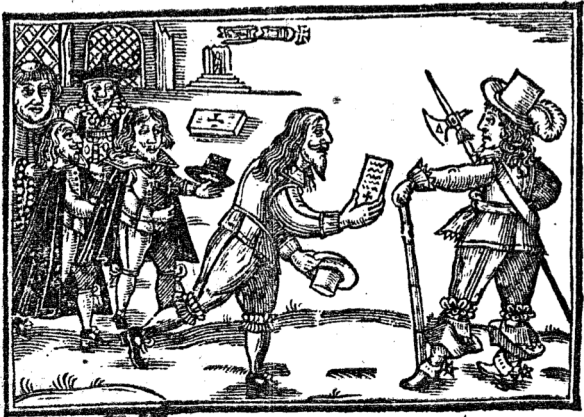
The Humble Petition of Jock of Bread (1648)

The Humble Petition of Jock of Bread (1648)

One type of source that some of contributors to the events found particularly promising was the ‘petition’ or ‘supplication’. Such documents have received attention on this blog from Mark Hailwood, Jonathan Healey, Michael Ohajuru, Laura Stewart, Jonathan Willis and myself. However, this failed to satisfy my own fascination with such documents, so I’ve joined with three colleagues from Birkbeck – Rebecca Tomlin, Laura Stewart and Sue Wiseman – to organise an event focusing specifically on these sources. Here are the details…

Addressing Authority: Petitions and Supplications in Early Modern Europe

One-day workshop

Friday, 18 March 2016

Birkbeck, University of London

Invitation for Participants

This event will have space for 10-15 participants in addition to the 12 speakers. The workshop will be informal and conversational with substantial time for discussion between the panel presentations, so there will be an opportunity for all attendees to participate.

If you would like to attend, please send a brief statement of your research interests in this topic (100-300 words) to Brodie Waddell (b.waddell@bbk.ac.uk) by Friday, 12 February 2016. Postgraduates and early career scholars are especially welcome.

Continue reading

Green Paper Blues: A Shiny New Bureaucracy for University Teaching

Earlier this month the UK government published its Higher Education Green Paper which sets out its plans for universities. Here John Arnold, Professor of Medieval History at Birkbeck and friend of the Monster, offers his reaction to the new policies and their justifications. This will not be of interest to everyone, but all UK academics and those of you thinking about doctoral studies, who may have read our earlier posts on the state of the field, need to be aware of what is going on. For the uninitiated, ‘TEF’ is Teaching Excellence Framework, ‘REF’ is Research Excellence Framework, and ‘HEFCE’ is the Higher Education Funding Council for England.

Gosh, isn’t it exciting finally to see the Government’s Green Paper? Turns out some rumours were true – there will be a TEF, say bye-bye to HEFCE – and others not so much (REF will live on). There’s quite a lot of it to wade through, but – regarding TEF in particular – as one colleague said in a management meeting earlier this week, ‘it’s not actually as bad as all that’.

And of course that’s right. Who could object to ‘putting students at the heart of the system’, and who would not want us to value teaching as well as research? The starting point for TEF is a mild adjustment to something we already do, i.e. institutional audit for quality. So – nothing to worry about here, and perhaps some things to celebrate? Continue reading

The undeserving poor: ‘rich beggars’

Brodie Waddell

Fear and hatred of the ‘undeserving’ poor pollutes our thinking about poverty. The shadows of scroungers, fraudsters and cheats who falsely claim to need our help loom over every conversation about benefits and over every new welfare policy.

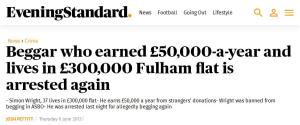
Rich beggar (2013) Evening StandardHeadlines about workshy swindlers march across the front pages of our papers almost every day. A quick online search reveals over 10,000 news stories on ‘benefit fraud’, reported both in the nation’s most popular newspapers and in local papers like the Bromley Times and Coventry Telegraph.
Such stories are part of our deep anxiety about those who get something for nothing. We worry that our taxes, our donations, our hard-earned money is being spent on people who don’t need it. The public believes that fraud accounts for over one in every four pounds in Britain’s welfare budget, when in fact it is well under one in a hundred. Such fear and fury are not confined to any particular class – they are common enough among the wealthy and educated as well as the working class. You have, I’m sure, occasionally heard examples of this from family and friends, just as I have. Sadly, if you pay careful attention, you’ll probably find it sometimes lurks in your own thoughts too. Continue reading

What is to be done? Seven practical steps for historians

Brodie Waddell

MI0000444321I’m very grateful to all of you who’ve already offered your thoughts on how we can improve the history profession. I agree with most of the comments on my previous posts on academic employment and practical responses – in fact some of the suggestions below are borrowed from those comments. However, I promised that I would offer my own tuppence so here I’ll try to set out some steps that we can take individually or collectively. Most of these are quite minor, but hopefully they are a good start. They aren’t in order of priority, but the first four are generally about gathering and publishing information and the rest are about more direct action. Continue reading

What is to be done? Mending academic history

Brodie Waddell

The study of history in Britain is not in crisis. The numbers set out in my post last week show that the last few decades have been a period of massive expansion for the field. There are more people ‘doing history’ at all levels of higher education, from new undergraduates to doctoral students and teaching staff. What’s more, I’d argue that public interest in history has been growing as well, a point brought home to me by the extraordinary response to the ‘History from Below’ and ‘Voices of the People’ online workshops that we’ve hosted.

It would, however, be irresponsible for historians like myself – who enjoy secure academic positions – to overlook the very real problems that confront the history profession today. In my recent posts I’ve highlighted two specific issues: the rapid growth in the number of doctoral students who are unlikely to obtain a permanent university post and, relatedly, the substantial number of early career historians trapped in precarious ‘casual’ employment. One might also add the under-representation of women in the academic upper ranks, the collapse in part-time studies, and the rising debt burden imposed on our students, among other things.

My previous posts provoked a flurry of valuable responses including one from Peter Mandler and another from Adam Smith, respectively President and Honorary Secretary of the Royal Historical Society. I’m very grateful to both of them for their feedback, which not only augmented and corrected some of my own conclusions, but also invited me to think about what practical measures the RHS (or other bodies such as the IHR) could take in the future. What sort of data should they be collecting and how? What kind of advice or information should they be providing? Is there anything else they can be doing to help to counter-act these problems?

i3rzjg8ciyls3ruxcheaThis presents an obvious chance for me to pretend to know everything there is to know about the historical profession in Britain and make some sagacious pronouncements about ‘what is to be done’. However, in the interests of continuing the conversation, rather than closing it off, I’m going to restrain myself, at least momentarily. Instead, I’d like you, whatever your position or career stage, to offer your thoughts in the comments below (or on twitter, tagging me, which I’ll post here). I will add my own ideas in the comments in the next day or so, some of which I hinted at in the conclusions of the previous post. But in the meantime, let’s find out what the rest of the historical community thinks.