Guest Blog by Amanda Herbert Continue reading
Marooned on an Island Monographs: a History of Femininities Reading List
6


Guest Blog by Amanda Herbert Continue reading
Our final post in ‘The Voices of the People’ symposium (full programme here) is by Jon Lawrence, Reader in Modern British History at the University of Cambridge. Jon discusses his ongoing project to write a social and cultural history of post-war Britain in which ordinary people take centre stage as the experts on their own lives and experiences. In the process he revisits a number of the issues that have run through this symposium: how to relate the individual voice to the collective voice and its wider culture; how to account for the influence of the archive on the voices that are recorded; the extent to which we can or should be looking for ‘authentic’ voices; and perhaps above all Jon reiterates the enormously rich and rewarding avenues of enquiry that are open to those engaged in the reflective pursuit of history from below.
Jon Lawrence
I often wonder what life’s for. Greavsey lives for work, but I don’t. I’m happy to go on as we are or get a packet and be the idle rich. I’m not bothered about sweating for a £40 a week job. I’m happy now. I could do with £50,000 but I’m happy as I am. Are you? How can you be? You’re far from home. You can drink but that’s not real happiness. You’re going to lecture and do teaching, the same things one time after another. That’s just talk. We put up with bad conditions. But we’re more free than you. We do something different each day. We can move about. We know how to have fun, we don’t try to worry or try to keep up with the Joneses.
‘Ron Morris’, October 1968[1]
I am currently writing a social and cultural history of post-war England based largely on contemporary voices as they were recorded by social scientists between the 1940s and the late 2000s. This extract is from a study of Swan Hunter’s Wallsend shipyard on Tyneside. I will say more about this man and the context in which he came to say these things later. For now I simply wish to offer this as an example of how rich such testimony can be; and also to plant the question: how should we treat a plebeian voice which is so obviously not just exceptionally eloquent, but also knowingly engaged in a dialogue with academic knowledge? Continue reading
Our next post in ‘The Voices of the People’ symposium (full programme here) is by David Hopkin, Associate Professor of Modern History at the University of Oxford. David explores another life story, that of a nineteenth-century female Breton farm servant, through a combination of historical records and three remarkable novellas written by his subject. The result is not only a fascinating examination of an individual life, he argues, but an insight into a collective commentary on the first-hand experience of hardship in the past. David has also written a book entitled Voices of the People in Nineteenth-Century France, from which this symposium borrows its name.
David Hopkin
Virginie Desgranges, born 1868, lived a short, peripatetic life along the Normandy-Brittany border. Her frequent moves were the result of her family’s rapid social decline. Her grandfathers were customs officers but her own father, who died when she was ten, was a rag-and-bone man, while her mother was first a servant and then a day-labourer. For a while the couple ran a bar. Virginie had one older brother, who briefly followed his father’s profession before joining the Atlantic fishing fleet. In 1881 he and his mother spent a month in prison for robbing a neighbour of her bed-sheets. By that time Virginie had already left home and was working as a farm-servant. When she died, aged eighteen, she was employed as a servant by her uncle and aunt in the village of Pleine-Fougères, about ten miles from Mont Saint-Michel.
Poor, rural, young, female, mobile – by every measure Virginie’s is a voice from below. Given her social marginality it’s debateable whether she could make that voice heard in her lifetime, let alone in the historical record. Back in Pleine-Fougères her voice would have been in dialogue with others – her family, her neighbours, her employers, the marketplace singers and the various other people she encountered. Some of the parameters of that discussion were set by what we might call, for want of a better term, the oral tradition. It was because she was a participant in and recorder of that tradition that her voice has been preserved. Continue reading
Our next post in ‘The Voices of the People’ symposium (full programme here) is by Helen Rogers, a Faculty Member of the English and Cultural History Department at Liverpool John Moores University. Here Helen continues our current focus on how to put the fragments of ‘voices’ we can find in the archive into context to recover a fuller picture of the ordinary individuals behind such voices – drawing on her work on nineteenth century prison inmates, Helen advocates a combination of biographical reconstruction and prosopography that she terms ‘intimate reading’.
Helen Rogers
History from below, writes Tim Hitchcock in this series, ‘is in essence, a politics of empathy and voice explored through a conversation with the dead.’ His proposition that we must read historical documents ‘against the grain’ if we are to recover experiences and voices from below from the records made by the powerful is one of the best descriptions of our practice. We need to listen out for the voices of the dead if we are to have a two-way conversation and allow them to challenge us about how we view the present and ourselves as well as our forebears and the past. But what if the dead ‘don’t want us to listen’, asks Julia Laite, and instead hoped to keep their secrets hidden? And what if it was not ‘voices’ they wanted, adds Will Pooley, but ‘bread, security, or just to be left alone.’
These questions resonate with me for I spend my days communing with the dead as I investigate how prisoners responded to punishment, Christian instruction and philanthropic intervention in the 1830s and 40s and whether these influenced desistance from crime or continued offending. When they left gaol, we can reasonably assume many strove to keep a low profile and some, though not all, will have remained indifferent to the moral education they had received inside. Since they left little or no first-person testimony I encounter their voices – and bodies – in the penal records that measured and described them, occasionally noting their words or abbreviations of them. Reduced to ‘offenders’ in the penal archive, I seek to recover their agency and humanity by examining their crimes and misdemeanours in the context of their ‘whole lives’ or what I can reconstruct of these from myriad sources. But can we derive historical meaning out of a single life plotted through the ten-yearly tabulations of the census returns or records of births, marriages and deaths? What interpretative weight can we place on incidental anecdotes and fragments of ‘voices’?
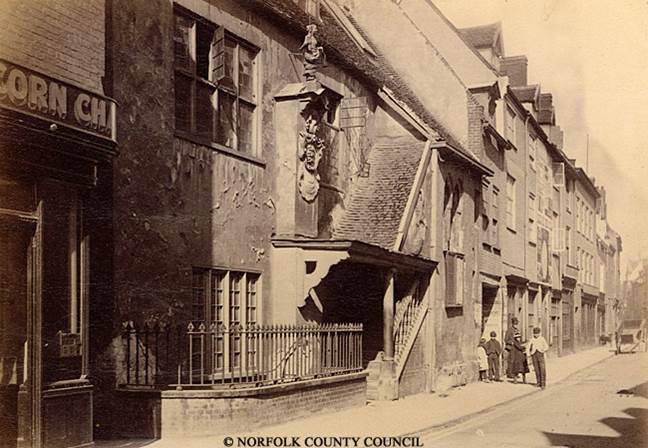
Great Yarmouth, Tolhouse (Gaol, House of Correction and Magistrate Court), photographed by Thomas Ayres, late 1800s, c. Norfolk County Council
The strategy I have developed is to weave biographical reconstruction with prosopography, or group biography. By viewing individual lives in the context of their social networks and the circumstances and characteristics they shared with others, we can speculate not only on the possible causes and outcomes of their actions, but also what was plausible and probable. I call this approach ‘intimate reading’: getting up close and personal with our subjects through immersive reading and extensive contextualisation.[1] Record linkage lets us explore the relationships binding individuals and groups, and their interactions – no matter how unequal – with officialdom. Intimate reading is smaller in scope than the ‘distant reading’ methods practiced in the digital humanities, and is concerned with excavating ‘deep’ data on specific individuals rather than ‘big’ data on large amorphous groups. But while the voices of the convicted were only rarely recorded, intimate reading may reveal how they made their mark in other ways, as we can see by following one boy in and out of the penal system.[2] Continue reading
Our next post in ‘The Voices of the People’ symposium (full programme here) is by Laura Gowing, Professor of Early Modern British History at King’s College London. Whereas the petitions and letters under consideration in recent posts often provide only tantalising details about the lives of the individuals behind them, our next batch of posts consider ‘ordinary’ individuals about whom we can say rather more. Here Laura is able to use depositional evidence to reconstruct the fascinating life story of Agnes Cooper of Southwark, but she leaves us with another crucial question to consider: was there anything empowering about the fact that Agnes was able to leave her life story to posterity?
Laura Gowing
In November of 1619, a fifty-eight year old woman found herself in a desperate position. Single and short of money and work, she had just been evicted from her lodging, and her Southwark parish, determined not to support her, drove her over the parish boundary to her birthplace near London Bridge. It was not an uncommon dilemma in early seventeenth-century England, where the poor law determined a ‘settlement’ for poor relief in the parish where a person had been born or had last spent a year. But Agnes Cooper was unusual in that her struggles left several pages of records, including this long and precise story of her working life.
In the recuperation of the ‘voices of the people’, those of women are often hidden: by low levels of female literacy before the 18th century, but also by being elided into a broader sense of ‘family’. Agnes lost her birth family young, and, like a surprisingly high proportion of Tudor and Stuart women, never married; instead she moved from household to household, working where she could, until she could work no longer. Her story begins in the parish where she was born and spent most of her life.
Agnes Cooper was (she told the scribe):
about the age of 58 years born in the parish of St Olave, Horsleydown Lane daughter of William Cooper by trade an embroiderer.
St Olave’s ran by the river from London Bridge to Bermondsey; it was a large parish, full of multi-occupancy houses and textile workers. Agnes’s father was one of the more skilled.
She went on: Continue reading
Our next post in ‘The Voices of the People’ symposium (full programme here) is by Nikolas Funke, a Leverhulme Early Career Fellow in the University of Birmingham’s History Department. Here Nick explores another remarkable archival survival – a bag of letters written by ordinary soldiers and civilians during the Thirty Years’ War of the 17th Century – and asks a number of the same questions that we have seen directed at petitions: who really wrote them, and in what ways do they reflect the voices of ordinary people?
Nikolas Funke
In the summer of 1625, about seventy people created a bagful of letters which is now kept at the Hessen state archive in Marburg, Germany. Of the fifty-one letters contained in the file, about half were written by women to their soldier boyfriends, fiancés and husbands in the army of the Catholic League, the others by former hosts, relatives and friends, a few by the soldiers themselves. The soldiers had been quartered in the small towns of Allendorf, Eschwege, Witzenhausen and Schmalkalden for about two years previously and, as the letters attest, found friends and lovers among the civilian population. Now that the Danish king, Christian IV, had entered the conflict we now know as the Thirty Years War, the troops had marched north about two months before and were currently encamped near Bielefeld and Herford.
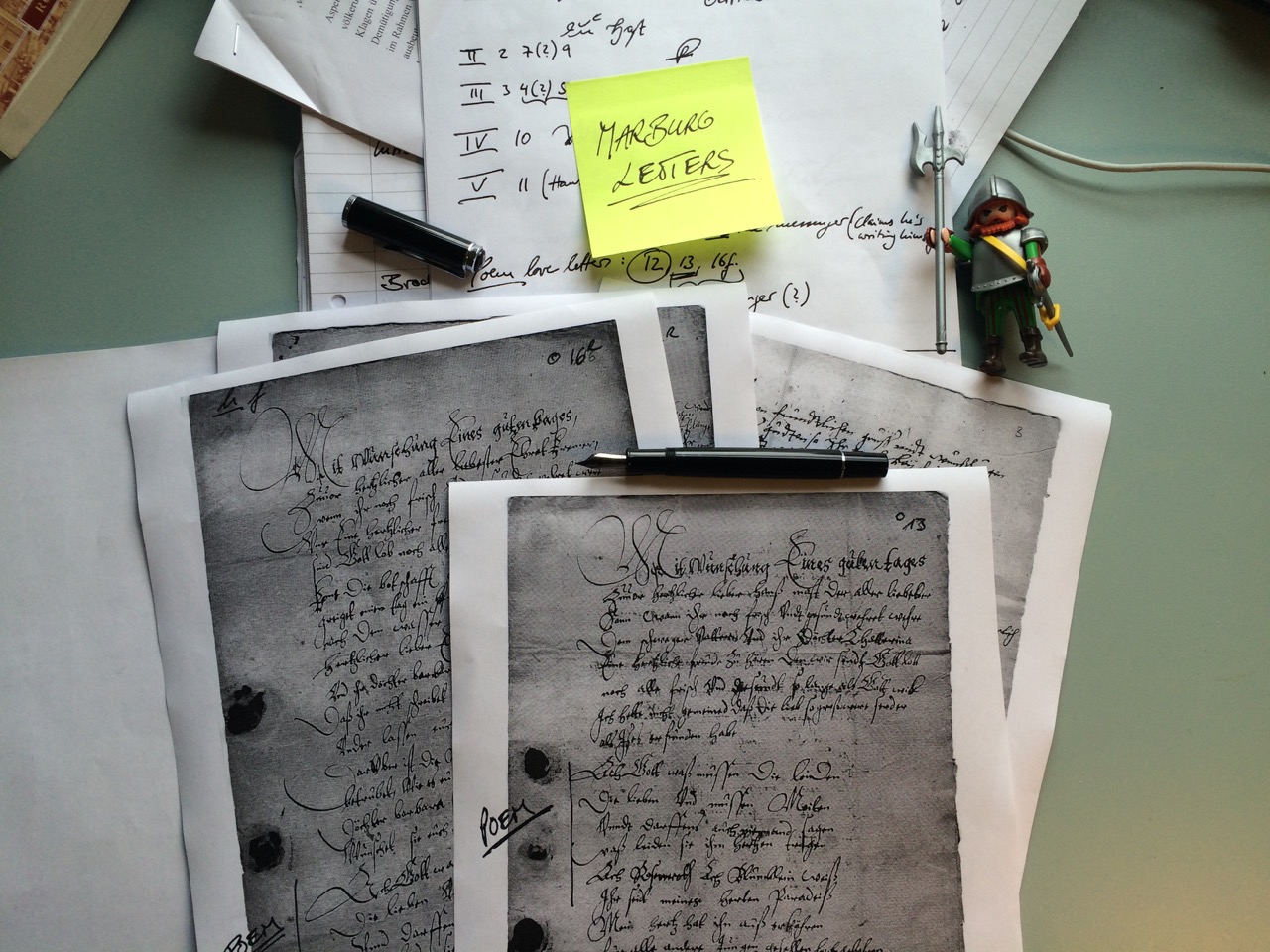 I came across these letters when I was researching my doctoral dissertation on the religiosity of soldiers fighting in the Holy Roman Empire. Jan Willem Huntebrinker had used them in his terrific doctoral dissertation and they were an absolutely fascinating find because the letters challenge our perception of the relationship between soldiers and civilians quite fundamentally. In this contribution, I want to first of all show how important such rare finds that carry ordinary peoples’ voices across the centuries are to the historian and secondly address the question of whose voice we are actually hearing. Continue reading
Our next post in ‘The Voices of the People’ symposium (full programme here) is by Jonathan Healey, University Lecturer in English Local and Social History at the Oxford University Department of Continuing Education. Focusing on petitions for poor relief, Jonathan further expands our discussion of early modern petitions and their value to practitioners of history ‘from below’, whilst at the same time raising crucial questions about their authorship and the extent to which they can really be considered the ‘authentic’ voices of the people.
Jonathan Healey
In 1699, Richard Tyldesley, a labourer from Little Hulton, Lancashire, presented at petition at Wigan Sessions.
It was on behalf of his neighbour Thomas Gerrard, and it described the latter man’s poverty in vivid terms.
‘Thomas Gerrard’, he wrote, ‘is now and hath lain sick in bed this five weekes, his wife is now in child bed, was allmost recovered, but now relapsed. The husband and new borne child lye in one poor bed the 3 children scarce recovered of sicknes. There is neither meat nor fire in the house.’
All they had received in poor relief was six shillings, ‘which will not pay and maintaine a person to looke after them’, and had not their neighbours offered their charity, ‘they had been all starved & miserably perished in the house before this’.
But charity had its limits, especially – though this was unsaid – at a time of high prices such as 1699, so ‘now their charity begins to slacken so that tis impossible they should any one of ‘em subsist 3 dayes longer but will miserably perish for want of releefe’.
Tyldesely’s petition, which was successful, is one of thousands of similar ones that survive in the Lancashire Archives. They begin in 1626, and cover the period of up to around 1710. It’s part of an elaborate process: the one by which poor relief – in what was the first national system of tax-funded poor relief in the world – was allocated. In the discussions about who was deserving or help – as Steve Hindle has eloquently argued – petitions like these show that the poor themselves were part of the conversation. They were active. They appealed. They negotiated. The Lancashire petitions give us a window onto these processes, and these negotiations.
They are, in many ways, quite simple documents. They asked for relief, gave some reason for why it was needed, and – sometimes – gave snippets of other information. Something about how the petitioner had tried to ‘make shift’, for example, or something about their bad treatment at the hands of the authorities.
Ostensibly, they are an ‘authentic’ voice of the poor. And yet, peel back the layers, and some considerable complications emerge. Continue reading
Our next post in ‘The Voices of the People’ symposium (full programme here) is by Michael Ohajuru, an art historian with an interest in the history of Black Africans in Renaissance Europe. Michael provides us with an example of the considerable potential of petitions as a source for uncovering difficult to find voices in the past, as he dissects a petition sent to Henry VIII by a black trumpter at his court.
Michael Ohajuru
It was my colleague Dr Miranda Kaufmann who introduced me to John Blanke’s Petition to Henry VIII. We collaborated on IRBARE – Image and Reality in Black Africans in Renaissance England, a joint project in which she discussed the lives of over 350 real Africans she had found in the records, while I considered the images of black Africans from the period. The star of our research was John Blanke, the black Trumpeter to the Tudor courts of Henry VII and Henry VIII, as uniquely there is both an image and supporting records of him in the archives.
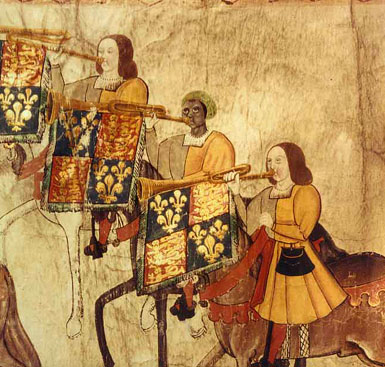
John Blanke Black Trumpeter
(detail from1511 Westminster Tournament Roll)
I was on my way to the National Archive to study a thirteenth century image of a black African in the Archives when I had a call from Miranda. She said she had come across a reference to a John Blake, a trumpeter who had petitioned Henry VIII. His name and function were too close to John Blanke not to consider further. Once at the National Archives I ordered both items. Miranda’s petition came first so I photographed it and emailed the images to her then went off to look at my image. Before I’d completed photographing my image I had an email back from Miranda – she had transcribed the complete petition! Continue reading
Our next post in ‘The Voices of the People’ symposium (full programme here) is co-authored by Helmut Graser and B. Ann Tlusty, a socio-linguist at the University of Augsburg and a historian at Bucknell University respectively. Their contribution shifts our focus onto the search for documents that record ordinary people speaking for themselves – or, at least, that seem to – a theme that will be developed over the next few posts. Here, Helmut and Ann introduce their ongoing project to collect the necessary sources to produce a ‘language history from below’ for early modern Germany – and it was a conversation about this project between the authors and Mark Hailwood, in a Pennsylvania bar, that planted the initial seed for this online symposium.
Helmut Graser and B. Ann Tlusty
Our approach combines social-historical research with socio-linguistics in an attempt to apply to the early modern period methods associated with “language history from below.” This term was coined, obviously after “history from below”, to counter the standard top-down approach that has been the traditional focus of language historians exploring the development of New High German. In a tradition much like that of earlier generations of historians, whose focus has primarily been on elite actors, scholars examining sources produced almost exclusively by professional writers and printers has resulted in a teleological view of the emergence of a New High German written standard.
This view has recently come under attack, not least due to its judgmental approach to non-elite writing, which is normally much closer to actual speech than the texts of educated or professional writers. Working with nineteenth-century letters written by German emigrants to the United States, German language scholar Stephan Elspaß was able to show that linguistic phenomena considered “wrong” from a standard point of view were in fact based on alternative regional and social written standards.[1] In short, “right” and “wrong” language features can in many cases be more accurately described as “elite” and “common.”
Inspired by these findings, our experiment began with the question of whether enough sources could be identified to produce a language history from below for the early modern period. The question begged interdisciplinary cooperation from the beginning for reasons of simple practicality. Very little of what was written by non-professionals before 1800 has survived, and what has been archived in public repositories tends to be scattered about and hard to find, requiring deep trolling through larger collections in accordance with the methods of a social historian. Once identified, however, the sources can only be fully exploited for the history of language by someone trained as a historical linguist. Here we would just like to introduce some of the kinds of sources we are looking at and what we are finding out about them. Continue reading
Our next post in ‘The Voices of the People’ symposium (full programme here) is by Laura A.M. Stewart, Senior Lecturer in Early Modern British History at Birkbeck, University of London. As they have done in our previous three posts, issues of power and the authority to speak continue to loom large, but our next two posts show a different aspect of that relationship – highlighting contexts in which the voices of ordinary people in the early modern period could, in albeit heavily circumscribed contexts, be accorded a degree of value and legitimacy.
Laura A.M. Stewart
In the spring of 1639, Scotland was facing an invading foreign army for the first time in eight decades. During the previous year, thousands of Scottish people had covenanted with one another and with God in defence of religion, kingdom, and king. This event had persuaded the government in London that Scotland was in revolt and needed to be restored to order through the use of force. Scotland and England had been joined together under one ruler since 1603, when King James VI of Scotland had acceded to the English throne on the death of Elizabeth I, but the Covenanters were not seeking liberation from British monarchic rule. Indeed, by seeking to repatriate some of the powers claimed by a London-based monarch, and thereby enable Scottish representative bodies to have a greater say in decision-making, the Covenanters offer parallels with current debates on the Anglo-Scottish union.[1] Unfortunately, the king in question, Charles I (1600-1649), did not believe he needed to be protected against ‘evil counsel’ by his Scottish subjects and he construed their religious covenant – with some justification – as an act of rebellion against his authority. Thankfully, Prime Minister David Cameron does not appear to have consulted the published works of Charles I’s polemicists on the perennial nature of the ‘British problem’.[2] For the second king of Britain, the best way of maintaining ‘one nation’ was to invade Scotland.[3]
In giving ‘mutual defence and assistance’ to one another as war loomed, the men and women of all social ranks who swore the National Covenant vowed never to ‘suffer ourselves to be divided’ and always to put ‘the common happiness’ before personal gain.[4] Historians have tended to think about the Covenant as a text to be read and signed, but many more people encountered it aurally and responded to it with voices rather than pens. My forthcoming book examines the communal swearing ceremonies that greeted the Covenant in parishes throughout the country. In some places, these ceremonies were emotionally charged events, in which entire parish communities gathered together to give voice to their faith. Leading clerics and politicians asserted in print and from the pulpit that the safety of the Scottish nation depended on the unity of its people.[5] Continue reading
the history of 'the unruly sort of clowns' and other early modern peculiarities
the history of 'the unruly sort of clowns' and other early modern peculiarities
An Open Access Graduate Course on Utopian Thought.
A blog about bodies and medicine c.1500 - 1780
Adventures in the world of history
history/folklore/writing
stories from a nineteenth-century prison
the history of 'the unruly sort of clowns' and other early modern peculiarities
Leverhulme Funded Project at University of Exeter: Adopting a New Methodological Approach to Early Modern Women's Work
Early Modern Material Culture
'Making good use of the things that we find / Things that the everyday folk leave behind': ramblings of an early modern historian
A blog (mostly) about early modern history
crime, women, digital history...
 the many-headed monster