The digital delegate: attending an international online conference

We are delighted to welcome our next guest blogger for our #SchOnline series (scholarly conversations online). Here Jennifer Farrell (@dr_j_farrell) reflects on her experience as a delegate of an online conference.

Jennifer Farrell

Last week saw the return of the International Medieval Congress (IMC) at the University of Leeds. This annual conference attracts thousands of medievalists from all over the world, eager to network with one another, to road-test their research, and to enjoy hearing about the work being done by others in their field. I have attended the IMC numerous times in the past, both as a delegate and as a speaker, but the major difference this year was that I did so from the comfort of my own living room!
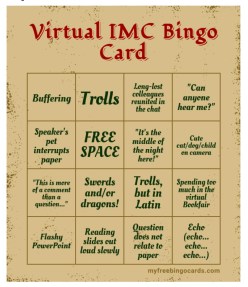
Bingo Card

Sadly moving a conference online will still not stop you spending too much time at the book stalls.

The Covid pandemic has impacted researchers in various ways, but one of the major changes we are seeing is the willingness and indeed tenacity of conference organisers to find ways of facilitating networking and the sharing of research via online platforms. The sheer scale of the IMC means that its move to a virtual conference was nothing short of heroic.  This year the virtual IMC supported the delivery of c.530 research papers, attended by c.3,200 delegates from across 60 countries. The organisers, moderators, panellists, and facilitators deserve to be commended for this.

Speaking purely from the perspective of a delegate, with no need to worry about my paper being interrupted by poor internet connection, bad sound, disruption from trolls, or just the generally odd sensation of talking about your research to a computer screen, my own experiences of the vIMC were very positive. Of course, a virtual environment is by no means the same as experiencing the conference in person, but that is not necessarily a bad thing.  Like many of the changes that have occurred to our working conditions on account of Covid, there are good and bad sides. Continue reading →
Time Zones Still Exist

In this guest post in our #SchOnline series (scholarly conversations online), Clare Griffin (@balalaichnitsa) calls for the organisers of online events to think about the access implications of time zones. 

Clare Griffin 

In the brave new world of virtual conferencing, there has been something of a sense that this is more open, more inclusive. After all, we don’t have to travel for hours to get to a physical venue. But there are still a number of accessibility issues, one of which I want to address here.

Time zones still exist.

A substantial number of these virtual events are being held live. That’s great, if you are in that time zone or a neighbouring one. Less so if you are not.

Many such English-language events are being held in North America and Western Europe, so are most directly accessible to academics based in those regions. What about those of us in other time zones? I am in Kazakhstan. There are academics interested in English-language events based in Australia, Singapore, India, and many other places.

Technically, we can still take part in such live virtual events, if we are prepared to get up in the small hours of the morning, or stay up until midnight.

When we were in the era of in-person events, I would regularly be flying multiple hours, crossing several time zones, to get to an event. And would be exhausted. Now, to take part in live virtual events I would often have to disrupt my sleep. And be exhausted.

Sleep is important for everyone, and we shouldn’t expect people to disrupt it to do their job.

Sleep is a particular issue for me, as sleep disruption is a major trigger for one of my conditions, a bipolar spectrum disorder. I am less well if I disrupt my sleep. If I try and participate in live events in time zones far to the West or East of me, I will harm myself. And weren’t well all supposed to be more concerned about our colleagues’ well-being during the pandemic? Continue reading →

Online Conferences: Four Reflections

In this guest post in our #SchOnline series (scholarly conversations online), Will Pooley (@willpooley) reflects on hosting an online workshop. 

Will Pooley

There is something odd about the effect the pandemic is having on online academic work, collaboration, discussion, and teaching. The lockdowns imposed in many parts of the world have given a renewed impetus to some forms of doing history online. The pressures of the current situation have provided momentary distractions from longstanding problems with the platforms and tools that historians have found themselves most drawn to, such as Twitter and blogging.

The challenges of the #SchOnline moment involve addressing these legitimate criticisms around issues including accessibility, abuse and harassment.

One big change has been the adoption – almost overnight – of teleconferencing software such as Zoom and Skype, to replace face-to-face meetings and events. Jan Machielsen and I decided to give an online workshop a go, to bring together people interested in talking about the broad issues of the supposed ‘decline of magic’.

I have four reflections on this.

Something Old?

The first thing I want to mention is something that Jan and I agreed on from when we first discussed the idea: an online ‘conference’ or ‘seminar’ cannot just simulate a face-to-face equivalent. It’s very hard to broadcast a 20 or 50-minute talk, especially given the unreliability of the technology, and the fact that none of us are media professionals. The videos that professional Youtubers, for instance, put out involve specialist equipment and a whole production team. Academics need to be realistic about what we can do using an old work laptop in a poorly-lit makeshift space.

Something New

The second point I would make about this is that different does not have to mean worse. Continue reading →

The Virtual Parish: Scholarly Communities Online

Laura Sangha & Mark Hailwood

In this post we reflect on eight years of running a ‘virtual’ scholarly community – this blog! – to consider questions that are currently pressing ones for all academics: what do we gain from taking our conversations online? What do we lose? What needs to be improved?   

In the spring of 2020, as much of the world was plunged into ‘lockdown’ by the advance of the coronavirus, regular forms of face-to-face interaction were swiftly replaced by online alternatives. For academics, the classroom morphed into the online seminar; the conference trip was replaced by a day tucked away in a corner of the bedroom staring at Zoom; the common-room catch-up was transferred to the Departmental WhatsApp group.

Innovative initiatives have abounded, including A Bit Lit, a series of fun and informal filmed conversations about history, literature and culture, designed to fill the gap left by the kind of over-a-coffee-conversations that might take place between scholars. We were delighted to receive an invite to take part, and you can see our ramblings here. In the opening film, Andy Kesson talked about A Bit Lit as part of a process of building new kinds of academic community—or to give it a more early modern twist, new kinds of ‘parish’—that would draw on digital forms of contact to overcome the obstacles of infection.

We liked this notion of new ‘virtual parishes’, especially since many of us have been involved in a variety of ad hoc ways in constructing such novel online communities in recent months. But this notion also struck a chord with us because we realised that we—along with Brodie Waddell and Jonathan Willis—had already created a ‘virtual parish’ long before the current crisis: this blog. The context of its creation was very different to the circumstances we face now, but the impulse to create a scholarly community that transcended physical obstacles was central. Indeed, the loss of physical proximity that we had enjoyed as a group of postgrads at Warwick was an important catalyst. Continue reading →

Books as Open Online Content: Paper Trails

Laura Sangha

This year I joined the editorial board of a BOOC for UCL press titled Paper Trails, and if you are an academic, librarian, curator, collections manager, archivist, or educator, we want to work with you.

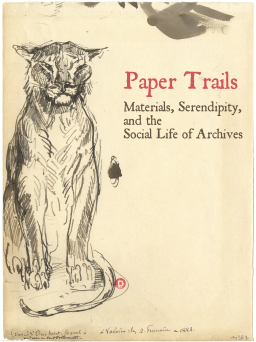
Paper Trails imageThat might need some explanation: a BOOC is a new, fully open access platform that allows for multi-form contributions across time. Living books for the digital age, if you will.
The innovative BOOC format comes with many benefits. It means that Paper Trails can offer space not only for peer-reviewed, ‘REF-able’ academic articles, but that these can be published alongside work by other practitioners who both study the past, and who make the study of the past possible. We thus hope that one of the things our BOOC will do will be to make visible and showcase the work of collection managers, curators, librarians, archivists and educators. The intellectual focus, multi-form content, and the four streams in our Call for Papers are designed with this in mind.

The Paper Trails BOOC therefore presents an excellent opportunity for interdisciplinary reflection on the ways that we construct the past, and on the collaborative nature of that project. In particular it will allow us to consider our relationship with research material more closely and coherently, by juxtaposing critical histories with reflections on practice, sources and materials.

img_3994

‘Engaging’ Lead Editor: Andrew WM Smith

Paper Trails is also intended as a means to capture and promote some of the excellent education and engagement work that many scholars are involved in, but which we often don’t get to hear about. We hope that the ‘Engagement’ stream will become a repository of shorter cases studies or think pieces that demonstrate particular skills or techniques, and which can therefore inform broader professional practice. Since creative and dynamic ways of engaging non-professionals with the past are now widespread, the BOOC can be the means to preserve and disseminate the best of this work. Continue reading →

Why do a PhD in History? A look at the data

Brodie Waddell

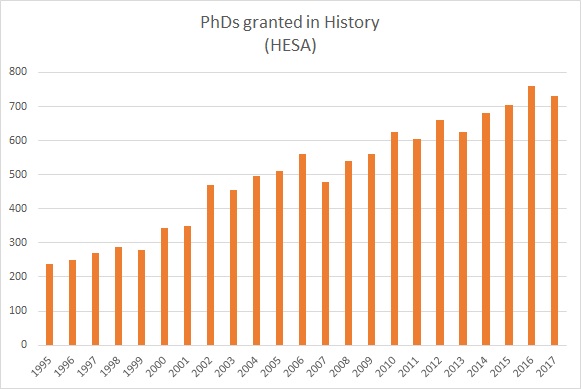
Hundreds of people complete a doctorate in History each year at UK universities, a process with huge implications for the strength and sustainably of academic history as a discipline. This figure has been rising gradually but fairly consistently over the past couple decades, from around 250 in the late 1990s, to around 550 in the late 2000s, to a peak of more than 750 in 2016.

PhDs granted in History, 1995-96 to 2017-18

In previous posts, I’ve discussed the job market for History PhDs using various measures including staff/PhD ratios, cohort studies and job listing data. None of the numbers present an especially rosy picture for newly completed PhDs searching for an academic post.

However, in response to each of these posts, readers have rightly asked about the motives of those pursuing doctorates. It is obvious that not all of those 700 or more new PhDs want to become lecturers, so the job market is thus presumably less disastrous than the headline figures imply. But the problem is that it is difficult to know whether this proportion is substantial or negligible.

Thankfully, Andy Burn not only brought it to my attention that there is a UK-wide survey of current PhD students about this, but also very generously turned the raw data into something useable for me. This is the ‘Postgraduate Research Experience Survey’ (PRES) and it asks all sorts of questions, including two about motivations. The highest recent response rate was in the 2017 survey and that’s what I’ve used here, though the proportions were similar in the 2018 survey.

So, what are the results for History? Continue reading →

Historians, PhDs and jobs, 1995/96 to 2017/18

Brodie Waddell

This is the time of year when many people are applying for PhDs or academic jobs and discussions of the current job market inevitably arise. A couple of years ago, I wrote a series of posts on job listings, doctoral cohorts and staff/student numbers, trying to provide some data to help inform these conversations, but I think it is time for an update. How have things changed since then?

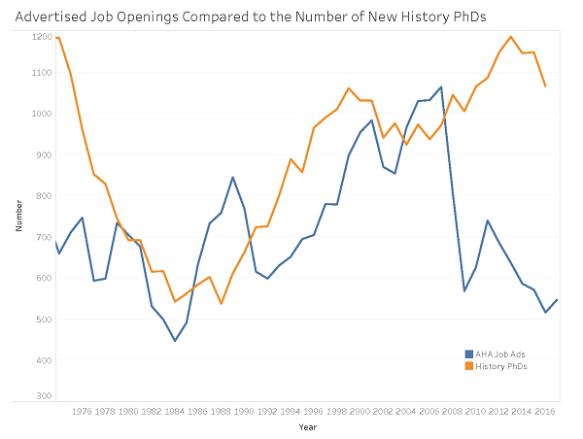
The American Historical Association publishes its notorious chart of doom each year, showing the terrible ratio of new PhDs to advertised jobs, and its most recent version leaves little room for optimism.

Fig 5

AHA Jobs Report 2019

In the UK, we lack a consistent, accessible annual list of academic history jobs. Although nearly all such posts are advertised on jobs.ac.uk, there is no easy way to turn these adverts into an annual figure except by manually monitoring and recording. So, instead, I’ve taken to focusing on the only reliable data that is publicly available: staff and student numbers. Continue reading →

Seventeenth-century England: A Symposium to celebrate Professor Bernard Capp’s 50 Years at Warwick

Laura Sangha

On Saturday 20 October I had the great pleasure of returning to my alma mater to attend ‘Seventeenth-Century England’, a symposium to mark and celebrate Professor Bernard Capp’s fifty years at the University of Warwick. All of the many-headed monster co-authors were fortunate enough to benefit from Bernard’s advice and knowledge when we were postgraduates at Warwick in the 2000s, so this review of the Symposium is our way of joining the chorus of congratulations and commendations that characterised the day.

Fifty years’ service.

Professor Capp was appointed as Lecturer in History in 1968, when Harold Wilson was Prime Minister, the Kray twins were arrested, the M1 was completed, and the Race Relations Act was passed. The University of Warwick had admitted its first undergraduates just four years earlier.

alex W

Alexandra Walsham exhorting us to undertake our own ‘generation work’

Whilst at Warwick Professor Capp became established as one of the leading historians of early modern England, his teaching and publications demonstrating an extraordinary breadth of research interests and expertise. The Symposium organisers, Peter Marshall and Naomi Pullin, did an excellent job of creating a programme that gave space to all the themes that underpin this work. Many papers explored gendered aspects of the seventeenth-century as well as the ‘religious marketplace’ of the age. Amanda Flather discussed the impact of Laudian ceremonialism on women worshippers, explaining how matters of conscience could be corrosive of female obedience. Tim Reinke-Williams regaled us with the masculine ‘banter’ of the early modern jestbook and laid bare the emotions that structured them. Ann Hughes’ paper on dissenting culture in Restoration England revealed the ways that religion connected single women to broad social networks and kinship. Hughes’ focus on the Gell family of Hopton Hall and the siblings in the family connected neatly to Alexandra Walsham’s paper on the ‘revolutionary generation’ of the 1640s and in particular the Fifth Monarchy Men, religious radicals bonded in solidarity by their conception of Christian history and the conviction that they were the ones to carry out a turbulent age’s vital ‘generation work’. Continue reading →

The Power of Petitioning in Seventeenth-Century England: The Long Road to a New Project

Brodie Waddell

[Update, April 2019: ‘The Power of Petitioning’ project website is now online.]

How can people without official political power push the authorities to act? Historically, one of the most common tactics was to create a petition or supplication. Even today, every year hundreds of thousands of ordinary citizens sign e-petitions addressed to parliament which can lead directly to high-profile debates in the House of Commons.

In seventeenth-century England, petitioning was ubiquitous. It was one of the only acceptable ways to address the authorities when seeking redress, mercy or advancement. As a result, it was a crucial mode of communication between the ‘rulers’ and the ‘ruled’. People at all levels of society – from noblemen to paupers – used petitions to make their voices heard. Some were mere begging letters scrawled on scraps of paper; others were carefully crafted radical demands signed by thousands and sent to the highest powers in the land. Whatever form they took, they provide a vital source for illuminating the concerns of supposedly ‘powerless’ people and also offer a unique means to map the structures of authority that framed early modern society …

****

That was our pitch to the Arts and Humanities Research Council for a grant of over £200,000. To my surprise and delight, they liked it.

So, from January 2019, I’ll be running a project looking at ‘the power of petitioning in seventeenth century England’. The co-investigator is Jason Peacey at UCL and we will hire a full-time postdoctoral research associate for twelve months as well. There will be much more information available once we have the project website up and running, but in the meantime I thought I’d announce it here and explain how it came to be. I hope it might be useful, or at least interesting, to other scholars thinking about their own projects. Continue reading →

the many-headed monsters’ resources for teaching

Laura Sangha

**shiver** The nights are drawing in. There is a cold wind blowing from the east. Berries weigh down the hedgerows. Fungus sprouts on your lawn overnight. The traffic in your inbox has increased tenfold in the last week. That’s right. Term is coming!

September finds many of us switching off research mode and turning our attention to teaching once again. As I write, another module handbook will be finished off, another final item will be added to a module bibliography. So to help ease us all through this difficult time, I have put together a list of some of the many-headed monster posts that go particularly well with teaching. I hope they bring you comfort in the wars weeks to come.

Continue reading →